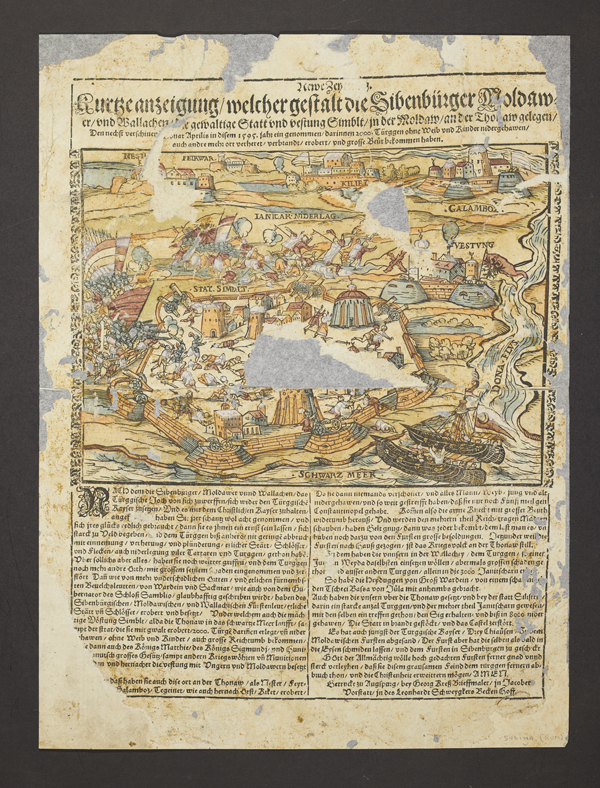
It is difficult for the historian to imagine how the scraps of paper encountered in the archive, filled with printed words and images, served as the first newspapers that were created, distributed, and read throughout early modern Europe. Taking an empathetic approach to history, the process could look something like this: In a village outside of Augsburg in late spring of 1595, a small crowd gathers around a well-worn tavern table, staring intently at a sheet of paper. Some focus their eyes on the brightly colored image filling the top half of the page: a bird's-eye view of a citadel in a heavily fortified countryside with throngs of armored figures mercilessly slaying their turbaned enemies. Others let their eyes wander through the two columns of text below, perhaps quietly sounding out the letters they recognize as they search for familiar words and phrases. One man, possibly the local notary, darts his eyes more rapidly across the lines, reading portions out loud to those still waiting to digest the contents of the sheet of paper. Everyone present knows the key points from the headline running along the top, having heard it called out by the street vendor who sold it in the square, a raspy voice crying: “The City and Fortress of Simbalt in Moldavia on the Danube, and other locations”; “2000 Turks slain with poleaxes”; “The army spared no one, men or women, young or old”; and “Lots of booty.” The peddler, who carried the sheet along with a variety of small wares as he moved around the countryside, had picked it up earlier that week from the courtyard establishment of Leonard Schweiger, in the Augsburg suburb of St. James. That morning, it had arrived in a stack of 100 to 500 identical sheets in the hands of the entrepreneuring publisher and Briefmaler, Georg Kress. Earlier, Kress had hurriedly added the finishing touches of paint to the image, the last of the white pigment still drying as he ran his latest batch of newssheets over to the shop. Time was of the essence. Kress needed to get his print out before his rival, Bartholomäus Käppler, overheard his source boasting about the events and created his own newssheet. This fresh news, of Christian forces defeating the Muslim Turks, sold quickly. Kress was ready to provide it, just in time for our hawker to pick up a stack of copies, one of which would eventually make its way into the hands of the villagers sitting around the tavern table.
While the print scrutinized in the tavern inevitably disintegrated from oily fingered overuse and spilled ale, another copy from the stack, folded away and safely kept for centuries, found its way into the Folke Dahl Collection of early newsbooks, corantos, and newspapers held in Princeton University's Firestone Library (see Figure 1).Footnote 1 This rare broadsheet, one of a small number known from 1595, comes from the hands of the most successful practitioner of the genre in Augsburg, Georg Kress.Footnote 2 It provides brief notes on the Long Turkish War (1593–1606), including a description and image of a siege for which no other sources are known. This single-page woodcut, referred to from here on as the Newe Zeytung, offers a window into the competitive market for broadsheets on the Ottoman wars at the end of the sixteenth century, and the roots and routes of knowledge along the well-worn path of the early modern news cycle in Central Europe. This article uses the Newe Zeytung to explore how text and image were combined to create a narrative that played into the expectations of its audience. It also addresses how this narrative relates to broader discourses on the Turks that existed in the late sixteenth and early seventeenth centuries in the Habsburg-ruled territories (including the Holy Roman Empire). After comparing Kress's rendition of the events with what we know about the Long War in 1595, the article asks what the flow of information from the region to these centers can tell us about Central European news networks and their integration in broader currents in the late sixteenth century. The need to rapidly produce desirable and digestible scraps of paper to convince consumers to part with four to five pfennigs often led to crude distortions. These distortions should not necessarily be read as part of a larger strategic or propagandistic agenda but rather as a reflection of the nature of the news cycle.
Georg Kress, Newe Zeytung: kurtze Anzeigung, welcher Gestalt die Sibenbürger, Moldawer, vnd Wallachen die gewaltige Statt vnd Vestung Simblt in der Moldaw an der Thonaw gelegen (Augsburg, 1595). Department of Rare Books and Special Collections, Princeton University (Broadside #143).

The Newe Zeytung
The vibrantly painted Newe Zeytung broadsheet by Georg Kress, made in or shortly after April 1595, tells of the raiding and pillaging of the Ottoman Turkish fortress of Sulina, in the historical province of Dobrudja (in present-day Romania), and a number of other fortified cities in the surrounding countryside. In the typical tripartite composition of late sixteenth-century broadsheets, the header contains basic information on the events, which are elaborated upon in the text blocks below. Between the two is an image of a seaside stronghold with loosely classicizing architecture topped by domes and crescents, the muddy thoroughfares littered with the dismembered bodies of its inhabitants. Two armored knights at the center raise their swords and continue the carnage, while a third strikes a fallen turbaned man in the back with a halberd. Another two figures run away with their arms raised, as if in a gesture of prayer. Infantrymen climb ladders up the southern walls, the front row with muskets puffing smoke. Toward the opposite end of the fortress, men scramble to escape, tumbling over the ramparts as they rush toward two ships on the Black Sea. Just above the fortification, in the open plains, another cluster of infantrymen attack a crowd of escapees. Flags emblazoned with the imperial eagle and the Cross of Burgundy dot the landscape, carried by the knights and waving from the bastions in the distance. The message of the broadsheet seems straightforward: the Christian army, flying the flags of the Emperor Rudolph II, lays waste to a countryside once lined with Ottoman-Muslim fortresses.
Latin capitals within the image form city labels while the title and block text below are in fraktur. The labels identify the castle and city of Simbalt (Sulina, Romania), the Black Sea, the Danube, a group of janissaries, and a series of fortresses along the horizon whose distances vary from twenty-eight miles to eight hundred miles from the central scene.Footnote 3 The full title reads: “New newspaper: wherein a short description appears of the Transylvanian, Moldavian, and Wallachian royal city and fortress Sulina, located on the Danube, captured in the Month of April in this year of 1595, in which 2000 Turks slain, not counting the women and children, and many other places were plundered, burned, conquered, and great amount of booty taken.” The two columns of text below tell of a prior submission to Ottoman rule and the recent testing of luck with the attack and plunder of the city that led to the region throwing off its Ottoman yoke (“Joch von sich zuwerffen”). It highlights the cooperation of Transylvanian, Moldavian, and Wallachian noblemen and their armies, and goes on to explain how the soldiers were handsomely rewarded with salaries and booty, after which the princes leading the armies returned home and the fighting came to a halt. The mercenary soldiers (heyduks) then set their eyes on “Tscheci” Pasha from Gyula and then Silistra, where a further eight thousand Turks were killed.Footnote 4 No individual actors on the Christian side are named, though explicit references are made to a Christian and a Turkish emperor, a grand vizier, and the governor of the fortress.Footnote 5 The last few lines relay other recent events: an attack on the city of Silistra (two hundred miles up the Danube from Sulina) and news of three “Chiausen” or messengers sent by the sultan to the duke of Moldavia who were imprisoned along the way. The broadsheet ends with a prayer: “May God bestow upon these highly esteemed princes grace and strength that they may stop these cruel Turks and promote the cause of the Christian faith.”Footnote 6
“Plundered, Burned, Captured”: The Long Turkish War
Visual and narrative strategies worked together to serve Georg Kress's goals: turning a profit by offering a digestible narrative laced with a pro-Christian vocabulary against the Ottoman threat. The vague and unidentified actors in both image and text become two concrete enemies in stark contrast, creating a crude division that erased the convoluted backstories of the historical individuals involved and presenting Christian and Muslim combatants in a timeless choreographed dance of war. The reality of the situation was in fact much more complex. Inconvenient details may have been shed from the news as it left the region, or anywhere along the path it took from the small towns on the Danube to the workshop of Georg Kress. There were more than two sides in the Long Turkish War, and they certainly could not be divided neatly into Christians fighting Muslims. In the image, gruesome death is visible everywhere, though the stylization of the small figures and bird's-eye point of view make the observer feel distant and removed from the scene. Perhaps one of the villagers at the tavern commented on the dismembered bodies. Perhaps the notary mentioned the imprisoning of the messengers (who were later killed) as an act against common customs. Or perhaps they were desensitized to these details and read the broadsheet uncritically, as an accurate portrayal of a series of events occurring far down the Danube.
Checking Kress's rendition against the known history of raids and conquests in the mid-1590s along the Danube is complicated by the fact that we still know very little about the thorny political and military landscape of the Long Turkish War. The conflict, known locally as the Fifteen Years’ War, officially raged between the Holy Roman Empire and Ottoman Empire in Central and Southeastern Europe between 1591 and 1606, yet skirmishes, sieges, and the repeated messy exchange of fortresses often occurred on a more local level. Smaller factions regularly engaged each other under the leadership of individuals claiming for themselves titles and jurisdictions that neither empire would afford them. This minefield of secret alliances and double-crossing has yet to be properly treated in a scholarly monograph.Footnote 7
The region of Dobrudja played an important strategic role in this conflict. Dobrudja was a critical though unwieldy portion of the Ottoman administrative region (sancak) of Silistra.Footnote 8 Its permanent loss to Habsburg forces would have endangered Ottoman dominance over the Black Sea in the long term. More importantly for 1595, Habsburg victories in the southeast coupled with increased cooperation between noblemen in Transylvania, Moldova, and Wallachia, and Rudolf II's generals, ran the risk of leaving the Ottoman hinterland further up the Danube River (in particular the Carpathian Basin province or Eyalet of Budin) isolated from the center in Constantinople.Footnote 9 This threat was real. In the months following the publication of the Newe Zeytung broadsheet, Habsburg forces recaptured a symbolically and geographically important stronghold at the Danube bend: Esztergom.Footnote 10 From here, they launched a series of unsuccessful sieges (1598, 1602, 1603) against the administrative center of the province, Buda, which was just fifty miles downstream, even occupying the fortress of Pest across the Danube in the winter of 1602–3.Footnote 11 In 1605, the Habsburgs lost much of what they had gained, including Esztergom and with it any chance at pushing the Ottomans out of Central Europe until the wars of the late seventeenth century would reconfigure the political and cultural landscape of the region permanently.Footnote 12
The 1595 cooperation between Habsburg officials and local rulers was critical for their strategy. This meant engaging a group of noblemen and their armies who were searching for opportunities to reestablish and expand their traditional privileges and whose confessional politics differed substantially from the Habsburg court.Footnote 13 In January 1595, representatives of Sigismund Báthory of Transylvania signed a treaty that shifted Transylvanian loyalty from the Ottomans to the Habsburgs.Footnote 14 The same year, the Wallachian nobleman Mihai Pătraşcu (known as Michael the Brave) was engaged in heavy raiding along the Danube against his former Ottoman overlords.Footnote 15 With the Transylvanian pivot, he was pressured to follow suit and soon signed a treaty with Sigismund Báthory, in which he accepted Báthory's suzerainty in exchange for help with a campaign to push back the Ottomans.Footnote 16 When the aid materialized in the form of additional soldiers and armor from Báthory and his European allies, Michael crossed the Danube sacking fortified locations farther south, his raids reaching into a region that was in Ottoman hands since the mid-fourteenth century.Footnote 17 At the same time, the combined Habsburg-Transylvanian armies were winning crucial strongholds in Hungary, and Christian Europe was rejoicing at the prospect of pushing back the Ottoman frontier. These successes, however, were short-lived, and the following year saw the Ottomans rising. At this same time, the competing interests of local and regional rulers from Transylvania, Poland, Hungary, Serbia, Wallachia, and the Crimean Khanate led to smaller skirmishes.Footnote 18 Each faction struggled to maintain a level of control over themselves and their neighbors, siding with the Habsburgs one day and fighting against them and their allies the next. Michael the Brave also took part in this culture of double-crossing, taking up arms in 1599 against Andrew Báthory, cousin of his former financial backer Sigismund Báthory, which eventually led him to all-out war with his former European allies with the support of the Ottomans.Footnote 19
Tracing the Webs: Handwritten Newsletters
A piece of information traveling the enormous distance from the blood-soaked marshes of Dobrudja to the Augsburg desk of Georg Kress seems extraordinary. Yet those 900 miles, 1,500 if following the winding water highway of the Danube, were regularly traversed by messengers. Though the postal service in Central and Southeastern Europe was not as well organized or consistent as its counterpart in Western Europe, Zsuzsa Barbarics-Hermanik has shown that the network of handwritten newsletters functioned well enough to actively participate in the continental information exchange.Footnote 20 Not only were the Fuggers circulating in the region (in places like Statu Mare, Alba Iulia, and Strovo), but her research has highlighted a vast number of other families and individuals with partially preserved archives, including the Nádasdys and Thurzós, who had agents in Mantua, Brussels, Vienna, and Prague with whom they regularly exchanged newsletters.Footnote 21 These families and their agents were also intimately woven into international fabrics of exchange using the Ottoman scribal, German mercantile, Slavic and German imperial, Italian religious, and Latin intellectual networks. In addition to these channels, merchants and travelers regularly moved along the Buda-Vienna highway, their work frequently disrupted by the ongoing war, which forced them to stay put and absorb bits of news they could then pass on along less official routes of communication.Footnote 22
None of the known sources reference the fall of the fortress of Sulina in April 1595. Correspondences from both the Western European and the Ottomans news circuits do, however, survive detailing the events of the taking of the fortress of Brăila, just eighty-two miles from Sulina and the fortress of Kiliya, depicted in the background of the image and lying just twenty-two miles upstream from Sulina. For example, on 15 January 1595, Pompeo Salvago sent a letter to Philip II on Michael the Brave's victories over the Turks at Giurgiu and Braila and indicated a movement toward Kiliya.Footnote 23 Kiliya appears as sacked in a separate note dated 4 March 1595.Footnote 24 On the Ottoman side, a dispatch by the kadi (judge) of Braila to the Sublime Porte dated 10 February 1595 describes the damages caused by the Ottoman soldiers to the inhabitants of the town.Footnote 25 The final scraps of information provided in the text of the newssheet on the city of Silistra and the messengers from the Sultan can be traced back to known events more securely. Silistra was taken before 4 March 1595.Footnote 26 The imprisonment of the messengers, mentioned at the end of the Newe Zeytung happened sometime before 14 April 1595, though Kress had the incorrect number as there were two of them, not three.Footnote 27
From Rumor to Printed Media
As details from the Long War arrived in the suburbs of the major centers of printing, entrepreneurs chose the stories they knew they could sell and quickly dove into the production process. Publishers accessed fresh material through creative means: some read handwritten personal correspondence secretly or by commission, while others strategically positioned themselves to overhear conversation in the streets, inns, and taverns. Printed media of this kind could appear as quickly as two weeks after the events took place, depending on the distance from the event, the intricacies of the production process (visuals took longer), and speed of the publisher's various contracted assistants.Footnote 28 The practitioners of printed media had well over a century of tradition behind them devising and revising methods for collecting and disseminating information as it trickled into a city. While regular subscription newspapers were still a decade out, printers delivered updates on current events in one of four ways: as incorporated into a larger history of a specific topic; as printed copies of handwritten newsletters or personal correspondence; as summaries of events in pamphlet length works; or in single-page broadsheets as “brief news.”Footnote 29 Actively developing names for themselves through early efforts in what we would now call “branding,” they standardized their products and aimed for repeat customers by placing their names in prominent positions on their works. Many even included the exact location of the establishment where their newssheets could be purchased, down to the very street corner. All this served to create a sense of authority, a trusted and reliable news source one could return to again and again.
Covering a wide range of geographies and topics, most news stories fit into one of four main categories: local news (such as records of flooding); gruesome or outrageous international crimes (such as the endless stream of reports on murder trials); (super)natural phenomena (often miraculous births or astronomical events); and, perhaps the most popular of all, warfare (often against the Ottoman Turks).Footnote 30 It is this last category that has proven most fascinating to scholars. Spreading across the different genres, prints covering the various aspects of the Ottoman Turks, collectively known as Turcica, have been the subject of numerous catalogs, most notably the monumental work compiled by the Romanian historian Carl Göllner. Göllner's three-volume list of sixteenth-century prints in German, Czech, Hungarian, Spanish, Dutch, Latin, French, Italian, and English gathers some 2,463 examples.Footnote 31 This includes 167 works appearing in 1595 alone, many of which take the Long War as their main subject.Footnote 32
Turcica from 1595 primarily spread news of the Habsburg capture of Gran (Esztergom) in July, the defeat of Sinan Pasha in October and November in the region of Dobrudja, and the actions of Sigismund Báthory, Miklós Pálffy, Frenec Nádasdy, and Giovanni de Medici.Footnote 33 In addition to these topics, a host of prints announcing the death of Sultan Murad III and accession of his son Mehmed III to the throne appear after 15 January, which, appallingly for Christian audiences unfamiliar with the Ottoman line of succession, was accompanied by the customary ritual fratricide of his nineteen younger brothers.Footnote 34 All these events appeared alongside a wide range of polemical tracts; diplomatic and personal diaries of travelers and captive narratives; chronicles of recent Ottoman history often compiled from handwritten newsletters and broadsheets; chronicles of the events of the past year written in verse in the form of a calendar; and lengthy Latin eulogies of heroic knights lost on the Ottoman frontier.Footnote 35
Within this corpus of works, one news pamphlet stands out as directly relevant to Newe Zeytung: a four-page print published in Dresden by Matthes Stockel, the Newe Zeittung: Von Eroberung der newen Festung Georgia vnd Symbeldt. Footnote 36 This is the only other reference of the fortress of “Symbeldt” from 1595. The pamphlet claims to be a publication of a letter from Chancelor J. Jósika to Archduke Matthias with a short description of the defeat of Sinan Pasha in the region of Dobrudja in October and November.Footnote 37 In publishing a portion of the text, the nineteenth-century bibliographer Károly Kertbeny identified the city and fortress as “Semliu,” the historical town of Zemun now a suburb of Belgrade, Serbia. The fortress shown in Newe Zeytung lies on at the point where the Danube meets the Black Sea and therefore cannot be Semliu. It is more likely that this “Symbeldt” is actually the same as the “Simbalt,” thus providing us with the only other reference to the town (though not to its capture) from 1595.
Broadsheet as Mass Media
Broadsheets like the Princeton Newe Zeytung were just one of many media covering “new news.” What set them apart was that they did so on a single sheet of paper and spoke to the widest possible audience with their combination of text and image. They are a particularly difficult medium to survey. Because of their hybrid nature, they can end up in print collections of museums rather than libraries or archives. Occasionally their visual elements are detached from their texts, making them more difficult to trace. While Göllner's catalog remains the primary overview of sixteenth-century Turcica, his work clumps all the genres of printed media together and leaves out a majority of the broadsheets. Instead, it is best to turn to other sources, such as the catalogs of single-leaf woodcuts compiled by Walter Strauss, where Turcica newssheets are mixed in with tales of miraculous births, floods, murder trials, and other popular topics.Footnote 38 Smaller studies on individual printers, cities, events, and genres are slowly filling in the gaps.Footnote 39 Most recently, ambitious digital humanities projects aiming to catalog early modern printed media have made such sources more accessible, and they are slowly revealing a much more complex picture than earlier printed catalogs were able to do.Footnote 40 As of October 2018, the Princeton Newe Zeytunghas yet to be included in these new studies.
John Roger Paas, who is the chief editor of a massive undertaking seeking to publish all known German political broadsheets from the seventeenth century has written on the production of these works.Footnote 41 He suggest that between 2 percent and 7 percent of the seventeenth-century examples survive, and the number drops lower for works from the sixteenth century.Footnote 42 Originally produced in runs anywhere between one hundred and five hundred copies, they sold for around four to five pfennigs a piece at the turn of the century, depending on the size of the paper, their price low enough to make them widely accessible both in cities and in the countryside.Footnote 43 The publishers in charge of the enterprise added their names to the bottom of their works, often followed by a reference to their profession, frequently “Briefmaler.”
Briefmaler participated in the production of a wide range of decorative and utilitarian works. This included visual catalogs of a craftsman's wares, the emblazoning of heraldry onto wooden shields and flags, and even the painting of furniture.Footnote 44 The production of devotional prints presented the most secure market, but they also made children's paper toys, playing cards, and painted coats of arms into friendship albums. In the world of early modern printing, they frequently acted as publishers, contracting out the various duties of the process to arrive at their phase, that of adding color to the works on paper.Footnote 45 In major cities throughout the Holy Roman Empire, Briefmaler actively participated in their own guilds, including Augsburg, where Kress served as a representative to the city council.Footnote 46
Broadsheets in 1595
For the year 1595, Strauss lists seven German broadsheets that deal with the Ottoman Turks, four of which bear the name of the prolific Nuremberg block cutter Lucas Mayer, while the remaining three come from different publishers in Augsburg. In addition to these German language works, Göllner lists one example in Czech.Footnote 47 All the prints compile bits of news from the Ottoman-Habsburg borderlands and present them alongside an image of the headline story. Their topics are representative of other Turcica from 1595, addressing the successful sieges of the Habsburg forces along the frontier, the actions of various noblemen involved, and Sultan Mehmed III's accession to the Ottoman throne.
Nuremberg block cutter Lucas Mayer's first sheet focuses on events from January in Lemberg (Lviv, Ukraine) and Pressburg (Bratislava, Slovakia) and briefly mentions the raiding near a number of small towns in Transylvania, Moldavia, and Wallachia in the last lines of the double-columned text with a list of successful sieges in which the city in the background of the Newe Zeytung, Kiliya, appears.Footnote 48 The scene shows a city set ablaze in the distance with a group of men raising swords as they slaughter turbaned figures on the ground. In the foreground, men in armor, flying flags of Rudolf II, move from right to left followed by two groups of women. The second Mayer print depicts the capture of Weissenburg (Alba Iulia, Romania), showing a successful army of combined European forces charging against fleeing Ottomans on 12 August.Footnote 49 Here the image remains the focus of the page. Bodies of Turks lie underneath the rushing army, one decapitated head frowning up eerily at the underbelly of a horse. The fortress and city burn in the distance, the towers of the tallest structures still bearing their crescents. The text that follows, curiously, makes no mention of Weissenburg, and instead addresses an encounter between the troops of the Holy Roman Emperor and the Pasha of Temesvar (Timișoara, Romania) alongside the Sancakbeys of Jenő and Lippa (Lipova, Romania). The Ottomans were defeated, both in the city of Lippa and a fortress of Fogiath (always printed in Latin type instead of Gothic). The third Mayer print covers news from Vienna dealing with events between 26 September and 4 October about the attack on Petrinja by count Lenkowitz and Ruprecht von Eggenberg and the situations in Győr, Buda, Pápa, and Visegrád.Footnote 50 The image focuses exclusively on the first set of information about the fortress of Petrinia (Petrinja, Croatia). The final print tells of a comet seen in Transylvania above a Turkish command post outside of Giurgiu (today in Romania) on 5 October.Footnote 51 These last two are also largely illegible in the copies available. The three remaining German broadsheets were published in Augsburg.
“Gedruckt zu Augsburg: Georg Kreß Brieffmaler”
As a center of printing where many imperial highways intersected, Augsburg operated as an information hub. Between 1550 and 1750, some 260 Briefmaler were active there, 75 percent of whom lived in the suburb of St James.Footnote 52 Though the poorest neighborhood of the city, it was filled with markets, inns, and taverns accommodating the travelers and merchants who were locked out at night while making their way along the trade route that entered the city at the Franciscan Gate (Barfüßer Tor), close to the homes of both Kress and his rival Käppeler. It was in this neighborhood that Samuel Dilbaum put out his broadsheet on the death of Sultan Murad III on 3 January, and Bartholomäus Käppler printed a description in verse of the characteristics and feats of Prince Sigismund Báthory. The last of the seven known German broadsheets from 1595 is a Georg Kress print on the Capture of Visegrád on 21 September.Footnote 53
Georg Kress was a successful entrepreneur. In 1990, John Roger Paas wrote a short article on his research in Augsburg to highlight the sheer wealth of information available on early printers in local archives.Footnote 54 Paas collected and read through dozens of guild records, court petitions, and tax documents to flesh out both his biography and map Kress's personal connections to other printers. Born sometime between 1561 and 1565 in Augsburg, tax records list him as deceased in 1639. Though his first extant work dates from 1591, he began his business in 1590. His home was outside the Franciscan Gate (Barfüßer Tor) in the suburb of St. James (Jakober Vorstadt), along with many others where Paas notes they could just stand outside their doors and gather information. In the 1590s he sold his prints in the shops of others, as noted on the Newe Zeytung, which was sold “in des Leonhardt Schweygkhers Becken Hof.”Footnote 55 He also sold his works in “Valenteins Mayrs Bierschencken Hof.”Footnote 56 By the early 1600s, he established himself enough to open his own shop where his taxable wealth continued to rise, leveling off in 1625, and then declining near the end of his life.
Of the forty known surviving prints bearing his name, thirty are single-page broadsheets. These single-page woodcuts include a group of devotional works, but a majority are newssheets providing details on local news from Augsburg and the surrounding countryside and various important events from across Europe. The high number of prints taking up events in Hungary led one scholar to speculate on possible personal connections with the region.Footnote 57 The remaining works are pamphlets, some covering news events in more detail and others printing Christian songs. Kress's oeuvre contains prints from all four categories: local, outrageous crimes, natural wonders, and war. In 1595, Georg Kress was still a young and promising craftsman working hard to build up the capital to open his own shop. Two other extant prints of his appear with the date 1595. The first, a newssheet, describes the capture of Visegrád on 21 September 1595, with the same signature as the Princeton broadsheet.Footnote 58 The second is a pamphlet with two songs bearing a simpler signature “Gedruckt zu Augspurg bey Georg Kress/Im Jahr. 1595.”Footnote 59
A closer examination of the Capture of Visegrád reveals the level of standardization for prints bearing his name at this time. The overall construction of the two matches, with the tripartite division of the page into title, image, and two columns of text, though the Visegrád image is oriented vertically rather than horizontally. Both the Capture of Visegrád and the Newe Zeytung have similar stylized figures with flags serving to identify actors and the text of the labels hovering near the elements they describe. The absent horizon line creates an oddly flattened bird's-eye view of the landscape, with the Danube running along the top while the town walls are seen from a different angle. Similar remarks can be made about another vertically oriented broadsheet on the siege of Tata from 1597.Footnote 60 These three broadsheets seem to fall into a group separable from much of the other work bearing Kress's name, and it is likely he contracted the same unknown artist to make the woodcuts.
Reception: Propaganda, News, or Something Else?
Though it is difficult, if not impossible to determine where the financial capital came from to produce each item, the individual wealth of certain practitioners of the trade suggests that once they had established themselves, Briefmaler could operate with a great deal of autonomy in the production and dissemination of their works. While some betray propagandistic elements, Kress's body of work leaves no indication he operated under a patron with a specific agenda. Instead, he sold his sheets for a profit, seizing the opportunity when stories he knew would sell found their way to his ears and in front of his eyes.
If not propaganda, then what was the purpose of the Newe Zeytung and how did it function? Broader discourses on the Ottoman Turks that existed in the late sixteenth and early seventeenth centuries fall into several categories. This print does not engage with the world of Renaissance humanists redefining the Ottoman Turks in classical terms, nor does it play into a world in which exoticism and accusations of idolatry were used to justify exclusion of the Turks from the idea of Europe.Footnote 61 This was a force of imperial soldiers collaborating with non-Germans from the region, united under an uncomplicated banner of “Christianity” (which conveniently elided confessional divisions) and positioned against a monolithic but strong enemy. We might be inclined to read elements of the idea of antemurale christianitatis or the bulwark of Christianity into the broadsheet, but the vague references to historical actors on the Christian side do not pin down any one responsible party serving as defender of the faith.Footnote 62 Rather than focus on the moral and religious implications of their victory, the text focuses on mass death and wealth acquired through the capture of booty.
Perhaps it is useful to consider, for a moment, the tavern table in the village outside of Augsburg again. What were those villagers around the table thinking when they looked at the image? What effect did the frequent updates on the Long War have on these people's daily lives? Was there a feeling of solidarity as the news trickled in? Fear? Excitement? Were there men in the crowd considering joining the next call for volunteer soldiers? How far away did they perceive this place to be? Many could imagine the Danube, having either stood on its banks (or on its tributary the Lech) themselves. Were any of them familiar with the other closer fortresses in the background of the image? The mass proliferation of these works, and particularly ones that aimed to represent some form of geographical space, would have led to people asking important questions about distance, the time it takes to traverse it, and orientation. Did they know how far along the river the town of Sulina was? Did anyone wonder out loud if they could take a boat and reach it or Galamboz within a few days, a week, a month?
Recent work on the growth of newsletter readership in the early modern Europe asks many of these same questions.Footnote 63 Brendan Dooley has looked at how “generating new notions about the layout of Europe and the pace of change helped build a sense of contemporaneity,” a “perception, shared by a number of human beings, of experiencing a particular event at more or less the same time.”Footnote 64 Already in the fifteenth century, Margaret Meserve observes how “a calamitous event … prompted a breakdown in the boundaries between standard generic categories—between historical commentary and deliberative rhetoric, epic artifice, and pious homiletic.” She goes on to assert that as “generic categories blur, so, critically, do the distinctions between the registers of popular and high culture.”Footnote 65 While the social and intellectual context of Meserve's study differs from many of the printers disseminating news on the Long War, her insights into the earliest stages of the broadsheet as news source encourage us to question how much the audience already knew about the topic and what their attachment was to it.
What was the audience's attachment to Sulina and the Newe Zeytung? The stylized Renaissance fortress and the cities sprinkled into the landscape were far away, both in terms of real distance and imagined geographies. Did they know anything about Kress, their trusted source of news? Were there skeptics in the crowd who questioned the veracity of the reports? Should we as scholars question these reports today? There is, in fact, little contemporary evidence to suggest that the event took place, let alone that it was widely discussed. Was the city and fortress ever even captured by soldiers flying Habsburg flags in April 1595?
Perhaps, in the context of this print, the real question we should be asking is “was the Newe Zeytung believable?” Some scholars have argued, in the context of historical chronicle writing, that veracity meant little so long as there was a sufficient amount of believability to satisfy the senses and curiosities of the viewers.Footnote 66 In other words, sixteenth-century authors (and printers) were “concerned with producing the effect of verisimilitude which had little to do with a concern for accuracy.”Footnote 67 There were, of course, certain devices used to underscore the truthfulness of a work: declaring the origin of the information, illustrating the conveying of news, reprinting a handwritten letter or newsletter in its entirety, noting translations, and describing an event in the first person, as an eyewitness.Footnote 68 Kress used a combination of techniques: adding specific details about objects taken as booty and references to a set of letters that provided the information.Footnote 69 Such details were added (and often fabricated) to help lend the text credibility.
At the end, we are left with a vague claim about the successful capture of Sulina in April 1595 and a believable image to reinforce it. Until more sources are found that help verify the details of the events that Kress purports to present, one is tempted to look at this sixteenth-century newsletter as a sensational product of the early modern rumor mill. Such complicated sources as the Newe Zeytung need to be properly unpacked, examined, and evaluated from within the context of mass printed news cultures in Central Europe. Only then can we begin to disentangle the interventions of the genre of high-speed money-making print ventures from the garbled collection of facts they contain. The tavern copy of the Newe Zeytung entertained a small crowd for some time before it was replaced by “new news,” perhaps the Capture of Visegrád or another now lost broadsheet from their trusted Briefmaler Georg Kress. The Princeton copy offers the historian a tactile layer of the Long Turkish War and its experience by Central European publics: recording the sack of a town for which no other sources are known, transmitting a set of details and garbled geographic names along its 1,500-mile journey upstream, and offering clues to the early methods of one of Augsburg's most important sources of quick information accompanied by believable images.
Appendix: Transcription of the Text
Newe Zeytung. kurtze anzeigung, welcher gestalt die Sibenbürger, Moldawer, und Wallachen die gewaltige Statt vnd Vestung Simblt in der Moldaw an der Thonaw gelegen, Den nechst verschinen Monat Aprilis in disem 1595. Jahr ein genommen, darinnen 2000. Türggen ohne Weib und Kinder nidergehawen, auch andre mehr Ort verheret, verbrandt, erobert, vnd grosse Beut bekommen haben.
Nachdem die Siebenbürger / Moldawer unnd Wallachen / das
Türggische Joch von sich zu werffen / sich wider den Türggischen
Kayser zusetzen / Und es mit dem Christlichen Kayser zuhalten /
angef … haben Sie irer schantz wol acht genommen / und
sich ires glücks redlich gebraucht / dann sie es ihnen ein ernst sein lassen / sich
starck zu Veld begeben / … id dem Türggen biß anhero / nit geringen abbruch
mit einnemung / verherung / und plünderung/ etlicher Stätt / Schlosser /
und Flecken / auch niederlegung viler Tartaren und Turggen / gethon haben.
Uber sollichs aber alles / haben sie noch weitter griffen / und dem Turggen
noch mehr andre Orth / mit grossem seinem [sh]aden eingenommen und zer=
stort Dann wie von mehr underschidlichen Ortten / und etlichen fürnembs=
ten Beuelchsleutten / von Wardein und Sackmar / wie auch von dem Gu=
bernator des / Schloß Samblio /glaubhafftig geschribe wirdt / haben des
Siebenbürgischen / Moldawischen / und Wallachischen Furstenleut / etliche
Stätt und Schlösser / erobert und besetzt / Under welchem auch die mäch=
tige Vöstung Simblt / alda die Thonaw in das schwartze Meer laufft / sa=
mpt der sttat / die sie mit gwalt erobert / 2000. Türgen darinnen erlegt / und nider
[ge]hawen / ohne Weib und Kinder / auch grosse Reichtumb bekommen /
… e dann auch des Königs Matthie / des Königs Sigmundi / und Huni=
… Janutsch grosses Gesütz / sampt andern Kriegswöhren und Manitionen
… n und hernacher die vestung mit Ungern und Moldawern besetzt
… daß haben sie auch dise ort an der Thonaw / ale Nester / Feyr=
… Galamboz / Tegeinet / wie auch hernach Orst / Riket / erobert /
Da sie dann niemands verschonet / und alles Mann / Weyb / jung und alt
nidergehawen / und so weit gestreifft haben / daß sie nur noch fünff meil gen
Constantinopel gehabt. Kommen also die arme Knecht mit grosser Beuth
widerumb herauß / Und werden den mehrern theil Reich / tragen Mäd[cen]
schauben / haben Gelt gnug / dann was jeder bekombt / dem last man es / un
haben noch darzu von den Fursten grosse besoldungen. Jetzunder weil die
Fursten nach Hauß gezogen / ist das Kriegsvolck an der Thonaw still.
Zu dem haben die unnsern in der Wallachey / dem Turggen / so einer
Jun[ge]n Weyda daselbsten einsetzen wöllen / abermls grossen schaden ge=
tho … d ausser andern Turggen / allein in die 3000 Janitscharn e …
So haben die Heyduggen von Groß Wardein von einem scha[rmutzel]
den Tscheci Bassa von Jula mit anheimbs gebracht.
Auch haben die unsern uber die Thonaw gesetzt / und bey der statt Silistri … /
darin ein starcke anzal Turggen / und der mehrer theil Janitscharn gewesen /
mit den selben ein treffen gethon / den Sig erhalten / und biß in 8000 nider
gehawen / Die Statt in brandt gestöckt / und das Castel zerstört.
Es hat auch jungst der Turggische Kayser / Drey Chiausen Z[u] [d]em
Moldawischen Fursten abgesand / Der Furst aber hat die selben als bald in
die Eysen schmiden lassen / und dem Fursten in Sibenburgen zu geschickt
GOtt der Almächtig wölle hoch gedachten Fursten ferner gnad unnd
sterck verleyhen / daß sie disem grausamen Feind dem turggen fernern ab=
bruch thon / und die Christenheit erweittern mögen / AMEN.
Getruckt zu Augspurg / bey Georg Kreß Brieffmaler / in Jacober
Vorstatt / in des Leonhardt Schweygkers Becken Hoff.