Sed convivatoris uti ducis
ingenium res adversae nudare
solent, celare secundae.
[But the Host is like a
General; adversity
oft reveals his true nature, whereas
good fortune conceals it.]
Horatius, Liber II, Satira viii,
73–74
1. Introduction
Generalized trust – the attitude towards unknown individuals in one-shot anonymous interactions (e.g. Tabellini, Reference Tabellini2008) – is of central importance in seeking to understand the complex causal interactionsFootnote 1 between civic society, political institutions and economic performance, as well as in interpreting the extensive array of empirical findings on these relationships. As widely documented in observational studies, generalized trust works as a societal ‘glue’ fostering economic growth (Algan and Cahuc, Reference Algan and Cahuc2013), human development (Graafland, Reference Graafland2020) and is at the root of citizens' trust in institutions and economic policies (Andriani and Sabatini, Reference Andriani and Sabatini2015).Footnote 2
But what of the other way around? What impact do aggregate economic conditions, and specifically growth and recession, have on trust? And, what role does inequality play? Here too a small strand of literature, again based almost exclusively on survey data, has addressed the role of inequality (e.g. Alesina and La Ferrara, Reference Alesina and La Ferrara2002; Kyriacou and Velásquez, Reference Kyriacou and Velásquez2015) as well as growth and recession episodes for explaining generalized trust (e.g. Algan and Cahuc, Reference Algan and Cahuc2013, Reference Algan and Cahuc2014). However, issues of endogeneity, measurement error and omitted variables can hinder the causal interpretation of empirical results based on observational data on self-reported levels of trust. One contribution of our analysis is to address explicitly these issues in the context of a lab experiment based on the familiar trust (or investment) game. The difference-in-difference (DiD) design in the experimental setting solves the endogeneity problem. Moreover, to our knowledge, no laboratory experiment has thus far sought to analyse the effects of redistributive and growth shocks on behavioural trust. We report findings which seek to populate this knowledge gap.
Improving our understanding of how growth and inequality affect individuals' trust takes on a new immediacy today. Both the financial crisis of 2008–2009 and the current COVID-19 pandemic brought with them economic recession, but also changes in income and wealth inequality. The global financial and economic crisis of 2008–2009 hit incomes at both the top and bottom of the distribution,Footnote 3 while early analyses show that the economic depression arising from the current pandemic seems to be primarily hitting those at the bottom (ILO, 2020). The COVID-19-induced economic crisis is thus provoking a significant increase in income inequality to accompany its substantial negative impact on economic growth. Recent studies have shown that support for the welfare state and redistributive policies hinge upon citizens' trust in their fellow citizens (e.g. Daniele and Geys, Reference Daniele and Geys2015). Thus, a better understanding of the effect of changing inequality and aggregate income on the tendency among citizens to trust each other and the government becomes an issue of central concern.Footnote 4 In seeking to disentangle some of these strands we hope to contribute to a better understanding of ‘the complexity of the nature and the evolution of culture and institutions’ (Chang, Reference Chang2011: 494), so necessary to move towards a more precise identification of the relationship between economic conditions, inequality and institutions.
A more general issue also motivates our analysis. Growth and recession episodes themselves necessarily involve greater or lesser economic redistribution with a reshuffling of individual positions and relative distances between them.Footnote 5 As Kuznets (Reference Kuznets1973: 252) pointed out nearly half a century ago, ‘Economic growth perforce brings about a decline in the relative position of one group after another […]. The continuous disturbance of pre-existing relative position of the several economic groups is pregnant with conflict – despite the rises in absolute income or product common to all groups. [Moreover,] only if such conflicts are resolved without excessive costs…is modern economic growth possible’. Kuznets' statement pertains to the relationship between growth, inequality and ‘conflict’ among groups. Arguably, the same logic holds for the relationship between growth, inequality and ‘trust’, in the sense that trust can be seen as one of the fundamental conflict resolution mechanisms, allowing for individual cooperation through markets or socio-political institutions.
We report the results of a lab experiment designed to analyse the effects on trust of both aggregate shocks that have heterogeneous impacts on individuals and localized shocks (to individual endowment and relative positions in the endowment distribution) that may well have aggregate consequences for the economic system. We implement a two-stage trust game with a baseline round involving complete equality in endowments and a second round involving the exogenous and heterogeneous variation in individual (and hence aggregate) endowments. The experiment allows us to assess the impact on trust of the shocks to the dispersion of the endowment distribution and how this is moderated by changes in the average endowments. Then, we can further investigate the source of this impact in terms of variations in (1) the aggregate level of wealth and, (2) individuals' conditions (i.e. their level of endowment and relative position in the endowment distribution). As discussed in the next section, the issue of inequality has already been addressed in a limited number of experimental studies. To the best of our knowledge, however, our experimental design is the first to study whether and to what extent shocks to the aggregate level of wealth mitigate or reinforce the effects on trust of induced heterogeneity in individual endowments.
We find that the average level of generalized trust among subjects decreases in response to a rise in the dispersion of the endowment distribution and increases with growth in the aggregate endowment. Trustworthiness also decreases with the dispersion of the endowment distribution, but is not affected by changes in the aggregate endowment level.
Applying a DiD approach, we find that – where there is a negative change in aggregate endowment between rounds 1 and 2 – most of the action is driven by the behavioural responses of subjects who find themselves at the bottom of the endowment distribution. In the presence of average endowment growth, the aggregate reduction in behavioural trust arising from an increase in the dispersion of the endowment distribution is almost completely counterbalanced by the increase in trust due to endowment growth. In other words, in the induced recession, those who find themselves at the bottom of the endowment distribution drive the observed reduction in aggregate trust; in the induced boom, the tendency to trust less among those whose relative position is worse than before is counterbalanced by the greater trust of those subjects whose endowment has been increased. Further regression analysis summarizes and confirms the average treatment effects on trust recorded in our experiment to facilitate the comparison with the regression results reported in relevant studies based on observational data.
These results echo the words of Horace cited at the outset regarding the influence of external circumstances on the behaviour and attitudes of a particular type of giver, the banquet host or anfitrione, a well-known social character in ancient Rome. Moreover, the fact that the results reported here have the same sign and are of comparable magnitude to those found by survey-based studies on the relationship between trust, inequality and growth lends support to the external validity of our experiment.
The rest of the paper is organized as follows. Section 2 provides a short literature review. Section 3 describes the experimental design. Section 4 reports the results of the baseline session. Section 5 looks at the overall impacts of induced shocks to the endowment distribution, while in section 6 we report the results of some simple econometrics to assess the relative importance of aggregate growth and the individual's relative position in the endowment distribution in determining the impact of the shocks to the endowment distribution on trust and trustworthiness. Section 7 concludes.
2. Literature review
Our study contributes to the empirical verification of conjectures regarding, and formal modelling of, the relationships between inequality, wealth and trust at the heart of sociological explanations of economic development (or its lack). Putnam (Reference Putnam2000), for example, argues that individual heterogeneity and socio-economic distance – particularly income inequality – hamper trust and hence growth. Banfield and Fasano (Reference Banfield and Fasano1967: 168) argue that, inter alia, it is ‘the dreadful poverty of the Montegranesi’ that contributed ‘to form their ethos’, introducing the possibility of reverse causation from misery to trust in a community of farmers in Southern Italy, where development seemed not to have taken root at that time.
A significant literature in recent years has investigated these issues both theoretically and, above all, empirically (see the survey by Algan and Cahuc, Reference Algan and Cahuc2013). A growing body of observational studies have provided evidence of a positive correlation between real per-capita GDP and trust (Algan and Cahuc, Reference Algan and Cahuc2013, Reference Algan and Cahuc2014; Dincer and Uslaner, Reference Dincer and Uslaner2010; Knack and Keefer, Reference Knack and Keefer1997; Zak and Knack, Reference Zak and Knack2001). Guiso et al. (Reference Guiso, Sapienza and Zingales2009, Reference Guiso, Sapienza and Zingales2016) provide historical evidence that trust is among the main preconditions for, and is a determinant of, long-run development.
A few experimental analyses have provided evidence for this view by documenting the association between differences in social norms and culture on the one hand and behavioural trust and reciprocity on the other (e.g. Akai and Netzer, Reference Akai and Netzer2012; Ashraf et al., Reference Ashraf, Bohnet and Piankov2006; Barr, Reference Barr2003; Bigoni et al., Reference Bigoni, Bortolotti, Casari, Gambetta and Pancotto2016; Holm and Danielson, Reference Holm and Danielson2005). This experimental evidence contributes to plausible explanations of non-convergent development paths across and within countries.
Miguel et al. (Reference Miguel, Paul and Levine2006) explore the inverse causal chain: the impact of growth on measures of social capital in Indonesia, during a rapid episode of industrialization in that economy between 1985 and 1997. They find that local growth shocks spurred increases in several measures of local social capital. Focusing on generalized trust, Ananyev and Guriev (Reference Ananyev and Guriev2019) identify the impact of negative income shocks on self-reported trust in Russia during the 2009 economic crisis using a quasi-experiment drawn from a large observational dataset on individuals. The results from our experiment provide support for these general findings.
Alesina and La Ferrara (Reference Alesina and La Ferrara2002), among the first to follow Putnam's (Reference Putnam2000) suggestions, document the role of inequality in shaping trust and their results have been strengthened by Costa and Kahn (Reference Costa and Kahn2003), Bjørnskov (Reference Bjørnskov2007) and Guiso et al. (Reference Guiso, Sapienza and Zingales2009). Moreover, Banerjee and Iyer (Reference Banerjee and Iyer2005) provide interesting, although not conclusive, historical evidence of how economic inequality works as a transmission channel for the long-run effect on trust of the different revenue collection systems imposed in India under British colonial rule. Our results are in line with these findings.
On the other hand, there has been relatively little analysis of the causal impact of inequality on trust based on experiments. Such investigations generally have not provided clear evidence of a negative impact of inequality on trust. Anderson et al. (Reference Anderson, Mellor and Milyo2006) and Hargreaves et al. (Reference Hargreaves, Shaun, Tan and Zizzo2013) report only weak evidence of the negative effect of exogenously induced inequality on trusting behaviour in a trust game played for several rounds. Using a different set up, Greiner et al. (Reference Greiner, Ockenfels and Werner2012) compare the effect of endogenously and exogenously induced inequality in a dynamic trust game where participants know the wealth state of their counterpart, and they find that inequality due to others' opportunistic behaviour (i.e. endogenous inequality) has a stronger negative effect on trust than inequality exogenously induced by design. Gächter et al. (Reference Gächter, Herrmann and Thöni2004) find that differences in socio-economic states are correlated with variations in subjects' attitude towards trust, which, in turn, reflects in different levels of voluntary contributions in a one-shot public good game. Finally, Gallego (Reference Gallego2016) provides evidence that the experimental manipulation of perceived inequality among participants affects the average level of self-reported trust in a sample of low-income citizens in Netherland.Footnote 6
Similarly, experimental investigations of the effect of inequality and growth on individuals' tendencies to cooperate in repeated public good games have generally not provided an unequivocal pattern of results. Chan et al. (Reference Chan, Mestelman, Moir and Muller1999) find that exogenously induced inequality increases the average level of contribution, while Sadrieh and Verbon (Reference Sadrieh and Verbon2006) do not find any significant correlation. In a repeated public good game with endogenously determined (endowment) growth and inequality, Gächter et al. (Reference Gächter, Mengel, Tsakas and Vostroknutov2017) find that the amounts contributed increase over time and that the level of inequality in the early rounds of the game negatively affects the average level of contributions in later rounds only if subjects have the opportunity of punishing free riders.
We contribute to this strand of literature in three ways. First, the robust evidence of a negative correlation between observed socio-economic heterogeneity (e.g. income inequality) and self-reported measures of generalized trust is not, or only mildly, supported by previous experimental evidence. We propose an experimental design based on strictly anonymous one-shot interactions in a trust game, the results of which reconcile the survey-based findings with evidence from the lab. Second, there is evidence from observational studies documenting the impact of growth shocks on self-reported trust. To our knowledge, however, our experiment is the first one that addresses this issue in the lab and the results here confirm the (causal) evidence reported in observational studies. Finally, in our sample, specific evidence emerges that an induced increase in the dispersion of the endowment distribution reduces average trust by discouraging trusting behaviour principally among those at the lower end of the distribution; an effect which, however, can be masked by the positive impact of economic (and income) growth on trust.
3. The experiment: concept and design
The following narrative summarizes our design. Imagine a big city, where inhabitants know that they all possess the same initial wealth and take part in one-shot anonymous economic interactions (a trust game), whose outcome depends on the level of trust and trustworthiness among them. Imagine that inhabitants of the original city migrate randomly into three new cities where each inhabitant is assigned a new endowment, which can now be different from that of other fellow citizens. These new cities are all characterized by the same degree of inequality (as measured by the variance of the initial endowments) and by differing levels of the average endowment to represent a boom, a stationary economic environment and a recession respectively. In each of the three cities, individuals are assigned to one of the three separate groups according to their new endowment: poor, middle class or rich. In the first city, aggregate wealth is larger compared to the original one (boom); in the second, average wealth is the same as in the original city (steady state) and, in the third city, aggregate wealth is smaller (recession). All inhabitants in all cities know the distribution of the individual endowments in the city where they live and they anonymously interact with their fellows following the same protocols as before. This narrative is operationalized in an experimental design where behavioural reactions to induced shocks to aggregate endowment and individuals' conditions (i.e. their endowment and relative position in the endowment distribution) are examined using a DiD framework.
Thus, 144 undergraduate and graduate students from the University of Salerno (Italy) with no previous experience of experiments played two consecutive rounds of a trust game (Berg et al., Reference Berg, Dickhaut and McCabe1995) with random and anonymous matching without replacement. The experiment was computer-based and implemented using z-tree (Fischbacher, Reference Fischbacher2007). Subjects were randomly assigned to computer slots that were completely isolated to guarantee full anonymity. They were not allowed to talk during the session and lab assistants checked for compliance.Footnote 7
Subjects were only told of the game and its structure at the start of each round, receiving instructions for each round separately to control for any strategic bias that could arise from subjects knowing the nature of subsequent behavioural tasks and/or the number of iterations. Subjects were informed of the outcome of both rounds, and were paid only at the end of the experiment. Finally, for each subject, one of the rounds was randomly selected to determine the payoffs.
Since subjects could not discern the average level of trust and trustworthiness in the baseline round, this setting allows us to control for learning and signalling effects.Footnote 8 Moreover, these features make the informational conditions of our design similar to those underlying survey-based measures of trust and allow us to elicit the behavioural implications of subjects' generalized trust (Cox, Reference Cox2009, Reference Cox2010; Sapienza et al., Reference Sapienza, Toldra-Simats and Zingales2013) as measured in the observational studies referred to above. Our design is thus different from that of Anderson et al. (Reference Anderson, Mellor and Milyo2006) and Hargreaves et al. (Reference Hargreaves, Shaun, Tan and Zizzo2013), which were based on trust games played for several rounds where subjects knew how many rounds would be played as well as being informed on the behaviour of their counterpart and hence their payoff at the end of each round.
In the baseline round there was no inequality; the mean initial endowment e c = 25 tokens (=7.5 euros) was uniformly distributed across all participants (senders and recipients). Senders could choose to send to their counterparts any discrete amount between 0 and 10 tokens (1 token = 0.30 euros); the recipient was then attributed the amount sent multiplied by 3. The strategy method was employed to elicit the discrete number of tokens that each recipient would return to their corresponding sender, for each of the 11 possible choices (0–10 inclusive) by senders. Hence, the outcome of recipients' choice was determined by the sender's yet unknown decision. The strategy method allowed us to reconstruct the return function for each recipient. We were thus able to measure the impact of our treatments on both the average level of trustworthiness and the whole return schedule. This favoured better comparability with the results from similar studies (Xiao and Bicchieri, Reference Xiao and Bicchieri2010).
The second round was identical to the first except for the initial individual endowments. Subjects were randomly assigned to one of three treatments: treatment 1 (boom) was characterized by a 20% increase in average initial endowment; treatment 2 (steady state) involved the same initial average endowment as the baseline and, treatment 3 (recession) featured a 20% reduction of average endowment. Within each treatment, subjects were randomly assigned to one of three groups, designated as poor, middle-class and rich respectively, that differed only in the new endowment allocated to subjects in each group in each treatment. The middle class received the mean endowment for the treatment, the poor received the mean minus 5 tokens and the rich, the mean plus five tokens. Table 1 summarizes the allocation of endowments across treatments and groups.
Endowment distribution in the control and treatment groups

Note: 1 token = 0.30 euros, city t, t = 1, 2, 3 stands for treatment group t to which subjects are randomly assigned; e t and e c denote the mean of the endowment distribution in treatments and control, respectively. The three groups (poor, middle class and rich) indicate subjects' relative position within the endowment distribution after treatment, respectively, bottom, median and top tertile.
Subjects knew their own endowments in each round. They were also informed of the distribution of initial endowment among all players in their treatment. Hence, the endowment distribution in the environment in which they played the trust game is to be considered as public information. Subjects, however, were not given information about the endowment or any other characteristics of their specific counterpart in the game, so as to elicit a measure of generalized trust consistent with that obtained from surveys and close to the theoretical definition used by several authors (e.g. Tabellini, Reference Tabellini2008). Otherwise, specific information on the characteristics of the partners in the game would confound the measure of generalized trust with other forms of trust based on socio-economic stereotypes. In our context, this would confound generalized trust with in-group favouritism within the three different endowment groups (i.e. poor, middle class and rich), among other things.
Treatment 2 has the same level of aggregate endowment as the baseline and hence the mean preserving spread induced allows a measure of the treatment effect on generalized trust and trustworthiness, similar to Anderson et al. (Reference Anderson, Mellor and Milyo2006) and Hargreaves et al. (Reference Hargreaves, Shaun, Tan and Zizzo2013), facilitating comparison.
In all treatments, the endowment distribution was symmetric with identical variance (=19.15). Thus, the level of inequality among individuals of different endowment groups was, in this sense, held constant across cities. The design shares some of the features of previous experiments (Anderson et al., Reference Anderson, Mellor and Milyo2006; Hargreaves et al., Reference Hargreaves, Shaun, Tan and Zizzo2013). However, by inducing a variance-preserving shift to the endowment distribution across the three treatments, our design allows for a DiD analysis in order to measure the impact of the induced shock to the spread of the endowment distribution under different aggregate conditions (i.e. boom, steady state and recession). Specifically, by comparing differences in behavioural variations across the three treatments vis-a-vis the baseline, our DiD analysis allows us to examine the source of the behavioural change in terms of shocks to individual conditions and aggregate endowment levels.Footnote 9
4. Experimental results: baseline with uniform endowment
Analysis of the baseline trust game allows a comparison of behaviour in our sample with behaviour in the extensive experimental literature on the trust game. The variable for senders is the sending rate, defined as the tokens sent as a share of the maximum amount that could be sent by senders (10 tokens). On average, the sending rate in the baseline was 41%. This is a little below the mean sending rate of 55% reported by Johnson and Mislin (Reference Johnson and Mislin2011) in their meta-analysis of the experiments on trust games.
A plausible explanation for the slightly lower sending rate observed in our experiment is the provision of an endowment to both senders and recipients, while many trust game experiments provide an endowment only to senders. Johnson and Mislin (Reference Johnson and Mislin2011) find that the average sending rate is about 27% lower in studies where recipients are also given an initial endowment compared to those where they do not. This is close to the difference between the sending rate found in our sample and the average sending rate of about 55%, as reported above.
The results on the tendency towards reciprocity among recipients are also in line with the existing literature. In our experiment, on average, recipients return 38% of the amount received from senders; a result very similar to the average of 37% reported in Johnson and Mislin (Reference Johnson and Mislin2011).Footnote 10
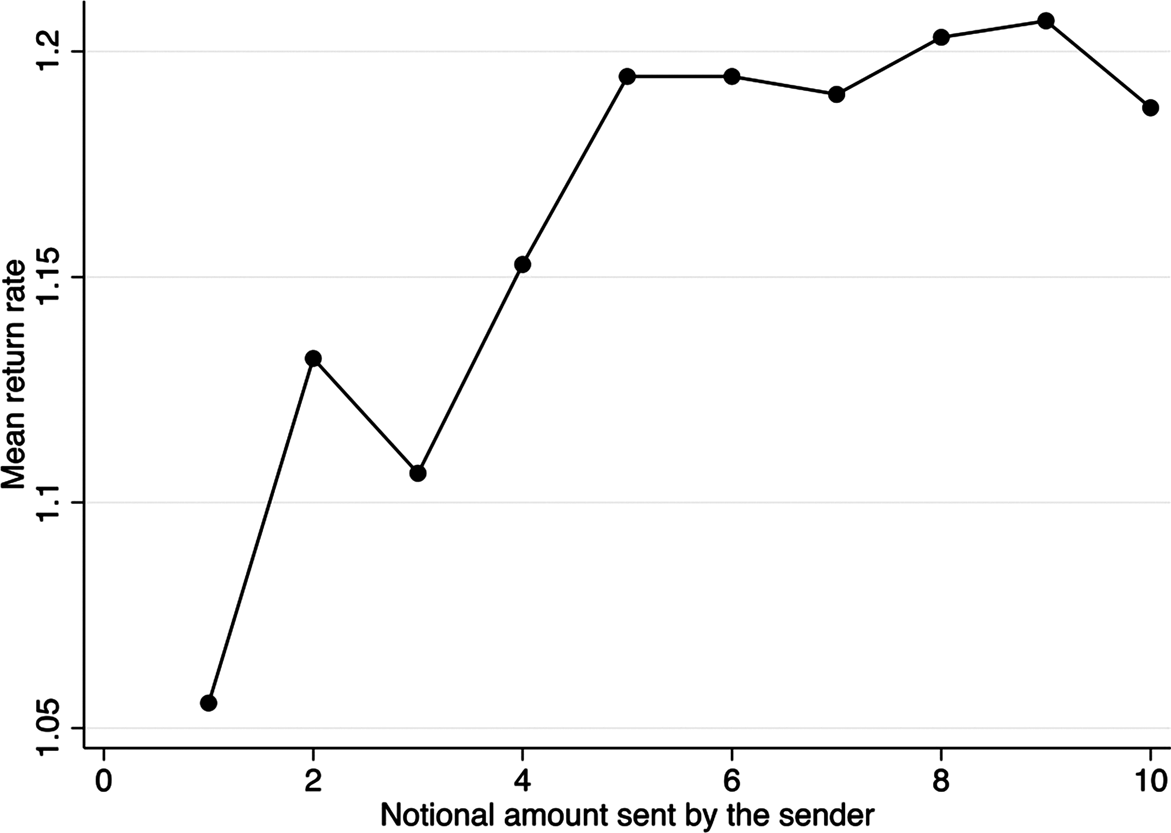
As in most of the literature, the analysis of recipients' behaviour suggests that the trust of senders was justified (Figure 1). The indicator of interest here is the return rate, the amount sent back by recipients divided by the notional amount sent by senders.Footnote 11 Using the strategy method, we can reconstruct the complete range of recipients' average return rates as a function of the notional transfer from the sender. In our baseline, the return rate is of the same order of magnitude and displays the same general features as the rest of the literature. Specifically, the trust of senders is, on average, positively rewarded with an average gain accruing to any positive amount sent. Moreover, the mean return rate is increasing in the level of notional transfers from the sender.
Mean return rate as a function of the notional transfers from sender in the baseline.

5. Experimental results: the impact of treatments
To assess how shocks to the endowment distribution affects trust and reciprocity, and how this impact varies with changes in the individual and aggregate economic conditions, it is natural to employ a DiD framework. Then, we compute the difference in sending (and return) rates between the second round and the baseline. We show how this difference varies across the aggregate scenarios (boom, steady state and recession) and across the individual positions within the endowment distribution (poor, middle class and rich) in that scenario.Footnote 12
Treatment effects on senders
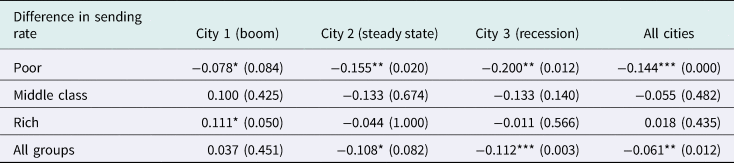
In Table 2, we examine how the shocks to the dispersion of the endowment distribution affects senders' average sending rate for each of the treatments in the second round. The last row of the table reports the average treatment effects for all cities, while the other rows report the effects separately by endowment group. Similarly, the last column presents the results for all the treatments aggregated.
Treatment effects on sending rates

Note: Wilcoxon-signed ranks test. Two-tailed p-values are in parentheses.
Aggregating across all treatments (last column of Table 2), the sending rate fell by an average of six percentage points (p.p.). For the middle class – i.e. those whose relative position did not change in the second round – the reduction was close to the average for the experiment at a little under 6 p.p. Perhaps most important, those belonging to the endowment group of the poor exhibit the strongest reaction to the treatment, reducing their sending rate by 14 p.p.
A consistent pattern is found when we focus on the second column of Table 2, which reports the effects of inducing a mean preserving spread of the endowment distribution, comparable to Anderson et al.'s (Reference Anderson, Mellor and Milyo2006) approach. For all those in the steady state taken together, the reduction in trust is around 11 p.p. For the middle class – those for whom the relative position, as well as individual and aggregate endowments did not change – the average reduction is around 13 p.p., although not statistically significant. Finally, the strongest effect is found among the poor, reducing their sending rate by 15 p.p.
Looking at the economic scenarios of boom (column 1) and recession (column 3), the results are consistent with the view that an increase in the dispersion of the endowment distribution has a negative impact on trust; this effect is, however, moderated by aggregate economic growth and exacerbated by economic recession. Indeed, the overall impact of the treatment is negative in recession (column 3) and not statistically significant in the presence of economic growth (column 1). In both treatments, we observe a stronger reduction in the sending rates by subjects who end up at the bottom of the endowment distribution. Moreover, within each endowment group, the negative treatment effect is larger as one moves from aggregate growth to steady state, to recession.
In sum, we find a rather consistent pattern; the variation in behavioural trust decreases as one moves from boom to recession (left to right) and increases as one moves from relative poverty to relative wealth (top to bottom). Thus, the results suggest that shocks to the dispersion of the endowment distribution reduce trust overall and this is primarily attributable to a strong reduction in sending rates among the poorest groups in the treatment.
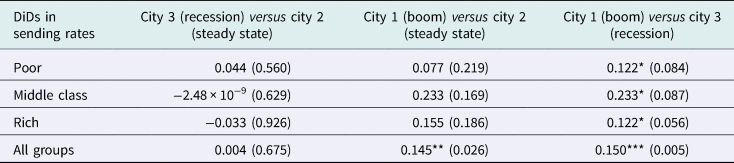
The DiDs of sending rates observable across cities and individual positions in the distribution provide a measure of the extent to which individual and aggregate economic conditions mediate the impact on trust of the induced spread of the endowment distribution (Tables 3 and 4). The most pronounced differences to be observed are between the most fortunate society (city 1) and the other two (Table 3). In fact, at the aggregate level, the DiDs in sending rates between city 1 and cities 2 and 3 respectively are both statistically significant (Table 3, last row). However, as we disaggregate and sample sizes fall, the differences across cities within the poor, middle-class and rich endowment groups are only statistically significant when one compares city 1 with city 3. However, the size of the DiDs in average sending rates is very similar comparing city 1 with either city 2 or city 3.
DiDs in the treatment effects on sending rates (by city)

Note: Mann–Whitney test. Two-tailed p-values are in parentheses.
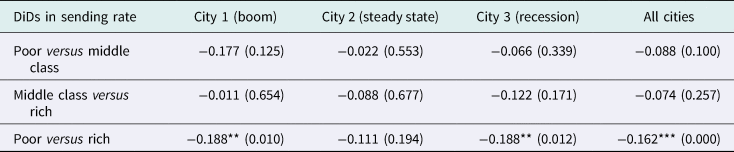
DiDs in the treatment effects on sending rates (by groups)

Note: Mann–Whitney test. Two-tailed p-values are in parentheses.
Somewhat similar findings emerge from a comparison of the treatment effects for different endowment groups, both as a whole and within each treatment (Table 4). In particular, a statistically significant difference in the behavioural reactions of the poor and the rich is found in the treatments taken as a whole as well as in boom and recession.
Overall, the results show that the impact of an increase in the endowment dispersion is negative and statistically significant across the experiment as a whole. The negative effect is stronger among the poor and in the recession environment.
Treatment effects on trustworthiness
We turn now to the analysis of trustworthiness. In this case, since the strategy method produces 10 non-independent observations for each player, we first compute the median return rate specific to each subject and then we run Wilcoxon signed ranks tests on the averages. Overall, trustworthiness reacts to the shocks to the dispersion of the endowment distribution in a stronger way than did behavioural trust, while the effects of individual conditions and aggregate endowment are less marked.Footnote 13
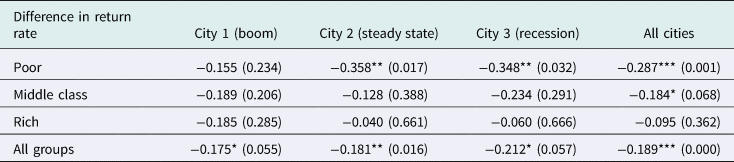
Consistent with similar studies (e.g. Xiao and Bicchieri, Reference Xiao and Bicchieri2010), induced shocks to the dispersion of the endowment distribution reduce the average level of trustworthiness among participants (Table 5, bottom right-hand corner). This negative impact appears to be moderated in cases where individual and aggregate endowments increase, but to a lesser extent than was observable for trust. Taking all endowment groups together, the treatment effect weakens as aggregate endowment grows. Similarly, taking all cities together, the treatment effect falls as individual position improves. However, DiDs across treatments (Cities 1–3) are never statistically significant. Also, although not reported here, the DiDs between rich and middle-class and between middle class and poor are never statistically significant, while the DiDs between rich and poor are only statistically significant in the case of recession and for all the treatments taken together.Footnote 14
Treatment effects on return rates

Note: Wilcoxon–signed ranks test. Two-tailed p-values are in parentheses.
6. Experimental results: econometric analysis
The evidence thus far presented has shown that the shocks to the spread of the endowment distribution exert downward pressure on behavioural trust and trustworthiness. Also, it appears that induced changes in both individual and aggregate conditions matter in determining the observed changes in behavioural trust but somewhat less so for trustworthiness. The latter reacts primarily to the overall increase in the dispersion of the endowment distribution with less variation in the reactions attributable to changes in individual and/or societal endowments. In this section, we provide a simple regression analysis to summarize, in terms of the resulting average treatment effects, the statistical evidence described above.
The purpose is to compare results obtained in our experiment with those obtained in related studies based on observational data. Note that, à la Kuznets, the induced shocks to the endowment distribution employed here entail, simultaneously, variations in individuals' endowment, to their position in the endowment distribution and to average endowments. Subjects' knowledge of the average endowments in the treatment may affect their expectations regarding their partner's endowment, which in turn may influence their willingness to trust. In addition, variations in individuals' conditions entail – potentially – a simultaneous variation in their endowment and their relative position in the endowment distribution. The experimental design, based on a variance-preserving shift, allows us, in contrast to previous studies, to assess how economic growth mediates the effect of inequality on trust, but not to separately identify each of these behavioural effects.
To circumvent this problem, we exploit the design feature that changes in individuals' positions are by design uncorrelated with the aggregate endowment shocks; consequently, we use the former as a proxy for the variations in individual endowment. Thus, in what follows, to arrive at an assessment of the average effect due to treatments, we estimate a behavioural equation, which measures the impacts of shocks to aggregate endowment and to an individual's position in the endowment distribution.
Senders
We first examine how shocks to average endowment and individual position induce a change in sending rates between treatment and control (ΔSR i) by estimating the following behavioural equation:

The constant term β 0 measures the average effect on sending rates of the change in the variance of the endowment distribution, measuring within-subject average behavioural variation. Note that the induced change in the variance of the endowment distribution is the only shock that is common across all individuals and all treatments compared to the control.
$\Delta \bar{x}_t$ takes on one of three possible values, −1, 0 or 1, depending on whether the average endowment in each treatment t (t = 1, 2, 3) decreased, stayed constant or increased with respect to the control. Therefore, the corresponding parameter β 1 measures the average p.p. change in the individual sending rate in response to a change in the economic scenario – from recession to steady state, or from steady state to boom.
The variable Δy it measures the change in individual position in the distributionFootnote 15; that is, the difference between the individual and the average endowment in each treatment t. We normalize this variable as before to take values, −1, 0 or 1, according to whether the individual's relative position worsened, stayed the same or improved with respect to the control: i.e. whether individuals are poor, middle class and rich in our designation. Therefore, the parameter β 2 measures the p.p. change in average sending rates associated with a change in the individual relative position in the endowment distribution.Footnote 16
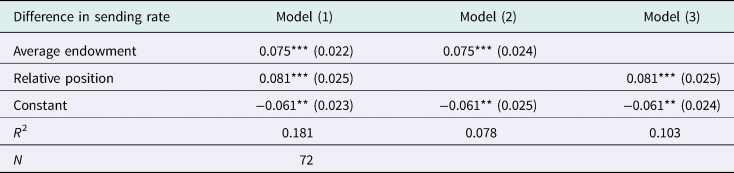
To assess the explanatory relevance of each variable, we compare the model represented in the above equation with two restricted models excluding one variable at a time (Table 6).
Average treatment effects on trust

Note: The dependent variable is the difference in individuals' sending rate between baseline and treatment. Robust standard errors in parentheses.
Overall, the measures reported in column 1 are consistent with the effects being determined by average growth and individuals' position in the endowment distribution. Since, by design, the two explanatory variables are orthogonal to each other, the coefficients are identical when inserted in a multiple or a simple (bivariate) regression, and the R 2 in the multiple regression is sum of the two R 2s from the simple regressions.
The average sending rate increases by 7.5 p.p. in response to a 20% increase (decrease) in the average endowment from (to) steady state to (from) boom (and similarly vis-a-vis recession and steady state). Similarly, the average sending rate increases by 8.1 p.p. as a sender's relative position improves from poor to middle class – or from middle class to rich.Footnote 17 The constant term measures the average effect of the dispersion in the endowment distribution and is identical to the difference of −6.1 p.p. between sending rates in treatment and control reported in Table 5 (bottom right-hand corner).
Taken together, the econometric results confirm that a rise in the variance of the endowment distribution reduces trust, but this effect is counterbalanced for those individuals who were fortunate enough to see their position improve in the distribution or who benefitted from being in an expansionary scenario. Conversely, the negative effect of endowment heterogeneity on trust is strongest where the aggregate endowment and individual's position worsens.
The econometric analysis allows us to provide a synthetic measure of the average treatment effects. Specifically, the induced change in individual positions, aggregate endowment levels and dispersion of the endowment distribution are all relevant determinants of the observed change in the average response, with a slightly smaller role played by the variance shift compared to the other two components. It is useful to compare these results above with those reported in observational and experimental studies on similar issues. As for growth, the coefficients reported here are of the same sign and comparable order of magnitude as results reported in observational studies on the relationship between the change in aggregate income and generalized trust (e.g. Algan and Cahuc, Reference Algan and Cahuc2013; Ananyev and Guriev, Reference Ananyev and Guriev2019).Footnote 18 This is of specific interest in that no previous lab experiment has investigated the impact of growth shocks on trust.
As for the impact of inequality on trust, our results are also consistent with evidence provided by observational studies, which show that income inequality – as measured by the Gini coefficient – has a detrimental effect on generalized trust (e.g. Alesina and La Ferrara, Reference Alesina and La Ferrara2002; Bjørnskov, Reference Bjørnskov2007; Costa and Kahn, Reference Costa and Kahn2003; Kyriacou and Velásquez, Reference Kyriacou and Velásquez2015). This contrasts slightly with previous experimental studies where, at the most, a weak effect of exogenously induced inequality on trusting behaviour has been detected in the context of trust games (e.g. Anderson et al., Reference Anderson, Mellor and Milyo2006; Hargreaves et al., Reference Hargreaves, Shaun, Tan and Zizzo2013).Footnote 19 The difference between our findings and lab evidence from similar trust games is most probably due to the specific design feature used here in order to identify generalized trust (Cox, Reference Cox2009, Reference Cox2010). Specifically, elimination of strategic biases as well as learning and signalling effects inherent in our one-shot anonymous interactions, make the object of study here closer to the notion of trust used in observational studies (Sapienza et al., Reference Sapienza, Toldra-Simats and Zingales2013). This strengthens our confidence in the external validity of the results reported here.
Recipients
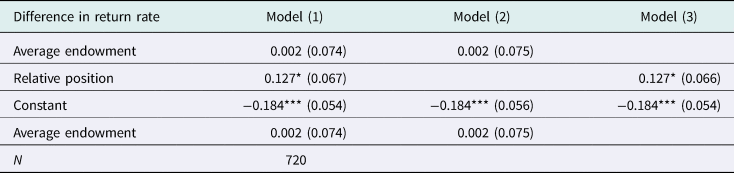
We perform a similar analysis for the average treatment effects on recipients, with slightly different findings (Table 7). The change in trustworthiness is measured by the difference in recipients' return rate between treatment and control. Standard errors are clustered at the subject level to account for the non-independence of the 10 observations for each recipient due to the strategy method.
Average treatment effects on trustworthiness

Note: The dependent variable is the difference in individual return rates between baseline and treatment. Clustered standard errors in parentheses.
In contrast to average senders' behaviour, only the relative position in the endowment distribution, along with the average impact of the variance of the endowment distribution (the constant term) affects recipients' behaviour, while the change in aggregate endowment across treatments plays no role. Specifically, individual return rates increase by 12.7 p.p. on average as recipients' relative position improves from the poor to middle class (or from middle class to rich), while the shock to the dispersion of the endowment distribution reduces recipients' return rate by −18.4 p.p.; a significantly larger response than for senders.
The lack of impact of the change in average endowment on recipients' behaviour across treatments confirms the difference between trusting and trustworthy behaviour. Indeed, given the strict anonymity of our protocol, the changes in the average endowment are relevant for senders' expectations on the counterpart's endowment, but not for recipients that choose the amount to give back contingent on each possible level of notional transfers from the sender.
7. Conclusions
This paper reports results from an experimental trust game with induced variation in the initial endowments, in order to contribute to the analysis of the relationship between inequality, growth and trust. Our starting point was the hypothesis that both inequality and growth are likely to affect behavioural trust and reciprocity among participants in the experiment, specifically through their shocks to both individuals' conditions and the aggregate environment in which they operate. The specific questions addressed were: Is there a causal impact of endowment variations associated with inequality and growth on trust and trustworthiness? Do shocks to an individual's relative position also matter? Our evidence suggests an affirmative answer to both questions.
We found that generalized trust unequivocally decreased with an increase in dispersion of the endowment distribution, whereas it increased in response to an increase in the aggregate level of the endowment. These average effects, however, were found to arise from differing behavioural responses across individuals in different positions in the endowment distribution. Specifically, the results were clearly driven by the strong behavioural response of those who ended up at the bottom of the endowment distribution after treatment, particularly in the environment featuring a lower average endowment. In this regard, we found that these negative reactions to the treatment are due to both the reduction of the average level of endowment and to the disadvantageous change of subjects' relative position within the endowment distribution.
As they stand, the results presented here add weight to the idea that shocks to the endowment distribution matter for trust. Perceived inequality, both as an aggregate measure of the dispersion and as the perceived measure of individual position and endowment in relation to the average, is damaging to the operation of society. Also, our results provide evidence of one mechanism through which this damage may accrue, particularly through its impact on the behaviour of those at the bottom of the income distribution.
These findings are likely to be of interest to those studying institutional economics and political science in that they document the impact of economic shocks on cooperative behaviour operating through a strictly defined notion of generalized trust. As observed at the outset, the latter shapes important features of civic society and its institutions. Consequently, not only is it important for societies to respond to inequality shocks, but these findings also point to the importance of economic conditions in determining whether appropriate institutional policy responses to shocks are likely to emerge. Ironically, if generalized trust and trustworthiness shape people's support to welfare state and policies (Daniele and Geys, Reference Daniele and Geys2015), then our results imply that redistributive policies will be more difficult to implement in the context of recession, precisely where they are needed the most.
The current context of contemporaneous shocks to growth and inequality presents the spectre of a downward spiral of increasing inequality and reduced growth, making the consequences of the initial shock all the harder to deal with. Moreover, we would hope that the empirical evidence presented here might stimulate research on how economic crises in a democracy may reduce peoples' trust in public institutions, so as to alter political equilibria by creating favourable conditions for an increase in the demand and supply of populist policies as recently studied, for example, in Guiso et al. (Reference Guiso, Herrera and Morelli2017).
The results of the paper point towards three main avenues to develop further our understanding. First, it would be interesting to appropriately extend the design in order to rigorously identify the impacts on trust of individual endowments, of their relative position in the endowment distribution and of aggregate endowments. This could be achieved by, for example, including further baseline ‘equality’ sessions in which the endowment under equality was varied accompanied by corresponding treatments. A more parsimonious alternative would be to add new treatments in which the variance preserving spread was abandoned to introduce variation in the absolute amounts by which the endowments of poor and rich changed between baseline and treatment or, ideally, both.
Second, it would also be informative to extend our design to identify the motivating forces (e.g. altruism, reciprocity and expectations of reciprocity) of the behavioural reactions to growth and inequality shocks, and to compare those reactions – together with their motivations – across subjects' samples of different nationalities. Indeed, a few experimental analyses document that cultural differences reflect in different trust attitudes and in different driving forces of trusting and trustworthy behaviours (e.g. Akai and Netzer, Reference Akai and Netzer2012; Ashraf et al., Reference Ashraf, Bohnet and Piankov2006; Barr, Reference Barr2003; Chaudhuri and Gangadharan, Reference Chaudhuri and Gangadharan2007; Holm and Danielson, Reference Holm and Danielson2005).
Finally, since individuals' preferences for economic policies – e.g. ‘interventionist’ and ‘libertarians’ preferences – influence their trusting and trustworthy behaviour (see for instance McCannon and Peterson, Reference McCannon and Peterson2014), it might well be worth investigating how such preferences affect individuals' perception of growth and inequality shocks and, in turn, the motivations underlying their behavioural reactions. More generally, in as much as generalized trust is a significant determinant of both long-run development and possible responses to economic crises from social and political institutions, the analysis points to the need to develop explicit theoretical work on the economic determinants of generalized trust, supported by an expansion of the experimental evidence on this issue.
Supplementary material
The supplementary material for this article can be found at https://doi.org/10.1017/S1744137421000552
Acknowledgments
The experiment was co-funded by the EU STYLE project (European Union, Seventh Framework Programme for research, technological development and demonstration under grant agreement no. 613256), research unit of the Department of Economics and Statistics of the University of Salerno. We thank the editor and three anonymous referees of this journal for their comments on previous versions of this paper. We wish to thank also Klaus Abbink, Maria Bigoni, Marco Casari, Gaurav Datt, Valerio Filoso, Francesco Guala, Ginevra Marandola, Dilip Mookherjee, Massimo Morelli, Francesco Parisi, Antonio Rosato, Alessandro Tarozzi and Daniel J. Zizzo, the participants at the IDEE meeting at the University of Bologna (April 2017), the participants at the Summer School in Development Economics in Prato (June 2018), the participants at the SABE-IAREP conference in London (July 2018), the participants at the research seminar of the Department of Economics and Statistics of the University of Salerno and the participants at the SEET workshop in Naples (February 2020) for helpful comments and insightful discussion. Francesco Lo Magistro from LABSI, University of Siena, provided us with excellent research assistance and programming. The usual disclaimers apply.