Phantoms of a Prophecy
Ever since October 2019, Chile has been boiling over with protests. As in Hong Kong and Ecuador, hundreds of thousands of people have stormed the streets, subway stations, parks, and public squares to defy, as never before, the cruel logic behind neoliberalism. The Chilean economic system — designed during the late 1970s by Milton Friedman, one of the Pinochet dictatorship’s (1973–1990) most illustrious advisers — is one of the most deregulated and unjust in the entire world. But, curiously, while Santiago burns, newspaper columnists voice what is reiterated on television and radio: “no one saw it coming.”Footnote 1
This may be true for some, but not for those of us involved in theatre creation and research. In the year before the protests, we witnessed a proliferation of dozens of prophetic documentary theatre plays that portrayed the effects of an economic system that Naomi Klein describes as “the shock doctrine” (Reference Klein2008:31). Furthermore, in the creative processes of these kinds of pieces, theatre companies often ally themselves with groups of victims of state violence such as LGBTQI+ activists, indigenous communities, and trade unions.Footnote 2
Animales invisibles (Invisible Animals) by La Laura Palmer theatre company has turned out to be particularly prophetic. The piece was made about and in collaboration with the technicians’ association of the National Theatre of Chile (TNCH), an institution under the auspices of the Universidad de Chile. These technicians provide the scenery, lighting, sound, and costumes at the TNCH, and they perform their labor in dismal working conditions: meager salaries, a deeply flawed social security system, and an extremely precarious theatre infrastructure are just a few of the many challenges they face. The play premiered on 9 August and ran for two months before the protests began at the TNCH building, a stone’s throw from the house of government in Santiago.
The 50-minute play is made up of two parts. In the first section (20 minutes), an audience of about 40 people is welcomed into the theatre’s foyer by a host — the young actor Nicole Waak — who divides the audience into two groups of approximately 20 people each. Both groups are invited to initiate an expedition to the catacombs of the theatre building, where the dressing rooms are located. In two separate dressing rooms, the groups watch a video projected onto one of the mirrors the actors use to do their makeup (the same video is shown in both dressing rooms). In the video, five technicians, all of whom are men over the age of 70 wearing everyday clothes, introduce themselves, summarize their work history, and describe their trade as if it were an obsolete practice. They denounce the TNCH’s implementation of a process of “corporatization” over the last few years. Following this process, the artistic directors buy theatre productions from outside companies that leave out the technicians’ traditional crafts. In the second section (30 minutes), the technicians reunite the audience on the theatre’s main floor. Now, on the stage, the technicians start a “memory exercise” in which all five of them tell stories from the good old days in the late 1970s and early 1980s when the theatre used to stage artistically ambitious, big budget productions. In both parts, the technicians’ script was written by the artistic directors at La Laura Palmer theatre company, Ítalo Gallardo and Pilar Ronderos. It was based on a series of interviews with the technicians conducted during the production process (simultaneously, the records of these interviews were released on the company’s Facebook page). In the end, the experience felt like an encounter with ghosts haunting a ruined theatre, evoking a kind of purgatory. Surrounded by crumbling old walls and rows of empty seats, only 40 people interacted in the middle of a large venue designed to receive a thousand people. The fate of these technicians seemed to microscopically embody the fate of a whole society.
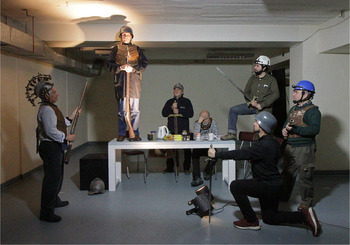
Rehearsal photo of the last sequence of Animales invisibles. The technicians declaim their lines calling to action, wearing parts of costumes and props from old plays (e.g., plastic helmets, blank rifles, fake bulletproof vests, and antique swords) as they prepare to storm the government palace across the Street. The National Theatre of Chile, Santiago, July 2019. (Photo by Ítalo Gallardo)

La Laura Palmer
A Poetic Vision of Documentary Theatre
In the context of legitimate demands for dignity and justice, the work of La Laura Palmer company stands out. Led from its inception in 2008 by Ítalo Gallardo and Pilar Ronderos, actors and graduates of Universidad de Chile’s drama school, the company is described as a “multidisciplinary group” that seeks to “clarify what is hidden” (El Mostrador Reference Cultura2018) by means of “technologies that promote their own obsolescence” (Richard Reference Richard, Blanco and Opazo2019:96). While the group originally focused on an intermedial re-creation of the weird and loopy atmospheres of David Lynch’s oeuvre (Hainge Reference Hainge, Sheen and Davison2004:136),Footnote 3 in 2012, La Laura Palmer began seeking to address what Gallardo describes as issues related to “documentary and biography” (in Equipo Hiedra Reference Hiedra2018: 03:45). The company’s renewed interest in using the methods associated with the theatre of the real (“transcripts, facts, trials, autobiography, and interviews” [Martin Reference Martin2013:5]) has its inflection point in Gallardo’s acting work in El año en que nací (The Year I Was Born, 2012) by Lola Arias (Equipo Hiedra Reference Hiedra2018: 05:15). In the play, “eleven Chilean performers born during the dictatorship reconstruct their parents’ youth through photos, letters, tapes, used clothes, stories, dim memories” (Arias n.d.). Since then, the company has embarked on a path, through seven productions to date, to scrutinize the biographical experiences of marginality, persecution, and repression: grandmothers who survived the dictatorship in a red-light district, hospitals, and finally cemeteries (Juan Cristóbal, llegando a Zapadores [Juan Cristobal on his way to Zapadores Street, 2013]); bystanders in the quasi-war between Chile and Argentina in the 1980s (Límites [Limits, 2015]); elderly people who live out their last days in ramshackle houses that look like shrines to everyday poverty (Los que vinieron antes [The Ones Who Came Before, 2016]); daughters damaged by the invisible violence of dysfunctional patriarchal families (Hija de tigre [The Tiger’s Daughter, 2016]); survivors of the 2010 earthquake (Amanecerá con escombros sobre el suelo [At sunrise there will be rubble on the ground, 2018]); and idealistic 1960s activists whom Pinochet’s dictatorship and the shadow of the Cold War condemned to unemployment, exile, and (dis)memory (Esto [no] es un testamento [This Is (not) a Testament, 2017]).
Using a method of investigation that focuses on unlocking unofficial archives, La Laura Palmer moved further along this path in 2017. While Esto (no) es un testamento sought to recover the fading memory of the aging veterans of the ICTUS theatre, the company’s next two productions, Animales invisibles (2019) and Exhumación (Isidora Aguirre) (2019), investigated labor conditions in the theatre industry, which have become increasingly precarious. In Exhumación (Exhumation), a theatrical performance staged a few weeks after Animales invisibles, La Laura Palmer explored the pedagogical and revolutionary vocation of the playwrights affiliated with the Popular Unity party, whose efforts the neoliberal governments of the democratic transition (1990–2019) attempted to dismantle.
An Expedition to the Catacombs
The Technicians and Their Demands
The first part of Animales highlights the contrast between the TNCH technicians and the authorities who administer the company, especially its artistic director, Ramón Griffero. Griffero is an iconic director/playwright of the Chilean artistic avantgarde of the 1980s, applauded by the cultural institutions of the transition, and winner of the National Award for Performing and Interpretive Arts in 2019. Griffero’s biography exemplifies the ideal of success: an artist who learned to shift his work from the underground insurgence during the dictatorship to the challenges that globalization brought in the late 1990s during the well-documented transition to democracy. As can be inferred from La Laura Palmer’s production, Griffero has exercised a type of authority geared more toward maintaining his own position as an avantgarde celebrity than safeguarding the dignity, independence, and tradition of his community, submissively bowing to the arts and culture establishment that has allowed contemporary capitalism to swallow up both material and symbolic heritage spaces, where citizens recognize traces of the national history.
Furthermore, this production could also be understood as a clash of generations in which the youngest uses the oldest to criticize the intermediate generation, which currently holds power. This struggle is analogous to the one being waged in the public sphere, where a new generation of politicians (contemporaries of Gallardo and Ronderos) reproach their predecessors (contemporaries of Griffero) for having been “accomplices” in a democracy that renounced its utopian ideals too quickly. Here, there is an element of intergenerational reparation.
Before the dictatorship (following a military coup in 1973), Chilean theatre — especially the TNCH — was a crucial part of a national modernization program developed during the 1940s by the left-wing governments. Actors, directors, playwrights, and scholars devoted to theatre took part in a vital mission: helping the masses marginalized by the university-educated class gain access to the values of a new society, founded upon the ideal of left-wing movements riding on the waves of the Cuban Revolution (1959) and May 1968. After the coup, the TNCH survived thanks to the work of these technicians — literally, supporting actors destroyed by exile and torture (during the dictatorship, more than 3,000 people were killed, many of them theatre workers). While theatre technicians endured the same kind of repression and persecution as many Chileans, they were relatively safe compared to actors, who were more exposed to public attention.
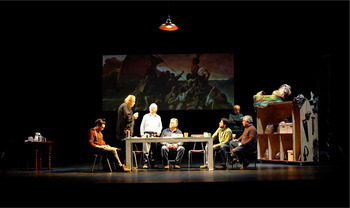
Theatre technicians discuss the state of theatre. Animales invisibles, directed by Pilar Ronderos and Ítalo Gallardo. Still from a video by Aquiles Poblete. (Courtesy of Aquiles Poblete)

During those years, the technicians engaged regularly in three kinds of support actions: lending money to actors who had been exonerated; opening the doors of their homes to artists sought by the secret police; and, of course, lending emotional support to a community whose human rights had been violated.
Through its theatrical productions, La Laura Palmer suggests that by the end of the dictatorship, the new political and cultural authorities had forgotten the legacy of these survivors and projected an idea of theatre shaped under the logic of neoliberal markets. In several passages of Animales invisibles, the technicians repeat: “this is no longer a theatre, it’s just an event center now.”Footnote 4 This accusation isn’t entirely fair: the TNCH is still a place where theatre works are staged. But it is a theatre that no longer has the capacity to undertake the kind of large-scale productions that it staged years ago. Nowadays it is only able to debut small productions with a few characters and one set or, more often, restage other companies’ productions.
Memory Onstage
When Technicians Remember
The second section of the piece brings the 40 spectators together onstage. After walking across the stage, they return to sit in the seats of the vast stalls. In front of them onstage, the technicians criticize the current state of the TNCH. They discuss its administrative dependence (although “national” in name, the theatre reports specifically to the Arts Faculty in Chile’s main public university, Universidad de Chile); the shortage of economic resources (which depend on the variable results of yearly bids for funding); and Griffero’s domineering, autocratic management style (he attempts to micromanage everything from annual programming to the position of the plant in the administrative offices). The technicians’ diatribe and their digs at the director are lackluster: although they allow themselves to talk in-depth about their daily tasks and their war stories about “the good old days,” they always do so with the stiffness of those who lack acting skills and simply memorize a text that comes out sounding mechanical rather than insightful. As mentioned above, every line the technicians utter was written by Gallardo and Ronderos on the basis of interviews. After years of frustration, the emotional range of the performers — whether expressing fury or tenderness — seems wilted: Have these pack animals lost even the spontaneity of affective memory? Is the basic fact of their lives that they are simply incapable of crossing the divide separating the caste of artists from that of the technicians? In what they say, they appear to repeat the language of another person (artist, creator) who speaks to them (employees, technicians). They repeat from memory convoluted metaphors about themselves: over and over they say they are “animals” that belong to an “endangered species,” like the “dinosaurs” and their own “dreams.” There are rehearsed jokes about them forgetting their lines, but, from time to time, the audience can see the panic in their eyes as they genuinely get lost in the script.
The main paradox of this play is that despite their life experience, the TNCH technicians edit their stories in line with the boundaries and interests of the university history as written by its bourgeois pupils. They put their memories into the hands of La Laura Palmer, and La Laura Palmer uses those memories to inveigh against Griffero. Yet again, the technicians are just the hired hands. This is on full display in the declared nostalgia the technicians have for a time they didn’t experience. They are not old enough to have participated in any of the milestones of the late, great golden age of Chilean theatre (1941–1973): the eldest of the technicians started working in the theatre in 1974, after the 1973 coup, while the others started in the 1980s. All of them received their training during the dark days of the military dictatorship and yet they talk about their past work as if it were a part of the golden pre-dictatorship era. Two operations that are particularly problematic from an ethical perspective stand out. On the one hand, the technicians describe with fascination the ancient set designs of works staged at the TNCH during the dictatorship (e.g., José Zorrilla’s Don Juan Tenorio [1976] or Fernando Debesa’s Mama Rosa [1982]).Footnote 5 They seem, perhaps unconsciously, to view these conservative and almost kitsch productions as part of the saga of productions born of the TNCH’s revolutionary glory days in the late 1960s (for example, Marat/Sade [1966] by Peter Weiss, Megan Terry’s Viet Rock [1969], and The Mother [1971], by Bertolt Brecht, based on Maxim Gorky’s novel).
On the other hand, however, one of the technicians tells a disturbing domestic anecdote to emphasize his bond with the longed-for past: as a child, he recalls, he would accompany his father, also a TNCH technician, to the jobs he took on during his free time. This included cleaning private houses, and one afternoon he found himself in the home of Víctor Jara, where his father got to work polishing the floors.Footnote 6 He remembers Jara as an intense man, with a voice like a flute and shoes with raised heels like those of a flamenco dancer. In its eagerness to scrutinize the archives of the institutional history of the theatre, La Laura Palmer ends up becoming its principal gatekeeper. On this particular point, Animales invisibles is a contradictory piece, criticizing the way in which the history of Chilean theatre has been formulated and retold, while repeating a number of myths with little basis in fact.
Without intending to, Animales invisibles puts a gloss on productions in which the theatremakers most critical of the dictatorship were locked up in dungeons or, in the best of cases, practiced their art in squatter houses or underground discotheques. Unwittingly, it paints a picture using the colors of comedy to tell of the exploitation of domestic workers.
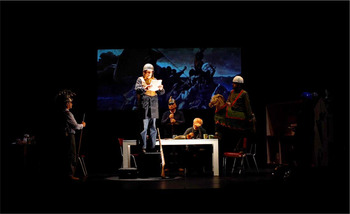
Dressed with old theatrical costumes and prop weapons, technicians prepare to storm the presidential palace across the street. Animales invisibles, directed by Pilar Ronderos and Ítalo Gallardo. Still from a video by Aquiles Poblete. (Courtesy of Aquiles Poblete)

The Politics of Costume
In a scene towards the end of Animales invisibles La Laura Palmer rectifies, perhaps without knowing it, the errors it made earlier in the play. The technicians, tired of waiting for a promised change in their working conditions, decide to arm themselves and assault the government palace, located 100 meters (about 325 feet) from the theatre. For their final demand, rather than seeking money for the theatre, they will lobby for the dignity for its workers above all other concerns. Of course, the theatre technicians do not have weapons, but they do have costumes and props: heaps of helmets like the ones worn by Spanish conquerors, Prussian soldiers’ uniforms, and stage prop bayonets and rifles. With only this eclectic and precarious equipment, they charge out of the theatre exit and run as fast as they can (which is pretty slowly, given their age). Meanwhile, the spectators are left stranded in their seats as a video is projected on the curtain.
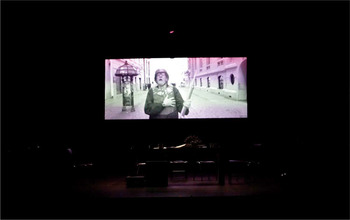
In the video projected on the empty stage, the oldest technician is about to collapse and die. Animales invisibles, directed by Pilar Ronderos and Ítalo Gallardo. Still from a video by Aquiles Poblete. (Courtesy of Aquiles Poblete)

This video gives the impression it was made by a war reporter following the technicians: the technicians try to run toward the presidential palace, but they seem disoriented, fragile, tired. To make matters worse, they can barely move under the weight of their costumes and prop weapons. Then, they stumble. They represent the obsolescence of these university theatres: No one needs the costumes or even the technicians anymore. As the technicians run, the oldest appears to collapse from a massive heart attack. Aghast, the leader of the crew rushes over to help him. This is a gesture of reconciliation: during the earlier discussions they had debated the ethics of armed struggle (as they drank tea and spoke of other, more inconsequential issues). The scene is abruptly interrupted: while the technicians embrace one another, a police officer pounces on them and beats them to death. The video stops as the house lights come on.
The video turned out to be prophetic. While we were writing this essay, the Chilean police were violently attacking demonstrators on the streets in cities all over the country. What began with fare-dodging by some students on Santiago’s subway (fares have become prohibitively expensive) soon mushroomed into a popular movement that, like the TNCH’s technicians, had a single demand: “Until dignity becomes the norm.” As in the video, the state has responded with violence. The President of the Republic declared, “we are at war” (BBC Mundo 2019), but failed to identify the enemy. Since then, over 30 people have died and over 400 have suffered eye injuries caused by ammunition from riot guns and tear gas bombs fired by the police. Amnesty International, Human Rights Watch, the United Nations Office of the High Commissioner for Human Rights, and the Inter-American Commission on Human Rights have published reports denouncing the atrocities committed by the Chilean police force under this government, the most brutal since the end of the dictatorship. Since October 2019, the TNCH has been closed and it is unclear when it will reopen or what the future holds. In the streets, a group of citizens, as idealistic as the technicians beaten in the play, gather every day in what is now called the Plaza de la Dignidad (Dignity Plaza), the former Plaza Italia, formerly the epicenter of civic celebrations. Disguised as superheroes, from Pikachu to Spiderman, the protesters continue to defy the police violence. Because of their courage, we call them the First Line: “until life is worth it,” they chant. In this light, the apocalyptic fantasy of La Laura Palmer theatre company has proven more prophetic than documentary.