


Introduction
Cognitive behaviour therapy (CBT) is an effective treatment for a number of psychological disorders including major depressive disorder and anxiety disorders such as panic disorder, generalized anxiety disorder, and social anxiety disorder (Barlow, Reference Barlow2008). Randomized controlled clinical trials generally use a treatment manual to increase both the consistency of the interventions used by the therapists and the construct validity of the treatment by enhancing treatment adherence (Waltz et al. Reference Waltz, Addis, Koerner and Jacobson1993; Kazdin, Reference Kazdin2003). However, few manuals exist for comorbid, complex, or complicated cases, placing the clinician in a difficult position in terms of deciding which treatment or what intervention components to apply, when, for how long, and in what sequence (Persons, Reference Persons2008; Haynes et al. Reference Haynes, O'Brien and Kaholokula2011).
For such cases, one alternative is to use a trans-diagnostic treatment manual focusing on general issues and processes that are common to multiple disorders (Barlow et al. Reference Barlow, Farchione, Fairholme, Ellard, Boisseau, Allen and Ehreneich-May2011). Such approaches look promising and their efficacy is under investigation (Farchione et al. Reference Farchione, Fairholme, Ellard, Boisseau, Thompson-Hollands, Carl, Gallagher and Barlow2012).
An alternative approach is to use a clinical case formulation (CF), such as a cognitive-behavioural case formulation (CBCF), to tailor treatment to the specific clinical needs of the client. Essentially, a CF provides an individualized or idiographic theory of the person or person-situation that has treatment relevance (Sundberg & Tyler, Reference Sundberg and Tyler1962; Korchin, Reference Korchin1976; Persons, Reference Persons2008; Mumma, Reference Mumma2011). A CBCF assists the clinician in specifying the problems (distress and dysfunction), identifying potentially relevant causal variables (e.g. cognitions, situational triggers) and explanatory mechanisms, and developing interventions, all of which are of greatest relevance for that particular person (Nezu et al. Reference Nezu, Nezu and Lombardo2004; Ghaderi, Reference Ghaderi2007; Kuyken et al. Reference Kuyken, Padesky and Dudley2009). The CBCF enables the clinician to draw on scientifically based cognitive-behavioural theory, both generic (Beck & Haigh, Reference Beck and Haigh2014) and disorder-specific (e.g. Clark & Beck, Reference Clark and Beck2010; Clark et al. Reference Clark, Beck and Alford1999) along with associated intervention methods to tailor an intervention plan most likely to be helpful for a particular client.
Approaches to CBCF
Since Persons’ (Reference Persons1989) classic book on CBCF, many manuals, both general (e.g. Nezu et al. Reference Nezu, Nezu and Lombardo2004; Persons, Reference Persons2008; Kuyken et al. Reference Kuyken, Padesky and Dudley2009; Beck, Reference Beck2011) and disorder-specific (e.g. Needleman, Reference Needleman1999; Tarrier, Reference Tarrier2006; Wells, Reference Wells2006; Zayfert & Becker, Reference Zayfert and Becker2007; Bakker, Reference Bakker2008; Clark & Beck, Reference Clark and Beck2010) have focused on how to develop the CBCF and use it to guide treatment. For example, in CBCF, Persons (Reference Persons1989) and Persons & Tompkins (2007) include a problem list, select a nomothetic causal model for the primary diagnosis, then individualize this to include the antecedents, precipitants, and situational triggering variables particularly relevant for that patient's distress and dysfunction. Beck's (Reference Beck2011) cognitive conceptualization focuses on precipitants, automatic thoughts evoked during typical problematic situations, developmental origins for core beliefs and compensatory strategies, and a working hypothesis that interrelates the client's historical experiences with the development and emergence of problematic thoughts and beliefs. The problem-solving CF approach of Nezu et al. (Reference Nezu, Nezu and Lombardo2004) involves generating a range of alternative causal variables, deciding on those most likely to be relevant and operative for the specific patient, and summarizing in a Clinical Pathogenesis Map, a diagram showing distal, antecedent, and organismic variables and their effects on distress and dysfunction. Finally, Kuyken and colleagues (Reference Kuyken, Padesky and Dudley2009) emphasize that the CBCF should be developed collaboratively with the client and include description of issues, explanatory variables including triggers, predisposing factors, and maintaining cycles, as well as protective factors and client strengths. Common features of these approaches to CBCF include developing a problem list (typically distress and dysfunction), exploring for possible causal variables (situational, predispositional, cognitive), developing hypotheses about the relationships between causal variables and distress and dysfunction, and generating individualized treatment targets and goals.
In terms of their efficacy, a small number of studies have compared formulation-based treatment (FBT) to standardized or manualized treatment. These studies have been summarized elsewhere (e.g. Kuyken, Reference Kuyken and Tarrier2006; Kuyken et al. Reference Kuyken, Padesky and Dudley2009). In general, FBT has outcomes comparable to manualized or standardized treatments, although results for some studies have favoured FBT (e.g. Ghaderi, Reference Ghaderi2007; Jacobson et al. Reference Jacobson, Schmaling, Holtzworth-Munroe, Katt, Wood and Follette1989) whereas results from a few studies have favored manualized or standardized treatments (Schulte et al. 1992; Emmelkamp et al. Reference Emmelkamp, Bouman and Blaauw1994). These studies have been criticized (Mumma, Reference Mumma2011) because (a) they generally have focused on populations with a single disorder whereas FBT is most valuable for complex or comorbid cases (Persons, Reference Persons2008; Haynes et al. Reference Haynes, O'Brien and Kaholokula2011), and (b) the validity of the CF was not evaluated in any of the studies.
Evaluating and testing CBCFs
In contrast to the surge of interest in developing and using CFs (e.g. Eells, Reference Eells2006), until recently there has been virtually no work on methods for empirically evaluating or testing CBCFs (Bieling & Kuyken, Reference Bieling and Kuyken2003; Mumma, Reference Mumma2004; Kuyken, Reference Kuyken and Tarrier2006; Kuyken et al. Reference Kuyken, Padesky and Dudley2009). This is problematic because using a non-validated CF to plan tailored treatment is analogous to using an assessment instrument that has not been psychometrically validated or using a manualized treatment that has not been empirically evaluated for efficacy or effectiveness! Approaches to evaluating CFs include testing certain behavioural CF hypotheses by manipulating contingencies as part of a functional analysis, perhaps even using elements of experimental single-subject designs (Hayes et al. Reference Hayes, Barlow and Nelson-Gray1999; Sturmey, Reference Sturmey2008). For example, a clinician can test hypotheses regarding the function of self-injurious behaviour in a child with autism by placing the child in simulated classroom situations and observing the effect of the contingencies in each situation on the self-injurious behaviour (Durand & Merges, Reference Durand, Merges, O'Donohue and Fisher2008). For behaviours under strong stimulus control, manipulation of contingencies results in an observable and generally rapid impact on the target behaviour. However, this approach will probably not work well for testing CBCF hypotheses. It may be difficult or impossible to manipulate the client's thoughts and beliefs in a way such that CF hypotheses about the role of cognitions in triggering or maintaining distress could be expeditiously or directly tested.
Two additional approaches that provide indirect information about the CBCF are discussing the CF or certain aspects of it with the client and tracking outcome measures over time. Discussing the CF with the client can help build rapport and can provide useful information about the client's perception of causal or functional relationships relevant to their distress (Kuyken et al. Reference Kuyken, Padesky and Dudley2009). This may be particularly important given recent evidence that some depressed clients may react negatively during the initial aspects of the CBCF development process (Kahlon et al. Reference Kahlon, Neal and Patterson2014). However, the extent to which the client's perceptions of the relationships between causal variables and distress accurately reflect these relationships when evaluated empirically over time is not known.
Finally, weekly or monthly monitoring of standardized outcome measures during treatment provides useful information on progress towards treatment goals. This information can be used to evaluate how the client is responding to treatment and, if not well, to consider reformulating the case (e.g. Persons et al. Reference Persons, Beckner and Tompkins2013). However, progress or lack thereof may not be an informative test of the validity of the CBCF because it (progress or not) may be due to other issues such as suboptimal selection or implementation of intervention(s), positive or negative effects of the therapeutic alliance, or positive or negative expectations for treatment efficacy by either the clinician, client, or both (Mumma, Reference Mumma1998, Reference Mumma2011; Persons et al. Reference Persons, Beckner and Tompkins2013). For example, if progress part way through treatment is largely due to the therapeutic alliance, positive expectancies, or the routine use of a standardized intervention, and this progress is attributed to a relationship between depression and a negative self-schema hypothesized in the CBCF that is actually not empirically valid, subsequent decisions based on that CF hypothesis may be suboptimal.
Person-specific evaluation of the CBCF
To address the absence of a valid empirical method to validate and test CBCFs, Mumma and colleagues (Mumma, Reference Mumma2004; Mumma & Mooney, Reference Mumma and Mooney2007 a,b) developed an approach involving the client making daily ratings of highly relevant items on an individualized questionnaire consisting of items measuring his/her idiosyncratic cognitive schema and particular experience of distress (e.g. depression, anxiety). Data is used first to test whether the items used to measure each variable or construct ‘hang together’ psychometrically for that person (i.e. ‘intraindividual construct validation’), then to test the hypothesized relationships between the causal variables (cognitions, situational triggers) and distress or dysfunction. All data analyses are intraindividual and person-specific (cf. Molenaar, Reference Molenaar2004; Molenaar & Valsiner, Reference Molenaar and Valsiner2005). However, the research demonstrations of the data analyses are rather technical and time-consuming to implement.
The primary purpose of using this person-specific method to empirically evaluate and test functional hypotheses in the CBCF is to refine the CF so that the tailored treatment plan is likely to be optimally helpful to the client (G. H. Mumma et al. unpublished data). The present article describes a step-by-step approach for empirically evaluating a CBCF that is potentially feasible to use with certain cases in a clinical training or possibly clinical practice setting. Note that this approach differs from those focused largely on monitoring treatment progress (e.g. Persons et al. Reference Persons, Beckner and Tompkins2013) in that it evaluates the CF prior to or during the very early stages of treatment. The treatment plan can be modified based on this empirical feedback well before the therapist has pursued an intervention plan that may be suboptimal because it is based on CF hypotheses that are not empirically supported. This approach is demonstrated with a case example obtained within a clinical training context (clinician: J.F.) using data collected approximately every other day from an individualized daily questionnaire.
Feasibility and appropriate cases for person-specific CBCF evaluation
There are pragmatic limitations to the use of this person-specific approach to evaluating hypothesized functional relationships in the CBCF. First, almost any CF approach to treatment is generally more demanding of the time and resources of the clinician than is required for relatively routine cases that can simply be assigned to one of the many existing empirically supported, manualized treatments. Included here are cases diagnosed with relatively uncomplicated single disorders such as panic disorder or a single major depressive episode. Second, the approach to evaluating the CBCF described in this article involves an additional time commitment from both the clinician and client that involves some delay in delivery of interventions while data is collected and analysed to evaluate and test the CBCF. Thus, this approach is not recommended for clients with urgent clinical needs such as those at risk for self-harm or other harm, for clients whose clinical condition or life circumstance is worsening, or for routine clinical practice situations involving limitations in the time or number of sessions available to a client.
However, the approach described herein is appropriate for clinical training situations where improving the CF and FBT planning skills of the therapist is an important goal and the client is amenable to working collaboratively with the therapist to enhance tailored treatment planning. Moreover, this approach may be usable in clinical practice situations where time is available to work collaboratively with a patient with relatively chronic or longstanding comorbid disorders and/or complex life circumstances who is interested in potentially optimizing the outcome of tailored CBT. Although the person-specific approach to CBCF evaluation was developed in a research context, the case example described herein was from a case seen in a university clinical training setting.
Within the contexts and constraints described above, this approach is clinically useful because it shows which clinical interventions are likely to work for each of the client's problems or issues. The approach is empirical in that it uses repeated (e.g. daily) ratings by the client to evaluate the validity of the CF. Finally, the approach is clinically feasible because once the CF and individualized questionnaire are developed, the additional time demands placed on the patient are minimal: about 4–7 min to complete the individualized questionnaire on each occasion for about 10 days to 4 weeks, depending on how the data collection is structured. This time commitment is in line with client time spent on monitoring or other homework activities often used in CBT. Furthermore, once this data is collected, the psychometric and most of the statistical analyses (described in Part B, below) can be done by a therapist with limited background in these areas, as illustrated with the case example. The authors believe that the person-specific approach to evaluating CBCF provides valuable empirical feedback to the therapist about the validity of functional hypotheses in the CF, and may have benefits beyond the small number of cases in which this is actually done by, for example, increasing the therapist's awareness of cognitive biases that influence clinical judgment (see Garb, Reference Garb1998 for a review).
Case example
Client history and presenting problems
To demonstrate the step-by-step approach to person-specific CBCF evaluation, we use the case example of ‘Phillip,’ a middle-aged, divorced, Hispanic man who referred himself to the University Psychology Clinic for anxiety (worrying, difficulty going to sleep, and difficulty concentrating) and depression (lack of motivation, anhedonia, weight loss, and thoughts of worthlessness/guilt) precipitated by a recent family crisis and loss of his job. During the assessment, Phillip was living with a family member upon whom he depended for financial support, reporting that he was unable to return to work due to the severity of his depression and anxiety. Medical history included congenital back problems causing numbness and erectile dysfunction. He reported no previous psychiatric or psychological treatment for anxiety or depression. After completing high school, Phillip held a blue-collar job for over 20 years after which he did maintenance work at a relative's business for about 10 years. Divorced at the time of referral, he had been married for over 30 years and had two adult children.
Phillip was seen by a clinical doctoral student in training (J.F.) and agreed to complete the CBCF evaluation at no additional cost to him as part of a professional competency training examination for his therapist. Upon completion of the data collection, he completed an IRB-approved consent form for research use of the archival data and received a discount on his subsequent clinic fees.
Standardized interviews and measures
SCID-IV (First et al. Reference First, Gibbon, Spitzer and Williams1996) diagnoses were major depressive disorder-moderate (to severe), recurrent without psychotic features and generalized anxiety disorder. Several administrations of standardized measures over time help establish levels of symptom severity and the phase state of the symptoms (Haynes & O'Brien, Reference Haynes and O'Brien2000). The phase state shows the trend of symptom severity and provides a context for interpreting the score at a particular time for that person. For Phillip, scores at intake and 3 weeks later indicated relatively stable moderately severe to severe depression [Beck Depression Inventory – II (BDI-II; Beck et al. Reference Beck, Steer and Brown1996) scores = 43 and 46, respectively]; mild to moderate and possibly increasing anxiety [Beck Anxiety Inventory (BAI; Beck et al. Reference Beck, Epstein, Brown and Steer1988) scores =17 and 27, respectively]. Additional measures completed subsequently indicated elevated to severe, and possibly increasing worry: Penn State Worry Questionnaire (PSWQ; Meyer et al. Reference Meyer, Miller, Metzger and Borkovec1990; Fresco et al. Reference Fresco, Mennin, Heimberg and Turk2003) scores = 64 and 78, respectively, and severe hopelessness [Beck Hopelessness Scale (BHS; Beck & Steer, Reference Beck and Steer1988) scores =19 and 20, respectively]. There was no history or report of suicidal ideation.
Additional assessments for CBCF
A detailed problem list, including the frequency, duration, strength and situational or temporal patterns of distress and dysfunction, was obtained via the Cognitive-Behavioural-Interpersonal Semi-Structured Assessment Interview (CBISSAI; G. H. Mumma, unpublished manual), a two-part, semi-structured interview yielding information about problems and prototypical sequences of thoughts and behaviour tied to distress and dysfunction (see Mumma & Smith, Reference Mumma and Smith2001; Mumma, Reference Mumma2004, Mumma & Mooney, Reference Mumma and Mooney2007 a,b; for validation information). Between-session monitoring initially involved open-ended logging of his functioning and experiences with a particular focus on worry and depression for 1 week, then use of a clinical monitoring log to report his automatic thoughts, behaviours, and ratings of emotions (sad, mad, anxiety) during distressing situations or events during the subsequent 12 days. Clinically significant events were explored in more detail using a situational or event analysis (Clark & Beck, Reference Clark and Beck2010; Beck, Reference Beck2011; G. H. Mumma, unpublished manual). For Phillip, this event exploration (done using procedures in CBISSAI) yielded several hypotheses for the CBCF about thoughts and beliefs that may trigger or maintain Phillip's distress, including Hopelessness, Inadequacy, and thoughts/beliefs of being Alone/Abandoned.
Case formulation
For Phillip, depression, somatic anxiety, worry, anger, and avoidance were included in the problem list for his CBCF. His anxiety and worrying often focused on his perception of having failed one of his adult children, conflict with his adult siblings (including a sibling with whom he was presently residing), financial difficulties, and his unemployment. Hopelessness, Inadequacy, and thoughts/beliefs of being Alone/Abandoned were included as variables that probably maintained Philip's depression.
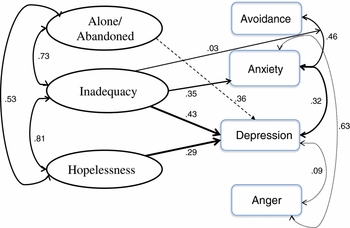
The functional analytic clinical case model (FACCM; Haynes et al. Reference Haynes, O'Brien and Kaholokula2011) provides a trans-theoretical model for CF that represents the most important outcome and causal variables and the hypothesized functional relationships between them. The clinician's FACCM for Phillip's CBCF is given in Figure 1. In this diagram, rectangles are problems (distress, dysfunction) and ovals are hypothesized causal variables. Curved lines represent hypothesized relationships between problem variables or between causal variables (e.g. cognitions). Straight lines connecting causal variables to outcome variables or problems are hypothesized functional or causal relationships in the CBCF. For both curved and straight lines, heavier lines correspond to stronger hypothesized relationships.
Philip's cognitive behavioural case formulation: functional analytic clinical case model and results of tests from steps B2 and B3. Hypothesized bivariate strength of relationship: –––, weak; ——, moderate; ▬▬▬, strong; -----, hypothesized incremental (semi-partial) relationship. Estimated correlations are next to the paths.

Specific CBCF hypotheses
For Phillip, the clinician's hypotheses about the relationships among distress variables included a moderate positive correlation between anxiety and depression (because the CBISSAI event analyses suggested depression and anxiety were triggered by similar stressors or hassles). Further empirical evaluation of this relationship is important because if supported, then interventions aimed at changing these stressors, their appraisal, or coping responses should influence both depression and anxiety. The clinician also hypothesized that both depression and anxiety are mildly or weakly related to anger and that anxiety is positively associated with avoidance.Footnote † Hypothesized relationships between cognitive schema included moderate positive correlations between Hopelessness, Inadequacy, and Alone/Abandoned. The clinician also hypothesized that Inadequacy cognitions consist of three components, Failure, Inability to Cope, and It's my fault, but he did not make differential predictions about relationships of these subscales to outcome variables.
The clinician's CBCF included four hypotheses about relationships between Phillip's cognition variables and distress. (1) Hopelessness is highly correlated with depression. (2) Inadequacy strongly predicts depression, moderately predicts anxiety, but does not predict anger. (3) Alone/Abandoned cognitions incrementally predict depression over and above the other two cognition scales. (4) The positive relationship between anxiety and avoidance is stronger when Phillip is having thoughts of inadequacy. That is, Inadequacy moderates the relationship between anxiety and avoidance.
Although Phillip's CBCF also included several hypotheses about functional relationships between triggers and distress (e.g. conflict with his adult siblings, reminders of his adult daughter's present situation), these were not tested empirically because the bi-daily frequency of data collection that was agreeable to the patient was thought to be inadequately sensitive to these relationships. Instead, the CBCF hypotheses tested focused on functional relationships that maintained (rather than triggered) his distress.
Treatment plan
FBT is tailored to the specific clinical needs of the client as assessed in the CBCF. Interventions may include treatment components that are part of empirically tested manuals for specific disorders, specific empirically supported interventions (e.g. progressive muscle relaxation), or either of these with theory-based or contextually based adaptations for complex or difficult cases (e.g. Robinson, Reference Robinson2013). By evaluating the validity of the CBCF, the clinician tests those aspects of the treatment plan that are tied to the CF. Interventions targeting those aspects of the CF that are empirically supported using the methods described below are more likely to be helpful and successful for that particular individual (Haynes et al. Reference Haynes, O'Brien and Kaholokula2011; Mumma, Reference Mumma2011).
Based on the initial CBCF, Phillip's preliminary tailored treatment plan included the following: (1) Development of alternative coping skills to manage his anxiety and to replace the avoidant coping that was hypothesized to be related to his anxiety. This avoidance was hypothesized to exacerbate and maintain his anxiety (as well as contributing to reduced efforts to find a job). (2) Cognitive restructuring methods focused primarily on his Failure cognitions (one component of his Inadequacy cognitions). Specific planned interventions included (a) identifying, challenging, and replacing/countering his negative automatic thoughts related to failure [see Appendix for specific Failure cognitions included in the Individualized Questionnaire (IndQ)]; (b) reattribution of stressors from global and enduring self-blame to more appropriate event-specific attributions; and (c) behavioural experiments evaluating the effects of these new coping responses and cognitive counters on his depression and anxiety. In the CBCF, these cognitions were hypothesized to be functionally maintaining both his anxiety and depression. Thus, these interventions were expected to reduce both.
The remainder of this article describes the steps in evaluating and testing the CBCF. First, steps A1–A6 describe the process of obtaining the necessary data for the person-specific testing of CF hypotheses. Although the first several steps actually occur during the assessment and CF development process, they are included here because they are the initial steps involved in evaluating or testing the CF.
Step-by-step manual for empirical CBCF validation
A. Develop an individualized measure and collect data
Step A1. Eliciting idiographic data. During the assessment process, the clinician should be vigilant for client statements that capture his/her interpretation or perception of events, distress, and experiences. This is particularly important during diagnostic interviewing, during exploration of distress (depression, anxiety) including those facets particularly relevant to that client, and during situational analyses. The latter are particularly likely to elicit verbatim statements of thoughts and beliefs that may function to trigger or maintain distress or dysfunction.
Specific phrases or words used by the client are likely to describe the most important aspects of his/her distress, dysfunction, physiological sensations, and thoughts and beliefs and may be used as items in the IndQ (see Beck, Reference Beck2011 for specific suggestions or queries to access automatic and intermediate thoughts). Using verbatim statements increases the relevance and potential sensitivity of idiographic items.
Step A2. Develop and select items measuring the most relevant facets of outcome/distress and causal constructs. Client ratings of the relevance or importance of each item, or his/her suggestions on how to revise the item content to increase relevance, facilitate selection of items for the IndQ. Items modelled after those on standardized questionnaires may need to be reworded to be consistent with the time-frame and response scale of the IndQ (see below). Ideally, each outcome and causal construct is represented by at least three items, but this can be adjusted based on needs and time constraints.
General guidelines for item selection: (a) Use items that represent the most important facets or components of each construct for that person (Mumma, Reference Mumma2004, Reference Mumma2011; Haynes et al. Reference Haynes, Mumma and Pinson2009). Facets of depression for Phillip included sadness, anhedonia and loss of appetite, and suicidal thoughts. (b) Include items covering more than one response mode. Phillip's depression items, for example, included the affective (‘felt sad’), behavioural (‘I cried’), and cognitive (‘had thoughts about committing suicide’)Footnote † response modes. (c) Use items that vary in generality/specificity, including items that represent the construct generally for that person (e.g. ‘felt anxious’) and that are highly specific (e.g. ‘clenched my hands’). (d) Finally, for cognitions, include items that represent important judgmental biases evident in the client's thinking (e.g. overgeneralization or catastrophizing: ‘I'm a failure’; dichotomous thinking: ‘It's all my fault’). (See Appendix for Phillip's IndQ.)
Step A3. Set up a sampling time-frame and establish details of when the ratings will be done. Select a time-frame for the client to do the ratings that is most likely to be sensitive to important changes in mood, thoughts/images, or behaviour. For example, if a mood change is triggered during the day and is likely to remain for one or several days, then daily ratings may be optimally sensitive. However, it is equally important to select a time frame that is convenient and will optimize the chances the client will complete the ratings. In our experience, daily ratings done at the end of the day work well for many clients. Ratings made twice a day or every other day have worked well for others. For Phillip, end of day ratings completed approximately every other day were selected as the best compromise between frequency/sensitivity and compliance/completion of the ratings.
Step A4. Set up a rating response scale, dimension, and interval to be assessed. To be sensitive to changes over time, a relatively fine-grained numeric response scale (e.g. 0–10) is helpful. Anchors for the scale can be adjectives describing degree (mild, moderate, strong). A more time-consuming alternative is to anchor with specific experiences or events in the person's life (e.g. 10=‘anxiety as strong as the time last December when I had a panic attack and went to the ER’).
The dimension to be rated is likely to be overall severity, but alternatively could be intensity/strength or frequency/duration. Phillip rated ‘severity’ for the items assessing depression, anxiety/worry, anger, and avoidance, whereas for the cognition items he rated ‘how much you have experienced the thought today’ using the same 1–10 scale and adjective anchors.
The time interval to be rated is the span of time to be considered when the client is making the ratings. For example, Phillip did his end of day rating covering that day, even though he made these ratings every other day. Alternative spans could be ‘since the last rating’ or ‘right now’ (either could be used for ecological momentary assessments multiple times per day).
Step A5. Collect ratings. The self-rating data can be collected on a hardcopy or can be done electronically (e.g. on a personal data assistant, cell phone, or survey website). Ratings done electronically facilitate the process of data entry and thus data analysis, plus clients like them because it looks like a ‘regular’ activity. Phillip completed 28 IndQs at the end of the day approximately every other day. If possible, have the client start doing the ratings as soon as possible after the initial CBCF and IndQ is developed. Although the purpose of the ratings is to assess functional ratings for treatment planning, the ratings may need to continue while doing some initial interventions.
Step A6. Continue to evaluate level of distress with standardized measures. The IndQ is a client-specific idiographic measure used to test certain hypotheses in that person's CBCF and to track change over time. While the client is completing the IndQ ratings, continue to administer standardized measures of distress and relevant causal variables at regular intervals. For example, while completing the bi-daily measures, Phillip completed the BDI-II (scores ranged from 25 to 38), BAI (range 13–21), BHS (18–20), and PSWQ-Past Week (Stöber & Bittencourt, Reference Stöber and Bittencourt1998) (71–82), all indicating that moderate levels of anxiety, moderate to severe depression, and severe worry and hopelessness continued during this early period of assessment and initial treatment.
The next set of steps (B1–B4) describe data analyses to be done when a sufficient number of IndQs have been completed. Although formal analysis of the data used to test CBCFs done in a research context can be complex (for examples see Hokanson et al. Reference Hokanson, Tate, Niu, Stader and Flynn1994; Mumma, Reference Mumma2004; Mumma & Mooney, Reference Mumma and Mooney2007 a,b), it is likely that ‘good enough’ analyses can be done for clinical training and practice settings using spreadsheets with statistical add-ons available at no cost. The case example demonstrates the latter.
B. Evaluating the validity of the CBCF
Data analyses to evaluate the CBCF are divided into four steps. For Phillip's case, a few of the clinical implications of the results of this validity evaluation are mentioned at several steps of the process.
Step B1. How well do the items measure the variables or constructs in the CBCF?
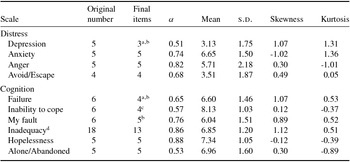
Step B1a. Quick item screening. Items that receive the same rating a high proportion of time and thus have poor variability in scores add little to the measurement of the target construct over time and can be eliminated from the analyses used to evaluate the CBCF.Footnote † For Phillip, one item from each of the Depression and Inadequacy scales in his IndQ were eliminated due to high skewness and kurtosis (Kline, Reference Kline2005).
Step B1b. Examine correlations between items and eliminate items that do not fit well. Calculate the correlation between each item and the total score for the scale it is intended to measure. The correlation coefficient ranges from −1.0 to +1.0, with a correlation close to 1.0 indicating the scores between the item and total vary similarly across occasions. Items that correlate well with the total score for that scale (about ≥0.40) should be retained in that scale. Poorly fitting items should be dropped because they add noise to the total scores for that scale and can decrease sensitivity to detect relationships or change.
This step is important even for items based on those in standardized scales. The psychometric properties of the items and scale when rated repeatedly by the same individual are likely to differ from those found in aggregate-level research (Molenaar, Reference Molenaar2004). For Phillip, one additional item was eliminated from the Depression scale and four additional items were eliminated from his Inadequacy cognition scale due to poor correlations with other items in that scale (see Table 1).Footnote ‡
Intraindividual descriptive statistics for Phillip's Distress and Cognition scales

α Internal consistency reliability.
a One item dropped due to inadequate variability and high skewness and kurtosis.
b One item dropped due to inadequate correlation with other items in scale.
c Two items dropped due to inadequate correlations with other items in scale.
d Failure, Inability to cope, and My fault combined into the Inadequacy scale after item analysis.
Step B1c. Calculate approximate internal consistency reliability (optional). The internal consistency reliability (ICR) indicates how well the items are fitting together to measure the variable. The intraindividual or person-specific ICR (cf. Molenaar, Reference Molenaar2004) summarizes how well the item scores intercorrelate in their ratings over time for that person. Although we are unaware of any guidelines for a minimally acceptable intraindividual ICR, we suggest an intraindividual ICR of at least 0.5 or 0.6.Footnote †
The approximate intraindividual ICR for Phillip's four distress and three cognition scales are given in Table 1. Three of the four distress scales had ICR estimates that were adequate to good: 0.68–0.82, whereas the ICR of 0.51 for the 3-item Depression scale was marginal. ICR for Inadequacy and Hopelessness was strong, 0.86 and 0.88, respectively, but was marginal for Alone/Abandoned, 0.53. Thus, for Phillip, with the possible exception of Depression and the Alone/Abandoned cognition scales, the clinician's CBCF hypotheses should be testable using the scores from the IndQ scales (without excessive attenuation or dilution due to unreliability or measurement error).
Step B2. Evaluating CBCF relationships within both distress and causal variables
Prior to testing causal hypotheses in the CBCF or FACCM, test hypotheses about the relationships between the distress scales and between the cognition scales. These are tests for convergent and especially discriminant validity. For example, very large correlations between some of the distress measures might indicate that those scales are not measuring distinct constructs for that person. Further, to what extent are any relationships expected between the distress scales empirically supported? These tests should be done separately for different types of scales (e.g. distress scales, cognition scales, situational triggers).
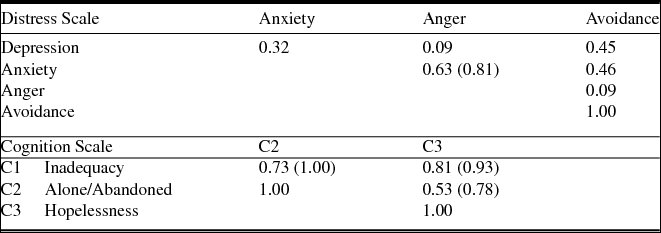
Step B2a. Correlations between distress scales. Intercorrelations between the distress scales should be examined to address whether the scales are empirically distinct (discriminant validity) and to test hypotheses about their relationships. For Phillip, the intercorrelations between distress scales (Table 2, top) were generally not so high as to suggest discriminant validity problems. However, the correlation between Anxiety and Anger (r = 0.63) is a possible exception.Footnote ‡ The clinician's first CBCF hypothesis about the distress scales was that Phillip's anxiety and depression is moderately positively correlated over time, but both are only weakly correlated with anger. Consistent with the hypothesis, the correlation between the Depression and Anxiety scales was 0.32, and Depression was unrelated to Anger. However, the correlation between his Anxiety and Anger scores (r = 0.63) was contrary to CF hypothesis. This higher-than-expected correlation may have important clinical decision-making implications. For example, an intervention that may affect anxiety may also affect anger. Figure 1 shows the person-specific correlations between Phillip's distress scales.
Intraindividual Correlations of Phillip's Same-Domain scales

For scales with high observed correlations, numbers in parentheses are the disattenuated correlations (estimated correlation between true scores after adjusting for scale reliabilities).
For Phillip's CBCF about distress scales, the clinician also hypothesized that Anxiety is positively associated with Avoidance. This hypothesis was supported (r = 0.46) (Table 2, Fig. 1). This result suggests that avoidance may play a role in maintaining anxiety for Phillip. Thus, reducing his avoidance (e.g. through exposure) may help reduce anxiety.
Examination of additional correlations, other than those specifically predicted in the CBCF, may also be helpful (see step B4).
Step B2b. Correlations between cognition scales. As with the distress variables, scores on cognition variables over occasions/time should be examined for convergent and discriminant validity – Are the scales empirically distinct for this person? Are expected patterns of relationships between the cognition scales apparent in his/her ratings? The case example of Phillip demonstrates why this is a necessary and important step prior to examining expected relationships between cognitions and distress/dysfunction. It also demonstrates how to proceed when person-specific discriminant validity difficulties are encountered and briefly touches on possible clinical implications.
Empirical tests of the correlations between the three idiosyncratic schemas hypothesized for Phillip – Inadequacy, Alone/Abandoned, and Hopelessness – suggested discriminant validity issues (see Table 2, bottom). Phillip's Inadequacy cognitions were not empirically distinct from either his Alone/Abandoned or Hopelessness cognitions. Although scores on Alone/Abandoned and Hopelessness were highly correlated, these scales were probably distinct. One implication of these results is that some of the clinician's causal or functional hypotheses could not be tested.
Clinical decision-making implications: The empirical relationships between the cognition scales indicate that only Hopelessness is distinct from the other hypothesized cognitive schema, which were not distinct from each other. Thus, cognitive interventions for Phillip focusing on Hopelessness and either Inadequacy or Alone/Abandoned are indicated. Moreover, the evidence suggests that more specifically focusing on Alone/Abandoned cognitions in addition to Inadequacy cognitions or any of its subscales (or vice versa) is unlikely to be helpful for Phillip. This is highly useful information in terms of developing a tailored treatment plan that is likely to be successful.
Step B3. Tests of CBCF hypotheses about relationships between predictors (e.g. cognitions) and distress
After resolving validity issues for the person-specific measures of distress and cognitions, causal or functional hypotheses in the CBCF should be evaluated. Relevant hypotheses include the predicted relationships between triggers and/or cognitions and distress (or dysfunction). Based on the results in step B2, it may be possible to fully test only a subset of the original hypotheses about these relationships. Alternatively, some of the original hypotheses may still be testable but may need to be revised.
For Phillip, given the results of step B2, step B3 involved testing a subset of the original hypotheses about the relationships between cognitions and distress in the CBCF (see Fig. 1). The first hypothesis tested was that Hopelessness cognitions will strongly predict depression. This relationship was found, but was of magnitude r = 0.29.
The second CBCF cognition-distress hypothesis for Phillip was that Inadequacy cognitions will strongly predict depression and moderately predict anxiety, but will not predict anger. Results (see Fig. 1) were consistent with this hypothesis. Inadequacy was moderately strongly related to depression (r = 0.43) and to anxiety (r = 0.35), but was unrelated to anger (r = −0.10). Notably, a similar pattern of correlations was found between Alone/Abandoned cognitions and these three distress scales (r = 0.46, 0.24, and 0.02, respectively), supporting the above finding of a lack of discriminant validity between Inadequacy and Alone/Abandoned cognitions.
Clinical implication: The first two CBCF cognition-distress hypotheses were empirically supported for Phillip. Cognitive interventions for depression could focus on both hopelessness and his thoughts and beliefs of inadequacy and aloneness/abandonment. Decreasing either of these cognitions should also decrease his anxiety.
For Phillip, the third cognition-distress hypothesis was that Alone/Abandoned cognitions will incrementally predict depression over and above the other two cognition scales. Given the inadequate discriminant validity between Alone/Abandoned and Inadequacy, though, this part of the hypothesis could not be fully tested. However, Alone/Abandoned did predict depression over and above Hopelessness – explaining an additional 13% of the variability in the daily depression scores (semi-partial correlation=0.36).Footnote † (See Fig. 1.)
Clinical implications: These results suggest several additional clinical implications. First, interventions designed to decrease Phillip's sense of being alone and abandoned may decrease his depression in addition to (i.e. over and above) interventions focusing on decreasing his hopelessness. Second, Anger is not predicted by any of the cognitions, so it is unclear from the CBCF what, if any, cognitive interventions may help Phillip with his anger. However, as mentioned above, Anger and Anxiety appear to be strongly related for Phillip (r = 0.63) (Fig. 1). Inspection of the Anxiety items (see Appendix) suggests this scale is measuring primarily somatic and psychomotor facets of anxiety (tense, nervous, clenching hands, pacing) whereas most Anger items are measuring action tendencies (‘felt like hitting someone or something’, ‘felt like cursing’). Perhaps, for Phillip, interventions that decrease his somatic/psychomotor experiences of anxiety may also decrease the angry action tendencies strongly associated with these experiences.
The fourth and final structural hypothesis was that the positive relationship between anxiety and avoidance will be stronger when Phillip is experiencing thoughts of inadequacy. That is, Inadequacy will moderate the relationship between Anxiety and Avoidance. This hypothesis, which involves more advanced data analysis methods, was tested using multiple regression to evaluate if an interaction between Anxiety and Inadequacy predicted Avoidance.Footnote † However, results did not support this hypothesis (the squared partial correlation for the interaction=0.03, n.s.).
Step B4. Inspect results for other relationships of clinical interest but not in original CBCF
It is generally not feasible to flesh out every hypothesis of possible clinical significance in the CBCF. Given the complexity of cases and the range of judgemental heuristics that may affect clinical judgement (Garb, Reference Garb1998), it is sensible for the clinician and client to focus on those relationships that appear most relevant and potentially clinically significant or useful during the assessment and early phases of treatment. However, an additional inspection of results after the CF hypotheses have been tested may indicate relationships between variables that were not included in the original formulation but that may be useful in treatment planning. Some examples from Phillip's case follow.
Step B4a. Within the distress scales. Although Phillip's CBCF included the relationship between anxiety and avoidance (r = 0.46), further inspection of results indicates his avoidance was also related to depression (r = 0.45). The substantially weaker relationship of avoidance to anger (0.09) suggests that Phillip used avoidant strategies when either depressed or anxious, but not when angry. Thus, interventions to decrease avoidance may also decrease anxiety and depression, but will probably not affect anger.
Step B4b. Within the cognition scales. Thoughts of inadequacy are strongly related to hopelessness (r = 0.81, see Fig. 1). This suggests that cognitive interventions for his inadequacy thoughts and beliefs may also reduce his hopelessness.
Step B4c. Between cognition and distress. Although the clinician had no CF hypotheses about what cognitions would be associated with avoidance, it might be useful to know if Phillip's thoughts of being alone/abandoned predict avoidance behaviours or possibly anxiety. When empirically tested, Alone/Abandoned cognitions did strongly predict Avoidance behaviours (r = 0.73), but much less so Anxiety (r = 0.24). Also, both Hopelessness and Inadequacy cognitions strongly predicted Avoidance (r = 0.63 and 0.67, respectively), but only Hopelessness made much of an incremental contribution over Alone/Abandoned cognitions [squared semi-partial correlation (sr2 ) = 0.08]. This finding makes sense given the person-specific discriminant validity problems between Inadequacy and Alone/Abandoned. Clinically, the direction of the relationship between Alone/Abandoned cognitions and his Avoidance behaviours is unclear, and may be reciprocal. If interventions to decrease his avoidance behaviours do not also decrease the thoughts of being alone and abandoned, the clinician could target these thoughts because they do predict depression.
Discussion
A CBCF helps the clinician specify the particular problems and issues, treatment goals, and, thus, specific interventions of greatest relevance for a particular individual. FBT planning is useful for developing interventions tailored to the clinical needs of a person with multiple problems, issues, or comorbid conditions. However, despite both the availability of manuals focusing on developing CBCFs and increasing interest in providing CB treatments tailored to the clinical needs of a particular person (O'Donohue & Lilienfeld, Reference O'Donohue and Lilienfeld2013; Beck & Haigh, Reference Beck and Haigh2014), relatively little work has been done in evaluating or testing the validity of the formulation. The existing work in empirically testing CBCFs (e.g. Mumma, Reference Mumma2004; Mumma & Mooney, Reference Mumma and Mooney2007 a) are research studies that tend to be highly technical in the data analysis and involve relatively long time series, and thus would not seem practical for most clinical practice or training contexts. The present article presents an easy to follow, step-by-step guide for the clinician (and client) showing how to go about evaluating and testing their CBCF hypotheses. This approach can be implemented within a framework of collaborative empiricism, a highly valued aspect of CBT (Beck et al. Reference Beck, Rush, Shaw and Emery1979; Kuyken et al. Reference Kuyken, Padesky and Dudley2009; Tee & Kazantzis, Reference Tee and Kazantzis2011).
As indicated in the Introduction, this person-specific idiographic approach to testing functional relationships in a CBCF is not intended to be applied to all cases. It is appropriate for comorbid and complex cases in which tailored CBT is planned, where the client and therapist have the time and motivation to work collaboratively to develop and evaluate/test the CF, and for relatively chronic situations where there is not a need for immediate intervention such as risk for suicide or harm to others or a deteriorating severity of distress or dysfunction. It is particularly well suited to clinical training situations where empirical evaluation of the CBCF may be helpful in reducing the influence of judgemental heuristics such as overconfidence, anchoring, or halo effects (Garb, Reference Garb1998; Grove et al. Reference Grove, Zald, Lebow, Snitz and Nelson2000).
Although this person-specific approach for evaluating/testing the CBCF was developed in a research context, this step-by-step manual and case example demonstrate how it can be applied by therapists with only limited training in data analysis (with the exception of several hypotheses tested with multiple regression). Aspects of the CBCF to be evaluated are most apparent when using the FACCM of Haynes and colleagues (Reference Haynes, O'Brien and Kaholokula2011) or the Clinical Pathogenesis Map (Nezu et al. Reference Nezu, Nezu, Friedman, Haynes and Eells1997).
The CBCF evaluation process involves two major components. Steps A1–A6 involve collaboratively developing an IndQ that measures the most important causal and outcome constructs in the CF and repeatedly collecting data using this idiographic measure. Steps B1–B4 involve analysing the data from the IndQ ratings to evaluate the adequacy (reliability and construct validity) of each person-specific scale and to test the CBCF predictions between the causal and outcome variables. The latter is done using either bivariate correlations or simple multiple regression (to test for incremental and moderation effects). All analyses are specific to the data from the client and can be done with easy-to-use data analysis software available at no cost.
This step-by-step approach is person-specific. Although items included in the IndQ may be based on those from standardized questionnaires, they will generally need to be modified to accommodate the time-frame of the ratings (e.g. daily). The IndQ can also use idiographic items, those of particular relevance to the individual, including the client's unique thoughts and experiences expressed during a clinical interview or therapy session or from between-sessions journals or logs. Depending on the interests, motivation, and time constraints of therapist and client, the IndQ as well as the data analyses may focus on a relatively small number of ratings or may be broader in focus and test more complex CBCFs. The case example of Phillip is somewhere in the middle in terms of complexity, and was complicated because some of the cognitive constructs or variables were not empirically distinct (step B2). One type of variable lacking in the case example was non-cognitive triggers of distress or dysfunction. These types of triggers can be readily incorporated into the CF and IndQ, as well as the analyses. Doing so potentially permits examination of the role of particular thoughts/cognitions as mediators between the triggers and distress on the person-specific level (Mumma & Mooney, Reference Mumma and Mooney2007 b; A. J. Marshall et al. unpublished data).
The case example of Phillip highlights the importance of empirically testing the CF. Whereas some of the cognition-distress hypotheses in the CBCF were supported by the data, others were not, and some could not be fully tested due to discriminant validity problems. Although assessment of idiosyncratic cognitive schema is a central focus of CBT for depression (Clark et al. Reference Clark, Beck and Alford1999; Beck, Reference Beck2011), discriminant validity issues were evident in this case example in that some cognition scales were so highly correlated that they were probably not empirically distinct for Phillip. Such issues may appear for one or more of several reasons. First, the items selected to measure scales may be poor and/or overlap in content with each other. Thus, time permitting, we recommend that prior to data collection reviewing the relevance of each item with the client (step A2) and, after data collection, examining the within-person internal consistency of each scale and removing poor items (step B1). Second, the sampling plan (e.g. frequency of data collection) may not be sufficiently sensitive to detect differences between scales (Haynes & O'Brien, Reference Haynes and O'Brien2000). Finally, the constructs (and thus the items scales measuring each) may not be empirically distinct within this individual. This can happen even if items are based on those from a well-validated standardized measure because the aggregate-level psychometric properties of such an instrument may not generalize to person-specific psychometric properties of the measure when used intraindividually (Molenaar, Reference Molenaar2004).
Although the importance of empirically testing the CBCF has received very limited attention compared to approaches for generating the CF (Kuyken, Reference Kuyken and Tarrier2006), the results of the empirical evaluation of the CBCF hypotheses for the case example illustrate why it is important to do so when feasible. The brief discussion of some clinical implications relevant to several of these results illustrates how the results of the empirical tests can impact treatment planning. This type of data addresses important issues over and above approaches that focus primarily on tracking change in outcome variables over time rather than testing the validity of the functional hypotheses in the CBCF (e.g. Weisz et al. Reference Weisz, Chorpit, Frye, Ng, Lau, Bearman, Ugueto, Langer and Hoagwood2011; Persons et al. Reference Persons, Beckner and Tompkins2013).
Validity of the approach to CBCF empirical evaluation
This step-by-step approach to evaluating and testing CBCFs uses simplified analyses on a relatively short time series. We have emphasized whether the data analysis results are congruent with the clinician's hypotheses, an approach which although quite simple in this case example, is consistent with more statistically sophisticated approaches involving ‘informative’ and confirmatory tests of hypotheses (Widaman, Reference Widaman2015). The case of Phillip included empirical tests of informative hypotheses about ordered relationships – for example the second CBCF hypothesis, that Inadequacy would predict depression most strongly, then anxiety, and would not predict anger. The hypothesis was formulated using the prior observations of the clinician and information from the client obtained during the event exploration (situational analysis).
The straightforward data analysis approach described here can be compared to more statistically sophisticated approaches to analysis of time series data that provide tests of statistical significance. Such approaches either require a substantially longer time series (60–70 observations) to model or remove dynamic processes from the data (e.g. Hokanson et al. Reference Hokanson, Tate, Niu, Stader and Flynn1994; Mumma, Reference Mumma2004) or require computer-intensive simulation approaches (Borckardt et al. Reference Borckardt, Nash, Murphy, Moore, Shaw and O'Neill2008) that may seem daunting to clinicians in a practice or training setting. However, given that autocorrelation (today's score is partially predicted by the score from the last measurement occasion) was not detected in Phillip's IndQ data (although power was low due to the relatively short time series), results of the conventional tests of statistical significance may be informative.Footnote † For the cognition-distress hypotheses: Hypothesis 1: Hopelessness did not significantly predict Depression; Hypothesis 2: Inadequacy significantly predicted both Depression and Anxiety but, as predicted, did not significantly predict Anger; Hypothesis 3: Alone/Abandoned positively, incrementally, and significantly predicted Depression; Hypothesis 4: Inadequacy did not significantly moderate the relationship between Anxiety and Avoidance.
Limitations of the step-by-step approach to CBCF validation
General guidelines about what types of cases and situations may be appropriate for using the approach described in this article were described above. In addition, the client must be willing to take a few minutes a day (or every other day) to make ratings on the items for the person-specific scales used to test his or her CBCF. Our clinical experience suggests that if the CF and measure is developed in a collaborative manner (see e.g. Mumma, Reference Mumma2006; Kuyken et al. Reference Kuyken, Padesky and Dudley2009) and items that are particularly relevant to the client are included in the IndQ, even initially reluctant individuals may be willing to take several minutes a day to complete the ratings. Collecting data over a relatively short period of time and at a time of day that minimizes inconvenience is helpful. A second limitation relevant to the case example of Phillip is that the sampling plan (e.g. bi-daily data collection) may not have been sensitive to some of the clinically important relationships hypothesized in the CBCF. Moreover, for Phillip, CBCF hypotheses about relationships between causal variables (e.g. thoughts, beliefs) and distress were concurrent. Hypotheses about lead-lag relationships, such as today's thoughts of hopelessness predicting tomorrow's depression, may also be important to develop and test (cf. Hokanson et al. Reference Hokanson, Tate, Niu, Stader and Flynn1994; Mumma, Reference Mumma2004). Finally, of course, the particular results of the data analyses for the case example presented here are based on his self-report and are not generalizable to other clients or CFs.
Summary
This article describes a step-by-step approach for evaluating and testing a CBCF developed to tailor treatment planning for adults with complex and comorbid conditions. This manual fills a gap in the CF literature because despite multiple books focusing on developing CBCFs, there has been very little attention to methods to evaluate and test CBCFs. This approach involves two main steps: (1) Collaboratively developing an IndQ that includes idiographic items of particular relevance for that client and a plan for making the IndQ ratings that will have good sensitivity for detecting the functional relationships hypothesized in the CF while being do-able for the client. (2) Data analysis of the IndQ ratings to evaluate the validity of the CBCF using readily available spreadsheets or basic statistical packages. These analyses are all person-specific and involve the translation of research that has used more complex dynamic regression and factor analysis models on data from longer time series. This approach differs from those that track outcome on a weekly or biweekly basis because it focuses on functional relations of causal variables such as situational triggers or cognitions with distress or dysfunction. The person-specific empirical testing of these functional relationships has direct implications for the likely effects of CB interventions focusing on these variables for that particular client. When implemented in certain practice or especially training contexts, it can provide relatively quick empirical feedback on important relationships hypothesized in the clinician's CBCF so that the treatment plan can be modified very early in the treatment process (as opposed to after months of therapy that may not have been particularly helpful for that particular case). The data can be collected in just three or four weeks when ratings are made daily, or it can be done in ≤10 days if data is collected multiple times a day (i.e. ecological momentary assessment). The value in receiving relatively quick feedback about the validity of the CBCF is consistent with research indicating better outcomes when therapists, or therapists and clients, receive feedback about progress early in treatment (Lambert et al. Reference Lambert, Whipple, Hawkins, Vermeersch, Nielsen and Smart2003; Anker et al. Reference Anker, Duncan and Sparks2009).
Ethical standards
The authors assert that all procedures contributing to this work comply with the ethical standards of the relevant national and institutional committees on human experimentation and with the Helsinki Declaration of 1975, as revised in 2008.
Acknowledgements
The authors thank Emma Evanovich, Andrew Marshall, and Caitlyn Sherfey for their assistance in manuscript preparation. This research received no specific grant from any funding agency, commercial or not-for-profit sectors.
Declaration of Interest
None.
-
(1) To understand the importance of and rationale for empirically testing hypotheses about functional relationships in cognitive behavioural case formulations (CBCFs) and how the results of such intraindividual tests can be used to revise a tailored treatment plan for a complex or comorbid case so as to increase the likely success of that intervention plan.
-
(2) Describe the kinds of cases and clinical situations for which this method is or is not recommended.
-
(3) Describe how and why this approach differs from other methods purporting to test or evaluate case formulations or CBCFs.
-
(4) Describe and implement the steps involved in both developing an individualized questionnaire (IndQ) for a client and obtaining repeated client ratings so as to evaluate that client's CBCF.
-
(5) Use basic person-specific data analysis methods to (a) evaluate internal consistency reliability and construct validity of the scales in the IndQ, and (b) empirically test the functional relations hypothesized in the CBCF.
Appendix
‘Phillip's’ Individualized Questionnaire Items
Distress scale items
-
1. Depression
-
1.1. I feel sad.
-
1.2. I cried.
-
1.3. I had thoughts about committing suicide.
-
1.4. (R) I enjoy activities. (Dropped)
-
1.5. I have no appetite. (Dropped)
-
-
2. Anxiety
-
2.1. I felt tense.
-
2.2. I felt anxious.
-
2.3. I felt nervous.
-
2.4. I clenched my hands.
-
2.5. I paced.
-
-
3. Anger
-
3.1. I felt like hitting someone.
-
3.2. I hate this person/thing.
-
3.3. I felt angry.
-
3.4. I felt like cursing.
-
3.5. I felt like hitting things.
-
-
4. Avoidance
-
4.1. I avoided dealing with difficult situations.
-
4.2. I watched TV or slept to cope with problems.
-
4.3. I avoided emotionally difficult situations by not thinking about them.
-
4.4. I avoided people or places that make me anxious or depressed.
-
Cognition scale items
-
1. Inadequacy: Failure subscale
-
1.1. I'm a failure.
-
1.2. I'm not much of a man. (Dropped)
-
1.3. I'm worthless/useless.
-
1.4. (R) Even though I have made some mistakes, I have provided for my family in many positive ways.
-
1.5. (R) I have made mistakes but I am not a failure. (Dropped)
-
1.6. I have failed and will continue to fail.
-
-
2. Inadequacy: Inability to Cope subscale
-
2.1. I can't handle this.
-
2.2. Something terrible will happen and I don't think I can handle it.
-
2.3. (R) I feel positive about my ability to handle situations in the future.
-
2.4. Things are going to get worse later on. (Dropped)
-
2.5. If it would have gone on longer, it would have gotten worse. (Dropped)
-
2.6. (R) Even if things get worse I will still be able to handle them.
-
-
3. Inadequacy: My Fault subscale
-
3.1. It's all my fault.
-
3.2. My daughter might hate me for the rest of her life.
-
3.3. I let down others important to me.
-
3.4. My daughter blames herself for what I am going through.
-
3.5. (R) I have done everything that could be expected of a parent to help my daughters. (Dropped)
-
3.6. I'm going to make her [daughter] situation more difficult.
-
-
4. Hopelessness
-
4.1. Things just don't work out the way I want them to.
-
4.2. My future seems dark.
-
4.3. Nothing will ever go right for me.
-
4.4. There is really no use trying.
-
4.5. I'm helpless.
-
-
5. Alone/Abandoned
-
5.1. I'm all alone.
-
5.2. There is no one I can turn to for significant support.
-
5.3. I don't have anywhere to go.
-
5.4. I've been abandoned.
-
5.5. I'm lonely.
-



Comments
No Comments have been published for this article.