INTRODUCTION
Individuals who have suffered a severe traumatic brain injury (TBI) exhibit a constellation of characteristics that frequently include risky decision-making (Grafman et al., 1996; Oddy et al., 1985; Tateno et al., 2003), impaired goal-directed action (Shallice & Burgess, 1991), failure to evaluate and adjust behavior to feedback/performance (Larson et al., 2006a), and decrements in their ability to respond adaptively to the consequences of their actions or responses (Bechara et al., 2000; Bechara et al., 1996; Schlund, 2002a, Schlund, 2002b; Schlund et al., 2001; Schlund & Pace, 2000). Such sequelae of injury can lead not only to deficits in essential cognitive activities but also poor learning/re-learning of socially appropriate behaviors, deterioration of interpersonal relationships, and ultimately poor rehabilitation outcomes and decreased rates of return to employment (Weddell et al., 1980).
Many of the aforementioned difficulties result from decreased sensitivity to stimulus-response contingencies (Bechara et al., 2000; Bechara et al., 1996; Salmond et al., 2005; Schlund et al., 2001; Schlund & Pace, 2000). Whereas brain injured patients may remain sensitive to certain consequences, they fail to adaptively discriminate among the relevant response-consequence relations (i.e., contingencies), which likely accounts for some increases in risky behaviors, as well as problems in skill acquisition and adaptive choice faced by survivors of TBI (Schlund, 2002a). For example, Salmond et al., (2005) found impaired decision making and increased impulsive responding when head injury survivors performed a computerized gambling task. These results were consistent with other accounts of increased levels of impulsivity associated with dysfunction of the frontal lobe (Fuster, 1997; Miller, 1992). Although there is substantial heterogeneity among TBI survivors, there is typically widespread damage to white matter tracts (Meythaler et al., 2001) and cortical regions involving the orbitofrontal cortex and temporal lobes (Levin et al., 1987). Impulsive or disinhibited behavior has been linked to orbitofrontal (Bechara, 2004; Rolls, 2000) and ventromedial prefrontal (Bechara et al., 1994) lesions in humans. More specifically, the actions of patients with injuries to the prefrontal cortex show reduced sensitivity to the consequences of their response and tend to respond preferentially to stimuli that are associated with the possibility of an immediate reward, without regard to the context of previous feedback or future contingencies, resulting in a form of “myopia for the future” (Bechara et al., 2000, p. 2198).
There remains a paucity of data on the neural correlates of impaired contingency sensitivity following TBI, despite the fact reinforcement/reward based treatments are frequently employed in the rehabilitation setting. Our understanding of the neurocognitive processes related to reward evaluation and monitoring has been enhanced through examination of the scalp-recorded event-related potential (ERP) known as feedback-related negativity (FRN). The FRN is a negative-deflecting component with mediofrontal scalp distribution that peaks approximately 250 ms following presentation of performance or reward feedback and shows greater amplitude following unfavorable than favorable outcomes (Gehring & Willoughby, 2002; Ruchsow et al., 2002). The FRN has been interpreted as an electrophysiological reflection of whether a desired reward has been achieved, as evidenced by Hajcak and colleagues' (2006) study of healthy adults that identified a dichotomous FRN response to multiple, graded forms of feedback, with the smallest negativity following positive outcomes and largest negativity following negative or neutral outcomes. Holroyd and colleagues' (2006) study similarly demonstrated neutral feedback elicits FRN amplitudes similar to cost/punishment, suggesting non-reward stimuli are processed as feedback that is inconsistent with the prevailing reward context. Holroyd and Coles (2002) propose the FRN is produced when an error processing system detects events that are worse than expected. More specifically, their reinforcement learning theory of the error-related negativity (RL-ERN) proposes the FRN, like its response error-related analogue known as the error-related negativity (ERN), is a reflection of a dopaminergic negative feedback reinforcement-learning signal produced when response outcomes are worse than expected. Interestingly, however, studies of the FRN assumed participant expectation through manipulation of reward probability, rather than direct assessment via questionnaire or otherwise. Thus, these studies of the FRN and the RL-ERN theory assume knowledge of participant expectation and, therefore, may be better conceptualized as studies of reward context rather than reward prediction/expectation, with larger FRN occurring when a high reward probability context is violated by the presentation of a non-reward stimulus.
Consistent with the RL-ERN theory, source localization studies of the FRN broadly implicate areas of the mesial-frontal cortex, specifically the anterior cingulate cortex (ACC), as the primary neural generator of the FRN (Gehring & Willoughby, 2002; Holroyd & Coles, 2002; Ruchsow et al., 2002). Recent attempts at more precise localization of FRN generation using fMRI and ERP source localization convergence implicates the rostral ACC (as opposed to the more dorsal ACC commonly found in studies of the response ERN), as well as posterior cingulate cortex and right superior frontal gyrus (Nieuwenhuis et al., 2005; van Veen et al., 2004). Accordingly, previous studies suggest an association between the rostral ACC, electrophysiological correlates of ACC activity, and emotional or motivational factors (Bush et al., 2000; Larson et al., 2006b)—findings that are consistent with Nieuwenhuis et al.'s connection between the rostral ACC and the reward sensitive FRN.
One paradigm that has been used to examine the FRN is a type of guessing task (Holroyd et al., 2003; Ruchsow et al., 2002; van Meel et al., 2005). In these tasks, participants are presented with several response options and told that there is a reward associated with one of these options. Following participant response, feedback indicating whether the response was correct (reward obtained) or incorrect (no reward) is presented. Unknown to the participants, feedback is presented in a pseudo-random fashion. In the high reward probability condition, participants receive positive feedback on 75% of trials, whereas in the low reward probability condition participants receive negative feedback on 75% of trials. This manipulation of feedback establishes distinct forms of reward context, which are dependent on whether a reward is likely or unlikely to be achieved. According to the RL-ERN theory (Holroyd & Coles, 2002; Holroyd et al., 2003), non-reward feedback in a low reward probability condition would be associated with a small FRN because feedback is consistent with the reward context, whereas non-reward feedback in a high reward probability condition would lead to a larger FRN, because a probability context violation has been registered by the reward monitoring system. Such guessing paradigms also allow for study of feedback-related neural processing independent of patient performance (van Meel et al., 2005), which would likely be impaired relative to healthy controls following a severe head injury, and ensures that response-reinforcement contingencies do not confound the FRN response to feedback.
Current Study
The present study examined reward context sensitivity and FRN in severe TBI patients and healthy controls. We predicted that findings in control participants would replicate those of previous studies using the same guessing paradigm described earlier (Holroyd et al., 2003), with increased amplitude FRN following non-reward feedback when averaged across conditions and largest FRN following non-reward feedback when reward probability is high. In patients with severe TBI, we predicted FRN amplitude would not differ as a function of feedback condition because of deficits in reward context sensitivity.
METHODS
Participants
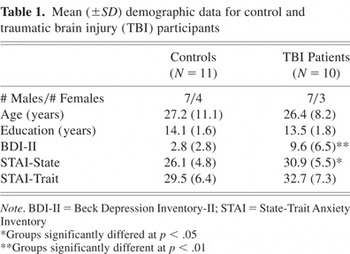
Initial study enrollment included 11 TBI and 11 healthy control participants. Data from one TBI participant were excluded because of too few artifact-free trials to compute reliable average ERP epochs. Thus, the final sample included 10 right-handed severe TBI participants between the ages of 18 and 42 years (3 women; M = 26.40 years, SD = 8.21) and 11 right-handed, age- and education-matched healthy control participants (4 women; M = 27.18 years, SD = 11.10; range = 18–49 years). Demographic characteristics of TBI and control participants are provided in Table 1. TBI participants were recruited from two Northern Florida trauma and rehabilitation hospitals; control participants were recruited via flyer and advertisement from the local community. All participants provided written informed consent according to procedures established by the University of Florida Health Science Center Institutional Review Board and were compensated for their participation.
Mean (±SD) demographic data for control and traumatic brain injury (TBI) participants

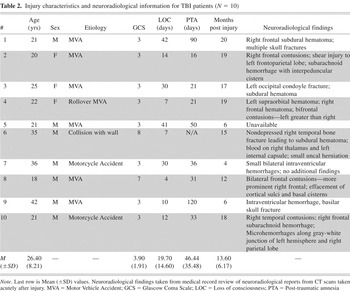
TBI severity was determined from medical record review of lowest post-resuscitation Glasgow Coma Scale (GCS) score (Teasdale & Jennett, 1974), with severe TBI defined as a GCS score <9. Neurological indices, including neuroradiological findings taken from acute computerized tomography (CT) scans, duration of loss of consciousness (LOC), and duration of post-traumatic amnesia (PTA), were also acquired from medical record review or, when LOC and PTA information were not available in medical records, from structured participant and significant other interview (King et al., 1997; McMillan et al., 1996). LOC and PTA data confirmed all patients met criteria for severe TBI as traditionally defined by LOC >6 hours and/or PTA >7 days (Bigler, 1990; Bond, 1986; Gerstenbrand & Stepan, 2001; Lezak et al., 2004).
Potential participants were excluded from the study for the following reasons: history of psychotic or bipolar disorder, learning disability, alcohol or substance abuse within six months prior to testing, other acquired brain disorders (e.g., epilepsy, stroke), inpatient psychiatric treatment predating brain injury, clinically-significant depression or anxiety within two years prior to injury, or color-blindness as measured by the Ishihara pseudo-isochromatic color plates (Clark, 1924). Patients with language comprehension deficits or uncorrected visual impairments were also excluded.
Injury characteristics and neuroradiological findings for the TBI participants are presented in Table 2. TBI participants were at least six months post-injury, with the exception of one who was functioning well and desired to complete the study before returning to employment. No participants were engaged in legal action at the time of the study. Participant groups were well matched for age, t(19) = .18, p > .85, and education, t(19) = .79, p > .43. TBI patients endorsed significantly more depressive symptoms, as measured by the Beck Depression Inventory-2nd edition (BDI-II; Beck, 1996), t(19) = 3.15, p < .01; however, no individual scores met common clinical cut-offs for depression (BDI-II>21) and mean scores for both groups were well within normal limits—not meeting criteria for even mild levels of depressive symptomatology (BDI-II>13; see Beck, 1996). Finally, TBI patients endorsed higher levels of state, t(19) = 2.15, p < .05, but not trait anxiety symptoms, t(19) = 1.10, p > .29, as measured by the State-Trait Anxiety Inventory (STAI; Speilberger et al., 1983).
Injury characteristics and neuroradiological information for TBI patients (N = 10)

Experimental Task
We utilized the experimental task employed by Holroyd et al., in their 2003 investigation of reward context and the FRN. In this task, participants viewed four circles in a row (OOOO) and were told that one of the circles contained a reward of five cents that would be summed throughout the task and provided in addition to their hourly compensation. Circles remained on the screen until the participant responded by pressing one of four keys placed directly below each circle on a response pad. A black screen was then presented for 500 ms, followed by the feedback stimulus that remained on the screen for 2000 ms. Reward feedback consisted of four dollar signs in a row ($$$$), while non-reward feedback consisted of four Xs (XXXX). The interstimulus interval between the feedback stimulus and the subsequent trial was 500 ms. All stimuli during the task were printed in yellow font on black background, visually centered, 0.6° high and 5.0° wide, and appeared on a 15 inch computer monitor ∼40 cm from the participant's head.
Participants were instructed that presentation of a reward feedback stimulus indicated they had received five cents, while presentation of a non-reward feedback stimulus indicated they received no money for that trial and that the goal of the task was to respond in a manner that would maximize their earnings. Unknown to the participants, feedback stimuli were presented randomly according to two separate reward probability conditions. In the high reward probability condition, participants received positive feedback on 75% of trials, whereas in the low reward probability condition participants received positive feedback on only 25% of trials. Each condition consisted of one block of 200 trials. For example, participants presented with 200 trials during the high reward probability block received reward ($$$$) feedback on 150 trials (75%), while 50 trials (25%) showed non-reward feedback (XXXX) for a sum of $7.50 earned. The probability of reward feedback was reversed in the low reward probability block. Order of block presentation was counterbalanced across participants. Following completion of the first block, participants were told to take as much time as they desired to relax, and the amount of money they had achieved was displayed on the computer monitor (either $2.50 or $7.50). After completing the task, participants were debriefed, and all were provided with $10 additional compensation. All participants responded to all trials and were awarded the same amount of compensation.
Electrophysiological Data Recording and Reduction
Electroencephalographic (EEG) activity was recorded from 64 scalp sites using a geodesic sensor net and Electrical Geodesics, Inc., (EGI; Eugene, Oregon, USA) amplifier system (20,000 gain, nominal bandpass = .10–100 Hz). EEG was referenced to Cz and digitized continuously at 250 Hz with a 16-bit analog-to-digital converter. A right posterior electrode served as common ground. Electrode impedance was maintained below 50 kΩ. Eye movement and blink artifacts were corrected using a spatial filtering method (Berg & Scherg, 1994; Ille et al., 1997, 2002). EEG was segmented off-line and single trial epochs with voltages that exceeded 100 μV or transitional (sample-to-sample) thresholds of 75 μV were discarded. EEG was re-referenced to an average reference (Bertrand et al., 1985), and digitally low-pass filtered at 15 Hz.
Individual-subject feedback-locked ERPs were derived separately for reward and non-reward trials for the two different feedback blocks (high and low reward probability) from 200 ms before- and 600 ms following-feedback and were baseline corrected using the 200 ms pre-feedback stimulus window. The FRN was quantified at electrode FCz. This electrode location was chosen because the FRN was largest there on examination of grand-averaged waveforms and based on previous studies showing the FRN is maximal at this medio-frontal site (Hajcak et al., 2006; Holroyd et al., 2006; Holroyd, 2004; Holroyd et al., 2003).
In light of previous findings that measurement of the FRN can be confounded by potential overlap with other components (e.g., P300; Holroyd et al., 2004; Holroyd et al., 2003), initial analyses of the FRN were completed by calculating difference waves subtracting the ERP associated with reward feedback from the ERP associated with non-reward feedback. The “non-reward minus reward” difference waves were also calculated for frequent and infrequent stimulus presentation contexts. The FRN was quantified as the maximum negative amplitude of the difference wave between 125 ms and 325 ms post-feedback presentation.
We next employed the base-to-peak scoring approach used by Holroyd et al., (2003) and others (Hajcak et al., 2006; Holroyd et al., 2006; Yasuda et al., 2004). More specifically, FRN base-to-peak amplitude was defined as the difference of the maximum value between 125 ms and 325 ms following feedback onset and the most negative point between this maximum and 325 ms post-feedback presentation. One control participant had no measurable negative deflection, thus the FRN amplitude for this participant was scored as zero.
To assess the potential for generalized ERP amplitude decrements or latency shifts in TBI participant ERP waveforms, N1 amplitude and latency data were extracted as the amplitude and latency of the first peak negative deflection in the ERP between 50 and 200 ms for reward and non-reward trials at posterior electrode site 38 (location of maximum N1 amplitude).
Data Analysis
Median response times (RT) as well as ERP (N1, FRN) amplitude and latency data were analyzed separately using repeated-measures analyses of variance (ANOVAs). The Huynh-Feldt epsilon adjustment was applied for ANOVAs with more than two levels of a within-subject factor and partial-eta2 (η2) reported as a measure of effect size. Initial ANOVAs for RT and feedback-related ERP activity included group (TBI, control) as the between-subjects factor and feedback probability condition (high, low reward probability) as the within-subject factor. Planned comparisons were used to decompose main effects and interactions and to examine the feedback factor separately within the high and low reward probability blocks. Cohen's-d effect sizes (Cohen, 1988) were calculated for condition-related effects.
RESULTS
Behavioral Data
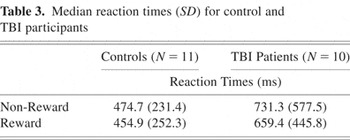
Median RTs for each feedback type in the high and low reward probability conditions are presented in Table 3. A Group × Feedback ANOVA showed no significant main effect of reward condition, F(1,19) = 2.46, p > .14, η2 = .11, no Group × Feedback interaction, F(1,19) = .38, p > .38, η2 = .04, and no significant main effect of group, F(1,19) = 1.71, p > .21, η2 = .08.
Median reaction times (SD) for control and TBI participants

ERP data
A total of 12% of trials were rejected from averaging because of artifact in the EEG. Control and TBI participants did not differ on number of trials retained for averaging under either high or low reward probability conditions, ts(19) ≤.96, ps > .35. Per participant, reward waveforms contained an average of 180 (SD = ±10; range = 166 to 193) trials for controls and 174 (SD = ±17; 133 to 193) trials for TBI participants, whereas non-reward waveforms contained an average of 179 (SD = ±14; 151 to 198) trials for controls and 170 (SD = ±25; 108 to 197) trials for TBI participants.
N1 Amplitude and latency. A Group × Feedback ANOVA on feedback-locked grand average ERP waveforms was conducted to examine the possibility of generalized amplitude decrements or latency shifts for TBI participants. Results of the analysis of N1 amplitude indicate no main effect of reward condition, F(1,19) = 1.13, p > .30, η2 = .06, no Group × Feedback interaction, F(1,19) = .23, p > .63, η2 = .01, and no main effect of group, F(1,19) = 1.84, p > .19, η2 = .09. Latency data were similar, with no significant Group × Feedback interaction, F(1,19) = 2.12, p > .16, η2 = .21, and no main effect of group, F(1,19) = 1.39, p > .25, η2 = .07. Thus, data suggest that there is not a significant generalized amplitude decrement or latency shift in the ERPs of the TBI participants relative to healthy controls.
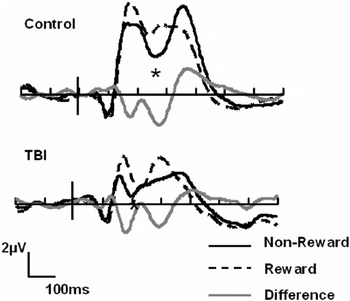
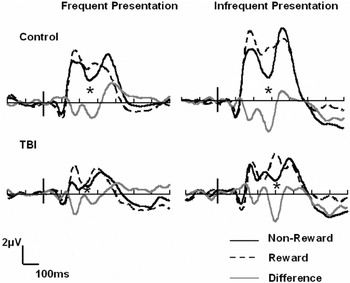
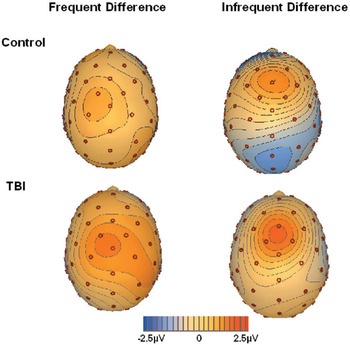
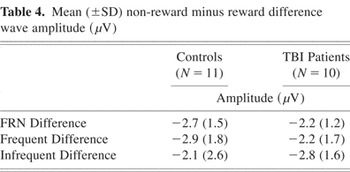
FRN Difference Wave Analysis. Feedback-locked grand average ERP waveforms for reward and non-reward conditions and accompanying non-reward minus reward difference waves are presented collapsed across reward context conditions in Fig. 1 and as a function of feedback frequency (high or low reward probability) in Fig. 2. Spline-interpolated scalp voltage maps of the difference waves are presented in Fig. 3, with FRN difference wave amplitude data shown in Table 4. As anticipated, feedback-locked ERPs showed an FRN occurring at a mean latency of 261ms in control and 233ms in TBI participants. Planned comparisons of non-reward minus reward difference waves showed no differences between groups, t(19) = .72, p > .47, d = .32. Subsequent between-groups analyses on FRN difference waves as a function of frequent and infrequent feedback presentation also yielded no group differences on either frequent, t(19) = .93, p > .37,d = .41 or infrequent, t(19) = −.71, p > .48, d = .30, stimulus presentation.

Grand average ERP waveforms depicting feedback-locked reward and non-reward activity as well as the non-reward minus reward difference wave at recording site FCz for control (top) and TBI (bottom) participants. * denotes approximate location of FRN.

Grand average feedback-locked ERP waveforms showing reward and non-reward activity as well as non-reward minus reward difference waves at recording site FCz for the high frequency trials (e.g., reward trial in a high reward probability condition) and low frequency trials (e.g., reward trial in a low reward probability condition) in control (top) and TBI (bottom) participants. *denotes approximate location of FRN.

Spline-interpolated voltage maps of the non-reward minus reward difference wave at 280 ms for control and TBI participants.
Mean (±SD) non-reward minus reward difference wave amplitude (μV)

As evident in Figs. 1 and 2, difference waves are insensitive to equivalent changes across feedback conditions. For example, the positivity following reward trials in the low reward probability block for TBI participants is increased in direct proportion to the slight negativity following non-reward trials (FRN)—leading to the appearance of a large negative difference. In contrast, the amplitude of the negativity (FRN) at approximately the same latency for control participants in the low reward probability block is much greater than that for reward trials. Thus, the finding of equivalent FRN difference waves between TBI and control participants is spurious and confounded by the variations in waveform morphology between-groups. Consequently, although unable to make direct conclusions about the FRN without taking into account the possibility of component overlap, we conducted base-to-peak analyses to directly examine the negative deflection of the FRN.
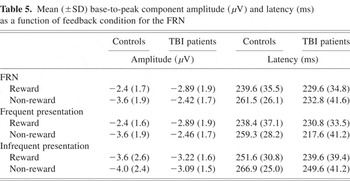
FRN Base-to-Peak Analysis. FRN component amplitude and latency data are presented in Table 5. A Group × Feedback ANOVA yielded a non-significant main effect of feedback condition, F(1,19) = 1.84, p > .19, η2 = .09. More importantly, however, there was a significant Group × Feedback interaction, F(1,19) = 9.76, p < .006, η2 = .34. Planned contrasts revealed that the FRN was significantly larger following non-reward than reward feedback in controls, t(10) = 2.64, p < .025, d = .67, but not TBI participants, t(9) = −1.85, p > .10, d = .25. The interaction was found in the absence of an overall main effect of group on FRN amplitude, F(1,19) = 0.19, p > .66, η2 = .01, further suggesting the effect is not because of an overall attenuation of ERP component amplitudes in TBI participants.
Mean (±SD) base-to-peak component amplitude (μV) and latency (ms) as a function of feedback condition for the FRN

After verifying that the two groups responded differently to feedback, we conducted a series of planned contrasts to test the specific hypotheses that: (1) control participants would show the largest FRN in response to non-reward feedback when a reward was expected (i.e., non-reward feedback in the high reward probability block); (2) FRN amplitude would not differ as a function of feedback condition when non-reward stimuli were predicted (i.e., during the low reward probability block); and, (3) FRN amplitude would not differ as a function of condition during the high and low reward probability blocks in TBI participants because of impairments in reward context sensitivity. Paired-samples t-tests conducted separately for each group confirmed these hypotheses, with control participants showing significantly larger FRN amplitude to non-reward stimuli during the high reward probability block, t(10) = 2.40, p < .03, d = .80; control participants not differentiating between reward and non-reward feedback during the low reward probability block, t(10) = .03, p > .90, d = .01; and, TBI participants showing no differences between feedback conditions in the high reward probability block, t(9) = .52, p > .60, d = .12. Interestingly, TBI participants showed significantly larger FRN amplitude to reward stimuli during the low reward probability block, t(9) = 2.54, p < .03, d = .47. Figure 2 presents the grand average waveforms as a function of feedback type and reward probability condition for TBI and control groups.
FRN Latency. A Group × Feedback ANOVA yielded no significant main effects or interactions on FRN latency (ps > .18).
DISCUSSION
Results of the current study largely supported our primary hypotheses regarding impaired neural processing of reward and non-reward stimuli following severe TBI. First, TBI participants demonstrated generally reduced feedback-related ERP differentiation between reward and non-reward conditions relative to healthy control participants. That is, TBI participants showed feedback-related ERP activity, but the amplitude of this activity did not differentiate between reward and non-reward feedback. In contrast, control participants showed significantly larger FRN amplitude following non-reward relative to reward trials. The results in control participants replicate previous studies of reward feedback on guessing tasks (Holroyd et al., 2003; Ruchsow et al., 2002), whereas results in TBI participants suggest that these survivors are largely responsive to feedback, but they do not generally differentiate reward and non-reward contingencies at the electrophysiological level. Moreover, the finding that the control and TBI groups did not differ on N1 amplitude or latency, or in the overall amplitude of feedback-related ERPs, provides evidence that the feedback-related differences do not simply reflect a more generalized ERP decrement in the TBI survivors.
Second, TBI and control participants differed in their sensitivity to reward context. Consistent with the hypothesis that the FRN is largest when reward-probability context is high but a non-reward is obtained (Holroyd & Coles, 2002; Holroyd et al., 2003), control participants showed the largest FRN to non-reward stimuli in the high reward-probability context, but did not differentiate between reward conditions in the low-reward probability context. TBI participants showed the opposite pattern of findings, with no differentiation between reward and non-reward trials in the high reward-probability context, but significantly larger FRN following reward stimulus presentation in the low reward-probability context. This finding was unanticipated, as FRN amplitude in TBI participants did not generally differentiate reward and non-reward feedback and previous studies show FRN amplitude is largest when rewards/goals are not obtained, rather then when feedback indicates reward attainment (Hajcak et al., 2006; Holroyd et al., 2004). This reversal in the direction of the reward-context effect on FRN in TBI participants could reflect the possibility that obtaining a monetary reward is more meaningful and less expected in TBI participants. That is, it may be that monetary incentives had a stronger motivating effect on TBI participants as they were largely unemployed or on disability at the time of the study. More likely, however, is the possibility that severe TBI patients show generally altered reactivity to change in reward context. As a whole, the current findings that TBI patients did not respond differentially to non-reward trials in the high reward-probability context and that FRN amplitude increased when a reward was presented during low reward probability blocks provides support for the hypothesis that reward context processing is impaired relative to control participants. Notably, between-groups FRN differences were found in the absence of significant effects of RT or frequency of feedback presentation (i.e., frequent vs. infrequent feedback within reward or non-reward blocks), suggesting speed of response/reward presentation and frequent/infrequent feedback presentation are not underlying reasons for the current findings.
To our knowledge, this is the first study to expose deficiencies in reward-context sensitivity in TBI patients. That is, neural reflections of reward processing in both high and low reward probability conditions were not differentiated in TBI participants and did not follow the pattern of results in control participants. This finding fits well into a burgeoning literature that implicates performance-monitoring deficits likely associated with medial-frontal cortex/ACC dysfunction following severe TBI. An fMRI study using the Stroop task to examine the performance-monitoring process of conflict detection found a relative decrease in ACC activity in TBI patients compared to controls (Soeda et al., 2005). Similarly, studies from our lab observed ACC dysfunction in severe TBI patients during performance of a task requiring working memory (Perlstein et al., 2004) and decreased amplitude ERN in severe TBI participants (Larson et al., submitted), and other diminished electrophysiological reflections of performance monitoring, presumably mediated by the ACC (i.e., N450 component of the scalp-recorded ERP) in a single-trial task-switching version of the Stroop task (Perlstein et al., 2006). A growing consensus from these studies is that ACC-related changes following TBI are the result of diffuse axonal damage that disturbs fronto-cortical and subcortical networks leading to subsequent neurobiological and behavioral manifestations of performance-monitoring impairment (e.g., reduced post-error slowing or increased Stroop RT or error-rate interference effects; Larson et al., 2006a; Seignourel et al., 2005). Results are also consistent with studies of individuals who have sustained damage to neuroanatomical structures strongly implicated in reward-processing, such as the ventral striatum, ventromedial/orbitofrontal cortex, and limbic system (Bechara et al., 2000; Bechara et al., 1996) that show impaired sensitivity to reward contingencies. Furthermore, recent studies suggest altered striatal dopamine activity following head injury contributes to deficits in cognitive performance (Wagner et al., 2005) and dopamine agonists have been shown to improve some aspects of cognitive performance following TBI (Kaelin et al., 1996; McAllister et al., 2004; Napolitano et al., 2005; Plenger et al., 1996). Thus, future research should examine the role of the dopaminergic system in reward context sensitivity deficits following TBI, as well as the possible pharmaco-therapeutic role of dopamine agonists (c.f., McAllister et al., 2004).
Results of this study suggest several implications for clinical application and future research. First, this study adds to the literature by suggesting TBI patients show reduced sensitivity to reward context—a key component to learning (and re-learning) of appropriate behaviors in the rehabilitation setting. Thus, clinicians should be vigilant to these decrements and realize learning of appropriate and non-risky behaviors and decision-making strategies may be difficult and time-consuming. Second, results provide insight into the neural mechanisms underlying previous findings of impaired stimulus-response contingencies in behavioral studies by demonstrated alterations in the neurobiological reflections of reward context sensitivity following TBI. Thus, a potential future line of research might examine the neurobiological instantiation of reward context processing with response-based contingencies as well as reward context utilization changes following rehabilitation targeting feedback processing, contingency-utilization skills, and risk-taking behaviors. Finally, results suggest a continued need for emphasis on decision-making skills in rehabilitation. Few empirically supported treatments currently target such deficits, though studies have begun to examine this domain (Levine et al., 2000; Park et al., 2003). Utilization of cognitive neuroscience methods (e.g., ERPs, functional magnetic resonance imaging) may aid in elucidating the mechanisms and corroborating the efficacy of potential rehabilitation strategies.
Findings of the current study must be considered within the context of potential limitations and alternative explanations. First, the small sample size limits the extent findings can be generalized to a larger population of TBI survivors. Second, the current study employed a guessing paradigm where feedback stimuli were presented in a pseudo-random fashion, rather than according to participant performance; that is, feedback was not response contingent. Thus, the task paradigm precludes our ability to examine behavioral data and strategic adjustments following feedback presentation. In addition, the ambiguous results of the difference-wave analyses and utilization of base-to-peak measurement leave open questions regarding the possibility of component overlap and alternative contributions to FRN differences between groups (e.g., potential overlap of the P300 or N2 components). Third, it is possible that individuals with abnormal reward processing are more likely to suffer a TBI. Thus, group differentiation of the FRN could be because of pre-existing differences, rather than a direct consequence of TBI. Fourth, an important potential limitation when comparing ERPs from neurologically injured groups with neurologically healthy comparisons is the potential alterations in cortical geometry, volume, and electrical conductivity in the patient group. Specifically, the propagation or volume conduction of potentials to the scalp surface, and therefore their scalp distribution, can be altered by the presence of injury-related factors. These can result in altered amplitude or scalp distribution of the ERP, as well as possibly challenging the assumption that using identical measurement electrode sites across the different groups yields similar measurement sensitivity to the ERP components of interest. Finally, the heterogeneity of lesion location, and level of recovery post-TBI preclude specific conclusions regarding lesion location or pathology and reward context sensitivity deficits (i.e., structural-functional relations) in the current sample.
Present findings implicate impaired reward context utilization mechanisms in survivors of severe TBI. The finding of an electrophysiological marker of impaired reward context sensitivity adds to the growing body of literature suggesting that, compared to control participants, severe TBI patients have difficulty monitoring their performance and environment. This study also places further emphasis on the need for continued use of cognitive neuroscience methods to increase understanding of the neurobiological bases of TBI-related dysfunction and provide a strong foundation for the potential development and validation of rehabilitation treatments.
ACKNOWLEDGMENTS
This original research has not been published elsewhere and is supported by a predoctoral National Institute of Health (NIH) Fellowship to MJL (F31 NS053335) and grants from the National Institutes of Health to WMP (K01 MH01857; R21 MH073076). The authors extend our appreciation to Drew Nagle, Raechel Steckley, Cortney Mauer, Floris Singletary, and Ashley Carrol for their assistance in patient recruitment and data collection. Portions of this data used in partial fulfillment of the doctoral dissertation of the first author.