


Introduction
On 15 November 2021, the Indian Prime Minister, Narendra Modi, inaugurated the Bhagwan Birsa Munda Smriti Udhyan Sah Swatantrata Sangrahalaya (Memorial Park-cum Freedom Fighter Museum) in Ranchi, Jharkhand.Footnote 1 The commemorative site holds a 25-foot-tall statue of Birsa Munda, the revered AdivasiFootnote 2 leader whose legacy is celebrated and valorized in the anti-colonial struggle.Footnote 3 The statue is situated at the Old Central Jail in Ranchi, where the tribal icon had breathed his last. The statue is sculpted by the noted sculptor Ram Sutar, who also designed the Statue of Unity (world’s tallest statue) commemorating Sardar Vallabhai Patel in Gujarat.Footnote 4 In his tribute to Dharti Abba,Footnote 5 PM also declared 15 November, the birth anniversary of Birsa, to be celebrated as Janjatiya Gaurav Diwas (Tribal Pride Day).Footnote 6 The statue inauguration of Birsa can be viewed as a mnemonic integration of indigenous contributions to the nationalist independence struggles. Standing in sharp contradiction to this seemingly ideal, state-led, celebratory, material memorialization of the past are Adivasi efforts at remembering their leader, Birsa Munda. Adivasi mnemonic practices to reclaim and assert their claims to Birsa’s legacy involve a complex interplay of homage and materiality expressed through erecting samadhi sthals and pathals during the Pathalgadi movementFootnote 7 of 2017–2018 in Jharkhand, India.
Through the juxtaposition of state monumentalization of Birsa Munda through statues and Pathalgadi movement as distinct mnemonic formations, the article demonstrates that Adivasi mnemonic practices constitute counter-aesthetics of remembrance, rooted in everyday material forms like samadhi sthals and pathals (stone inscriptions). Samadhi sthals refer to memorial sites associated with ancestral burial and commemorative remembrance within Adivasi communities, anchored in land, lineage, and collective history. These practices challenge the state’s hegemonic, assimilationalist appropriation of decolonization, wherein grand, nationalist monumentalization is presented as evidence for decolonial commitment even as material realities of extraction, dispossession, and violence against Adivasi communities persist.Footnote 8 By making these divergent materialities visible, the article illustrates how Adivasi mnemonic agency exposes the disjuncture between symbolic state-led remembrance and the ongoing forms of internal colonialism that structure Adivasi lives.
The article advances three interrelated analytical claims. Firstly, it argues that decolonizing memory requires more than representational inclusion of marginalized figures; it entails recognizing and theorizing the mnemonic-material practices through which Adivasi communities produce radically different spatial and political imaginaries. Secondly, the empirical focus on the Pathalgadi movement foregrounds Adivasi mnemonic practices as crucial, yet neglected, sites of political agency. Lastly, it contends that postcolonial memory regimes do not simply represent the past but actively sanitize and restructure political possibility in the present. The present HindutvaFootnote 9 led Indian state’s monumentalization of Birsa Munda through the erection of statues frames him as a celebrated figure, exemplifying how states deploy memory to claim decolonial legitimacy. Birsa’s afterlives thus reveal that decolonization is not an abstract, normative concern but a material, situated and deeply contested struggle over political legitimacy and belonging.
The ‘mnemonic turn’Footnote 10 in International Relations (IR) recognizes memory as a constitutive force in world politics, animating how states mobilize memory to legitimize authority, craft narratives of national belonging, and delineate boundaries of political communities. Existing literature has addressed how memory can function as a site of resistance to statist domination, revealing the fragility of national narratives and the political work involved in securing their authority.Footnote 11 However, resistance has often been theorized through discursive,Footnote 12 symbolic,Footnote 13 or affective practices,Footnote 14 leaving insufficient attention to the material infrastructures through which memory is made durable, visible, and actionable. This article builds on, but also extends these debates in IR by foregrounding material forms of subaltern mnemonic agency, specifically Adivasi practices of erecting samadhi sthals and pathals for Birsa Munda. These modest, material, counter-mnemonic sites contest hegemonic, grandesque state monumentalization by being grounded in land, relationality, and embodied autonomy. This materially attentive analysis of Adivasi mnemonic labour as a mode of world-making disrupts the epistemic, spatial, and temporal architectures of the Hindutva state, which strives to domesticate and sanitize anti-colonial histories.
These counter-memorial practices acquire deeper decolonial significance when situated within the contested politics of Adivasi identity. The term Adivasi, often translated into ‘ancient’ or ‘original inhabitants’, is a socio-political term specific to the Indian subcontinent that signifies claims to autochthonous identity and ancestral belonging.Footnote 15 Within the Hindutva discourse, their status as ‘original inhabitants’ is contested, and they are instead referred to as ‘Vanvasi’ or forest dwellers, a strategic move that strips them of their historical primacy and reframes them as merely geographically located populations with autochthonous claims.Footnote 16 This renaming is integral to Hindutva’s upper-caste, self-orienting worldview, which posits Aryans as original to the subcontinent. By denying Adivasis indigeneity and simultaneously asserting Aryan aboriginality, Hindutva collapses their distinct status and absorbs Adivasi histories into a homogenized Hindu civilizational narrative.Footnote 17 It is this ideological reordering of origins that makes the politics of memory in the postcolonial Hindutva state a critical site of analysis.
The rationale for exploring memory in this context is twofold: firstly, Hindutva’s attempt to recast genealogies of indigeneity by denying Adivasis their status as original inhabitants while asserting Aryan aboriginality reveals how contemporary majoritarian projects deploy memory to retroactively manufacture civilizational legitimacy. The scholarship on the memory–nation nexus has long underscored ‘no memory, no identity; no identity, no nation’.Footnote 18 This insight highlights both the centrality and the volatility of memory in sustaining national projects, and it helps explain why states invest so heavily in securing particular versions of the past. It is precisely this dependence on curated pasts that renders national narratives vulnerable to ideological articulation, a dynamic evident in how the Hindutva nationalist discourse has increasingly appropriated the language of decolonization to legitimize majoritarian histories and cultural revivalism.Footnote 19 The statist project of producing national histories is not sustained solely through coercive measures; it is equally enacted by spectacular modes of remembrance that naturalize particular pasts. Remembering is elevated as a civic and cultural duty – a marker of collective morality, yet what is to be remembered is never neutral. The state curates memory selectively, posited as a redemptive project.Footnote 20 The politics of commemoration, then, becomes an exercise in mnemonic governance, remembering not to reckon with the past, but to obscure its contradictions and render state power as temporally continuous and benevolent. The resurgence of national memory discourses requires attention to the material practices through which such narratives are rendered legitimate. The Indian context offers a distinct inflection, one in which state-led statue building itself can be a strategy of hegemonic containment rather than decolonial rupture.Footnote 21 Decolonization is rendered as an aestheticized allegianceFootnote 22 to nationalist teleologies wherein the state-led erection of statues of Birsa Munda constitutes a form of state coloniality of memory.
Secondly, the contestation of these hegemonic memory claims by Adivasi communities underscores the need to theorize how subaltern actors mobilize material-based mnemonic practices to articulate alternative political imaginaries. The potential plurality of memory is curtailed by the iconographic fixity of the statues that foreclose alternative interpretations of the past. The Pathalgadi movement is analytically significant because it departs from dominant trajectories of statue contestation in the Global North,Footnote 23 where decolonial struggles typically target monuments venerating imperial actors. By contrast, the Adivasi commemorative practices reveal a different decolonial horizon, one which does not deface or remove state monuments but is based on generative forms of remembering through erecting pathals and samadhi sthals that materially instantiate a different ontology of resistance.
Decoupling the traditional link between nation and collective memory, the Pathalgadi movement challenges the progression of memorialization from a linear, vertical, and monolith perspective. The mnemonic labour deployed by Adivasi populations into their commemorative practices to remember Birsa highlights the multivalency of memory and how micro-dynamics of material memory are grounded in the lived experiences and articulations of the processes that are both historically situated and affectively loaded. The contrast between state-sponsored statues and samadhi sthals of the Pathalgadi movement reveals two incommensurable trajectories of material memory – one rooted in monumental capture and the other in subaltern refusal. While state-sponsored statues consolidate a singular, universalized memory through scale, permanence, and verticality, samadhi sthals embed memory in land and lived struggles. Decolonizing memory can be understood as grounded in material micro-political practices that structure memory from below.
The article is structured as follows: the first section situates the argument within the wider debates on memory and demonstrates how material culture, particularly statues, functions as an apparatus of state memory. The second section analyses the Indian state’s monumentalization of Birsa Munda, showing how his figure is domesticated into a nationalist, majoritarian memory regime. The third section turns to the Pathalgadi movement as a counter-mnemonic attempt to theorize Adivasi mnemonic practices as decolonial interventions that reconfigure the political life of memory in postcolonial contexts. The conclusion draws these strands together to reframe decolonization as a material-mnemonic practice that shapes the spatio-ethico-temporal horizons of postcolonial memory regimes.
Sculpting memory: commemoration and statues in IR
Memory is never merely a passive recollection of the past; it is an active and deeply political practice through which histories are narrated, silenced, reclaimed, or monumentalized. Maurice Halbwach’sFootnote 24 theorization of collective memory goes beyond the recognition of its social nature to embed it in spatiality.Footnote 25 In a similar vein, Pierre Nora’s work on lieu de mémoire Footnote 26 (site of memory) elaborates on the physical place/material object which acts as a container of memory. These ‘sites of memory’ are simultaneously concrete and abstract, performing material and symbolic functions at once. Thus, collective memory is inseparable from material culture: it is produced, stabilized, and contested through the social and spatial configurations that shape the topography of public history.
This material understanding furthers the point that collective memory is never singular or self-contained; rather, it emerges dialogically, drawing on unexpected solidarities, analogies, and political openings.Footnote 27 Bernard Stiegler’s account of memory further clarifies how materialization structures collective remembrance. His distinction between primary retention (immediate perceptual experience), secondary retention (individual recall), and tertiary retention (the exteriorization of memory in material forms such as writing, monuments, and digital media) underscores that political memory is fundamentally organized through its tertiary forms.Footnote 28 For Stielger, memory is always already mediated; the material inscriptions sediment certain interpretations that shape how future generations encounter the past.
The emphasis on form as constitutive of meaning finds further analytical grounding in the German triad of denkmal (remembrance), mahnmal (warning/admonishment against past atrocities), and ehrenmal (honouring or celebrating a heroic deed, event, or person), indexing distinct mnemonic orientations, with each carrying particular political and affective registers.Footnote 29 The triad becomes useful in foregrounding how the form of remembering shapes the meaning of what is remembered – a distinction that becomes salient in tracing the divergent afterlives of Birsa Munda. The erection of Birsa’s statues by the Indian state can be captured by ehrenmal, celebrating a youthful, depoliticized icon compatible with nationalist self-imagining. By contrast, the Pathalgadi movement and their erection of stone slabs operate closer to the logic of denkmal and mahnmal – as they are acts of remembrance that reclaim Birsa’s struggle for land and autonomy while simultaneously warning of the continued dispossession faced by the Adivasi communities. In this sense, the politics of form – each material configuration enacts a different claim over how Birsa’s memory is understood and for whom.
Understanding how different material forms encode distinct mnemonic orientations also draws attention to the term national sensorium, which refers to the visual, spatial, and affective cues through which the nation is rendered sensible – experienced, felt, and internalized by its subjects.Footnote 30 It comprises the material-symbolic infrastructure that mediates national belonging and concretizes the imagined community by reifying its temporal and moral legitimacy. Within this national sensorium, statues function as pivotal instruments in producing memory that is visible, tangible, and affectively charged – both vertically and spectacularly. Statues are best understood not as a uniform commemorative form, but as a heterogeneous sculptural medium whose political effects vary by scale, location, and patronage. Large, monumental statues, particularly those erected through state commemorative projects, often privilege reverence, elevation, and visual distance, enforcing a top-down relationship between the state and its subjects. Through their sheer scale and aesthetic grandeur, these state-sponsored statues command attention and evoke affective response; their spectacle becomes a strategy of legitimation. They are mnemonic dispositifs that glorify a selectively curated past. In this sense, monumental statues are an important facet of the state’s mnemonic repertoire. They are not just static objects but living artefacts whose meaning is continually negotiated and shaped by the societies they inhabit.
While there have been linkages between postcolonial nation states and memory practices (focusing on museums and monuments), statues have been an under-studied phenomenon in shaping national memory discourses. State-sponsored statues become an apparatus in conferring visual permanence to the majority’s historical claims. These material markers serve as touchstones of the nation, making tangible the histories and heroes, participating in the creation of an ontology of the social world. The erection of Birsa’s statues highlights the mnemonic efforts of the Indian state in shaping national discourse.
Statues can be described as a free-standing sculptural form that might vary in size (from a small statuette to a large colossus). We reify, deify, and heroise individuals through statues – they are political statements. The primary motive for erecting a public statue is to honour and express gratitude towards the achievements and qualities of an individual, commemorating the life and legacy which is thought of as worthy within a larger socio-political context. At the surface, these acts of remembrance are often invested with affective attachments that exceed the bare commemoration of the person they represent.Footnote 31 As compared to museums, textbooks, or archives, statues present history in a more public and accessible manner. Because of their public ‘presence’, they are more deeply integrated into our common understandings of nation and national identity. While there has been literature on affective and aesthetic dimensions of nationalism,Footnote 32 statues help to focus on the interlinkages between materiality, ritualization, and enskilmentFootnote 33 by cojoining the historical and everyday in making national identity. Attending to statues, therefore, offers not merely an object of analysis but a methodologicalFootnote 34 vantage point of tracing how material culture mediates the affective and aesthetic dimensions of nationalism.
Unlike other forms of memory culture, which are based on ephemeral commemorative practices, state-sponsored statues possess an enduring spatial materiality and durability that ranges across temporalities. This permanence not only imbues them with a sense of historical gravitas but also anchors them in the physical landscape through a sense of timelessness, which further naturalizes power hierarchies. Statues, particularly patronized by the state, are significant investments, both economically and symbolically, designed to project hegemonic cultural narratives. They are not merely passive artefacts or inert tabulae rasae, rather they actively mediate collective memory through their physical prominence. These statues transcend as being mere objects of admiration; they affect the senses and emotions, prompting viewers to experience a response that is a real-time somatic experience of memory.Footnote 35
The erection and toppling of statues highlights the interplay between the material and the intangible.Footnote 36 Unlike textual or archival forms of memory culture that require interpretive engagement, statues communicate through their embodied presence, inviting physical and sensory interactions (physical acts of looking up, touching, and walking around) that render them more immediately accessible to the audience. The three-dimensionality of statues (having height, width, and depth) is not merely an aesthetic feature but a functional aspect that enhances their experiential impact in significant ways. Their presence is unconsciously understood and accepted as accustomed elements of the environment. Statues do not just appear; they must be conceived, paid for, and maintained with official state sanction. The erection and retention of statues in public spaces is part of the ‘authorised heritage discourse’,Footnote 37 whereby state authorities establish the legacies of the past to be present in the public realm and why it is important for preservation. Thus, being of historical importance does not necessarily connote meriting commemoration for the sake of posthumous reputation. The grandeur of state-sponsored, monumental statues alludes to the need to suspend belief, as they promote consolatory illusions and encourage nostalgia while neglecting ‘what is real and immediate’.Footnote 38
In the contemporary ‘image saturated landscapes’ with seductive appeal of popular iconographies, statues often spring to public attention through moments of their consecration or spectacular acts of vandalization and destruction. The discussions of statue destruction, removal, and recontextualization have proliferated in the wake of global movements for racial and historical justice, particularly in the Global North.Footnote 39 There have been a series of events around the globe, bringing into focus a wave of statueclasm:Footnote 40 in 2015, the statue of Cecil Rhodes was removed from the University of Cape Town in the wake of Rhodes must fall protests seeking decolonizing educationFootnote 41; in 2020, the statue of Christopher Columbus was removed from Mexico City after indigenous peoples protests and was replaced by a pre-Columbian statue known as the Young Woman of AajacFootnote 42; the statue of British slave trader Edward Colston was toppled and thrown into the harbour in 2020Footnote 43; and Confederate statues in the United States including those of Robert E. Lee in Charlottesville,Footnote 44 statue of Charles Lin,Footnote 45 and the Confederate soldiers Monument were demolished during the George Floyd protests. These protests marked a pivotal moment in global politics of memory where material and public representations glorifying exclusivist and violent pasts were challenged by the masses. These statues brought attention to the racist legacies of white supremacist monumentality, and their destruction sought to reshape the commemorative landscape.Footnote 46 The tearing down of statues is considered a form of iconoclastic decolonization – a refusal to be interpellated by inherited symbols of power and insistence on new mnemonic horizons.
While the dismantling of statues in the West signals an attempt to rupture the visual economies of imperial nostalgia, in postcolonial societies, statues are frequently mobilized not to preserve colonial memory but to authorize nationalist narratives of unity and modernity. The inert passivity associated with the sacralization of the dead, particularly those in independence struggles, is at the centre of modern national identity construction. The erection of statues, particularly of anti-colonial leaders, functions as a mnemonic articulation of the postcolonial state’s desire to present itself as the legitimate heir to the historical struggle. Rahul Rao writes, ‘statues are vulnerable, typically standing alone, unguarded … simultaneously aggressive and insecure’.Footnote 47 This encapsulates the ontological instability of statues within contested political landscapes. Statues, though constructed to project sovereign coherence and permanence, are in fact deeply precarious mnemonic artefacts. They attempt at rendering memory as singular and spatially commanding, yet their insecurity stems from the very fact that such narratives are always unstable, contested, and open to interpretation.
Statues become the embodied form for tracing the fissures between collective national memory and subaltern memory. In evaluating statues as projects of state building, we need to ask ourselves: who needs statues? How do statues occupy the public space and shape collective cultural memory? Do they contribute to shaping counter-public narratives? The exclusions embedded in national commemorative regimes point to a broader tension within the grammar of ‘post-colonial’.Footnote 48 The prefix ‘post’ in postcolonial does not signify the end of effects of colonial rule but rather points to the tensions in acknowledging violent legacies and realities of erasure against marginalized groups. Against this backdrop, decolonizing memory cannot be reduced to celebrating anti-colonial icons but to interrogate the ways in which the postcolonial state instrumentalizes memory to foreclose critical engagements with its own complicity in reproducing the logics of colonial rule. Adivasi practices offer a unique lens for reading the aesthetics of decolonization through sensorial, imaginational, and ethical negotiations between the hegemonic and subaltern politics of representation. The Pathalgadi movement enacts a decolonial praxis of memory that is not centered on spectacular construction or erasure of statues but a horizontal and living form of memory-making. Instead of dismantling state-sanctioned statues, the Adivasis assert their right to remember otherwise.
The attempts at decolonizing memory, thus, need to move beyond the reductive binaries of ‘remembering and forgetting’Footnote 49 and instead be grounded in mnemonic labourFootnote 50 in which multiple, albeit unequal social actors shape public narratives of the past. The next section explores two aspects of mnemonic labour performed by the postcolonial state: a) ritualized reinforcement of a past, albeit appropriating it in present circumstances; and b) sanitization by conveniently omitting negative associations.
The legacy of Birsa Munda: mnemonic appropriation and restorative nostalgia
In an attempt to decolonize memory studies,Footnote 51 study of statues as markers of national memory is extremely relevant. Statues occupy a central role in the symbolic reconstitution of Indian national history. The mnemonic monumentalism operates through the strategic convergence of political aesthetics and ideological performativity, mobilizing religious and cultural symbolism to naturalize the majoritarian claims. Statues occupy a privileged position within the broader economy of commemorative practices, embodying and enacting a self-congratulatory approach to national mythmaking through ritualized reinforcement of the past. Functioning as iconic avatars, the statues are imbued with psychic value, transforming historical figures into reified symbols of collective virtue. The practice of setting up statues of political leaders on public sites can be traced back to colonial times, when Britishers installed statues of soldiers and civil servants of the Raj. Most of the monumentalizing coincided with the statue-mania that took hold in Britain and France in the nineteenth century.Footnote 52 After independence, the practice was continued with the installation of statues of Mahatma Gandhi, B.R. Ambedkar, and more recently, Netaji Subhash Chandra Bose and Sardar Vallabhai Patel.Footnote 53 The Bahujan Samaj Party has installed 15,000 statues of Ambedkar in the state of Uttar Pradesh alone.Footnote 54 These statues portrayed him dressed in a western suit, holding the Indian Constitution in one hand and pointing the way forward with the other, were strong symbols of asserting DalitFootnote 55 presence in the public space long marked with segregation and exclusion.
Within the Indian context, the contemporary material turn towards memory politics has been shaped by the Hindu right’s investment in religious monuments, statues, and temples as instruments of cultural consolidation.Footnote 56 By engaging in selective historical remembrance and myth-making (around figures like Chatrapati Shivaji and Sardar Vallabhbhai Patel, among others), the Hindu right has appropriated narratives around national identity, reinforcing its majoritarian and exclusionary vision. The Statue of Unity, which is 182 metres, touted to be the world’s tallest statueFootnote 57 is a homage to the first Home Minister, Sardar Vallabh bhai Patel, celebrated by the ruling Hindu right-wing Bharatiya Janata Party. Patel, historically associated with the political integration and territorial unification of post-independence India, is strategically invoked to project a politics of muscular nationalism.Footnote 58 There is also the proposed 212-metre-high statue of Maratha warrior king Shivaji to be constructed in Maharashtra.Footnote 59 Shivaji’s legacy is reframed as an illustration of Hindu resistance against religious ‘others’, i.e. Muslims, thus serving to consolidate a homogenized Hindu identity. Statues far from being merely aesthetic markers reflect a convergence of mnemonic nationalism and neoliberalism wherein historical memory is being commodified and rendered consumable within the logic of market-driven spectacle and leisure.
Against this backdrop of majoritarian monumentalism, the near absence of Adivasi figures from the national memoryscape becomes analytically salient, rendering the exceptional incorporation of Birsa Munda, not as a sign of inclusion but revealing a site of mnemonic struggles.Footnote 60 Birsa’s legacy is as diverse and ambivalent as his tragic life. He was born on 15 November 1875 into a peasant family in the Chota Nagpur region of Eastern colonial India. He led the Birsa Ulgulan (rebellion or great tumult) against the dikus (outsiders), including British officials, upper caste zamindars,Footnote 61 and missionaries. His followers granted him the status of Bhagwan Birsa (God) and Dharti Abba (father of the earth) since his struggle contributed to the protectionary legislation – Chota Nagpur Tenancy Act 1908, which restricted the transfer of Adivasi land to non-Adivasis.Footnote 62 The act specifically protects the rights of Mundari Khuntkattidari, a traditional form of tenancy that recognizes the ownership of the original inhabitants of the forest. On 9 June 1900, Birsa died in Ranchi Central Jail after he was arrested by colonial authorities for spearheading the third major Adivasi uprising, following the Kol rebellion of 1831 and the Santal Hul of 1855. The rebellion was against the depredations causing dispossession, indebtedness, and bonded labour.
It is precisely this layered insurgency of the Ulgulan, directed simultaneously against colonial authorities and entrenched local hierarchies, that renders Birsa Munda’s subsequent incorporation into nationalist memory as politically revealing. Within the dominant Gandhi–Nehruvian template of nationalism, Birsa is absorbed into a seamless narrative of anti-colonial nationalism, a tribal hero who resisted the foreign ‘other’, much like other heterogeneous peasant, tribal, and caste-based uprisings which were combined into a unified, universal narrative of anti-colonial freedom struggle.Footnote 63 This nationalist framing flattened the complex social antagonisms that actually animated the Ulgulan.Footnote 64 Birsa’s Ulgulan, which was an anti-feudal, anti-zamindar, anti-money-lender revolt, was reimagined as a proto-nationalist uprising, its specific antagonism dissolved into an abstracted fight against colonial rule, as the state positions itself as the natural inheritor of his legacy. By monumentalizing Birsa and positioning him within a pantheon of nationalist freedom fighters, the Indian state effectively subordinates an Adivasi agrarian insurgency to a statist narrative of unity, obscuring it of historical autonomy and radical critique of internal domination.
This symbolic framing of Birsa allows the state to frame ongoing Adivasi struggles for land, forest rights, including the Pathalgadi movement, as aberrations or threats to national sovereignty rather than continuations of the very struggles Birsa led. While honouring Birsa, the state simultaneously criminalizes Adivasi protestors, levying sedition charges and branding their land-rights movements as ‘anti-development’Footnote 65 or ‘anti-national’.Footnote 66 The canonized Birsa as a nationalist hero functions as a symbolic alibi to allow the state to claim its fidelity to indigenous histories even as it extends policing, extraction, and dispossession across Adivasi territories. The state’s ostentatious memorialization of Birsa serves to distract from its securitized response to Adivasi struggles visible in the anti-mining protests in Hasdeo Aranya, Khunti, and Hazaribagh.Footnote 67
Birsa’s efforts to fight for the recognition of indigenous land and political rights constituted an early articulation of claims that would crystallize in regional movements for autonomy, culminating in the formation of the state of Jharkhand.Footnote 68 This newly independent state of Jharkhand witnessed a renewed interest in commemorating the past, with competing ideological and political interests laying claim to Birsa’s legacy.Footnote 69 These subaltern Adivasis have used Birsa’s memory as a tool of political mobilization for their struggles of jal, jangal and jameen (water, forest, and land).
Statues became the preferred medium to communicate underlying political visions to the audience as they form a metonymic chain of contiguity from the statue to the collective identity. The contrasting elements of collective identity: national and subaltern emerge from the process of Birsa’s canonization in the contemporary socio-political milieu. As depicted in Figure 1, the bronze statue of Birsa, mounted on an elevated pale stone pedestal within a carefully crafted civic landscape, exemplifies the visual grammar of state monumentalization. Birsa is minimally clothed to evoke the Adivasi aesthetic as he stands upright in a commanding, heroic posture with a bow and arrow by his side.
Birsa Munda Statue at the Birsa Munda Museum and Memorial Park in Ranchi.

In 1982, the Birsa Munda Statue committee in Rourkela (Chhattisgarh) installed the first bronze statue.
The government launched a postal stamp with Birsa Munda’s picture in 1988.Footnote 70 This was followed by his portrait being unveiled at the Indian Parliament in 1989.Footnote 71 The Indian parliament had not a single portrait of an Adivasi leader till 1989. After the formation of Jharkhand in 2000, on the occasion of his birth anniversary, the central jail installed a statue. It was intended to highlight the legacy of the tribal freedom fighters and give them respect at the national level. In November 2022, when President Draupadi Murmu visited Ulihatu, members of Birsa’s family handed her a collective letter requesting to change the commemorative name to Birsa Munda Adivasi Diwas (Indigenous Day).Footnote 72 This is indicative of a larger tension over Birsa’s legacy, highlighting the complicated relationship between the political and commemorative practices.
The statue of UlgulanFootnote 73 is a proposed 150-foot-tall statue of Birsa Munda that will be built on the NH 33 Ranchi–Jamshedpur national highway near Bundu with stones collected from every household in the region.Footnote 74 Har Ghar se Pathar, Har Ghar se Sahyog (a stone from each home helps us build it). The slogan was intended to invoke a sense of solidarity in erecting a statue that will reflect the collective will of people. The reclamation of physical space to mark it with historical figures illustrates the idea of subaltern canonization within national memory, shaping larger public consciousness. These monumental structures demonstrate the state’s command over resources, with the will to enduring power via visibility. The rhetoric of reverence around the statues seeks to integrate the Adivasi histories within the national past while distancing them in the present. In 2016, the BJP government announced the removal of the jangir (handcuffs) from the Birsa Munda Statue installed at Birsa Chowk in Ranchi and others across the state.Footnote 75 The iconography of subalternity in India resides in the criminalized handcuffed portrait of Birsa. It was argued that the handcuffed statue would send a negative message to the youth. This symbolic act of taking off the handcuffs stands in contrast to the reality of the continuation of Adivasi oppression. The act of removal of handcuffs was interpreted as an attempt to correct historical wrong, even though the symbolism fails to acknowledge the violations of Adivasi rights due to land legislations.
In recent years, the dominant Hindutva ideology has sought to project Birsa as a leader who rejected Christianity and embraced Hinduism.Footnote 76 There have been efforts to represent him as a social reformer. This appropriation had been challenged by both scholars and political actors who have asserted their distinction from Hinduism.Footnote 77 Jharkhand Chief Minister, Hemant Soren, an Adivasi himself, has publicly stated that ‘Adivasis are nature worshippers and followers of their ancestral indigenous faith – Sarna religion which is entirely different from Hindus’. In August 2022, the Ministry of Culture released a comic book published by Amar Chitra Katha titled Tribal Leaders of the Freedom Struggle, which covered Birsa Munda’s story with emphasis on his rejection of Christianity.Footnote 78 The Hindutva narrative paints Birsa as a saviour of Hindus and their culture against an attack from Christian missionaries.
With the state of Jharkhand undergoing large-scale land dispossession, it is significant to underscore the relevance of memory politics in understanding how Adivasi groups invoke Birsa Munda to stake their claims from the state.Footnote 79 The uncanny intermingling between past and present destabilizes the verities of historicism as it challenges the linear, state-centric models of remembering the national past. As Dipesh Chakrabarty puts it, ‘in order to understand the nature of anything in this world, we must first see it as an historically developing entity, as an individual and whole and second as something that develops over time’.Footnote 80 By focusing on the material endurance of statues, we glean on the relationship between the objects that remain after the subjects. An awareness of the multivalency of these practices of commemoration requires a recognition of the different frames of dissemination within which they operate. As Spivak notes, the idea of ‘subject effects’ refers to the oscillating identities between and within subaltern (mass mobilized) and ethnocentric (demographic) perspectives.Footnote 81 A self-fashioned messiah, a colonial subject and territorial rights activist: Birsa embodied all these roles within different social texts. This is symptomatic of the conditions under which subaltern agency becomes intelligible – it is always mediated, strategically articulated and liable to capture by dominant epistemes.
This state-driven monumentalism of Birsa as depicted in Figure 1 demands critical engagement from a decolonial standpoint – one that interrogates how such commemorative practices perpetuate erasure through assimilation and sanitization, even as they profess a rhetoric of cultural revivalism. Decolonizing memory, therefore, necessitates confronting the mnemonic violence embedded within statue erection, critically unpacking ideological appropriation and foregrounding alternative mnemonic practices that contest, disrupt, and re-territorialize memory from below. The next section discusses the Pathalgadi movement, which demonstrates the challenging of hegemonic narratives of material memory by the Adivasis.
The Pathalgadi movement: afterlives of Birsa Munda
In 2017, the Pathalgadi (translated as a carved stone) movement emerged in various parts of the state of Jharkhand.Footnote 82 Pathalgadi refers to the traditional practice of erecting engraved stone slabs on a dead person’s tomb, which was used as a strategy for resistance for reclaiming rights over their ancestral land by Munda Adivasis.Footnote 83 As objects, pathals are remarkably ‘unmagnificent’ as opposed to state-erected statues, yet are extremely powerful in their very unpretentiousness and material simplicity. How does the erection of stone slabs become the cornerstone of hope, acting as an antidote to the precarious lives of Adivasis? As a material-discursive strategy, these material artefacts are evidential of their persistent agency in the wake of state oppression. The inscribed stone slabs become mnemonic anchors of refusal and anticipatory embodiments of justice as they challenge the temporal logic of state benevolence and deferred emancipation. They index not only a history of struggle, but a futurity grounded in autonomy and rights as they invert dominant hierarchies of commemorative legitimacy. Kanhai Munda claims, ‘We are Adivasis. For a thousand years or more, we have lived under conditions of exploitation. Everyone seeks to govern us. We reject that’.Footnote 84 This encapsulates the affective core and historical consciousness that animates the Pathalgadi movement. The movement inspired by the legacy of Birsa Munda and his vision of ulgulan (revolution) continues to serve as a mnemonic anchor for contemporary resistance. This form of material memorialization helps us articulate how ordinary practices of conviviality revitalize the social presence of Adivasi populations.
The Pathalgadi movement, as it emerged in the Munda – dominated regions of Khunti and Simdega – the birthplace of Birsa Munda – was a direct response to the BJP-led Jharkhand government’s attempts at revising and allegedly diluting the provisions of the Chota Nagpur Tenancy Act 1908 and the Santhal Pargana Tenancy Act 1876.Footnote 85 These colonial era legislations were hard won through sustained Adivasi resistance and formalized in the wake of uprisings such as those led by Birsa, were designed to protect indigenous land rights by prohibiting the transfer of tribal land to non-tribals. The Sasandiri – which are the ancestral burial grounds held collectively by the Munda Khunt families, constitute sacred geographies that underpin the ontological relationship between land, lineage, and cosmology in Adivasi life-worlds.Footnote 86 Each khuntkatidar family, tracing its descent from the original forest dwellers, maintains a sasandiri which is imbued with historical, ritualistic, and affective significance. The proposed amendments in 2016–2017 sought to dilute these protections by allowing the state to lease tribal land for commercial and infrastructural projects, thereby undermining the bulwarks against dispossession. The Adivasis claimed that, under these new provisions, Jharkhand would turn into a mining hub as the government proposed a ‘land bank’ scheme, in which it was estimated that land would be leased to companies for development purposes.Footnote 87
The digitization of land records as part of the larger technocratic reforms under e-governance schemes has rendered many of these sites untraceable in official cadastral maps. As Sambal Singh Munda from Khunti laments: ‘over 14 acres of our land has vanished from the records. We visit the land revenue officers everyday seeking redress, but our ancestral ground is nowhere to be found’.Footnote 88 The erasure of sasandiris through bureaucratic abstraction not only disrupts practices of mourning but also the displacement of memory, foreclosing the possibility of future belonging. The question – ‘where will we bury our dead now?’ becomes emblematic of the larger crisis as indigenous modes of belonging are rendered illegible and violable by the state. The dilution of their juridical rights became a catalyst for resistance, wherein Adivasi communities asserted their presence through erecting stone plaques and signboards that came up in over 200 villages of Jharkhand.
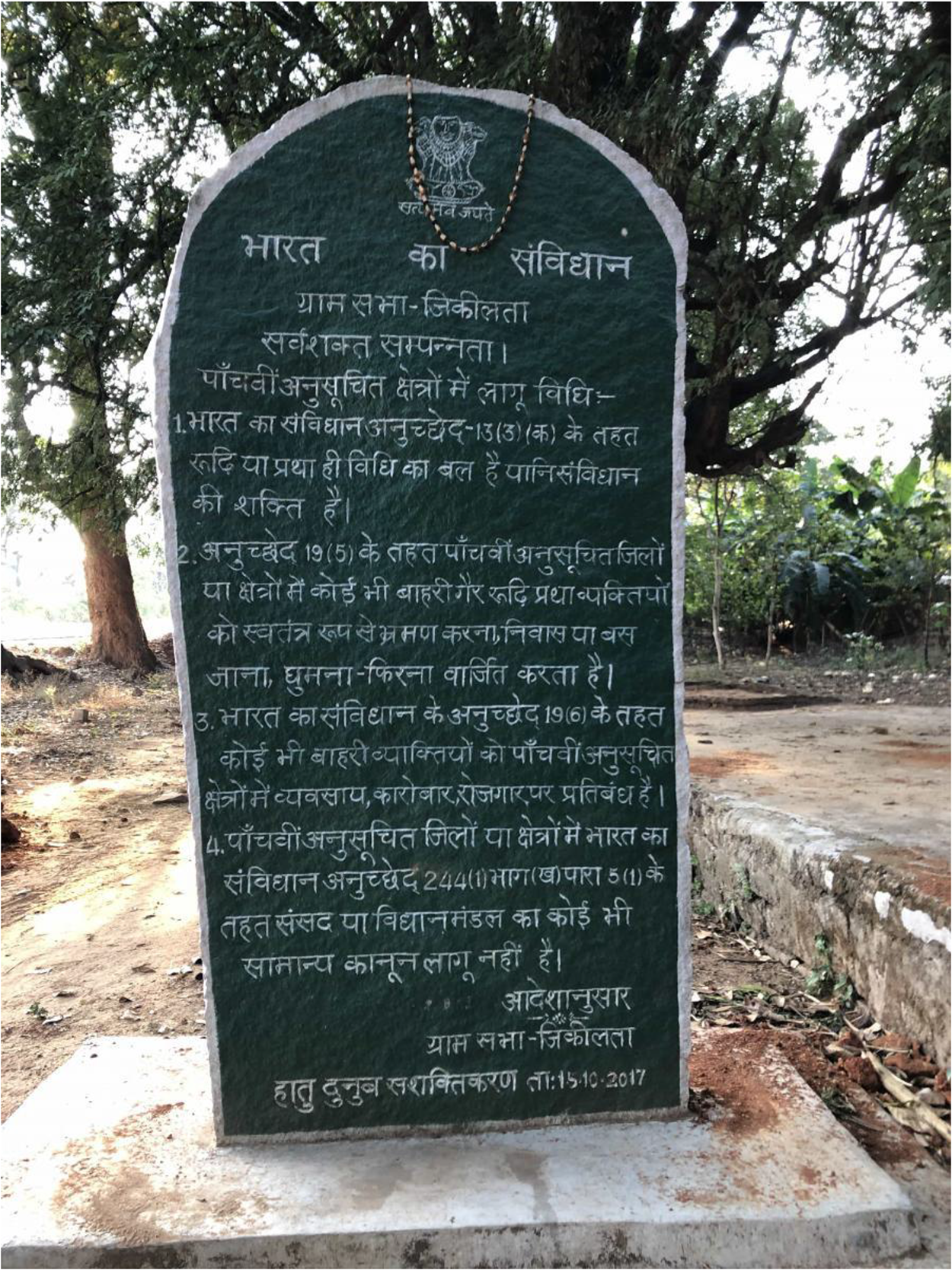
Rooted in long-standing traditions of territorial autonomy, the stone slabs are commemorative of the legacy of Birsa as they encode both historical memory and contemporary political demand. In places, the slabs are painted in green (the colour of Adivasis), are 15-feet long and 4-feet wide, and are used to write the provisions of the Panchayats (Extension to Scheduled Areas) Act (PESA) 1996, which asserts the significance of local governance to preserve the traditions and customs of the people, their cultural identity and community resources. By inscribing constitutional provisions on these customary slabs – these material artefacts exposed the state’s juridical double speak of granting Adivasis rights but disavowing them in practice. As Budhua Munda remarked, ‘they plan to dispossess us of our land and forests – we cannot allow that’.Footnote 89 For Munda, the threat is not merely material, in terms of loss of land or forest, but ontological as it is an attempt at erasure of a way of life, memories associated with it and community autonomy.
The Pathalgadi movement’s mobilization of the Constitution resonates strongly with a wider repertoire of subaltern memory practices, particularly DalitFootnote 90 resistance. Both mobilize memory against state appropriation. A rich repertoire of memorial practices – Ambedkar statues, street corner busts, murals, and processional celebrations of Ambedkar Jayanti are reflective of asserting Dalit counterclaims to equal citizenship and dignity.Footnote 91 Much like in the Adivasi case, these memorial forms exist in tension with the state’s own attempts to ‘capture’ and monumentalize Ambedkar, often sanitizing him of his radical critique of caste and transforming him into a figure of national pride. Both Dalit and Adivasi communities use the Constitution as the foundational instrument for claim-making, using material culture to articulate political demands.
At the same time, the differences between Adivasi and Dalit memorialization are instructive in illuminating distinct trajectories of subaltern practices. Statues of Ambedkar are often placed in urban settings; their placement is spatially confrontational to claim access to urban public spaces and challenge everyday caste hierarchies. The Pathalgadi movement centres on memorialization based on ancestral land-based sovereignty, foregrounding relationality with land and customary ways of living. While both are subaltern, constitutional projects, they articulate different visions of what it means to inhabit the Constitution: one claims it as a guarantee of equality within modernity; the other sees it as a resource for anti-extractive, communitarian futures rooted in land and collective life. Reading these two forms of memorialization together allows us to see constitutionalism not as a singular, normative project but a field of subaltern interpretation where memory and materiality are mobilized towards distinct visions of political belonging and social justice. It is precisely this subaltern reworking of constitutionalism – one that unsettles the state’s monopoly that renders such movements vulnerable to criminalization.
The Pathagadi movement was described as anti-national, seditious, and Maoist-driven, hampering the prospects of development in the region by the Indian state.Footnote 92 The BJP government in the state, headed by Raghubar Das, had booked more than 10,000 people for sedition under Section 124A of the Indian Penal Code for participation in the movement.Footnote 93 This discursive framing and criminalization of subaltern resistance is not incidental but integral to delegitimizing the memory and material claims of Adivasis.Footnote 94
This brings forth the politicization of the memory of Birsa and its concretization through indigenous means of resistance as a direct challenge to the spectacular statues established by the state. As the Indian state seeks to remember Birsa and use his legacy for vote bank politics, the Adivasis keep the struggle for their rights. Figure 2 depicts a stone slab by the roadside, painted in a striking green colour with constitutional provisions inscribed in Hindi across its surface. Birsa fought for the rights of Adivasis, and central to his political struggle was the oneness with nature, something that has been marginalized in the developmentalist vocabulary of the postcolonial state. Both pathals and statues are material inscriptions of memory, but they inhabit different symbolic economies: one asserts mnemonic sovereignty from below while the other asserts symbolic legitimacy from above.
A Pathal in Khunti district outlining the Constitution of India.
The canonization of Birsa Munda is not just claiming physical space but also a coherent national memory. Statues amplify people’s capacity to visualize the past and embed it in public consciousness. On the other hand, the Pahalgadi movement articulated the material deprivation and exclusion of Adivasis as a continued struggle in the precarious present. The eventual withdrawal of the contentious ordinances aimed at amending land tenure laws in Jharkhand stands as a significant success of the subaltern agency.Footnote 95 The state roll back reveals how mnemonic resistance, when spatialized and collectivized, can unsettle hegemonic narratives of memory. The movement affirmed the capacity of the indigenous communities to assert their mnemonic personhood, reclaim representational space, and expose the deep contradictions of the postcolonial Indian state that memorializes Birsa Munda while obscuring the struggles he embodied.
The stone erections acted as a bulwark against the state intervening in the lives of the Adivasis. The long-standing cultural tradition of erecting Pathals ties to material objects as a repertoire of record keeping and proclamation. The positioning of pathals at the entrance of villages, along with their height and words inscribed, acted as sentinels guarding the Adivasi population of the villages. As depicted in Figure 2, the pathals marked village boundaries, asserting the Adivasi rights for local governance whilst simultaneously acting as a mirror to the actions of the state that violated the spirit of the Constitution. Even more importantly, these material artefacts of inscriptions on stones successfully led to the collective mobilization of Adivasi identity demanding their rights.Footnote 96 The promises of neo-liberal developmental projects were in contradiction to the constitutionally mandated rights of Adivasi people. The electoral defeat of the incumbent BJP government in Jharkhand in the 2019 elections must be situated within the broader political reverberations of the movement, revealing the fragility of Hindutva’s symbolic incorporation of tribal icons like Birsa Munda when juxtaposed with its extractive and dispossessive policies on the ground.Footnote 97 It exposed the limits of mnemonic co-optation and highlighted how material-memory practices of the subaltern can escalate into formidable counter-politics capable of reconfiguring electoral outcomes.
The subaltern’s exercise of their identity through culturally resonant material artefacts that act as semiotic tools in navigating, negotiating, and resisting the dominant material memory. These material objects are not just residues of the past but act as active signifiers of asserting marginalized epistemologies and ontologies within the public sphere. They are material markers of apparent oxymoronic painting of strength and vulnerability that marks the lives of Adivasis. The material memory is the locus for the manifestation and perpetuation of subaltern cultural capital through which the subaltern enunciates a counter-hegemonic identity. The mnemonic labour by Adivasis in connecting the past to the present, asserting their distinctiveness in the face of cultural erasures, represents a spirit of resilience against forces that seek to homogenize their unique ways of living. As a synecdoche for the ‘dirty and other’ Adivasis, the Pathalgadi movement functions as a metonym for democratic struggle and popular sovereignty. The stone slabs constitute a communicative vocabulary that works both materially and semiotically to make Adivasi demands legible.
By troubling conventional genres of memorialization, the pathals generate a productive catachresis; they are different from the statues but troubling reminders of the Adivasi present. The Pathals materialize a liminal evocation of the subaltern within the national political experience; they are reminders of the state’s absence, a testament to the indifference and willingness to forget. Such material practices of memorialization encompass the configuration of space that frames social ordering as well as the production of temporalities. They articulate the messianic heroism of Birsa and the mundane equivocation of the Adivasis whose struggle for their rights continues. Their presence marks and territorializes an agonizing gap between the lived experiences of Adivasi populations and the everyday complicity of the state. The pathals are markers of materialized melancholia of Adivasis for rights and life of dignity. They signify a politicized mode of remembering which is generative – a decolonial affective infrastructure that sustains memory, articulates political desire, and refuses the foreclosure of indigenous futurity by the state’s commemorative apparatus.
The juxtaposition of statues and pathals (stones) is not just about mnemonic representation but a contrast between competing constitutional imaginaries that are materialized in space. State-led monumentalization takes the form of anthropomorphic, vertical statues – a heroic, elevated figure that rises above spectators, generating a permanent, visual, and spatial hierarchy. Such verticality is not incidental: it lends itself to deification within Hindu idioms, reinforces leader-centric narratives wherein ‘great men’ embody history while masses appear as followers or beneficiaries. The aesthetic of Birsa’s statues registers him as an exceptional, almost saint-like figure with moral and symbolic significance seamlessly absorbed into national mythology. This closes off the possibility of reading the Ulgulan as a mass mobilization against caste-feudal extraction, instead rendering it as a discrete episode in the biography of a singular national hero. Furthermore, statues are designed by commissioned artists and built on high budgets sanctioned by the state. Statues operate on the grammar of legibility valued by the state.
By contrast, the Pathalgadi movement relies on horizontal commemoration – inscribing rights onto pathals that are rooted in the ground, representative of the collective and embedded in the everyday landscapes of Adivasi life. They resist vertical hierarchy; pathals are not looked upon, they are approached and read, fostering a politics grounded in collective agency and participatory memory. Politically, the pathals’ inscriptions have articles from the Fifth Schedule of the Indian Constitution and PESA provisions, making resolutely constitutional, counter-modernist claims. Subaltern habitations of counter-modernity are best understood as ways of dwelling in the world that refuse, exceed, or creatively rework the teleologies of state-driven modernity.Footnote 98 For Adivasi communities, such counter-modernity is expressed through collective land holding, kin-based authority, and ecological reciprocity that becomes visible through the pathals. In contrast to the state statues of Birsa Munda that represent a vision of modernity that is linear with sovereignty vested in the nation-state, the Pathalgadi movement expresses plural, insurgent modernities that reclaim space and agency using constitutional vocabulary from below. Pathalgadi’s horizontal, collective commemoration thus operates simultaneously as an assertion of Adivasi agency and as a refusal of the hierarchical, deifying tendencies of state monumentalization. While statues stabilize memory into an object of admiration and reverence, pathals transform memory into a grounded, collective act of claim-making.
Conclusion: in pace with times
The article examined the contested afterlives of Birsa Munda as a site through which memory and political belonging are negotiated through friction between statist memory projects and subaltern mnemonic practices. The evolving, adaptive, and self-making efforts by the Indian state through developing a hegemonic simplification of the past are embodied in statues. The state surreptitiously plans on cultivating and imposing a sense of common identity in non-violent and non-coercive ways through these statues. This reveals the messiness and contradictions in this nation-making project, which simultaneously harmonizes and subjugates the indigenous populations within the state’s cosmos. The engagement with statues uncovers tensions and contradictions in producing a socially just memoryscape. Statues, erected by the state, function as visual anchors of a curated national past that is frequently underwritten by a majoritarian nostalgia. This nostalgia instrumentalizes selective histories to stabilize dominant cultural imaginaries while simultaneously foreclosing alternative mnemonic registers. Within this logic, statues do not merely commemorate; they demarcate the boundaries of public memory as visibility becomes synonymous with political recognition and legitimacy. The analysis of Birsa Munda’s afterlives shows that memory is not only a discursive field but a material terrain where struggles over sovereignty, belonging and legitimacy are fought.
Can the monumentalization of Birsa Munda by the state be described as amnesia, redirection, or atonement? The mnemonic recalibration of Birsa selectively celebrates the icon while severing him from the structural conditions and radical politics he embodied. In doing so, the state enacts a curated amnesia – a process in which visibility and symbolic recognition forestall material redress. The state’s deployment of statues as instruments of mnemonic capture operates through a logic of aesthetic containment where radical histories are selectively appropriated and rendered inert within a depoliticized narrative of anti-colonial nationalism. In contrast, the Pathalgadi movement articulates a decolonial praxis of memory embodied in lived, territorial experiences, refusing the state’s representational monopoly over the past. In framing memory as a contested and relational site of struggle, the article foregrounds decolonization not as an additive gesture of inclusion within dominant memory orders but as an assertion of subaltern material practices.
What kinds of political futures are imagined and foreclosed through acts of memorialization? The article highlights how postcolonial states mobilize aesthetic forms to perform ‘decolonization’ while simultaneously reproducing internal hierarchies and extractive relations. The Pathalgadi movement warns against reading decolonization through the lens of inclusion alone; the state can memorialize a subaltern icon even as it sustains the forms of dispossession that betray his political legacy. Attending to the material dynamics of how Adivasis mobilize land, stones, and aesthetic practices to resist state appropriation allows us to move beyond the abstract call to ‘decolonize’ and instead grapple with the concrete, contested and embodied processes through which decolonization is enacted. By foregrounding Adivasi material practices as autonomous forms of mnemonic agency, the article highlights the frictions between state monumentalism and Adivasi counter-aesthetics. Attending to these dynamics helps in recognizing the plural, material grammars through which political communities claim their past and imagine their future.
By focusing on mnemonic labour of everyday practices of resistance, I position the Pathalgadi movement as a lively space of activist curating. The Pathalgadi movement serves as a critical exemplar of how enduring colonial entanglements continue to structure lives, lands, and temporalities in postcolonial contexts. Through the creation of samadhi sthals, as embodied sites of memory, the Pathalgadi movement articulates a decolonial praxis that links localized resistance to broader global movements of indigenous and subaltern resistance. These movements, anchored in grassroots civic activism, aim at exposing and addressing the consequences of colonial past in the present. Moving beyond the romanticized understandings of counter-political resistance, the article attempts at revealing the power of material memory to celebrate or camouflage histories of colonial/state violence. Through the pathals, the Adivasis are not just speaking but simultaneously acting – reasserting their democratic rights in the public space.
A final contribution of this article lies in demonstrating how contemporary far-right projects mobilize memory as a key terrain for consolidating political authority – a dynamic that IR has only partially theorized within the context of the Global South. The far right has deployed commemorative practices, monumental aesthetics, and selective historical retrievals to reconfigure the boundaries of political community by legitimizing majoritarian desires and overwriting plural pasts. The contrast between state monumentalization and Adivasi commemorative practices advances IR’s engagement with how far-right politics operates through contested struggles over memory and materiality. Birsa Munda – an Adivasi rebel who fought imperial as well as internal hierarchies is recast selectively, emptying him of political radicalism within a civilizational narrative that vindicates majoritarian rule.
In tracing the significations of variously situated material memory, the article reveals the multiplicity of connections between the political, symbolic, and juridical. The Pathalgadi movement and the Adivasis reclaiming material memory associated with Birsa engenders a precarious yet sustained practice of political and social possibility that produces these spaces of community beyond sites of ruination. In doing so, the Adivasis resist not only the coloniality of state violence but also the cultural hegemony of majoritarian nationalism masquerading as decolonization.
Video Abstract
To view the online video abstract, please visit: https://doi.org/10.1017/S0260210526101892.
Acknowledgements
I am grateful to the journal editors and anonymous reviewers for their generous engagement with the manuscript.



