INTRODUCTION
It is well known that bottom trawling has a paramount role in the degradation of benthic coastal and deep-water ecosystems, by directly removing large amounts of biomass or, indirectly, by jeopardizing ecosystem functioning (Watling & Norse, Reference Watling and Norse1998; Roberts, Reference Roberts2002; Colloca et al., Reference Colloca, Carpentieri, Balestri and Ardizzone2004; Gray et al., Reference Gray, Dayton, Thrush and Kaiser2006). In the North Atlantic European margins, the impact of human activities on deep-water coral reefs has been studied in relation to the effects of bottom trawling on reefs dominated by Lophelia pertusa (Rogers, Reference Rogers1999; Fosså et al., Reference Fosså, Mortensen and Furevik2002). These studies show that bottom trawling has a negative impact on the reefs and associated species by directly destroying or removing them, but also indirect impacts due to increased resuspension of bottom sediment, which damages filter feeding organisms such as corals by siltation (clogging). Additionally, long-term indirect effects include the removal of protection or feeding places for slope-dwelling species and, in general, an impoverishment of continental-slope ecosystems (as with their tropical counterparts: Watling & Norse, Reference Watling and Norse1998; Roberts, Reference Roberts2002). The recovery of the direct and indirect damage produced by bottom-trawling on these habitats may take decades or centuries, according to the slow growth rates of deep-water corals (few to several mm per year: Wilson, Reference Wilson1979; Andrews et al., Reference Andrews, Cordes, Mahoney, Munk, Coale, Cailliet and Heifetz2002; Fosså et al., Reference Fosså, Mortensen and Furevik2002).
Deep-water corals in the subclasses Hexacorallia (mainly scleractinians) and Octocorallia (mainly gorgonaceans) are known to provide essential habitat for fish and invertebrates along the continental slope in different areas of the world (Andrews et al., Reference Andrews, Cordes, Mahoney, Munk, Coale, Cailliet and Heifetz2002; Fosså et al., Reference Fosså, Mortensen and Furevik2002; Etnoyer & Morgan, Reference Etnoyer and Morgan2003; Freiwald et al., Reference Freiwald, Fosså, Grehan, Koslow and Roberts2004; D'Onghia et al., Reference D'Onghia, Maiorano, Sion, Giove, Capezzuto, Carlucci and Tursi2010). Deep-water corals form three-dimensional structures on the sea-bottom, in an otherwise relatively homogeneous and flat landscape, either by forming reef structures (such as the scleractinian Lophelia pertusa in the North Atlantic) or as ‘coral meadows’, where individual corals rise from the bottom forming tree-like or candelabra-like structures (many species of gorgonacean corals). Krieger & Wing (Reference Krieger and Wing2002) showed that gorgonacean Primnoa spp. in the Gulf of Alaska provide essential habitat to fish and invertebrates by: (i) acting as feeding places for their predators (sea stars); (ii) providing protection to large fauna (rockfish, crabs and shrimps); or (iii) providing an attachment substrate to other suspension feeders (basket stars, anemones and sponges). Husebø et al. (Reference Husebø, Nøttestad, Fosså, Furevik and Jørgensen2002) reported that the abundance of commercial fish was higher and individual size was larger in reef habitats built by Lophelia pertusa when compared with surrounding areas in Norwegian waters, suggesting that deep-water coral reefs provide feeding habitat for commercial species. In the central-eastern Mediterranean, D'Onghia et al. (Reference D'Onghia, Maiorano, Sion, Giove, Capezzuto, Carlucci and Tursi2010) showed that the relict white coral banks composed of Lophelia and Madrepora harbour large densities of reproducing individuals of certain fish species (rockfish and blackspot seabream), while at the same time being nursery areas for the deep-water shark Etmopterus spinax and some important commercial fish species such as hake. Gage & Tyler Reference Gage and Tyler(1992, pp. 212–214) suggested a positive relationship between habitat complexity and species diversity, hence, in the bathyal domain, habitats dominated by corals (reef-building scleractinians or solitary gorgonaceans) would provide patches of high-diversity habitats in a relatively homogeneous environment of low diversity. For example, Mastrototaro et al. (Reference Mastrototaro, D'Onghia, Corriero, Matarrese, Maiorano, Panetta, Gherardi, Longo, Rosso, Sciuto, Sanfilippo, Gravili, Boero, Taviani and Tursi2010) recentaly showed that the white coral bank off Santa Maria di Leuca Cape (central-eastern Mediterranean) represents a biodiversity ‘hot-spot’ of the Mediterranean bathyal domain.
Deep-water gorgonacean corals of the family Isididae (with 138 known species) are cosmopolitan, occurring mainly in deep-waters (200 to 1500 m depth). Locally, they form large, single-species stands that dominate communities on soft-bottom sediments (‘coral meadows’). Branching isidid corals can reach 3 m length (Krieger & Wing, Reference Krieger and Wing2002) and they are long lived (several decades in Primnoa resedaeformis: Andrews et al., Reference Andrews, Cordes, Mahoney, Munk, Coale, Cailliet and Heifetz2002). In the Mediterranean Sea Isidella elongata (Esper, 1788) characterizes a facies of bathyal compact mud substrates between 500 and 1200 m depth on relatively flat bottoms with slope <5% (Pérès, Reference Pérès1967; Bellan-Santini, Reference Bellan-Santini, Moraitou-Apostolopoulou and Kiortsis1985; Laubier & Emig, Reference Laubier and Emig1993). Isidella elongata is a near-endemic to the Mediterranean Sea, reaching the adjacent Atlantic Ocean in the Ibero-Moroccan Gulf (Grasshoff, Reference Grasshoff1988, Reference Grasshoff1989).
Among species reaching their maximum abundance in bottoms inhabited by I. elongata, the deep-water red shrimps Aristeus antennatus and Plesionika martia are commercially important and represent a prime target of large trawlers, due to the high price fetched (Maynou et al., Reference Maynou, Sardà, Tudela and Demestre2006). The activity of trawlers removes colonies of this rather long and rigid gorgonacean. The effects of bottom-trawling on biological diversity and production of this biota are unknown, although, according to studies of impact on benthic communities by trawling on shelf habitats (Jennings et al., Reference Jennings, Dinmore, Duplisea, Warr and Lancaster2001; Gray et al., Reference Gray, Dayton, Thrush and Kaiser2006) a decrease in biodiversity, along with a parallel decrease in production and increase in the production/biomass ratio (P/B) by elimination of larger specimens can be expected.
Based on four extensive scientific trawl surveys carried out between 1985 and 2008 we present data on the distribution of I. elongata in the north-western Mediterranean and on the fish and invertebrate species associated with this habitat. The objectives of this study are: (i) to provide quantitative data on the fish and invertebrate assemblages associated with I. elongata habitats; (ii) to investigate the effect of bottom-trawling on the community characteristics (species richness and species composition); and (iii) to enumerate the main fishery species of this habitat.
MATERIALS AND METHODS
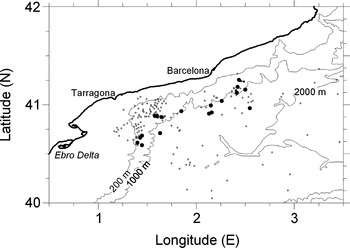
Four experimental trawl cruises (BATIMAR: September 1985 and July 1988; ZONAP: May 1992; GEODELTA: April 1994; and BIOMARE: June 2007, February 2008) were conducted along the continental slope (depths sampled: 85–2253 m) of the noth-western Mediterranean aboard RV ‘García del Cid’, where the entire benthic faunal assemblage was analysed. The study area comprised the continental margin of the Iberian Peninsula around latitude 41°N and longitudes 1°–3°E (Figure 1). A total of 189 trawl hauls were performed and 20 hauls yielded live I. elongata colonies. The area swept by each trawl haul was 0.022 to 0.033 km2. The trawl used in the OTSB-14 model, commonly employed in deep-sea megafaunal studies in Europe, was fitted to a 6 mm stretched mesh codend, with 8-m long bridles and 1.2 m vertical opening. Decapod crustaceans and fish were identified to species level, counted and weighed. Other invertebrates were identified to the lowest practical taxonomic level (species, genus or family), but could not always be counted or weighed.
Map of the study area showing the location of 189 trawl hauls conducted along 4 trawl surveys between 1985 and 2008. Filled circles indicate the presence of live Isidella elongata colonies. These were recovered between 418 and 1656 m depth.

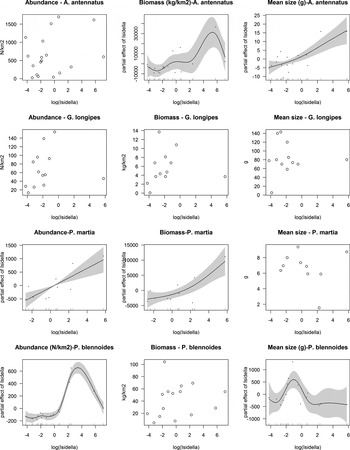
The effect of I. elongata biomass (kg/km2) on the faunal assemblage in the 20 hauls yielding I. elongata was analysed statistically by means of non-parametric regression techniques, using generalized additive models (GAMs: Hastie & Tibshirani, Reference Hastie and Tibshirani1986) to compare species richness (S), abundance (number of individuals/km2), biomass (kg/km2) and mean size of individuals (g) with log-transformed biomass of I. elongata. The comparison was made separately for decapod crustaceans, fish and other invertebrates. Additionally, the abundance, biomass and mean size of the species of commercial fishery interest were also tested: the decapod crustaceans Aristeus antennatus, Geryon longipes and Plesionika martia, and the fish Phycis blennoides. GAMs are a flexible class of statistical predictive models which allow establishing relationships between a set of predictors, in our case I. elongata biomass, and a dependent variable. We used smoothing splines to represent the (possibly) non-linear effect of predictors. The maximum degree of smoothing allowed was 6, to avoid unrealistic patterns in the explanatory variables and to reduce overfitting (Wood, Reference Wood2006). The dependent variable was modelled using a Gaussian distribution function with logarithmic link. We built a GAM for each dependent variable and selected those models yielding a statistically significant (P < 0.1) smoothing term. We computed the GAMs with the statistical programming environment R using the library mgcv (Wood, Reference Wood2006).
RESULTS
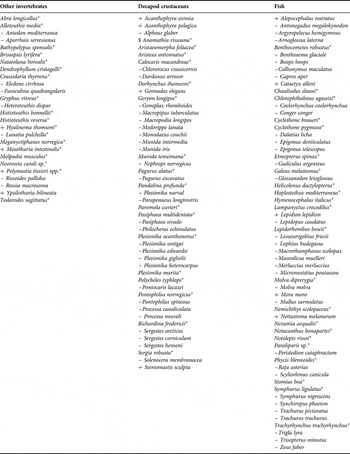
Isidella elongata colonies were collected from 418–1656 m depth in the study area (Figure 1). The abundance of I. elongata was not related to depth (Spearman's correlation test r = –0.092, P = 0.667). The mean biomass of I. elongata was 97.63 ± 73.83 kg/km2, with a maximum of 28 kg (1292 kg/km2) in a single haul at 626 m depth. The faunal assemblage recovered from trawl hauls containing I. elongata remains comprised 54 species of decapod crustaceans, 61 species of fish and 118 taxa of other invertebrates; the most characteristic taxa are shown in Table 1 (cf. Pérès, Reference Pérès1967; Laubier & Emig, Reference Laubier and Emig1993).
List of representative species recovered from trawl hauls containing the gorgonacean coral Isidella elongata. Species typical of the I. elongata facies (cf. Pérès, Reference Pérès1967; Emig & Laubier 1993) are marked *. Species whose typical distribution is shallower than this facies are marked – and deeper than this facies are marked + (Cartes et al., Reference Cartes, Maynou, Fanelli, Romano, Mamouridis and Papiol2009, and references therein).

$, only 5 individuals of A. rissoana were recovered across the 4 surveys and they were captured in the haul with the largest catch of I. elongata (28 kg at 626 m depth; cf. Mura et al., Reference Mura, Orru and Cau2005).
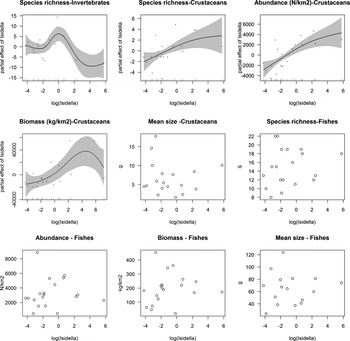
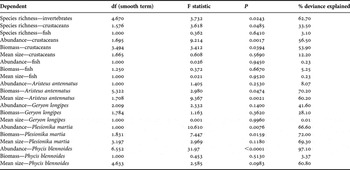
Table 2 shows the results of the non-parametric regression between community indicators and I. elongata abundance. Only regression models with a significant smooth term were considered and they are shown in Figure 2. The relationship between I. elongata abundance and non-significant community indicators is presented with simple scatterplots (Figure 2). Species richness of invertebrates was higher at intermediate densities of I. elongata, with maximum species richness at around 1 kg km−2. Crustacean species richness, abundance and biomass were significantly higher at higher densities of I. elongata, while for mean size no effect of the coral was determined. Fish species richness, abundance, biomass or mean size were not significantly related to I. elongata density.
Results of the non-parametric regression analysis (generalized additive models) between community indicators (species richness, abundance and biomass) and Isidella elongata biomass. When the regression model was not significant a simple scatterplot is shown.

Summary of the non-parametric regression analysis (generalized additive models) between community indicators (species richness, abundance and biomass) or commercial fishery species and Isidella elongata abundance. Regression models were determined to be significant when the smoothing term was significant at the level P < 0.1 based on the approximate F statistic (Wood, Reference Wood2006).

The non-parametric regression analysis of fisheries target species (Figure 3; Table 2) shows that biomass and mean size of the red shrimp Aristeus antennatus are significantly higher at higher densities of I. elongata. The crab Geryon longipes was not significantly affected by I. elongata biomass, but the crab was mostly present at coral densities below 1 kg km−2. Both abundance and biomass of the shrimp Plesionika martia were positively correlated with I. elongata, but not mean size of this shrimp. In the case of the greater forkbeard Phycis blennoides a non-monotonic significant response was determined for abundance and mean size, with maximum abundance of the fish at intermediate biomass of I. elongata (5–150 kg km−2) and maximum fish size at relatively low biomass of the coral (0.1–1 kg km−2).
Results of the non-parametric regression analysis (generalized additive models) between commercial fishery target species (abundance, biomass and mean size) and Isidella elongata biomass. When the regression model was not significant a simple scatterplot is shown.

DISCUSSION
The deep-water coral I. elongata was recovered from 418–1656 m depth in 20 of 189 trawl hauls from 4 intense trawl sampling surveys between 1985 and 2008. This deep-water coral is increasingly rare in the Mediterranean due to intense fishing pressure from trawlers targeting the red shrimp at continental slope depths (mainly between 400 and 800 m), who detach the coral from the soft bottom or destroy its branches. Our results show that higher densities of coral support higher crustacean species richness, abundance and biomass and are significantly related to overall invertebrate richness. Some indicators for species of commercial interest are also significantly related to higher density of the coral. Trawling, by destroying coral colonies, may decrease crustacean species richness, abundance and the biomass of some commercial species (A. antennatus and Plesionika martia).
Similar findings by Husebø et al. (Reference Husebø, Nøttestad, Fosså, Furevik and Jørgensen2002) report that fish abundance was higher and fish size was larger in Lophelia reefs in Norwegian waters, although in our study the main living resource (Aristeus antennatus) of mid-slope depths in the north-western Mediterranean was not more abundant, but only showed higher biomass and mean size; confirming the observations by Pérès (Reference Pérès1967) that this species is characteristically associated with I. elongata facies, at least as adult. By contrast, we could not confirm the nursery habitat provided by deep-water reefs of Lophelia pertusa for commercial fish as in the North Atlantic (Fosså et al., Reference Fosså, Mortensen and Furevik2002), at least for the target species of the trawl fishery in the area. In the Mediterranean, the shelf break habitat characterized by the crinoid Leptometra phalangium has also been shown to support increased abundances of recruits and juveniles of important commercial species, such as Merluccius merluccius, Phycis blennoides or Parapenaeus longirostris (Colloca et al., Reference Colloca, Carpentieri, Balestri and Ardizzone2004) and a similar role for white coral reefs in the central-eastern Mediterranean has recently been shown (D'Onghia et al., Reference D'Onghia, Maiorano, Sion, Giove, Capezzuto, Carlucci and Tursi2010).
Analyses of possible causes explaining the positive effect of I. elongata biomass on decapod crustaceans are necessarily speculative because of a lack of specific studies. From a trophic point of view, Aristeus antennatus has the most diversified diet (H′ = 5.3: Cartes, Reference Cartes1994) among deep-Mediterranean species. Trophic studies show that most infaunal prey ingested by A. antennatus in non-trawled bottoms (below 1000 m depth) are captured by rooting in mud (e.g. polychaetes and bivalves: Cartes, Reference Cartes1994). This species of broad trophic spectrum may act as an opportunistic species, feeding on the rich invertebrate communities associated with I. elongata meadows. The possible alteration of trophic webs by trawling on Isidella facies must have two different effects: (i) a short-scale, immediate effect by increasing prey availability after damaging and habitat alteration of benthos; and (ii) a longer scale effect on benthos production. The effects of chronic disturbance on production are a decrease in P and a parallel increase in P/B (Jennings et al., Reference Jennings, Dinmore, Duplisea, Warr and Lancaster2001) basically by elimination of large sizes.
The disturbance created by trawling on continental-slope communities decreases community structure (species richness) and damages the habitat of invertebrates and some commercial decapod and fish species (Jennings & Kaiser, Reference Jennings and Kaiser1998). Isidella elongata, together with other suspension feeders (Desmophyllum cristagalli and Gryphus vitreus), is mainly distributed in the Balearic Basin over the middle and lower continental slope, between two depositional areas of sediment and particulate organic matter occupied by deposit feeders (holothurians and Brissopsis lyrifera: Cartes et al., Reference Cartes, Maynou, Fanelli, Romano, Mamouridis and Papiol2009). Studies on trophic webs in the area suggest the belt occupied by I. elongata is rich in near-bottom zooplankton (Cartes et al., Reference Cartes, Maynou, Fanelli, Romano, Mamouridis and Papiol2009), the main food source for deep-corals (Sherwood et al., Reference Sherwood, Heikoop, Scott, Risk, Guilderson and McKinney2005). In addition to the direct impact or damage created by the mechanical action of trawling, deep-water coral reefs are also negatively impacted by the resuspension of bottom sediments which clogs the filter-feeding mechanisms of suspension feeder species (Rogers, Reference Rogers1999; Fosså et al., Reference Fosså, Mortensen and Furevik2002) probably altering zooplankton availability to Isidella polyps. Palanques et al. (Reference Palanques, García-Ladona, Gomis, Martín, Marcos, Pascual, Puig, Gili, Emelianov, Monserrat, Guillén, Tintoré, Segura, Jordi, Ruiz, Basterretxea, Font, Blasco and Pagès2005) detected resuspension of sediments due to trawling even downstream from the main fishing grounds, below 1000 m depth.
The very slow growth rates of deep-water corals (Andrews et al., Reference Andrews, Cordes, Mahoney, Munk, Coale, Cailliet and Heifetz2002; Fosså et al., Reference Fosså, Mortensen and Furevik2002; Krieger & Wing, Reference Krieger and Wing2002) make problematic the recovery of these habitats from trawling in the short and medium term. In addition to trawling, the threat of solid refuse dumping to I. elongata facies was already pointed out by Relini Orsi (Reference Relini Orsi1974). Other human activities, such as mineral extraction (Grassle, Reference Grassle1991; Thiel, Reference Thiel and Tyler2003) may be highly detrimental to deep-sea ecosystems and the services provided by these to humans (e.g. fisheries: Roberts, Reference Roberts2002). Sustainable fisheries require viable stock populations but also appropriate habitat. Deep-water corals provide essential habitat, either as reefs (scleractinians) or stands (gorgonaceans) necessary for fish to survive (feeding, protection or reproduction places) and the impact of human activities on deep-water, fragile ecosystems must be carefully monitored and assessed.
ACKNOWLEDGEMENTS
We thank participants in the cruises BATIMAR, ZONAP, GEODELTA and BIOMARE for their assistance during fieldwork. Funding for the project BIOMARE (CTM-2006-13508-C02/MAR) was provided by the Spanish National Research Programme. Current research by the authors on deep-water habitats is funded by project ANTROMARE (CTM-2009-12214-C02/MAR) of the Spanish National Research Programme.