Introduction
Malnutrition arising from dietary deficiency of mineral micronutrients such as iron (Fe) and zinc (Zn) has widely been recognized as a serious public health problem worldwide, affecting more than 2 billion people (WHO, 2002). Fe deficiency ranks 9th and Zn deficiency ranks 11th among the 26 major risk factors for the global burden of disease estimates (Ezzati et al., Reference Ezzati, Lopez, Rodgers, Vanderhoorn and Murray2002). This problem is particularly serious in developing countries, especially in high-risk groups such as pregnant women, infants and adolescent children. For instance, in India, about 80% of pregnant women, 52% of non-pregnant women and 74% of children in the age group of 6–35 months suffer from Fe deficiency-induced anaemia (Chakravarty and Ghose, Reference Chakravarty and Ghose2004). In sub-Saharan Africa, 88% of pre-school children in Burkina Faso and 77% in Mali suffer from Fe deficiency-induced anaemia (Birner et al., Reference Birner, Kone, Linacre and Resnick2007). Numerous health problems arising from Zn deficiency could be as serious as those arising from Fe deficiency; however, there are no well-documented studies to establish this fact. Pearl millet (Pennisetum glaucum (L.) R. Br.) is a highly nutritious major warm-season cereal grown primarily for grain production on more than 28 million ha in some of the most marginal arid and semi-arid tropical environments of Asia and Africa (Yadav et al., Reference Yadav, Rai, Rajpurohit, Hash, Mahala, Gupta, Shetty, Bishnoi, Rathore, Kumar, Sehgal and Raghvani2012). It is a major source of dietary energy and nutritional security for vast rural communities in these regions. A recent study has shown that pearl millet accounts for 19 to 63% of the total Fe intake and 16 to 56% of the total Zn intake from all food sources in some of the major pearl millet-growing states of India such as Maharashtra, Gujarat and Rajasthan (Parthasarathy Rao et al., Reference Parthasarathy Rao, Birthal, Reddy, Rai and Ramesh2006). It is also the cheapest source of Fe and Zn when compared with other cereals and vegetables.
Considering the magnitude of Fe and Zn deficiency problem as well as the potential of pearl millet in addressing this problem, the International Crops Research Institute for the Semi-Arid Tropics (ICRISAT), supported by the HarvestPlus Challenge Program of the Consultative Group on International Agricultural Research (CGIAR) (a global research partnership for a food secure future), has initiated research-for-development efforts to breed improved genetic materials (breeding lines, populations, hybrid parents and hybrids) with high levels of Fe and Zn densities. Results of preliminary studies conducted at ICRISAT showed that most of the potential hybrid parents, composites, improved populations and population progenies with high levels of Fe density were entirely or largely based on the so-called iniadi germplasm in their parentage (Velu et al., Reference Velu, Rai, Muralidharan, Kulkarni, Longvah and Raveendran2007, Reference Velu, Rai and Sahrawat2008). Iniadi, also known by various local names such as nara, nata, ignati, ignate, ignie, misse and likoun, refers to an early-maturing and large-seeded landrace found in the adjoining parts of Togo, Ghana, Benin and Burkina Faso (Andrews and Anand Kumar, Reference Andrews and Anand Kumar1996). The objective of this study was to conduct a wider search in this group of germplasm to examine the magnitude of variability and to identify accessions as additional sources of high levels of grain Fe and Zn densities.
Materials and methods
Germplasm materials
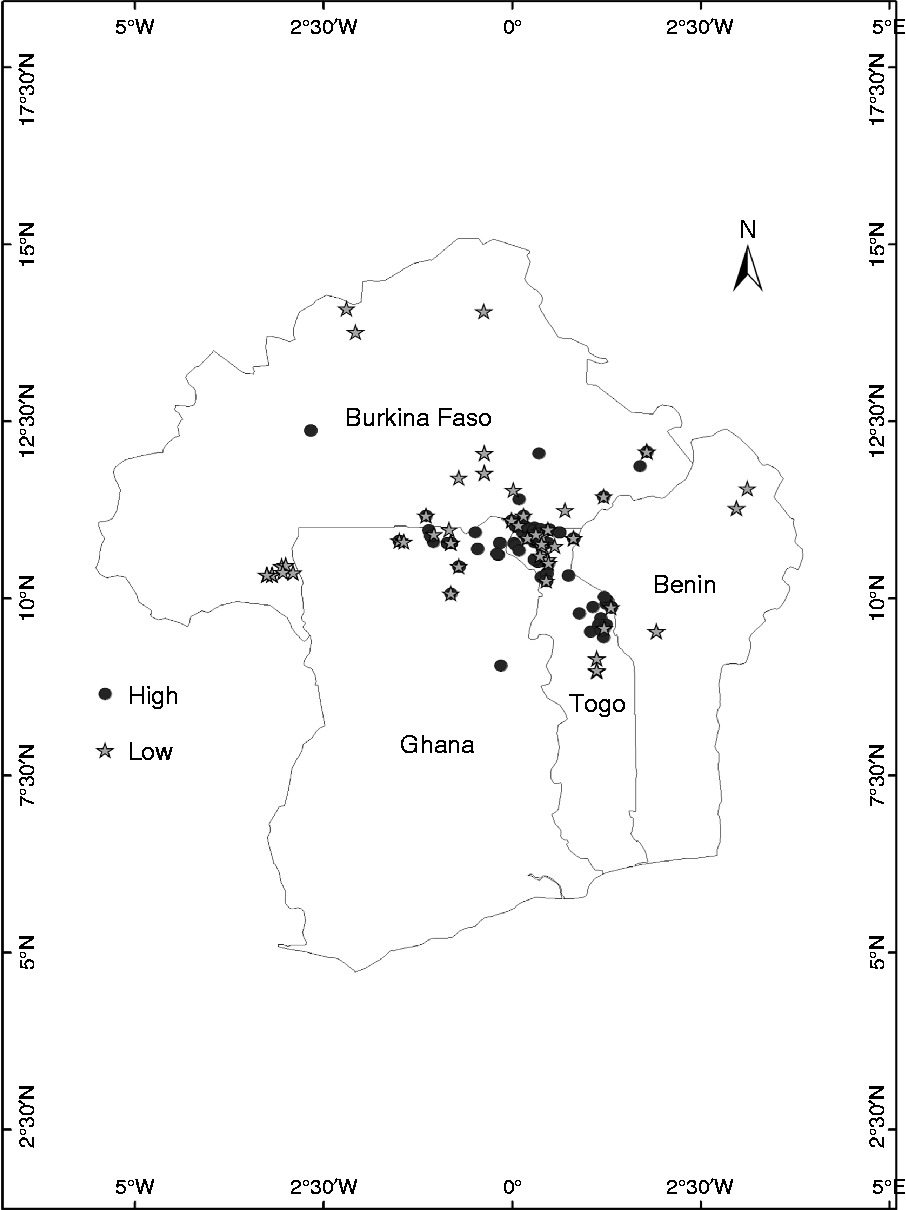
A set of 297 iniadi germplasm accessions originating from northern Togo (146) and adjoining eastern Ghana (83), southern Burkina Faso (63) and western Benin (5) regions of Western Africa (Fig. 1) were selected from genetic resource collections in the genebank at ICRISAT, Patancheru. These accessions were evaluated along with a control commercial open-pollinated variety, ICTP 8203, in an unreplicated nursery during the 2006 summer season at ICRISAT, Patancheru, and selfed grains were produced. These grain samples were initially screened for Fe density using Perl's Prussian Blue staining technique that provides a qualitative classification of Fe density based on the intensity of blue stain absorbed by the powdered grain samples (Velu et al., Reference Velu, Kulkarni, Rai, Muralidharan, Longvah and Raveendran2006). Of these screened accessions, 191 staining dark blue to medium blue and presumed to have high Fe density were selected for this study (Fig. 1).
Geographic distribution of 295 (190 high-Fe and 105 low-Fe) geo-referenced accessions of iniadi pearl millet germplasm for grain iron and zinc densities.

Field trials
The experiment was conducted in a randomized complete block design with two replications in Alfisols at ICRISAT, Patancheru, India (17° N; 78° E). Each accession was grown in one row of 4 m at a spacing of 75 cm between the rows in the 2010 rainy season, and at a spacing of 60 cm in the 2012 summer season, with a spacing of 15 cm between the plants within the row during the two seasons. The trials involved the application of 75 kg N/ha (50% basal in the form of diammonium phosphate and 50% top dressed at 20 d after sowing in the form of urea) and 35 kg P/ha during the two seasons. While the rainy season trial was conducted under rain-fed conditions, the summer season trial involved irrigation at an interval of 7 to 10 d until physiological maturity to avoid any moisture stress. Briefly, two soil samples were taken from the top layer (30 cm deep) at the time of planting to determine the available levels of Fe and Zn densities in the soil. In each plot, open-pollinated main panicles of eight to ten plants were harvested, sun-dried for 10 to 15 d and machine threshed (Wintersteiger – ID780ST4 – Single head thresher, Ried, Austria), and then clean grain samples (about 50 g), free of any debris, were collected for analysis of Fe and Zn density levels at the laboratory. Time to 50% flowering was recorded when the stigma in the main panicles of 50% of the plants in each plot had fully emerged. Random samples of 100 grains were used to determine 1000-grain mass in the 2012 summer season trial.
Laboratory and statistical analyses
Soil samples were analysed at the Central Analytical Services Laboratory at ICRISAT, Patancheru by extraction of Fe and Zn with the diethylenetriamine penta-acetic acid (DTPA) method. Fe and Zn contents in the extract were determined using an atomic absorption spectrophotometer (Model Savant AA; GBC Scientific Equipment, Victoria, Australia), as described by Lindsay and Norvell (Reference Lindsay and Norvell1978). Grain samples were analysed using the inductively coupled plasma optical emission spectroscopy method developed by Wheal et al. (Reference Wheal, Fowles and Palmer2011) at the Waite Analytical Services, Adelaide, Australia. A fixed model analysis of variance for testing the significance and determining the correlation between the levels of Fe and Zn was done following Gomez and Gomez (Reference Gomez and Gomez1984).
Results
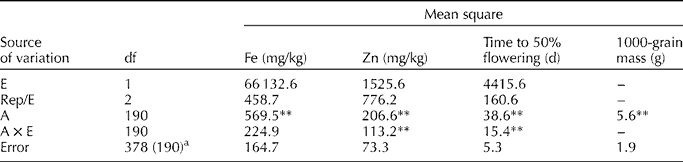
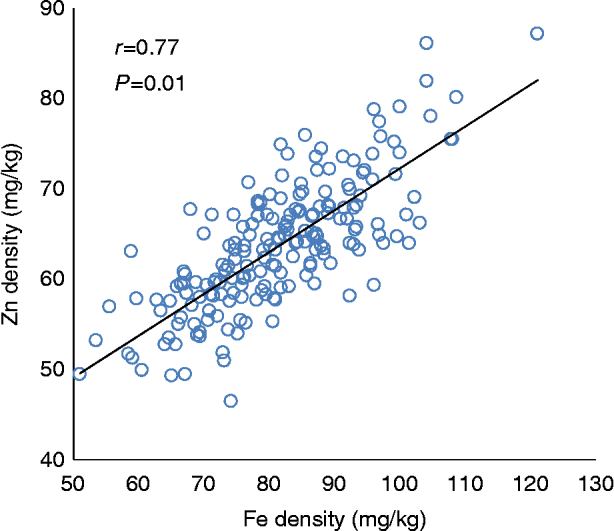
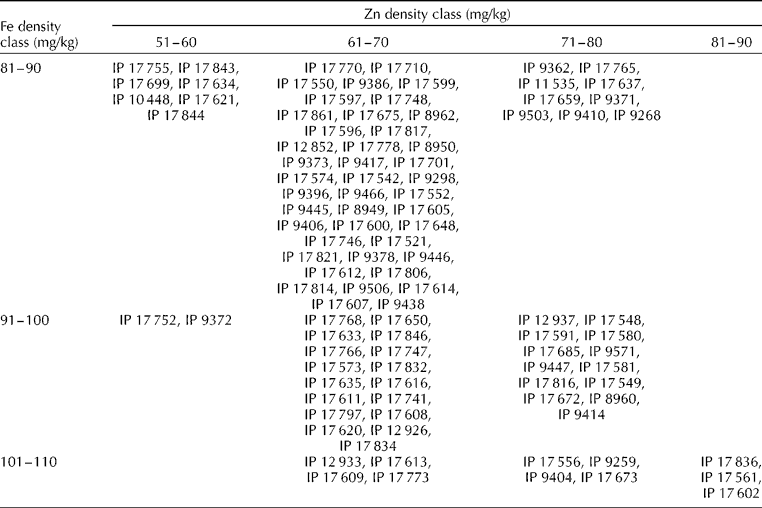
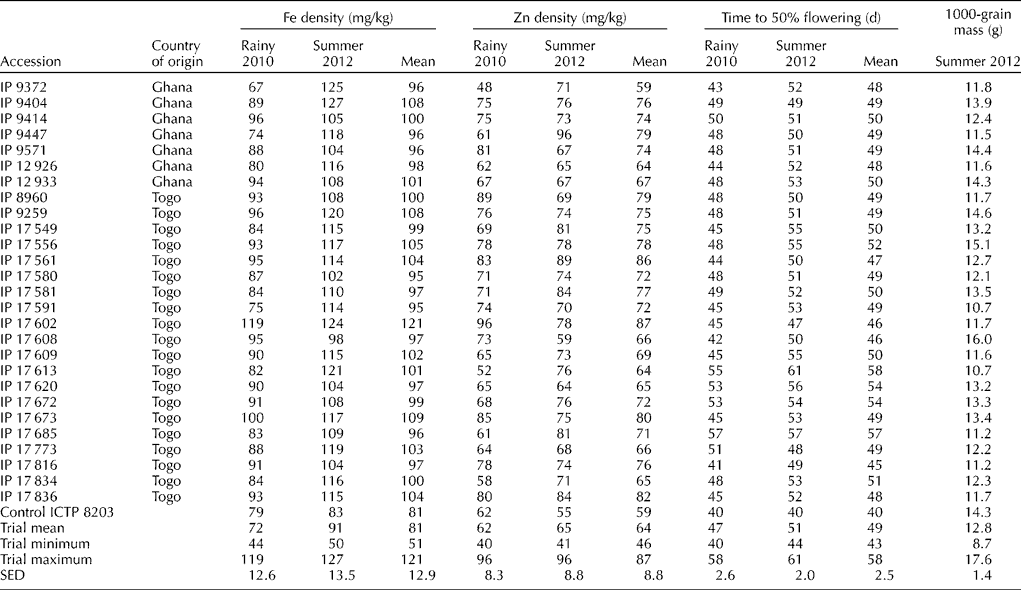
Grain Fe and Zn density levels, time to 50% flowering and 1000-grain mass were found to be highly significantly different among the accessions (P< 0.01; Table 1). Also, there was a high significant effect of the accession × environment interaction, accounting for 40% of the variability due to differences in Fe density and time to flowering and 58% of the variability due to differences in Zn density among the accessions. The mean performance over the two seasons (environments) revealed that Fe density varied from 51 to 121 mg/kg and Zn density from 46 to 87 mg/kg among the accessions (Table 3; Fig. 2). There was a highly significant and high positive correlation (r= 0.77, P< 0.01) between the two micronutrients (Fig. 2). Fe density in 101 accessions (53%) was equal to or higher than that in the early-maturing, large-seeded and high-Fe control commercial open-pollinated variety ICTP 8203 (81 mg/kg; Table 2). Of these high-Fe density accessions, ninety-two also had Zn density ≥ 61 mg/kg (59 mg/kg for ICTP 8203; Table 3). The Fe density of 27 accessions exceeded that of ICTP 8203 by >1 SED (standard error of difference). The Zn density of all these accessions exceeded that of ICTP 8203, with 20 accessions exceeding by >1 SED.
Mean squares for grain iron and zinc densities, time to 50% flowering and 1000-grain mass for the accessions of iniadi pearl millet germplasm across two environments at Patancheru

df, degree of freedom; E, environment; Rep/E, replication within the environment; A, accession.
a df for 1000-grain mass.
** Significant at the P< 0.01 level.
Correlation between grain Fe and Zn densities in the accessions of iniadi pearl millet germplasm (mean performance over the two environments).

Iron (Fe) and zinc (Zn) density classes for the accessions of Iniadi pearl millet germplasm (mean performance over the two environments) at Patancheru
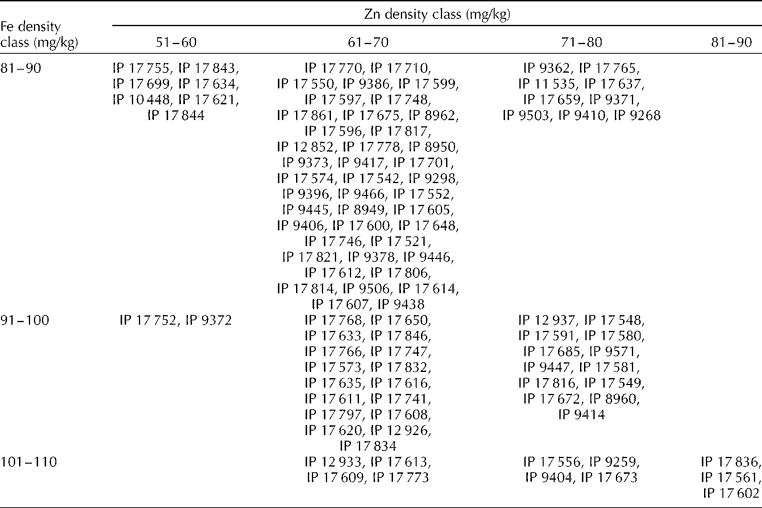
Iron (Fe) and zinc (Zn) densities and 1000-grain mass for the selected accessions of iniadi pearl millet germplasm, and trial means with standard errors of difference (±SED)
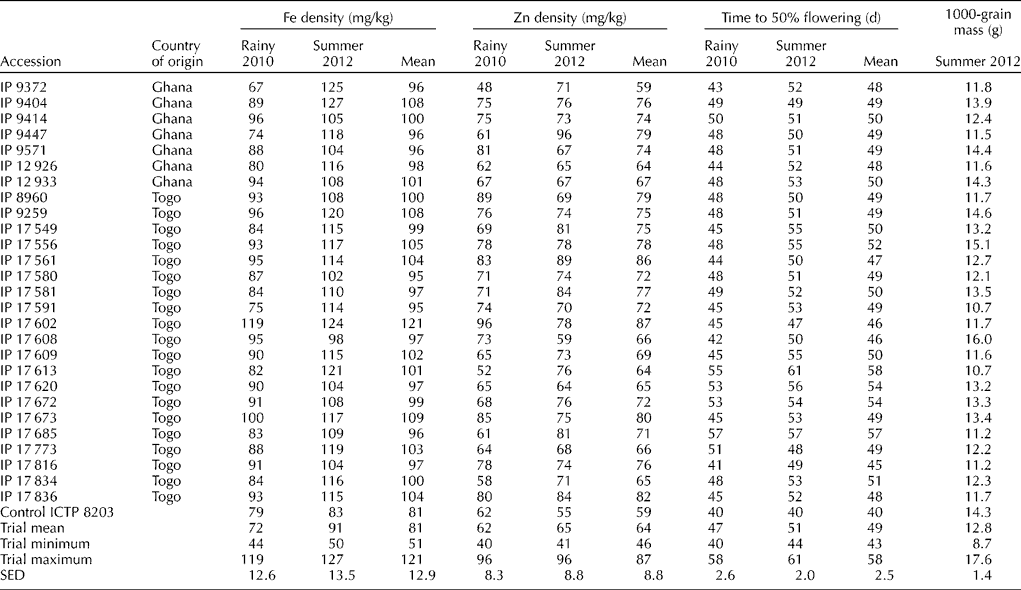
Averaged over all accessions, the mean Fe density level during the 2012 summer season was found to be 91 mg/kg, which was 26% higher than that in the 2010 rainy season (Table 3). Grain Zn density was comparable in both seasons (65 mg/kg in summer and 62 mg/kg in the rainy season). The DTPA-extractable Fe content in the soil was found to be 11.1 mg/kg in the 2012 summer season and 7.7 mg/kg in the 2010 rainy season, while the DTPA-extractable Zn content in the soil was comparable in both seasons (3.7 mg/kg in summer and 3.8 mg/kg in the rainy season). Fe density in the rainy season was found to be < 100 mg/kg in most of the accessions selected for very high Fe levels, while it was >100 mg/kg in almost all of these accessions in the summer season, varying from 102 to 127 mg/kg (mostly between 15 and 50% higher than in the rainy season; Table 3). The differences in Zn density were much smaller between the rainy and summer seasons in most of the accessions, and where relatively larger differences did occur, more frequently, the levels of Zn density were found to be higher in the summer season.
On the basis of the mean performance over the two seasons, large differences were observed among the re-evaluated set of 191 accessions for time to 50% flowering (43–58 d), with 94% of the accessions flowering in 45 to 55 d (data not shown). None of the accessions selected for high levels of Fe and Zn densities flowered as early as ICTP 8203, flowering of which occurred in 40 d (Table 3). The summer season data showed large variability for 1000-grain mass (8.7–17.6 g), with 59% of the accessions selected for high levels of Fe density having 12 to 16 g of 1000-grain mass. Except for two accessions, all the others had smaller seeds than ICTP 8203 (14.3 g of 1000-grain mass), although 16 accessions had >12 g of 1000-grain mass, which is considered to be a large grain size in pearl millet. In the full set of 191 accessions, there was no significant correlation observed between grain mass and Fe and Zn densities (r= 0.12 and 0.04, respectively). Similarly, there was no significant correlation observed between time to flowering and Fe and Zn densities (r= 0.08 and 0.04, respectively). Also, there was no correlation observed between grain mass and time to flowering (r= 0.05).
Discussion
Among a large number of pearl millet cultivars produced in India, an early-maturing and large-seeded open-pollinated variety, ICTP 8203, derived from selection within an iniadi landrace from Togo has been found to have the highest level of Fe density (Rai et al., Reference Rai, Yadav, Rajpurohit, Patil, Govindaraj, Khairwal, Rao, Shivade, Pawar and Kulkarni2013). This variety, released in India in 1988 (Rai et al., Reference Rai, Anand Kumar, Andrews, Rao, Raj and Witcombe1990), was cultivated on more than 0.8 million ha at the peak of its adoption in 1995 (Bantilan et al., Reference Bantilan, Subba Rao, Rai, Singh, Bantilan and Joshi1998), and it is still cultivated on about 0.2 million ha, mostly in the Maharashtra state of India. While ICTP 8203 serves as a good source of high levels of Fe density for breeding high-Fe cultivars, as are some of the population progenies of iniadi origin, this study identified several iniadi accessions having far higher levels of Fe density than those observed in ICTP 8203. Most of these high-Fe accessions also had far higher levels of Zn density than ICTP 8203, which resulted from a highly significant and high positive correlation between these two micronutrients. Earlier studies in pearl millet have also shown a highly significant and high positive correlation between the levels of Fe and Zn densities (Velu et al., Reference Velu, Rai, Muralidharan, Kulkarni, Longvah and Raveendran2007, Reference Velu, Rai and Sahrawat2008; Gupta et al., Reference Gupta, Velu, Rai and Sumalini2009; Rai et al., Reference Rai, Govindaraj and Rao2012; Govindaraj et al., Reference Govindaraj, Rai, Shanmugasundaram, Dwivedi, Sahrawat, Muthaiah and Rao2013). Similar relationships between Fe and Zn densities have been reported in other cereals such as finger millet (Upadhyaya et al., Reference Upadhyaya, Ramesh, Shivali, Singh, Varshney, Sarma, Ravishankar, Narasimhudu, Reddy, Sahrawat, Dhanalakshmi, Mgonja, Parzies, Gowda and Singh2011), sorghum (Ashok Kumar et al., Reference Ashok kumar, Reddy, Ramaiah, Sanjana Reddy, Sahrawat and Upadhyaya2009, Reference Ashok Kumara, Reddy, Ramaiaha, Sahrawat and Pfeiffer2013), maize (Oikeh et al., Reference Oikeh, Menkir, Maziya-Dixon, Welch and Glahn2003, Reference Oikeh, Menkir, Maziya-Dixon, Welch, Glahn and Gauch2004), rice (Anandan et al., Reference Anandan, Rajiv, Eswaran and Prakash2011) and wheat (Garvin et al., Reference Garvin, Welch and Finley2006; Velu et al., Reference Velu, Ortiz-Monasterio, Singh and Payne2011). These positive correlations could be due to common and overlapping quantitative trait loci (QTL) for grain Fe and Zn densities as reported in pearl millet (Kumar, Reference Kumar2011), wheat (Peleg et al., Reference Peleg, Cakmak, Ozturk, Yazici, Jun, Budak, Korol, Fahima and Saranga2009; Singh et al., Reference Singh, Chhuneja, Tiwari, Rawat, Neelam, Aggarwal, Malik, Keller and Dhaliwal2010), rice (Stangoulis et al., Reference Stangoulis, Huynh, Welch, Choi and Graham2007) and common bean (Blair et al., Reference Blair, Astudillo, Grusak, Graham and Beebe2009; Cichy et al., Reference Cichy, Caldas, Snapp and Blair2009). Thus, it would appear that these selected iniadi accessions can be effectively used to introgress high levels of Fe and Zn densities into elite breeding lines as selection for any one of these micronutrients is likely to lead to a correlated selection response for the other micronutrient.
While mean grain Fe density levels over all the accessions were found to be higher in the summer season than in the rainy season as observed for soil Fe content in these two seasons, the mean grain Zn density levels were found to be similar in both seasons as observed for soil Zn content. However, the patterns of Fe and Zn contents between the two seasons in the soil may not entirely be the reason for the corresponding patterns of grain Fe and Zn densities in these two seasons as the levels of both micronutrients in the soil were much above their critical levels of 2.0 mg Fe/kg and 0.8 mg Zn/kg. It is possible that with better control of soil moisture in the summer season, resulting from controlled irrigation regime, leading to better nutrient uptake from the soil, and more efficient nutrient translocation and loading under mostly clear and/or high-temperature conditions, accessions may show higher levels of Fe density in the summer season than in the rainy season. Considering the large genotype × environment interaction, further studies are needed to evaluate these accessions identified with high levels of Fe and Zn densities over a diverse range of environments to select those with stable performance.
Earliness is a farmer-preferred trait in most of the pearl millet-growing regions, as it helps escape terminal drought and permits double cropping. Large grain size is also a farmer-preferred trait in several parts of Africa and India. Lack of any adverse association of Fe and Zn densities with time to flowering and grain mass showed that accessions identified with high levels of Fe and Zn densities can be effectively used to breed improved high-Fe and high-Zn density cultivars without compromising on maturity and grain size. Since pearl millet germplasm accessions are highly variable populations due to the cross-pollinated breeding system of this crop, it is likely that progenies with much higher levels of these micronutrients can be produced by selecting within these accessions, as has been shown by developing a higher-Fe version of ICTP 8203 through intra-population selection (Rai et al., Reference Rai, Yadav, Rajpurohit, Patil, Govindaraj, Khairwal, Rao, Shivade, Pawar and Kulkarni2013). Production and evaluation of progenies from the accessions of iniadi germplasm selected with high levels of Fe and Zn densities are under way at ICRISAT to derive stable breeding lines with much higher levels of these micronutrients. These breeding lines will be used in crosses with elite inbred lines to develop high-yielding hybrid parents and consequently high-yielding hybrids with higher levels of Fe and Zn densities. These lines will also be used to investigate the relationships of Fe and Zn densities with grain yield, and to identify those for breeding open-pollinated varieties that exceed the grain yield and Fe and Zn densities of ICTP 8203. Some of these lines can be used for developing mapping populations to identify QTL for high levels of Fe and Zn densities. Genomic studies of the accessions of iniadi germplasm selected for high levels of Fe and Zn densities would provide useful information on the extent of diversity for genes responsible for high levels of these two micronutrients in these accessions. It would also be interesting to examine the distribution of Fe and Zn densities in the grains of breeding lines selected with high levels of these micronutrients.
Numerous positive agronomic attributes of iniadi germplasm, such as relatively less photoperiod sensitivity, early flowering, large seeds of dark grey colour and globular shape, compact panicles and good combining ability, have led to its extensive utilization in the breeding programmes worldwide (Andrews and Anand Kumar, Reference Andrews and Anand Kumar1996). A recent research has shown that lines derived from this germplasm could be good sources of downy mildew (Sclerospora graminicola (Sacc.) Schroet) resistance, drought tolerance and high stover quality (Rai et al., Reference Rai, Hash, Singh and Velu2008). Therefore, the results of this study showing this germplasm as a source of high levels of Fe and Zn densities, and also showing that these traits are not associated with time to flowering and seed size, indicate iniadi germplasm to be a valuable germplasm resource for genetic improvement in pearl millet.
Acknowledgements
This study was carried out under the Dryland Cereals Research Program. The authors acknowledge the funding support from the HarvestPlus Challenge Program of the CGIAR, and support from Waite Analytical Services, Adelaide, Australia, for laboratory analysis.