Buffalo are widely chosen for production of milk in many countries worldwide, especially in the Asian ones. In general, buffaloes produce about 1000 kg milk/lactation, on one milking per day, and lactation length range between 250–270 d. They have shown significant responses to the selection process, due to their high genetic variability with a great ability of adaptation to various environments, high fertility and the longevity in production, which allowed the global herd to evolve (Vieira et al. Reference Vieira, Teixeira, Kuabara and Andrade de Oliveira2011). The water buffalo has prime importance in the lives of farmers and thus in the economy of many countries worldwide. They are not only draught animals, but also a source of meat, horns, skin and particularly rich and precious milk that may be converted into cream, butter, yoghurt and many different kinds of cheese (Michelizzi et al. Reference Michelizzi, Dodson, Pan, Amaral, Michal, McLean, Womack and Jiang2010).
The use of highly polymorphic markers as microsatellites is extremely important to investigate the genetic status. These markers are particularly important to access intra-racial diversity, levels of inbreeding, genetic differentiation between breeds, mixed breeds introgression and they are essentials in studies of genetic diversity and species conservation for purposes of selection of traits of economic interest (Freeman et al. Reference Freeman, Bradley, Nagda, Gibson and Hanotte2005).
The water buffalo was imported into Cuba from Australia and Trinidad and Tobago Island. A total of 2984 buffalos (2705 swamp buffalo and 279 river buffalo) were imported in order to contribute to the agricultural economy and food security of Cuba. The current national herd far exceeds the number of animals imported which is indicative of their ability to adapt to the environmental conditions in the country. Animals of river breed ‘Buffalypso’ came from Panama and Trinidad and Tobago (Mitat, Reference Mitat2009). In Cuba, this population was mixed, without control, with swamp buffalo (Carabao) subsequently imported from Australia (Borghese & Mazzi, Reference Borghese, Mazzi and Borghese2005). Recently, semen from the Mediterranean breed was imported to improve dairy production indicators and reduce inbreeding, although there is little information about the effects of this importation.
The aim of this study was to validate a panel of 30 microsatellite recommended by FAO/ISAG for studies of biodiversity in cattle to improve the characterisation of Cuban buffalo populations.
Materials and methods
Peripheral blood samples of 50 adult female buffaloes were collected from a population of unrelated water buffalo (uncontrolled mattings between Buffalypso and Carabao animals), clinically healthy and bred extensively in the Institute of Animal Science (ICA), Mayabeque province, Cuba. Genomic DNA was extracted using Promega Wizard®Genomic DNA purification commercial kit according to the MSRP protocol (Promega Corp., Madison, WI). The quality and quantity of DNA (ng/μl) for each sample was analysed in a spectrophotometer (Nanodrop ND1000, Thermo Scientific).
A total of 30 heterologous bovine microsatellite loci were amplified from a panel of 30 markers recommended by the International Society for Animal Genetics (ISAG)/Food and Agriculture Organization of the United Nations (FAO) working group. These microsatellites were analysed to estimate various genetic diversity parameters.
The polymerase chain reaction (PCR) was carried out using the QIAGEN multiplex PCR kit. The internal size standard GeneScan-500LYS (Applied Biosystems, Warrington, United Kingdom) was used for sizing alleles.
There was determined the genetic variability and genetic structure using several software previously designed for this purpose.
For more details of materials and method see online Supplementary file.
Results and discussion
The investigation of the genetic relationships among buffalo populations will provide a useful tool to support conservation decisions and to contribute to the selection and preservation of genetic resources (Attia et al. Reference Attia, Abou-Bakr and Nigm2014). Several authors have been investigating the genetic diversity of buffalo populations worldwide using microsatellite markers (Nagarajan et al. Reference Nagarajan, Kumar, Nishanth, Haribaskar, Paranthaman, Gupta, Mishra, Vaidhegi, Kumar, Rajan and Kumar2009; Abou-Bakr et al. Reference Abou-Bakr, Ibrahim, Hafez, Attia, Abdel-Salam and Mekkawy2012; Acosta et al. Reference Acosta, Uffo, Sanz, Obregón, Ronda, Osta, Martin-Burriel, Rodellar and Zaragoza2014; Martínez et al. Reference Martínez, da Silva, Mitat, Ponce, Benício da Silva, Paes Barbosa, Uffo and Gomes Filho2015).
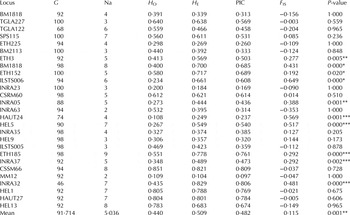
After PCR and capillary electrophoresis, twenty-eight of the 30 tested regions were amplified successfully and only one of these markers (ETH10) turned out to be monomorphic. Using multiplex PCR amplification, microsatellites displayed reproducible and non-ambiguous peaks for allele assignation. The alleles varied in their size from 69–281 bp. We observed 143 alleles in the Cuban water buffalo population, higher than any other previously observed. For example, Acosta et al. (Reference Acosta, Uffo, Sanz, Obregón, Ronda, Osta, Martin-Burriel, Rodellar and Zaragoza2014) found a total of 87 alleles in the studied Cuban water buffalo population in their work using 16 bovine microsatellite markers. The average number of alleles per locus was 5·04, similar to the 5·44 found by Acosta et al. (Reference Acosta, Uffo, Sanz, Obregón, Ronda, Osta, Martin-Burriel, Rodellar and Zaragoza2014). The number of alleles per polymorphic locus ranged from two (INRA63 and MM12) to nine (ETH185) while Acosta et al. (Reference Acosta, Uffo, Sanz, Obregón, Ronda, Osta, Martin-Burriel, Rodellar and Zaragoza2014) reported values ranging from two (TGLA126) to nine (ETH225) (Table 1). In a different report, Martínez et al. (Reference Martínez, da Silva, Mitat, Ponce, Benício da Silva, Paes Barbosa, Uffo and Gomes Filho2015) found a total of 88 alleles across the five studied microsatellite loci when comparing three different populations, one of them being Cuban. The total number of alleles per population ranged from 26 in Brazilian Murrah buffaloes to 33 in Cuban Buffalypso/Carabao hybrids. Locus CSSM033 showed the highest Na per locus (12) while ILSTS5 showed the lowest (2). Mean Na values ranged from 5·2 in Murrah to 6·6 in Buffalypso/Carabao hybrids.
Descriptive statistics of the 27 polymorphic microsatellite marker loci for Cuban water buffalo

Na, # alleles; G, # genotype; H O, observed heterozygosity; HE, expected heterozygosity; PIC, polymorphism information content; F IS, Wright F-statistics.
Exact test for Hardy–Weinberg equilibrium (P-value); statistical significance *P < 0·05; **P < 0·01; ***P < 0·001
The observed and expected heterozygosity ranged from 0·108 (HAUT24) to 0·851 (CSSM66), and 0·104 to 0·829 in MM12 and INRA32 loci, respectively in the studied population and were similar to reported values by Acosta et al. (Reference Acosta, Uffo, Sanz, Obregón, Ronda, Osta, Martin-Burriel, Rodellar and Zaragoza2014). The polymorphic information content (PIC) (Table 1) ranged from 0·097 (MM12) to 0·806 (INRA32), and the overall value for these markers was 0·482.In this work, 27 (96·4%) of the 28 bovine markers amplified were polymorphic, which confirms the conservation of DNA sequences flanking microsatellites within the Bovidae family. A total of 571 microsatellite markers had been characterised for water buffalo until now (Nagarajan et al. Reference Nagarajan, Kumar, Nishanth, Haribaskar, Paranthaman, Gupta, Mishra, Vaidhegi, Kumar, Rajan and Kumar2009); Abou-Bakr et al. (Reference Abou-Bakr, Ibrahim, Hafez, Attia, Abdel-Salam and Mekkawy2012) analysing a total of 471 unrelated Egyptian buffaloes found 82% of the studied markers polymorphic (9 of 11). Martínez et al. (Reference Martínez, da Silva, Mitat, Ponce, Benício da Silva, Paes Barbosa, Uffo and Gomes Filho2015) described three of the markers (ILSTS5, ETH152 and CSSM042) with PIC values below 0·5, thus being moderately informative (0·5 > PIC > 0·25). Genetic markers with PIC values lower than 0·25 are considered to be less informative and those with values higher than 0·5 are reckoned as distinctly informative in population genetic studies; loci with many alleles and a PIC near one are most desirable. Following this criteria, in this study, twenty-six microsatellite loci appeared to be highly informative (PIC > 0·5) and thus will be useful to evaluate the genetic diversity in Cuban buffalo population.
Fourteen loci displayed significant reduction of heterozygosity (ETH3, BM1818, ETH152, ILSTS006, INRA05, HAUT24, HEL5, INRA35, HEL9, ETH185, INRA37, INRA32, HEL1 e INRA63: 1). All of loci within significant population inbreeding (F IS) were out of Hardy-Weinberg equilibrium (HWE) conditions with a significant heterozygote deficit. The statistics F IS is an estimate of variation within a population that measures the reduction in heterozygosity in an individual due to nonrandom mating within sub populations. The F IS in Cuban water buffalo can be considered higher compared with other populations (F IS = 0·109) like the results reported by Shokrollahi et al. (Reference Shokrollahi, Amirinia, Djadid, Amirmozaffari and Ali Kamali2009) who found a value of 0·047 in Iranian river buffalo. It could be inferred that the obtained low values of genetic variability are a consequence of the use of single 70 samples of DNA for the analysis. In our opinion, this it is not a reason of great weight in the obtained results if it is considered that FAO has suggested that for reliable estimation of allele frequencies, at least 25 animals per breed should be typed, but at least 40 animals should be sampled to allow for possible losses, mistyping, missing values and genetic subdivision within breeds or various degrees of cross-breeding (FAO, 2011). Acosta et al. (Reference Acosta, Uffo, Sanz, Obregón, Ronda, Osta, Martin-Burriel, Rodellar and Zaragoza2014) found also a lower F IS value (0·087) when studied 16 bovine microsatellite loci in a Cuban buffalo population as well as Martínez et al. (Reference Martínez, da Silva, Mitat, Ponce, Benício da Silva, Paes Barbosa, Uffo and Gomes Filho2015) who found low F IS values (0·018) when studied Cuban Buffalypso/Carabao hybrid breed.
Our analysis revealed a possible drastic reduction in heterozygosity. Apparently, in the Cuban population there is equilibrium between mutation and drift, as is shown in online Supplementary Fig. S1 which maintains the L-shape. Santana et al. (Reference Santana, Aspilcueta-Borquis, Bignardi, Albuquerque and Tonhati2011) established that problems exist in the structure of the Murrah buffalo population in southeastern Brazil, in the form of bottlenecks and small effective size; they also identified that inbreeding generally had a negative effect on milk production and quality traits ant the effect observed may have important economic implications for production systems. Moreover, the higher average relatedness coefficient values suggest that inbreeding will continue to quickly increase if breeders do not rapidly implement appropriate management and breeding strategies. For this reason, we propose that a mating system designed to avoid an increase of inbreeding should be applied to Cuban buffalo population to maintain genetic diversity.
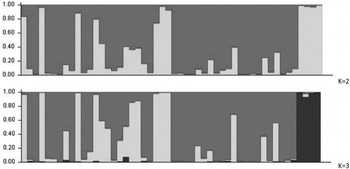
A structure analysis using a Bayesian approach showed the highest ΔK at K = 5. The individuals on the buffalo population were separated between them after the first calculation clusters (K = 2). Three groups of animals are distinguished in the population, clustered together at K = 3 (Fig. 1).These results are expected due to the selection applied for genetic improvement of economic traits, mainly milk production and are in agreement with the results obtained by Attia et al. (Reference Attia, Abou-Bakr and Nigm2014) who investigated biodiversity in Egyptian and Mediterranean buffalo respectively, using microsatellite markers and found significant deviation from HWE. In the Cuban population there have been no recent imports of live animals. On the other hand, insemination with semen from the Mediterranean race to increase genetic diversity has been used in an effort to introduce new genes to provide better production characteristics.
Estimated population structure obtained by structure analyses. Each thin vertical line represents an individual, which is partitioned into coloured segments that represent the proportional contribution of the inferred K clusters.

Results of this study confirm that a large fraction of bovine DNA microsatellite markers can be amplified and are polymorphic in the Cuban buffalo. These DNA markers could be used for population genetic studies on the Cuban buffalo, which possesses a considerable amount of genetic diversity due to low pressure of artificial selection and possibility of random mating. The Cuban buffalo population require a scientific production system in order to improve the production without losing the significant genetic structure of these economically important animals, so a mating system to avoid an increase of inbreeding should be applied to Cuban buffalo population to maintain genetic diversity.
Supplementary material
The supplementary material for this article can be found at https://doi.org/10.1017/S0022029917000425.
This work was supported by research grant MAEC-AECID. We would like to acknowledge Dr José Raul López Álvarez for providing the blood samples from Buffalo farm of Instituto de Ciencia Animal (ICA), from Cuba and Mrs Carmen Cons (LAGENBIO, UNIZAR, Spain) for technical assistance.