Introduction
As the population of adults with congenital heart disease (CHD) continues to increase,Reference Mareljuli, Ionescu-Ittu, Mackie, Guo, Dendukuri and Kaouache 1 it is important to address the full impact of living with this lifelong medical condition. Previous studies indicate that up to one-third of these patients experience difficulties with anxiety or depression.Reference Kovacs, Saidi and Kuhl 2 – Reference Kourkoveli, Rammos, Parissis, Maillis, Kremastinos and Paraskevaidis 4 Elevated rates of anxiety and mood disorders have in turn been associated with poorer clinical outcomes.Reference Kourkoveli, Rammos, Parissis, Maillis, Kremastinos and Paraskevaidis 4 , Reference Kim, Gauvreau, Bacha, Landzberg and Benavidez 5 Guidelines for the management of adults with CHD recommend screening for depression symptoms during clinical encounters.Reference Warnes, Williams and Bashore 6 This is consistent with an American Heart Association Science Advisory recommending routine screening for depression symptoms in adults with coronary artery disease.Reference Lichtman, Bigger and Blumenthal 7 This likely reflects the known link between depression and poorer prognosis among adults with acquired heart disease.Reference Lichtman, Froelicher and Blumenthal 8 However, as the connections between stress and anxiety with cardiovascular disease are further elucidated,Reference Steptoe and Kivimaki 9 , Reference Tully, Cosh and Baune 10 a broader definition of psychological distress among adults with CHD becomes necessary.
Study aims were to: (1) investigate the prevalence of elevated symptoms of depression vs. anxiety in adults with CHD, and (2) explore whether demographic factors, medical variables, and/or quality of life differ between patients with elevated depression vs. anxiety symptoms.
Materials and methods
Study population
Consecutive adults (≥18 years old) with CHD who presented for outpatient care were approached to participate. Patients who lacked cognitive or language abilities to provide informed consent and complete surveys in English were excluded. Study participation included completion of questionnaires, including a background information survey, as well as medical record review. This study was approved by the institutional review board, and verbal and written informed consent were obtained from all participants.
Measures
Participants completed the Hospital Anxiety and Depression Scale, which is comprised of a 7-item anxiety subscale and a 7-item depression subscale.Reference Zigmond and Snaith 11 Scores ≥ 8 on a subscale indicate clinically elevated symptoms within that domain. The Hospital Anxiety and Depression Scale was developed and psychometrically validated for use in individuals with medical conditions,Reference Bjelland, Dahl, Haug and Neckelmann 12 , Reference Bambauer, Locke, Aupont, Mullan and McLaughlin 13 and has previously been administered to adults with CHD.Reference Enomoto and Nakazawa 14 , Reference Westhoff-Bleck 15
We adopted the definition from Moons et al. that quality of life is most appropriately defined as overall life satisfaction, both related and unrelated to health,Reference Moons, Marquet, Budts and De Geest 16 and the following two surveys which have previously been used in CHD were selected.Reference Apers, Kovacs and Luyckx 17 The Linear Analogue Scale ranges from 0 (worst imaginable quality of life) to 100 (best imaginable quality of life).Reference Apers, Kovacs and Luyckx 17 The Satisfaction with Life Scale is a 5-item measure for which total scores range from 5 to 35, with higher scores reflective of greater life satisfaction.Reference Diener, Emmons, Larsen and Griffin 18
Patients also completed a background demographics survey. Medical data abstraction included CHD complexity,Reference Warnes, Williams and Bashore 6 history of cardiac surgeries or catheter interventions, and medical comorbidities.
Statistical analysis
Descriptive statistics were performed with normally distributed continuous variables summarized as means and standard deviations and skewed continuous variables summarized as medians and interquartile ranges. Counts and percentages are reported for categorical variables. We focused on Hospital Anxiety and Depression Scale cut-off scores ≥ 8 because we wished to explore factors that differentiated patients with vs. without elevated psychological distress. Chi-Square tests were performed to explore the distribution of categorical variables across groups. Mann-Whitney U Tests and Kruskal-Wallis Tests were performed to determine differences in continuous dependent variables. All statistical tests were two-tailed, and p values of <0.05 were considered statistically significant in this exploratory study. Data were analyzed using SPSS version 22 software (IBM Corp., Armonk, NY, USA).
Results
Patient characteristics
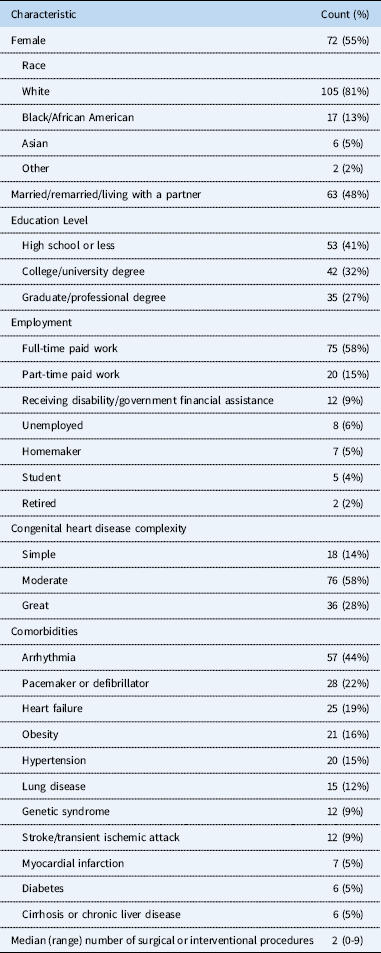
Of 222 patients approached, 138 (62%) consented and were enrolled. Time and scheduling concerns were the most frequently cited reasons for declining study participation. Eight participants were excluded from analysis due to incomplete or uninterpretable surveys, resulting in a final sample size of 130. The most common CHD diagnoses were tetralogy of Fallot (21%), transposition of the great arteries (10%), and bicuspid aortic valve/congenital aortic stenosis (9%). The median number of previous surgical or interventional procedures was 2 and ranged from 0 to 9. Table 1 presents the demographic and medical characteristics of the sample.
Participant demographic and clinical characteristics (n=130).

Prevalence of elevated psychological distress and mental health treatment
The mean anxiety subscale score was 7.0±3.8 and the mean depression subscale score was 4.0±3.1. Overall, 56 participants (43%) reported elevated symptoms (scores ≥ 8) on at least one subscale; 15 patients (12%) reported elevations on both subscales, 40 patients (31%) reported elevations on the anxiety subscale only, and 1 patient reported elevated symptoms on the depression subscale only. Thus, most patients with elevated depression symptoms (15/16; 94%) also had elevated anxiety symptoms.
Fifty-one participants (39%) reported having engaged in psychotherapy and/or pharmacotherapy for a psychological concern. Patients with a self-reported history of mental health treatment were more likely to have elevated anxiety scores (59% vs. 32%; p=0.003) but not more likely to have elevated depression scores (16% vs. 10%; p=0.360). Thirty-four percent (19/56) of participants with elevated anxiety and/or depression symptoms reported mental health treatment at the time of study participation.
Factors associated with elevated psychological distress
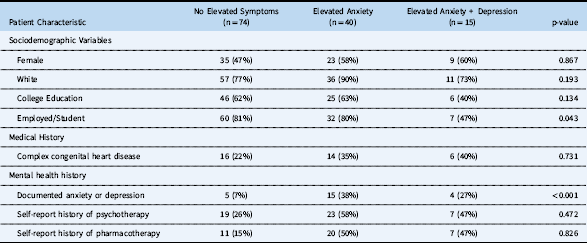
Table 2 presents sociodemographic and clinical variables across 3 categories of patients: those with no psychological distress (n=74), those with elevated anxiety scores only (n=40), and those with elevations in both anxiety and depression scores (n=15). The one patient with an elevated depression score without an elevated anxiety score was not included in this set of analyses. There were no significant differences in age, sex, race, education level, or defect complexity between the 3 categories. However, compared to a collapsed group of patients with no elevated symptoms or elevated anxiety subscales alone (n=114), patients with both elevated depression and anxiety symptoms (n=15) were approximately half as likely to be employed or a student (47% vs. 81%, p=0.016).
Sociodemographic and clinical variables by symptom categories (n=129).

*p<0.05
Note: We excluded one patient with an elevated HADS-D score without an elevated HADS-A score
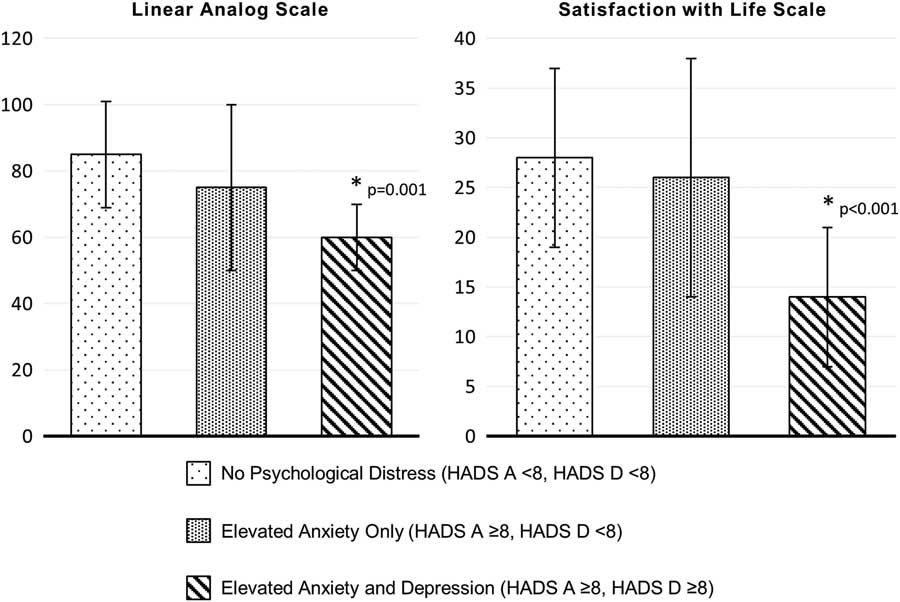
In the entire sample, the median Linear Analogue Scale quality of life score was 80 (interquartile range: 65-90). Compared to patients with 0 or 1 elevated subscales, patients with elevations in both reported lower scores on the Linear Analogue Scale (60 vs. 81, p<0.001). The median score of the Satisfaction with Life Scale was 27 (interquartile range: 19-30). Compared to patients with 0 or 1 elevated subscales, patients with elevations in both also reported lower scores on the Satisfaction with Life Scale (14 vs. 28, p<0.001). Figure 1 displays scores on the 2 quality of life measures across 3 categories: no psychological distress, elevated anxiety scores only, and elevated anxiety plus depression scores.
Scores on two quality of life measures according to psychological symptom profiles. Patients with elevated symptoms of anxiety and depression have significantly lower scores on quality of life metrics compared to those with no psychological distress or elevated anxiety alone.

Discussion
There are two important findings from this study. First, elevated symptoms of anxiety (n=55) were over three times more common than elevated symptoms of depression (n=16). The majority of participants (73%) with elevated anxiety symptoms did not demonstrate simultaneous elevated depression symptoms. This suggests that routine clinical screening for depression, as advocated by published guidelines,Reference Warnes, Williams and Bashore 6 , Reference Lichtman, Bigger and Blumenthal 7 would likely miss a sizable proportion of the psychological distress among adults with CHD. A recent study also observed that approximately 1 in 5 adults with CHD endorsed symptoms consistent with post-traumatic stress disorder.Reference Deng, Khan and Drajpuch 19 Thus, attempts to identify and manage psychological distress in adults with CHD must extend beyond a singular focus on depression symptoms. Given the unique challenges faced by individuals with CHD throughout their lives, often including multiple surgeries and interventions, it is not unexpected that psychological symptoms are common. Thus, adult CHD programs and providers are urged to develop strategies to identify clinically-significant psychological distress and facilitate mental health treatment with professionals experienced in providing care to individuals with chronic health conditions.
Second, 15 of 16 patients with elevated depression symptoms also had elevated anxiety symptoms and it was this combination that was most strongly associated with poorer outcomes (less likely to be employed/studying and lower quality of life). Although we anticipated being able to compare participants with elevated depression symptoms vs. those with elevated anxiety symptoms, this was not possible because there was only one patient with an elevation on the depression subscale without an elevation on the anxiety subscale. However, given that elevated depression symptoms most often co-occurred with elevated anxiety symptoms, and that the combination had strong quality of life implications, this may be considered a higher-needs group to which to target psychological intervention. When conducting future research and also when providing mental health treatment, it is important to be mindful of the relationship between psychological and social functioning (e.g., family, friendships, and romantic relationships). For example, a prior study identified social adjustment (loneliness and social anxiety) as the strongest correlates of depression and anxiety symptoms.Reference Kovacs, Saidi and Kuhl 2
There is emerging evidence supporting the importance of employment for quality of life of adults with CHD.Reference Apers, Kovacs and Luyckx 20 It is reasonable to hypothesize a bidirectional relationship between employment status and psychological distress. Some patients will be unable to work due to physical limitations, possibly contributing to psychological distress. Some patients with significant psychological distress may have difficulty facing the challenges of obtaining and retaining employment. It is thus reasonable to speculate that better outcomes may be associated with combined interventions that target psychological distress and employment readiness in adults with CHD who are medically able to work. We strongly encourage future research to better understand and address employment challenges faced by adults with CHD, including those who are job-seeking as well as those who have jobs and might be struggling to maintain them.
Participation was limited to patients who had health insurance, attended scheduled appointments at a tertiary center, and consented to participate. Thus, findings may not be generalizable to all adults with CHD, particularly those without access to specialized care. We also do not know whether patients who opted not to participate (most often reportedly due to time and scheduling concerns) differed from those who chose to participate; it is unknown whether they would have equivalent, worse, or better psychological well-being. Another limitation is the use of self-report instruments (rather than clinical interviews) to assess anxiety and depression. We do not know the percentage of patients with elevated symptoms who would meet diagnostic criteria for a mood or anxiety disorder and be directed toward mental health treatment. However, our observation that 43% of study participants had elevations on at least one subscale is only slightly higher than North American clinical interview studies in which 29–36% met diagnostic criteria.Reference Kovacs, Saidi and Kuhl 2 , Reference Bromberg, Beasley, D’Angelo, Landzberg and DeMaso 3 Finally, given the significant overlap between elevated depression and anxiety symptoms in our sample, as stated we were unable to explore differences between patients with elevated depression vs. anxiety symptoms.
Conclusions
The responsibility to adults with CHD extends beyond medical treatment and outcomes. Over 40% of adults with CHD in our study reported elevated symptoms of anxiety and/or depression. Routine screening limited to depression would overlook a large proportion of patients with other forms of psychological distress, including anxiety and post-traumatic stress disorder. Further strategies to identify clinically-significant anxiety and depression in the clinical setting, facilitate mental health treatment, and support appropriate engagement in employment are needed to enhance the lives of adults with CHD.
Acknowledgements
The authors wish to acknowledge Katherine Awh for editing assistance.
Financial Support
This study was supported with a grant from Big Hearts to Little Hearts and the Bronchick Family Foundation.
Conflicts of Interest
None.
Ethical Standards
The authors assert that all procedures contributing to this work comply with the ethical standards of the relevant American guidelines on human experimentation and with the Helsinki Declaration of 1975, as revised in 2008, and has been approved by the Hospital of the University of Pennsylvania Institutional Review Board.