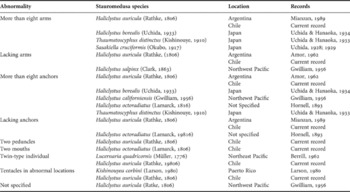
The order Stauromedusae are small polyp-like medusae which live attached to algae or other objects by means of a stalk-like peduncle. Members of this order are typically described as having an umbrella that draws out into eight simple (e.g. Haliclystus auricula; Clark, Reference Clark1878) or four bifurcated (e.g. Sasakiella cruciformis; Uchida, Reference Uchida1929) arms, each tipped with a bunch of short tentacles. On the exumbrellar side of the margin, between each pair of arms are eight adhesive anchors. As with other animals, morphologically abnormal medusae may be present in the population (Uchida, Reference Uchida1928). Despite descriptions of the order dating back to the late 1700s (Müller, Reference Müller1776), morphological abnormalities in this group have, however, rarely been reported. Individuals with abnormal symmetry are the most commonly reported, with an excess of arms or anchors (e.g. Haliclystus auricula with up to 12 arms and 12 anchors; Uchida & Hanaoka, Reference Uchida and Hanaoka1934). Organisms which seemed to be damaged and lack parts of their body such as arms or tentacles have been recorded by Amor (Reference Amor1962) and Gwilliam (Reference Gwilliam1956). A more unusual account is the description of an abnormal twin-type individual of Lucernaria quadricornis (Berrill, Reference Berrill1962), which had two nearly separate individuals, the peduncle of the smaller one arising from the peduncle of the larger. Some of these abnormalities (summarized in Table 1) have been attributed to the physical action of waves (Amor, Reference Amor1962) or predation (Uchida & Hanaoka, Reference Uchida and Hanaoka1933), removing body parts (Amor, Reference Amor1962) which could later be regenerated (Hornell, Reference Hornell1893; Berrill, Reference Berrill1962).
Known stauromedusan abnormalities.

Records of morphological variation and abnormalities present in organisms are essential for understanding and increasing our knowledge of their taxonomy, biology and ecology. This is especially true for the order Stauromedusae, where taxonomic revisions of some groups (e.g. the genus Haliclystus; Hirano, Reference Hirano1997) are still necessary and little information about their biology and ecology exists. If a morphologically abnormal specimen is observed and it has not been previously described in the literature, it may lead to confusion and erroneous identification. Abnormal organisms may also be indicators of ecological processes, such as disturbances, affecting populations. The aim of this work is to describe the morphological abnormalities and their relative abundance in a population of Haliclystus auricula in southern Chile and discuss their possible causes.
Between November 2001 and November 2002, whilst researching the population biology, habitat and diet of the stauromedusa Haliclystus auricula (Zagal, Reference Zagal2004a, Reference Zagalb), 3790 Stauromedusae were sampled (see Zagal, Reference Zagal2004b for detailed methodology) and their morphological abnormalities recorded and photographed.
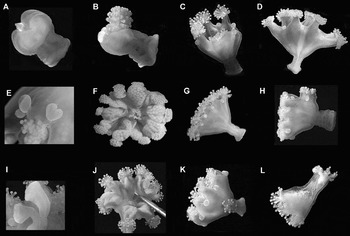
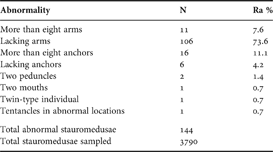
Abnormalities were present in 144 medusae, 4% of the sample. The eight types of abnormalities observed and their relative abundances are summarized in Table 2 and Figure 1. The most frequent abnormality recorded (74% of all abnormalities) consisted in medusae which seemed to be damaged, lacking some or all arms. These included an individual with no arms and with only one anchor (Figure 1A) and medusae with one to seven arms (Figure 1B–D) instead of eight. In most cases (Figure 1A–C), missing arms seemed to have been removed, leaving an empty space where one would expect the arm to be. In other cases (Figure 1D) only a change in symmetry of the animal was observed, with no vacant spaces between arms. Medusae with 9–12 anchors instead of eight made up 11% of the abnormalities recorded. These medusae usually had two individual anchors or joint heart-shaped anchors between one or more arms (Figure 1E). Eleven (8%) medusae with 9–12 arms were observed (Figure 1F–H). These medusae had pentamerous (Figure 1F) or hexamerous symmetry (Figure 1G) or a second calyx apparently growing from the side of the main calyx (Figure 1H), with its own arms, tentacles, anchors and gonads. Less frequent abnormalities include individuals lacking 1–3 anchors between some of their arms (4%), medusae with two peduncles (1%; Figure 1I) and one individual with two mouths (Figure 1J) instead of one. An individual with a bunch of tentacles growing from the side of its calyx instead of the arm was also found (Figure 1K). One twin-type specimen consisted of two nearly complete individuals sharing the same peduncle, with a smaller medusa growing out of the larger one at the base of its calyx (Figure 1L).
Morphological abnormalities in the stauromedusa Haliclystus auricula (umbrella height): (A) no arms (2 mm); (B) one arm (1.9 mm); (C) five arms (5.5 mm); (D) seven arms (6 mm); (E) double anchors (6.8 mm); (F) ten arms (7 mm); (G) 12 arms (5 mm); (H) 12 arms (5.1 mm); (I) two peduncles (5.3 mm); (J) two mouths (5.5 mm); (K) tentacles in abnormal location (6.1 mm); and (L) twin-type individual (larger medusa, 2 mm).

Frequency of occurrence (N) and relative abundance (Ra %) of morphological abnormalities observed in Haliclystus auricula.

Eight morphological abnormalities were seen in H. auricula. The most frequently observed was medusae which seemed to be damaged, lacking arms and anchors. This is most probably caused by predators or physical disturbance by the environment such as wave-action. Known predators of Stauromedusae include fish (Davenport, Reference Davenport1998) and pycnogonids (Uchida & Hanaoka, Reference Uchida and Hanaoka1933). The nudibranchs Hancockia schoeferti and Thecacera darwini and the fish Myxodes viridis were frequently observed near or on the same algae as H. auricula, but no evidence was found of them eating Stauromedusae. Medusae with abnormal symmetry have been frequently reported in other cnidarians such as the medusa Aurelia (Gershwin, Reference Gershwin1999) and the hydromedusae Gonionemus (Hargitt, Reference Hargitt1901) and Olindias sambaquiensis (Nogueira Junior & Haddad, Reference Nogueira Junior and Haddad2006). It is unclear whether variations in symmetry are caused by genetic, environmental, or developmental factors, or some combination of these (Gershwin, Reference Gershwin1999). Stauromedusae with two peduncles or two mouths are described for the first time and a twin-like individual for the first time in this species. These abnormalities, together with a medusa with a second calyx apparently growing out of the first one, raise the question of whether H. auricula might be able to reproduce asexually. Collins & Daly (Reference Collins and Daly2005) have already raised this question previously after the observation of dense aggregations of the deepwater species Lucernaria janetae and a juvenile attached to the base of the peduncle of a large adult. The only records of asexual reproduction in the order Stauromedusae are for Stylocoronella riedli and S. variabilis (Kikinger & Salvini-Plawen, Reference Kikinger and Salvini-Plawen1995) where planuloids are produced by budding of the calyx or special tentacles, respectively. Asexual reproduction by longitudinal fission or budding of the stauromedusa itself into new polyps has, however, never been recorded. The presence of more body parts than normal may also be the result of regenerating injured tissue. Although this has been suggested previously by Hornell (Reference Hornell1893) and Berrill (Reference Berrill1962) and is well-developed in scyphozoa (Arai, Reference Arai1997), it has not been tested experimentally in Stauromedusae. The abnormalities observed may also reflect a lack of genetic variation in the population. Dispersal in H. auricula seems to be limited to detachment and re-attachment of the peduncle in adults and the development of crawling larvae during sexual reproduction (Otto, Reference Otto, Chia and Rice1978) which may restrict dispersal and gene-flow. Future studies in this group are necessary to test whether the abnormalities found are environmentally induced, caused by a lack of genetic variation or a combination of these two. It is unclear whether the abnormalities shown in this study are within the normal morphological variation of Haliclystus auricula. The geographical range of this species includes the North Pole, Arctic Ocean, North Atlantic (Y.M. Hirano, personal communication), Pacific coast of Chile (Quezada, Reference Quezada1970; Zagal & Hermosilla, Reference Zagal and Hermosilla2001) and the Atlantic coast of Argentina (Amor, Reference Amor1962). To date, only Hirano (Reference Hirano1997) has addressed the need for a taxonomic revision of the genus Haliclystus and has been capable of identifying many specimens of the Haliclystus auricula morph. Genetic studies would be useful in determining the true geographical range of Haliclystus auricula and in determining the range of morphological variation in the species.
ACKNOWLEDGEMENTS
I am most grateful to Y. Hirano for preliminary identification of the stauromedusa and for her help and advice. I thank C. Mills for her encouraging support. Field work was greatly assisted by C. Hermosilla and J. Harries. This work formed part of my undergraduate thesis under the supervision of C. Jara, E. Clasing and J. Zamorano. I thank A.J. Underwood and anonymous referees for reviewing the manuscript.