Once considered taboo in public schools, an increasing number of scholars and policymakers have come to agree that religion deserves more extended discussion in the curriculum than it currently receives (Wexler 2002; Douglass Reference Douglass2000). Not only is teaching about religion's influence on history, art, and culture a crucial part of a liberal education (Nord Reference Nord1995; Prothero Reference Prothero2007), but teaching about religion can be an avenue into discussion of how to reconcile cultural differences with liberal, democratic values (Wexler 2002). With religious diversity expanding even in traditionally homogeneous communities and frequent conflicts erupting over religious issues, teaching about religion has the potential to foster either harmony or division. Explicit acknowledgment of religious differences could be a source of irreconcilable conflict, or it could help Americans negotiate differences and discuss common values more civilly (Segers and Jelen Reference Segers and Jelen1998; Eck Reference Eck2002). The consensus on teaching about religion is neither comprehensive nor seamless. Members of non-Christian religious minorities, atheists, and agnostics fear that courses will be biased in favor of religion in general and more populous religions in particular. Many evangelical and particularly fundamentalist Christians worry that teaching about many religions will weaken their children's commitment to their faith.Footnote 1
Despite the impressive array of opinions voiced on this important and controversial educational policy debate, survey research on the subject is scant. This article presents the results of the first extended research examining the effects of teaching students about religion in public schools as a means to improve students' knowledge about religion and increase tolerant attitudes and behaviors. Over a two-year period, we surveyed over 300 students three times and approximately 170 a fourth time, and conducted numerous interviews with students, educators, and community members in Modesto, California. We chose Modesto because it is the only school district in the nation to require all students to take an independent, extended course in world religions.Footnote 2 Our research found that Modesto's course increased students' knowledge about other religions, as well as their tolerance for religious diversity, and for First Amendment rights in general. Students and parents were generally satisfied that the course was not biased, and our surveys and interviews found no evidence of an increase in students' relativism.
The success of Modesto's course is particularly impressive given the community context in which it took place. Modesto, a city of 190,000, is a highly diverse community, including Jews, Buddhists, Sikhs, and Muslims. Evangelical “megachurches” have sprung up alongside mainline Protestant and Catholic denominations. These divisions led to an acrimonious dispute about teaching tolerance for homosexuality just prior to the implementation of the required world religions course.
The research contributes to work on education policy, tolerance studies, and civic education. While a growing literature examines the sources of intolerance of race, ethnicity, and sexual orientation, studies of religious tolerance are rare (Sniderman and Piazza Reference Sniderman and Piazza2002; Steiber Reference Steiber1980). When scholars do assess attitudes toward religion, they rarely go past questions about support for First Amendment rights and liberties. This study helps fill the gap by examining the sources of religious tolerance and intolerance. It also contributes important conclusions on the crucial theoretical and empirical question of why education increases religious tolerance.
Isolating religious from other forms of tolerance in empirical research is important because the requirements of and limits on promoting religious tolerance are distinctive. On the one hand, the inclusion of religious minorities requires that citizens not only refrain from discriminatory actions — which we describe as passive tolerance — but also take positive actions to prevent alienation — which we describe as active respect. Tolerance researchers have usually focused on passive tolerance (McClosky and Brill Reference McClosky and Brill1983). On the other hand, religious freedom includes the right to disagree with other faiths, and public schools in a liberal democracy must be particularly careful not to encourage a belief in the truth value of alternative faiths.
Consider, for instance, the difference between promoting racial tolerance and promoting religious tolerance. The truth claims of different religions are often mutually exclusive while beliefs about racial and ethnic identity are less likely to be mutually exclusive. Almost all Americans do not believe that the achievements and positive attributes of one race are negated by accepting the achievements and positive attributes of other races. But many Americans do believe that the respect for the truth of other religions negates the truth of their religion. Many evangelical and fundamentalist Christians, for instance, believe that to reconcile themselves to the belief that there are many ways to be saved denies the central role that accepting Christ plays in salvation.
Even if individuals held mutually exclusive views about race and ethnicity in equal numbers, race and religion would still be distinct because the consequences of accepting alternative truth claims for religious believers are greater than the consequences racists endure when they are encouraged to accept the value of other races' beliefs and practices. Intolerant religious believers and racists alike may face temporal consequences for embracing the value of alternative beliefs such as the loss of community, family, and friends. But many religious believers hold that there are eternal consequences for accepting the legitimacy of other religions' truth claims. Many conservative Christian parents, for instance, feel that by being encouraged to accept the legitimacy of belief systems that deny Christ's divinity their children risk betraying God and earning damnation (Stolzenberg Reference Stolzenberg1993, 594). Liberal democratic states thus have an obligation to cultivate a form of tolerance more strenuous than passive tolerance. But they should also be concerned solely with the political and civil rights of vulnerable religious groups, and should not require an individual to accept the legitimacy of the beliefs and practices of the group whose rights she respects.Footnote 2
Our research examines whether a public school course is capable of pulling off this delicate balance of promoting active respect while avoiding relativism. This article thus begins by establishing the distinctive nature of religious tolerance, and then proceeds to establish the empirical tolerance and civic education context for our research before presenting our methods, findings, and explanations concerning the effects of Modesto's course.
COURSE HISTORY
Modesto's required course on world religions grew out of the district's “safe schools” policy, created in the wake of harassment directed at gays and lesbians and misunderstandings among religious and immigrant groups. School board members, who were deadlocked before over cultural issues such as teaching tolerance of homosexuality, all agreed on the need for a safe school environment. With the help of an advisory board of religious leaders from the community and outside consultants, the district crafted a nine week course on world religions intended to promote mutual understanding and tolerance and to be taken by all students in the ninth grade.
To make the course's relationship to the safe school policy explicit, administrators designed the course to begin with a two-week discussion of the United States' tradition of religious liberty. Freedom of conscience, the course teaches, is a reciprocal right that must be applied universally to be meaningful. The remaining seven weeks of the course focused on seven major world religions in the following order based on each religion's appearance in history: Hinduism, Buddhism, Confucianism, Sikhism, Judaism, Christianity, and Islam. Teachers do not have time to discuss differences within each religion, and the course's organizers steered clear of explicit comparisons among religions in order to remain neutral and avoid controversy. Classroom lectures focused on a descriptive treatment of the historical development and major contemporary beliefs and practices of each religion. The course's careful avoidance of controversy assumes that teaching respect for religion and freedom of conscience requires steering clear of emotional topics and open conflict.
Modesto required that teachers participate in 30 hours of in-service training in preparation for the course. Teaching the course requires knowledge of both the historical material and how to model civil discussion for students. Modesto addressed the former by having teachers attend extended classes on each religious tradition with faculty members from California State University at Stanislaus and through reading texts related to the religious traditions. Books and lectures may provide the skeletal structure of each religion's beliefs and practices, Rabbi Gordon (Rabbi Paul Gordon 2004. Personal Interview. Modesto, California. October 11, 2004) of Modesto's Congregation Beth Shalom told us, but the flesh and blood of a religion's lived experience must be learned elsewhere. Modesto's training accounted for this insight by requiring teachers to meet with local religious leaders and visit religious institutions.
First Amendment Center consultant Marcia Beauchamp supplied the civic context of the course. Beauchamp (Personal Interview. June 10, 2007) lectured about the historical origins of religious liberty, the meaning of the First Amendment, and major past and recent Constitutional cases interpreting the First Amendment.Footnote 3 Modesto's social studies curriculum coordinator, Linda Erickson (Personal Interview. Modesto, California. May 12, 2004), told teachers that the purpose of the course was to convey facts about religion, and not to have students engage in any critical evaluation of particular religions or religion in general.Footnote 4
RESEARCH METHODS
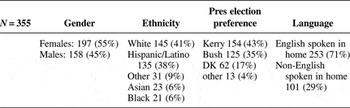
We first administered a preliminary survey to 168 students in May 2004 in order to refine our survey and test our questions. These students were selected because their classes suited our tight travel schedule to Modesto. We then refined the survey to suit a high school audience.Footnote 5 We administered the final survey to 426 students in October 2004 and again to the same students in January and May 2005.Footnote 6 (Our N's for these surveys vary between 345 and 365 depending upon the question because some answers were unreadable or missing). Approximately 3000 students took the course that year, but we wanted to administer the surveys in person during the first iteration. We were able to survey approximately 40 students each during nine course periods. We chose these classes in consultation with school officials and teachers primarily because they suited our interview schedule. The classes represented all times of the day and a mix of teachers, new and old, male and female. Based on our interviews with students, teachers, and administrators, we have no reason to believe that students who were not surveyed differ from those who were.Footnote 7Table 1 reports the demographics of students from the January 2005 survey.
Demographic information on participants in the January 5th survey

The survey consisted of 77 questions measuring the course's effects on (1) respect for rights in general, (2) respect for religious diversity, and (3) students' level of relativism. This was the maximum number of questions that most students could answer during a class period, according to our pre-test. In many instances, we coded “tolerant” responses as 1 and “intolerant” or less tolerant responses as 0 in order to distinguish between these poles. We were not certain that scaled responses were always useful since we did not know how to interpret the difference between “agree” and “somewhat agree” and because the intervals between respondents do not always regard intervals on a five or seven-point scale as equidistant (Babbie Reference Babbie2004, 174). We can distinguish, however, between tolerant and less tolerant responses, or between varieties of agree or disagree.
The surveys were accompanied by extended personal interviews with 23 Modesto students.Footnote 8 The more detailed answers in the interviews enable us to provide further confirmation of the survey results and better understand the reasons behind students' views. Extensive interviews were also conducted with 11 teachers, Modesto school administrators including the superintendent, school board members, and religious and community leaders.
The major limitation of our research was our inability to ask important but sensitive questions about the nature of students' religious beliefs. California state law and the understandable anxiety of Modesto administrators prevented us from surveying students about their religious identity and the intensity of their religious preferences. (Students were allowed to voluntarily divulge their religious beliefs in personal interviews.) The importance of empirical research for the policy and academic debates surrounding teaching about religion makes it essential to perform such research, we feel, even when such limitations apply.
Furthermore, the unique benefits of surveying Modesto's students outweighed the disadvantages. Although numerous school districts around the nation provide various elective courses on religion, the self-selection bias associated with the fact that students must opt into these courses would be a significant obstacle for external and internal validity. If students in these courses demonstrated an increase in tolerance, we could not be sure how much of the increase was attributable to students' idiosyncratic characteristics or the course itself, and if the results could be repeated among a wider, more representative swath of public school students. In addition, the number of students taking electives on religion in individual high schools or even school districts constitutes a relatively small sample. Modesto is the only school district in the nation to require all students to take an independent and extended course on religion.Footnote 9
MEASUREMENT AND RESULTS
Religious Knowledge
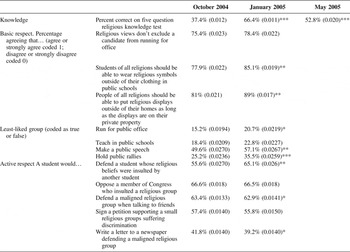
Students took a five-question test measuring their knowledge of world religions and the American tradition of religious liberty.Footnote 10 The questions remained the same each of the three times the students took the test (although fewer took it the third time). On average, student scores improved from 37.4 percent correct in the October test to 66.4 percent correct in January. The average dropped to 52.8 percent in May. The differences between the scores were significant according to t-tests (P > |t| = 0.000) (See Table 2). The course increased students' knowledge of world religions, although the average score decreased among students after having taken the course, it remained significantly higher than their pre-test score.
Means (standard errors) of tolerance survey questions

t-tests compare October and May surveys with January survey of the same students. * = p < 0.05, ** = p < 0.01, *** = p < 0.001. The October and January tests have an N of between 345 and 365, while the May tests have a much smaller N of 163–166. While we surveyed most of the students taking the course in the first two tests, logistical difficulties prevented such a large canvass in May. We have no reason to suspect, however, that the group of students surveyed in May differed in any significant way from those in the first two surveys. The May group includes only students who were surveyed in both October and January.
Passive Tolerance for Religious Liberty
We define “passive tolerance” as the willingness to grant rights and liberties explicitly protected in the United States Constitution to members of religious groups with which one disagrees. Generations of scholars have shown that Americans, and particularly non-elites, are surprisingly intolerant in the attitudes measured by survey research (Stouffer Reference Stouffer1955; Sullivan, Piereson, and Marcus Reference Sullivan, Piereson and Marcus1982). For each of three questions about tolerance, we coded agree or strongly agree as 1 and disagree or strongly disagree as 0. We find that a majority of students even in the pre-test are supportive of basic rights and liberties; means range from 75 to 81 percent. While the mean in agreement with the statement “religious views don't exclude a candidate from running for office” increased by three points, the change did not reach an acceptable level of statistical significance. For the other two statements, however, t-tests did indicate a significant difference between the pre- and post-tests (P > |t| = 0.01) (See Table 2). The other two statements asked whether “Students of all religions should be able to wear religious symbols outside their clothing in public schools” and whether “People of all religions should be able to put religious displays outside their homes as long as the displays are on their private property.” The increase between the pre- and post-test was five and eight percent, respectively. The course produced modest yet statistically significant gains in passive tolerance.
Several considerations indicate, however, that the modest changes in students' attitudes and behaviors here and below are more impressive than they appear on the surface. First, as we have mentioned, civic education research often fails to detect even modest changes in students' behaviors and attitudes. Second, even modest gains are notable given the course's short duration. A semester or year-long world religion course advocated by several religion and education authorities (Nord and Haynes Reference Nord and Haynes1998; Wexler 2002) might have a stronger effect on students.
The interviews lend further support to the course's significant impact on students' religious tolerance. All the students we interviewed agreed that the course made them more respectful of religious liberty. The changes in some students' opinions were dramatic. “I had a Hindu person living across the street and he'd be praying to a statue,” a Russian Orthodox student began, “I'd be all confused. I couldn't understand why he were doing it. I thought it was just plain dumb. But I notice now that he had a pretty good reason to” (Modesto Student Personal Interviews. Modesto, California. January 10–14, 2005).
Least-Liked Groups
Tolerance studies originally measured attitudes toward specific out-groups, including communists, socialists, and atheists. It is difficult to measure a general level of tolerance using question about specific groups, however, because attitudes toward specific groups change over time. Sullivan, Piereson, and Marcus (Reference Sullivan, Piereson and Marcus1982) developed a tolerance instrument, termed “least-liked groups,” to remedy the problem. This approach asks classic tolerance questions about a person's willingness to let a group exercise a right but leaves the name of the group blank for the respondent to fill-in with his or her least-liked group. This approach has the added advantage of measuring the tolerance of any group that a person dislikes the most, regardless of political or demographic characteristics. This approach is particularly applicable to the diverse students of Modesto who do not share the same biases and predispositions.
We asked students four least-liked group questions, about their willingness to allow members of their least-liked group to run for public office, teach in public schools, make a public speech, or hold public rallies. We introduced the question with this preface: “Here's a list of political groups with which some people have problems with: Racists; Feminists; Nazis; members of Al Qaeda; Communists; skinheads; Ku Klux Klan; members of groups that support rights for gays and lesbians. In your head, choose the group that you dislike the most. (You don't need to write down the name of the group).”
The initial number of students expressing tolerant attitudes was surprisingly low, ranging from 15.2 percent to 49.6 percent on various questions. For all four of the questions, however, students were more likely to extend liberties to their least-liked group after taking the course, and the differences achieved appropriate levels of statistical significance. The increase in means ranged from 4.4 percent to 10.3 percent. The lowest increase in respect referred to the activity closest to students' daily lives — the liberty for a member of a least-liked group to teach in public schools (See Table 2).
We asked about least-liked groups because of the survey instrument's long history in the tolerance literature.Footnote 11 We did not, however, expect a course on world religions to have much of an effect on political tolerance generally. In fact, the course increased students' willingness to extend rights and liberties to least-liked groups. Teachers began the course by emphasizing the rights and liberties granted by the First Amendment and imparted to students the refrain that “a right for one is a right for all” (Yvonne Taylor. Personal Interview. Washington, D.C. May 8, 2006). Our interviews with students suggest that they appreciated the way in which the course modeled civil discussion and explained the value of the freedom of political expression. After taking the course, one student told us that “[i]t helps to know about other people's religion when you talk to them because you don't want to say something bad about their religion that affects them. Even if you don't wish to accept or believe all religions, you should have knowledge about them” (Modesto Student Personal Interviews. Modesto, California. January 10–14, 2005). This student, like most who participated in our focus groups, was able to separate respect for others' religious beliefs from endorsement of or belief in a particular religion.
Active Respect
Most studies of tolerance measure a person's willingness to extend constitutionally-protected rights and liberties to groups with which the person disagrees. In the words of a classic study, “Tolerance implies a willingness to ‘put up with’ those things one rejects or opposes” (Sullivan, Piereson, and Marcus Reference Sullivan, Piereson and Marcus1982, 2). We think that a flourishing democratic society requires something more — a group of people who actively defend the rights and liberties of people with whom they disagree. We measure active respect through five questions about students' willingness to take action in defense of religious freedom. For four of the five questions, about opposing a member of Congress, writing a letter to a newspaper, signing a petition, and defending a maligned religious group to a friend, the course appeared to have no effects.
The one question that addressed a situation with which students could identify yielded statistically significant (P > |t| = 0.0016***) results. Students were asked if they would “defend a student whose religious beliefs were insulted by another student.” The percentage of students willing to take action increased from 55.6 percent before the course to 65.1 percent after (See Table 2).
A change in behavior occasionally accompanied this change of attitude. Teacher Yvonne Taylor (Personal Interview. Washington, D.C. May 8, 2006) witnessed several students teasing a Jewish student in the lunchroom for wearing a yarmulke. Another group of students confronted the tormentors for their intolerance. Although several interviewed students were concerned about standing out too much or being bullied themselves by larger classmates, almost all said the course strengthened their willingness to take action either by standing up to the insulter or by comforting the victim. “If a person took [an insult] the wrong way,” one student told us, “I would go over and say something. It's not polite to talk about a person's religion because that's what he believes in” (Modesto Student Personal Interviews. Modesto, California. January 10–14, 2005).
Our research shows that a modest attempt at civic education produces measurable changes in students' active respect, their willingness to actively defend the religious freedom of fellow students. The active respect questions measure only attitudes, but as the next section shows, the course produced measurable effects on students' behavior as well. Modesto schools appear safer and more comfortable for students of all religions after the establishment of the course because our survey results show a decrease in students who sense discrimination and discomfort and an increase in students' willingness to take action to protest religious insults.
Moral Similarities of Religions
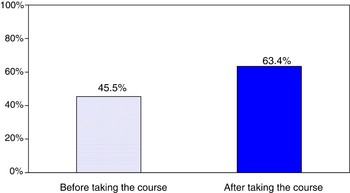
As Figure 1 indicates, the number of students who agreed with the statement “all religions share the same basic moral values” increased from 45.5 percent before the course to 63.4 percent after taking the course (p < 0.001). In interviews, teachers and students emphasized that studying other religions revealed common ground. The course was designed to avoid comparing and evaluating religions in favor of a description of each religion on its own terms, although description that in practice brought out commonalities and avoided mention of major differences. When we asked one student why she enjoyed studying other religions, she said: “All my life I've been a Christian and that's really the only religion I know about. So when I take this class I see there are other religions out there and they kind of believe in the same thing I do” (Modesto Student Personal Interviews. Modesto, California. January 10–14, 2005). As students begin to appreciate the similar moral teachings of the major world religions as taught through the course (whether such a similarity exists objectively is open to dispute), they are more willing to grant rights and liberties to other religions. The course's emphasis on the similarities among major religions may contribute to increased respect; in the regression below (Table 3) responses for the “same moral values” question are highly correlated with religious knowledge. Nevertheless, the course also increased students' general level of respect, on average, as measured by the least-liked groups questions, not just their respect toward religious groups.
(Color online) Similar Moral Concerns of World Religions Percent of students who agreed with the statement “all religions share the same basic moral values.” Note: N = 339; p < 0.001.

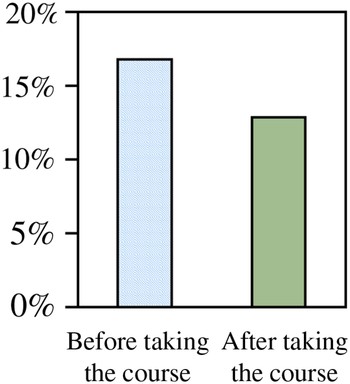
(Color online) Threat Percent of students who thought they or their families would likely be a victim of a terrorist attack within the next six months. N = 340, p < 0.10.

Relativism
If the course increases basic respect for rights and liberties by emphasizing the shared values of major religions, the course runs the risk of promoting relativism, or the belief that one religion is just as good as any other. We asked students whether they agreed or disagreed with the following statement: “I believe that one religion is definitely right and all others are wrong.” Twenty-one percent agreed or strongly agreed with the statement before taking the course, and 23 percent agreed or strongly agreed with it after, suggesting that there was no significant change.Footnote 12 Students were no less likely to believe in the truth of their religion after taking the course than before.
None of the students interviewed said they could anticipate converting to a new faith in the near future. Several interviews suggested that students were aware of the distinction between religious common ground and relativism. “As I've been in this class I've noticed how all these religions tie-in in some way,” one student said, “but I try not to convert to anything because I strongly believe in my religion” (Modesto Student Personal Interviews. Modesto, California. January 10–14, 2005).
Even more surprising, however, was that five of the 23 students we interviewed said the course strengthened their faith. One student told us she learned more “[e]specially about my religion — Christianity. If I had a question about something . . . we learned that my parents may be able to expand on it and give me a little more detail about it. I got some clarification on my own religion and learned a little bit more about it.” A Hindu student testified that the course connected her with her faith by deepening her knowledge. “[S]ome of the stuff I didn't know about my religion and my parents didn't know either because they weren't from India, they're from Fiji,” she told us, “so it's completely different from our religion and they didn't know everything from the past” (Modesto Student Personal Interviews. Modesto, California. January 10–14, 2005). Modesto's conservative Christians seemed convinced that the course would inform even committed Christians about their faith. Paul Zeek, associate pastor of Modesto's First Baptist Church, expressed satisfaction that students in his evangelical Baptist congregation who had taken the course “have a clearer understanding of the distinctiveness” about religion and Christianity (Paul Zeek. Personal Interview. Modesto, California. October 13, 2004).
Threat
Numerous studies establish a link between perceived threat to one's person and one's family and intolerance toward the threatening group (Feldman and Stenner Reference Feldman and Stenner1997; Haney and Wagner Reference Haney and Wagner1999; Huddy et al. Reference Huddy, Feldmen, Capelos and Provost2002). We test this hypothesis with reference toward fears about Muslim attack following September 11. Figure 2 indicates that the number of students who thought they or their families would likely be victims of a terrorist attack within the next six months decreased from 16.8 percent before taking the course to 12.9 percent after (N = 340; p < 0.10). We lack a control group for this period so we cannot determine whether students' sense of threat decreased because of the effects of the course or simply because of the passage of time since the terrorist attacks of 2001.Footnote 13
THE VALUE OF THE COURSE AND THE RESEARCH
On average, five to eight percent more students provided “tolerant” answers to questions about their attitudes and behavior after taking the course than before. We consider this result meaningful because it supports our theory and because the difference is statistically significant. At the same time, the increase is small. The course's short-term increase in tolerance serves the important goal of creating a more tolerant public school environment for students of all faiths. But the major logistical problems of tracking students after they took the course mean that we were not able to measure the long-term persistence of the course's effects.Footnote 14 In a conversation about the course's long-term benefits, Superintendent James Enochs (Personal Interview. Modesto, California. October 11, 2004) compared the course to “an unseen harvest” and speculated that students would be better citizens in the long run than if they had not taken the course. Given that the effect of the course on knowledge and tolerance lasted four months after the course ended, Enochs's speculation appears reasonable, but our research does not enable us to make a definitive claim.
In addition, the Modesto course was relatively short. Accommodating themselves to political realities and resource restraints, Modesto administrators designed a course that devoted only one week to each major religious tradition. While our research was designed to yield insights on issues relating to religious tolerance, we were interested simultaneously in performing applied research on an important public policy innovation. Applied research on a hotly disputed topic such as how to discuss religion in public schools cannot wait for an ideal program to study, but must focus on innovations currently in place. Modesto is the only school district in the nation to require a course in world religions. That said, the course's duration made it unlikely that it would have a very profound impact on students' tolerance. Modesto's caution in designing the course was understandable, but almost all advocates of including world religions courses in the required curriculum have argued it should last at least a full semester (Nord and Haynes Reference Nord and Haynes1998; Prothero Reference Prothero2007). Our results suggest that a more extended, required course could have a quite significant and long-term impact on students' tolerance levels,Footnote 15 but until such a course is put into effect we just cannot know. This study should be seen as exploratory and provide a guide for future research and for lessons that might be applied in future studies. We hope that more extensive studies can track individual students over a longer period than the four months after taking the course that this survey includes.
Given these qualifications, we find that the course had a positive impact not only on students' respect for the rights of other religions and their willingness to act on behalf of vulnerable religious minorities, but also on students' respect for the First Amendment and political rights in general. Students' knowledge about the religious traditions of their fellow students and citizens increased significantly, most students found the course material interesting, and many students expressed a desire to learn even more about world religions. The increase in students' willingness to take action to protest insults based on religion and the lessening of discomfort experienced by students provide evidence that the course has made Modesto schools safer and more comfortable for members of all religions. While the Modesto case provides crucial evidence that a course on world religions can increase respect, future studies should compare how courses with different content shape respect for religious rights and liberties.
Modesto's course was able to accomplish these goals without causing the problems feared by those who object to extended discussion of religion in schools. Most notably, the course did not encourage students to change their religious beliefs or abandon religion altogether, a chief concern of some religious leaders. Students increased their appreciation for the similarity of the moral foundations of major world religions without concluding that the differences among religions are negligible or that choices about religion are arbitrary. Indeed, the interviews provide examples of students taking a greater interest in their faith traditions after taking the course than before. Modesto's course thus provides evidence that a liberal democratic society is capable of avoiding the potential paradox of religious tolerance. If public schools carefully design courses on world religions, they can encourage active respect for religion without illegitimately encouraging acceptance of the truth value of alternative beliefs.
WHY DID TOLERANCE AND RESPECT INCREASE?
Knowing that world religions courses increase tolerance and respect is valuable, but our research contains more far-reaching implications. America today struggles to accommodate exploding ethnic, racial, and cultural diversity as well as religious diversity. Public schools bear the burden of preparing young people to accommodate this diversity. Battles over multicultural education attest to the conflicts about the best way to promote diversity. Social science research has a crucial role to play in this debate. It can help to shape school policy about diversity by telling us what factors and strategies best promote tolerance. Civic education literature has begun to grapple with this issue, but results so far are inconclusive. Tolerance scholars agree that education is the strongest predictor of tolerance (Citrin et al. Reference Citrin, Sears, Muste and Wong2001). But competing explanations exist for exactly why education increases tolerance. Education provides knowledge of facts and strengthens critical thinking abilities. The substance of knowledge affects response to framing and priming (Ottati and Isbell Reference Ottati and Isbell1996). That is, greater knowledge can dispel false stereotypes and make people more resistant to the media and politicians foisting false stereotypes on them. Since the Modesto course's primary goal was to increase students' knowledge of other religious traditions, our research is well-situated to address the crucial theoretical and practical question of why education in general and an increase in knowledge increase tolerance.
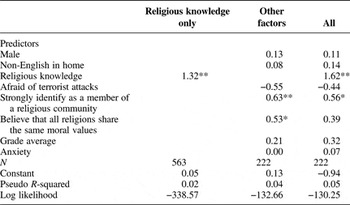
We thus begin by presenting the results of regression analysis for one particularly important variable, students' willingness to defend persecuted students, in order to illustrate the relationship between religious knowledge and other independent variables. Our results show that scores on a five-question religious knowledge quiz increased 29 percent after taking the course and remained higher than the original score in another survey four months later. When we use religious knowledge to predict tolerant behavior, we find results similar to what researchers have discovered in other contexts: religious knowledge consistently predicted tolerant behavior, including both passive respect for basic rights, and liberties and willingness to actively defend the rights and liberties of others. Table 3 below shows how religious knowledge compares to the other factors that might predict tolerant behavior in explaining one particular behavior, students' willingness to come to the defense of religiously persecuted students.Footnote 16
Predicting students' willingness to defend religiously persecuted students (Regression coefficients)

* = p < 0.10, ** = p < 0.05.
The question asks: Imagine that you lived in a place where most people disrespect members of a small religious group. How likely would you be to … Defend the small religious group when talking to friends? The answers “definitely would” and “probably would” are coded as 1, and “probably would not” and “definitely would not” are coded as 0. We were not confident that respondents viewed “probably” and “definitely” as equidistant, so we coded the results as a dichotomous variable.
Religious knowledge explains more of the variance than any other single factor; it is statistically significant at the 0.05 p value level when observed alone, and it remains at an acceptable level of statistical significance when included with other variables. People who strongly identified as a member of a religious community were also more likely to say they would come to the aid of a disrespected religious group. In addition, people who believed that all religions share the same basic moral values were more likely to come to the aid of the group. The belief that all religions share the same moral values was correlated with religious knowledge, however.
Still, our model explains only a small proportion of the variance. Increasing religious knowledge contributes to students' willingness to defend the rights and liberties of others as well as to a general level of political respect.Footnote 17 Nevertheless, much of the difference observed between students' attitudes before and after taking the course remains to be explained by something other than their increase in factual knowledge about world religions and the American tradition of religious liberty. As we will explain in the next section, our interview evidence suggests that the course's ability to model civil exchange about a sensitive topic promoted understanding.
A POSSIBLE MISSING LINK: MODELING RELIGIOUS TOLERANCE AND CIVIL DISCUSSION
When statistical models and analyses based on surveys fall silent, alternative research methods must be heeded. Our interviews not only with students but also with teachers, administrators, and outside consultants who helped prepare the course, and our observation of the course's implementation help fill in the blanks.
There are several possible alternative explanations for the increase in tolerance.Footnote 18 One particularly noteworthy and plausible missing link, which could not be easily measured in survey research, was Modesto's emphasis on modeling civil discussion about religion. Teaching students to engage members of other religions respectfully by modeling civil discussion was a pervasive and persistent concern of administrators and teachers from the alpha of the course's construction to the omega of its classroom implementation. The main purpose of the course, according to school Modesto school board president Gary Lopez, was to teach that “[i]f you're raised Catholic, not everyone thinks like a Catholic or if you're raised a conservative Christian not everyone thinks like a conservative Christian” (Gary Lopez. Personal Interview. Modesto, California. January 11, 2005).
The course's designers intended to provide information about other religions to improve students' mutual respect through knowledge. They specifically avoided designing a course that emphasized the disagreements between religions and the religious practices that violate liberal norms and values. Few students complained about biased treatment of religion by their teachers, probably because of the course's historical orientation and because of the weeks of training that the school district provides teachers.
Students begin the nine-week course by learning about the rights and responsibilities of the First Amendment, and this early discussion of religious freedom frames later discussions of seven major world religions. Educational consultants prepared teachers for the course by teaching how to mediate controversies and navigate difficult classroom situations. Teachers learned how to discuss religious traditions in a civil and impartial manner. Beginning the course with an extended discussion of the First Amendment and religious liberty shaped students' attitudes to the religions they subsequently studied. Even the precise placement of the course in the curriculum reflected a careful concern for promoting respectful deliberation. Study of the less controversial topic of world geography preceded study of world religions. This gave the freshmen taking the course time to develop the emotional maturity and familiarity with rules of high school classroom discussion necessary to deal with the more controversial topic of world religions (Linda Erickson. Personal Interview. Modesto, California. May 12, 2004).
The students we interviewed understood that the course was created so that they might use their newfound knowledge about religion as a tool for respectful engagement with members of other religions. “It helps to know about other people's religion when you talk to them,” one student told us, “because you don't want to say something bad about their religion that affects them.” A Hispanic Catholic student told us she “really want[s] to learn about other religions than my own” because “[t]here are certain things that they may not agree with and in your own religion it's not really that bad.” Learning about other religions, she concluded, “helps you treat them with the respect that they want and that they deserve” (Modesto Student Personal Interviews. Modesto, California. January 10–14, 2005).
Modesto realized that public schools are in an unique position to play a crucial role in modeling civil dialogue about religion. No other authority — whether journalists, politicians, religious leaders, or parents — regularly stresses the importance of respectful discussion about religion or, more importantly, teaches young people how to engage in such deliberation. On the contrary, these authorities more often model and encourage civic vices. The media favor extremists who shout at each other and discourage religions besides their own. Many politicians exploit religious differences for partisan gain. Perhaps, however, we should not judge these voices of disrespect too harshly. Unlike Modesto's students, their schools never taught them differently.
These observations fall short, of course, of allowing us to confirm that the modeling of civil discussion was the primary factor in explaining the variance between students' views on tolerance in the pre-test and post-tests. But the plausible relationship between the modeling of civil discussion and increase in tolerance contributes an important hypothesis that future general and religious tolerance research should take into account. Greater thought needs to be devoted to a consideration of how to operationalize and test the modeling of civil discussion as an independent variable. One central aspect of this research is clear, however. Research on civil discussion must focus on public schools because they are the primary institutions that model civil discussion for a diverse audience.
The stakes for research on how civic education might promote democratic values are high. The founders of the discipline of political science were motivated by concerns about how to improve civic values through education, and that concern remains (Leonard Reference Leonard1999; Schachter Reference Schachter1998). Tolerance for religious liberty is an important social goal that is often neglected, and the distinctive paradox of religious tolerance this article describes suggests that modeling a civil discussion that respects the rights of religious minorities and the intolerant is difficult. Modesto's course and our research about it do not resolve debates or discussions about how to further tolerance through public school policy — far from it — but they do serve as significant starting points in addressing these essential issues.