INTRODUCTION
In traditional health plan case management programs, case managers (CMs) work telephonically with Medicare patients who are frail, have multiple comorbidities, are at high risk for becoming clinically unstable, or have life-limiting illnesses such as cancer. The goals of case management typically include providing member-centered care and encouraging informed choices. Often during the course of conversations patients voice concerns about family dissonance around goals of care, their own mortality, and wishes for their loved ones. They may also discuss their own goals for care, their preferences, and their priorities. Yet frequently, no advance care planning (ACP) has occurred, or there are questions about existing documents or discussions.
Case managers, even when skilled in disease-specific counseling and care coordination, are often ill-prepared to fully engage patients who express concerns or have questions about ACP. When patients raise existential questions during telephone conversations, those questions cannot be ignored. Yet, other than their general motivational interviewing skills, most CMs have not had dedicated training focused on discussing ACP with patients, and they often lack the skills to facilitate ACP discussions. In addition, very few communities have organized systems for engaging patients in ACP discussions to which a case manager could refer.
Telephonic ACP (TACP) is a novel approach to this problem, but there appears to be little literature available about its development or outcomes. Telephonic case management, including understanding and assisting with completion of advanced directives, has been described by Aetna Health Plan in its “Compassionate Care Program” (Spettell et al., Reference Spettell, Rawlins and Krakauer2009), but there are no (or very few) models using a studied and replicated telephonic-facilitated ACP discussion.
CONTEXT AND OBJECTIVES
Priority Health is a regional health insurance company, with headquarters in Grand Rapids, Michigan, that serves more than 550,000 members. Its case managers regularly work telephonically with members who are frail and have multiple comorbidities. However, little or no ACP has historically occurred in that context.
In 2010, Priority Health leaders decided to address this issue by planning and initiating a TACP pilot program. The objective of this program was to determine whether ACP by health plan CMs could be successfully facilitated telephonically with a small segment of Priority Health's members. If this pilot program proved successful, the company would go on to implement TACP on a broader scale.
The decision to conduct the preliminary study occurred in a politically challenging climate. National debate about the value of ACP was heightened by a furor over “death panels” (Tinetti, Reference Tinetti2012). Medicare's inclusion of ACP discussions in the annual well-person evaluation, and then its sudden withdrawal, only served to heighten skepticism that Priority Health should undertake such an initiative. However, in spite of these difficulties, the decision was made to conduct the pilot study and, potentially, to disseminate TACP to the entire Medicare CM team thereafter.
THE RESPECTING CHOICES® MODEL
Priority Health partnered with the director and associate director from Respecting Choices, Gundersen Health System, to test their established ACP facilitator model telephonically. The key elements of the model included: (1) a comprehensive definition of ACP; (2) the use of trained facilitators; (3) a staged approach to ACP using patient-centered structured interviews; and (4) standardized competency-based training.
According to the Respecting Choices model, ACP is
(. . .) an organized process of communication to help an individual understand, reflect upon, and discuss goals, values, and beliefs for future healthcare decisions. When this process is done well, it has the power to produce a written plan (i.e., advance directive) that accurately represents individuals' preferences and thoroughly prepares others to make healthcare decisions consistent with these preferences.” (Respecting Choices, 2007, p. 1.13).
The ACP facilitator is typically a nonphysician who works as a member of the patient's healthcare team, helping them to understand their healthcare options, identify gaps in their knowledge, develop questions for their physician, and create a written plan that represents their goals, values, and healthcare decisions (Briggs, Reference Briggs and Hammes2012).
However it is accomplished, ACP is not a “one-size-fits-all” conversation. Respecting Choices has developed a staged approach to planning: First Steps, Next Steps, and Last Steps ACP. Each step is based on an individual's stage of illness, readiness to participate, and venue of care:
-
■ First Steps ACP is appropriate for healthy adults and those who have never planned. Its goals are to help individuals understand the importance of planning; select a well-qualified healthcare agent; explore goals of care in the event of a severe, neurological injury from which cognitive recovery is unlikely; and complete a basic written plan (advance directive).
-
■ Next Steps ACP is initiated for those with advanced illness who are receiving active treatment yet beginning to suffer the complications of progressive disease. Goals of care are established.
-
■ Last Steps ACP is consistent with the physician orders for life-sustaining treatment (POLST) paradigm (see www.polst.org). It is designed to assist individuals who are likely to die within the next 12 months, with specific healthcare decisions documented as medical orders to be followed in emergency situations.
At each stage of planning in the Respecting Choices model, patient-centered interview questions are used to assess individuals' understanding of their illness, gaps in their knowledge, their fears, and their goals for living well. This information is employed to craft an approach to planning that respects individuals' personal, religious, and cultural beliefs, and offers a framework to assist them in making specific healthcare decisions.
ACP facilitators who utilize Respecting Choices are certified through standardized, competency-based training programs in First, Next, and/or Last Steps ACP, depending on their background, clinical setting, and expertise. Facilitator competency is assessed through the use of structured interview scripts, role-play activities, and group discussions. These skills-based ACP facilitator training courses have been employed for years as one of the hallmarks of successful outcomes (Hammes & Briggs, Reference Hammes and Briggs2011).
METHODS
For its pilot project, Priority Health worked with Respecting Choices personnel to adapt the key elements of that program for a new telephonic ACP approach. An overall plan was developed to test the feasibility and member acceptance of TACP facilitation with three Priority Health CMs during a six-month pilot study. It was hoped that positive outcomes would emerge from evaluation of the pilot's successes, challenges, and lessons learned, allowing TACP to be disseminated to the entire Medicare CM team.
Participants
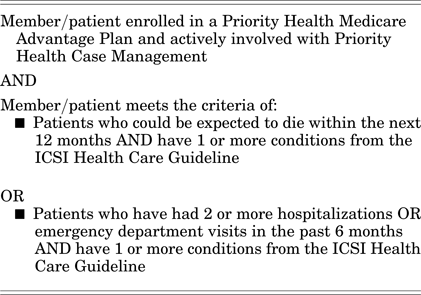
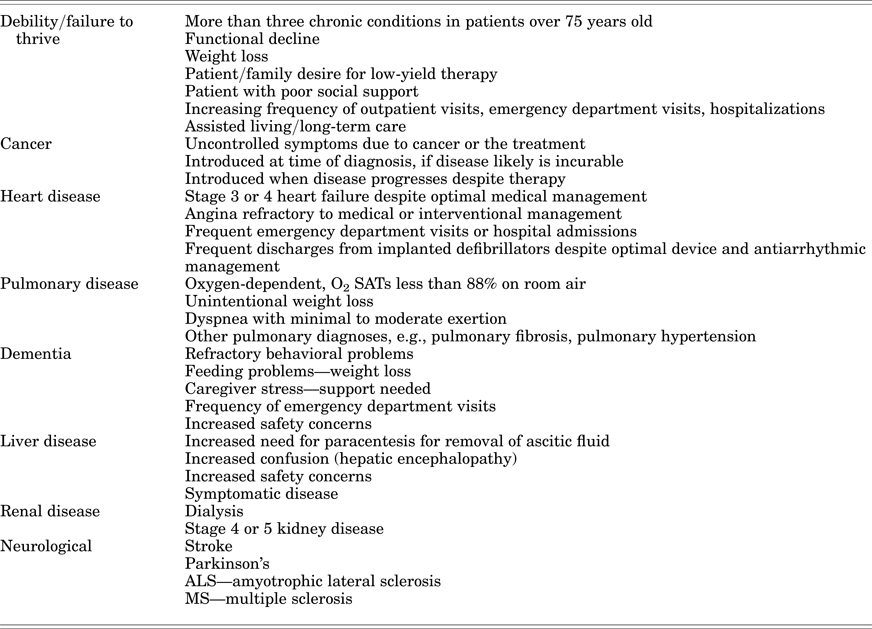
The participants selected for the TACP project were Priority Health Medicare members in active case management who met certain criteria (see Tables 1 and 2) as defined by the Institute for Clinical Systems Improvement (ICSI) (Institute for Clinical Systems Improvement, 2009). The initial pilot study limited participation to health plan members enrolled with a select group of four primary care physicians (PCPs). These physicians were educated about the TACP pilot and agreed to encourage their patients to participate in the TACP discussions and to allow CMs to approach their patients with an ACP introduction. Soon after the start of the pilot, as members outside of those physician practices were identified as meeting the pilot inclusion criteria, the physician group was expanded to more than 100 PCPs in a large multispecialty physician practice.
Health plan member criteria for pilot study participation

Institute for Clinical Systems Improvement (ICSI, 2009) palliative care guideline conditions

Case Managers
For the pilot study, 3 of 16 Priority Health Medicare CMs were trained to telephonically facilitate both First and Last Steps discussions using the Respecting Choices curriculum and faculty. To evaluate integration of ACP facilitation into their workflow, facilitation protocols and scripts were embedded in their electronic assessment tool. The document chosen for the facilitated First Steps TACP discussion was the “Designation of Patient Advocate Form” used by local health systems and endorsed by the Michigan Health and Hospital Association, the State Bar of Michigan, the Michigan State Medical Society, and the Michigan Osteopathic Association. Documentation of Last Steps consisted of completion of a form created by Respecting Choices entitled “Patient Orders for Scope of Treatment” (PtOST). (At the time of writing this article, there is no statewide form in Michigan for end-of-life patient preferences or physician orders such as the POLST.)
In addition to this training, CMs were provided with a script to approach both members and PCPs for inclusion in the pilot. To provide the CMs with further support and document their skill development, monthly meetings were held for staff and project leaders to identify barriers and process issues, and conduct case reviews. In addition, the Priority Health Medicare medical director was available for case reviews, questions, and suggestions at any time. Case manager skill assessment was documented using the Respecting Choices “Self-Assessment Perceived Competency” form following initial TACP training and at three and six months post-training.
RESULTS
Pilot Study
A total of 38 members were contacted by the three CMs during the pilot; only three members refused to participate. Nine First Steps and two Last Steps documents were completed during the pilot. Although the entire TACP process was not completed for 26 members, their cases continued and were carried forward when full TACP implementation occurred. At the conclusion of the pilot, we determined that physician and member response was positive and that TACP could be offered to Priority Health Medicare members meeting the clinical criteria, regardless of their PCP assignment.
TACP Implementation
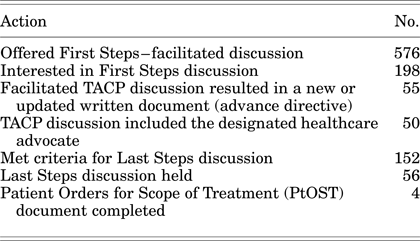
When the pilot study was completed, the remaining 13 Medicare CMs were trained and began working with other identified Priority Health Medicare members in a full implementation of the TACP model. As can be seen from Table 3, during the 12-month period from September of 2012 to September of 2013, the team offered 576 health plan members First Steps discussions. Of these, 198 (34.4%) indicated interest in engaging in further ACP. Some 152 members were identified for Last Steps TACP using the established criteria, and discussions occurred with 56 members (36.8%). Full implementation of the TACP model resulted in 55 new or updated First Steps documents and 4 Last Steps documents. There were 50 discussions that included the designated healthcare advocate.
TACP 12-month implementation results

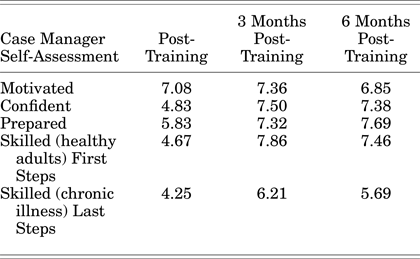
With the opportunity for TACP skill development, the 16 CMs generally reported enhanced comfort with and skill in the process and increased discussions as TACP rollout proceeded. As Table 4 indicates, they reported increases and peak numbers in all self-assessment categories at three months. Six-month self-assessment data indicated decreases in most competencies compared to the data for three months post-training. However, these decreases were evaluated and determined to be due to role changes within the team, which resulted in half the CMs having the majority of TACP discussions.
Facilitator self-assessment: Perceived competency in facilitating ACP discussions (N = 16) (“On a scale of 1 to 10, I feel … to facilitate ACP discussions”)

DISCUSSION
The success of any ACP program depends on more than the facilitated discussions, and project leaders met frequently to assess barriers, evaluate the program, and support the CMs. The TACP pilot study identified some of the workflow, infrastructure, and community challenges that need to be addressed in order to construct a successful systematic TACP program. For example, the electronic assessment record and workflows were modified and improved during the pilot, with changes in data capture points, algorithm flow, and definition of case closure and completion.
Continuous improvement processes were utilized during the pilot study and were maintained during the full TACP implementation process. Operational changes were implemented as needed, including work with Respecting Choices to modify the protocol and process flow. A significant change during full implementation was to expand the patient population involved and offer First Steps TACP to Medicare members engaged in case management. As with the pilot study's expansion to all PCPs, broadening the TACP population reflected the team's commitment to ACP and the value placed on the process.
Case manager challenges during both the pilot study and full implementation included integration of TACP into their regular workflow without additional resources. Challenges within the healthcare system and community included the need for a process of document dissemination (e.g., to family, advocate, physician, hospital) and storage and retrieval of TACP documents in each member's electronic medical record.
Case managers reported only positive comments and feedback on the TACP pilot study from participating members, physicians, and the community at large. Priority Health's customer service department also reported positive comments. No negative reports or comments were received during the pilot, which provided positive reinforcement to continue the work in light of the political climate noted earlier. Although a formal satisfaction survey was not part of the TACP project, anecdotal responses have continued to be positive.
Overall, the entire TACP project highlighted the need for a systematic, integrated infrastructure for ACP woven into the fabric of our healthcare delivery network. The infrastructure for this system is under development by the team. Key components to this system include the development and acceptance of common documents, a common storage and retrieval mechanism, and collaboration among competing healthcare systems within the surrounding areas. Full and successful implementation of TACP will depend on these important infrastructure components being in place.
CONCLUSION
This TACP project demonstrated the feasibility of telephonic ACP facilitation for frail elders with advanced disease. There was acceptance of the telephonic model by case managers, participating members, primary care physicians, and Priority Health staff. The successes and lessons learned allowed TACP to be disseminated to the entire Priority Health Medicare case manager team during 2012–2013, with continuing evaluation of TACP. Although the model is new, it has the potential to be successfully utilized by other health insurance companies.
ACKNOWLEDGMENTS
The authors wish to thank Mary Cooley, M.S., R.N., Karen George, Sallie Prins, M.S.N., R.N., and Barbara Terrien, R.N., for their efforts in implementing a system of advance care planning for medically complex Medicare patients. The authors also gratefully acknowledge the assistance of Beyond Words Inc. in the editing and preparation of this manuscript. The authors maintained control over the direction and content of the article during its development. Although Beyond Words Inc. supplied professional writing and editing services, this does not indicate its endorsement of, agreement with, or responsibility for the content of this article.
AUTHOR DISCLOSURE STATEMENT
Linda Briggs, Associate Director of Respecting Choices®, was a paid consultant for the pilot study described in this article. Funding was provided by Priority Health. All other authors have no actual or potential conflicts of interest to disclose and hereby state that no competing financial interests exist.