Introduction
In phytophagous insects, host selection for egg laying influences reproductive success, particularly when larvae are less mobile. Therefore, the capacity to find and recognize a suitable host plant is a critical challenge in their life history. Fruit flies have evolved mechanisms using olfactory and visual signals derived from their hosts, which generally integrate several hierarchical levels: (i) habitat, (ii) plant or tree, (iii) branch, (iv) batch of fruit, and (v) individual fruit (Roitberg, Reference Roitberg1985; Aluja & Prokopy, Reference Aluja and Prokopy1992). The rules that govern the behavioural sequences may be different according to the hierarchical level. For example, insects that use volatile compounds to find host plants have to face quantitative and qualitative variations of chemical cues (Judd & Borden, Reference Judd and Borden1992). In fruit flies, most studies have focused on how females locate host fruit once they arrive in host plant habitat. To determine how the female of Rhagoletis pomonella (Walsh) detects its host fruit, Prokopy & Roitberg (Reference Prokopy and Roitberg1984) hung coloured spheres mimicking apples to tree branches, near real fruit. Adult females visited spheres as often as apples, suggesting that, at a short distance, visual characteristics are the main or sole stimuli guiding host fruit detection. However, Fein et al. (Reference Fein, Reissig and Roelofs1982) identified seven volatile esters that triggered upwind flight towards the source of odour, while volatile compounds emitted by the foliage were supposed to play a secondary role in the host location process. Aluja & Prokopy (Reference Aluja and Prokopy1993) and Aluja et al. (Reference Aluja, Prokopy, Buonaccorsi and Cardé1993) showed that when fruits are not visible or scarce, fruit odour may interact with visual cues throughout the searching process. In order to improve understanding of how visual stimuli aid fruit detection and may interact with fruit odour at a short distance, the objective of the present study was to demonstrate that the habitat pattern may also influence high-egg load females’ orientation during host fruit location. The term ‘habitat’ may be defined here as the physical conditions that surround (influence and are utilized by) the foraging flies. As an oligophagous species, the tomato fruit fly, Neoceratitis cyanescens (Bezzi) (Diptera: Tephritidae), represents a suitable model to study the role of visual and olfactory cues in the host fruit location process. It is a frugivorous species attacking both wild and cultivated Solanaceae species, particularly bug weed (Solanum mauritianum Scop.) and tomato (Lycopersicum esculentum Mill.) (Orian & Moutia, Reference Orian and Moutia1960; Etienne, Reference Etienne1972). Prokopy & Owens (Reference Prokopy and Owens1983) proposed the hypothesis that monophagous and, particularly, oligophagous insects tend to behave as visual specialists of their host plant characteristics. Even if spectral characteristics of plants are not specific enough to allow visual discrimination of the host, visual aspects of certain plant structures per se can induce an orientation response together with appropriate olfactive stimuli. The hypotheses to be tested were that habitat cues other than fruit odour assist flies in detecting suitable host plants and fruit and that sensitivity to those cues is specific to mature females with a high oviposition drive. To carry out this task, a series of experiments was conducted in an outdoor field cage wherein flies were released and captured on sticky coloured spheres displayed within or above potted host or non-host plants.
Materials and methods
Insect material
Studies were conducted on laboratory-reared adult flies (Etienne, Reference Etienne1973). Wild pupae were collected from tomato crops in the western part of Reunion Island. Flies of both sexes (50:50 sex ratio) emerged in 30×30×30-cm screen Plexiglas cages under controlled conditions (25±1°C, 70±10% relative humidity and L12:D12 photoperiod) and were held there until testing. Adult flies had free access to granulated sugar, enzymatic yeast hydrolysate (ICN Biomedicals, USA) and water until the time of testing. They were allowed no contact with host plant material and females had no ovipositional experience in fruit prior to testing. Attention was focused on the response of 8- to 11-day-old mated females, highly stimulated by an ovipositional drive (Brévault & Quilici, Reference Brévault and Quilici1999, Reference Brévault and Quilici2000a). Additionally, starved mature females of the same age (deprived of food for 24 hours), 3-day-old immature females (partial egg maturation) and 5–6-day-old males were tested to evaluate the effects of physiological state and sex on the response to visual stimuli.
Plant material
Five species of plants were used to create a semi-natural environment: ficus (Ficus benjamina L.), citrus (Citrus reticulata L.) or longans (Dimocarpus longan Lour.) as non-host plants and bug weed or tomato as host plants. Bug weed plants were recovered from the wild while the other plants were provided by an experimental nursery (CIRAD Réunion). The plants were selected or cut so as to obtain approximately the same size, about 120 cm height and 40 cm diameter. They were then transferred into 30-cm high and 15-cm diameter pots while flowers and fruit were removed from branches when necessary.
Experimental procedures
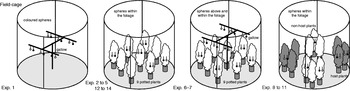
Tests were conducted in a single outdoor field cage, 2.5-m high and 3.0-m diameter, with walls made of fine mesh that allowed easy manipulation of the habitat (fig. 1). Coloured spheres consisted of a 3.7-cm diameter table tennis plastic ball painted with watercolours (Lefranc & Bourgeois, France) then coated with Tanglefoot glue (Biosystèmes, France) to capture the flies that landed on it. The characteristics of the colours were measured with a chromameter (CR-300 Minolta, Japan), based on Hunter's three-dimensional system: brightness (L*=80.8 and 60.7), yellow content (b*=84.0 and 53.9) and saturation (C*=85.0 and 70.4) for yellow and bright orange spheres, respectively. With a spectrophotometer equipped with an integrative sphere (Varian Cary 17 D, Biometry Unit, INRA Avignon), a reflectance peak was measured around 600 and 650 nm for yellow and bright orange spheres, respectively.
Outdoor field cage and experimental designs to assess the response of flies to coloured models in changing habitat patterns. The release of 300 individuals and recapture on sticky models was proposed in multiple choices.

Fruit mimicking bright orange spheres was chosen to measure the specific response of mature females (Brévault & Quilici, Reference Brévault and Quilici1999), while yellow sphere captures would have been associated with less specific responses, including food searching and resting sites. In a choice situation between yellow and orange spheres, starved females displayed a higher propensity than well-fed females to land on the yellow spheres (Brévault & Quilici, Reference Brévault and Quilici1999). The reflectance of the yellow sphere in the same spectral region as the green of the foliage could mimic foliage where flies can find associated food (Prokopy, Reference Prokopy1972; Cytrynowicz et al., Reference Cytrynowicz, Morgante and De Souza1982; Katsoyannos, Reference Katsoyannos, Robinson and Hooper1989). A preliminary experiment in a flight chamber showed that Tanglefoot had no effect on the response of flies to coloured spheres (Brévault, unpublished).
A cohort of 300 flies was released in the field cage, 30 minutes prior to the introduction of the coloured models. Each test started at 14:00 h (GMT+3) and lasted three hours, a period that corresponds to the most intensive search activity for laying sites in high egg-load females (Brévault & Quilici, Reference Brévault and Quilici2000b). A minimum of three replicates of 300 individual flies each were carried out. Captured insects were removed from the sticky spheres every 30 min or hourly in order to prevent saturation. Rull et al. (Reference Rull, Prokopy and Vargas2003) and Pinero & Prokopy (Reference Pinero and Prokopy2004) showed that grouped females of Ceratitis capitata (Wiedemann) and Bactrocera cucurbitae (Coquillett) preferred to alight in significantly greater numbers on artificial fruit occupied by conspecific females than on unoccupied hosts. On the contrary, the presence of females on the spheres may prevent others from landing. Diaz-Fleischer & Aluja (Reference Diaz-Fleischer and Aluja2003) observed that when females of Anastrepha ludens (Loew) were grouped, more landings occurred on unoccupied hosts (i.e. devoid of flies) than on occupied ones (i.e. with at least one fly on it).
Trapping data were transformed by Y=(X+0.5)0.5 and statistically analysed by ANOVA followed by Student Newman-Keuls test (P=0.05).
Experiments
To determine how habitat cues other than fruit odour can assist flies in detecting host fruit, we measured the response of mature female flies to odourless bright orange and yellow spheres according to the nature of the habitat. In experiment 1, the design consisted of six pairs of yellow and bright orange spheres hung from wooden supports placed 1 m above the ground, in the absence of potted plants (fig. 1). In all experiments, a distance of 10–20 cm separated both spheres of the same pair. In experiments 2–5, the design consisted of six pairs of yellow and bright orange spheres displayed within the foliage of nine potted host or non-host plants (fig. 1). Next, the response of flies was assessed in relation to the position of the models on the potted plants. In experiments 6 and 7, six pairs of spheres were displayed both 20 cm above and within the canopy of nine ficus or bug weed plants, respectively (fig. 1).
To determine how habitat cues other than fruit odour can assist flies in detecting suitable host plant and fruit, two sets of three potted host plants (bug weed or tomato) and two sets of three potted non-host plants (ficus or citrus) were alternately positioned in the cage (fig. 1, exp. 8–10). In each set of potted plants, three pairs of yellow and bright orange spheres were hung within the foliage. In experiment 11, potted host plants were replaced by potted non-host plants (ficus) whose leaves were previously sprayed with an aqueous extract of bug weed leaves. The objective of this experiment was to determine how olfactory cues emitted by the host plant foliage per se might influence the orientation of flies toward plants and their response to coloured spheres. This extract was obtained by the filtration of 300 g of fresh crushed leaves of bug weed that macerated during 1 h with 300 ml of water. Approximately 50 ml of this extract were sprayed with a hand sprayer (5 l) on the leaves of the ficus plants, 30 min before re-introducing the plants into the cage. Non-treated ficus were sprayed with water.
Finally, experiments 12–14 were conducted to show if the response to fruit mimicking spheres placed in a suit-able habitat was specific to mature females with a high oviposition drive. The responses of mature starved females, immature females and males to orange and yellow spheres displayed within the foliage of nine potted bug weed, was assessed according to the experiment 4 design. However, the capture period was fixed at 9.00–17.00 h for the males and immature females because of the low rate of capture.
Results
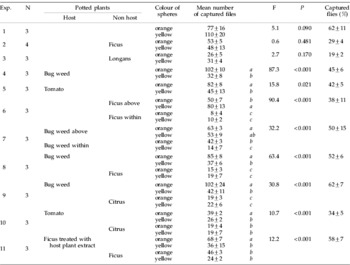
The nature of the habitat strongly influenced the distribution of N. cyanescens mature females between the yellow and orange spheres (table 1). In the absence of potted plants, captures on the yellow spheres was predominant but the difference was not significant (table 1, exp. 1). When spheres were displayed in non-host plants such as ficus or longans, the females did not express any significant preference to landing sites (table 1, exp. 2–3). On the other hand, when spheres were displayed in host plants such as bug weed and tomato, females landed mainly on the bright orange spheres (table 1, exp. 4–5). Even if the data could not be statistically compared since the experiments were conducted on different days and with different cohorts of flies, the percentage of captured flies was higher in the absence of plants than in the presence of host plants, which in turn was higher than in the presence of non-host plants. In both experiments 6 and 7, a significant interaction between the position of the sphere and the attractiveness of the colour was observed (F=5.8 and F=10.4, respectively, df=1, P<0.05). Above the ficus canopy, the yellow spheres captured more flies than the bright orange spheres, whereas no difference between colours was observed within the plant canopy (table 1, exp. 6). Spheres hung above the bug weed canopy captured more flies than those displayed within the canopy, but the bright orange spheres captured more flies than the yellow spheres within the canopy, whereas no difference was observed between colours when placed above the plant canopy (table 1, exp. 7). The percentage of captured flies was higher in the presence of bug weed than in the presence of ficus.
Mean number of mature females N. cyanescens captured on sticky yellow or bright orange spheres placed in the canopy of host and non-host potted plant.

Means followed by standard deviation. N, number of replications. Values of the same experiment followed by different letters are significantly different (ANOVA and Student Newman-Keuls test, P<0.05).
When sets of host and non-host plants were placed concurrently in the cage, the orange spheres hung in the host plants captured significantly more flies than other spheres, irrespective of the colour (table 1, exp. 8–10). For bug weed-ficus (exp. 8) and bugweed-citrus (exp. 9) combinations, we observed a significant interaction between the nature of the potted plants and the attractiveness of the colour (F=34.9, df=1, P<0.01, and F=16.8, df=1, P<0.05, respectively). Bright orange spheres captured more females than yellow spheres in bug weed, whereas no difference in choice between the coloured spheres was observed in the associated non-host plant. In experiment 11, bright orange spheres placed within the sprayed ficus captured significantly more flies than bright orange spheres placed within the unsprayed ficus. No significant interaction between the nature of the potted plants and the attractiveness of the colour of spheres was observed (F=0.4, df=1, P>0.05). Nevertheless, bright orange spheres captured more females than yellow spheres in the sprayed ficus, whereas there was no difference between coloured spheres hung within the unsprayed ficus.
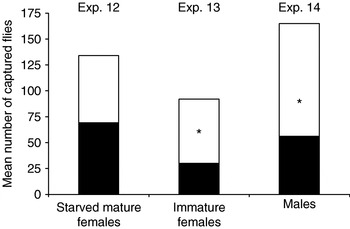
In the last experiments (fig. 2, exp. 12–14), an equitable distribution of captures of starved females was observed between the two coloured spheres placed within bug weed plants. On the contrary, immature females and males showed a significant preference for yellow spheres.
Mean number of N. cyanescens flies captured on sticky yellow or bright orange spheres placed within the canopy of potted bug weed (host plant) in a field cage, according to the physiological status (mature starved or immature females) and sex (males). n=3 replications with 300 individual flies. ANOVA and Student Newman-Keuls test, *(P<0.05). Exp. 11 (F=0.6, df=1, P=0.501), Exp. 12 (F=8.1, df=1, P=0.046) and Exp. 13 (F=13.5, df=1, P=0.021). (□, yellow; ■, orange.)

Discussion
In C. capitata, Katsoyannos (Reference Katsoyannos1987) touched on the possibility of different responses to visual stimuli based on the nature of the plant in which odourless coloured models were displayed. In our experiments, the behavioural response of N. cyanescens mature females to bright orange spheres mimicking host fruit was clearly influenced by the habitat pattern. Bright orange spheres were significantly more attractive than yellow spheres when placed within the canopy of host plants but not when placed either within non-host plants or above both types of plants. Similarly, Owens & Prokopy (Reference Owens and Prokopy1984) reported that the characteristics of the habitat might modify the response of R. pomonella to models that mimicked fruit. Like Finch (Reference Finch1995), Kostal & Finch (Reference Kostal and Finch1996) showed that a slight modification of the contrast with the background may modify the response of Delia spp. to visual traps. Our results showed that visual characteristics of the habitat are not the sole criteria that influence the host fruit location but that volatile cues emitted by the foliage may affect the visual response of flies (1) in attracting mature females engaged in a searching behaviour for a laying site and (2) in assisting them to find host fruit. In experiment 8–10, more flies were captured in host plants than in non-host plants and bright orange spheres captured more females than yellow spheres in host plants. Experiment 11 involving ficus treated with bug weed leaf extract highlighted the foliage odour as a major component of habitat cues. The response to host odour might be expressed by increased search activity. In Papilio polyxenes Fabricius (Lepidoptera: Papilionidae), the numbers of landings and eggs laid on artificial leaves increased with the availability of host plant odour in an experimental cage (Feeny et al., Reference Feeny, Städler, Ahman and Carter1989). Olfactory signals may be an indicator of an appropriate host, leading insects to search for a visual image, as a behaviour called ‘cross-channel potentiation’ (Bell, Reference Bell1990). Moreover, if the stimulation of females by the odour of host plant leaves does not trigger any orientated flight, it may constitute an indicator of a new hierarchical habitat. Prokopy & Haniotakis (Reference Prokopy and Haniotakis1976) observed that certain chemical or physical factors in the leaves or branches of olive trees retained the females of the olive fly, Bactrocera oleae (Gmelin), despite the absence of fruits.
The influence of endogenous factors on the readiness of insects to engage in any particular behaviour is the basis of their ability to order their resource-orientated behaviours (Barton Browne et al., Reference Barton Browne, Smith, van Gerwen and Gillott1993; Bernays & Chapman, Reference Bernays and Chapman1994). Starved mature females showed a weak response to stimuli and no significant preference for orange spheres. The nutritional state of insects or the time passed since the last food absorption may affect their response to stimuli. For example, females of R. pomonella deprived of proteins showed less interest in egg laying sites than normally fed flies (Prokopy et al., Reference Prokopy, Cooley, Luna and Duan1995). Immature females and males were more attracted by yellow spheres. Immature females probably needed food to complete their egg maturation while males were searching for refuge, food or mating sites as shown by Brévault & Quilici (Reference Brévault and Quilici2000b) in N. cyanescens and Aluja & Birke (Reference Aluja and Birke1993) in Anastrepha obliqua (Macquart).
According to Prokopy & Owens (Reference Prokopy and Owens1978), monophagous and oligophagous insects may present behavioural traits that qualify them as ‘visual specialists’. The formation through the natural selection of a specific image (physical or chemical) to locate the essential resources may be seen as an adaptive strategy for the ‘specialist insects’ (Cornell, Reference Cornell1976). For generalists that use a great diversity of resources, the formation of an image might be less efficient and less adaptive. It is worth noting that some generalists, like those that feed on nectar, are capable of memorizing images, flexible in relation to the nature and location of important resources. Consequently, it could be interesting to make a comparative study of the response of polyphagous flies belonging to the genus Ceratitis, for which the odour of host plant might not be of equal importance in host location mechanisms. In this regard, Prokopy & Papaj (Reference Prokopy and Papaj1986) observed that females of C. capitata detected a host fruit placed in host or non-host plants. In this situation, the characteristics of the plant did not necessarily play a role in the efficiency of the search process. For applied purposes, information on visual and chemical ecology could be useful in developing efficient traps for monitoring tomato fruit fly populations.
Acknowledgements
We thank S. Glénac for assistance in rearing flies, J. Achaleke for review of the manuscript, and the European Union for financial support of this research (Commission de l'Océan Indien, Programme Régional de Recherche appliquée sur les Mouches des Fruits, Convention N°7.ACP.RPR.400ID N°REG(RIN) 7502).