Introduction: Why Multi-nodal politics?
The nation state and the states system have constituted the dominant structured field of action for both domestic and international politics ever since the transition from feudalism nearly half a millennium ago. When the sovereign nation state emerged the winner in the post-medieval struggle between competing alternative institutional forms, it is said to have had considerable comparative structural advantages over its main rivals, the (mainly Germanic) city-league and the (mainly Italian) city state.Footnote 1 Those advantages were, firstly, that the state quickly became a more efficient arena for the organisation of endogenous collective action than the alternatives, especially with regard to integrating powerful new political and economic interest groupings which were on the ascendancy during that era; and, secondly, that states were relatively more efficient organisational vessels for the negotiation and maintenance of credible commitments amongst the exogenous universe of embryonic political units than the others, whether for threatening (and making) war or for keeping the fragile peace that emerged in the Westphalia settlement of 1648. It has been called the ‘Janus-faced state’, after the Roman God with two faces whose image was put on the gates of ancient cities – one face looking inwards to guard the welfare of domestic society, the other face looking outwards to protect the city from attack. This dual, ‘inside/outside’ character of the nation state would prove to be its great strength as an organisational form in a world which was rapidly changing from one of multi-layered but still essentially parochial economic (and political) relations to one of translocal trade, mercantile capitalism, competing royal bureaucracies and the expansion of European empires world-wide along with the emergence of new actors previously ‘subsumed’ in medieval society but increasingly socialised into national culture societies and market economies.Footnote 2
Internally, states became the privileged arenas of politics. Control over territory and increasingly well-delineated geographical boundaries defined the limits of each mutually exclusive ‘political system’. When social and economic groups have sought to pursue their interests in the public arena, they have done so by targeting the institutions and processes of one overarching political order, the state in which they happened to be physically located. When powerful individuals and groups have sought to institutionalise their dominance, they have legitimised and embedded their power in and through the political institutions of the state. When broad-based, mass groups have claimed new rights, equality, prosperity and greater security, they have done so by demanding democratic accountability and redistributive public policies from and through national states. And when political philosophers have defined normative social and political values such as justice, civic virtue and the public good, they have expected these to be embodied in better, fairer, or more just states.
Externally, states have not been mere mutual antagonists in an unorganised world. In the first place, relations between and among states took on a systematic character because powerful forces within each state, starting in Europe, recognised their potential mutual vulnerability in a hostile world. Through expanding diplomatic relations and standards of behaviour, through a desire to be free from outside interference and yet have access to the benefits of cosmopolitan culture and foreign material goods, and through a competitive interdependence which fostered both interstate rivalry and a common Western hegemony over the rest of the world, European and later other elites secured their power as much through international (interstate) relations as through domestic consolidation. And they drew middle-class and later working class groups into these national culture societies by imposing national languages, taxation, military conscription, the development of national markets and ultimately liberal democracy based in national political institutions, all of which reinforced the capabilities of these evolving units to act more effectively in their foreign relations too. Occasional wars, revolutions and the changing balance of power further entrenched the interstate character of the international system, while at the same time allowing it to adjust to a fluctuating and evolving range of social, political and economic pressures and structural changes, both old and new, inside and outside.
However, despite its long gestation and organisational durability, the modern nation state as we have known it represents only one particular kind of governance structure among many possibilities. In the broad sweep of history, many kinds of societies and forms of political organisation have existed in the world, from isolated village societies and more outward-looking city states, to traditional empires and looser leagues and confederations, as well as to the more hierarchically structured states of the modern world. Furthermore, only in the Second Industrial Revolution did the high modern nation state begin to develop the range of socio-economic functions we became accustomed to seeing in the 20th century, when mass production and modern industrial enterprises, the Weberian bureaucratic revolution in both public and private sectors, and mass politics brought together a range of structural elements conducive to the development of the welfare state. Today a number of factors including ethnic and religious ties, multiculturalism, transnational communities, and the internationalisation of production, consumption and finance have fostered the emergence of a vast range of alternative sources of economic advantage, political influence and social identity.Footnote 3 Of course, states will not become entirely redundant or disappear. Nevertheless, they are increasingly caught up in webs of power that limit or transform their activities by altering the context within which they exist and operate.
These varied processes of change are usually brought together under the label of globalisation. The concept of globalisation has been critiqued in a range of ways; however even its critics usually accept that a range of processes are at work that are transforming world politics and society in crucial ways.Footnote 4 As I have argued elsewhere, globalisation should not be seen as an all encompassing, seamless process of ‘level shift’ but as the result of the addition and interaction of a complex set of intertwined processes on a range of diverse, intersecting and overlapping, and often quite uneven levels and playing fields. These processes include the development of denser relations among states (usually called ‘internationalisation’),Footnote 5 growing below-the-border dealings cutting across states (‘transnationalisation’), denser interactions among localities and regions (‘translocalisation’ or ‘glocalisation’), and the transformation of social, economic and political relations and processes at the domestic and local levels themselvesFootnote 6 – the macrocosm within the microcosm.Footnote 7 More important than any one of these levels, however, are the interaction effects among them. It is these interaction effects that destabilise the structural equilibrium underpinning the levels of analysis distinction, thereby undermining the path dependency of the international system as we have known it, and lay the foundations for ongoing and future developments. This overall process of transformation, I suggest, has three main interlocking dimensions.
The first and most obvious dimension involves a change in the character of the state's domestic tasks, roles and activities. This basically involves the way so-called ‘public goods’ are perceived, pursued and provided.Footnote 8 In particular, the aim of social justice through redistribution has been challenged and profoundly undermined by the marketisation of the state's economic activities (and of the state itself) and by a new embedded financial orthodoxy.Footnote 9 These changes not only constrain the state in its economic policies but also alter people's understanding of what politics is for and thereby challenge the political effectiveness of the national liberal democratic political systems which are supposed to represent what the people want. The second dimension involves a fundamental reorientation of how states interact economically with each other. State actors are increasingly concerned with promoting the competitive advantages of particular production and service sectors in a more open and integrated world economy – what I have called the ‘competition state’ and what Sheehan calls the ‘civilian state’Footnote 10 – not only in order to produce collective economic gains, but also to build new socio-political coalitions and expand the scope and reach of own their power and influence. In pursuing international competitiveness, state agencies closely linked with those economic sectors most closely integrated into the world economy accept and indeed embrace those complex interdependencies and transnational linkages thought to be the most promising sources of profitability and economic prosperity in a rapidly globalising world.
The final dimension concerns the relationship between structure and agency – in other words people – between constraints embedded in existing structural and institutional rules, existing patterns of the distribution of resources and power, and existing practices and ways of doing things, on the one hand, and the individuals and groups who make tactical and strategic, day to day or long term, decisions that can alter or break those rules, patterns and practices, directly or indirectly, intentionally or unintentionally, on the other. In other words, rather than continuing path dependency, these effects generate multiple equilibria, creating the possibility of new ‘branching points’, thus opening the way to potential path modification and reconstruction of the system itself. It is crucial to identify these structural fault lines and explore the potential constraints and opportunities that actors may face in attempts to manipulate and reshape the structure of the system.
This does not merely concern those global ideologists in business studies, important as they are, who declare that we live in a ‘borderless world’, nor just the rapid growth of transnational cause pressure groups like Greenpeace who focus on the problems of ‘the planet’. It also involves strategic action across both public and private domains not only for more concrete competitive advantages in the world marketplace but also for reshaping social and political processes and institutions to reflect new distributions of power and resources (‘distributional changes’) and new ways of looking at the world (‘social epistemologies’).Footnote 11 In this process, for example, the focus of the economic mission of the state has shifted considerably from its traditional concern with production and producer groups to one involving market structures and consumer groups, and from its understanding of the state in general as a ‘decommodifying agent’ to one as a ‘commodifying agent’. In this context, not only have state actors found their roles changing as the state itself has become more ‘splintered’ and ‘disaggregated’Footnote 12 but the density and complexity of their interactions of state actors with other political, social and economic actors has also increased together with those of the objects of their concerns – the dramatic expansion of transnational socio-economic interpenetration, the immediacy of global economic, social, environmental and security challenges, the evolution of transnational communication and norms, and the limits of traditional forms of national power projection.
These three dimensions, I suggest, add up to a profound challenge to the traditional structures both of the domestic nation state and of the interstate system, undermining key aspects of the previously symbiotic relationship between the two. Thus we should not expect the nation state to wither away; indeed, in some ways it will continue to expand and develop its tasks, roles and activities. The crucial point, however, is that those tasks, roles and activities will not just be different, but will lose much of the overarching, macro-political and holistic philosophical character traditionally ascribed to the effective state, the good state or the just state, all of which concepts have assumed a level and quality of internal coherence and of difference from the external ‘other’ that the state's most essential – and most ideologically and culturally legitimate – task has been to protect. Future structural developments will be the product of an increasingly transnational, cross-cutting structure of micro- and meso-interdependencies, partially mediated through the state but with their own autonomous dynamics too. The state can attempt to manipulate and influence these but cannot fundamentally change them. In the long run, state actors must adapt their own strategies to perceived global realities, while other kinds of actors, economic and social, will play key roles too in restructuring the political arena.
Restructuring the political arena: the process of structuration
Theories of globalisation have privileged structural explanations of change. The prevalent image is that of a shrinking world. In this context, changes in exogenous conditions are seen in turn to alter human behaviour in ways that are broadly predictable because their patterns are determined by the material or ideational morphology of those exogenous conditions per se. Exogenous structural variables include the infrastructure of travel and transportation, competitive imperatives facing the multinational corporation, the abstract and all-pervading character of international finance, the flexibility of post-Fordist production techniques, the innovation and spread of information and communications technology, a general speeding up of the tempo of life and consciousness, the cultural ‘global village’, or the indivisible ecology of ‘the planet’. Nevertheless, attempts to extrapolate future world orders from such structural changes always border on science fiction. They never really capture the range of possibilities, possibilities which are shaped by actors.
At the same time, most agency-centred approaches, particularly constructivism, have shied away from grappling with the structural or material aspects of globalisation. They go too far in the other direction. Constructivists’ overemphasis on the potential autonomy of ideas and institutions has paradoxically turned the attention of scholars away from broad paradigmatic change and focused discussion on limited debates about the ideational character of existing institutions, incremental changes within the existing states system, and/or the possibilities for resistance within the current world order. Much of today's constructivism in International Relations, far from reflecting the transformational epistemological vision of Berger and Luckmann's critique of functionalist social theory,Footnote 13 seems content to challenge the hard structuralist character of neorealism with a soft classical realism of a more historical and ideational typeFootnote 14 – although allowing national actors greater scope for international regime-building within that context.Footnote 15 In addition, postmodernism and post-positivism, while taking a more critical stance, have nevertheless had little to say about the globalisation process except as a potential negation of modernism and positivism.
In contrast to both the determinism of structuralism and the indeterminacy of constructivism, this article starts from the structurationist view that structure and agency are mutually constituted in an ongoing process that simultaneously both (a) consolidates and yet fractures structures and (b) constrains and yet empowers agents, in a reciprocal, interactive process over time.Footnote 16 The concept of structuration has been interpreted in various ways, and critics tend to see it as breaking down when operationalised. In other words, structuration based approaches usually end up privileging either structures or agents, or indeed reifying the process of interaction between them. However, these critiques do not in my opinion undermine the heuristic value of using structuration as a hypothetical starting point for identifying and tracking key variables in a structure/agency analysis, and that is how I am applying it here. In this context, agents are conceived of – hypothetically – as acting within (unevenly) structured sets of constraints and opportunities – Crozier and Friedberg's concept of ‘structured fields of action’Footnote 17 – while at the same time those sets of constraints and opportunities are conceived of hypothetically as the cumulative products of agency in an ongoing interactive process.
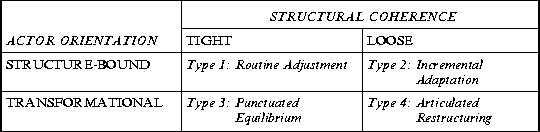
In order to construct a preliminary simplified representation of the structuration process, then, it is necessary to make some typological distinctions. Structures, whether static or changing, can be characterised as either uneven and loosely held together, on the one hand, or homogeneous and tightly interwoven, on the other. Agents, in turn, can act either in structure-bound or merely adaptive ways, on the one hand, or in entrepreneurial and potentially transformational ways, on the other. In this sense, I would suggest a stylised heuristic typology of ideal-type or polar-type structuration processes, represented in the above 2×2 matrix (Table 1).
Structuration processes
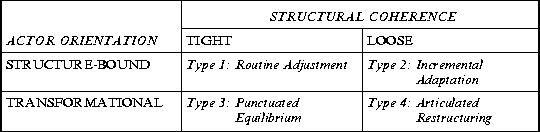
In the upper left hand quadrant, where structure-bound actors are situated within a tightly woven structural context (Type 1), the interaction between structure and agency would tend to be of a fairly static, routine kind, predominantly leading to passive adjustment to exogenous structural changes; such change should be robustly predictable from knowledge of its exogenous sources. In the upper right hand quadrant, where structure-bound actors are situated within a loosely articulated structure (Type 2), a form of incremental adaptation analogous to certain kinds of traditional Darwinian random selection might be anticipated; however, actors would be likely to have some limited opportunities (‘wiggle room’) for creative adaptation and institutional bricolage. In the lower left-hand quadrant, where change-oriented or transformational actors – those whose understandings, visions and knowledge enable them to transcend existing structural constraints in developing their strategies and tactics – are situated within a tightly woven structure (Type 3), one might expect an uneven structuration process where both exogenous and endogenous pressures for change would build up over time and lead to punctuated equilibria – for example, to unpredictable conjunctural upheavals the outcomes of which can take a variety of different forms from re-equilibration to structural degradation to revolutionary change. Stanley Hoffmann has referred to this process as ‘homeorhetic change’;Footnote 18 such conjunctural upheavals can also be seen as ‘Black Swans’ or ‘grey swans’, in the framework developed by Taleb.Footnote 19 And in the lower right hand quadrant, where change-oriented actors are situated within a loosely held together structure (Type 4), possibilities for actor-orchestrated articulated restructuring would be greater – accompanied, however, by increased uncertainty about how controllable different component parts of the structure might be (especially under strong exogenous structural pressures). With the partial exception of Type 1 structuration, therefore, even the tightest exogenously-led processes of structural change generate multiple equilibria that actors can to some extent manipulate or reshape. In this context, globalisation entails permissive conditions for change, not restrictive ones, despite (or rather because of!) increasing uncertainty.
The five stages of structuration
To put this approach into perspective, I will first outline a five-stage model of change, adapted from a format originally developed by Spruyt in the context of the European transition from feudalism to the sovereign nation state. (Spruyt identified three stages of transition, which I expand to five; see below.) He calls this process one of ‘institutional selection’, the core of which is the identification of multiple equilibria – in other words, the existence of multiple alternative potential future developmental pathways generated by the decline of the feudal system.Footnote 20 He identifies three of these alternative pathways: the city state on the Venetian model; the city-league, based on the Hanseatic League in Northern Europe; and the sovereign nation state, based on the Bourbon monarchy in France. Had the early, relatively centralised French state not been as bureaucratically and economically strong as it was in the 14th to 17th centuries as the result of factors unique to its previous historical development, the other models might have proved more resilient, leading to either the coexistence of different post-feudal succession models in Europe or to the dominance of one of the other models. But the dual capacity of the French state on the one hand as an arena of collective action domestically and a source of credible commitments – that is, as the result of its ability to pursue a coherent and unified foreign and security policy and to make reliable and durable contractual arrangements, both formal and informal, with other actors internationally – on the other, led to a process of emulation by dominant groups in other proto-states in order to ensure their survival and political power. Thus the nation state as an institutional construct was reproduced and imitated by actors seeking to defend and promote their own interests and values in a fluid, unsettled and complex set of historical circumstances – a process identifiable with hindsight but relatively open and unpredictable within the ebb and flow of events and choices at the time – until, at a later stage, the states system emerged in Europe and was spread outwards through empire and further imitation.
This developmental route did not, of course, emerge and crystallise in a vacuum. Previous elements of the old feudal system remained, although their position was altered, often for the worse, but sometimes finding new sources of power and influence – for example the Roman Catholic Church and the aristocracy.Footnote 21 And many new trends were already in place, such as: urbanisation and the migration of former serfs from the countryside; the development of new productive technologies; the growth of social organisations such as guilds rooted in those emerging forms of production, along with local corporatist governments; the development of consumer demand – and demand for more influence on the political and social front – from more affluent nobles to the growing urban middle classes and lumpen proletariat to more independent sectors of the peasantry to merchants involved in burgeoning long-distance trade (what Spruyt calls ‘translocal trade’ to indicate that it was not yet fully ‘inter-national’); the development of Common Law in England and the rediscovery of Roman Law on the European continent; and of course new forms of warfare, more efficiently organised and controlled from the top down, first in France and then in Prussia on land and in the Netherlands and England on the sea. Indeed, the transition from feudalism to the nation state laid the groundwork for a first phase of globalisation led by the most powerful states themselves through their later frustration at the territorial carve-up of Europe and consequent quest for overseas empire.
In this process, five stylised stages can be distinguished. Of course, these phases do not succeed each other neatly; they are uneven, overlapping, often largely concurrent and inextricably intertwined with each other. The first involves what Spruyt calls ‘exogenous independent variables’ – although these, too, can be traced back to earlier, analogous developments in the prior emergence and consolidation of European feudalism itself from tribal societies and empires, as well as its decline. In this case, typical exogenous independent variables were the emergence of artisan manufacture, the growing monetisation of labour, new forms of transport, technological developments such as early mechanics, the expansion of translocal trade, the rapid growth of food production in the late feudal era before its decline and economic crisis, and the development of long distance financial relationships. In other words, European feudalism itself underwent accelerating and increasingly dramatic changes analogous to globalisation today, as the political structures and institutions of medieval society were overtaken by the transformation of the socio-economic infrastructure.Footnote 22 Patterns of production, trade, finance and labour – what today are often taken for proxy variables for economic globalisation, and sometimes globalisation tout court – were changing across Europe, pointing to the emergence of what would prove to be a set of permissive preconditions for the fundamental social, political and economic transitions that were beginning to take place.
The second stage, linking Spruyt's first stage, above and the third stage, below (that is, Spruyt's second stage), is the result of the first. The structural changes represented by Spruyt's exogenous independent variables lead to, and are inextricably intertwined with, changing distributions of resources and therefore of power and influence during the period of transition – and shaping yet more distributional changes further down the line. Two sorts of distributional changes can be identified, although they are again often intertwined in practice. The first concerns the partial, but highly significant, ways that the amount and distribution of power and material resources commanded previously by actors embedded in the old system are converted by those actors into new forms of power and influence both in the period of transition and in the succeeding phase of development, whether the nation state in the post-feudal period or the emerging global (dis)order of the 21st century. In the former, nobles and churches increasingly bureaucratised and monetised their holdings, especially through the development of private property rights in land and the marketisation of their products. The leading nobles sought to increase and entrench their power through the development of centralised monarchies and through more highly organised forms of taxation and warfare. And peasants sought greater control over their work and rewards from their labour, whether in the fields or through migration to the newly expanding cities.
Secondly, of course, ‘new’ groups emerged and sought innovative ways to increase their wealth and power. Urban entrepreneurs and international merchants were able to control the rapidly growing productive sectors of the economy, to obtain greater profits and to invest in new forms of production, distribution and exchange. Bankers and financiers became increasingly crucial to the translocalisation of production, trade and consumption. Urban labourers, although usually at the sharp end of any direct confrontations, became increasingly able to use new skills and the capacity to vote with their feet to live better, at least better than they had done as serfs, and to seek upward social mobility. And a ‘petty bourgeoisie’ of shopkeepers, clerks, supervisors, bureaucrats and what would later be called the ‘intelligentsia’ became more and more central to social change and economic development. But most important were the political consequences, as these groups in transition sought more influence over entrenched feudal elites and over the outcomes of political and legal processes – the expansion of private property rights, regulatory backing and protection from market failure, the opening of overseas markets, and, most importantly – the source of the British, French and American Revolutions of the 17th and 18th centuries, not to mention the many more since – more ‘voice’ in governmental processes.
Absolutist monarchies lasted only as long as they promoted and reinforced these trends and were eventually overthrown when they were seen not to by large enough coalitions. This was not democracy yet, but it was a new embryonic pluralism. It is this second stage that I argue constitutes the closest analogy to globalisation today, rooted in corresponding distributional changes at the transnational level. In particular, the shift from traditional forms of political and economic hegemony of sectors of society that made their living from the land to those who increasingly made it through industrial production and translocal trade is not dissimilar to today's shift from the hegemony of those groups whose power and influence derived from their domestic dominance, whether national level corporations, national bureaucracies or national trade union organisations, to those whose political and economic clout and muscle derive from the transnational scale and scope of their activities and networks, whether multinational producers, consumers or, increasingly, workers. Nevertheless, elements of the third, fourth and fifth stages are not far behind.
The third stage, deriving from the second, is what Spruyt calls the ‘rearticulation of social and political coalitions’. This represents the heart of the pluralist political process itself, as the fluid and volatile distributional changes described above lead actors to seek new ways of pursuing their interests and furthering their values through shifting alliances and seeking new forms of influence in both public and private arenas. In the transition from feudalism to the nation state and the states system in Europe, this process concerned in particular the ability of the rising urban classes to challenge the monopoly of power of the aristocracy; of various sections of the aristocracy both old and new to forge alliances with sections of the bourgeoisie in order to convert their previous power resources into ones more relevant to changes in the economy, the bureaucracy and emerging nation state-based practices of diplomacy, warfare and imperialism; of monarchies to convert their power base from personal, feudal ties into bureaucratic hierarchies and to seek support sometimes from sectors of the aristocracy, sometimes from the new middle classes and sometimes even from the emerging masses through patriotism, religion or national defence; and of value groups, whether religious, liberal or revolutionary with (and against) each other and a range of diverse competitors and collaborators. As the newspaper editor Charles Dudley Warner famously said in 1850 (following Shakespeare): ‘Politics makes strange bedfellows’ – especially true in times of transition and change. It is this process of the rearticulation of social and political coalitions that lies at the heart of Barrington Moore Jr.’s magisterial Social Origins of Dictatorship and Democracy and Theda Skocpol's States and Social Revolutions, chronicling how diverse groups competed for control and influence in the consolidating nation states of the 17th to 19th centuries.Footnote 23 Today, analogous alliances among diverse transnationally linked groups, in and between both private and public sectors, involving both sectional groups pursuing common material interests and/or value groups often referred to collectively as ‘global civil society’, are increasingly driving the globalisation process.Footnote 24
The fourth stage, again inextricably linked and overlapping with the third, involves a shift from the emergence of new reactive new forms of competition and coalition-building in the context of structural change to new strategic and substantive forms. This stage is characterised by the uneven but sometimes rapid and increasingly imperative search for the stabilisation of more successful experiments in resource and influence building, for more regularised control of reconfigured policymaking processes and for new, more systematic policy agendas. In particular, during the long transition to the nation state and the states system, European political, economic and social actors experimented with new ways to promote economic growth and ultimately industrialisation, to entrench property rights, to regulate trade and finance, to develop new police powers to control urbanisation and protest, to resolve conflicts through more elaborate and autonomous legal mechanisms, to deal with growing problems of mass society through labour regulation and embryonic forms of welfare, and to pursue economic and social as well as security goals in the new, highly competitive international system of state consolidation and imperial expansion.Footnote 25 Crucial to all of these was innovation in different forms of government intervention in the economy. Today, political competition over – once again – economic growth (and decline) not only of the system as a whole but also of particular sectors and regions, over regulation of trade, finance, labour and migration, and over the nature of political bonds themselves is bringing into question basic assumptions of social belonging, legitimacy and, of course, the distribution of resources, power and influence in a rapidly globalising world.
The fifth stage – Spruyt's third stage – is what he calls ‘institutional selection’. It is not enough to rearticulate social and political coalitions or to develop new policy agendas in the context of such far-reaching change. It is necessary to rethink and reconfigure the very institutional superstructure of society and politics. In the transition from feudalism to the modern nation state, and in the development of the modern state itself, this meant building a more centralised (or centripetal) state, reflecting Waltz's distinction between the ‘anarchy’ of the international arena and the ‘hierarchy’ of the domestic state.Footnote 26 These two dimensions were mutually reinforcing. For example, in order to make credible commitments, pursue national interests and project state power on the international stage, it was necessary to develop central military command and control systems, industrial production, infrastructure for transportation, communications and weapons production, more efficient taxation and national banking systems to provide funding, and in many ways most importantly in terms of creating an expanding base for new forms of warfare, mass military conscription.Footnote 27 All of these developments went alongside a redefinition of citizenship, the promotion of patriotism and loyalty to central institutions – not merely personal fealty to the monarch or nobility – and, eventually, the expansion of popular forms of legitimacy through parliamentary representation and ultimately the mass franchise. Crucial to all of these were the development of constitutionalism, of mechanisms of state economic intervention and the institutionalisation of legal systems and the rule of law.
Today, of course, we are in a relatively provisional stage of the development of international institutions and regimes, one in which different regimes and agencies are often set up for distinct issue areas – there is no overarching institution except the United Nations, which is often hobbled by its highly intergovernmental structure – leading to both what is called ‘venue shopping’ or ‘forum shopping’ on the one hand and what Lake has called the ‘privatisation of governance’ on the other.Footnote 28 International, transnational and global institutions are in the midst of a process of institutional bricolage – that is, a combination of ad hoc experimentation in a fluid institutional context and in particular conjunctural circumstances on the one hand with a combination of pragmatic adjustment and strategic action on the other. This institutional bricolage is similar to what I have elsewhere called, following Foucault, ‘governmentalisation’.Footnote 29 This fifth stage, the process of institutional selection, is bound up with the previous four – sometimes manifest, sometimes latent – is at the core of the development of what is often called ‘global governance’. Governance is itself a contested concept, originally consisting of informal practices, networks and power structures; however, in the context of international institutions and regimes, ‘global’ governance has been redefined to include more formal institutions such as the International Monetary Fund, the World Bank, the World Trade Organisation and a range of others, although usually restricted to particular issue areas. However, the coherence, capacity and control span of global governance institutions and processes are seen to be tentative, uneven and open to a wide range of multiple equilibria over the coming decades. On another level, international and transnational institutional selection is also at the heart of the transformation of the state itself into a competition state.
Transforming the ‘public’ arena
The process of structuration in a globalising world is therefore a complex one in which different kinds of existing structures and institutions interact with an expanding and increasingly diverse set of actors seeking to pursue their interests and values. I will first briefly look at some of the main structural shifts characterising the current era of globalisation, after which I will consider the role of pluralist and neopluralist political theory as a way of conceptualising how structuration works in practice. There are two fundamental structural shifts which will be considered here. In the first place, the state has traditionally been perceived to be inextricably intertwined, even coterminous, with the concept of the ‘public’, in terms of both the classical notion of the ‘public interest’ and the contemporary quasi-economic concept of ‘public goods’. I argue that the very constitution of the public is being transformed in the context of political (as well as economic and social) globalising trends. Secondly, I will address the institutional framework and the changing roles of the state. I will not deal directly with the issue of institutional selection – that is, the fifth stage of the broader process – in any detail, as the development of global governance is as yet embryonic, fragmentary and contested. Broadly speaking, however, the power structure of a globalising world inevitably becomes more complex and diffuse, diffracted through a ‘prismatic’ structure of socio-economic forces and levels of governanceFootnote 30 – from the global interaction of transnational social movements and interest/pressure groupings, multinational corporations, financial markets, and the like, on the one hand, to the re-emergence of subnational and cross-national ethnic, religious and policy-oriented coalitions and conflicts of the type familiar in domestic-level political sociology, on the other. World politics – that is, both domestic politics and international relations, taken together – is being transformed into a ‘polycentric’ or ‘multinucleated’ global political system operating within an increasingly continuous geographical space and/or set of overlapping spaces. In these conditions, it becomes harder to maintain the boundaries that are necessary for the efficient ‘packaging’ of public or collective goods. Indeed, it becomes harder to determine what collective goods are demanded or required in the first place – that is, even to measure what is the ‘preferred state of affairs’.Footnote 31
State actors themselves – although they continue to have a range of significant economic, financial, political and bureaucratic resources at their disposal and are still crucial actors in regulating particular economic and social activities – paradoxically act in routine fashion to undermine the holistic and hierarchical character of traditional state sovereignty, authority or potestas – a ‘hollowing out of the state’. The result is a growing ‘privatisation of the public sphere’, not only by selling off or contracting out public services and functions, but in the deeper sense of reducing society itself to competing ‘associations of consumers’ in which administrators are little more than buyers in competing corporations.Footnote 32 This combination of structural trends triggers a reassessment of the conception of public or collective goods in a globalising world. Collective goods in theory are those (a) which are difficult to divide up into marketisable commodities because of the structural characteristics of their production, that is, their physical requirements and/or technological economies of scale, requiring centralised managerial control and the funding of their provision through authoritative means like fees and taxes rather than the price mechanism and (b) from the enjoyment or use of which those who live within the territory cannot be excluded, thus requiring authoritative mechanisms – rather than markets – not only for determining what and how much is produced, but also who gets what, when and how and excluding non-paying users (‘free riders’).Footnote 33 In other words, true public goods are characterised by indivisibilities of both production and distribution. The provision of public goods has thus been a classic task of hierarchical governments (states).Footnote 34
For example, many of what were thought to constitute collective goods at the time of the Second Industrial Revolution are either no longer controllable by the state because they have become transnational in structure or constitute private goods in a wider world marketplace (or both). Today, oligopolistic and mass production industrial sectors that have been incorporated into state-led and/or ‘neocorporatist’ structures must become internationally competitive to survive; technological changes diffuse quickly across borders; defence industries and other ‘strategic’ sectors are no longer immune from foreign competition; macroeconomic policy is increasingly vulnerable to cross-border shifts in demand, supply and financial flows; small businesses and the service sector increasingly have to compete; even the welfare state and employment policy can no longer be insulated from external economic pressures for marketisation and restructuring in the name of greater efficiency and ‘choice’.
Thus the nature of the political debate is also changing in fundamental ways. In theoretical terms, the idea of what is ‘public’ is essentially normative. In the economic theory of collective goods, the main issue is indivisibility: only what is most efficiently organised and run publicly in economic terms (that is, that which provides the best possible product at the lowest possible cost when organised according to the definition set out below) ought to be so organised and run. In a globalising world, however, such calculations become more complex. In some industries, goods that once may have been most efficiently produced on a collective basis, especially on a national scale, may nowadays be more efficiently organised along lines which imply larger, transnational optimal economies of scale, making traditional ‘public’ provision unacceptably costly and uncompetitive; whereas in other cases, technological change and/or flexible production may actually reduce optimal economies of scale, turning such goods effectively into private goods, which also are increasingly produced and traded in a global rather than a national marketplace. At the same time, in a globalising world it has become increasingly difficult to exclude ‘foreign’ free riders from outside national boundaries from benefiting from nationally-provided collective goods in ways that are unacceptably costly in terms of domestic politics and public policy, as today's debate over different kinds of free trade agreement demonstrates. Thus with regard to both production and consumption, it is becoming more and more difficult to maintain the sort of public or collective boundaries necessary for efficient and/or exclusive state provision of public or collective goods.
The heart of political debate today is therefore increasingly about choosing among competing conceptions of what should be treated as public and what should not. In the first place, in a world of relatively open trade, systems of financial regulation and the increasing impact of information technology, property rights and other basic rules are increasingly complex for states to establish and maintain. In this context, the ability of firms, market actors, and competing parts of the national state apparatus itself to defend and expand their economic and political turf through activities such as transnational policy networking and regulatory arbitrage has both undermined the control span of the state from without and fragmented it from within. Furthermore, the advent of flexible manufacturing systems and competing low-cost sources of supply – especially from firms operating multi-nationally – has been particularly important in undermining state-owned and parapublic firms. International competitiveness counts for far more than does maintaining an autonomous, self-sufficient national economy, in both the developed and developing worlds. The same can be said for more traditional forms of industrial policy, such as state subsidies to industry, public procurement of nationally produced goods and services, or trade protectionism.
In addition, basic public services and functions such as the provision of public health, education, garbage collection, police protection, certain kinds of transport or energy infrastructure, etc., which have been at the bureaucratic heart of the modern welfare state, are being disaggregated and commodified in a range of ways through the ‘New Public Management’ and ‘reinventing government’.Footnote 35 Employment policies are under challenge everywhere in the face of international pressures for cross-border wage restraint, labour competitiveness and flexible working practices, while there has also been a significant transformation of the welfare state, from the maintenance of free-standing social and public services to the provision of conditional unemployment compensation and other ‘entitlement’ programs, and from maintaining public bureaucracies to devolving and privatising their delivery and sometimes their production.Footnote 36 Finally, environmental protection is particularly transnational in character; pollution and the rape of natural resources do not respect borders. These changes not only increase actors’ options but also prioritise strategic and tactical flexibility, increasing overall openness to change.
In terms of the transformation of public policy and policymaking, therefore, several types and levels of state activity are significantly affected and even transformed by the globalisation process, opening new avenues for actors to reshape and even transform political and policymaking processes and their outcomes. The interaction of transnationalisation, internationalisation and domestic restructuring has pushed four specific types of policy change to the top of the political agenda: (1) a shift from macroeconomic to microeconomic interventionism, as reflected in both regulatory change and industrial policy; (2) a shift in the focus of that interventionism from the development and maintenance of a range of ‘strategic’ or ‘basic’ economic activities (in order to retain minimal economic self-sufficiency in key sectors) to one of flexible response to competitive conditions in a range of diversified and rapidly evolving international marketplaces, that is, the pursuit of dynamic ‘competitive advantage’ as distinct from the more static ‘comparative advantage’;Footnote 37 (3) an emphasis on control of inflation and neoliberal monetarism – supposedly translating into non-inflationary growth – as the touchstone of state economic management and interventionism; and (4) a shift in the focal point of party and governmental politics away from general maximisation of welfare within a nation (full employment, redistributive transfer payments and social service provision) to the promotion of enterprise, innovation and profitability in both private and public sectors. In this context, there have been some striking similarities as well as major differences among both developed and developing countries.Footnote 38 Trade policy, monetary and fiscal policy, industrial policy and regulatory policy are all changing to a more differentiated repertoire of state responses to the imperatives of growth and competitiveness – what has been called ‘embedded neoliberalism’, with all its complex emerging varieties.Footnote 39
Underlying all these changes is the uneven transnationalisation of issue areas, a question we will return to below. State actors and their different agencies are increasingly intertwined not only with ‘transgovernmental networks’ – systematic linkages between state actors and agencies overseeing particular jurisdictions and sectors, but cutting across different countries and including a heterogeneous collection of private actors and groups in interlocking policy communities, especially those involving regulators, legislators and the legal systemFootnote 40 – but also with transnationally linked non-state actors in complex networks such as ‘epistemic communities’ of experts and policymakers in a range of technical issue-areas.Footnote 41
Complex globalisation has therefore to be seen as a process involving (at least) three-level games, with third-level – transnational – games including not only ‘firm-firm diplomacy’ but also transgovernmental networks, transnational policy communities, internationalised market structures, transnational pressure and interest groups (of both the ‘sectional’ and ‘cause’ varieties) and many other linked and interpenetrated markets, hierarchies and networks.Footnote 42 These changes increase the opportunities actors face in reacting to such changes, including manipulating the possibilities inherent in the multiple equilibria that result, deconstructing and reconstructing coalitions, developing wider strategies for change, and transforming institutional structures – engaging in institutional bricolage – to reshape longer-lasting power configurations. In particular, contrary to the popular image of ‘deregulation’, the growth of competing authorities with overlapping jurisdictions does not reduce interventionism. Rather, it expands the range of possibilities for splintered governments and competing groups of actors to challenge old fiefdoms and attempt to develop new patterns of influence and power both domestically and transnationally. Indeed, the return of regulation to the forefront of policymaking and both economic and political debate at the time of writing as the result of the financial ‘meltdown’ of September-October 2008 demonstrates how globalisation not only requires actors to engage across borders at multiple levels but also enables a range of transnational and international policy innovations to be experimented with alongside more traditional neo-Keynesian approaches at the domestic level.
Pluralism and neopluralism
It is not enough, however, just to say that International Relations, the international system, world politics, or whatever, is being made more ‘complex’ in the globalisation or structuration process. It is also necessary to provide an analytical framework and set of hypotheses about how that complexity emerges and develops. In this context, I argue here that it is primarily the capacity of a wider range of actors to manipulate and reshape the distribution of power and resources, to alter the rules of the game, to transform political practices and to redefine the concept of the public and the public interest that will determine the evolutionary pathway and shape of the globalisation process. In the context of the structural shifts outlined above, this capacity privileges those actors whose interests and values allow them to build transnational coalitions in particular issue areas, spilling over into a broader process of system transformation. I have elsewhere gone into more detail with regard how one might classify specific categories of actors within this process – in particular, how highly stylised types of economic, political and social actors might hypothetically interact with systemic constraints and attempt to alter those constraints in ways that affect the wider evolution of the system.Footnote 43 I will not go into such detail here. My purpose here is to characterise the wider processes within which these actors operate. In doing so, my main aim is to adapt the analytical frameworks of pluralism and neopluralism to the global/transnational arena and to argue that ‘multi-nodal politics’ can provide the analyst with a useful and insightful tool to investigate, explain and understand what is going on in a globalising world.
In developing this argument, it is necessary to point out that there is a key distinction between how the term ‘pluralism’ is used in mainstream International Relations theory and the way it has been used in Political Science. This article focuses on importing the latter into the former, and in doing so it must be clear what is entailed in terms of specifying the theoretical and analytical issues involved. In mainstream International Relations theory, the English School in particular, not only is each state normatively entitled to possess its own internal moral, ethical and socio-economic system, but each is also for historical and logistical reasons fundamentally distinct from all the others in size, resources, capabilities, culture and political system – that is, its unique developmental pathway. These differences imply that a ‘pluralistic’ international system not only will be characterised by a plurality of significantly differentiated sovereign states, but also that a key part of the dynamics and structure of the system will involving bringing those diverse states together while at the same time recognising their essential autonomy and right to protect that autonomy – although the extent of that autonomy is historically variable. Indeed, in this context, those whom one might call moral realists have argued paradoxically that peace could only be promoted through non-interference and mutual recognition of the ultimate sovereignty of states to determine their own priorities and national interests. The existence of a plurality of different kinds of states with different values and interests can therefore be seen to be a guarantee of a kind of state-based pluralism rooted in the mutual recognition of those differences, almost a kind of vertically containerised international multiculturalism.Footnote 44
In contrast, the pluralism I am talking about here does not mean vertical containerisation but rather horizontal social, political and economic stratification among social categories, interest groups, political parties, business sectors and socio-economic classes. In other words, pluralism of this kind implies not only horizontal stratification within particular nation states, as has been the case with traditional Political Science approaches, but also potential and real – or, to use Truman's venerable distinction, ‘latent’ and ‘manifest’ – linkages and common action bases cutting across states, regions and, with regard to some issue areas, the world more generally.Footnote 45
I am using two distinct but interrelated labels here, ‘pluralism’ and ‘neopluralism’ (the latter sometimes seen as a separate category, sometimes a subcategory of pluralism), but I will first outline the basic tenets of pluralist theory proper. Pluralism is an approach to political sociology that can be either normative or empirical (positivist), or both. It is rooted in the following propositions. Firstly, the key independent variable in explaining the operation and outcomes of political processes is the role of the actor or agent. Structures are important in they constitute the ‘playing field’ on which actors operate, but, as argued above, such playing fields are not set in stone. They of course constrain actors’ behaviour in key ways, but under certain circumstances – see the discussion of structuration above – they are complex and often somewhat or even highly fragmented, manipulable, vulnerable to structural crisis under particular conditions, and, most importantly, open to the production of multiple equilibria or alternative outcomes.Footnote 46 Therefore the capacity of particular actors to manipulate, dominate, ignore, break out of, transcend, reshape and/or reconstruct those patterns of structural constraints and opportunities is highly variable – indeed, the key independent variable in determining how those structures ‘behave’ in practice. The goals and the capacities (or lack of capacity) of different actors to ‘work’ or transform the institutions will determine the substance of political outcomes, as to whether they are institution-or-structure-bound, on the one hand, or whether they are reconstructing and/or transformative, on the other.
Secondly, actors may be individuals, and individuals may be reactive or proactive, mixed-motive or strategic ‘political (or institutional) entrepreneurs’. But most of the time, actors normally cluster in collective action units, traditionally called ‘groups’. Groups are said to represent ‘interests’,Footnote 47 and, as noted above, those interests reflect either (or both) common material self-interests – sectional groups – and/or common social, ideological or philosophical values – value groups – or both. Groups, in pursuing their interests, seek to gain influence and power through bargaining, competition and/or coalition-building among themselves and with relevant state actors. In this context, it is crucial for there to be alternative possible outcomes – multiple equilibria, again – depending upon the state of the bargaining, competition and coalition-building processes involved – that is, the balance of power, resources and influence among those groups themselves. In this situation, state actors such as bureaucrats and officials either may act as surrogates for particular groups (‘capture theory’) or may maintain a certain – debatable – level of ‘relative autonomy’ where they represent either their own personal interests (as usually posited in rational choice theory) or what they see as the wider or higher interests of ‘the state’ as a collective actor or institutional structure.Footnote 48 Therefore state actors may also constitute a distinct interest group or set of interest groups. Groups are not monolithic but are themselves composed of competing sub-groups and factions. ‘Who rules’ is a relatively fluid process – never fully closed, static or hierarchical.Footnote 49
Thirdly, however, the concept of pluralism has been widely criticised as both normatively and empirically deficient. In modern liberal societies, the recognition of the legitimacy of plural claims on the political and social system is seen not only by Marxists and radicals but also by domestic as well as international realists and conservatives as overly optimistic, intentionally misleading or even suffering from false consciousness – that is, as apt to obscure the real, harder power structures of state, violence and/or class that determine the most crucial outcomes. As the result of these criticisms and of a range of empirical investigations over time, the kind of mid-20th century pluralism reflected in the ‘end of ideology’ and, more recently, ‘end of history’ literatures has been to a large extent supplanted by ‘neopluralism’.Footnote 50 Neopluralist approaches emphasise more than their pluralist predecessors the fact that some actors and groups are, over time, more able to marshal resources, make and interpret rules and embed practices in ways that privilege their own interests over others. In other words, to paraphrase Orwell, all groups in the traditional pluralist universe are sort of equal, but from the neopluralist perspective some are far more equal than others. There are three caveats to this claim, however, that are crucial to maintaining the distinction between traditional elite theory and class analysis on the one hand neopluralism on the other. The first is that relatively powerful and influential groups often have conflicting interests and therefore will clash over outcomes, so no permanent hegemonic coalition will be possible. Second, therefore, powerful groups must rely on coalitions with less powerful groups, which therefore have at least some power and influence over outcomes. And finally, the configuration or balance of power among a variety of groups will depend to a large extent on the kinds of issue areas in play – and, of course, complex historical circumstances. Different groups may well have conflicting interests in different issue areas and therefore must make a range of partly complementary, partly conflicting coalitions and bargains over time and across the political system as a whole. Whether there is a ruling class than can rule in a coherent fashion is highly questionable in this context – a debate that has also characterised the development of neo-Marxist theory in recent decades.Footnote 51
McFarland takes on board both the early neopluralist approaches of Lindblom and Dahl and contemporaneous debates on the relative autonomy of the state and places them in the context of an evolving ‘research sequence’, leading from pluralism to neopluralism.Footnote 52 He identifies three main – familiar – categories of actors: producer groups (similar to Key's sectional groups); social movements (similar to value or cause groups, but with a wider ‘movement’ dimension); and institutional actors and officeholders. In identifying the basic dynamic of the political process as a pluralist one, he, like Lindblom, denies that any one coalition analogous to a social class in Marxist class analysis has the coherence and muscle to monopolise rule within the system. As noted above, however, the key to understanding how neopluralism works in practice is the way the power dynamics vary from issue area to issue area. In some cases, oligopolistic economic sectoral interests are allied with prominent legislators and key bureaucrats in what have been called ‘iron triangles’ – a key instance of which was traditionally the Second Industrial Revolution steel industry, thus the label – whereas in other issue areas outcomes are more open and bargains more uncertain, in which case there are likely to be a range of competing groups (both sectional and value), alternative points of access to relevant policymaking processes, conflicts among state actors themselves in different institutional branches and agencies, and multiple potential policy agendas and instruments that can be competed and bargained over.
Multi-nodal politics: towards transnational neopluralism
Pluralism and neopluralism, in the ‘domestic’ Political Science sense used here, have overwhelmingly been subordinated in International Relations theory to the distinctions among sovereign states, whether seen as ‘like units’Footnote 53 or as a pluralistic diversity of states.Footnote 54 However, I argue that globalisation, in a way analogous to the transition from feudalism to the nation state, entails a fundamental transformation of world politics. This transformation – seen as a process of structuration working through the five stages elaborated earlier in this article – increasingly enables interests to organise across borders and enmeshes states as well as interests in a transnational political process characterised by neopluralism. Therefore the central hypothesis entailed by the multi-nodal politics approach is that those actors (a) who possess the most transnationally interconnected resources, power and influence in a globalising world will be those who perceive and define their goals, interests and values in international, transnational and translocal context – what might be called the ideational matrix – (b) who are able to build cross-border networks, coalitions and power bases among a range of potential allies and adversaries – the political-sociological matrix – and (c) who are able to coordinate and organise their strategic action on a range of international, transnational and translocal scales in such a way as to pursue transnational policy agendas and institutional bricolage – the institutional matrix. Globalisation in this sense not only constitutes a set of permissive conditions for the development of transnational pluralism and neopluralism, it is also itself increasingly constituted by the political processes identified here. Globalisation in effect is transnational neopluralism, manipulating and shaping the multiple equilibria of world politics and the international political economy. The processes of globalisation and pluralisation are thus inextricably intertwined, and globalisation, as the process unfolds, is increasingly what actors make of it. Jessop calls this aspect of political life ‘strategic selectivity’.Footnote 55 The strategies and tactics adopted by actors to cope with, control (including damage control), manage, and restructure political institutions, processes, and practices that determine what sort of globalisation we get. These strategies and tactics unfold at three levels.
The first, the base, concerns such factors as: the distribution of resources in society; the kind of processes of production, distribution and exchange prevalent therein; the state of consciousness or the perception of interests, values and possibilities of the various individual and group actors; and the sorts of basic solidarities and alliances of a more political nature that emerge from all of these taken together. The second concerns what de Tocqueville called the character of ‘intermediaries’, or the openness or closure of political processes and coalitions that transform the raw material of the base into more specific political and economic resources within a narrower political process – sometimes called the power structure. How open or closed are elites? Do interests interact systematically with politicians, bureaucrats, etc., in a corporatist or neo-corporatist fashion? What embedded alliances have evolved over time, and how open or flexible are they? Is public policy made by iron triangles, closed policy communities, wider policy networks, or transparent, competitive, pluralistic processes? And the third concerns the structure of the institutional playing fields themselves, whether concentrated or diffused, unitary or fragmented, and the sorts of rules and practices that have evolved to coordinate different levels and/or pillars of the political system. Although some writers talk about the emergence of a global ‘public sphere’,Footnote 56 the main thrust of the literature on globalisation is that globalisation makes such publicness more problematic – creating a need for a new politics of reshaping multi-level governance around various ‘new architectures’ that will recreate the ‘public’ either at a higher level or through a more complex network structure. At the same time, however, as noted earlier, globalisation also involves the uneven multiplication of points of access and control, which, allied with plurality, pluralistic practices, and pluralism-promoting strategic actors, entail the evolution of a new kind of transnational neopluralism, however uneven.
Do such changes support genuine competitive pluralisation, or do they merely entrench new forms of political oligopoly or monopoly at a transnational and/or global level? In the global economy, shifting patterns with regard to economies of scale and scope do not provide conclusive evidence either way. Of course, multinational corporations hold a ‘privileged position’, as do financial market actors in an integrated, 24-hour global financial marketplace. But small and medium-sized enterprises also increasingly operate on a transnational scale, and it is even argued that globalisation is leading to a long-term Ricardian process of the equalisation of wages across the world.Footnote 57 Only where particular industries such as commercial aircraft possess overwhelmingly global economies of scale are oligopoly and monopoly clearly dominant (usually with state support), whereas in nearly every other industry new entrants have been proliferating. Of course, ‘old groups’ have in many cases been able to parlay their existing resources into new profits by developing new investment strategies, restructuring and ‘flexibilising’ enterprises, etc. Perhaps more important, however, has been the emergence of ‘new’ groups of entrepreneurs, both economic and socio-political, whether in countries that have traditionally supported such groups like the US or in those that have in the past suppressed or inhibited their activities, like China and India.Footnote 58 The power of ‘latent’ or potential groups or categories has been growing as well. Perhaps the most important of these is consumers, whose role in the allocation of resources has dramatically increased in contrast with that of more traditional producer groups.Footnote 59 Of course, new categories of losers have been created as well, although in some cases these are groups that have long been disenfranchised, suppressed, or subsumed in pre-existing authoritarian social hierarchies such as tribes and ethnic groups, agrarian bureaucracies or fascistic capitalist societies. Nevertheless, existing hierarchies are everywhere being challenged by new coalitions, whether coalitions seeking greater participation in global capitalism and economic growth or those seeking to resist change such as traditional kinship hierarchies, anti-capitalist movements, or religious fundamentalists.
A dialectic of fractionalisation and reorganisation is therefore taking place that is analogous to the ‘rearticulation of socio-political coalitions’ that Spruyt identified with regard to the earlier transition from feudalism to the nation state. The control of politics by pre-existing iron triangles, corporatist blocs, or domestic policy coalitions is everywhere being challenged by different coalitions at different levels of aggregation and organisation. Perhaps the most important change in developed countries has been the growing predominance in economic policymaking of transnationally linked interest and value groups and the decline of nationally-based, protectionist politics. While it is always possible for geographically concentrated groups whose position is worsened by economic globalisation, such as workers displaced by import competition or by outsourcing, to organise resistance up to a point – and often to receive media attention for doing so, as in the US in the run-up to the 2008 presidential election – the increasing imbrication of both small and large businesses in international markets, production chains and strategic alliances has tended to diffuse such effects more widely across the economy. Together with the combination of deskilling and re-skilling of the workforce, along with the flexibilisation of production methods and the long-term decline of trade unions, it is becoming more and more difficult to organise politically effective resistance to globalisation as such. Meanwhile the restructuring of financial markets has drawn more sectors of the population into marketised finance, whether directly or indirectly through institutional investors such as pension funds, while traditional banking institutions have themselves become more marketised. Indeed, policy responses to the current financial crisis have been directed to ‘saving (transnational) capitalism from the capitalists’ through bailing out international financial capital at multiple levels, not to seeking alternative ‘decommodifying’ approaches. In other words, the socio-political balance between what were once called ‘national capital’ and ‘international capital’ has both blurred and shifted. There is hardly any purely national capital left.
The blurring of these traditional lines between what once formed the basis for the left-right divide at national level has switched the focus of group politics toward other kinds of linkages, whether the translocal restructuring of influence around multiculturalism and/or mutually exclusive but cross-border religious and ethnic identities, diaspora communities, world cities, and the like, on the one hand, or the transnational/global reorganising of businesses and market structures around more extended networks, the development of epistemic communities of scientists and experts, and the rapid growth of transnational advocacy coalitions and networks (NGOs, civil society, environmentalism, etc.), on the other. Some dimensions of public and economic policy have increasingly become embedded and over-determined – the reduction of barriers to trade and cross-border finance, the shift of government policy away from direct intervention toward so-called ‘arms’-length’ regulation, the transformation of the state from the welfare state to the competition state, the expansion of mixed governance and the outsourcing of traditional governmental functions to private and/or mixed public/private providers, the flexibilisation of labour markets, etc. These constitute a new ‘embedded neoliberalism’.Footnote 60 And across borders, more and more policy issue areas are debated, competed over and re-regulated in various mixed arenas of international regimes, global governance and transnational groups of private sector actors. As noted earlier, actors must themselves be able to operate on the basis of flexible response, shifting coalition-building, and variable geometry in terms of both choosing short-term and/or long-term allies and developing policy strategies that involve the coordination of policymaking across borders. Long-term left/right blocs are giving way to mixed, complex, and shifting coalitions. Indeed, this process is running well ahead of consciousness of the implications of such changes, leading to political cognitive dissonance and, at times, to strange alliances that distort preferences rather than effectively pursuing them, as with the rise of ‘social conservatism’ in the US from the mid-1970s to its apogee in the George W. Bush Administration (2001–2009).Footnote 61
As stated before, this kind of political transformation has led to a range of new debates, and not a few confusions, concerning the nature of the superstructural complex that is evolving and being continually shaped and reshaped by actors. Pluralism is particularly relevant to a context where institutional parameters are in flux; it is, after all, as Bentley contended, itself a ‘great moving process’.Footnote 62 Probably the central debate has been about the role of the state. Despite all of the debate about the ‘hollowing out of the state’, for example, it is still clear that the nation state remains the most durable and strongly organised institutional structure in the world. Little can be achieved politically without the nation state. But in many ways, the state by itself can do lessFootnote 63 – or at least state actors are increasingly led to do things quite differently. Their role is being transformed as different demands are made and different outcomes are seen to be relevant. For example, in the making of economic policy, treasuries are more limited by what they can do in an era of tax cuts and increasing international capital flows, while central banks, with their relative independence from ‘political’ control and their close links to international financial markets, are increasingly the source of the most important decisions not only for the domestic economy but also for the global economy.
Of course, their pre-existing clout is crucial in a time of crisis, but it too is only significant in the context of international and transnational cooperation, multi-level bargaining and multi-nodal politicking. The shift of the core of policymaking and policy outputs from redistribution to regulation, in particular, has, paradoxically, meant the construction and imposition of increasingly restrictive and hierarchical regulatory regimes, regimes whose role is being both reinforced and restructured in the context of the financial crisis.Footnote 64 The ‘agencification’ of national, subnational/regional, and local governance has created new spaces for special interests to inhabit and capture. But control of the state no longer means the unfettered control of policy outcomes, as the multiplication of levels of governance leads not so much to a more effective division of labour among decision makers and decision implementers as to a multiplication of sites of conflict, competition and coalition-building. This kind of institutional schizophrenia makes it more difficult for groups to act strategically, as they must be continually rethinking and reorganising their strategies and tactics – not to mention their internal organisations and external alliances. Nevertheless, this involves a learning curve, and the literatures on global civil society and global governance essentially focus on that learning curve, even if mainly from an institutional-determinist perspective rather than from an actor-oriented one. The development of multi-nodal politics is both an existing reality and a pluralist project in the making.
Pluralism and neopluralism are plastic; furthermore, they are not static. The changing constellation of actors in a globalising world plus the increasing complexity of the structured field of action creates opportunities for reactively and/or proactively restructuring that playing field itself as particular problems and issues are confronted in practice, at all levels – micro, meso and macro. New patterns of influence and control are generated – not merely fractionalisation, but also new hierarchies, control mechanisms and unequal power structures. Globalisation in its ideal type end state form is fragile and unrealisable, because it is never achieved in practice and depends upon political practices and institutional rules of the game for its stabilisation and continuity. At the same time, however, globalisation as a political process is inherently dynamic, and the very plurality of groups in a changing structural context gives it a critical fungibility in a world in flux. In this context, actors are the link that makes plurality pluralistic – or constrains it from being so. Just as Adam Smith argued that getting two or three businessmen together in the same room is likely to lead to a conspiracy against the public interest, it is of course only to be predicted that political actors are likely to engage in monopolistic behaviour much, if not all, of the time. But pluralism is also normatively necessary for the pursuit of wider interests, for the pursuit of political stability, economic growth, and social development – what de Tocqueville called ‘enlightened self-interest’. These processes of change will not be smooth or self-regulating; there will be the development of new inequalities, conflicts and destabilising events, interacting with old inequalities, conflicts and destabilising events in a heady brew represented in its more extreme form by cross-border ethnic and religious conflicts and terrorism.Footnote 65
Conclusion: scenarios of change
This article has focused on both sides of the global structuration process. A key part of the argument here is that the sorts of outcomes that might be hypothesised with regard to any ongoing process of transnational structuration, given the increasing openness of the system to pressures for paradigm shift, will depend on the way strategically situated agents of all kinds consciously or unwittingly shape that process in pursuit of their increasingly transnationalised interests. The final question must then be: ‘What sorts of outcomes can be anticipated in the case of particular groups of entrepreneurs shaping the structuration process in specific ways?’ Let us look at some alternative scenarios.
A first scenario might suggest that the structural developments outlined above do not entail a paradigm shift in the international system. From this perspective, globalising pressures merely trigger a range of adaptive behaviours on the part of the most significant strategically situated actors, who are still significantly constrained by existing state structures and the states system, in their attempts to form effective transformative transnational networks and coalitions. In such circumstances, it is likely that the key to understanding structural change (however limited) is most likely to rest with traditional political agents and ‘state actors’. Such agents, enmeshed in deeply embedded nation states and the states system, would react to pressures for change and the operation of endogenous structural tensions by increasing the adaptive capacity of, for example, traditional forms of international cooperation, especially intergovernmental regimes, along with pressure on domestic actors to adapt as well.Footnote 66 This characterises the first reaction by governments to the current financial crisis.
A second alternative scenario might be based on the predominance of transnational social movements and liberal globalisers and their ability to shape the agendas of other actors both within and cutting across states. Two linked hypotheses can be raised again here: on the one hand, the development of a ‘global civil society,’ based on common transnational norms and values; and on the other, the emergence of a cross-cutting pluralism. Held, for example, has suggested some mixture of analogous developments might well lead to the emergence of a transnational ‘cosmopolitan democracy’ based on convergence around pluralistic, liberal legal norms.Footnote 67 It might especially be the case that, should transnational social movements prove to be the predominant institutional entrepreneurs of the transnational structuration process – these are the core what is often called ‘global civil society’ – then a more complex, supranational process of ‘mainstreaming’ might well provide the glue for some form of de facto democratisation-without-the-state. However, this remains a ‘rosy scenario’, an idealised state of affairs which it might be unwise to expect.
Nevertheless, the dominant image of transnationalisation and globalisation today, as suggested earlier, is still that of economic and business globalisation. Economic agents, through the transnational expansion of both markets and hierarchical (firm) structures and institutions, increasingly shape a range of key outcomes in terms of the allocation of both resources and values. Neoliberal ideology presents such developments as inevitable; in Mrs. Thatcher's famous phrase: ‘There is no alternative’ (TINA). Without a world government or set of effective ‘inter-national’ (cooperative-political) governance mechanisms, private economic regimes such as internationalised financial markets and associations of transnationally active firms, large and small, are likely to shape the international system through their ability to channel investment flows and set cross-border prices for both capital and physical assets as well. However, capitalists are concerned first and foremost with competing with each other, not with policing the system (which can eat up profits); and there is no collective mechanism, no ‘ideal collective capitalist’ to regulate the system in the interests of capital as a whole, other than the state.Footnote 68 Nevertheless, indirect forms of control may be more important than the state per se. Gill, for example, sees the Trilateral Commission, the World Economic Forum (Davos) and other formal and informal networks among transnationally-linked businessmen and their social and political allies as bearers of such hegemony – what he calls the ‘new constitutionalism’.Footnote 69 Private sector dominated mechanisms of control at a transnational level may indeed replace the state as a ‘committee of the whole bourgeoisie’, for example in the form of a ‘transnational capitalist class’.Footnote 70 However, the crystallisation of other structural forms of international capital can also be envisaged, reflecting an unequal distribution of power or representation, for example among different economic sectors. For example, in the 1970s what essentially were cartels of multinational corporations were thought by many on both sides of the political divide to be the form that international capital would take in the future. And in the 1990s’ world of dramatic international capital movements, it is more often the financial markets which might be seen as exercising a ‘sectoral hegemony’ over the international system.Footnote 71
A third scenario, which I have explored elsewhere,Footnote 72 is that exogenous pressures on the nation state/states system, interacting with and exacerbating the tensions within that system, will cause that system to erode and weaken in key ways, but without providing enough in the way of structural resources to any category of agents (or combination of categories) to effectively shape the overall transnational structuration process. Institutional selection would stall; no group or group of groups will be at the steering wheel of change in the international system, and competition between different groups will in turn undermine the capacity of any one of them to exercise such control. In such circumstances, the outcome might be what has been called ‘neomedievalism’ – a fluid, multi-layered structure of overlapping and competing institutions, cultural flux (postmodernism?), multiple and shifting identities and loyalties, with different ‘niches’ at different levels (social issues, economic sectors, etc.) for groups to focus their energies on.Footnote 73 There is no reason in principle, after all, why ‘governance’ in this broad sense has to be tidy and logically coherent. The nation state as such, and in particular the national Industrial Welfare State of the Second Industrial Revolution, may well be caught up in such wider, more complex webs, leading to increased uncertainty and possible disorder. At the same time, however, crosscutting networks of economic, political and social agents would still lead to an increase in the influence and power wielded by transnationally-linked institutional entrepreneurs, some of whom would certainly attempt to transcend the limits of adaptive behaviour and develop new institutional strategies to for transforming and reconstructing the political in this fluid, globalising world.
In each of these scenarios, nevertheless, we can see either an incremental or a much more rapid feedback process, based on actors’ evolving strategies, behaviours and discourses, leading to a ratcheting up of the globalisation process itself. In the final analysis, the shape that process takes will differ depending on which actors – and coalitions of actors – develop the most influence and power to manipulate and mould particular outcomes within and across a range of critical issue areas. The evolution of globalisation, unlike Darwinist evolution, is not a random process of natural selection. In terms of the philosophy of science, it is more Lamarckian. It involves conscious actors, whether individuals or groups, who can interpret structural changes, multiple equilibria and opportunities creatively; change and refine their strategies; negotiate, bargain, build coalitions, and mobilise their power resources in ongoing interactions with other actors; and – both in winning losing – affect and shape medium-term and long-term outcomes. Multi-nodal politics is a complex phenomenon that must be analysed and understood in its full historical, structural and conjunctural complexity. I believe that we are currently somewhere in the late second or early third stage of the structuration process as outlined earlier, at a critical moment when alternative avenues of transformation – combining the old and the new – are opening up. The globalisation process will continue to develop and grow, but it will be shaped more and more by the interaction of an expanding, pluralistic constellation of actors operating across increasingly diverse, ‘multinucleated’ transnational spaces, opening up a range of alternative outcomes and multiple equilibria.