

I. INTRODUCTION
Research on business cycles and waves has benefited from contributions of a relatively large number of well-known economists, including pioneers such as Clément Juglar, William Stanley Jevons, Joseph Kitchin, Henry L. Moore, Evgenii “Eugen” Evgenevich Slutsky, and Nikolai Dmitrievich Kondratiev. The ideas of the latter on this topic and his eponymous long waves have been the focus of thorough historiographical work (Barnett Reference Barnett1998; Freeman and Louçã Reference Freeman and Louçã2001; Schumpeter Reference Schumpeter1939).Footnote 1
Kondratiev ([1922] Reference Kondratiev2004) looked for broad dynamic forces shaping capitalism and triggering long cycles. While some would acknowledge that long cycles do exist, others would think that conjunctural movements do not answer “the question of the cyclic nature of the transition between those periods”; a third group would reject that such movements “are cyclic, viewing them as the result of random factors and movements in economic life” (Kondratiev [1926] Reference Kondratiev, Makasheva, Samuels and Barnett1998, p. 27). Based on a broad and careful literature review, he described six different lines of research on business cycles: (i) identification of cyclical price movements without attempts to explain them; (ii) cycles as consequences of random causes, like wars, revolutions, or fluctuations in gold production; (iii) gold production, monetary circulation, and credit; (iv) socio-economic conditions of capital accumulation; (v) relationship between supply and demand; and (vi) relationship between supply and demand and the volume of gold production (Kondratiev [1928] Reference Kondratiev and de la Conjoncture1992, pp. 423–424). One important question, which at the time remained without an answer, would be how to combine different causes.
Kondratiev led the Moscow Conjuncture Institute (henceforth the “Institute”) between 1920 and 1929, when it was closed under the yoke of Stalin, but not before it entered into the history of econometrics (Morgan Reference Morgan1990, pp. 64–68) and, more broadly, into the history of time series analysis (Klein Reference Klein1997, p. 246). The Institute was created by the Council of the Professors of the Timiryazev Agricultural Academy within the People’s Commissariat for Agriculture (Narkomzem) aiming mainly at the statistical assessment of the state of the Soviet and world economies, receiving, verifying, and analyzing data from various organizations and publications (Kondratiev Reference Kondratiev1925). After its transfer to the People’s Commissariat for Finance (Narkomfin) in 1923, it grew to be the largest institution in the country for the study of economic conjuncture (Komlev Reference Komlev and Iaroshevsky1991).
Kondratiev ([1926] Reference Kondratiev, Makasheva, Samuels and Barnett1998, pp. 29–30; [1926] Reference Kondratiev1935, p. 115) explains he “arrived at the hypothesis concerning the existence of long waves in the years 1919–1921.” His results were published in 1922 in book form (The World Economy and Its Conjunctures During and After the War), although the research project itself had already existed while he worked at a division of the Timiryazev Agricultural Academy.Footnote 2 Upon its creation, the Institute was a small institution with “only five persons being engaged, three of whom were computers [i.e., those in charge of calculations]” (Kondratiev Reference Kondratiev1925, p. 320). In 1922, the “Treasury Department offered to the Institute the possibility of enlarging to a considerable extent its scientific researches, in exchange for which the Institute was called upon to supply the Treasury Department with reliable data on economic conditions. The number of collaborators of the Institute increased to forty persons” (Reference Kondratiev1925, p. 322). In 1928, it had “54 permanent and 14 temporary members, including 23 leading economists and statisticians, many of whom [were] professors” (Kondratiev [1927] Reference Kondratiev, Makasheva, Samuels and Barnett1998, p. 272). Kondratiev’s investigations on long waves benefited from the growth of the Institute and its focus on “the study of world economic fluctuations” and “scientific research and methods” (Kondratiev [1927] Reference Kondratiev, Makasheva, Samuels and Barnett1998, p. 278), not to mention his expanding network of collaboration and support.Footnote 3
At the end of 1925, Kondratiev invited Slutsky to work at the Institute. He officially joined in January 1926 (Barnett Reference Barnett2011, pp. 81–82). In 1927, Slutsky would publish his groundbreaking article on random causes of cyclical patterns (Slutsky Reference Slutsky1927). His innovative approach to the random causes of cycle composition made use of the so-called harmonic analysis, which is based on the Fourier transform—a powerful mathematical tool to understand wave-like natural phenomena developed roughly one century earlier by the acclaimed mathematician and physicist Jean-Baptiste Fourier (Reference Fourier1822).
There are two sides to the application of harmonic analysis to business cycles, namely, wave composition and decomposition, which were to some extent jointly addressed at the Institute (Kondratiev Reference Kondratiev1925; [1927] Reference Kondratiev, Makasheva, Samuels and Barnett1998; Barnett Reference Barnett1998, pp. 8–13). Judy Klein (Reference Klein1997, p. 16) alludes to the combination of Kondratiev’s focus on decomposition of time series and Slutsky’s pioneering work on the sources and composition of business cycles (see also Barnett Reference Barnett2006, Reference Barnett2011; Kliukin Reference Kliukin2011). They were both aware of and interested in the works of Columbia University’s professor Henry Moore and his “use of Fourier’s theorem” (Moore Reference Moore1914, pp. 6–13). Other senior researchers of the Institute, such as Albert Lvovich Vainshtein (who prepared at least two detailed reviews of Moore’s works) and Nikolai Sergeevich Chetverikov (the director of a formal project entitled “On the Application of Harmonic Analysis to Conjunctural Cycles”), also contributed to imprint a very comprehensive and promising interpretation of business cycles at the Institute, characterized by this integrated approach to cycle (de)composition and warranting a thorough historical account of how it unfolded.
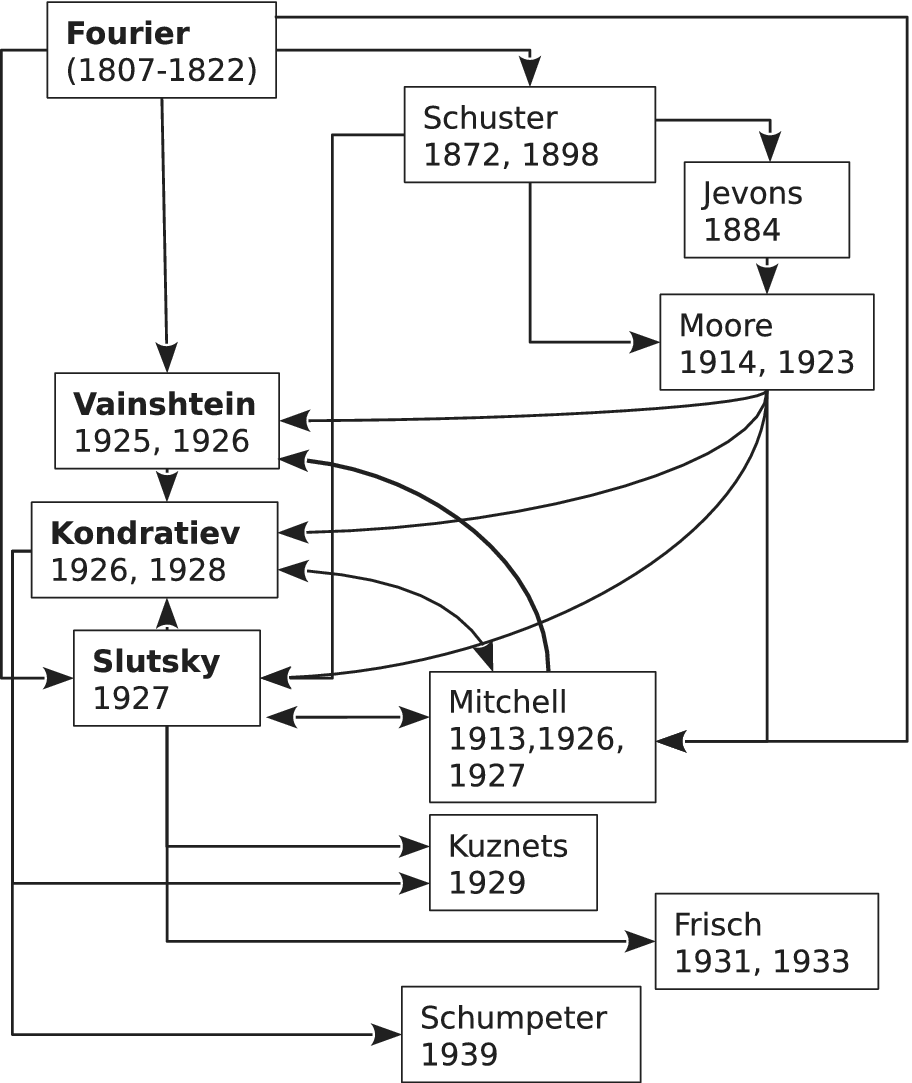
As a first and broad attempt to situate the use of harmonic analysis in business cycle research centered on the Institute, Figure 1 presents a citation-based genealogy from Fourier to its members (Vainshtein, Kondratiev, Slutsky), including intermediaries (Arthur Schuster, Jevons, Moore, Wesley Mitchell) and succeeding contributors (Simon Kuznets, Ragnar Frisch, Joseph Schumpeter).Footnote 4 As it will become clear in the following sections, the Institute acted as a mainstay in these developments.
A Citation-Based Tentative Genealogy of the Links between Fourier and the Moscow Conjuncture Institute, Including Intermediaries and Succeeding Contributors
Source: Authors

While more general accounts of the application of harmonic analysis to business cycles at the Institute and elsewhere exist, as well as of the roles played by Kondratiev and Slutsky (e.g., Klein Reference Klein1997; Morgan Reference Morgan1990; Schumpeter Reference Schumpeter1939), the details of how Fourier’s breakthrough appeared at that juncture remain unclear. Which members of the Institute or Western scholars contributed to this development? What was the Institute’s role in the dissemination of harmonic analysis as a tool in business cycle research? Was there an orchestrated effort to deepen the understanding of business cycles by means of this tool, or did it mostly amount to individual interests and achievements? To answer these questions, this article proposes a historical assessment of harmonic analysis of business cycles according to its reception at the Institute.
The next section presents Fourier’s main idea leading to harmonic analysis and its two-sided character in the investigation on cycles and waves, and depicts Moore as a pioneer in the use of harmonic analysis in economics, whose work contributed to the dissemination of this tool among the researchers of the Institute. The following section assesses the role of Vainshtein in this same context. Section IV focuses on the figures of Slutsky and Kondratiev during the final years of the Institute, contrasting their stance toward harmonic analysis and establishing what could be referred to as a missed opportunity for further joint research work. Section V sheds light on Slutsky’s legacy as the epitome of the importance of the Institute as a center for the dissemination of the application of harmonic analysis in economic conjuncture studies. Section VI brings concluding remarks.
II. THE FOURIER TRANSFORM AND MOORE’S PIONEERING WORKS ON CYCLES
In 1807, Fourier (Reference Fourier1822) not only conceived a differential equation describing heat transfer phenomena but also developed a non-trivial technique to solve it (Narasimhan Reference Narasimhan1999). His achievement amounted to the most significant theoretical advancement on the issue of heat transfer since Isaac Newton proposed the law of cooling, which states that the rate of heat transfer is proportional to the temperature difference between two bodies (Bergles Reference Bergles, Layton and Lienhard1988). Fourier’s partial differential equation mathematically describes the rate at which temperature is changing at any location in the interior of a solid body as a function of time. The equation mixes time and space, having a tough solution, which becomes straightforward if Fourier’s technique is used, writing a generic function
 $ f(t) $
as a sum of oscillatory functions (sines and cosines), known as the “Fourier transform.”Footnote
5
Mathematically speaking, this transformation multiplies the original curve by the exponential function of an imaginary number, i.e.,
 $ {e}^{- i\omega t} $
(ω is the angular frequency), and integrates it over its domain. Thus, decomposing a function
 $ F(t) $
into the different waves that constitute it is equal to calculating
 $$ F\left(\omega \right)\hskip0.35em =\hskip0.35em {\int}_{-\infty}^{\infty }F(t){e}^{-\omega it} dt $$
Using this technique, it is possible to decompose an arbitrary initial temperature distribution inside a solid body into each of its constituent frequencies and, in turn, to solve the heat transfer equation to each one of them, before finally adding up the temporal and spatial solutions from each frequency in order to get the general solution.
In an analogous manner, the Fourier transform can also be used to build an arbitrary function from periodic waves by means of the inverse transform. Due to the properties of the exponential of an imaginary number, the inverse Fourier transform is obtained by a simple sign change of the exponent in the previous equation:
 $$ F(t)\hskip0.35em =\hskip0.35em {\int}_{-\infty}^{\infty }F\left(\omega \right){e}^{\omega it} d\omega $$
As the exponential of an imaginary number can also be written as
 $ {e}^{i\omega t}\hskip0.35em =\hskip0.35em \sin \omega t+i\cos \omega t $
, the exponential term represents an oscillatory wave. Hence, in the inverse Fourier transform, we basically multiply an oscillatory wave (the exponential term) by its weight in the original function
 $ F\left(\omega \right) $
, and then add up all the waves with different frequencies (the integration over
 $ d\omega $
). Therefore, once the weight and the frequency of each wave are known, it is possible to build the original function by multiplying the weight along different wave frequencies and adding up all these frequencies.
Once developed, the Fourier transform would spread through different branches of science and engineering, with countless applications (Narasimhan Reference Narasimhan1999, pp. 122–135). It has gradually entered into business cycle analysis in the late nineteenth century, when the influence of meteorological phenomena over agricultural output and economic crises became a key research question (e.g., Jevons Reference Jevons1878, Reference Jevons1884; Schuster Reference Schuster1872, Reference Schuster1898).
Klein (Reference Klein1997, pp. 250–251) mentions Moore as the first economist to deal with the Fourier transform in an explicit and well-developed way.Footnote 6 His 1914 book brings a complete section on “The Use of Fourier’s Theorem” (pp. 6–13); in a second book, Moore (Reference Moore1923, pp. 42–46) includes a topic on “data and method,” which again uses Fourier. As Figure 1 shows, Moore’s use of the Fourier transform was influenced by Schuster (Reference Schuster1898), especially in relation to his application of periodograms, which Moore would transpose into economic analysis.Footnote 7 His pioneering role in the utilization of harmonic analysis in economics is well known in the history of economics and econometrics (Le Gall Reference Le Gall1999; Morgan Reference Morgan1990; Schumpeter Reference Schumpeter1939; Turner and Wood Reference Turner and Wood2020).
Moore’s use of periodograms was instrumental for his analysis of the causal connections between an eight-year economic cycle and meteorological patterns. Moore (Reference Moore1923, p. 102) attributes his eight-year cycles to “the planet Venus in its eight-year periodic motion with respect to the Earth and the Sun.” Despite the shortcomings of Moore’s theory and the scorn from the majority of the academic community toward such “harvest theories” of economic cycles, there has more recently been a sort of “rehabilitation movement” to ascertain Moore’s true legacy to economics (Le Gall Reference Le Gall1999), such as the acknowledgment of this role “in econometric business cycle research” (Morgan Reference Morgan1990, p. 33); his “alternative program of mathematical economics, rival to neoclassicism” (Mirowski Reference Mirowski1990, pp. 598–599); and the assertion that he would be “considered by many to be the ‘father of econometrics’” (Klein Reference Klein1997, p. 249). We would add one more argument in favor of Moore’s rehabilitation: the fact that he served as an important reference to senior researchers of Kondratiev’s Institute (Kondratiev [1928] Reference Kondratiev and de la Conjoncture1992, p. 424; Slutsky Reference Slutsky1927, p. 106; Vainshtein Reference Vainshtein1925, [1926] Reference Vainshtein and Kliukin2010, passim) (see Figure 1), presenting the Fourier transform as an adequate tool to investigate business cycles.
Notwithstanding the relevance of Moore’s legacy, the problems and limitations of his approach can also help to understand the role of the Fourier transform in business cycle research. To Klein (Reference Klein1997, p. 118), Moore (along with Jevons and other advocates of the “harvest theories”) was targeted for his “inclusion of meteorological phenomena as exogenous variables in economic functions.”Footnote 8 Klein adds that Moore’s position was “based on the assumption that the variables under investigation were functions of time” and, therefore, “he was unable to contemplate a more organic, self-determining notion of dynamics … based … on a functional relationship with previous states of a process” (p. 257). To Philippe Le Gall (Reference Le Gall1999, p. 739), Moore’s use of the Fourier transform displayed a “determinist framework … illustrated by his endless investigations of an eight-year cycle” and by an “exact periodicity of cycles.” Analogously, Paul Turner and Justine Wood (Reference Turner and Wood2020, p. 8) state that “Moore appears to be concerned with identifying cycles with periods defined in terms of integer numbers of years rather than cycles defined in terms of particular frequencies.”
As affirmed by Le Gall (Reference Le Gall1999) and Turner and Wood (Reference Turner and Wood2020), it seems Moore was fixated on the eight-year cycle, what might have prevented a wider investigation on other uses of the Fourier transform, such as the superposition of cycles. Moore’s approach to cycle decomposition was constrained by a framework of strict and single periodic cycles, which is blatantly an influence of Schuster’s works. This blind spot toward a more comprehensive use of the Fourier transform often meant a disregard for waves with different periodicities (and the implications in terms of superposition). An example would be his focus on eight-year cycles taken from “Sauerbeck’s index numbers of general wholesale prices,” although the obtained periodogram showed twenty-four different periods (Moore Reference Moore1923, p. 66). Vainshtein (Reference Vainshtein1925), to whom there was no reason why the eight-year cycle should be predominant, would fiercely criticize Moore’s conclusions.
III. VAINSHTEIN ON MOORE: THE FOURIER TRANSFORM ARRIVES AT THE INSTITUTE
Vainshtein was a physicist and mathematician interested mainly in statistical economics, a subject in which he would be trained at the Moscow Commercial Institute, later renamed as Plekhanov Institute. He worked on a variety of issues, such as agricultural economics, systems of national accounts, linear programming, history of economic thought, and translations of academic works. He became well known for his contributions on national income and wealth (Vainshtein Reference Vainshtein1969), although his legacy as an economist of the 1920s working for the development of the new socialist economy has not gone unnoticed (Campbell Reference Campbell2012).
Vainshtein served as a senior consultant at the Institute, alongside Slutsky and Nikolay Nikolaevich Shaposhnikov, a figure better known for his role in the Russian synthesis between classical political economy and marginalism (Allisson Reference Allisson2015). Vainshtein had previously worked at the Office for Agricultural Economics of Narkomzem and was associated with the Timiryazev Agricultural Academy, what might have been a stepping stone leading to Kondratiev’s invitation to work at the Institute. Vainshtein remained there between 1923 and 1928, being “strongly involved in all the work of the Conjuncture Institute” (Campbell Reference Campbell2012, p. 425), for which he would suffer long jail and exile sentences after it became a target of Stalinist repression.
Overshadowed by his prolific scientific production, Vainshtein’s reviews of Moore’s work are usually not mentioned amongst his main contributions. However, they sparked an interest in harmonic analysis within the ranks of the Institute, which is attested by its inclusion in formal research projects on economic cycles led by Slutsky and others.Footnote 9 The first of them was “Novaia Teoriia Ekonomicheskikh Tsiklov” (New theory on economic cycles), an article published in the first issue of Voprosy Koniunktury (Questions of conjuncture), an irregular series of the Institute dedicated to methodological and theoretical expositions (Vainshtein Reference Vainshtein1925).Footnote 10 In the following year, Vainshtein would publish an extended appraisal of Moore’s work in a collection organized by the Research Institute for Agricultural Economics of the Timiryazev Agricultural Academy (Vainshtein [1926] Reference Vainshtein and Kliukin2010).
First, Vainshtein presents Moore’s main proposition of eight-year cycles in rainfall fluctuations and their strong relationship with fluctuations in harvest yields, as well as raw material cycles for the same period, which would constitute key economic cycles caused by non-economic factors and, hence, intensely affect general price cycles:
Hence, we get the following coherent reasoning by Prof. Moore: cyclic and strictly periodic fluctuations of meteorological factors cause fluctuations primarily in the production of goods, depending on climatic and environmental conditions, and in general cause similar fluctuations in the production of raw materials going into industrial processing. These are the main (generating) economic cycles. Fluctuations in the production of raw materials are correspondingly reflected in the prices of these goods, transmitted according to the law of production costs, and also in the prices of final products. Cyclical price fluctuations are, therefore, already derived from the main economic cycles; they are strictly periodic and can be explained by a single cause. (Vainshtein Reference Vainshtein1925, pp. 165–166; our translation)
Vainshtein then makes a thorough exposition of how empirical series can have their cyclicity investigated by means of what he calls the “Fourier method,” according to which “any periodic motion, however complex it may be, can be decomposed into a series of simple harmonic oscillations” (p. 167). Moreover, Schuster’s periodogram is presented as a criterion to probabilistically distinguish between “true” and “random” cycles.
Moore’s search for mathematically strict periodicities (as opposed to Jevons’s average values derived from different periods) is systematically questioned by Vainshtein. Although one cannot deny its possibility, he highlights the lack of evidence from different perspectives, such as the shortcomings in the empirical data provided by Moore, especially in the face of diverging results obtained in other studies, and the legitimacy of statistical conclusions based on the use of periodograms (e.g., the inobservance of other likely periods or Moore’s controversial removal of the secular trend prior to the application of the harmonic analysis). Similar criticism is given for Moore’s results on raw material production and price cycles.
Furthermore, Vainshtein dismisses Moore’s hypothesis for the cause of the eight-year cycles, for whom periodic changes in the position of Venus in relation to Earth and the Sun—due either to its influence on solar radiation on its way to Earth or to its direct effect as a source of magnetic fields—would account for changes in meteorological and, consequently, economic conditions. There would be no available knowledge in theoretical physics to support such claims. In addition, while the period of Venus’s movement is strictly eight years long, those of rainfall and crop yields are only approximate figures. Vainshtein also weighs that, even if we accept such a strict relationship, there are non-meteorological phenomena that influence the cyclical fluctuations of agricultural productivity: improvements in land cultivation, soil conditions, crop composition, etc. Moore’s method would be of little help in the consideration of these elements.
Overall, Vainshtein acknowledges Moore’s arguments in favor of the relationship between rainfall, harvest yields, and prices of agricultural products, although he remains skeptical on Moore’s elucidation of the mechanism through which raw materials cycles influence prices and the production of final goods. His main reproach to Moore’s works relates to the “absence of an economic explanation for the mechanism of influence in the interconnections he establishes, an explanation which could not be given using his research method” (Reference Vainshtein1925, p. 179). The formal statistical analysis, to Vainshtein, must be aided by an economic appraisal of the issue, requiring a detailed analysis of the dynamics of the development of an economy. As an attempt to find the root cause of economic phenomena, Moore’s approach is unsuccessful. However, his theory is deemed as “elegant in form, lean in content, and rich in statistical material” (p. 179). With these statements, Vainshtein recognizes the merits of harmonic analysis for the study of economic cycles, despite the overstretched, naive, and sometimes illogical inferences Moore seems to make based on his own results. While Vainshtein apparently understands the potential and limitations of the “Fourier method” in terms of explanatory power, Moore’s ill-conceived use of harmonic analysis in order to develop theories such as those correlating planetary movements and economic cycles is easy prey for his sharp mathematical understanding of the method.
In his second and expanded review of Moore’s books, Vainshtein ([1926] Reference Vainshtein and Kliukin2010, p. 265; our translation) warns about an intrinsic limitation of the harmonic analysis:
But there is a very significant consideration of a mathematical nature which forces the economist to be very careful when using the method of harmonic analysis to study economic phenomena. … [T]he magnitude values of the components of a statistical series must be completely independent from each other. In reality, the complete independence of individual members of the series from each other rarely takes place. One of the founders of this method, Prof. Schuster, on whose work Moore has relied, in his first article on harmonic analysis indicates that, even in the case of meteorological data, we are not dealing with independent values.
Economic phenomena (e.g., prices and production output) would entail even stronger “inertial” regularities over time. This observance implies that the elements of the Fourier series do not present the same probabilities, and the likely effect is usually a decrease in the amplitude of shorter periods. Unlike William Beveridge and G. Udny Yule, Moore would have completely ignored how this condition affected his results.
Vainshtein’s approach to harmonic analysis raises some questions in the context of the Institute. Why was he interested in this subject matter? In intellectual terms, it could be seen as a continuation of his earlier works on agricultural prices. Alternatively, the originality and peculiarity of harmonic analysis within economic science, as well as the then international outlook of the Institute, might point to Kondratiev and other senior colleagues as active supporters of this initiative.Footnote 11 According to the latter, the Institute provided a fruitful atmosphere for the exchange of ideas: “the Institute carries on another kind of research work requiring a greater period of time. These are the researches of individual members, although the results and the conclusions are also discussed collectively” (Kondratiev Reference Kondratiev1925, p. 323). To Vincent Barnett (Reference Barnett1998, p. 11), “Kondratiev worked very closely with his consultants on specific issues.” In addition, Kondratiev, who had first conceived his long wave hypothesis a few years earlier (Kondratiev [1926] Reference Kondratiev1935), and Vainshtein, the second-in-command at the Institute,Footnote 12 shared the view in which an economic explanation for the mechanisms of influence in the generation of cycles was absolutely necessary. Vainshtein ([1926] Reference Vainshtein and Kliukin2010, p. 279, our translation) also posed this question for the purpose of forecasting:
[W]e must point out that, even if one assumes that one of the components of the general dynamic process is the true harmonic oscillation of certain elements or the influence of cosmic factors, this is far from enough for forecasting purposes. The perturbing forces in economic and social events are so significant that any attempt to make an economic forecast based on only periodicity or due to cosmic factors is doomed to failure in advance. To obtain a true picture of the world around us for the near future, it is necessary to combine various types and methods of forecasting, using, along with the formal mathematical and statistical method, an economic analysis of causal relationships and dependencies.
Another question relates to Vainshtein’s influence over Slutsky’s well-known Reference Slutsky1927 article. Despite the different approaches that would be adopted, on the one hand, by Vainshtein and Kondratiev, and, on the other hand, by Slutsky, the fact that the application of harmonic analysis to business cycles was a given at the Institute might have caught the latter’s attention upon his arrival in 1926. Barnett (Reference Barnett2005, p. 112) asserts that the development of Slutsky’s Reference Slutsky1927 paper was actually “conditioned by his move from Kiev to Nikolai Kondratiev’s Conjuncture Institute.” However, Barnett (Reference Barnett2006, p. 425) also deems that “Vainshtein’s attitude [toward Moore’s works] suggested he might have been similarly critical of Slutsky’s effort.” In contrast, we believe that, based on a careful assessment of Vainshtein’s reviews of Moore’s works, he might have been less disapproving of Slutsky’s article than suspected. His criticism focused on particular aspects of Moore’s analysis, which cannot be imputed to Slutsky. Overall, Vainshtein had a positive stance toward harmonic analysis and his works reveal some level of engagement in the institutional environment leading to Slutsky’s Reference Slutsky1927 article, not least because a detailed appraisal of harmonic analysis applied to business cycles could thitherto be found in none of the other published documents of the Institute.
IV. SLUTSKY, KONDRATIEV, AND THE END OF THE INSTITUTE
Slutsky arrived at the Institute after thirteen years of working at the Kiev Institute of Commerce. By that time, he was already reluctant to engage in economic research, although his intellectual interest in such issues would never completely disappear.Footnote 13 In his autobiography, Slutsky affirms that the new planned socialist economy of the Soviet Union offered problems for which he would neither care nor be equipped to tackle (Sheynin et al. Reference Sheynin, Rauscher and Wittich2010). In this sense, it seems strange that he would choose (not without some hesitation) to relocate to the Institute, even though he rightly believed that his mathematical and statistical skills would be deservingly acknowledged in his new position. In a letter to Ladislaus Bortkiewicz dated May 16, 1926, he explained that his move to Moscow had been due to problems with the Ukrainian language (a compulsory decree came into effect stating that the Ukrainian language was to be used in all lectures held at academic institutions of that republic, and Slutsky was not a fluent speaker) (Sheynin et al. Reference Sheynin, Rauscher and Wittich2010, letter n. 7). Other reasons for Slutsky’s move to the Institute, according to Petr Kliukin (Reference Kliukin2011), would have been its computational capacity and the autonomy enjoyed by researchers, in addition to the presence of Nikolai Chetverikov, Slutsky’s close friend and follower of Alexander Alexandrovich Chuprov (a leading figure of the so-called Saint Petersburg Statistical School).Footnote 14 Thus, the Institute would rather be a solution at the personal level than an opportunity to make the transition toward non-economic applications of mathematics and statistics. Yet, while his first three articles as a member of the Institute (all published in 1927) deal with economic subjects, his subsequent contributions, a total of eight pieces dated from 1927 to 1930, focus on pure mathematics and statistics.Footnote 15
Furthermore, as shown above, Slutsky was far from being the only economist at the Institute who was familiar with harmonic analysis and its use in the study of business cycles. According to Chetverikov ([1959] Reference Chetverikov, Sheynin, Rauscher and Wittich2010, p. 254), “soon upon his arrival there, he was attracted by some scientific investigations (the study of cycles in the economy of capitalist countries). … E. E. [Slutsky] became an active participant of this research, and, as usual, surrendered himself to it with all his passion.” A letter to his wife written in March 1926 reads as follows:
I am head over heels in the new work, am carried away by it. I am almost definitively sure about being lucky to arrive at a rather considerable finding, to discover the secret of how are wavy oscillations originating by a source that, as it seems, had not been until now even suspected. Waves, known in physics, are engendered by forces of elasticity and rotary movements, but this does not yet explain those wavy movements that are observed in social phenomena. I obtained waves by issuing from random oscillations independent one from another and having no periodicities when combining them in some definite way. (Slutsky in Chetverikov [1959] 2010, p. 255; italics in the original)
Hence, Barnett (Reference Barnett2006, p. 425) correctly raised the possibility that “Slutsky had first realized that such statistical techniques might have been relevant to economic matters through exposure to such discussion in the Conjuncture Institute” (e.g., Kondratiev’s long waves, Timofei Ivanovich Rainov’s association between economic cycles and scientific breakthroughs, Vainshtein’s review of Moore’s books, Chetverikov’s connection between prices and harvests, etc.). Conversely, Slutsky’s background and brilliancy would stand out at the Institute. His 1927 article draws from a wide variety of sources, which go way beyond the usual references in Soviet economics (e.g., Tugan-Baranovsky). To an extent, “the impetus for the new approach of the 1927 article had originated from Slutsky himself” (Barnett Reference Barnett2006, p. 417) and his ideas on random processes had already been formed back in Kiev (Kliukin Reference Kliukin2011).Footnote 16 In any case, it remained little known until its English translation and publication in Econometrica in 1937. A few years later, it would already be deemed as a “classical contribution” (Allen Reference Allen1950).
Slutsky’s Reference Slutsky1927 article successfully applies harmonic analysis to support his claim on the random causes of cyclical patterns. He showed that an oscillatory series resembling actual business cycles could be generated from a random series by taking a moving sum or difference, regardless of the presence of weights or repetition in the process. Thus, instead of only looking for ways to decompose such cycles, Slutsky sets forth the possibility to build similar cycles using random series, and by doing so he brings into economics this other side of Fourier’s contribution (the inverse transform for the purposes of wave composition). Unlike Moore, he avoided focusing on determined single-period cycles, describing cyclical processes rather as phenomena in which “on the waves of one order there appear superimposed waves of another order” (Slutsky [1927] Reference Slutsky1937, p. 116).
The implications of Slutsky’s results are at least twofold: on the one hand, actual business cycles might be explained as “statistical artefacts” and, hence, can do without explanations in terms of economic mechanisms (the “spurious” or “statistical” interpretation); on the other hand, the inability to distinguish between randomly generated cycles and those with underlying periodic causes, given the fact that both might exist as manifestations of economic life, needs to be taken into account when studying cyclical economic phenomena (the “real” or genuine” interpretation) (Barnett Reference Barnett2006, pp. 412–413).Footnote 17 Slutsky summarizes his Reference Slutsky1927 article as follows:
The summation of random causes generates a cyclical series which tends to imitate for a number of cycles a harmonic series of a relatively small number of sine curves. After a more or less considerable number of periods every regime becomes disarranged, the transition to another regime occurring sometimes rather gradually, sometimes more or less abruptly, around certain critical points. ([1927] Reference Slutsky1937, p. 123; italics in the original)
Although Slutsky acknowledges Schuster’s periodograms as a means to discover hidden periodicities, he deems that the lack of independence between the components of empirical series (as noted by Vainshtein in his review of Moore’s book) renders the use of Schuster’s method unreliable, as “casual” waves could be interpreted as bearing strict regularity (also given the fact that empirical series are not long enough to provide proof of such strict regularities).Footnote 18 From these premises, Slutsky—inspired by Yule (Reference Yule1926) in relation to what would be dubbed as the Slutsky–Yule effect—formulates the question: “is it possible that a definite structure of a connection between random fluctuations could form them into a system of more or less regular waves?” (Slutsky [1927] Reference Slutsky1937, p. 106). Instead of searching for the source of regularity in “the superposition of regular waves complicated only by purely random components” (p. 107), why not seek an explanation in random causes? This would have been the main course of action in promising fields within physics and biology, in which order (regularity) arises from chance or randomness precisely due to its arbitrary nature.
After 1927, Slutsky would not carry on with economic applications of his sophisticated analytical toolkit, preferring to work on mathematical and statistical theory or its implications to the natural sciences. Neither would his colleagues take up the challenge. It seems the technical staff of the Institute was becoming increasingly aware of the dangers of being associated either with economic issues of political relevance or, more precisely, with the figure of Kondratiev. According to Barnett (Reference Barnett1995, p. 417), “members of the Conjuncture Institute must have realised that their personal positions within the Soviet economic bureaucracy were inextricably connected to the fate of the actual markets which they studied and analysed in such an enthusiastic and original manner.” That was certainly so for Slutsky, according to his letters to his wife discussing the personal risks associated with his work (Chetverikov [1959] Reference Chetverikov, Sheynin, Rauscher and Wittich2010).
Another reason for the interruption of this line of research at the Institute could be the overly advanced mathematical content of Slutsky’s work. Barnett (Reference Barnett2011, pp. 91–92) raises the question whether most of its researchers would possess the necessary mathematical skills to contribute to Slutsky’s study on random causes of periodic waves. After all, Slutsky was not a clear political target; in fact, he was not arrested after the end of the Institute, to the contrary of other highly ranked scholars. Whatever the case, a look into Kondratiev’s writings in the context of his role as head of the Institute is quite insightful regarding the level of interest in harmonic analysis of business cycles among its members.
Kondratiev (Reference Kondratiev1989, pp. 416–450) wrote a report about the activities of the Institute (“Report on Works of the Conjuncture Institute in 1926–1927 and Prospects for 1927–1928”), including a topic on “Work on the Methodology of the Study of Conjuncture Conditions and Dynamics” (p. 430). Kondratiev explained that “[w]ork of this kind was carried out partly in connection with the formulation of problems on the study of patterns in the development of conjuncture conditions and dynamics, partly in connection with the development of issues related to the analysis of the current conjuncture.”Footnote 19 He mentions the leaders of the group working on these issues:
[W]orks on techniques for studying cyclic waves: in this area, the mathematical part of Slutsky’s study “Summation of random causes as the source of cyclic processes” (printed in Voprosy Koniunktury, v. 3) has started the work on the economic application of the methods he found for explaining cyclic waves. This also includes the study of the question “On the application of harmonic analysis to conjunctural cycles”—a work coming under the direction of N. S. Chetverikov and E. E. Slutsky. (Kondratiev Reference Kondratiev1989, p. 430)
At this stage, the “Fourier method” discussed and applied at the Institute seems to have fulfilled two different but related roles. First, following Moore’s use of periodograms, harmonic analysis led to the development of tools for investigating the duration and amplitude of existing cycles. Second, with Slutsky (Reference Slutsky1927), harmonic analysis would be a tool for theoretically building a cycle. Taken as a group, the members of the Institute pioneered this two-sided use of Fourier’s elaboration on cycles. This is additional evidence that harmonic analysis had found there a friendly host environment, and that a very fruitful interaction between those two uses might have been in motion at that specific time and place.
However, at that junction, Kondratiev did not believe in the role of random processes and their ability to build cycles. In his 1926 report, he reaffirmed the purpose of decomposition methods as making “the existence of large cycles more visual and accurate,” and deemed randomness as a burden to be minimized by the accuracy of the method, as in any other scientific endeavor. Kondratiev (Reference Kondratiev1989, p. 320) repeatedly states that “the applied method can, given a determined research problem, destroy cycles, and not create them” and that “it is clear that large cycles are not created by the method, but, on the contrary, the method is applied due to the presence of large cycles in empirical curves.” Therefore, Kliukin (Reference Kliukin2011) points to a certain methodological opposition between Slutsky and Chetverikov (who was the head of the methodological section of the Institute), on the one side, and Kondratiev, on the other, not only with respect to such diverging views on large cycles, but also as a result of Kondratiev’s focus on the construction of index numbers, in detriment of other research lines, as the main contribution of the Institute to the stabilization and development of the Soviet economy.Footnote 20
Kliukin also detects what could be retrospectively seen as a missed opportunity: on June 11, 1926, Slutsky showed to Kondratiev some of his results leading to the 1927 paper, having that same day written to his wife that “Kondratiev is very pleased and will not rush me to finish” (in Kliukin Reference Kliukin2011, p. 120). Apparently, these results were of an empirical nature and still lacked the innovative mathematical foundation, which Slutsky would develop only a few days later, between June 16 and 22. Thus, Kondratiev might have interpreted the cyclical processes obtained by Slutsky as a corroboration of his own theory on large cycles, failing at that moment to realize the theoretical significance of Slutsky’s work. A few years later, as a prisoner in Suzdal, Kondratiev would acknowledge the far-reaching meaning of Slutsky’s breakthrough. Between 1932 and 1933, he would request innumerous copies of Slutsky’s papers, especially those related to the law of large numbers and the gradual development of his concept of random processes leading to the constitution of order (e.g., Kondratiev [1930–1932] Reference Kondratiev, Makasheva, Samuels and Barnett1998). Unfortunately, his first reaction, back in 1927, to Slutsky’s final draft is unknown, which is probably due to the dramatic change, from the second half of 1927 onwards, in the hitherto relatively peaceful political atmosphere within the Institute.Footnote 21
As freedom of thought quickly vanished in Stalin’s Soviet Union, especially in fields and subjects associated with public policy, the Institute became one of the first victims of the new administrative command system. Kondratiev’s defense of pro-market industrialization, his disagreements with Gosplan officials and their views on economic development, and his involvement in agrarian issues—based on which he was accused of being one of the leaders of the Working Peasants Party—would cost him dearly. Since July 1927, his signature would disappear from official documents of the Institute to higher authorities. He lost his position in the beginning of 1928 (cutting short his ongoing research project on large cycles, at least at that moment), his personal liberty in 1930, and his life in 1938.Footnote 22 In July 1928, the Institute would be transferred from the auspices of Narkomfin to the Central Statistical Administration, and many of its senior scholars would be sacked.Footnote 23 It operated for a little over one year, for some time under the leadership of the statistician Pavel Ilich Popov. The Institute was officially closed at the end of 1929, when the Central Statistical Administration itself went through organizational changes (Komlev Reference Komlev and Iaroshevsky1991).
In its short existence, the Institute managed to become one of the worldwide leading research centers in the study of market conjuncture (Barnett Reference Barnett1995, Reference Barnett2011). To Sergei Komlev (Reference Komlev and Iaroshevsky1991), its disbandment and those of similar institutions meant not only a significant loss to Soviet economic science but also the end of one of the last links to pre-revolutionary Russian economic thought, characterized by a highly scientific culture, a deep understanding of the nature of self-regulating economic processes, and the development of state-of-the-art methodologies for market research.
V. KUZNETS, FRISCH, AND SLUTSKY’S LEGACY
The implications of Slutsky’s results mentioned above, the “real” or genuine,” and the “spurious” or “statistical” interpretations, would be formulated by two of Slutsky’s well-known contemporaries, respectively Simon Kuznets and Ragnar Frisch. Their interpretations would contribute to the development of different lines of research throughout the twentieth century, enduring to this day.
Kuznets was a member of Mitchell’s National Bureau of Economic Research (NBER). He could read Russian, so his views on Slutsky’s article were already published in 1929. His corroboration of Slutsky’s main thesis is accompanied by a discussion on a so-called inverted inference, i.e., whether the fact that a summation of random causes yields a periodic wave also means that such waves are primarily a result of this type of causes and can be explained by their characteristics. Kuznets (Reference Kuznets1929, p. 274) is skeptical: “[s]uch inference, of course, cannot carry with it any certainty, since we are never certain of all the contingencies of other hypotheses to which the formations of cycles in economic data may be reduced.” He acknowledges the significance of the influence of random factors, albeit it is not an exclusive one. Other conditions would need to be assessed (e.g., how economic mechanisms act upon probability distributions), a hint toward the desirability of an integrated approach hitherto rarely to be seen in the literature.
For Kuznets, treating cycles as the mere summation of random events leads to the conclusion that they do not require hypotheses on underlying, recurrent economic reasons; all that is necessary is to explain how a determined cumulative process acts within the economy in order to produce a determined cyclical oscillation. In this respect, Kuznets alludes to how “institutional explanations of business cycles deal mainly with the economic forces that make for cumulation, with forces that explain why a given random event is not immediately cancelled by an opposite reaction but allowed to exert its influence for some time to come, an economic counterpart of the statistical mechanism of a moving average” (Reference Kuznets1929, p. 275).
This is what Barnett (Reference Barnett2006, p. 417) calls the “Kuznets elucidation” of Slutsky’s Reference Slutsky1927 article, which would be in favor of a “real cyclical process occurring in an economy modelled as a moving average procedure itself.” It is to be contrasted with the “Frisch elucidation” (p. 419), focused on “spurious cycles generated by some types of statistical manipulation of data series.” Frisch (Reference Frisch1931) pointed to the econometrically relevant aspects of Slutsky’s work, mainly how to use his results to eliminate spurious cycles, instead of considering the potential role of the summation of random causes in the formation of business cycles.Footnote 24
Klein (Reference Klein1999, p. 156) attributes Slutsky’s “subsequent reputation for discovering spurious qualities of random functions” to Yule (Reference Yule1926) and “Frisch’s (Reference Frisch1931) spin on Slutsky’s work,” i.e., to the “Frisch elucidation.”Footnote 25 As a result, “Slutsky’s name is now more closely associated with the generation of spurious cycles than with his advocacy of the summation of random disturbances as an explanation for actual cyclical phenomena” (p. 157).
While both elucidations can be somehow traced back to Slutsky ([1927] Reference Slutsky1937), the “Frisch elucidation” seems to be a misinterpretation or at least an unintended consequence from his own point of view. His belief in the actual manifestation of economic cycles as a result of the effects of linear combinations of random elements is clear in the text. For example, one of his premises is: “[s]uppose we are inclined to believe in the reality of the strict periodicity of a business cycle” ([1927] Reference Slutsky1937, p. 106). Whereas his mention to Yule’s work on nonsense correlations might be seen as legitimization of the “Frisch elucidation” (Barnett Reference Barnett2006), it is unlikely that Slutsky would agree that his findings only imply that there is a problem with the manipulation of time series. Klein (Reference Klein1997, pp. 278–279) agrees with this view, stating that “Slutsky saw true, not spurious cycles resulting from moving averages on random variables” and that “it was obvious that he was searching for true causes of cycles in his models.”
Slutsky’s employment of harmonic analysis to the study of business cycles would have a long-lasting impact. After the initial responses of his contemporaries, this part of his legacy would be revived in the second half of the twentieth century by the so-called modern spectral analysis, which is based on wave decomposition using the Fourier transform (e.g., Hatanaka Reference Hatanaka1963; Nerlove Reference Nerlove1964; Granger Reference Granger1966; Harvey Reference Harvey1975).Footnote 26 Clive Granger and Robert Engle (Reference Granger, Engle, Brillinger and Krishnaiah1983) mention Moore (Reference Moore1914) and Beveridge (Reference Beveridge1921, Reference Beveridge1922) as the first applications of the method, and Harold Davis (Reference Davis1941) as a forgotten link among Fourier series, periodograms, and modern approaches.Footnote 27
VI. CONCLUDING REMARKS
Fourier’s development of harmonic analysis has been a part of the history of business cycle research since at least the late nineteenth century. The account of such a history revolves around its ability to decompose cycles as well as to build them. In this regard, the research program conducted at the Institute by Slutsky and Chetverikov, supported and shared by Kondratiev and Vainshtein, and having Moore as a key reference (alongside the indirect or less evident influences of Schuster, Mitchell, Jevons, Axel Enström, and others), served as a uniquely fruitful juncture for the reception of the Fourier transform as a tool for the investigation of business cycles.
Harmonic analysis became an established research method at the Institute, although the pioneering and recurrent application of Fourier’s mathematical conception into economic dynamics by these four senior researchers (aided by the data-related supporting role of many statisticians and computers) was only one of the methodological advances then made to address economic conjuncture issues (the construction of index numbers was favored by Kondratiev in terms of time and resource allocation). In any event, the Institute played an important role in the dissemination of this tool in economics, epitomized in Slutsky’s Reference Slutsky1927 article.
Although the evidence does not warrant the conclusion that there was an orchestrated effort at the Institute to push forward a research agenda on harmonic analysis of business cycles, it certainly unfolded as more than the summation of random events and individual incursions. Within its walls, the approach to cycles based on Fourier transforms amounted to a group effort that preceded the arrival of Slutsky. He ultimately benefited from the contributions made by Vainshtein’s reviews, Chetverikov’s co-direction of a formal research project, and Kondratiev’s institutional support and interlocution, which together constituted fertile ground for his breakthrough. Moreover, based on the exchanges between Slutsky and Kondratiev in 1926 and 1927, as well as on Kondratiev’s belated understanding of the implications of Slutsky’s ideas in The Summation of Random Causes, the Institute as a whole could have produced much more if it had escaped Stalinist oppression for at least a few more years.