Implications
Neonatal lamb mortality is a significant welfare and production concern. Inadequate trace element and vitamin supply to the ewe may be a contributory factor. In the present experiment and in contrast to previous experiments, no response in lamb vigour was found to supplementation of the ewe with vitamin E above requirement. Reasons for this discrepancy may lie in the pre-experiment vitamin E status of the ewe.
Introduction
Neonatal lamb mortality is a significant welfare and production concern. Mortality of live-born offspring is about 15% in the UK (Defra, 2004). Approximately 80% of lamb mortality can be attributed to the starvation–mismothering–exposure complex and, as a consequence, the vast majority of deaths occur in the first 3 days after birth. Thus the neonatal period is critical for ensuring pre-weaning survival. Lamb vigour, that is, the ability of the lamb to stand up and move to the udder to suck, is critical for consumption of adequate amounts of colostrum by the lamb and avoidance of starvation. Although factors such as lamb birth weight, genotype (both maternal and lamb) and the birth process are important determinants of lamb vigour, maternal pregnancy nutrition has also been implicated (Dwyer and Lawrence, Reference Dwyer and Lawrence2005; Dwyer, Reference Dwyer2008).
Sub-optimal supply of trace elements and vitamins to the pregnant ewe is a potential risk factor for lamb mortality. Rooke et al. (Reference Rooke, Dwyer and Ashworth2008) concluded from a literature review that evidence was strongest for the involvement of selenium, vitamin E and fatty acids. Positive responses to selenium supplementation throughout gestation have recently been recorded (Munoz et al., Reference Munoz, Carson, McCoy, Dawson, O’Connell and Gordon2008). Similarly, positive but inconsistent lamb responses have been observed in most studies to maternal vitamin E supplementation above requirement in the last third of gestation (Rooke et al., Reference Rooke, Dwyer and Ashworth2008). This inconsistency is probably due to differences between studies, of which the amounts of vitamin E fed and lack of information on base-line vitamin E status of the ewe population are of particular importance. Only Merrell (Reference Merrell1999) has characterised the effect of the amount of vitamin E supplied on lamb responses: in general, lamb responses were curvi-linear and dependent on the specific response measured. The objective of the experiment reported here was to further characterise responses in lamb viability to supplementation of the maternal diet during the latter stages of pregnancy with increasing amounts of vitamin E above the stated requirement.
Material and methods
The experiment was reviewed by the Animals Experiments Committee of the Scottish Agricultural College and was conducted under the auspices of, and in accordance with, the requirements of the Home Office Animals (Scientific Procedures) Act 1986.
Animals and allocation to treatments
Twin-bearing, crossbred ewes (n = 80; approximately 21 months of age at allocation to treatments) were weighed and condition-scored (five-point scale of Lowman et al. (Reference Lowman, Scott and Somerville1976)) at housing in January 2008, 9 weeks prior to the predicted date of lambing. Ewes assigned to treatments had been naturally mated with either Suffolk or Texel rams (40 ewes per sire group). Within sire groups, ewes were blocked into groups of four by weight and one ewe from each group randomly allocated to a treatment group to give four treatment groups of 20 ewes, 10 of which had been mated with Suffolk and 10 with Texel rams. The ewes were housed in one of four straw-bedded pens (one group of 20 ewes per pen) and each pen randomly allocated to one of the four nutritional treatments that supplied either 50, 100, 150 or 250 IU supplementary vitamin E per ewe per day. Thus, the experiment took the form of a 2 (sire genotype) × 4 (nutritional treatment) factorial design. There were no differences between groups in mean BW (kg, 63.4; s.d. 3.86) or condition score (3.0; s.d. 0.29) at housing.
Feeding
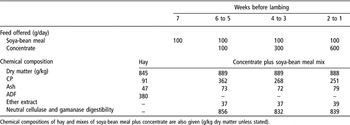
From housing, ewes were offered hay ad libitum and from 7 weeks before predicted lambing date, 100 g soya-bean meal per head per day. From 6 weeks before lambing, in addition to the 100 g soya-bean meal, ewes were offered concentrate (g/kg; barley, 585; soya-bean meal, 195; molassed sugar beet pulp, 146; rapeseed meal, 49; vitamin/mineral pre-mix 25). The vitamin/mineral pre-mix (DSM Nutritional Products (UK) Ltd, Heanor, Derbyshire, UK) contained (g/kg) calcium, 196; sodium, 90; magnesium, 80; phosphorus, 50; (mg/kg) zinc, 4000; manganese, 2000; iodine 120; cobalt, 60; selenium, 30 and (IU/kg) vitamin A, 480 000 and vitamin D3, 80 000 but no vitamin E. The amount of concentrate offered met energy requirements for stage of pregnancy (AFRC, 1993) and was adjusted every 2 weeks. The amounts of feed offered daily are given in Table 1. Ewes were offered their daily allowance in one (7 to 5 weeks before lambing) or two daily feeds (from 4 weeks before lambing until lambing). Between lambing and when ewes and lambs were turned out to grass, ewes were offered hay and a commercial concentrate.
Amounts of soya-bean meal and concentrate offered per head per day

Chemical compositions of hay and mixes of soya-bean meal plus concentrate are also given (g/kg dry matter unless stated).
Treatments
Vitamin E was added to the diets to give 50, 100, 150 and 250 IU supplementary vitamin E per head per day in addition to any vitamin E supplied by the hay, soya-bean meal and concentrate mix. Analysis of the hay established that it contained less than 2 IU vitamin E/kg. The supplementary vitamin E (Rovimix E-50 adsorbate; DSM Nutritional Products (UK) Ltd) was offered from 7 weeks before predicted lambing date (i.e. from when soya-bean meal was first offered).
Vitamin E was incorporated into experimental diets as a mixture of Rovimix E-50 and soya-bean meal (50 g Rovimix E-50/kg; 25 000 IU vitamin E/kg) that was stored at −20°C. Feed was prepared in 15 kg batches by mixing in a cement mixer (Clarke CCM125, 125 l capacity; Lawson HIS, Southampton, UK) for 10 min. The soya-bean meal and soya-bean meal/vitamin E mix were first thoroughly mixed by hand and then added to the concentrate. Representative samples of each mix (concentrate plus soya-bean) were accumulated over the 2-week feeding periods and stored at −20°C giving a total of 12 samples (four levels of vitamin E for three 2-week periods). On completion of the experiment, these 12 samples were milled to pass through a 1 mm screen and their vitamin E content measured. For each 2-week period, a composite sample was prepared from the individual samples representing each vitamin E treatment and analysed for nutrient composition. The chemical compositions of the hay and the soya-bean meal plus concentrate mixes are also given in Table 1.
Experimental procedures
Blood samples
Blood samples were obtained by jugular venepuncture and collected into a heparinised tube on three occasions (prior to introduction of experimental diets, 2 weeks after introduction of experimental diets and within 24 h of lambing) from a subset of eight ewes per treatment (32 in total). Plasma was prepared by centrifugation at 3000 × g for 15 min at 4°C and stored at −20°C until analysis.
Colostrum
Colostrum samples were obtained from as many ewes as possible approximately 12 h after birth of the second lamb and stored at −20°C to await analysis.
Lambs
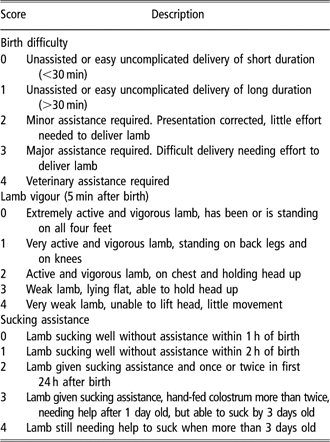
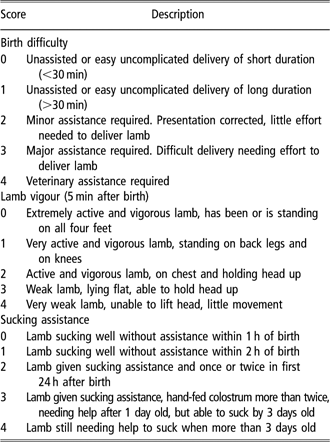
All births were observed. The times of each of the following behaviours were recorded for each lamb: birth; shaking of head; on knees; attempting to stand; successfully standing; reaches udder; attempts to suckle; successfully suckles. From these observations, a vigour score was assigned to each lamb according to the progress the lamb had made by 5 min after birth and using the criteria described in Table 2. Scores for birth difficulty and sucking assistance were also assigned to each lamb from the criteria also listed in Table 2. At 1 and 12 h after birth rectal temperature and at 12 h after birth, sex, crown-rump length and weight of each lamb were recorded. Ewes and their lambs were turned out to grazing approximately 3 days after birth. All lamb deaths and lamb weights at weaning (17 weeks of age) were recorded.
Criteria used to assign scores for birth difficulty, vigour and sucking assistance to lambs
Analyses
Feed
Composite feed samples were analysed for dry matter, ash, crude protein, acid-hydrolysed ether extract and neutral cellulose and gamanase digestibility (Ministry of Agriculture Fisheries and Food, 1992).
α-Tocopherol
Supplementary vitamin E concentrations in soya-bean meal plus concentrate samples were analysed as follows. Samples (0.1 to 0.5 g) were shaken with ethanol (10 ml) for 1 h. Aliquots of the extract (1 ml) were saponified with KOH (4 M) in the presence of ascorbic acid (50 g/l) for 30 min at 70°C. α-Tocopherol was extracted with hexane after addition of ethanol (1 : 1 v : v) containing internal standard (δ-tocopherol; Hoehler et al., Reference Hoehler, Frohlich, Marquardt and Stelsovsky1998) and quantified by HPLC. Separation was performed isocratically on a Spherisorb silica (250 mm × 4.6 mm) column (Waters Corporation, Milford, MA, USA) with hexane : ethanol (99 : 1 v : v) at 2 ml/min as eluant. Tocopherols were detected fluorimetrically (excitation 295 nm, emission 330 nm) and quantified with reference to the internal standard.
Plasma was extracted and analysed for α-tocopherol as described above without prior saponification. Colostrum samples (10 per treatment) were diluted 10-fold with 9 g/l NaCl containing 0.02 M sodium dodecyl sulphate (Burton et al., Reference Burton, Webb and Ingold1985) and α-tocopherol extracted and quantified as above.
Statistics
Data related to one ewe that miscarried 14 days prior to expected date of lambing were excluded. Data were analysed by ANOVA according to a 2 (sire) × 4 (vitamin E concentration) design. Parametric data were analysed using general linear models within Genstat (2008). Covariates tested were pre-experiment plasma α-tocopherol for subsequent α-tocopherol concentrations and lamb sex, BW and birth order for lamb measures. Effects of supplementary vitamin E were identified using orthogonal polynomials. Lamb scores were analysed similarly after converting scores to ranks.
Results
There were no interactions between vitamin E and sire-type for any measurement made.
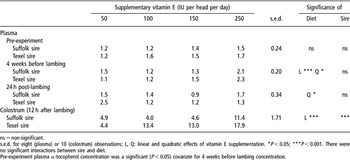
Measured concentrations of vitamin E in mixtures of soya-bean meal and concentrate were similar (Figure 1) to those necessary to supply the required amount of vitamin E in each feeding period. There were no differences between treatment groups in pre-experiment plasma α-tocopherol concentration (Table 3). However 4 weeks before lambing, plasma α-tocopherol concentrations reflected dietary intakes (linear effect; P < 0.001). In plasma samples taken within 24 h of lambing, there was no linear or quadratic effect of diet on plasma α-tocopherol concentration. However, there was a linear effect (P < 0.001) of dietary vitamin E on colostrum α-tocopherol concentration. Ewes mated with Texel rams had higher colostrum α-tocopherol concentrations than those mated with Suffolk rams (P < 0.001); there was no obvious biological reason for this difference.
Analysed (y) v. planned (x) concentrations of supplementary vitamin E (IU/kg feed) in soya-bean meal and concentrate mixes prepared to supply 50 (□), 100 (▪), 150 (○) or 250 (●) IU vitamin E per head per day in each of the three 2-week feeding periods: y = 0.89x + 73.6 (R 2 = 0.94).

Concentrations of α-tocopherol (μg/ml) in ewe plasma and colostrum in response to supplementary vitamin E

ns = non-significant.
s.e.d. for eight (plasma) or 10 (colostrum) observations; L, Q: linear and quadratic effects of vitamin E supplementation. *P < 0.05; ***P < 0.001. There were no significant interactions between sire and diet.
Pre-experiment plasma α-tocopherol concentration was a significant (P < 0.05) covariate for 4 weeks before lambing concentration.
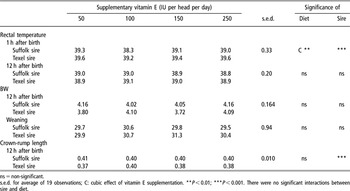
Lamb sex and birth order were not significant covariates for any analyses. There were no consistent effects (Table 4) of vitamin E supplementation on lamb rectal temperature, BW or crown-rump length 12 h after birth. Lambs born to Suffolk sires had lower rectal temperatures at 1 (P < 0.001) but not 12 h after birth and had longer crown rump lengths (P < 0.001) than lambs born to Texel sires. Lamb mortality in the 1st week of life was low (four lambs out of 158) and unrelated to either sire or supplementary vitamin E. Similarly, 146 of 154 lambs turned out to pasture were present at weaning. Weaning BW was not influenced by sire or treatment.
Lamb rectal temperatures (°C), BW (kg) and crown-rump lengths (m) in response to maternal supplementation with vitamin E

ns = non-significant.
s.e.d. for average of 19 observations; C: cubic effect of vitamin E supplementation. **P < 0.01; ***P < 0.001. There were no significant interactions between sire and diet.
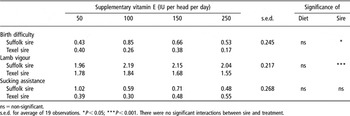
Lamb viabilities are reported as scores (Table 5) as these gave a true representation of the effects of sire and treatment on underlying measurements. Lambs born to Texel sires had significantly less birth difficulty (P = 0.047) and superior vigour scores (P < 0.001) than those born to Suffolk sires; there were no differences between sires in sucking assistance score. Supplementation with vitamin E had no effect on any lamb scores.
Lamb birth difficulty, vigour and sucking assistance scores in response to maternal supplementation with supplementary vitamin E

ns = non-significant.
s.e.d. for average of 19 observations. *P < 0.05; ***P < 0.001. There were no significant interactions between sire and treatment.
Discussion
This experiment focused on the possibility of improving viability of newborn lambs by dietary supplementation of the ewe with vitamin E prior to lambing. There was no evidence for any response to vitamin E, despite supplementation increasing maternal plasma and colostrum α-tocopherol concentrations and clear differences in lamb vigour between offspring of the different sires. These data were in keeping with the variability in responses to vitamin E in the literature (Rooke et al., Reference Rooke, Dwyer and Ashworth2008). It is therefore the main objective of the discussion to address this variability in response.
Lamb responses to maternal vitamin E supplementation can be considered in two parts: responses (birth BW and lamb vigour prior to suckling) attributable to events prior to lambing and those (BW gain and mortality prior to weaning) that are a composite of events before and after lambing. The general consensus is that there is little placental transfer of vitamin E (McDowell et al., Reference McDowell, Williams, Hidiroglou, Njeru, Hill, Ochoa and Wilkinson1996) based largely on the low plasma vitamin E concentrations measured in lambs prior to suckling and a lack of any response in lamb plasma vitamin E to maternal supplementation (Debier and Larondelle, Reference Debier and Larondelle2005; Liesegang et al., Reference Liesegang, Staub, Wichert, Wanner and Kreuzer2008). However, it is likely that lamb plasma α-tocopherol may be a poor index of neonatal status as Capper et al. (Reference Capper, Wilkinson, Kasapidou, Pattinson, Mackenzie and Sinclair2005) found that newborn lamb brain and muscle α-tocopherol concentrations responded to maternal supplementation when plasma α-tocopherol was not detectable in the lamb. In contrast, the post-natal increase in lamb plasma α-tocopherol in response to colostrum consumption is well documented (McDowell et al., Reference McDowell, Williams, Hidiroglou, Njeru, Hill, Ochoa and Wilkinson1996; Debier and Larondelle, Reference Debier and Larondelle2005).
Although Rooke et al. (Reference Rooke, Dwyer and Ashworth2008) summarised 10 studies in which lamb responses to maternal vitamin E supplementation had been reported, in only four studies was ewe pre-experiment plasma α-tocopherol measured (Gentry et al., Reference Gentry, Ross, Oetting and Birch1992; McDowell et al., Reference McDowell, Williams, Hidiroglou, Njeru, Hill, Ochoa and Wilkinson1996; Merrell, Reference Merrell1999; Daniels et al., Reference Daniels, Hatfield, Burgess, Kott and Bowman2000). Including the present experiment, mean pre-experiment plasma α-tocopherol concentrations were more than 1 μg/ml in all studies, greater than the ranges considered to be low (0.5 to 1.0 μg/ml) or deficient (<0.5 μg/ml; McDowell et al., Reference McDowell, Williams, Hidiroglou, Njeru, Hill, Ochoa and Wilkinson1996). There was no obvious relationship between pre-experiment α-tocopherol status and response as the studies that gave positive responses (Merrell, Reference Merrell1999; Capper et al., Reference Capper, Wilkinson, Kasapidou, Pattinson, Mackenzie and Sinclair2005) reported both the highest (2 μg/ml; Capper et al., Reference Capper, Wilkinson, Kasapidou, Pattinson, Mackenzie and Sinclair2005) and lowest (1 μg/ml; Merrell, Reference Merrell1999) base-line α-tocopherol concentration. It has been suggested that plasma (and liver) α-tocopherol concentrations are an index of current vitamin E (McDowell et al., Reference McDowell, Williams, Hidiroglou, Njeru, Hill, Ochoa and Wilkinson1996) intake rather than an index of body vitamin E storage. As a fat-soluble vitamin, a proportion of vitamin E is stored in adipose tissue; together with liver and muscle, adipose tissue may account for more than 90% of vitamin E in the body (Debier and Larondelle, Reference Debier and Larondelle2005). Tissue uptake (Toutain et al., Reference Toutain, Hidiroglou and Charmley1995) and depletion (Fry et al., Reference Fry, Smith, McGrath, Speijers and Allen1993; Hidiroglou et al., Reference Hidiroglou, Madere, McDowell and Toutain2003) studies have shown that adipose tissue acquires vitamin E more avidly and is depleted at a similar rate to muscle. In the current study and those of Capper et al. (Reference Capper, Wilkinson, Kasapidou, Pattinson, Mackenzie and Sinclair2005) and Merrell (Reference Merrell1999) the concentrate feed offered to the sheep was intended to result in some mobilisation of adipose tissue during late pregnancy. Thus, availability of vitamin E from body stores may have been an important factor underlying responses to supplementation. In this context, whereas in Capper et al. (Reference Capper, Wilkinson, Kasapidou, Pattinson, Mackenzie and Sinclair2005) and Merrell (Reference Merrell1999), plasma concentrations of α-tocopherol in control ewes declined as the experiment progressed, in the current experiment, α-tocopherol concentrations remained largely unchanged until lambing. Therefore, in the current experiment, the extent of vitamin E storage in adipose tissue and its rate of mobilisation may have been sufficient to support lamb responses without supplementation above the lowest level fed.
Another factor that may influence responses to vitamin E is oxidative stress. Capper et al. (2006) noted a reduced latency to stand, in lambs, when maternal vitamin E was offered in combination with unsaturated fatty acids but no response when saturated fatty acids were fed. Similarly Dafoe et al. (Reference Dafoe, Kott, Sowell, Berardinelli, Davis and Hatfield2008) noted a poorer thermogenic response to cold stress in lambs whose dams had been fed an unsaturated fatty acid-containing diet in the absence but not presence of supplementary vitamin E. In the present experiment, the diet was not supplemented with unsaturated fatty acids and therefore it is unlikely that oxidative stress would have been a problem.
A further issue is the sensitivity of the scoring system used to measure lamb vigour. The lamb vigour score was derived from underlying measurements such as time for the lamb to stand, contact the udder and suckle. Capper et al. (2006) and Merrell (Reference Merrell1999) based reports of improved lamb vigour on these underlying measurements. However, there were no differences in time to stand, contact the udder and suckle the ewe etc. in the present experiment. In addition, the scoring system was sensitive enough to detect the impact of the sire of the lamb on vigour. Although differences between pure breeds in lamb vigour are well documented (Dwyer and Lawrence, Reference Dwyer and Lawrence2000), reports of sire-effects when the dam is cross-bred and positive effects of heterosis might be expected are fewer. For example, Flinn and Whiteman (Reference Flinn and Whiteman1974) did not find a significant difference in vigour between Dorset and Blackface sires. Therefore, there was no reason to suspect that the vigour scoring system used in the present experiment was not sensitive enough to detect meaningful differences in lamb vigour.
In conclusion, this experiment did not find any responses in lamb vigour or performance to supplementation of the ewe with vitamin E above requirement. It is considered that assessing ewe vitamin E status by measuring plasma α-tocopherol concentrations may not be an adequate measure when the ewe is mobilising body fat reserves during late pregnancy, as is normal industry practice.
Acknowledgements
The authors gratefully acknowledge funding from the Scottish Government (RERAD) and thank DSM Nutritional Products (UK) Ltd for supply of vitamin E and mineral/vitamin mixes.