INTRODUCTION
Prospective memory (PM) is remembering to carry out intended actions (such as remembering to take medication) at an appropriate point in the future (McDaniel & Einstein, Reference McDaniel, Einstein, McDaniel and Einstein2007). A critical difference between PM and retrospective memory (RM) tasks (e.g., list-learning or story recall), is that there is no external agent requesting a memory search when the target event occurs (McDaniel & Einstein, Reference McDaniel and Einstein2000). It is generally accepted that PM requires a greater degree of self-initiated retrieval operations, compared with RM tasks, requiring inhibition of an ongoing task, and switching to another action (Einstein & McDaniel, Reference Einstein, McDaniel, Brandimonte, Einstein and McDaniel1996).
Einstein and McDaniel (Reference Einstein, McDaniel, Brandimonte, Einstein and McDaniel1996) distinguished between time-based tasks, requiring performance of actions at a certain time and event-based tasks, requiring performance of actions in response to external events. For event-based tasks, encoding factors such as specificity of instructions and retrieval factors such as perceptual salience of PM cues are associated with superior prospective remembering. The multiprocess model of PM argues that both factors reduce the self-initiated retrieval demands of PM tasks (McDaniel & Einstein, Reference McDaniel and Einstein2000). These factors have been investigated in older healthy adults (Henry et al., Reference Henry, MacLeod, Phillips and Crawford2004), but not in individuals with Mild Cognitive Impairment (MCI).
MCI is a broad syndrome characterized by impaired cognitive performance that lies on the continuum between normal ageing and a dementing process, and is associated with increased risk of developing dementia (Kluger et al., Reference Kluger, Golomb, Ferris and Qizilbash2000). MCI represents a heterogeneous group presenting with different cognitive profiles and underlying etiologies (Petersen et al., Reference Petersen, Doody and Kuz2001). We focus on Mild Cognitive Impairment-Alzheimer’s Disease (MCI-AD), a term describing individuals with MCI whose underlying disease is clinically suspected to be AD (Portet et al., Reference Portet, Ousset, Visser, Frisoni, Nobili, Scheltens, Vellas and Touchon2006).
Only two studies have previously investigated PM in MCI. Kazui et al. (Reference Kazui, Matsuda, Hirono, Mori, Miyoshi, Ogino, Tokunaga, Ikejiri and Takeda2005) found that while single-trial event-based PM tasks proved sensitive to MCI, the degree of specificity was not as robust, concluding that PM tasks were not useful for detecting MCI. More recently, Troyer and Murphy (Reference Troyer and Murphy2007) found that a time-based PM task was particularly sensitive to MCI, but no data regarding the discriminatory capacity of this task were presented. Interestingly, Driscoll et al. (Reference Driscoll, McDaniel and Guynn2005) found significant PM deficits in healthy elderly APOE є4 gene carriers, known to be associated with increased risk and decreased age of onset for AD relative to noncarriers.
The present study intends to fill current gaps in the literature by focusing on the relative vulnerability of PM and RM to the cognitive impairment in MCI-AD. Our primary hypotheses were that (1) An event-based PM task would show higher discriminatory efficacy to detect MCI-AD from NC relative to RM tests due to its higher self-initiated retrieval demands. (2) Conditions of non-specificity of instructions and perceptual non-salience of the PM cue would be particularly sensitive to MCI-AD because they require greater strategic attentional resources to monitor the PM cue.
METHOD
Participants
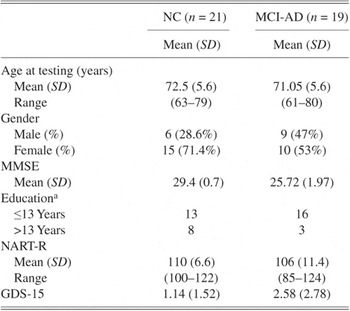
Participants were 21 normal controls (NC), and 19 individuals with a diagnosis of MCI-AD, in accordance with the Report of the MCI Working Group of the European Consortium on Alzheimer’s disease (Portet et al., Reference Portet, Ousset, Visser, Frisoni, Nobili, Scheltens, Vellas and Touchon2006) (see Table 1).
Demographic and clinical details of the two groups of participants

Note.
MCI-AD = mild cognitive impairment-Alzheimer’s disease; NC = normal controls; SD = standard deviation; MMSE = Mini-Mental State Exam; NART-R = National Adult Reading Test-Revised; GDS-15 = Geriatric Depression Scale.
a In Ireland, completion of Secondary Level (High-School equivalent), entails 13 years of formal education.
NC were recruited from two local Active Retirement Groups (community-based social groups). Participants qualified as NC if they scored ≥27/30 on the Mini-Mental State Examination (MMSE; Folstein et al., Reference Folstein, Folstein and McHugh1975), >8 on Clock Drawing (Manos, Reference Manos1999), ≥7 on the Geriatric Depression Scale-15 item Short Form (Sheikh & Yesavage, Reference Sheikh, Yesavage and Brink1986), and were functioning normally in the community as documented by self-report on the Lawton-Brody Instrumental Activities of Daily Living (Lawton & Brody, Reference Lawton and Brody1969). MCI-ADs were identified through a Hospital Memory Clinic (Swanwick et al., Reference Swanwick, Coen, O’Mahony, Tully, Bruce, Buggy, Lawlor, Walsh and Coakley1996). Methods were approved by the Hospital’s ethics board. Before enrolment in the study, patients underwent a neuropsychological evaluation using a range of standardized cognitive tests including Cambridge Cognitive Examination (CAMCOG; Huppert et al., Reference Huppert, Brayne, Gill, Paykel and Beardsall1995); Delayed Word Recall (DWR) test (Coen et al., Reference Coen, Kirby, Swanwick, Maguire, Walsh, Coakley, O’Neill and Lawlor1997; Knopman & Ryberg, Reference Knopman and Ryberg1989), and executive functions, using both phonemic (FAS; Benton & Hamsher, Reference Benton and Hamsher1978), and semantic (animals, fruits, vegetables; Monsch et al., Reference Monsch, Bondi, Butters, Salmon, Katzman and Thal1992) verbal fluency tasks.
Exclusion criteria for both groups included a diagnosis of dementia (DSM-IV-TR; American Psychiatric Association, 2000), primary psychiatric disorder, history of alcohol or substance dependence, cognitive impairment caused by concomitant medications, or the presence of a major neurological illness.
The two groups were matched on age [t(38) = 0.83; p = .41], gender [χ2 = 1.50; df = 1; p = .22], years of education [χ2 = 2.48; df = 1; p = .115], estimated premorbid intellect (NART-R; Nelson, Reference Nelson1991) [t(38) = 1.33; p = .19], and affect (GDS-15) [u = 140; p = .174]. As expected, the NC group had higher scores on MMSE [t(38) = 8.01; p ≤ .0001] (see Table 1).
Measures
Retrospective memory tests. Both groups were assessed using two RM tests, not part of the diagnostic process: The Rivermead Paragraph Recall Test from the Rivermead Behavioural Memory Test (RBMT-PRT; Wilson et al., Reference Wilson, Cockburn and Baddeley1985), and the Word List Memory subtest from the Consortium to Establish a Registry for Alzheimer’s disease (CERAD-Word List; Welsh et al., Reference Welsh, Butters, Mohs, Beekly, Edland, Fillenbaum and Heyman1994).
The RBMT-PRT is a paragraph with 21 separate ideas, read to the subject who must recall it immediately and after a 10- to 15-min delay. The CERAD-Word List has 10 words presented over three trials. Participants read out each word in turn, followed by immediate recall. Delayed recall is assessed after a 5-min delay.
The Silly Sentences PM Task. This was a novel event-based PM task using a dual-task paradigm where a PM intention was embedded in an ongoing task.
Ongoing Task. This consisted of a lexical decision task, preventing continuous rehearsal of the PM intention. Participants were shown two series of 108 short sentences, in which two different conditions of the Silly Sentences PM task were embedded.
Participants were told that we were interested in determining their ability to verify a series of sentences, individually presented in the middle of the computer screen with the alternatives true/false written underneath, and that sentences would automatically appear and disappear. Participants were asked to read each sentence and to say “true” (e.g., Africa is home to tigers), or “false” (e.g., lions live in hotels) as appropriate, and told that no immediate performance feedback would be provided. Sentences were inspired by the Silly Sentences Test, an instrument measuring speed of language comprehension (Baddeley et al., Reference Baddeley, Emslie and Nimmo-Smith1992).
To control for differences in information processing-speed, and based on piloting results, rate of presentation was 6 s per sentence for NC and 8 s for MCI-AD. This was done to avoid possible processing-speed deficits precluding the noticing of the PM cue in MCI-AD. While it could be argued that this introduces variations in the retention delay between critical sentences, existing research has failed to find increased forgetting with delay variations of just several minutes or more (Brandimonte & Passolunghi, 1994). Sentences were projected on a 15.1-inch screen laptop, displayed in lower case, (Times Roman, 44-point), on a white background. Participants were initially presented with six practice sentences (three true, three false) to familiarize them with the procedure.
Prospective memory task. Following the practice trials, participants were told that we were also interested in studying their ability to remember to do something in the future.
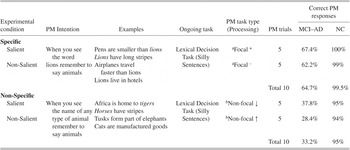
With the aim of creating a task that placed a differential degree on strategic attentional resources, two variables were manipulated (i.e., specificity of the instructions and perceptual salience of the PM cue) (see Table 2).
Parameters of the prospective memory task and performance of NC and MCI-AD

Note.
+High in focal processing; –Low in focal processing; ↓Low in non-focal processing; ↑High in non-focal processing. NC = normal controls; MCI-AD = mild cognitive impairment-Alzheimer’s disease.
a The PM cue overlaps with the information constellation relevant to performing the ongoing task (McDaniel et al., Reference McDaniel, Einstein, Rendell, Kligel, McDaniel and Einstein2008).
b The PM cue is present in the environment but not part of the information being considered by the person (McDaniel et al., Reference McDaniel, Einstein, Rendell, Kligel, McDaniel and Einstein2008).
In the Specific condition, participants were given specific instructions concerning the PM cue (e.g., when you see the word “lions” written in any of the sentences, remember to say “animals”). Ten critical sentences containing the PM cue lions were embedded throughout the first 108 sentences. Within the specific condition, the perceptual salience of the recall cue (RC) was varied so that 5 of 10 critical sentences were presented with the word “lions” in italics (i.e., Specific-Salient condition), and the other 5 in regular format (i.e., Specific-Non-Salient). Presentation of salient and non-salient sentences was intermixed.
In the Non-Specific condition, participants were given general instructions (i.e., when you see the name of any type of animal remember to say “animals”). Ten critical sentences containing the PM cue of an exemplar of the category “animals” were embedded throughout the second 108 verification sentences’ trial. Each one of the 10 PM cues was only shown once, and exemplars were equated against the exemplar “lion” in terms of their typicality using Irish-based norms (Brown & Semrau, Reference Brown and Semrau1986). Within the Non-Specific condition, the perceptual salience of the RC was also varied so that 5 of 10 critical sentences were presented with the name of the animal in italics (e.g., horses) (i.e., Non-Specific-Salient condition), and the other 5 in regular format (e.g., elephants) (i.e., Non-Specific-Non-Salient). Presentation of these sentences was also intermixed.
Procedure. Participants were tested individually under all testing conditions. The two PM tasks (i.e., Specific and Non-Specific) were introduced separately, and order of administration was counterbalanced. In both conditions, participants were told to keep the instructions in mind because they would not be repeated and were asked to repeat back the instructions to ensure their learning. Participants were not told how often the PM cue would appear. Critical sentences appeared relatively equally throughout the verification sentences (on average every 10 sentences, at a rate of 1.5 min approximately). Cues were counterbalanced for location (i.e., beginning or end of sentences), and verification form (i.e., true or false). In both conditions, participants were told that making the PM response precluded the need to do the sentence verification task. To minimize the RM demands of the task, the intended action (i.e., say animals) was held constant and highly associated with the PM cue in both conditions. Following the PM task, it was verified that 100% of individuals remembered the instructions. Total time of administration for each condition (Specific/Non-Specific) was 14 min.
Statistical Analyses
Data distribution in the PM task and several conditions of the RM tests was skewed. For this reason, either nonparametric tests (Mann-Whitney U), or their parametric equivalents (t test), were used, as appropriate, to analyze group differences.
Analysis of group differences. A compromise approach (setting alpha (α) level for statistical significance (p) at α = 0.01) to balance the risk of Type I and Type II errors was adopted (Aron et al., Reference Aron, Aron and Coups2006).
Discriminatory efficacy of prospective and retrospective memory. A series of Receiver Operating Characteristic Curve (ROC) analyses was produced to examine the relative discriminative efficacy of PM tasks compared with RM tests. The cut-off scores providing the highest sensitivity balanced against optimum specificity were selected. Positive predictive values (PPV = true positives / [true positives + false positives]), negative predictive values (NPV = true negatives / [true negatives + false negatives]), and overall accuracy (i.e., percentage of MCI cases accurately categorized as MCI + percentage of NCs correctly classified as NC) were also calculated.
RESULTS
Prospective and Retrospective Memory: Analysis of Group Differences
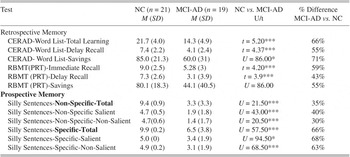
There were significant differences between the NC and MCI-AD groups on all the RM tests and all PM conditions, reaching our criterion (p < .01) on all but RBMT (PRT)-Savings (see Table 3). These differences remained even when education was accounted for (i.e., analysis of covariance and case summaries).
Analysis of group differences on memory functioning

Note:
NC = normal controls; MCI-AD = mild cognitive impairment-Alzheimer’s disease; CERAD = Consortium to Establish a Registry for Alzheimer’s Disease; RBMT (PRT) = Rivermead Behavioural Memory Test-Paragraph Recall Test; M = mean; SD = standard deviation.
* Significant value (p < .01); **Significant value (p < .001); ***Significant value (p < .0001).
Discriminatory Capacity of PM tasks and RM Tests: Detecting MCI-AD From NC
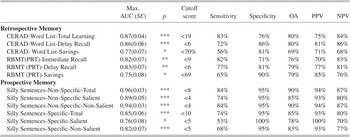
ROC analysis was significant for all measures of memory administered except for RBMT-PRT-Savings. Overall accuracy (OA) ranged from 69% to 90%. With the exception of the Silly Sentences-Specific-Salient condition, which showed poor sensitivity to MCI-AD (<55%), all other measures demonstrated reasonable sensitivity and specificity. Notably, the Silly Sentences-Non-Specific-Total score (sensitivity = 84%; specificity = 95%) and its individual conditions, the Silly Sentences Non-Specific-Non-Salient (sensitivity = 84%; specificity = 95%), and Silly Sentences-Non-Specific-Salient (sensitivity = 73%; specificity = 95%) demonstrated the highest discriminatory power to detect MCI-AD from NC, and was superior to all RM tests, certainly in terms of specificity and overall accuracy (see Table 4).
Summary of the ROC analyses with cutoff scores for NC (n = 21) vs. MCI-AD (n = 19)

Note.
ROC = receiver operating characteristics curve; AUC = area under the curve; SE = standard error; OA = overall accuracy; PPV = positive predictive value; NPV = negative predictive value; NC = normal controls; MCI = mild cognitive impairment; CERAD = Consortium to Establish a Registry for Alzheimer’s Disease; RBMT (PRT) = Rivermead Behavioural Memory Test-Paragraph Recall Test.
* Significant value (p < .01); ** Significant value (p < .001); ***Significant value (p < .0001).
DISCUSSION
The first aim of this study was to investigate the relative discriminatory efficacy of a newly developed PM task compared with two traditionally-used RM tests. The sensitivity, specificity, positive and negative predictive indices derived from ROC analyses showed that an event-based PM task (i.e., Silly Sentences-Non-Specific), was superior to traditionally used RM tests (RBMT-PRT and CERAD-Word List) in discriminating MCI-AD from NC. This is consistent with the idea that PM tasks demand a greater degree of self-initiative retrieval operations relative to RM tasks (Einstein & McDaniel, Reference Einstein, McDaniel, Brandimonte, Einstein and McDaniel1996), requiring the monitoring of the environment to identify the cue that signals the initiation of the action. This finding is most noteworthy since the CERAD-Delay Recall (Welsh et al., Reference Welsh, Butters, Mohs, Beekly, Edland, Fillenbaum and Heyman1994), and RBMT have been found to discriminate very mild AD from NC, and MCI-AD from NC (Kazui et al., Reference Kazui, Matsuda, Hirono, Mori, Miyoshi, Ogino, Tokunaga, Ikejiri and Takeda2005).
The second aim of the study was to investigate whether varying parameters of the event-based PM task (i.e., specificity of the instructions and perceptual salience of the PM cue) would result in differential levels of discrimination between the groups. According to the multiprocess view of prospective remembering, the cognitive processes recruited in PM tasks, and the likelihood of success, are determined by the nature and demands of the ongoing task, and parameters of the PM cue (McDaniel & Einstein, 2000). This theory posits that ongoing tasks that encourage focal processing of the PM cue, and cues that are salient relative to the existing context in which they are presented, are more likely to produce an involuntary orienting response to the PM cue, and stimulate a relatively spontaneous retrieval of the intended action. In contrast, non-focal tasks, using non-salient PM cues, are likely to require more strategic attentional resources to monitor for the PM cue signaling the appropriateness of performing the intended action (McDaniel & Einstein, 2000; McDaniel et al., 2008; McDaniel & Einstein, Reference McDaniel, Einstein, McDaniel and Einstein2007). Consistent with the multiprocess theory, we found that the Silly-Sentences-Non-Specific-Non-Salient condition was superior to the Silly-Sentences-Specific-Salient in discriminating MCI-AD from NC. This differential pattern is consistent with the early presence of defective executive functioning in MCI-AD (Grober et al., Reference Grober, Hall, Lipton, Zonderman, Resnick and Kawas2008).
This study contributes to the limited literature on PM in MCI. Our findings are consistent with the two previous studies (Kazui et al., Reference Kazui, Matsuda, Hirono, Mori, Miyoshi, Ogino, Tokunaga, Ikejiri and Takeda2005; Troyer & Murphy, Reference Troyer and Murphy2007), indicating that event-based PM tasks are sensitive to the cognitive effects of early MCI-AD. In addition, we have shown that a certain type of event-based PM task, the Silly Sentences-Non-Specific-Non-Salient, achieved a greater discriminatory power relative to traditional RM tests. This finding has research and clinical implications. First, paraphrasing McDaniel's & Einstein (2000) idea applied to the study of PM in MCI, we should move from investigating whether MCI affects prospective remembering to studying the types of PM tasks that provide a robust cognitive marker in MCI, aiding early detection. Second, future research will be needed to develop shorter PM tests appropriate for use in clinical settings.
Limitations of this study include, small sample size, use of convenience samples (MCI-AD were a selected group attending a memory clinic, and the NC were healthy Active Retirement Group participants), and, albeit not statistically significant, differences on educational profiles, all reducing the generalizability of our results. Present findings are regarded as preliminary results awaiting replication in larger unselected samples. Despite these limitations, the findings indicate that PM deficits are relatively more pronounced compared with RM failure in MCI-AD and that the Silly Sentences PM task may prove useful in the early detection of this group.
ACKNOWLEDGMENTS
The authors thank the participants and their families who cooperated in this study. The manuscript is new and original, is not currently under review by any other publication, and has not been previously published either electronically or in print. The project did not receive any financial support, and there are no conflicts of interest affecting this manuscript.