1. Introduction: mainstream as a data-driven meta-genre
The mainstream is not one homogeneous and self-evident stream that does not deserve our research attention (Steinbrecher Reference Steinbrecher2021). Often used metaphors, such as those on the main river stream and its surrounding branches and tributaries, might be misleading (Huber Reference Huber2013, p. 10): there can be many tensions, forces, and whirlpools even in the seemingly homogeneous and uniform course of a main river. This is even more pronounced in today’s hybrid media systems (Chadwick Reference Chadwick2013), characterised by the coexistence of old and new media, and a complex interplay of human (editorial), algorithmic, and data-driven gatekeeping (Hesmondhalgh and Meier Reference Hesmondhalgh and Meier2018).
This complexity is often overlooked when mainstream music is treated as nothing more than the tautological result of popularity, mediation, and intentional market attempts to please the consumer. Of course, statements highlighting commercial logic behind the mainstream selection are not wrong in themselves, but they are often too general and vague, neglecting the more complex question of why a particular music – in a specific period, and by a specific audience – is massively affirmed and accepted. These phenomena cannot simply be dismissed as a universal ‘mysterious willingness of the technologically educated masses to fall under the spell of despotism’, as Horkheimer and Adorno (Reference Horkheimer and Adorno2002 [1947], p. xvi) argued.
As we argue in this article, mainstream music is not the most homogenous and standardized form of music, whose identity is known in advance. Rather, it is an entity that is conditioned or directed by the dominant logic of selection of media gatekeeping, curation, and distribution of music, in the defined media ecosystem, and the corresponding logic of consumption. In other words, mainstream music represents the particular feedback loop between the curation and consumption of music. In this article, we will therefore address the formation of mainstream music in Slovenia through a feedback loop of curation and consumption by the combination of two complementary data sources: music airplay lists from Slovenian radio stations and survey data on genre preferences among a representative sample of the Slovenian population.
Following this approach, we take into consideration four basic assumptions about the concept of mainstream. First, ‘mainstream’ should be seen as a meta-genre that serves as a good illustration of how music genres, in general, often function as overly simplistic representations that rigidly frame the dynamic developments within the sphere of pop culture. Of course, scholars have long emphasized that genre is not merely a stylistic classification but a dynamic social, institutional, technological, and market construct, or how it should not be treated as a self-evident and unchanging classificatory tool (Negus Reference Negus1999). However, the concept of the mainstream poses a different challenge for the understanding of music through genre and genre classification. While the mainstream is conventionally identified with the commercially produced pop, it is, in essence, genre-agnostic: mainstream music cannot be defined (like other genres) primarily by its aesthetic components (sound, lyrics, style, etc.), and any genre that achieves mass popularity can be considered mainstream. According to Gayraud, the mainstream music, as a cultural phenomenon, represents the largest community of listeners and appears to support aesthetic pluralism by embracing all genres, provided they do not exclude one another (Gayraud Reference Gayraud2019, pp. 214–215). It is therefore important to analyze mainstream music through the (dis)associative relations between genres, or the sociology of genres. Nevertheless, in a Bourdieuan sense, the relations between genres and their association in the mainstream serve as a manifestation of a judgment of taste and their preferences as a way to establish (micro) social distinctions.
Second, the mainstream music is repetitive. The phenomenon of repetitive listening, or the preference for already known songs, has long fascinated popular music researchers (Margulis Reference Margulis2014). Familiarity with music has been shown to correlate strongly with listeners’ preferences – a relationship particularly pronounced in the case of nostalgic songs from their adolescent years (Sidhu et al. Reference Sidhu, Urian, Zheng and Grahn2025). Interestingly, the opposite tendency towards novelty and serendipity – the unexpected yet meaningful discovery of new music – has also become a central element in the rhetoric of music-streaming platforms and contemporary musical culture (Kischinhevsky et al. Reference Kischinhevsky, Ferreira and Vieira2023). Such a dual tendency – one that simultaneously strives towards the old and new, the unprecedented and the expected, towards difference and repetition (Deleuze Reference Deleuze2001) – appears to be one of the defining characteristics of contemporary mainstream music curation.
Furthermore, mainstream music is media-specific. For example, as Weisbard (Reference Weisbard2014, p. 2) demonstrates, various forms of the mainstream – such as Adult Contemporary, Middle of the Road, and Top 40 – emerged in parallel with changes in radio formats or programming. The concept and the format of mainstream music on radio and on streaming platforms are not equal. Radio, particularly, is becoming a conservative medium, especially in the digital age, where attracting new (particularly younger) audiences is no longer guaranteed. As argued by Lengar Verovnik and Oblak Črnič (Reference Lengar Verovnik and Oblak Črnič2022), young people in Slovenia tend to listen to the radio mainly in family settings or while driving, and only rarely on their own initiative. From the perspective of adolescents, mainstream music is therefore often understood as broadly and intergenerationally accepted music, closely associated with the gatekeeping practices of commercial radio (Steinbrecher and Pichler Reference Steinbrecher and Pichler2021).
Another important characteristic of mainstream music is that it is the most data-driven music, subject to the logic of numerical representation and quantification (Osborne and Laing Reference Osborne and Laing2021). Historically, the formation of mainstream music has been characterized by the logic of the charts and an increasingly sophisticated empirical approach to understanding audience taste. Charts, lists, or other forms of numerical representations ‘establish an epistemological framework in which the popular music field comes both to know itself and be known by its consumers’ (Young Reference Young2017, p. 52).
Methodologically, when engaging with mainstream, one then quickly arrives at a realization akin to the post-essentialist philosophy of Gilles Deleuze (Reference Deleuze2001), namely, that entities and identities are not a starting point but rather a temporary product of a much more dynamic process of formation through difference and repetition. In line with such methodological anti-essentialism, the concept of the mainstream cannot be approached in isolation from empirical data – constantly shifting charts and playlists that reflect airplay, streams, likes, and comments. Within this flux, possible entities and regularities are yet to be identified.
In this spirit, engaging with the mainstream music as a data-driven meta-genre, we are particularly interested in how the construction of mainstream music – emerging at the intersection between audience selection and radio programming – reflects and reproduces broader cultural tendencies within a small, semi-peripheral, post-socialist, and post-Yugoslav European music market. Based on the premises identified in previous research on popular music in the Western Balkans, which emphasize tensions and compromises between global influx of popular music and local cultural identity, Slovenia, with its transitional position between Europe and the Balkans, offers a particularly fruitful case for applying an approach that emphasizes distinctions among various sources of music: global popular music, regional traditions, and national heritage.
The central research question guiding our analysis is: How are the distinctions between local, regional, and global musical cultures enacted in the construction of the mainstream – both in Slovenian radio programming and in audience genre preferences?
2. Demarcations and distinctions in popular music in the region
The development of ‘national’ post-socialist music ecosystems in the Western Balkans, however, cannot be understood apart from the region’s broader social and political transformations in the latter half of the twentieth century (Baker Reference Baker2024; Beard and Rasmussen Reference Beard and Rasmussen2020; Mišina Reference Mišina2013).
Slovenia’s predecessor, Socialist Yugoslavia (1945–1991), was not a stereotypically closed socialist regime but embraced many aspects of Western popular culture (Čvoro Reference Čvoro2014, p. 3). Western music genres such as rock, new wave, punk, and pop were quickly adapted and localized – though not always without friction (Pogačar Reference Pogačar2008; Valetič Reference Valetič2018). Alongside these influences, a dynamic folk and folk-pop scene emerged – including Slovenian folk-pop (slovenska narodnozabavna glasba), newly composed folk music (novokomponovana narodna muzika), and Croatian and Slovenian evergreens (popevka) – blending local traditions with global pop sensibilities (Čvoro Reference Čvoro2014; Rasmussen Reference Rasmussen2002; Stanković Reference Stanković2021).
This convergence of global and regional influences, and of popular music with folk traditions, helped shape a vibrant Yugoslav music scene, widely seen as a key cultural force uniting an increasingly fragmented country. However, during the 1980s, one of the key cultural lines of demarcation in Yugoslavia was carved out between the urban, cosmopolitan rock, punk, and new wave audience and the audiences of various folk-pop genres, which supposedly corresponded to the differences in musical taste between the educated upper-middle class and the (often rural) lower classes (Čvoro 2014, p. 16; Perković Reference Perković2018). Similar tensions between Western pop culture, local/regional traditions, and socialist cultural policy appeared in other socialist countries in Eastern Europe as well (Barna and Ignácz Reference Barna and Ignácz2018; Machek Reference Machek2022).
During the transition from socialism to post-socialism and the breakup of Yugoslavia into independent nation-states, the music market underwent a significant transformation. Alongside the old (often state-owned) gatekeepers in socialist-era media, new actors emerged who quickly adapted to the early 1990s ‘free market’ conditions in independent Slovenia (Bašić Hrvatin in Milosavljević Reference Bašić Hrvatin and Milosavljević2001), driving the rise of a commercial radio model based on Western Top 40 formats. Another key shift was the fragmentation of the music market: most stakeholders had to adjust to smaller, more insular national markets that replaced the once diverse Yugoslav space. Yet, a broader regional (Yugoslav and Balkan) identity and nostalgic memory of socialism have remained influential in pop music production, distribution, and consumption to this day (Hofman Reference Hofman2025; Velikonja Reference Velikonja2009).
These dynamics produced a regionally specific tension in musical gatekeeping, balancing preferences for local (national, Slovenian-language), regional (Western Balkans, Serbo-Croatian-language), and global (English-language) music. In particular, various folk-pop genres were often – justifiably or not – linked to specific political tensions in the post-socialist context: turbo-folk in the 1990s was perceived as an expression of Milošević’s regime in Serbia (Gordy Reference Gordy1999), while Slovenian folk-pop was associated with Europe-oriented nationalism and with specific ‘nation branding’ strategies (Šepetavc and Majsova Reference Šepetavc and Majsova2023). Cultural distinctions and demarcations were also observed in empirical research on music taste in the region. In her 2012 study on popular culture and class distinctions, Luthar identified three dominant types of cultural taste among audiences in two of Slovenian largest cities, Ljubljana and Maribor: (1) ‘elite cultural taste’, (2) ‘domestic (domačijski) taste’, and (3) a ‘commercial taste’ that rejects high culture in favour of global popular culture (Luthar Reference Luthar2012, pp. 24–29). Similar patterns emerged in research by Tonković, Krolo, and Marcelić (Reference Tonković, Krolo and Marcelić2020) on high school students in Croatian coastal towns. They emphasized the divide between global-cosmopolitan tastes – linked to English-language content, urban settings, higher education, and higher social class – and local-traditional tastes, tied to Croatian-language content, rural environments, and lower socioeconomic status.
Social distinctions identified in previous research on popular music in the Western Balkans are also reproduced and reinforced in the curation and consumption of music on Slovenian radio stations. In our earlier study on gatekeeping practices in Slovenian radio stations (Kaluža and Bobnič Reference Kaluža and Bobnič2023), we identified three key selection principles. First, ‘national-oriented’ gatekeeping prioritizes domestic music and music that represents the nation – such as Slovenian folk-pop (narodnozabavna glasba), evergreens (slovenska popevka), and local pop (slovenska zabavna glasba) – especially on local and some public radio stations. Second, self-proclaimed ‘urban’ gatekeeping reflects editorial taste, favouring pop and rock selected by music experts, mainly on public and certain local stations. Third, commercial gatekeeping is driven by audience research data and leans towards global (Anglo-American) pop, typical of major commercial stations that belong to the Adult Contemporary and Top 40 radio formats. We also highlighted (1) the selection of music on radio is based on the assumption that radio’s audience is getting older and generally not interested in the discovery of new music (or in diversity of music phenomena), and (2) the role of the so-called ‘rejection principle’, which prioritizes maintaining established listening habits and high-frequency repetition of a small number of tracks. These principles clearly underline the conservative orientation of today’s mainstream radio programming.
3. Methodology
Following the logic of critical data studies (Kitchin Reference Kitchin2014), we advocate for a theory grounded in empirical research and for empirical approaches informed by theoretical reflection (Kaluža Reference Kaluža2024). We have chosen to focus on two complementary data sources that together capture the dynamics of mainstream music circulation on Slovenian radio – one reflecting the presence of music in the media, the other revealing patterns of musical taste. These include (1) survey results documenting music preferences within a representative sample of the Slovenian public and (2) playlists curated by Slovenian radio stations. The duality between these sources aligns with our conceptualization of mainstream music as a feedback loop between curation and (preferred) consumption, shaped by the logic of mainstream bias: what is heard tends to be liked, and what is liked tends to be heard.
To address the meta-positional genre structure of the mainstream, we analyzed results from the Slovenian Public Opinion Survey (conducted in 2021), in which a representative sample of Slovenian citizens (N = 1022) was asked about the musical genres they listen to. The approach and implementation of the research followed the established methodology used in conducting national public opinion surveys based on probability sampling (Hafner-Fink et al. Reference Hafner-Fink, Malnar, Črnak-Meglič and Krašovec2022). We focus primarily on the analysis of the question regarding the popularity of musical genres among respondents, who were allowed to select any number of musical genres, with the following genre categories available: pop; rock; Slovenian folk-pop music (slovenska narodnozabavna glasba); Croatian pop; turbo-folk; R‘n’B, hip hop, or trap; electronic music; Slovenian evergreen songs (slovenska popevka); jazz; metal; alternative music; world music; other. No additional explanations or definitions of genres were provided.
The second major data source in our research – playlists of tracks circulated across various radio stations – reveals underlying patterns in music curation. Playlists are not neutral entities; they constitute complex embodiments of audience tastes, gatekeeping decisions, media policies, cultural trends, and prevailing industry norms. It is precisely this layered complexity that makes them analytically significant. Our analysis of playlists and airplay data draws on datasets from Slovenia’s two main collective music rights organizations: SAZAS (representing authors) and IPF (representing performers and phonogram producers).Footnote 1 These datasets cover only traditional media – radio and television – with television now playing a marginal role in music consumption. We focused primarily on radio, which remains highly relevant despite the rise of new media formats. Survey research by Hafner-Fink et al. (Reference Hafner-Fink, Malnar, Črnak-Meglič and Krašovec2022) confirms that radio continues to be the most important medium for music consumption among the general Slovenian population. Accordingly, our analysis centres on airplay data from Slovenian radio stations between 2017 and 2022. As such, the results speak to broadcast-mediated mainstream dynamics and should not be generalized to digital-first consumption.
While our theoretical approach challenges fixed binaries and essentialist notions of identity (of the mainstream), empirical analysis – particularly when working with large datasets – necessarily relies on provisional distinctions. Such distinctions are embedded in the very structure of the datasets we analyze. For instance, the SAZAS database includes song titles, names of copyright holders (authors, lyricists, arrangers), genre classifications, indicators of domestic or foreign origin, and annual airplay frequencies on both radio and television. The database also enables differentiation between commercial media, public media, and media of so-called special importance (mostly local or niche radio stations). The IPF database, covering the years 2017 to 2022, is organized differently but likewise relies on a series of categorical distinctions. It includes song identifiers, titles, annual airplay counts, media type (radio or television), timeband (day or night), and track origin (domestic or foreign).
In our analysis, we focused primarily on the IPF database, as it contains the names of performing artists rather than only the holders of author rights. The SAZAS database was used mainly to verify our findings and in those parts of the analysis that examine differences in airplay between public, commercial, and local radio stations. Consistent with the analysis of survey responses and in line with our research questions, the main aim was to identify local, regional, and global flows of music within these datasets.
Because the study employed a range of statistical procedures tailored to specific analytical objectives, the detailed methodological steps are presented within the corresponding sections of the analysis. In general, to analyze clusters of audience tastes – identified through the co-occurrence of musical genres – we primarily used factor analysis and network analysis. Various descriptive statistical methods were applied in the analysis of airplay data. All analyses were conducted using Gephi, Orange Data Mining, Microsoft Excel, RStudio, and Python programming languages (we used factor_analyzer, SciPy, and statsmodels open-source libraries). ChatGPT-4 and ChatGPT-5 were occasionally consulted for content-related feedback (e.g. title suggestions and interpretations of results), coding and debugging of code, and for refining the grammar and style of the written text.
4. Genre preferences as limits between global, regional, and national mainstream
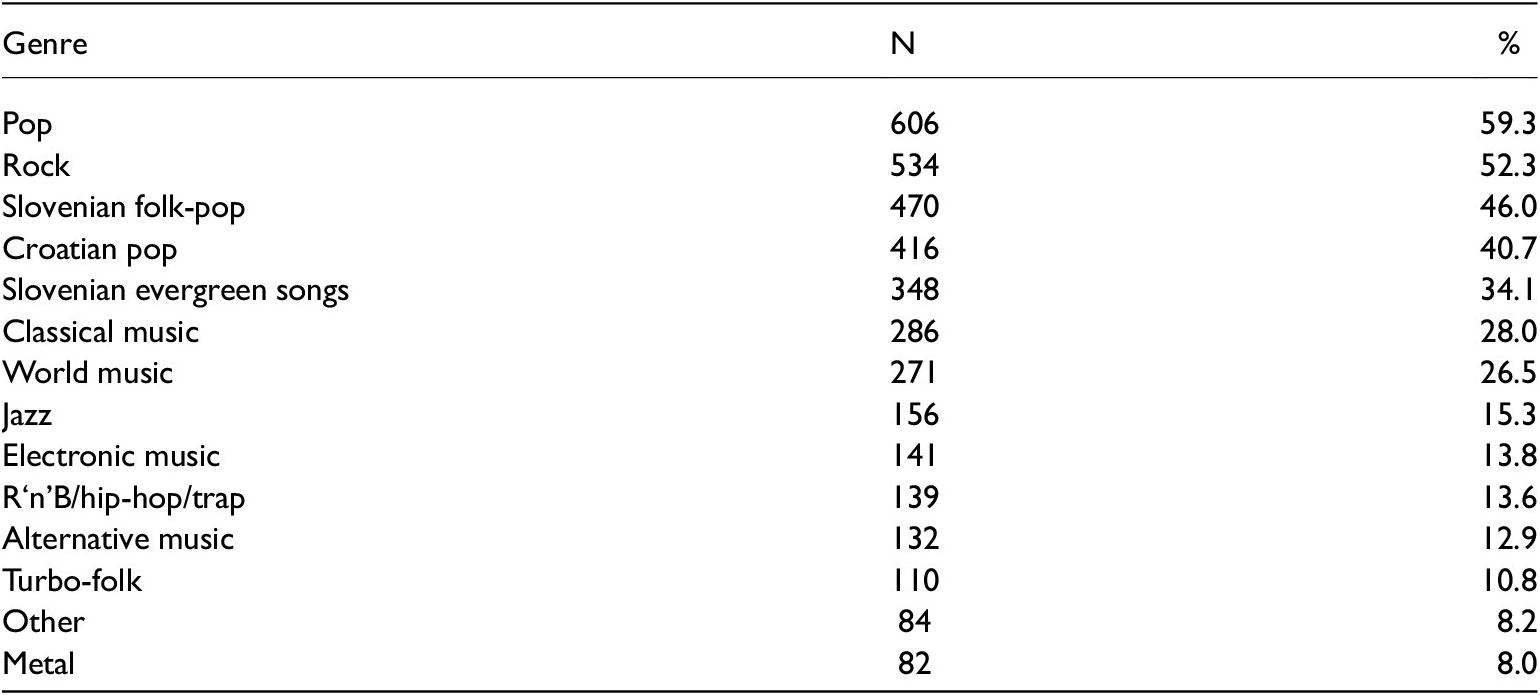
In order to describe the genre structure of the mainstream, we first analyzed the responses regarding genre preferences in the Slovenian Public Opinion Survey (Hafner-Fink et al. Reference Hafner-Fink, Malnar, Črnak-Meglič and Krašovec2022). As shown in Table 1, pop and rock are (unsurprisingly) the most popular music genres in the country, but more importantly, they are followed by locally and regionally specific genres such as Slovenian folk-pop and Croatian pop. For the understanding of mainstream music in Slovenia, it is also important to emphasize the low popularity of R‘n’B/hip hop/trap, one of the predominant genre clusters of global mainstream in the 21st century.
Genre preferences (N = 1,022), Slovenian Public Opinion Survey (Hafner-Fink et al. Reference Hafner-Fink, Malnar, Črnak-Meglič and Krašovec2022)

However, to address the meta-genres’ position in the mainstream, we conducted a factor analysis and analyzed the social distinctions between the latent taste patterns. Because the genre preferences in our dataset are binary indicators, we estimated tetrachoric correlations before conducting an exploratory factor analysis (Bartholomew et al. Reference Bartholomew, Knott and Moustaki2011, p. 93). The number of factors was chosen with parallel analysis (Glorfeld Reference Glorfeld1995): the first three eigenvalues (4.43, 2.04, 1.55) exceeded the 95th-percentile benchmark from random data, while the fourth (1.03) did not. This supports a three-factor solution.Footnote 2 Using factor scores as outcomes, we then estimated OLS (Ordinary Least Squares) models with heteroskedasticity-robust (HC3) standard errors and categorical predictors (Long and Ervin, Reference Long and Ervin2000) for age, education, settlement type, and class.Footnote 3 Model fit suggests that results are valuable: (R2) ≈ 0.174 for F1, 0.96 for F2, and 0.167 for F3.
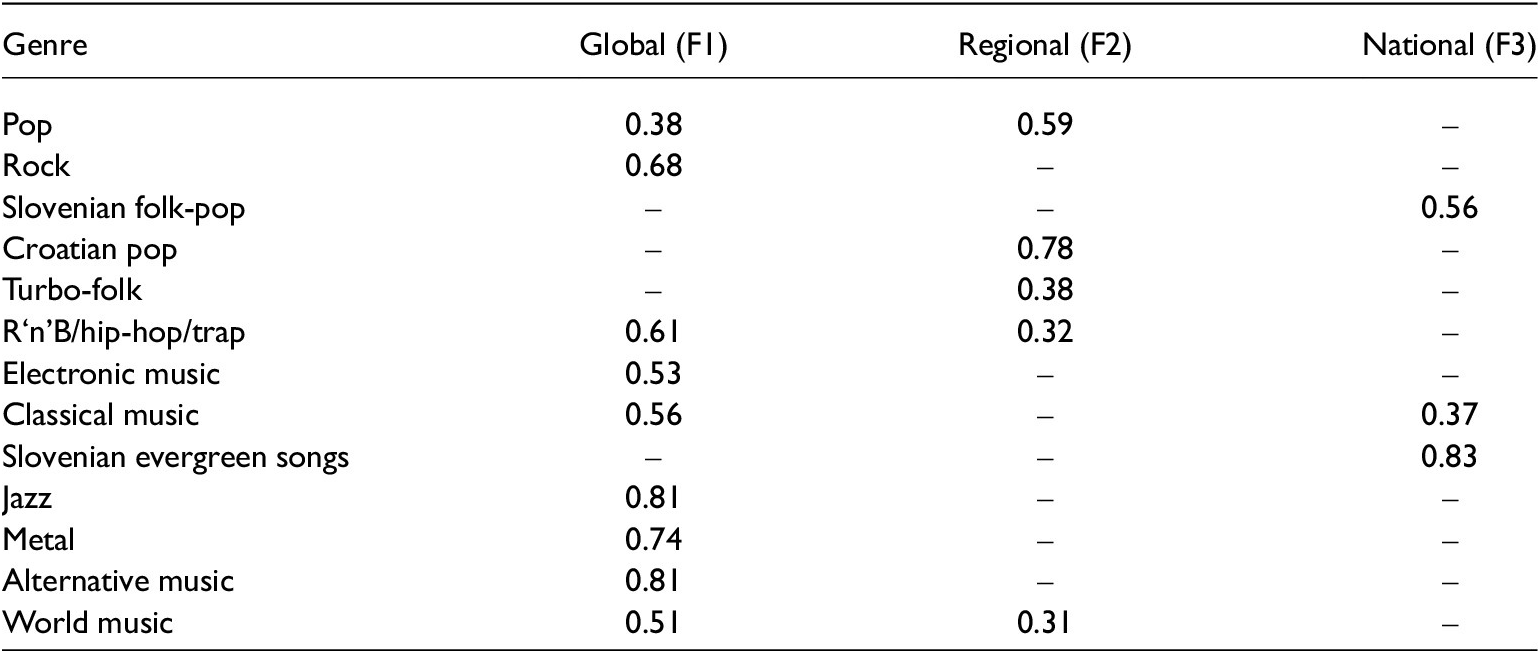
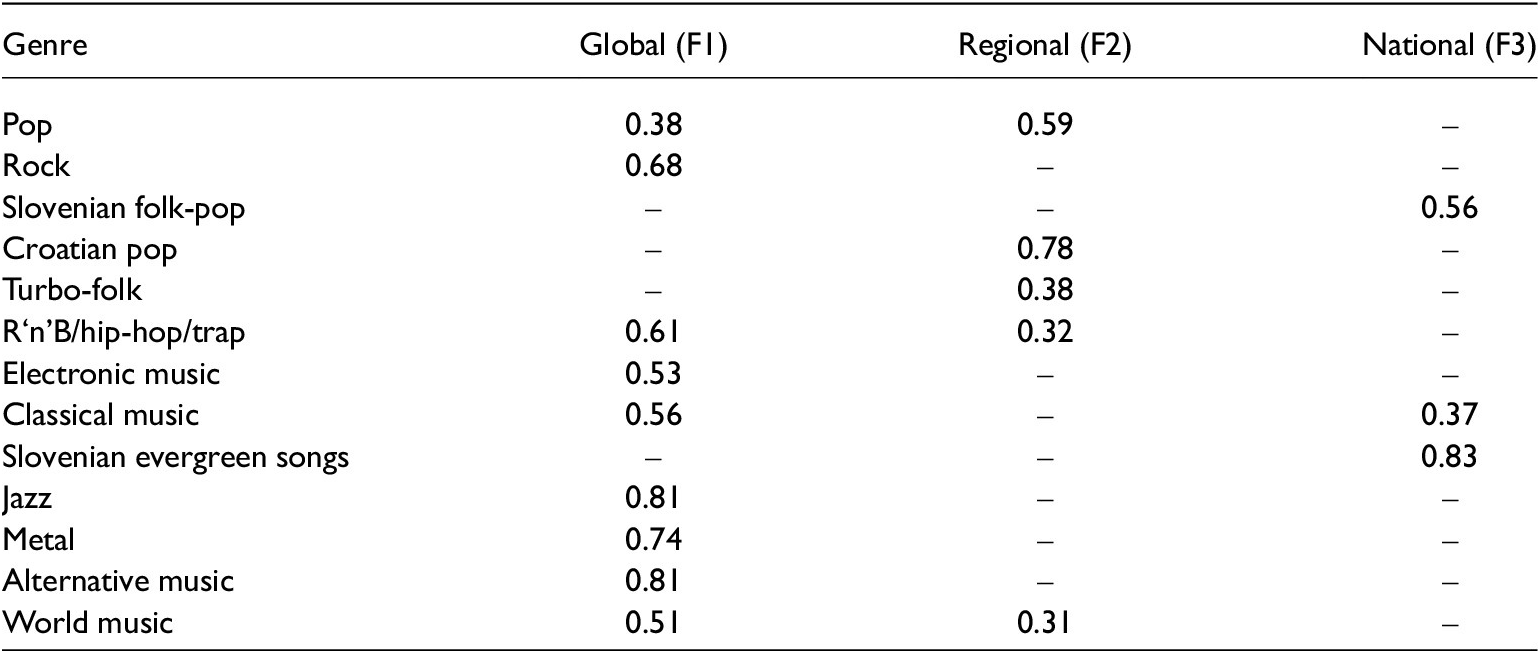
As shown in Table 2, the first factor (F1) combines the preferences for (in the sense of genre’s origin) non-local, transversally circulating genres, such as rock, alternative, metal, jazz, R‘n’B/hip hop/trap, and electronic music. We interpret these genre preferences as instances of a global(ized) taste. This makes sense when we take into consideration the second factor (F2), which explicates consumption of a South-East European (or the Balkan) specific regional popular music genres: although it associates with pop, it is highly correlated to Croatian pop, and to a lesser degree with turbo-folk, and R‘n’B/trap/hip-hop. The third factor (F3) reveals even a more locally and historically specific taste pattern, with preferences for Slovenian traditional genres: Slovenian evergreen and folk-pop define this taste orientation.
Exploratory factor analysis of music-genre preferences (Hafner-Fink et al. Reference Hafner-Fink, Malnar, Črnak-Meglič and Krašovec2022)
Multivariable analysis explicated that these taste formations are expressions of social differentiations, mostly by age, education, and type of settlement. Across all factors, age appears to be the strongest predictor (Type-II ANOVA, all p<10–12; η2 up to 0.13). Substantively, younger cohorts (18–30) are inclined towards global and regional taste profiles, whereas older respondents (61+) tend towards (Slovenian) traditionalistic taste. For example, relative to the youngest cohort, the oldest differ by −0.61 SD on F1 and −0.79 SD on F2, but by +0.99 SD on F3 (all P <0.001). Education is positively associated with both globalized and regional orientations: the highest educational level corresponds to +0.36 SD on F1 and +0.45 SD on F2 (both P ≤0.002), while education is not associated with traditionalistic taste (P = 0.576). Settlement type differentiates tastes most clearly for traditionalistic repertoires: urban residents (Ljubljana/Maribor/other urban) score lower on F3 than more rural settlements (all P ≤0.022). In parallel, the most urban category scores higher on globalized taste (P = 0.003) and lower on regional (P = 0.034). Surprisingly, social stratum, or class, does not contribute uniquely once age, education, and settlement are controlled (all P >0.13).
It is also important to note that these taste formations are largely distinct or even exclusionary; factor correlations are small (F1–F2 = 0.08, F2–F3 = 0.06, F1–F3 = −0.12), indicating only modest association. Although the globalized taste pattern is associated with subcultural genres (alternative, jazz, etc.), which were historically positioned against the mainstream, this does not mean that the difference between these genre preferences and more regional/locally oriented preferences simply corresponds to a distinction between mainstream and non-mainstream. Rather, mainstream appears as a latent configuration that is differentially distributed among global taste, regional popular music genres, and locally anchored (heritage) repertoires. The heterogeneous structure of the mainstream becomes even more evident when we consider that, while rock music (as a conventional mainstream genre) generally aligns with globalized genre preferences, pop is mostly connected to regionally specific tastes (and, to a lesser extent, global tastes). This suggests the existence of regional mainstream tastes in Slovenia – comprising Croatian pop and pop (with some overlap from trap/hip-hop and turbo-folk) – which can be understood both as a local instance of post-Yugoslav cultural specificity and as an outcome of programming strategies in Slovenia’s radio music market. Conversely, more traditional taste formations, which develop in opposition to globalized taste (or vice versa), can be viewed as an even more localized form of mainstream music, particularly given the popularity of Slovenian folk-pop.
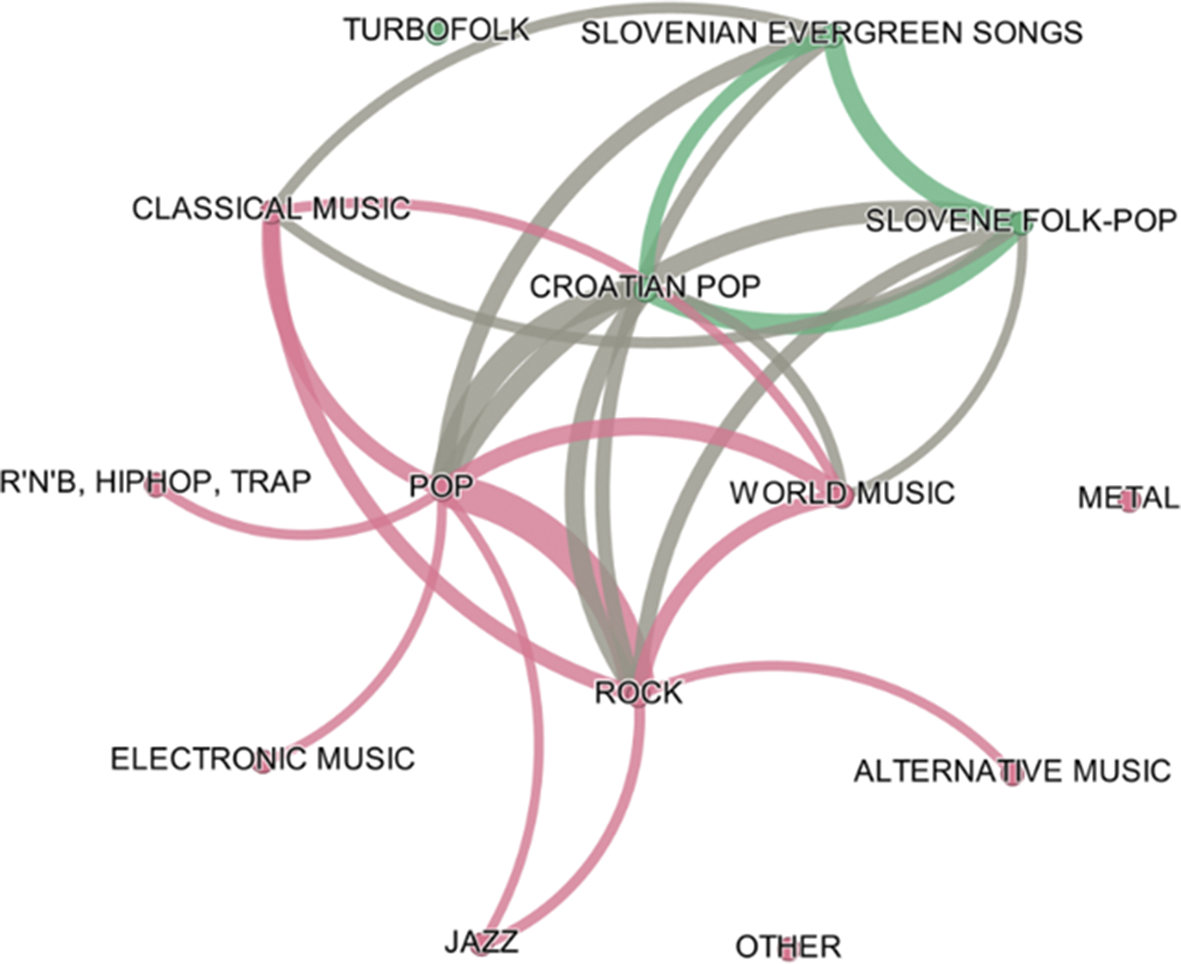
Furthermore, we tested the structure of genre relations with network analysis. With the use of Gephi software, we constructed an undirected, weighted network of genre co-selections, where stronger connections indicate more frequent co-occurrence between the two genres. By applying the Louvain community detection algorithm (modularity, resolution = 1), we identified two genre clusters that suggest underlying taste formations (Figure 1): the pink cluster is close to F1 and the global taste pattern, whereas the green cluster corresponds to F3, indicating a local/national taste pattern. For visualization, we used the Fruchterman-Reingold layout, which distributes nodes evenly but does not reflect actual distance-weighted connections (these are represented by edge thickness). Still, the spatial grouping of genres and their central or peripheral positions remains meaningful. Coloured edges (pink and green) indicate connections within clusters, while grey edges link genres across clusters. In this layout, genres placed at the centre tend to be less ‘repellent’ (i.e., more broadly accepted), while those at the periphery are more polarizing. The resulting modularity score was very low (0.024), suggesting that the genre network is highly interconnected.Footnote 4
Filtered co-occurrence of music genres in respondents’ answers (N = 1022); Slovenian Public Opinion Survey (Hafner-Fink et al. Reference Hafner-Fink, Malnar, Črnak-Meglič and Krašovec2022).

To get more meaningful insights, we applied a software-inbuilt filter to the network edges, retaining only strong connections between genres and removing weaker or infrequent ones. In this sense, we set the filter threshold at 106, which preserved 26.37% of all connections, resulting in an average of 3.43 visible links per genre. This filtered network highlights the most robust co-occurrences between genres, offering a clearer view of which genres are well-connected and which are more isolated.
The results show that genres located at the core of the network – such as pop, rock, and Croatian pop – tend to be more interconnected, reflecting their centrality in more non-selective taste profiles. In contrast, peripheral genres tend to be more isolated, which may signal their association with more selective audiences. A cluster of genres in the upper-right quadrant of the network – Croatian pop, Slovenian folk-pop, Slovenian evergreen songs, pop – forms a strongly interlinked structure, pointing towards a mainstream yet regionally inflected taste. The most isolated genres – metal and turbo-folk – are not only weakly connected in the filtered network, but are also among the least frequently listened to in the sample. Other low-connection genres include alternative music, electronic music, and R‘n’B/hip hop/trap, each with only one strong connection.
These analyses demonstrated that genres commonly associated with the mainstream – such as pop and rock – occupy central positions in audience preferences, marked by both widespread popularity and high connectivity to other genres. However, we also identified regionally inflected variants of the mainstream, exemplified by genres like Slovenian folk-pop and Croatian pop, which, despite lower global visibility, form tightly interconnected clusters among specific subgroups of listeners.
This article focuses on the construction of the mainstream on radio stations; therefore, we also tested the difference between the entire sample and respondents who consume music by listening to the radio (N = 788). We regressed factor scores from the full sample on a binary indicator for radio listening, with controls for age, education, settlement type, and class. The radio coefficient thus represents the adjusted mean difference between listeners and non-listeners on each factor. The results show no association with the global taste factor (adjusted means: non-radio 0.037 vs. radio −0.007). By contrast, radio listening is positively and substantively associated with both regional mainstream taste (adjusted means: −0.316 vs. 0.097) and local traditionalistic taste (adjusted means: −0.338 vs. 0.107). These contrasts indicate that radio listening aligns with regional and locally anchored repertoires, while remaining less significant for those who prefer globalized genres.
5. The non-egalitarian structure of airplayed mainstream
Analysis of survey responses underscored the importance of the distinctions between the local, the regional, and the global in the musical tastes that shape the construction of mainstream. This chapter shifts focus to the airplay data, particularly the distribution of airplay. As we argue in the introduction, one of the key markers of the mainstream structure is the frequency of repeated airplay. Therefore, to analyze the distribution of airplay, we first calculated the Gini coefficient, which indicates how unequally something is distributed and is typically used as a measure of economic inequality. IPF data on radio airplay between 2017 and 2022 – covering all types of radio stations – shows that the Gini coefficient remained relatively stable during this period (ranging from 0.851 to 0.866), indicating a high degree of inequality, particularly during daytime airplay. In contrast, the Gini values – although still high (between 0.78 and 0.82) – are consistently lower at night, which reflects greater editorial freedom and fewer data-driven or audience-driven constraints in this time band.
However, the number of times individual songs are broadcast varies significantly depending on the (economic) type of radio station (SAZAS dataset):
-
1. Public radio features the most egalitarian distribution, with 99.76% of songs receiving fewer than 200 yearly plays and almost no high-rotation tracks, indicating low repetition. On average, a song is repeated 8.5 times throughout the year.
-
2. Local/regional/student stations follow a similar pattern, though more songs in the mid-rotation range (200–1000 plays/year). On average, a song is repeated 88.6 times/year.
-
3. Even on commercial radio stations, 80.56% of songs have under 200 plays per year. On average, a song is repeated 148.4 times/year.
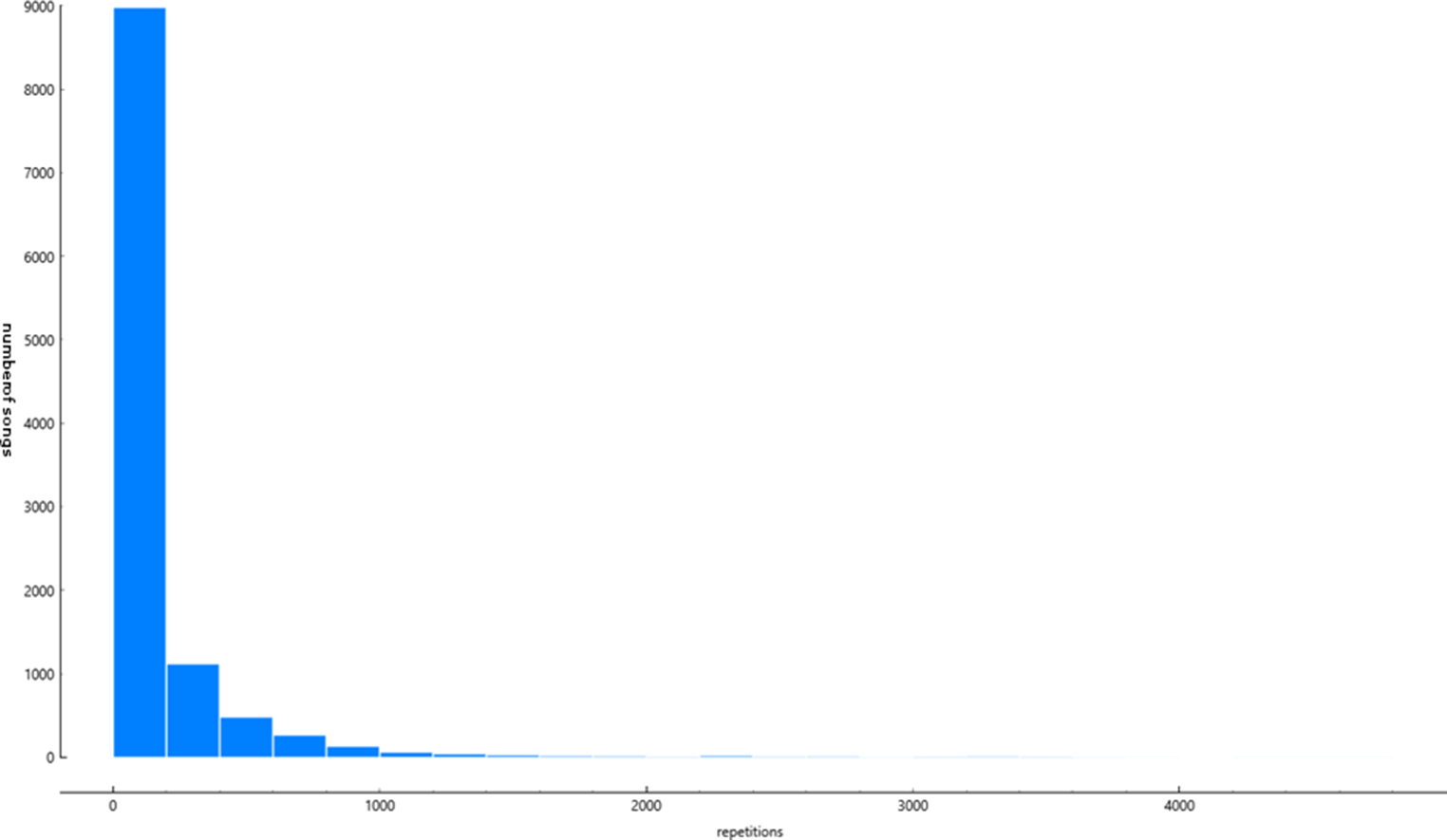
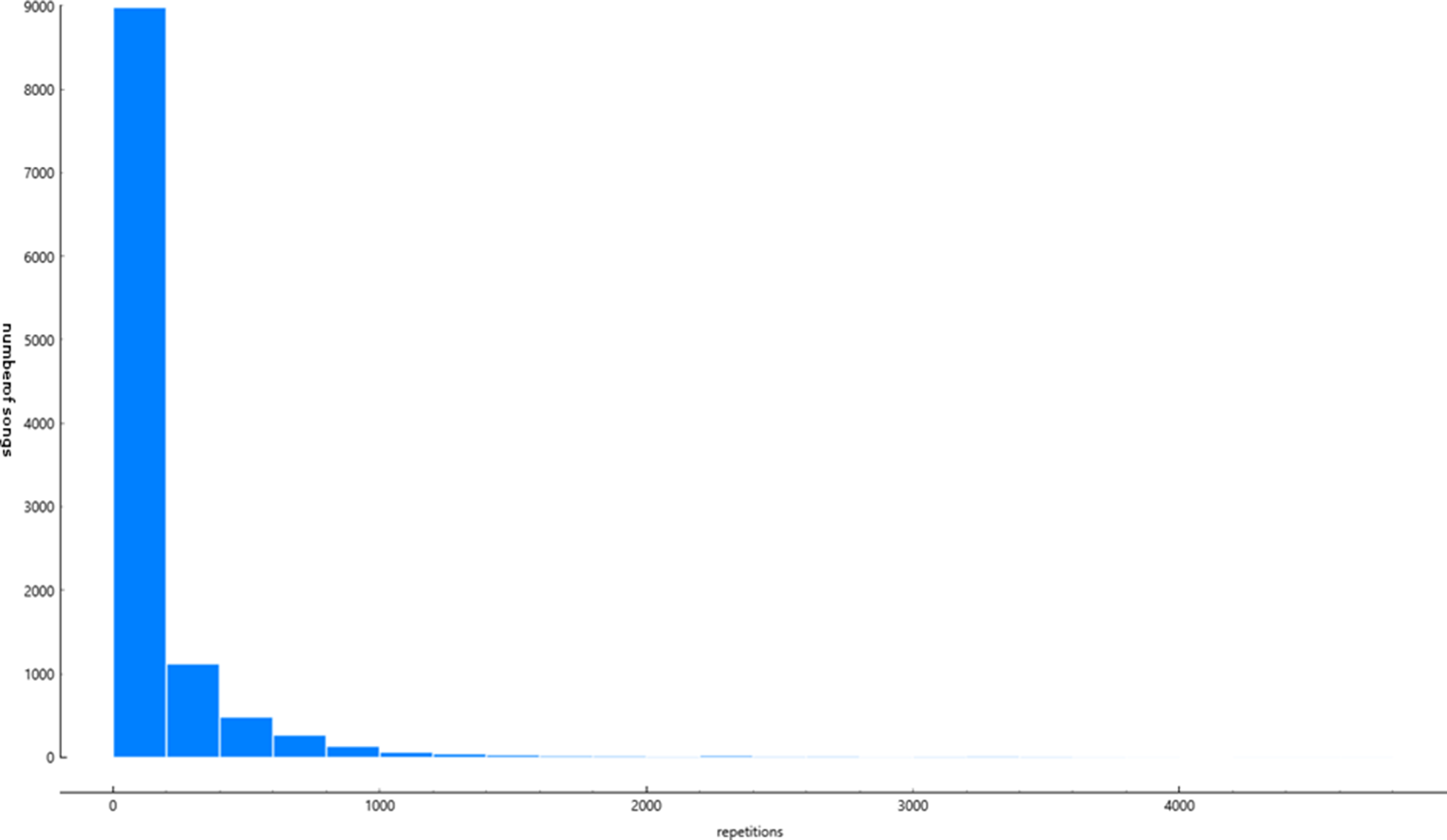
The distribution of airplay on commercial radio stations (Figure 2) therefore exhibits a pronounced long-tail pattern, whereby the vast majority of songs register relatively low repetition counts (less than 200), while a tiny subset of tracks is played with high frequency. In total, only 52 songs were broadcast more than 2,000 times during the recorded year in the SAZAS dataset. This indicates a markedly uneven distribution of exposure, with airplay disproportionately concentrated on a limited number of highly promoted tracks. For example, tracks that received significantly higher exposure are ‘Head, Shoulders, Knees and Toes’ by Ofenbach (4,650 airplays), ‘Cover Me in Sunshine’ by Pink (4,521 airplays), and ‘Follow You’ by Imagine Dragons (4,335 airplays).
Distribution of song repetitions on commercial radio stations; SAZAS dataset.
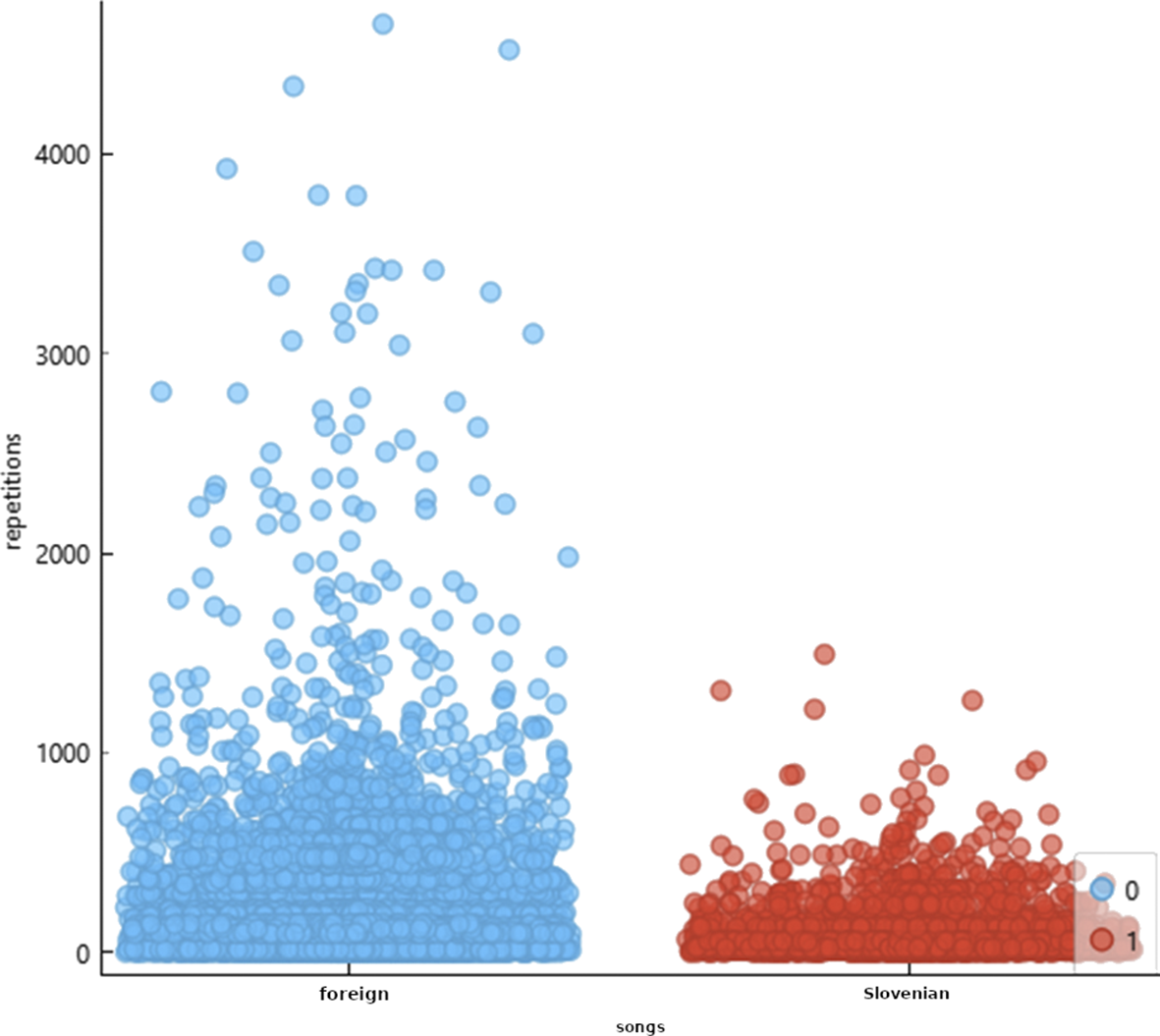
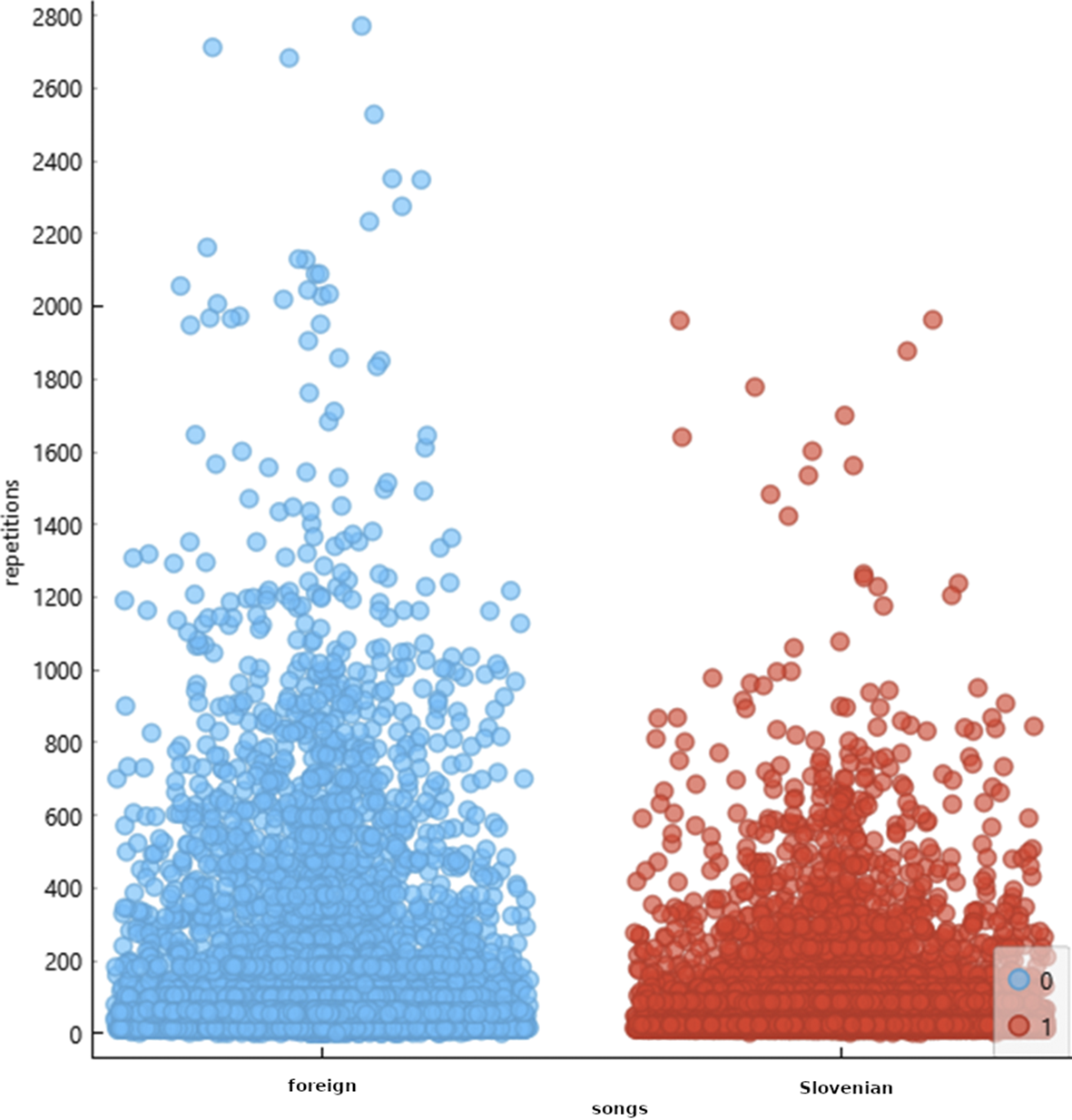
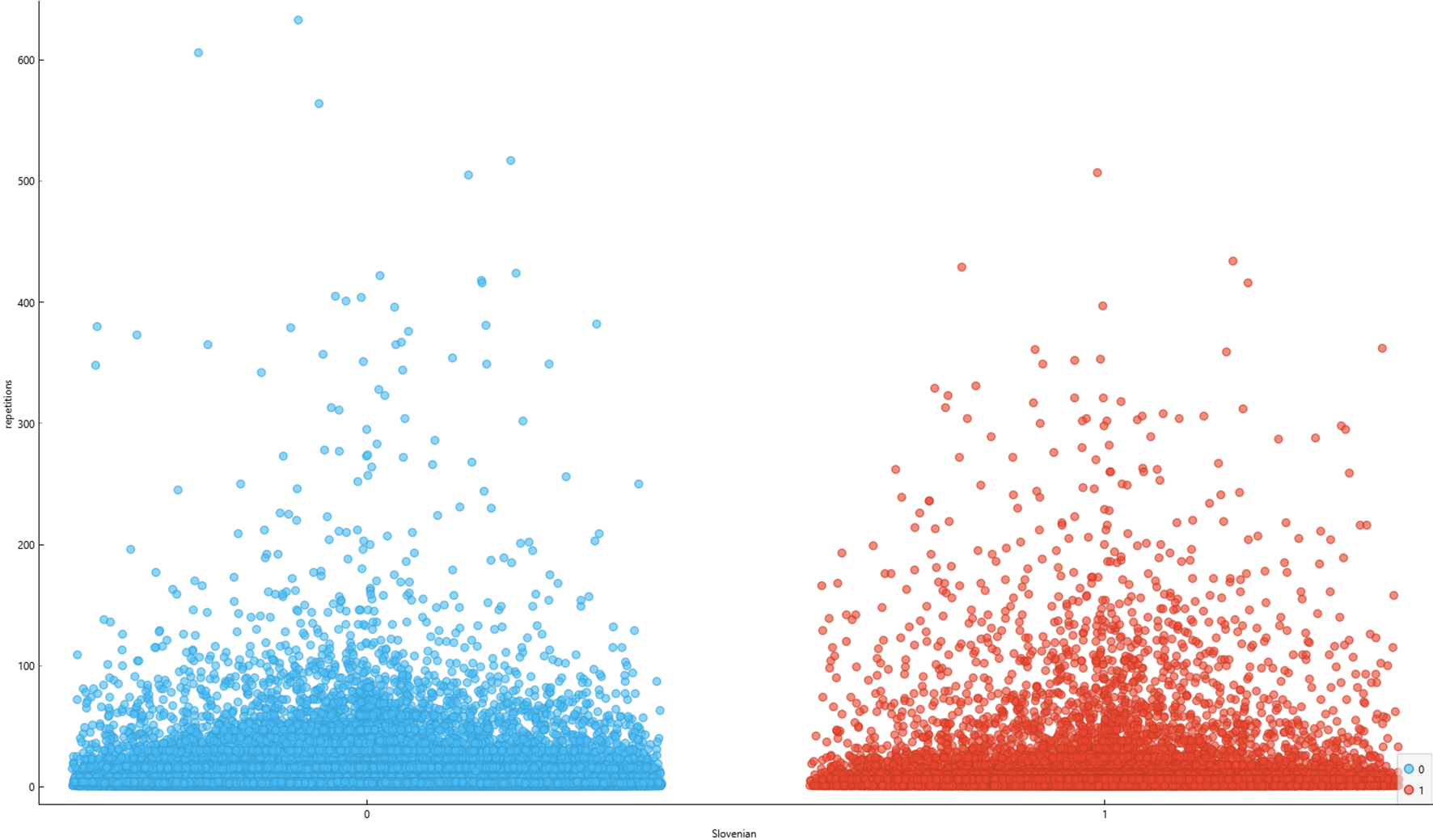
A more granular view of differences in the airplay could be seen in Figures 3, 4, and 5, where another important distinction, between the airplay of domestic and foreign music, is also displayedFootnote 5 Commercial stations, which reach the largest audiences, have the highest share of foreign music (80.82% foreign/19.18% domestic), followed by stations of special importance (62.34% foreign/37.66% domestic) and public radio stations (63.88% foreign/36.11% domestic) that broadcast larger shares of Slovenian music.Footnote 6 Notably, on commercial stations, almost all songs surpassing 1,000 annual plays are of foreign origin. In contrast, among the stations of special importance, which cater to regionally specific or niche audiences, a small number of domestic songs also emerge as mainstream outliers.
Yearly repetitions by origin of music on commercial radio; SAZAS dataset.

Yearly repetitions by origin of music – local/regional/student radio (programmes of special importance); SAZAS dataset.

Yearly repetitions by origin of music – public radio; SAZAS dataset.

According to IPF data (private correspondence), the share of Slovenian music across all broadcast media declined from approximately 42.2% in 2010 to around 32.7% in 2017. Between 2017 and 2022, the share of domestic music increased slightly, reaching 35.8%. However, the share of Slovenian music was particularly low among the top (mainstream) tracks. Among the Top 20 tracks, there were six Slovenian songs in 2016, five in 2017, and none between 2019 and 2021. The proportion of Slovenian songs in the Top 100 fell from 18% in 2017 to 7% in 2022, while the share in the Top 500 dropped from 17.2% to 13% over the same period. We can therefore observe a consistent decline in the presence of Slovenian tracks among the most popular (mainstream) radio hits (Top 10, Top 50, Top 100, and Top 500). We interpret this as a symptom of the broader crisis facing Slovenian popular music, which struggles to compete with the highly professionalized and globally circulated repertoire of contemporary international mainstream.
6. Seasonal peaks of globalized mainstream and (domestic) historical send/t/iments
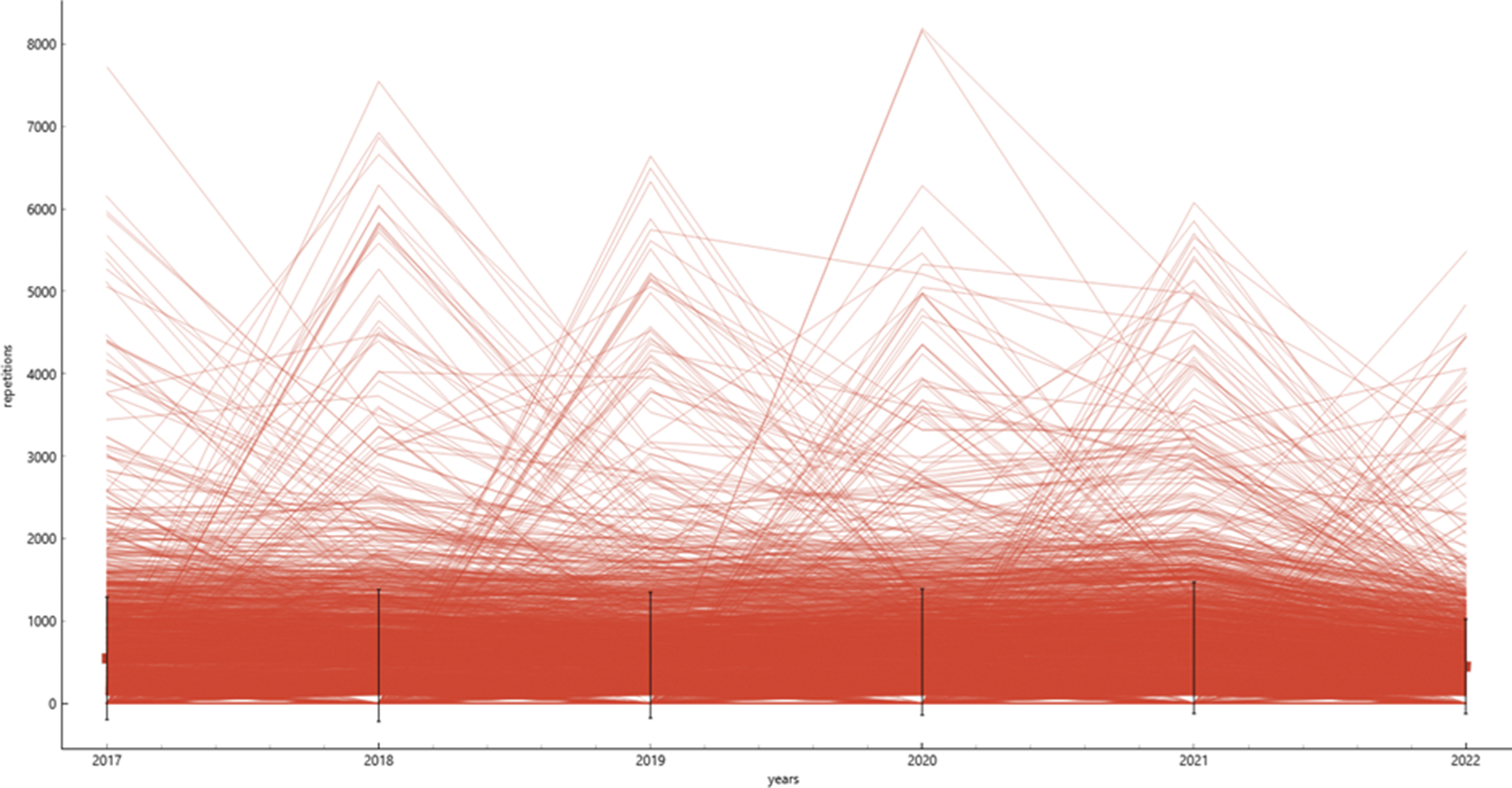
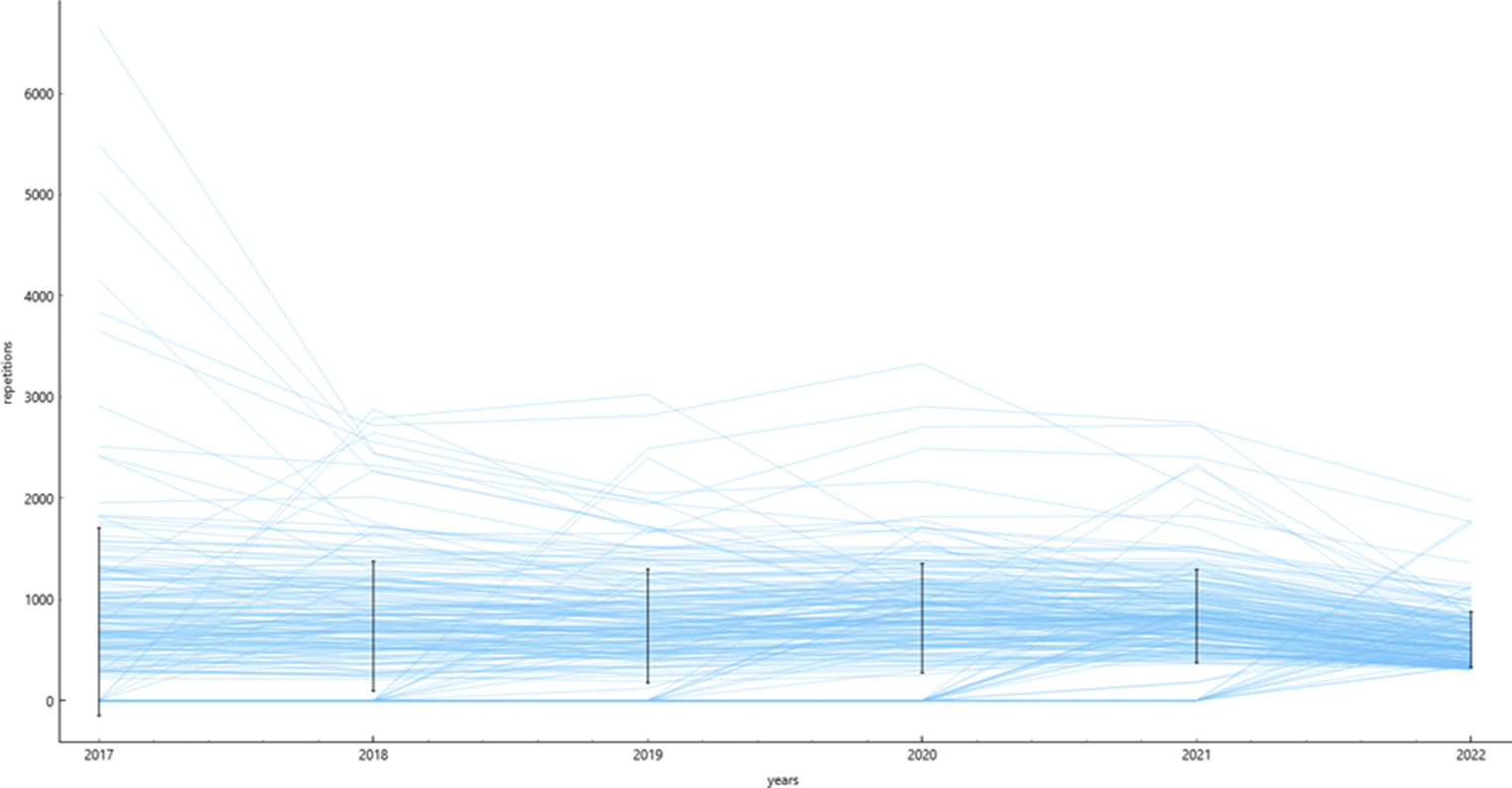
A static presentation of yearly airplay data does not allow for the analysis of trends and patterns over time. We therefore examine how the airplay of individual foreign and domestic hitsFootnote 7 has changed between 2017 and 2022 (Figures 6 and 7).
Yearly repetitions (>100) of foreign tracks (2017–2022); IPF dataset.

Yearly repetitions (>100) of Slovenian tracks (2017–2022); IPF dataset.

In the case of foreign tracks, the pattern is marked by the presence of steady tracks and striking seasonal peaks – sharp increases in airplay followed by equally rapid declines. These peaks typically correspond to global mainstream popFootnote 8 that briefly dominated Slovenian airwaves. This pattern is consistent with prior studies on mainstream radio programming, which link such music – especially Adult Contemporary and Top 40 formats – to a non-specialized segment of the general audience that listens passively rather than with strong identification (Weisbard Reference Weisbard2014).
By contrast, the repetition curves for Slovenian tracks show a markedly different profile. Seasonal peaks are rarer and generally less pronounced, especially after 2017. Instead of dramatic rises and falls, Slovenian songs tend to maintain steady, moderate levels of airplay over time. Many of these are older tracks from the 1990s and early 2000s that possibly evoke nostalgia among listeners, while there is relatively little contemporary domestic production among the most popular songs. Of course, such tracks with little variation in popularity from year to year also appear among foreign songs – mostly mainstream evergreen classics such as ‘Summer of ‘69’ (Bryan Adams), ‘Take On Me’ (A-ha), ‘Livin’ on a Prayer’ (Bon Jovi), and similar.
To get a list of the most popular Slovenian music on radio stations, we summed up all the airplays (10 repetitions per year minimum) of each group/artist and ranked them by popularity for each year (from 2017 to 2022). It turns out that there are a few artists who consistently appear in the Top 20. The most popular artists (and year of their establishment/first appearance on the scene according to Wikipedia) – in this order – are: 1) Nina Pušlar (2005), 2) Tabu (1998), 3) Jan Plestenjak (1992), 4) Alya (2001), 5) Kingston (1994), 6) Čuki (1989), 7) Siddharta (1995), 8) Ansambel Lojzeta Slaka (1964), 9) Rok‘n’Band (1995), 10) Vlado Kreslin (1970), 11) Neisha (2000), 12) BQL (2016), 13) Victory (1987), 14) Dan D (1995), 15) Magnifico (1992), 16) Pop Design (1985), 17) Alenka Godec (1988), 18) Ansambel Bratov Avsenik (1953), 19) Tanja Žagar (1996), and 20) Modrijani (2000).
As their years of first appearance suggest, almost all of these performers started their careers in the previous century. They are well established in the Slovenian media, but mostly do not have an international presence. In terms of music genres, the most popular Slovenian artists can be classified as ‘light/soft pop’, ‘pop-rock’, and ‘folk-pop’ (narodnozabavna glasba). They sing in Slovenian, and their sound could be distinguishable from the production of contemporary global mainstream. This creates a characteristic duality between the global and local mainstream: the local sound is more nostalgic, traditional, and identifiably domestic, sometimes marked by the prominent use of the accordion – an instrument rarely heard in contemporary (electronic) pop.
Because there were so few genuinely new artists visible, we applied various methods to identify Slovenian artists who ‘grew’ the most between 2017 and 2022 – that is, artists that did not appear on the list of top 100 in 2017 but emerged in the following years. It is striking how few such cases there actually are: over the four years from 2018 to 2022, only 56 artists entered the Slovenian Top 100 (who had not been present in 2017). Even among these ‘newcomers’, there are only a few truly fresh acts; they are mostly artists who were already among the Top 200 in previous years. The largest share appears to come from the folk-pop scene (of the 56, twelve have ‘ansambel’Footnote 9 in their name). The surprising popularity of folk-pop, which has been discussed many times in recent years (Majsova and Stanković Reference Majsova and Stanković2025; Stanković Reference Stanković2021), is also a result of the specific structure of the mainstream in Slovenia, in which distinctively traditional-sounding genres – without international competition – seem to perform better than newly produced or more contemporary-sounding Slovenian music.
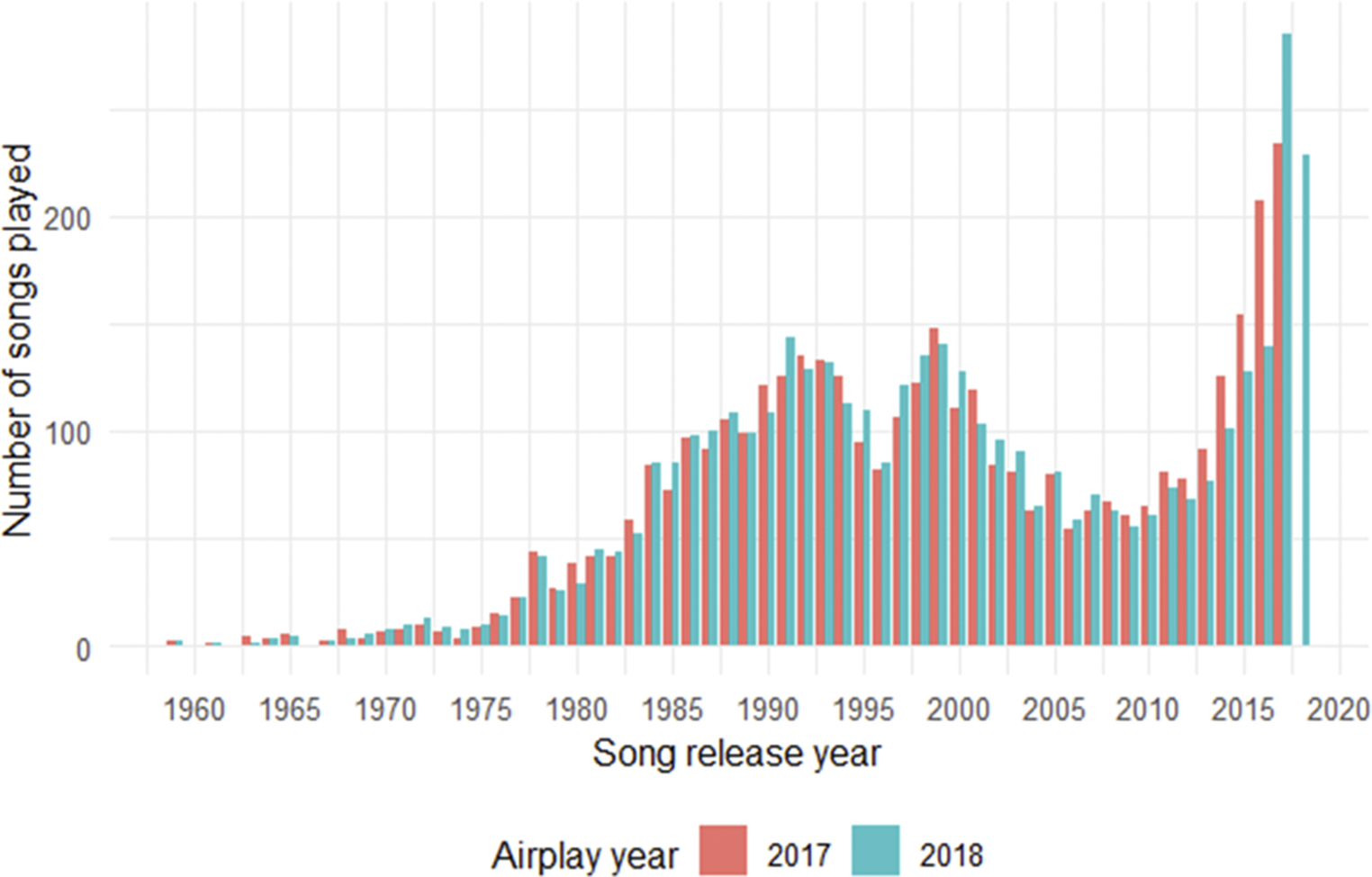
Additionally, we extracted release year data for the airplays in 2017 and 2018 using the MusicBrainz API, a widely recognized open-source music database. We executed a custom script in R, queried the MusicBrainz database for each entry, and retrieved the earliest release date when available. Among the 10,000 most frequently played tracks, release years could not be identified for 1,904 of them – representing 9.54% of foreign and 45.49% of Slovenian songs. These results, which should therefore be interpreted with caution due to missing data, are presented in Figure 8. Two distinct patterns can be observed: (1) the prevalence of airplayed tracks released in the same or previous year, indicating the contemporary seasonal mainstream, but also (2), surprisingly, the large share of older songs released between 1983 and 2003.
Year of release for the Top-10,000 songs played in 2017 and 2018; IPF and MusicBrainz databases.

7. Pop from ex-Yugoslavia
Our research question required the analysis of an additional parameter – the presence of music from the region (Western Balkans). Because the latter is not available in the SAZAS or the IPF datasets, additional data collection and analysis were necessary to detect the regional influx of music.
The binary distinction between domestic and foreign tracks does not provide sufficient granularity to analyze the presence of music from the region on Slovenian radio stations. To address this limitation, we applied automated language detection to song titles (IPF database, 2021–2022) using Google Sheets’ built-in language recognition function. This approach is based on the assumption that the language of a song title generally corresponds to the language of its lyrics and thus serves as a useful proxy for identifying songs from the region, which would otherwise be subsumed under the ‘foreign’ category.
Among the foreign tracks that received more than ten yearly airplays, the English language overwhelmingly dominates, accounting for 71,7% of detected titles. This is followed by Croatian/Serbian/Bosnian language (approximately 14%), with smaller numbers identified in Italian (3,72%), Hungarian (3%), Spanish (1,63%), French (0,67%), and German (0,52%). The relatively strong presence of music in Serbian and Croatian suggests shared history and the continued importance of regional music in post-socialist times. Among other neighbouring countries, Italian and German or Austrian music appear to be of much lesser importance, while Hungarian music is present almost exclusively on local radio stations in the Prekmurje region, which has a significant Hungarian minority. However, the accuracy of these results must be interpreted with caution. Given the brevity of song titles – often comprising just one or two words – automated language detection is prone to misclassification. This is why we used the results (songs identified as Croatian/Serbian/Bosnian language) only to identify the names of the most important artists and further analyze them.
We used the same procedure as in the case of Slovenian music: we summed up all the airplays of each artist and ranked them by popularity for each year (from 2017 to 2022). The twenty most popular artists (and year of their establishment/first appearance on the scene according to Wikipedia) are: 1) Oliver Dragojević (1974), 2) Novi fosili (1969), 3) Parni valjak (1975), 4) Petar Grašo (1995), 5) Tony Cetinski (1990), 6) Toše Proeski (1996), 7) Magazin (1979), 8) Crvena jabuka (1985), 9) Plavi orkestar (1982), 10) Severina (1989), 11) Gibonni (1986), 12) Bajaga (1984), 13) Prljavo kazalište (1977), 14) Boris Novković (1986), 15) Dražen Zečić (1990), 16) Jasmin Stavros (1987), 17) Bijelo Dugme (1974), 18) Jelena Rozga (1996), 19) Goran Karan (1988) and 20) Jole (1988).
Similarly to the case of Slovenian music, most popular radio artists do not belong to the contemporary mainstream production but rather to an older, pre-Internet style of regional pop, which can be classified as Croatian (Mediterranean) pop, Yugo-rock, or zabavna glasba (‘light pop’). The contemporary influx of music from the region is limited, yet older tracks remain popular, reflecting both a shared historical sentiment and the enduring cultural proximity within the region.
8. Conclusion
In this article, we have approached mainstream music not as a self-evident entity, but as produced through a feedback loop between taste, value judgement, and social distinction within musical cultures, on the one hand, and the programmed curation of music on radio, on the other.
Mainstream was conceptualized as a meta-genre: it emerges from relations between genres – how they combine, overlap, or exclude one another – at the level of listeners’ preferences, which we examined using Slovenian public opinion data. The analysis showed that genres cluster into three latent taste formations: one oriented towards globalized genres, one towards regional repertoires (such as Croatian pop and other ex-Yugoslav music, such as turbofolk), and one towards characteristically Slovenian genres, including Slovenian pop evergreens and folk-pop. Among the socio-demographic factors, age has the strongest effect on these formations, with younger respondents gravitating towards global contemporary genres and older respondents more closely attached to Slovenian and regional canons.
At the level of radio curation, mainstream appears as fundamentally repetitive. Analysis of airplay data revealed a highly unequal distribution of plays: a small number of tracks account for a disproportionately large share of repetitions. These tracks are predominantly global (Anglophone) pop hits, and this pattern is particularly pronounced on commercial stations. Public and local/regional stations exhibit somewhat less repetition and broadcast a higher share of domestic music, partly reflecting legal obligations. The temporal profile of the repertoire is also uneven. While foreign repertoires include more recent global hits, Slovenian and regional repertoires are dominated by older material. Slovenian music is increasingly marginalized in high-rotation slots, and when it is present, it is mostly as older, canonized tracks. These songs are repeated less for their novelty than for their nostalgic and commemorative function, activating collective memories of past periods. A similar pattern is visible in regional Western Balkan music, where persistent airplay is driven by evergreen authors from the period of Yugoslavia or the 1990s, rather than current production, especially outside the genre limits of Croatian pop.
Such a structure imposes systemic limitations on the renewal of the mainstream. Entry into the radio mainstream is particularly difficult for younger domestic artists, who do not follow the Slovenian radio mainstream of conventional pop and rock genres, reinforcing a generational and technological divide between analogue radio audiences and digital, platform-based listening. Radio, as our primary empirical focus, thus appears as a medium whose programming logics largely stabilize existing hierarchies of taste and memory rather than fostering innovation or discovery, and in doing so, it helps to reproduce a historically sedimented mainstream in Slovenia.