I. INTRODUCTION
Polymers have been widely used as conventional material substitutes due to their range of thermal and mechanical properties and low cost. The crosslinked epoxy resin system, an outstanding material, is considered to be the most attractive and commonly applied one, as it offers a large range of formulations and structural characteristics that allow different applications varying from simple objects to aerospace parts. Reference Wu and Xu1,Reference Meyer, Sanz, Eceiza, Mondragon and Mijovic2
Although epoxy resins exhibit some desired features for engineering applications, a significant restriction is caused by the high crosslink density that affects the toughness characteristics. This latter property has a strong influence on properties such as impact, fatigue, and damage tolerance, among others. Reference Flores, Francos, Ferrando, Ramis and Serra3,Reference Xu, Shi, Gong, Yu and Feng4
Efforts to improve toughness have involved the use of rubbers, thermoplastics, and inorganic materials, such as silica nanoparticles. Reference Flores, Francos, Ferrando, Ramis and Serra3,Reference Zhang, Xu, Xia, Zhang and Yu5 Reactive liquid rubbers have been the most widely used materials because they form a homogeneous solution during preparation, beyond a second phase precipitation after curing. Reference Yahyaie, Ebrahimi, Tahami and Mafi6 Unfortunately, the precipitated rubber particles can reduce both the Young's modulus and glass transition temperatures (T g) in addition to impairing the processability due to increasing viscosity. Reference Liu, Sue, Thompson, Bates, Dettloff, Jacob, Verghese and Pham7 This fact has encouraged the search for new materials that can improve the epoxy resin toughness without significant influence on thermal and mechanical properties.
Studies have shown that an efficient toughening agent promotes phase separation because two phases have a better effect on absorbing and deflecting cracks through an increase in plastic shear yielding and rubber particle cavitation, which is an additional mechanism contributing to toughness improvement due to increasing energy absorption by matrix plastic deformation. Reference Flores, Francos, Ferrando, Ramis and Serra3,Reference Ratna and Simon8–Reference Bussi and Ishida11 The effect is also dependent on interfacial compatibility and chain interaction, which are influenced by particle size, distribution, and shape. Reference Flores, Francos, Ferrando, Ramis and Serra3,Reference Rico, López, Montero and Bellas12
Very recently, the systems used as epoxy toughening agents to overcome the conventional limitations have been dendrimers and hyperbranched polymers (HBPs). Their Newtonian behavior, low viscosity, and small dimensions, despite their high molecular weight, make them very attractive as toughening agents for epoxy resins designed for liquid infusion processing. Reference Mezzenga, Boogh and Manson13,Reference Cicala, Recca and Restuccia14
The compatibility and reactivity as well as the phase-separation between epoxy and HBP are functions of the bulk structure and the nature of the HBP chemical end-groups. The bulk structure of HBP contributes to resin toughness improvement through absorption of more energy when subjected to impact testing, while the end-groups contribute to compatibility and reactivity with the surrounding matrix materials. Reference Mezzenga, Boogh and Manson13,Reference Boogh, Pettersson and Manson15
In this work, the comparison of the toughness improvement between a commercial dendrimer and a synthesized HBP upon addition to a one-part epoxy RTM resin was analyzed. The thermal, thermomechanical, and viscosity behaviors were monitored to define a formulation that can improve the toughness while minimally affecting the processability and thermal properties.
II. EXPERIMENTAL
A. Materials
A commercial one-part liquid epoxy resin system (Cycom 890 RTM—Cytec Industries), T g = 210 °C, was used as the matrix. This resin system is a blend of multifunctional epoxy resins, 4,4′-methylenebis(N,N-diglycidylaniline) (30–60 wt%), N,N-diglycidyl-4-glycidyloxyaniline (10–30 wt%), and an aromatic diamine (30–60 wt%) acting as a curing agent.
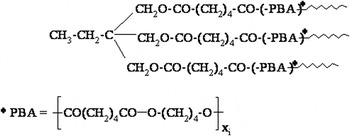
A commercial hyperbranched polyol (HPOH) (Perstorp Boltorn H311, M n = 5300 g/mol, T g = −5 °C) and a synthesized linear-hyperbranched poly(butylene adipate) copolymer (HPBA), T g = −50 °C, were used as toughening agents. This latter product was obtained through a branching reaction of the linear tailored OCH3-terminated prepolymer 1,1,1-tris(hydroxymethyl)propane as a branching agent, according to the procedure described in detail in a previous work. Reference Samperi, Battiato, Puglisi, Scamporrino, Ambrogi, Ascione and Carfagna16 The chemical structure of HPBA is illustrated in Fig. 1.
Schematic chemical structure of HPBA.

The HPOH has a very high hydroxyl functionality and a highly branched flexible backbone while the HPBA presents complex architectures with hydroxyl-terminated branches.
B. Epoxy blend preparation
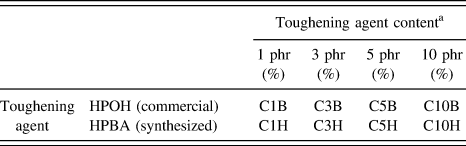
The blends were prepared by mixing the HPBA and HPOH with the epoxy resin. The mixture was heated at 90 °C for 1 h under stirring. The cure was conducted at 180 °C for 2 h under vacuum. The percentages of a toughening agent added to epoxy resin and the sample codes are summarized in Table I.
Composition and codes of RTM epoxy resin blend samples.

a Toughening agent percentages have been calculated according to the equation: % (phr) = (toughening agent mass)/(epoxy mass) × 100.
C. Characterization
1. FTIR spectroscopy
A Thermo Fischer Scientific Nicolet 6700 FTIR (Waltham, MA) was used to collect the attenuated total reflectance (ATR) spectra of the cured and uncured epoxy resins, the toughening agents, and their blends with commercial RTM epoxy resin. ATR was used at a resolution of 4 cm−1, and 16 scans were averaged for each spectrum in a range between 4000–650 cm−1.
2. Differential scanning calorimeter (DSC)
The blend curing process was studied in a TA Instrument Q20 DSC (New Castle, DE) under a nitrogen atmosphere (flow rate of 50 mL/min), at 10 °C/min in a temperature range from 30 to 310 °C, with the samples sealed in aluminum crucibles.
3. Thermogravimetric analysis (TGA)
TGA was performed in a TA Q5000 analyzer (New Castle, DE) to investigate the thermal stabilities of the cured samples, tested from 40 up to 600 °C at 10 °C/min in a nitrogen atmosphere.
4. Dynamic mechanical analysis (DMA)
Samples were analyzed using a Triton Technology DMA model Tritec 2000 (Granthan, UK) according to ASTM D7028. Analysis was performed in a single-cantilever mode with the amplitude of 10 µm, frequency of 1 Hz, at a heating rate of 3 °C/min from −50 up to 250 °C. The storage and loss moduli and tanδ peak of neat RTM epoxy and blends were determined.
5. Viscosity measurements
The viscosities of the blends and neat epoxy were measured with a TA Instruments model AR-G2, using a steel plane-spindle ETC 25 mm in an oscillatory shear at 1 rad/s with the gap of 1 mm, strain percentage of 70%, and strain amplitude of 40%. Using these parameters, a linear regime preserving an adequate strain value was obtained. The viscosity was analyzed at 80 and 100 °C for 60 min.
6. Fracture toughness
Fracture-toughness tests were performed using the single-edge-notch bending (SENB) method according to ASTM D 5045-99 using an Instron 4505 universal tester. Samples with 60 × 6 × 4 mm and a cross-head speed of 1 mm/min were used for testing. The critical stress-intensity factor, K IC, was determined.
7. Scanning electron microscopy (SEM)
The fracture areas of the samples were observed with a JEOL JSM-5310 scanning electron microscope (Tokyo, Japan) after metallization to understand the fracture mechanisms involved in failure.
III. RESULTS AND DISCUSSION
HPOH and HPBA have different chemical structures, and their introduction into the epoxy resin is expected to have a different influence on both the crosslinking mechanism and the final performance of the modified epoxy resin.
A. Neat epoxy and blend curing mechanism
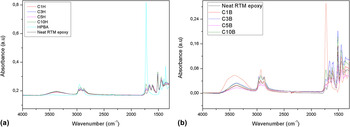
Among the experimental methods used to evaluate the polymer-to-polymer interactions, infrared spectroscopy (IR) is one of the most effective because it is highly sensitive to the presence of noncovalent bonds, such as hydrogen bonds. The FTIR-ATR spectra of cured epoxy resin and blends are shown in Figs. 2(a) and 2(b).
FTIR-ATR spectra of (a) RTM epoxy/HPBA and (b) RTM epoxy/HPOH cured blends.

During the epoxy curing reaction, the nucleophilic attack by the amine epoxy unsubstituted nitrogen atom causes epoxy ring opening. The amine-to-epoxy addition reaction was monitored through spectroscopic analysis by observing the disappearance of the band at 909 cm−1 related to the oxirane C–O stretching absorption bond deformation and the simultaneous appearance of C–N stretch at approximately 3300 cm−1, indicating the successful curing process. Moreover, a second band located at approximately 3050 cm−1 was also evident, which might be attributed to the C–H tension of the methylene group of the epoxy ring, although this band could not contribute significantly due to its low intensity and closeness to the strong O–H absorptions. Reference Campbell, Pethrick and White17
The multicomponent shape of the O–H band indicates a complex system in which multiple H-bonding species coexist. In particular, two spectral ranges are of particular interest for analysis: the hydroxyl-stretching associated with the broad band in the range 3300–3450 cm−1 and the carbonyl stretching region from 1660 to 1800 cm−1. Additionally, in Fig. 1, it is evident that the peak relative to the C=O group stretching typical of the polyester sample increases as the percentage of modifier increases.
The interaction between the epoxy resin and the toughening agents is a factor of paramount importance in the mechanical behavior of the modified epoxy systems. When the epoxy resin crosslinking reaction occurs in the presence of a polyester, the possible reactions are not only those between the amine group of the epoxy hardener resin and the hydroxyl groups generated within the resin during crosslinking but also those forming ether linkages between the hydroxyl groups of the hyperbranched polyester and the epoxy resin. In addition to chemical reactions, the formation of intermolecular hydrogen bonding between the toughening agent polar groups and the epoxy resin-OH is also possible, allowing the formation of miscible blends through the establishment of interassociated hydrogen bonds.
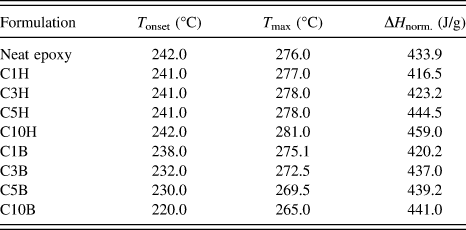
From Fig. 2, the different nature of mutual interactions between the epoxy resin and both modifiers is evident. The infrared absorbance band at 3300–3450 cm−1 associated with a hydroxyl-stretching shift to lower frequencies (red shift) increases in its intensity upon the addition of increasing amounts of HPOH [Fig. 2(b)]. Conversely, no meaningful change is observed upon HPBA addition [Fig. 2(a)]. This result is justified by the hydroxyl functionalized systems of HPOH compared to HPBA, which can affect both the crosslinking density and the start of curing in the blends, as shown in Table II. However, the polyester band intensity at 1730 cm−1 is higher for HPBA and RTM epoxy/HPBA blends.
Dynamic DSC analysis results for neat RTM epoxy and blends.
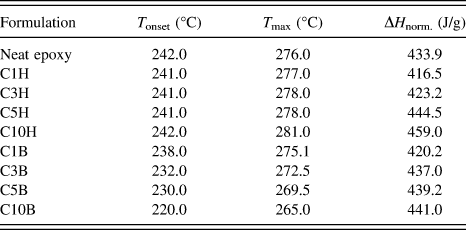
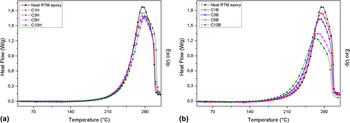
Observing the calorimetric data reported in Table II and Fig. 3(b), the T onset and T max observed for RTM epoxy/HPOH blends decrease with HPOH addition, indicating a quantity-dependent effect and facilitation of the curing process. Reference Flores, Francos, Ferrando, Ramis and Serra3,Reference Francos, Cook, Salla, Serra and Ramis18 Figure 3(a) shows a well-defined cure onset and endset, the same baseline, and a similar shape of the curing curve. For the latter, no significant variation is visible, showing that the HPBA causes no change in the curing process. Reference Foix, Rodriguez, Ferrando, Ramis and Serra19,Reference Foix, Yu, Serra, Ramis and Salla20 The different chemical structures are the main reason for curing behavior differences because the HPOH presents a large number of hydroxyl functional groups with respect to HPBA and, consequently, is more prone to catalyze/accelerate the epoxy ring-opening reaction.
Dynamic DSC scans of uncured (a) RTM epoxy/HPBA and (b) RTM epoxy/HPOH blends.

The modifier influence on ∆H is a function of modifier amount (Table II). Until 3% of added modifiers, the curing enthalpies decrease, gradually increasing to amounts equal and up to 5%. When two polymers are blended, the overall enthalpy is a balance among contributions related to the breaking of hydrogen bonds in the self-associating polymer and hydrogen bonds forming between the two polymers. In most cases, the mixing is endothermic, but in thermoset/thermoplastic blends, the curing enthalpies can also be explained based on phase separation. When curing the blends, the phase separation can hinder the curing reaction through a decrease in the reaction probability because thermoset monomer contact is delayed by the thermoplastic phases. Reference Carvalho, Ferraz and Neto21 Therefore, the mixing phenomenon likely contributed to lowering the curing enthalpies in the blends; however, for high percentages (i.e., C5H, C10H, C5B, and C10B), the increase in mixing enthalpies was lost due to the difficulty of the epoxy monomer reaction caused by increasing phase separation.
Although HPBA shows partial crystallinity, no melting peak was observed during curing because crystallinity is lost during the blend preparation, which is performed at the higher HPBA melting point temperature. The crystallinity is not recovered even when the uncured blend is cooled to room temperature, keeping the HPBA amorphous in the presence of epoxy resin as verified by a further DSC heating scan performed on the HPBA-containing systems. The HPOH, however, is already an amorphous polymer.
B. Thermal and thermomechanical properties
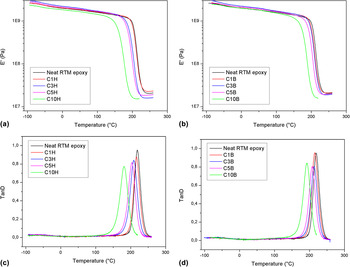
The E′ glassy plateau observed in Figs. 4(a) and 4(b) is slightly high for blends up to 5 phr, lowering for those with 10 phr of modifiers in relation to neat epoxy, irrespective of the modifiers used, thereby suggesting a crosslinking density reduction due to the higher free volume induced by this amount of added modifiers. Reference Foix, Ramis, Serra and Sangermano22,Reference Supaphol and Krutphun23
E′ curves of (a) HPBA and (b) HPOH and tanδ curves of (c) HPBA and (d) HPOH cured blends comparison with neat RTM epoxy.

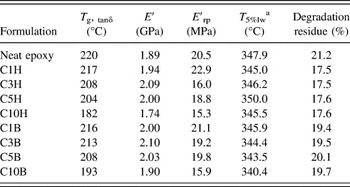
Considering the rubbery plateau, the E′rp values of blends are lower than that of neat RTM epoxy, suggesting a crosslinking density reduction caused by modifier addition, except for C1H and C1B blends. These higher observed E′rp values can be attributed to lower network structural interference and also thermal stress relief promoted by a reduced amount of modifier. Reference Carvalho, Ferraz and Neto21,Reference Foix, Ramis, Serra and Sangermano22,Reference Santiago, Francos, Ramis, Salla and Sangermano24
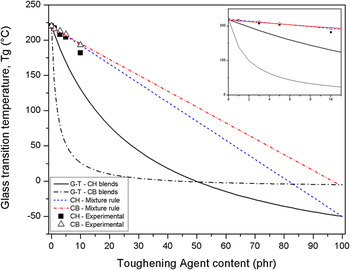
As for T g s [Figs. 4(c) and 4(d)], decreasing values were observed for increasing amounts of toughening agents, being more intense and proportional for the blends containing HPBA. Moreover, the T g s values were found to be intermediate between those of their precursors, suggesting complete miscibility, verified through Gordon–Taylor (GT), and mixture rule (MR) presented in Fig. 6. Reference Supaphol and Krutphun23
T g curve prediction and experimental data for CH and CB blends.

The Gordon–Taylor (GT) equation [Eq. (1)] is often used for the prediction of T g in miscible blends while a simple mixture rule (MR) [Eq. (2)] can be applied if both precursors have the same contribution to the blend T g. Reference Supaphol and Krutphun23,Reference Brostow, Chiu, Kalogeras and Dova25
 $${T_{\rm{g}}} = {{\left( {{w_1}{T_{{{\rm{g}}_1}}} + k{w_2}{T_{{{\rm{g}}_2}}}} \right)} \over {\left( {{w_1} + k{w_2}} \right)}}\quad {\rm{,}}$$
 $${T_{\rm{g}}} = {w_1}{T_{{{\rm{g}}_1}}} + {w_2}{T_{{{\rm{g}}_2}}}\quad {\rm{,}}$$
where w is the proportional weight and k is an adjustable parameter estimated through constituent properties via Simba–Boyer rules [Eq. (3)]. Indices 1 and 2 refer to the precursors.
 $$k \cong {{{\rho _1}{T_{{{\rm{g}}_1}}}} \over {{\rho _2}{T_{{{\rm{g}}_2}}}}}\quad {\rm{.}}$$
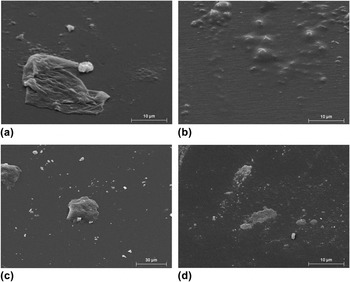
The T g prediction and experimental data plotted in Fig. 5 suggest an equal blend precursor contribution to the T g of this binary system because the experimental data are nearer to the M-R than to the GT curve prediction, leading to the traditional interpretation of good miscibility of different species. Although this behavior can be observed in both blends, suggesting a single phase, the epoxy T g drop is considerably smaller than that predicted by the GT model showing a partial miscibility, as such observed for carboxyl-terminated butadiene-acrylonitrile (CTBN)-modified epoxies, which are also two phases. SEM images of Fig. 6, obtained from fracture section, clearly show dual-phase formation. Fracture pattern differences also corroborate with the existence of two phases.
HPBA and HPOH dispersed in RTM epoxy blends (a) C1B, (b) C1H, (c) C10B, and (d) C10H.

As observed by Bussi and Ishida, when the modifier acts as a plasticizer and flexibilizer, phase separation virtually does not occur. The blend has just one T g value, and the experimental data suggest a miscible blend due to the proximity with the predicted T g curves using M-R and GT. The second phase becomes discernible when the T g value departs from the prediction curve. Reference Bussi and Ishida11,Reference Santiago, Francos, Ramis, Salla and Sangermano24 In this case, the 10 phr showed a greater decrease in E″, T g and, for RTM epoxy/HPBA blends, as well as E′.
Although the T g values decreased to a lesser extent, neither tested modifier prevents the application of these blends as advanced composite matrix. The influence of a modifier physical structure on T g and E′ of blends can be attributed to the modifier relaxation dynamics, explained by accounting for epoxy-network structure distortions and also the free volume induced in epoxy by these structures. Reference Carvalho, Ferraz and Neto21,Reference Varley, Hodgkin and Simon26
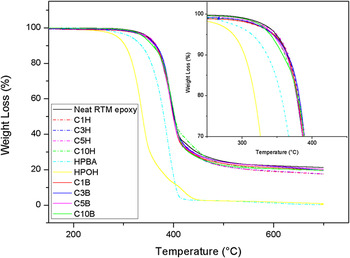
Figure 7 shows similar degradation behavior among neat RTM epoxy and the blends although both modifiers present lower thermal stability than neat RTM epoxy. Considering that degradation behavior is a function of the type of bonds present in the network structure, the insignificant influence of toughening agents on thermal stability indirectly supports the hypothesis that only physical interactions between polymers occur, thereby corroborating the other results presented. Reference Santiago, Francos, Ramis, Salla and Sangermano24 The values presented in Table III were obtained at 5% weight loss. The residue obtained is lower for blends but comparable for all (Table III), suggesting an advantage of the environment.
TGA comparison between neat RTM epoxy and HPBA and HPOH cured blends under a N2 atmosphere.

DMA and TGA analysis results for cured neat epoxy and blends.
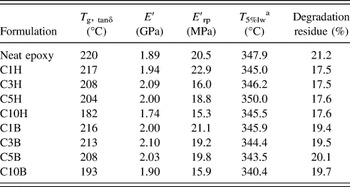
a E rp = E′ rubbery plateau; T 5%lw = degradation temperature at 5% loss weight.
C. Blend viscosity behavior
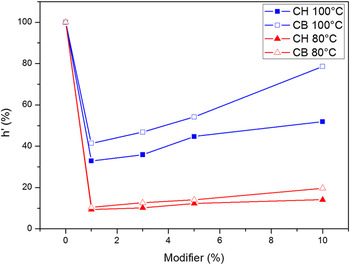
Figure 8 shows the relative viscosity of the blends changing with modifier addition. By analyzing the values, it is clear that both contribute to viscosity reduction in an epoxy system, which is an effect attributed to the hydrodynamic volumes of the branched polymers. Reference Morell, Ramis, Ferrando and Serra27
Relative viscosity values of HPBA (CH) and HPOH-based blends (CB) at T = 80 °C and T = 100 °C.

The highest reduction was achieved using HPBA molecules, most likely due to its highest free volume. An increasing tendency observed with the amount of modifiers added can be attributed to instantaneous hydrogen-bond linkage and delinkage between hydroxyl groups of the modifier and the epoxy resin functional groups during the test, which was also observed by Parzuchowiski et al. Reference Parzuchowiski, Kizlinska and Rokicki28
The results indicated advantages for polymer injection processes, as well as the filtering phenomenon reduction during fiber impregnation process compared with other modifiers, such as rubber particles. Reference Parzuchowiski, Kizlinska and Rokicki28
D. Toughening mechanism
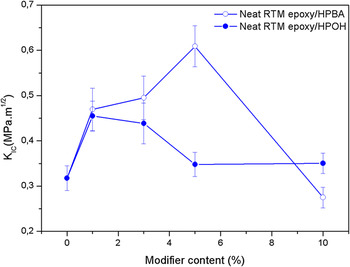
Relevant results have been found for addition of hyperbranched modifiers until an upper limit. Figure 9 shows the modifier effect on epoxy toughening, which could be improved up to 90% using 5% HPBA, while among HPOH blends, a higher value was achieved at 1% loading.
K IC values as a function of HPBA and HPOH weight percentages in the blends.

HPOH addition above 1% most likely promotes particle aggregation and excessive phase separation, and, consequently, an impaired effect on toughness. This effect was also observed by Dhevi et al., Reference Dhevi, Jaisankar and Pathak29 who showed a property decrease caused by particle aggregation and particle-size influence on the toughening effect.
Better average results were obtained using HPBA as the modifier, suggesting greater homogeneity in distribution and better modifier/epoxy interaction, but considering the error bars only the RTM epoxy/HPBA 5% formulation is tougher than the RTM epoxy/HPOH system. Reference Parzuchowiski, Kizlinska and Rokicki28 Matrix/modifier interaction through interfaces is classified as either chemical or physical and must guarantee satisfactory stress transfer from matrix to particles, allowing a property gradient around each particle due to a large degree of chain interaction between both Reference Fu, Shi, Yuan, Zhong, Zhang, Chen and Wu30 ; this interaction is also a reason for the toughness improvement. Reference Bagueri and Pearson31
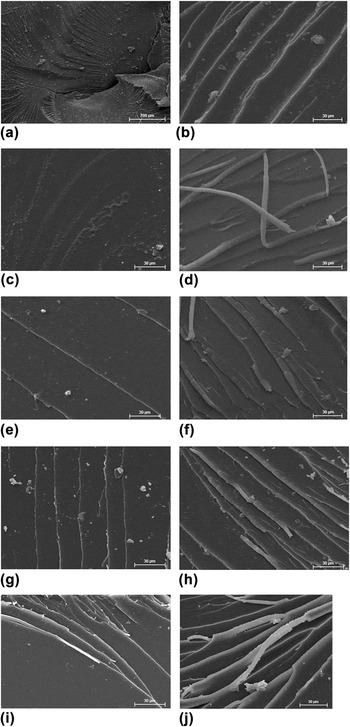
The neat RTM epoxy matrix fracture observed in Figs. 10(a) and 10(b) is brittle. Matrix cracks are attributed to poor toughness.
SEM surface fracture micrographs of the (a) 50x, neat RTM epoxy; (b) 1000x, neat RTM epoxy; (c) 1000x, C1B; (d) 1000x, C1H; (e) 1000x, C3B; (f) 1000x, C3H; (g) 1000x, C5B; (h) 1000x, C5H; (i) 1000x, C10B; and (j) 1000x, C10H.
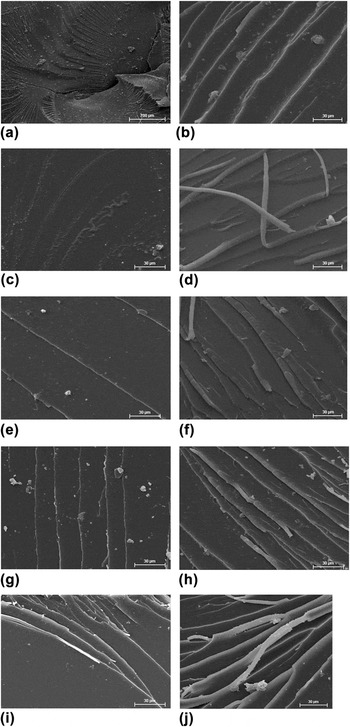
The matrix plastic shear yielding is the main cause of polymer toughness improvement. Considering the presence of a second phase, shown in Fig. 5, the plastic deformation starts from this phase because its acts as a stress concentrator. This mechanism is able to dissipate a great amount of fracture energy by changing the original crack plane, which increases the surface roughness, i.e., the crack surface area. The surface roughness indicates ductile fracture, cause by a reduction in the crosslink density, but can also be attributed to the presence of the second phase. Reference Saxena, Francis, Rao and Ninan10,Reference Bussi and Ishida11
The second phase stops crack propagation via segmented cracking, reduction of the crack propagation rate, and bowing out around particles, thereby improving tension around this second phase due to plastic zone enhancement. A triaxial tension zone change can lead to cavitation, i.e., detachment of added particles, which is an additional toughness mechanism that allows higher energy dissipation and consequently a toughening improvement in the epoxy system. Reference Saxena, Francis, Rao and Ninan10,Reference Bussi and Ishida11,Reference Dhevi, Jaisankar and Pathak29,Reference Dittanet and Pearson32
The shear deformation of the epoxy matrix promotes fibril formation due to high tensile stress in the crack-tip region, which is corroborated by the ductile behavior promoted by epoxy modifier addition. Reference Fu, Shi, Yuan, Zhong, Zhang, Chen and Wu30 Although toughness dimples can be observed for all blends, revealing microvoid coalescence during crack propagation, the RTM epoxy/HPBA [Figs. 10(d), 10(f), 10(h), and 10(j)] blends display fibrils, while RTM epoxy/HPOH [Figs. 10(c), 10(e), 10(g), and 10(i)] blends do not show the same features.
SEM images corroborate the higher RTM epoxy/HPBA K IC values observed in Fig. 9, with these superior values justified by the greatest matrix deformation and consequent higher energy absorption.
IV. CONCLUSIONS
In this work, the effect of two different dendritic polymers on a one-part RTM epoxy resin was studied. Although both HPBA and HPOH showed K IC values higher than neat RTM epoxy due to the influence of their shell structure on energy absorption, the addition of 5% HPBA yielded the best results.
In addition to the higher K IC values, blends prepared with 5% HPBA did not show significant changes in thermal and thermomechanical properties nor viscosity behavior.
By selection of an adequate amount of modifier, a reduction in particle aggregation and regular phase separation can be obtained, thereby contributing to a good epoxy and HBP interfacial interaction through chain entanglement. As a consequence, stress transfer from the matrix to HBP has been improved leading to higher toughness levels.
Fibril formation is further evidence of better entanglement and efficiency of HPBA as a toughness agent.
ACKNOWLEDGMENTS
The authors would like to thank São Paulo Research Foundation (FAPESP - 2012/13431-7, 2011/11311-1) for financial support, the National Research Council of Italy (CNR-Pozzuoli-NA) and University of Naples “Federico II” for the equipment use license and scientific support. They would also like to thank Cytec Industries and Perstorp for kindly providing Cytec 890 RTM and HPOH, respectively.