Introduction
The manipulation of embryos during in vitro culture at ambient oxygen concentrations, carries the risk of exposure to high levels of reactive oxygen species (ROS) and free radicals that adversely affect early embryonic development (Kitagawa et al., Reference Kitagawa, Suzuki, Yoneda and Watanabe2004; Agarwal et al., Reference Agarwal, Said, Bedaiwy, Banerjee and Alvarez2006). Apoptosis during preimplantation embryo development plays a critical role in eliminating defective cells, however inappropriate loss of normal cells may be induced (Byrne et al., Reference Byrne, Southgate, Brison and Leese1999), partially due to the culture conditions (Hao et al., Reference Hao, Lai, Mao, Im, Bonk and Prather2003).
Melatonin (N-aceyl-5-methoxytryptamine) is well known as a free radical scavenger, antioxidant, and anti-apoptotic production of developmentally competent embryos (Chen et al., Reference Chen, Chen, Lee and Chen2006). The free radical scavenging activity of melatonin also extends to its metabolites, which up-regulate antioxidant enzymes and down-regulate the pro-oxidative and proinflammatory enzymes making melatonin highly effective, even at low concentrations, in protecting organisms from oxidative stress (Galano et al., Reference Galano, Tan and Russe2011). Melatonin has been supplemented to embryo culture media as a protectant, in concentrations ranging from 10−3 to 10−13 M. Ishizuka et al. (Reference Ishizuka, Kuribayashi, Murai, Amemiya and Itoh2000) found that melatonin at concentrations from 10−6 to 10−8 M supports fertilization and early in vitro development of mouse embryos. Rodriguez-Osorio et al. (Reference Rodriguez-Osorio, Kim, Wang, Kaya and Memili2007) reported that melatonin at a concentration of 10−9 M had a positive effect on cleavage rates and blastocyst cell numbers of porcine embryos, whilst the highest concentration of melatonin (10−3 M) significantly decreased cleavage rates and blastocyst rate. Furthermore, it was reported that addition of melatonin to culture medium of buffalo embryos increased the in vitro development rate and the number of transferable embryos (Manjunatha et al., Reference Manjunatha, Devaraj, Gupta, Ravindra and Nandi2009). Recently, it has been also found that melatonin in the culture medium improved the development rate of thawed ovine embryos with resulting higher hatching rates after 24 h of culture (Abecia et al., Reference Abecia, Forcada and Zúñiga2002). To our knowledge, there is no report on the effect of melatonin as antioxidant in the culture medium on rabbit in vitro embryo development. Therefore, this study was carried out to investigate the effect of melatonin supplementation at different levels in culture medium on in vitro development of preimplantation rabbit embryos.
Materials and methods
Source of embryos
In total, 100 nulliparous donor does belonging to the Red Baladi breed (Khalil & Baselga, Reference Khalil, Baselga, Khalil and Baselga2002) were used in this study. To synchronise the receptivity of females, a dose of 20 IU eCG per doe (Folligon Intervet, The Netherlands) was injected intramuscularly 60 h before insemination. The females were inseminated with a semen pool from adult males of the same line and generation. The method of semen recovery, evaluation and dilution of the semen and subsequent insemination has been described by Lavara et al. (Reference Lavara, Lavara, Vicente and Mocé2000).
Embryos were collected surgically 24, 48 and 72 hours post-insemination (hpi) by ventral midline laparotomy as previously described by Forcada & Lopez (Reference Forcada and Lopez2000) with some modifications. Anesthesia was induced by an intramuscular injection of 16 mg xylazine (Xyla-Ject, ADWIA, Egypt), followed by an intravenous re-injection of ketamine hydrochloride of 1.2 ml/kg (Ketam, E.I.P.I.CO, Egypt) in the marginal ear vein to maintain does under anesthesia during laparotomy. Embryos were recovered by separate perfusion of each oviduct from the fimbria to the utero-tubal junction with 5 ml of pre-warmed recovery medium followed by perfusion of each uterine horn with about 20 ml of recovery medium [0.132 g calcium chloride/1 litre of Dulbecco's phosphate-buffered saline (PBS; Sigma-Aldrich Chemicals S.A., Egypt), supplemented with 2 g bovine serum albumin (BSA; Sigma) and 10 ml antibiotics (10,000 units penicillin-G and 10 mg streptomycin per ml, penicillin–streptomycin solution 100×, BioShop Canada Inc.)]. An epidural needle (1 mm of inner diameter, Vigor Epidural G17) was introduced at the base of uterine horn receiving the recovery medium with embryos in a Falcon tube. After that, the reproductive tract of females was washed by PBS with 0.1% ethylene diamine tetraacetic acid (EDTA; Sigma) in order to diminish possible abdominal adhesions post-laparotomy and females were injected i.m. with 0.5 ml antibiotics (0.123 mg streptomycin; ADWIA, Egypt) in order to prevent any bacterial infection.
Treatments and embryo culture
Melatonin was obtained from Sigma-Aldrich Chemicals S.A., Egypt and stored at –20°C until use immediately at culture time. The culture medium consisted of Medium-199 + 20% fetal bovine serum (Sigma, Egypt) supplemented with 1% antibiotics (10,000 units penicillin-G and 10 mg streptomycin per ml, penicillin–streptomycin solution 100×, BioShop Canada Inc.). Three development stages of embryos were obtained according to the time of recovery (2–4-cell embryos, 8–16-cell embryos and morula embryos recovered at 24 h, 48 h and 72 h post-insemination, respectively). Only normal recovered embryos from each donor with intact mucin coat and zona pellucida from each stage were allocated randomly into the following four culture media: (i) control (culture medium without melatonin); (ii) control + 10−9 M melatonin; (iii) control + 10−6 M melatonin; and (iv) control + 10−3 M melatonin. Embryos were cultured at 38.5°C, in 5% CO2 in air and saturated humidity, and the numbers of total blastocysts and hatched blastocysts were recorded at the end of culture.
Statistical analysis
A probit link with binomial error distribution was used to analyze the effect of melatonin level on blastocyst and hatching rates for each post-insemination recovery group (24, 48 and 72 h). General linear model was performed with SPSS software package (version 16.0, SPSS Inc., USA, 2002).
Results
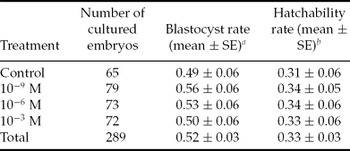
In total, 289 normal embryos were obtained at 24 h post-insemination and their development with melatonin is summarized in Table 1. There were no significant differences between melatonin groups with average of 52% in vitro blastocyst and 33% hatchability rates.
Effect of melatonin on in vitro development and hatchability rates of rabbit embryos recovered at 24 h post-insemination

aDeveloped embryos to blastocyst stage as a percentage of cultured embryos.
bHatched embryos as a percentage of cultured embryos. SE, standard error.
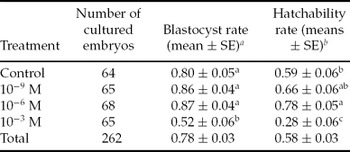
Results of melatonin supplementation on in vitro development and hatchability rates of recovered embryos at 48 h post-insemination (262 normal 8–16-cell stage embryos) are summarized in Table 2. Addition of melatonin to culture medium at concentrations of 10−9 M and 10−6 M did not improve the development rate of embryos (86 and 87%, respectively) when compared with the control (80%). Hatchability rate significantly increased (P < 0.05) at concentrations of 10−6 M (78% versus 66% and 59% for 10−6 M versus 10−9 M and control, respectively). In contrast, a significant decrease was markedly found in the in vitro development rate (52%) and the hatchability rate (28%) of 10−3 M group in comparison with other groups (P < 0.05).
Effect of melatonin on in vitro development and hatchability rates of rabbit embryos recovered at 48 h post-insemination

Values with different letters in the same column are significantly different (P < 0.05).
aDeveloped embryos to blastocyst stage as a percentage of cultured embryos.
bHatched embryos as a percentage of cultured embryos. SE, standard error.
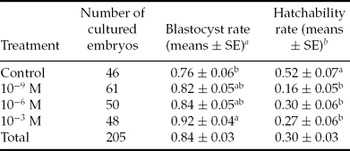
Embryos recovered at 72 h post-insemination (205 normal morula stage embryos) and results of culture with melatonin are shown in Table 3. Results indicated that the in vitro development rate of embryos at morula stage was higher in at a 10−3 M melatonin concentration than in control group (92% versus 76% blastocyst rate for 10−3 M versus control, P < 0.05). However, the addition of melatonin at different concentrations did not improve the hatchability rate of these embryos (16–30% versus 52% for melatonin groups versus control, P < 0.05).
Effect of melatonin on in vitro development and hatchability rates of rabbit embryos recovered at 72 h post-insemination

Values with different letters in the same column are significantly different (P < 0.05).
aDeveloped embryos to blastocyst stage as a percentage of cultured embryos.
bHatched embryos as a percentage of cultured embryos. SE, standard error.
Discussion
Melatonin is a key factor to improve in vitro culture conditions of preimplantation embryos due to its capacities as an antioxidant (Farahavar et al., Reference Farahavar, Shahne, Kohram and Vahedi2010) and as an anti-apoptotic agent (Pang et al., Reference Pang, An, Wang, Yu, Yin, Wang, Zhang, Zhang, Yang, Guo, Wua and Tiana2012). However, most studies have concluded that there is still much to investigate and understand regarding the mechanisms of action of melatonin on free radicals (Casao et al., Reference Casao, Abecia, Cebrián-Pérez, Muiño-Blanco, Vázquez and Forcada2010). Taking into account the previously described effects of melatonin on embryo development, it is important to clarify what stages of preimplantation embryo development are influenced by melatonin and to verify which concentration of melatonin is effective for each stage, as is the focus of the present study using rabbits as experimental model. The physiological concentrations of melatonin in plasma of rabbits, previously estimated by radioimmunoassay (RIA) (Noguchi et al., Reference Noguchi, Kitazumi, Mori, Shiobara and Shiba2003) were 22.7 pg/ml (equivalent to 10−10 M). In the current study, we used a concentration of melatonin close to physiological levels (10−9 M) and higher concentrations (10−6 M and 10−3 M) to study its effect on development of rabbit embryos recovered at different stages.
We found that melatonin had no significant effect on the in vitro development of 2–4-cell embryos recovered at 24 h post-insemination. These results are in agreement with previous authors who also did not find effects for melatonin on in vitro development of mouse zygotes (McElhinny et al., Reference McElhinny, Davis and Warner1996) or bovine zygotes (Tsantarliotou et al., Reference Tsantarliotou, Attanasio, Rosa, Boccia, Pellerano and Gasparrini2007). In contrast, recent work by Tian et al. (Reference Tian, Wen, Shi, Wang, Zeng and Tian2010) reported that melatonin had beneficial effects on the in vitro development of mouse 2-cell embryos.
When embryos were recovered at 48 h post-insemination, we found that supplementation of culture medium with 10−9 M or 10−6 M melatonin did not increase the development rate of embryos; it could be melatonin was depleted in the culture medium or that these concentrations were lower than the amount required to protect embryos effectively from free radicals (Rodriguez-Osorio et al., Reference Rodriguez-Osorio, Kim, Wang, Kaya and Memili2007). However, other authors have shown that melatonin at concentrations of 10−4 M to 10−9 M increased in vitro development of early murine embryos (Ishizuka et al., Reference Ishizuka, Kuribayashi, Murai, Amemiya and Itoh2000) and bovine embryos (Papis et al., Reference Papis, Poleszczuk, Wenta-Muchalska and Mondlinski2007). In our study, the significant increase in hatchability rate at concentrations of 10−6 M melatonin in comparison with 10−9 M and the control allowed us to recommend the use of melatonin as an effective antioxidant in the culture medium at concentrations of 10−6 M for early rabbit embryos. On the other hand, we found a negative effect of melatonin at a 10−3 M concentration with a marked decline on the development and hatchability rates of embryos at this stage (Table 2). Rodriguez-Osorio et al. (Reference Rodriguez-Osorio, Kim, Wang, Kaya and Memili2007) explained similar findings and suggested that there may be a toxic effect of melatonin on early porcine embryos when used in a high concentration in culture medium. Recent results by Gao et al. (Reference Gao, Han, Tian, Tan, Wang, Zhou, Zhu and Liu2012) also showed a significant increase in blastocyst rate and hatching rate when melatonin was added at 10−11–10−5 M to the cultured vitrified mouse 2-cell embryo, but the highest dose of melatonin (10−3 M) was detrimental to the embryos.
In the present study, blastocyst rate of embryos recovered at 72 h post-insemination at 10−9 M melatonin was similar to that of the control group (Table 3), possibly because this level is very close to the physiological concentrations of melatonin in the plasma of rabbits (Noguchi et al., Reference Noguchi, Kitazumi, Mori, Shiobara and Shiba2003). With higher melatonin concentrations (10−6 M and 10−3 M), the blastocyst rate increased compared with the control group but this difference was significant only at the 10−3 M concentration. However, hatchability rates at all concentrations of melatonin were lower than that of the control. Abecia et al. (Reference Abecia, Forcada and Zúñiga2002) studied the development rate of thawed ovine embryos in compact morula or early blastocyst stages after culture in medium supplemented with 1 μg/ml melatonin (equivalent to 10−6 M). They reported that the addition of melatonin improved the development rate of blastocysts with high hatching and low degeneration rates after culture, but seemed to exert no effect on the development of embryos at morula stage. Nazzaro et al. (Reference Nazzaro, Salerno, Marino, Granato and Pastore2011) reported that melatonin increased the uptake of essential amino acids and vitamins such as myo-inositol, which stimulates zona pellucida shedding or hatching of blastocysts. The uptake and transport of inositol by rabbit embryos is highly correlated with blastocyst diameter and surface area (Warner et al., Reference Warner, Conlon and Kane2003). In our study, we found that most embryos recovered at 72 h post-insemination were at the compact morula stage rather than being early blastocysts and were subjected randomly for culture with melatonin at different concentrations irrespective of its specific stage. According to results obtained by Abecia et al. (Reference Abecia, Forcada and Zúñiga2002), the lower response in morula embryos compared with blastocysts to melatonin may explain why melatonin seem to be not effective on hatchability rates at all levels; why these embryos need a high concentration of melatonin to enhance its development to blastocyst in our study.
In conclusion, our results show that a moderate concentration of melatonin (10−6 M) may improve the development and hatchability rates of rabbit embryos recovered at 48 h post-insemination. Adding melatonin at a 10−3 M concentration to morula rabbit embryos enhances their development but may negatively affect the development of embryos at earlier stages. More studies are needed to optimize the use of melatonin in in vitro embryo culture procedures and to discuss its effects at morphological and molecular concentrations in rabbits.
Acknowledgements
This research was supported by The Rabbit Embryo Cryobank Project (RECP, Code: 3–2 p11), funded by the 3rd International Conference of Scientific Research and Its Applications (ICSRA, Cairo University, 2007–2009).