Who can be wise, amazed, temp'rate and furious,
Loyal and neutral, in a moment? No man.
—William Shakespeare, Macbeth
One of the climactic scenes of George Eliot's Middlemarch sees Mr. Brooke addressing an angry crowd of reformists who confront him with his own effigy:
At one and the same moment there had risen above the shoulders of the crowd, nearly opposite Mr Brooke, and within ten yards of him, the effigy of himself: buff-coloured waistcoat, eye-glass, and neutral physiognomy, painted on rag; and there had arisen apparently in the air, like the note of the cuckoo, a parrot-like, Punch-voiced echo of his words. (504; ch. 49)
Mr. Brooke himself has already been described by the narrator as having a “neutral physiognomy,” and that neutrality itself identified as one of few “striking points in his appearance” (503). Part of the effigy's menace, clearly, is its uncanny similarity to the original. As described, however, the effigy is unlikely to be a piece of skilled imitative craftsmanship; indeed, it is the very shoddiness of the thing that makes it eerie. Unlike the banality and apparent harmlessness of this vaguely empty caricature, a rag-doll in waistcoat and monocle, the “parrot-like, Punch-voiced echo of [Mr. Brooke's] words” threatens because it offers no legible meaning, instead forcing interpretive agency onto the reader. Indeed, the “neutral physiognomy” must foreground interpretive agency, otherwise it would be impossible for a non-trait such as neutrality, either in Brooke or in his effigy, to be a “striking point” at all.
The foregrounding of “neutral physiognomy” in this scene exemplifies the emphasis throughout Middlemarch on both neutrality and physiognomy. The latter of these, a pseudo-scientific methodology promoted by Johann Caspar Lavater in the late eighteenth century, has stimulated an exciting and varied critical discussion in which the prominence of beauty, appearance, portraiture, and the legible body in this novel has been situated within a physiognomic context.Footnote 1 As John Graham discusses, Lavater's physiognomy was celebrated in England by figures such as William Cowper, who asserted that “faces are as legible as books” (qtd. in Graham 566), and was appreciated for its roots in a romantic ideology that treated every part of the human being in organic relation to the whole (564). That Middlemarch interrogates such Romantic worldviews accentuating organic part/whole relations is evident from the attempts of multiple characters to create or discover coherent social, historical, and epistemological systems: Casaubon's Key to All Mythologies, Lydgate's “primitive tissue,” and the narrator's own “Experiments in Time.” These too have attracted critical attention within the context of Victorian science.Footnote 2 Michael York Mason, for example, usefully recognizes the role of the “‘Social Organism’, in its pedestrian examination of every point of resemblance between organisms and society” (156) – an important analogy for examining the epistemological relevance of science writ large, as well as the experiments themselves.Footnote 3
What the stress on the “neutral physiognomy” makes clear is that the larger epistemological valence of physiognomy is itself under scrutiny in this novel. Just as Eliot deconstructs the different epistemological quests of Casaubon and Lydgate, she evacuates the possibility of a coherently legible symbolic system (as exemplified by Lavater's tracts). Graeme Tytler argues that Dorothea's injudicious marriage to Casaubon is rooted in a mistaken physiognomic reading – her misrecognition of Casaubon's resemblance to a “portrait of Locke” (16; ch. 1) – and that Dorothea's maturation is marked by an increasing “physiognomic sensitivity” (“Lines” 46). I argue that Eliot's novel expresses misgivings not only about wrong physiognomic readings but about the very ideological grounding, and epistemological implications, of physiognomy. The failure of Dorothea's physiognomic reading of Casaubon, even compared to Celia's more appropriately skeptical reading, is situated within a novel obstinately concerned with the unreadable body. By consistently emphasizing the illegibility of faces and bodies, Eliot deconstructs Lavater's premise that a readable face signifies an essential and fixed set of traits. The general epistemological value of physiognomy collapses in Middlemarch, proving unable to withstand the intense social and political contingencies of intersubjective relations.
The supposedly neutral body offers on several occasions a meaningful structural invitation to read it, as well as an interrogation of the body's ability to signify transcendently. Although neutrality should in theory reveal neither one thing nor another about a subject's consciousness, the narrator's free indirect discourse divulges the intensely meaningful presence that neutrality poses to the characters within the text. The “neutral physiognomy,” by foregrounding interpretation, requires an analyst to project his or her own anxieties into a reading, thereby establishing not the vacuousness of a subject but rather a layered psychological subjectivity; not a lack of meaning but an excess of it.Footnote 4
Furthermore, Middlemarch recasts illegibility as a volitional mode of self-representation: the neutral face becomes a form of affect and performance. When ascribed to a woman, neutrality in Middlemarch is not just willful but tactical – particularly in the case of Rosamond, whose supposedly neutral face threatens the male by virtue of its indecipherability. Her illegibility is cast by the narrator as a savvy mastery of discursive, subjective relationships. By situating neutrality within a tactical social framework, Eliot both troubles the reification of legible character traits and exposes the social conventions that discouraged women from explicitly revealing their thoughts.Footnote 5 As the male scientists of Middlemarch attempt and fail to decode the unreadable secrets of science and theology, the female subjects grow to recognize how powerfully illegibility can destabilize and intimidate the masculine mind. To Macbeth's query – “Who can be wise, amazed, temp'rate and furious, / Loyal and neutral, in a moment?” – George Eliot responds, “No man.”
Counterpoising neutrality against physiognomy, Eliot simultaneously evacuates and appropriates both concepts. Achieving actual neutrality proves to be practically impossible, for as long as there exists an interpreter to read into the neutral, it will have meaning; nevertheless, the perception of neutrality unseats the false stability of scientific interpretation, including that of physiognomy. Conversely, physiognomy – though philosophically untenable – proves fruitful, in that it effects a productive play of subjective interpretation. It is through exposing the tactical rather than transcendent epistemological valence of physiognomy that neutrality asserts itself in Middlemarch as both a potentially menacing and a narratalogically productive dynamic.
“Deep Eye-Sockets”? Projection and Analogy in Physiognomy
But all this is denied by those who oppose the truth of the science of physiognomy. Truth, according to them, is ever at variance with herself: Eternal order is degraded to a juggler, whose purpose it is to deceive.
—Lavater, Essays on Physiognomy
It is a temptation but an error to treat Eliot's physical character description as a literal grafting of Lavater's physiognomic ideas into the novel. The novel's emphasis on neutrality undercuts the coherence of physiognomic systems and disavows the simple legibility of character traits, revealing instead the characters’ subtle and tactical recognition of the unreadable body and its menace. Eliot consistently refuses to privilege projects of knowledge that reify essential, idealized characteristics of an uncorrupted original while obscuring the contingency of reality.
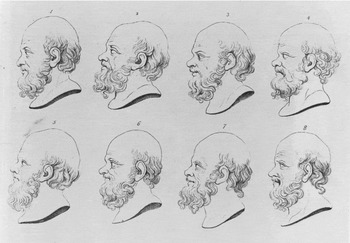
Lavater's physiognomy therefore provokes an epistemological crisis as well as an aesthetic and moral one. For although physiognomy is premised, as Tytler writes, on a “categorical equating of virtue and vice respectively with beauty and ugliness” (“Lines” 29), it represents also an attempt to “decipher nature's involuntary language of physical appearance” (Shookman 3). Lavater's assumption that the subject's outward countenance is a reliably legible code for his or her moral worth drives physiognomy's principles as well as its methodology, which is based on fairly gross analogies among humans (and non-humans). As K. J. H. Berland discusses, Lavater attempted to discern the relation between Socrates’ character and appearance by creating a “composite” picture based on nine “antique versions” of his face (267; Figure 5), a process of creating aesthetic wholeness out of multiplied representations, of eliding difference and foregrounding similitude. The methodology of physiognomy was rooted, then, in an inductive process of sublime cognitive dissonance.Footnote 6 In the Essays on Physiognomy, Lavater refuses even to read these pictures without qualification, assuming that Socrates’ “appearance was better” than the drawing under scrutiny, and offering a search for origins in which he rediscovers the original, better-looking philosopher: “this may be the twentieth copy, each of which is less accurate” (1844 ed., Plate XV).Footnote 7 Physiognomy presumes the legibility of the body, but in rendering that legibility it consistently fails, not for lack of effort, to obscure its inductive quality: the interpretation that precedes and informs the “facts.” The imaginative force of physiognomy, while of questionable epistemological value, nevertheless sustains a productive agency on the part of the physiognomist to read, interpret, associate, and project.
“Eight Ways of Looking at Socrates.” Illustration from Johann Casper Lavater, Essays on Physiognomy, Designed to Promote the Love and Knowledge of Mankind (London: J. Murray, 1789–98), in K. J. H. Berland, “Reading Character in the Face: Lavater, Socrates, and Physiognomy.” Word & Image 9.3 (1993): 266. Courtesy of Taylor and Francis.

The physiognomic portrait, in spite of its presentation as rational, consists in the “scientist's” projection of preconceived notions onto the subject. As an artistic, not just scientific, statement, physiognomy participates in the shift of portraiture from a product of mimetic realism to a product of the viewer's subjectivity. When Naumann and Ladislaw gawk at Dorothea in the Vatican museum (189; ch. 19), for instance, Eliot's focus on physiognomy discourages an alignment of the narrator with a desiring male gaze that fixes the woman as a sexual object, for the description of Dorothea as a “breathing blooming girl” (189) is distinctly sexualized and immediate, the interpretation of a sexual subject rather than a narrative persona. Rather than having their line of vision sanctioned by the narrator, Will and Naumann see in the gallery exactly what they want to see: a living version of the ekphrastic portrait with which they are so enamored.Footnote 8 By complicating the question of perspective, rooting it in projection, Eliot makes it impossible for Will's observation of Dorothea to act as a fixing gaze. Rather, it becomes a reading of the body that foregrounds not just a sexually available object but a desiring interpreter.
The novel's destabilization of physiognomic perspective requires the reader to understand that all forms of the gaze, including the gaze of masculine sexual desire, are equally contingent and under the same sort of skeptical scrutiny. The multiplicity of perspectives within Middlemarch “struggles,” Patricia Johnson argues, to “free Dorothea from an exclusive male gaze by multiplying angles of vision” (40). It is precisely because physiognomy privileges the “scientist's” own projection, forcing “multiplying angles of vision” into one tidy autoptic perspective, that Eliot needs to analyze it – literally, to break it up into a far more dynamic play of interpreters that avoids strictly aligning the subjectivities of author, narrator, character, and reader.
In its awareness of its own subjective projection, the narrative voice itself discredits the elision of perspective entailed in physiognomy. Attempting to “caution against a too hasty judgement” of Casaubon, the narrator writes, “I am not sure that the greatest man of his age, if ever that solitary superlative existed, could escape these unfavorable reflections of himself in various small mirrors; and even Milton, looking for his portrait in a spoon, must submit to having the facial angle of a bumpkin” (84; ch. 10). The narrator blames not the appearance of the poet but the warped surface into which he is looking, and offers a “protest against any absolute conclusion. . . derived from. . . a middle-aged scholar's appearance” (84). The absurdity of the blind Milton descrying his reflection in a spoon is perhaps more than a cruel joke: it comes within the context of a larger shift from external perspective (the various spectators judging Casaubon's appearance) to internal “consciousness.” Whatever “facial angle” the poet perceives will derive more from consciousness and affect than from apperception. Rather than search Casaubon's physiognomy, we are to explore the “deeper fixity of self-delusion” of a man whose “lot is important in his own eyes” (84). In describing Casaubon's (lack of) self-knowledge in terms of his “own eyes,” the narrator sets up a comparison between outer and inner vision, and in doing so appeals not just to scientific or epistemological accuracy, but to sympathy, claiming that Casaubon's inner state “claims some of our pity” (85, ch. 10). It is this inner emotional state that makes necessary the machinations of free indirect discourse; both the outer and the inner perspectives produce “unfavorable perspectives,” but one confesses to, rather than denies, the affective processes responsible for those “perspectives.” The operative problem is the inner “eye” rather than the outer one, the “self-delusion” and not a “facial angle.”
The comparison of Casaubon to Milton merits attention, since the poet is frequently invoked in the text.Footnote 9 Clearly Milton stands, for Dorothea especially, as an object of admiration, a poet who has well understood the costs of labor and of genius in both his poetry and his life. Milton's ostensible surrogate in Middlemarch is Casaubon, a seriously misguided religious thinker who works within a Miltonic legacy, striving to corral a complicated religious history into a unified and (excessively) coherent project through intellectual labor. But the analogy breaks down. Unlike Casaubon, Milton completes his project before dying. Dorothea, who at the end of Casaubon's life refuses to finish his Key, originally figures her relation to her husband as analogous to that of Milton's daughters to the poet, especially with respect to her desire to learn ancient languages (64; ch. 7), but she finds that labor to be an insufferable weight rather than an “odd habit it would have been glorious piety to endure” (10; ch. 1). As Lavater does with Socrates, the narrator draws a seemingly prescient but necessarily limited comparison with a prototypical figure of greatness. The collapse of this analogy lays bare the epistemological collapse of analogy in general.
Those collapses, however, do not enervate the productivity of analogy; they merely expose the extra levels of mediation that analogy compels. Indeed, Lavater himself foregrounds the symbolic and analogical resonance of his “science” – the need not only to analogize, but then to express those analogies in elusive forms of language:
A keen penetration is indispensable to the physiognomist, that he may easily perceive the resemblance that exists between objects. . . . He must have the capacity of uniting the approximation of each trait that he remarks, and to be able to define the degree of this approximation. No one who is not inexhaustibly copious in language, can become a physiognomist; and the highest possible copiousness is poor, comparatively with the wants of physiognomy. All that language can express, the physiognomist must be able to express. He must be the creator of a new language, which must be equally precise and alluring, natural and intelligible. Every production of art, taste, and mind. . . . must supply his necessities. (Lavater, 1794 ed., 81)
The interpreted body becomes doubly and triply implicated in analogical expression: “perceive[d]” by virtue of “resemblance” and “approximation,” the body is then subjected to a “new language” imagined to be capable both of capturing “precise” physiognomic detail and also of “alluring” the reader, yet inadequately “copious” to match physiognomy's rich visual codes.Footnote 1 The attractively packaged and beautifully illustrated physiognomic books themselves crystallized the importance of subjective analogy and heroic association in the physiognomic process, as well as the mutual imbrication of science and art (cf. Graham 562), proving Lavater as fashionable and marketable a name in artistic and cultural spheres as he was in the scientific. Physiognomy reveals not the codified legibility of the subject whose face is being read, but rather the aesthetic and interpretative subjectivity of the physiognomist, himself a sort of reader who in turn produces a cultural commodity in the scientific packaging of a physiognomic tract (to be picked up by another reader in turn).
Eliot foregrounds portraiture in Middlemarch as a basis for physiognomic reading, as in the early scene in which Dorothea reads Casaubon vis-à-vis his resemblance to a portrait of Locke, “His manners, she thought, were very dignified; the set of his iron-grey hair and his deep eye-sockets made him resemble the portrait of Locke. He had the spare form and the pale complexion which became a student; as different as possible from the blooming Englishman of the red-whiskered type represented by Sir James Chettam” (16; ch. 2). Dorothea dismisses the “type” of Englishman represented by Chettam only for another kind of type – for the student whose work itself offers a proto-structuralist taxonomy of all the world's beliefs. But this type too gets unduly reified in the process. Casaubon's “dignified” manners and emaciated pallor are clearly environmental, resulting from, not in, his refinement and education. Similarly, Casaubon's resemblance to Locke on the basis of his “deep eye-sockets” anticipates his resemblance to Milton on the basis of his blindness. In drawing attention to Casaubon's “eye-sockets,” Eliot anticipates the exhaustion of the eyes themselves; Casaubon confesses not a page later that he has been “using up” his “eyesight on old characters lately” (17; ch. 2). In the complex interaction of Casaubon's quickly fading eyes and, as I have discussed, the various eyes on Casaubon, Eliot questions the very interpretive faculty of vision on which physiognomy and portraiture rely.
The diminishing strength of Casaubon's eyesight initiates the anxiety that Dorothea will expend her own eyesight on “old characters” – including the “old character” of Casaubon himself: Middlemarch menacingly blurs the line between the “character” of Casaubon and the “characters” he reads and writes. As Tytler argues, Dorothea misreads Casaubon in this scene: her mistaken decision to marry Casaubon “not despite, but, apparently, because of his resemblance to ‘the portrait of Locke’” is “symptomatic of the heroine's sexual immaturity” (“Lines” 46). To note Dorothea's physiognomic misreading of Casaubon is, if anything, to understate the stakes of the predicament. Casaubon, as J. Hillis Miller has written, becomes “a text, a collection of signs which Dorothea misreads, according to that universal propensity for misinterpretation which infects all the characters in Middlemarch” (“Narrative” 466). The problem is with misreading writ large, with the illusion of fixity that is physiognomic portraiture in general, and with the “propensity for misinterpretation” effected by the reification of analogy, or what Miller refers to as the “fundamental linguistic error of. . . assuming that because two things are similar they are equivalent” (“Narrative” 464).
In this respect George Eliot recognizes that the epistemological shortcomings of interpretation are rooted in the assumption of likeness without recognition of difference. Dorothea herself acknowledges this frustrating naïveté in a context both scientific and linguistic, revealed through the narrator's peroration on the failures of analogy:
Mr. Casaubon's theory of the elements which made the seed of all tradition was not likely to bruise itself unawares against discoveries: it floated among flexible conjectures no more solid than these etymologies which seemed strong because of likeness in sound, until it was shown that likeness in sound made them impossible: it was a method of interpretation which was not tested by the necessity of forming anything which had sharper collisions than an elaborate notion of Gog and Magog. (478; ch. 48)
Thus the analogous “elements” of Casaubon's Key prove the “occasion of error” precisely because Casaubon refuses to submit them to the “bruising” corrections of empirical testing. Because they are based in an illusion of similitude and not in the realities of difference, Casaubon's “conjectures” have no intellectual or material value. The elusive and illusive likenesses of etymology make Casaubon's project not a search for origins but a deluding vision of Apocalypse – not of Paradise Lost, which for Dorothea is meaningfully material, but rather of Revelation, which is “elaborate” and forced, and therefore dull and unpenetrating. Recognizing the preposterousness of her fantasy that learning Hebrew and Greek would help her “arrive at the core of things” (64; ch. 7), Dorothea now realizes there is no “core of things”: only the play of difference, of “sharp collisions.” Likeness in language is a fantasy.
The reductive analogy on which Lavater and Casaubon rely requires an elision of difference and creates the false sense of a flat, unified meaning. As the compendium of analogical force that is Middlemarch demonstrates, however, this false sense is productive, even if wrongly: productive because of its imaginative energy, not because any transcendent correlation exists between language and reality. In this sense, as the narrator of Middlemarch powerfully reminds us, the force of imagination supersedes any necessity to experimentally verify the relationship of signifier to signified: “a man may be puffed and belauded, envied, ridiculed, counted upon as a tool and fallen in love with. . . and yet remain virtually unknown – known merely as a cluster of signs for his neighbors’ false suppositions” (142; ch. 15). But to be “known merely as” something, even if wrongly, is not to “remain virtually unknown.” Because there is no essential inner being in play to be “known” correctly, the visual misinterpretation of these physiognomic bodies, “clusters of signs,” is equally productive of false meaning and, importantly, of false analogy. As Miller writes elsewhere, “Seeing is always interpretation, that is, what is seen is always taken as a sign standing for something else, as an emblem, a hieroglyph, a parable” (“Optic” 143).
Eliot implicates the reader, as well as the characters, in the “fundamental linguistic error” (“Narrative” 464) of taking analogy for fact. These visual descriptions introduce new historical figures (Locke, Milton, his daughters) that urge a new system of analogies, the unpacking of which requires the drawing of further analogies yet. Readers align different failed analytical minds (Casaubon, Lavater, the narrator) against poetic minds (Milton, Eliot) against laboring minds, whether productive (Milton, Satan, potentially Dorothea) or unproductive (Casaubon) – and finally, against those figures of authority introduced as historical allegories (Milton and his daughters, Locke, Lavater's Socrates, Lavater himself). Given Eliot's warnings, one must be careful to recognize how tenuous, blurred, and provisional these analogies are.
Indeed, Lavater himself in his Essays on Physiognomy seems explicitly to grant the finitude of such analogies, warning that “however intimate the analogy and similarity of the innumerable forms of men, no two men can be found, who, brought together, and accurately compared, will not appear to be very remarkably different” (1794 ed., 3). But he then proceeds as usual, dismissing the possibility that these differences at all undercut the reality of a “native analogy” between appearance and essential character traits (4): doubters of physiognomy, therefore, are guilty of believing that “[t]ruth. . . is ever at variance with herself: Eternal order is degraded to a juggler, whose purpose it is to deceive.” True to form, Middlemarch reveals the Key to this “eternal order” to be indeed elusive, deceptive, and “at variance with” itself. But although Eliot understands that physiognomy is an act of interpretive induction rather than a discovery of pre-existing truths, she, like Lavater, understands the productive imaginative value of analogy. Her introduction of physiognomy, and her shifting ascription of its dubious methodology, compels extensive narrative work.
This introduction and ascription effects an interplay of multiple interpretive subjectivities, all of which induce projection and creative misreading: the reader's, the narrator's, the author's, and the characters’. By introducing to self-aware readers a complicated “web” of self-aware narrators, writers, laborers, poets, historical figures, and scientists, Middlemarch compels the drawing of productive but certainly limited associations. Neil Hertz offers another example of this encouraged but deferred drawing of likenesses, in which Casaubon is figured as vaguely analogous to the city of Rome (cf. ch. 33). But as Hertz suggests, “these paragraphs don't dwell on this analogy or spell out its terms” (34), and the comparison rests only on Dorothea's analogous responses to Rome and to Casaubon, not on fundamental similarities between the two. The interpretive process itself is foregrounded, as Middlemarch both pushes and disavows analogical comparison.
Indeed, the addiction to analogical similitude that characterizes Lavaterian typologies transcends even the boundaries of species. As Berland explains, Lavater attempted to draw, with both mind and pencil, comparisons between an animalesque human countenance and the “‘peculiar mental character’ usually ascribed to that animal” (252). In Middlemarch the narrator describes, seemingly as a simple part of the scenery, a “grizzled Newfoundland lying in the sun” as it “looked on with the dull neutrality of extreme old age” (572; ch. 57). Eliot adds another perspective to the picture, momentarily entertaining and interrogating the idea of positing similitude between human beings and animals. What the narrator does here is more akin to the work of Darwin, who drew conclusions about animal subjectivity based on his “knowledge” of human beings, than to Lavater (who reasoned the other way around). Even if the “dull-eyed” dog has a “neutral” expression, its perspective still counts.Footnote 11
Throughout Middlemarch, Eliot uses the “neutral physiognomy” to reveal the epistemological force of a reader's drawing of analogies based on his or her own psychological compulsions. These analogies are both productive and untenable; they perform indispensable narrative work, even if they are of questionable or even negligible truth value. Eliot probes the value of analogy, likeness, and difference in the scene with which I began this essay – the “neutral physiognomy” of the effigy – wherein the narrator introduces two other forms of imitation, the parrot and the cuckoo. Both are introduced by way of simile, a figure of speech that emphasizes likeness rather than difference and that recognizes the portentous productiveness of form rather than content. Both parrot and cuckoo appear to have the capacity of sound rather than sense, the parrot's appearance of coherent syntax notwithstanding. The “Punch-voiced echo” is itself an empty form, a caricature of a caricature, imitating another puppet rather than Brooke himself, which suggests an interpretive transference of a familiar voice (that of the Punch-doll) onto a voiceless object. By acknowledging the recursive structure of this noisy transference, compounding empty forms upon empty forms, Eliot insistently obscures the actual observed object. Eliot similarly recognizes the inaccessibility of the signified in the visual realm, as in Lavater's drawings of Socrates: the “neutral physiognomy” asserts the primacy of interpretation – particularly of form – rather than of “content.”
The illegible body stymies physiognomic reading while simultaneously encouraging it, in the process offering a formal structure to be interpreted and compelling the self-conscious subjectivity of an interpreter. The “neutral” physiognomy for Lavater would be an opportunity – a shape onto which he could project whatever meaning suited his preconceptions. But in the social and political context of Middlemarch, in which reform is brewing and the happiness of our protagonists is constantly at stake, neutrality can also be menacing, complicating the process of reading that produces meaningful events with material effects. Such menace is particularly evident through Eliot's gendering of social and narrative tactics, in which she genders a concept that is ostensibly “neuter” by casting it as an excess of meaning rather than a lack of it.
“Within Themselves”: The Languages of Feminine Neutrality
It is therefore useless to trap women into giving an exact definition of what they mean, to make them repeat (themselves) so the meaning will be clear. They are already elsewhere in this discursive machinery where you claim to take them by surprise. They have turned back within themselves, which does not mean the same thing as “within yourself.”
—Irigaray, “This Sex Which Is Not One”
Keeping in mind Dorothea's misreading of Casaubon, compare the narrator's description of another, less eerily rendered, physiognomic reading, this one of Ladislaw (another man, of course, whom Dorothea will marry): “Dorothea could see a pair of grey eyes rather near together, a delicate irregular nose with a little ripple in it, and hair falling backward; but there was a mouth and chin of a more prominent, threatening aspect than belonged to the type of the grandmother's miniature” (79; ch. 9). In comparison to the portrait of Will's grandmother, who is described in almost identical terms – with Dorothea's faint-praising addition of “peculiar rather than pretty” (76; ch. 9) – Will himself presents a mixture of qualities: his “delicate irregular nose” wars with his “prominent, threatening” lower features. In addition, Will has in this scene a “pouting air of discontent” (79), a feature of affect rather than of essential character. The narrator's (and probably Dorothea's) recognition that Will's countenance results not only from his features but from his “air” exposes the contingency of portraiture and the inapplicability of physiognomic essentialism to social relations – perhaps affect is the only “essential character.”Footnote 12
Indeed, as Berland discusses, facial expression was eventually abandoned by the disciples of Lavater for its susceptibility to affect as opposed to essential character traits. The irony caught by George Eliot is that Lavater, whether or not his work was actually scientific, was self-consciously aware of his efforts to represent his work as science – that Lavater himself exemplified a sort of rhetorical and scientific affect. Eliot sees, therefore, a double problem. First, physiognomy's incapacity to account for the problems of affect undermines its utility. Second, Lavater's physiognomy untenably attempts to disavow its own subjectivity, insofar as Lavater is both susceptible to affect and eager to renounce it. Eliot unseats physiognomy as a system of knowledge in order to replace it with an irrevocably contingent state of being, where representational strategies are recognized so that they can be used. For this reason, the “neutral” physiognomy is psychologically productive insofar as it is tactical rather than accidental. Just as much an “air” as a “pout” is, neutrality signifies conscious affect, an effort to remain unreadable in order to force interpretation. The façade of “neutrality” allows the female subject to situate herself tactically, thereby damaging physiognomy as a credible system of centered meaning.14 The “neutral physiognomy” furthermore implies a layered subjectivity that privileges the illegible body being read: the subject using neutrality as a volitional tactic understands the reader perhaps better than that reader – still struggling to project a meaning onto the subject's body – understands him- or herself.
The very concept of neutrality invites careful attention to the play of signs and plurality of meanings. By virtue of its etymology (from the Latin neuter) neutrality is a “neither/nor”: neither positive nor negative, neither for reform nor against it, neither for Athens nor for Sparta, neither male nor female. As Neil Hertz discusses, “neutral” is a term that “eludes conceptualization itself” (127) – and yet is so constantly in play in Middlemarch that it demands the reader's attention. Even as the term “neutral” acts as a “nullification of all differences” (Hertz 130), i.e. of language itself, it simultaneously acts as the site of meaningful excess. As Jacques Derrida writes in “Living On,” however, it is form rather than “substance” (whatever that might be) that asserts this excess: “not richness of substance, semantic fertility, but rather structure, the structure of the remnant or of iteration” (123). This structure of iteration, like the Punch-voiced doll, proves the “neutral physiognomy” to be an impossibility. Even if it implies all of the multiple physiognomies that it is not, the “neutral physiognomy” implicates a “fertil[e]” structure, ready to be infused with the meaning produced by the unwitting physiognomist that is any interpreting subject.
Appropriately for Middlemarch, Derrida reaches this conclusion in the process of attempting to seek an “origin of narrative” (87) and concluding that narrative begins with the visual: “That which enables us to see should remain invisible” (90). In Middlemarch, the neutral physiognomy is in turn looking back at the interpreter – it is menacing not only because it “remains invisible,” but also because the eyes looking the other way signify a force of will behind that illegibility.Footnote 13 Thus neutrality in Middlemarch is menacing partly because it refuses to cohere with the multiple failed efforts of characters within the novel to create a flat, unified, logocentric text. “Neutral physiognomy” underscores the instability of these systems, the Lavaterian model included – an instability rooted not only in their perspectival naïveté, but also in their inability to account for volitional representational strategies.
Eliot situates neutrality as meaningfully intentional during a brief and apparently simple utterance offered by Rosamond in response to the revelation of Lydgate's debts. She asks, “‘What can I do, Tertius?’” and the narrator proceeds to interpret the curious force behind these words:
That little speech of four words, like so many others in all languages, is capable by varied vocal inflexions of expressing all states of mind. . . from the completest self-devoting fellowship to the most neutral aloofness. Rosamond's thin utterance threw into the words “What can I do!” as much neutrality as they could hold. They fell like a mortal chill on Lydgate's roused tenderness. He did not storm in indignation – he felt too sad a sinking of the heart. (594; ch. 54)
Here, Eliot reveals the chilling communicative potency of neutrality as a form of performance. Equating speech with the expression of “states of mind,” the narrative voice also recognizes that Rosamond does her most powerful work on Lydgate through her selection of a particular “vocal inflexion.” Rosamond's “thin” utterance, a flat text (that is itself about doing work), is imbued with meaning through both expressive and interpretive agency. Her inflectional performance “thr[ows]. . . neutrality” into those words, “neutrality” that is then rendered meaningful only through Lydgate's interpretive agency. The sexualized diction with which the narrator describes Lydgate's response – the “mortal chill” on his “roused tenderness” – suggests that Rosamond's neutral words have frozen her husband's desire and silenced his ability to “storm”: humiliated and emasculated, Lydgate can only “sink.” Rosamond's appropriation of “neutral” language effectively signifies displeasure under the guise of sympathy. Her tactical discursive performance effectively unsettles her ostensible performance of tender wifely conventions. As the narrator recognizes the tenuousness of speech and meaning, Lydgate recognizes the contingency of his wife's affection and of his own authority.
The “neutrality” of Rosamond's speech helpfully illuminates the novel's physiognomic readings of the “neutral” body, insofar as both foreground affect. Lydgate's terror with respect to Rosamond's “neutrality” is reiterated when she learns of his plans to leave Middlemarch. Rosamond notes that the “presence of a new gloom in her husband, about which he was entirely reserved towards her – for he dreaded to expose his lacerated feeling to her neutrality and misconception – soon received a painfully strange explanation. . . “ (754; ch. 75). Lydgate perceives the silence of Rosamond to be just as intentional as her speech: when he demonstrates this “new gloom” by shouting at his wife, Rosamond says nothing. As Luce Irigaray contends, women's silence signifies neither submission nor the lack of anything to say, but rather their having exceeded a naïve phallogocentric economy of meaning: “If you ask them insistently what they are thinking about,” Irigaray writes, “they can only reply: nothing. Everything” (“This Sex,” 101). Lavater similarly essentialized feminine communication as operating in extremes of affect and self-composure: “When communicative, they [women] are more communicative than man; when secret, more secret” (1794 ed., 177). While appropriating these masculine anxieties for the purposes of tactics in a social space, Eliot stops short of endorsing an all-encompassing gendered epistemology (i.e. of a “Sex Which Is Not One”), preferring to endorse a discursive epistemology “which is not one.”Footnote 14 Lydgate's reticence, his “dread to expose” the truth, and Rosamond's icy neutrality are in a silent but insistently signifying conversation, in which the external visage of “nothing” is, in fact, much ado about “Everything.”
The language of emasculation, even castration, is both striking and menacing. Both here and above (in the “chill” on his “roused tenderness”), Lydgate reads his wife as a sexually unavailable and threatening subject: in that sense too, Rosamond's “neutrality” is no doubt all too tactical. At the same time, it is not that neutrality confirms Lydgate's fear of (or fear of becoming) what Judith Butler unsympathetically terms the “category of women” (9); rather, it accentuates the threat that “neutrality” poses to the decipherability of categories in general. Were Lydgate to “expose” his already “lacerated feeling” to Rosamond's neutrality, he would lay bare the overpowering strategic meaningfulness of the silent, illegible female body, thereby interrogating the very foundations of meaning and interpretation that drive his scientific pursuits so unforgivingly. He would also be forced to confront the general lack of meaning underlying the primitive tissue, a notion that is aligned with what Butler calls a “univocal and hegemonic discourse” (25).
Rosamond and Lydgate's interaction does not, however, make it entirely clear who recognizes this tactic and communicates this “dread,” and who exactly has perceived Rosamond's neutrality. Is it – as the offsetting dashes imply – Lydgate himself, recognized through the free indirect discourse of an omniscient narrator? If so, then the narrative voice itself remains meaningfully neutral, shifting its alliance mid-sentence and then back again. Yet the strikingly suggestive language of “lacerat[ion]” further calls into question the gendered alliances of the narrator. Neutrality is only neuter insofar as it carries that threat of exposing the neutered male; it signifies excessive, uncontainable gendered alliances rather than a lack. The neutral female body exceeds a singular coherent representation and forces multiple interpretation. The social convention requiring Rosamond to put on a neutral face compels a reshaping of what Irigaray calls (in my epigraph to this section) the “discursive machinery,” obviating the possibility of a “meaning” that is “clear” (“This Sex” 103). When Rosamond presents an indecipherable physiognomy, she proves more menacing than if there were no convention of feminine silence in the first place. Yet she is menacing only from the perspective of the emasculated Lydgate: from the multiple perspectives of the text, her neutrality is as productive as it is terrible.
If, after all, Lydgate's internal “dread” is indeed perceived by Rosamond, then neutrality becomes an even more subtle problem, and the gendered alliance of the narrator even more elaborately layered. In reading Lydgate's body, Rosamond herself is performing a retroactive reinterpretation of Lydgate's “gloom,” altered by the introduction of new facts, and retroactively reinterpreting her own neutrality. By leaving ambiguous the interpretive agency in this passage, Eliot destabilizes monolithic discourses – like science and theology, traditionally associated with the masculine – and instead embraces neutrality: shifting, strategic, and multiple. Rather than representing one pole of an essentialized gender rubric, Rosamond exemplifies the capacity to recognize the contingent tactical value of neutrality as a form of performance implicating multiple subjectivities. In either reading (or, better yet, in both readings) this short passage creates a doubled excess of menacing meaning, the more so because its ambiguity prevents the reader from pinning down the source of the menace.Footnote 15 While form and social convention disallow Rosamond from threatening Lydgate directly, the “neutral physiognomy” provides her with a way of signifying a threat while avoiding direct confrontation and reprisals.
That the performance of neutrality in Middlemarch carries particularly feminine associations is evident, too, in Eliot's more literalized treatment of illegibility, particularly with regard to handwriting. As Neil Hertz explains, Eliot's own letters reveal an anxiety about illegible handwriting, tying “opaque” language with language that is “too purely in the service of self, when self-expressive scribbles replace legible communicative signs” (Hertz 25). In Middlemarch, handwriting represents a crisis of gendered affect: Dorothea's initially “uncertain” handwriting in writing her acceptance of Casaubon's proposal (45; ch. 5) gives way to the “firmness of stroke” in copying her Latin (she “could have been patient with John Milton,” but she had “never imagined him behaving in this way”) (282–83; ch. 29). By this time Dorothea has also “learned to read the signs of her husband's moods” (281), one sign of which is a hand that “tremble[s] so much that the words see[m] to be written in an unknown character” (283).Footnote 16 Conversely, Rosamond proves more capable than Lydgate of performing illegibility, verbally and physically. Dorothea's eventual unflappable mastery of the pen and the icy inaccessibility of Rosamond's voice prove threatening, and ultimately productive, not because Lydgate and Casaubon are categorically afraid of “Woman” – but because the women in Middlemarch have such superior control over what and how they perform.
Eliot's gendering of neutrality affects our perceptions of her narrator as well. The narrator is excessively but unstably gendered, rather than “neuter” in the colloquial sense: in other words, the narrator is both female and male rather than neither/nor. Similarly, Eliot's pseudonymity itself acts as a sort of neutral costume, effacing the author's person while refusing to efface her persona: her chosen name situates the author strategically between the masculine (readable but empowered) and the feminine (silent but menacing). The neutrality of the narrator and author makes it clear that non-signification in physiognomy is a problem of language and linguistic subjectivity.
So too does Eliot's frequent alliance of “neutral physiognomy” with neutral speech and silence. In an early scene, Dorothea fantasizes about drawing up plans for the cottages, but she then “checked herself suddenly with self-rebuke for the presumptuous way in which she was reckoning on uncertain events” (29; ch. 3). “Checked” speech, as the workings of a fragmented psychological subjectivity, is a private discourse, unavailable to physiognomic reading but available to us through free indirect narration. A “neutral physiognomy,” however, is a public text in visible circulation. Juxtaposing the two, as Eliot does in a later scene with Rosamond, illustrates the excess of meaning – including that which the observer projects back – which makes the observer of “neutrality” consistently uneasy. Here, Rosamond entertains a fantasy in which Will Ladislaw, by coming to Middlemarch, would compel Lydgate to leave for London. The narrator asserts that “it is precisely this sort of sequence which causes the greatest shock when it is sundered: for to see how an effect may be produced is often to see possible missings and checks; but to see nothing except the desirable cause, and close upon it the desirable effect, rids us of doubt and makes us strongly intuitive” (770; ch. 77). The narrator makes a crucial distinction here between fantasy and strategy: strategy is constituted in misfires, in “checks,” which fantasy ignores. Eliot links this sort of “check” with the sort that results in Dorothea's “self-rebuke”; the “check” signifies a corrective alien internal entity who recognizes strategic logic even if the ego does not.
Rosamond's fantasy, which is cogitated under a “perpetual silent reproach” (770), is situated immediately between two legible forms of “check,” which could theoretically refine her secret strategy. Having learned that Dorothea is on her way to Rosamond with a “cheque” for a thousand pounds (769; ch. 76), which would keep Lydgate in Middlemarch, we are told that Dorothea has been “checked now. . . by the consciousness of a deeper relation between them which must always remain in consecrated secrecy” (773; ch. 77) – a relation that, even if unspoken, threatens Rosamond's similarly directed affections. More literally, Dorothea's approach to Rosamond (in the presence of Ladislaw) is impeded by a table, so she lays down the letter (with the cheque enclosed) on the “small table which had checked her entrance” (775). Throughout Middlemarch, the narrator refers to the architectural layout of a room or landscape as its “physiognomy,” a public system of signs allowing that landscape to be subjectively read and interpreted for the “little details” that make it “dear to the eyes” (104; ch. 12). The external presences in this late scene of the table and the cheque, both institutions and products of social and monetary exchange, frame the internal psychological economy of checking, counterpoising the contingencies of the external against those of the psychological subject. The two complex internal subjectivities of Rosamond and Dorothea are rooted in misfire, in constantly being checked by the character's own psychology, and are counterpoised against the very material, socially salient impediments that check the materialization of their fantasy.
Only free indirect discourse, then, can be responsible for revealing the internal psychological complexity of what seems like an epistemological cessation: being checked, like being neutral, constitutes an excess of meaning rather than an absence of it. The external “neutral physiognomy” and the internal “check” become points of narrative tension mediated by the narrator, who takes a discourse that is private within the narrative and makes it public to us, while at the same time taking a system of public signs and revealing the internal exigencies behind it. Even while the narrator questions the structuralist modes of thinking within the novel, wherein a “character is shown to be mystified by a belief that all the details he confronts make a whole governed by a single center, origin, or end” (Miller, “Narrative” 464), the narrator also becomes a site of excessive meaning constituted in illegibility. As Derrida argues, the “neutral” represents excess which “cannot be governed by any of the terms,” excess that “is not outside of language: it is, for example, narrative voice” (106–07). The narrative voice is not neutral in the sense that it is self-effacing or without allegiance, but is the epistemological locus at which the internal discourses of the characters, and the public discourse of their legible bodies, are to be set into play, resulting in a clash of meanings that creates excess (“neutrality”).
As such, Eliot's narrator offers us a system of internal “checks” and balances, as well as an external “neutral physiognomy” – seemingly tied more closely to the subject, but nevertheless illegible to the interpreter – in order to explode the Lavaterian system, which is ostensibly a representation of salient character traits through salient external traits. Eliot uses her narrator to confuse this system by showing that the unrepresentable face, the “neutral physiognomy,” is the richest with meaning, enclosing a dynamic movement of internal “checking.” The epistemological systems in Middlemarch, Lavater's included, rest on the untenable assumption of legibility, and the Lavaterian system – like Casaubon's panicked scrawling – collapses into indecipherability. In attempting to explain the psychology in coherent mimetic structures, physiognomy falls apart in trying to represent what should be the default state, but which is in fact a tactical form of affect – the “neutral physiognomy.” The dread of neutrality is as always dual. It lies in the association of the illegibility of language with internal distress, which can only be menacing; but it also lies in the recognition that neutrality is a masking of internal distress, not empty of meaning but overflowing with it, and also that this illegible meaning functions “in the service of self” (Hertz 25). It is threatening, not innocuous, eradicating the social presupposition that silent women are submissive, rather than “within themselves,” speaking a subversive language of neutrality.
The constitution in language of all unified philosophical systems within Middlemarch is what compels their destruction – language is too unstable to be contained by legibly cohesive accounts of reality. Eliot undercuts the apparent clarity of her character description by insistently privileging the meaningfulness and force of interpretation. The Lavaterian model of physiognomy is, for Eliot, both incredibly rich and laughably feeble: rich, because it is a case study of the projection that drives all interpretative processes; feeble, because as a unified system it limits itself to the legible body and proves itself incapable to deal with the contingencies of tactical self-representation. Neutrality, therefore, allows Eliot to insist on the importance of interpretation – and the tactical prescience of forcing interpretation onto another subject – while simultaneously refusing to efface its instability. By so consciously insisting on such a seemingly meaningless but always menacing concept as “neutral physiognomy,” the representation of something that cannot be represented, Eliot perseveres in foregrounding the excess of unstable meaning, which can be neither represented nor ignored, but which can always be used.