


INTRODUCTION
Southeast Asia has some of the oldest dates for rock art in the world obtained from indirectly dating the superimposed speleothems for a minimum age (Aubert et al. Reference Aubert, Brumm, Ramli, Sutikna, Saptomo, Hakim, Morwood, van den Bergh, Kinsley and Dosseto2014, Reference Aubert, Setiawan, Oktaviana, Brumm, Sulistyarto, Saptomo, Istiawan, Ma’rifat, Wahyuono, Atmoko and Zhao2018, Reference Aubert, Lebe, Oktaviana, Tang, Burhan, Jusdi, Hakim, Zhao, Geria, Sulistyarto and Sardi2019). However, in the whole of Southeast Asia, there has been no direct dating of rock art motifs (Aubert et al. Reference Aubert, Brumm and Taçon2017). There is untapped potential for dating charcoal rock art figures in the region and their chronology might help address questions of human migration (O’Connor et al. Reference O’Connor, Louys and Kealy2015; Aubert et al. Reference Aubert, Brumm and Taçon2017). During a 2019 survey, one anthropomorphic figure was sampled and dated to provide the first published directly dated rock art not just in the Philippines, but in Southeast Asia.
Of the 22 known rock art sites in the Philippines, 12 are in Peñablanca, Cagayan Valley (Jalandoni Reference Jalandoni2018). The Negrito indigenous people who still inhabit the area, the Agta, are presumed to be the artists of the Peñablanca rock art (Tobias Reference Tobias1998). Negritos could be related to the earliest human remains recovered from Callao Cave in Peñablanca (Delfin et al. Reference Delfin, Salvador, Calacal, Perdigon, Tabbada, Villamor, Halos, Gunnarsdóttir, Myles, Hughes and Xu2011; Détroit et al. Reference Détroit, Corny, Dizon and Mijares2013). A comprehensive chronology of the rock art in the region could help to determine whether the Agta or their ancestors are the artists of the Peñablanca rock art.
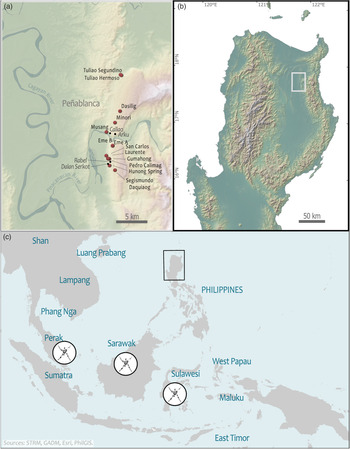
In 1976–1977, the National Museum of the Philippines surveyed the rock art caves. One of the aims of this project was to compare what could still be identified in 2019 from the original record to determine the state of preservation of the cultural heritage of Peñablanca. A second aim was to understand the Peñablanca anthropomorph motifs by placing them in a regional context with similar motifs in Southeast Asia (Figure 1).
Peñablanca and rock art site locations (a) in northern Philippines (b). States in Southeast Asia that have black anthropomorph rock art motifs analogous to Peñablanca (c).

Previous Research in Peñablanca
Excavation
Peñablanca plays an important role in the study of human evolution, prehistory and environmental change in northern Philippines. Fifty-two archaeological sites were catalogued, 12 were excavated, and seven out of the 12 have been dated to the late Pleistocene and Holocene (Ronquillo and Santiago Reference Ronquillo and Santiago1977) (Figure 2).
Dated anthropomorph from Hermoso Tuliao Cave (upper) and where the date fits into the timeline of human occupation in Peñablanca (lower). A photograph of the male anthropomorph with a white rectangle indicating the area that was sampled and an inset image of the same anthropomorph traced from a different angle (a). Enlarged image of the area before (b) and after (c) sampling encircled in red.

Callao Cave has provided evidence of at least three phases of human activity. The earliest phase resulted in the deposition of faunal and human bones including the Homo luzonensis dated by U-series analysis to a minimum age of 67,000 (Mijares et al. Reference Mijares, Détroit, Piper, Grün, Bellwood, Aubert, Champion, Cuevas, De Leon and Dizon2010; Détroit et al. Reference Détroit, Mijares, Corny, Daver, Zanolli, Dizon, Robles, Grün and Piper2019). The second phase of habitation occurred during the Late Pleistocene with a date of 28,980–27,420 cal BP from in situ hearth charcoal and associated with flake tools (Mijares Reference Mijares2005). This was succeeded by cave occupation and burials following the introduction of pottery dating to about 3693–3527 cal. BP (Mijares Reference Mijares, Piper, Matsumura and Bulbeck2017). The cave sediments were also examined through soil micromorphology (Mijares Reference Mijares, Piper, Matsumura and Bulbeck2017).
A terminal Pleistocene date of 12,600–11,000 cal BP (2σ) was obtained for Musang Cave via a shell retrieved from the bottom of the excavation (Thiel Reference Thiel1988). The excavated assemblage consists of flake tools, shell, animal bone, human bone, pottery, a few beads, earrings and other ornaments, a brass needle, and other artifacts of varying age.
Hunting and gathering activities were sustained in Peñablanca in the early Holocene as supported by Dalan Serkot Cave dated to 7260–6990 cal BP (2 σ) (Mijares Reference Mijares2005, Reference Mijares2008). The dated charcoal was attached to a chert flake from a depth of 70 cm along with freshwater gastropods in a preceramic layer. Other faunal remains were three Cervus sp. (deer) teeth and a Sus sp. (pig) tooth.
Furthermore, charcoal recovered from archaeological investigation in Minori and Rabel Caves revealed dates of 5464–5052 cal BP (2σ) (Mijares Reference Mijares2002) and 4260 ± 360 BP (Ronquillo Reference Ronquillo1981), respectively. Both caves yielded numerous lithic artifacts and were analyzed in the context of how prehistoric people made and utilized stone tools.
Foraging activity flourished around 3,000 years ago, based on the assemblages unearthed from Arku and Eme Caves. Charcoal was dated in Eme to 3990 – 3690 cal BP (2σ) (Mijares Reference Mijares2008) and in Arku to 2755–2340 cal BP (2σ) (Thiel Reference Thiel1986). These caves have ceramics, lithic flake tools and debris, land snails and freshwater shells, and animal bones
Rock Art
Rock art was first surveyed by the National Museum in 1976–1977 (Ronquillo and Santiago Reference Ronquillo and Santiago1977; Peralta Reference Peralta1979). Tobias (Reference Tobias1998) compiled the National Museum data, which included museum reports, raw data (maps, tracings, photos), and visits to four of the sites. There were twelve known rock art sites: Dasilig A, Eme A, Gumahong, Hermoso Tuliao, Laurente, Minori A, Musang, San Carlos, Segismundo Daquioag, Segundino Tuliao, Hunong Spring, and Pedro Calimag Rockshelter with a total of 384 black pictograms (Tobias Reference Tobias1998). Polarized light microscopy revealed the pigment to be carbon black in Minori and bone black in Segundino Tuliao and Hermoso Tuliao (Tongson Reference Tongson2013). In 2007, Jalandoni (Reference Jalandoni2018) visited seven sites and obtained copies of the National Museum tracings for eight sites. In 2012, Faylona et al. (Reference Faylona, Lising and Dizon2016) recorded 10 of the sites, all except Hunong Spring and Pedro Calimag Rockshelter. The 10 sites visited had 372 pictograms in the 1976–1977 NM surveys, while the 2012 survey recorded only 241 pictograms, or 65% of the previous survey (Jalandoni Reference Jalandoni2018). Jalandoni (Reference Jalandoni2018) noted many discrepancies between the 1976–1977 survey (as reported in Tobias Reference Tobias1998) and the 2012 survey (Faylona et al. Reference Faylona, Lising and Dizon2016). These discrepancies might be attributed to the fading of rock art figures in some sites and the addition of new figures in other sites. Weathering, graffiti, and deterioration of the rock art was noted in the 1990s (Tobias Reference Tobias1998), 2007 (Jalandoni Reference Jalandoni2018), and 2012 (Faylona et al. Reference Faylona, Lising and Dizon2016).
METHODS
Three methods were employed to better understand the age of the rock art and its deterioration since 1976–1977, digital records, accelerator mass spectrometry (AMS) radiocarbon (14C) dating and classifying the rock art by type. Marks that could possibly be the remains of rock art designs were also noted and tabulated.
Digital Recording
The rock art was recorded using photogrammetry and terrestrial laser scanning (TLS) (following Grussenmeyer et al. Reference Grussenmeyer, Landes, Alby and Carozza2010; Lerma et al. Reference Lerma, Navarro, Cabrelles and Villaverde2010). The photogrammetric component of the project focused on the 3D documentation of both pictographs and petroglyphs identified at each of the sites visited. The advantage of using both photogrammetry and TLS to create 3D models of the rock art is that TLS is fast and systematic while the photogrammetry allows for hard to reach areas to be imaged. Photogrammetry at its core also provides high-resolution 2D documentation that is unachievable with just TLS. Using both techniques takes advantage of the best of both technologies. Photographs of the cave entrances and surrounding landscape were also captured with a drone.
Dating
AMS 14C dating is the most effective method of dating the rock art at Peñablanca because the previous polarized light microscopy study by Tongson (Reference Tongson2013) determined the pigments sampled to be carbon black and bone black. Permission to collect samples for dating was obtained from the National Museum of the Philippines. Most of the rock art figures in Peñablanca were not conducive to dating because they were too faint, or the lines were too thin to obtain enough sample material.
After carefully examining the painted figure for areas of concentrated pigment, a sampling location was chosen that would minimize damage to the aesthetic of the rock art figure. A new sterile scalpel was used to slowly scrape off a small portion of the pigment onto baking paper and funneled into a sterile plastic laboratory bottle. One sample was collected from an anthropomorphic figure in Hermoso Tuliao and sent to Waikato Radiocarbon Dating Laboratory in New Zealand.
No chemical characterization has been done do confirm the material, but the observations made during subsequent processing are consistent with a carbon black description (pers. comm. Fiona Petchey of Waikato Radiocarbon Dating Laboratory, 1 Dec. 2020). Carbon black can include charred organics from a range of sources including bone, fats, resins, and other vegetable matter (Petchey Reference Petchey, David and McNiven2017). Such material is less chemically stable than charcoal and will not withstand routine processing methods used for radiocarbon dating. Approximately 3.5 mg of material was used for pretreatment purposes. Visible contaminants on the surface of the material were removed. The sample was then treated in 1M HCl at 80ºC, rinsed and dried. A sample of 2.5 mg of pretreated material was loaded for combustion and graphitization. In terms of contamination, tests on similar charcoal samples treated with HCl have not shown up any residual CaCO3, and while oxalates are a potential problem at the expected age range they will make almost no difference (Pers. Comm. Fiona Petchey of Waikato Radiocarbon Dating Laboratory, 11 Mar 2021). For additional information on the AMS procedure, see Petchey et al. (Reference Petchey, Dabell and Hogg2017).
The %C value (which is 26.6%) is not a relevant measure for quality except for charcoal samples (which should be >50%). Since this is carbon black the lower value is as expected. The mgC yield (0.67) from the carbon black sample is a routine combustion sample size and the sample is not considered to be a “small AMS”, which in the Waikato system would be <0.2mgC (pers. comm. Fiona Petchey of Waikato Radiocarbon Dating Laboratory, 12 Jan. 2021).
Classification
The eight available tracings from 1976–1977 were compared with the data collected in 2019 to ascertain which of the figures could still be identified. All other markings were initially classified as possible rock art. This classification was used in order to not neglect the remnants of a rock art figure that had been identified in the 1976–1977 survey, even if the figure could not presently be identified.
The pictograms were characterized as leaf skeleton, diamond, kite-like, net-like, circle, circle with rays, anthropomorph, combination, linear and broken lines (Tobias Reference Tobias1998). Those with a lack of clear form were categorized into either broken lines or linear form. Possible rock art motifs that have dots and dashes with an unclear direction or looked smudged were classified into broken lines. Possible rock art that was made prominently with lines across different directions (not resembling the net like figure or the leaf skeleton) were classified into broken lines. Finally, the category “combination” consists of drawings that have a mix of different motifs.
RESULTS
In the 1976–1977 survey, 18 figures were identified at Hermoso Tuliao Cave but in the 2012 survey only 16 were recorded. In 2019, 36 possible figures were identified during the survey of the cave. However, it was difficult to find a figure with enough material for sampling. Due to the limitation on sampling, only one of the three anthropomorph figures from Hermoso Cave was sampled for radiocarbon dating, with a result of 3299 ± 18 BP or 3570–3460 cal BP (2 σ) (Wk-51453; date modelled in OxCal v.4.4.2, using IntCal20 calibration curve [Bronk Ramsey Reference Bronk Ramsey2020; Reimer et al. Reference Reimer, Austin, Bard, Bayliss, Blackwell, Ramsey, Butzin, Cheng, Edwards, Friedrich, Grootes, Guilderson, Hajdas, Heaton, Hogg, Hughen, Kromer, Manning, Muscheler, Palmer, Pearson, van der Plicht, Reimer, Richards, Scott, Southon, Turney, Wacker, Adolphi, Büntgen, Capano, Fahrni, Fogtmann-Schulz, Friedrich, Köhler, Kudsk, Miyake, Olsen, Reinig, Sakamoto, Sookdeo and Talamo2020]; Figure 2).
DISCUSSION
Lost Rock Art Figures
The disparities in numbers of pictograms recorded per cave, per survey (1976–1977, 2012, 2019) can be attributed to three main factors: (1) environment, (2) human and, (3) technology. The decrease in the number of visible drawings, as well as the considerable fading of others, could be due to environmental factors hastening natural weathering. Human factors that may have influencing the differing numbers of motifs between surveys include (1) the method of counting, which varies per research group, (2) the ability of the researchers to recognize rock drawings, and (3) modern graffiti and other vandalism that can destroy or obfuscate the rock art but also make it seem like there is more rock art. Technology is a factor with the intensity of artificial light, the recording equipment, and enhancement software. The finding and documentation of rock art still relies largely on human efforts, which are subjective, varied, and change over time.
Because of this, we matched every possible figure with available records to get a clearer picture of which figures are no longer identifiable. Only 94 out of 250 (37.6%) of the figures traced in 1976–1977 were identified in the 2019 survey. The loss of an entire rock art site (Hunong Spring) and large number of lost rock art figures throughout is disconcerting and should be addressed to prevent further loss.
Dating
The anthropomorph in Hermoso Tuliao is the first published directly dated rock art not just in the Philippines, but in Southeast Asia. The figure dated to 3570–3460 cal BP indicates the rock art is early Austronesian or Agta. Austronesians are thought to have arrived in northern Philippines circa 4000 years ago and are the dominant current population in the Philippines (Bellwood Reference Bellwood, Bellwood, Fox and Tryon1995). The Negritos are presumed to have arrived in the Philippines during the Pleistocene via landbridges or short watercraft trips (Turner and Eder Reference Turner, Eder, Oxenham and Tayles2006; Jinam et al. Reference Jinam, Hong, Phipps, Stoneking, Ameen, Edo and Saitou2012). Both groups currently inhabit the area. More rock art needs to be dated to possibly make a determination between the two. However, the date corresponds with other archaeological activity in Peñablanca such as foraging activities in Eme Cave and Arku Cave and pottery in Callao Cave. The rock art provides a more holistic picture of the people inhabiting the Peñablanca Caves circa 3500: they foraged for food, used pottery, and created rock art (Figure 2).
The sample has not been characterized as charcoal but the “old charcoal” problem needs to be recognized as a possibility to account for the old date (Armitage et al. Reference Armitage, Brady, Cobb, Southon and Rowe2001). The “old wood” effect is unlikely because wood degrades quickly in the tropics (David et al Reference David, Armitage, Hyman, Rowe and Lawson1999). While it is possible that old charcoal was picked up at a later date and used to make the anthropomorph figure, it is unlikely that exposed charcoal would last on the surface in the tropics.
The date is significant because it challenges the preconceived notion that all black pigment rock art is recent. It provides the impetus to create a conservation plan for the rock art that is fast disappearing. Finally, the date may also be used to provide a possible chronological marker for similar anthropomorphs found in Southeast Asia.
Similar Anthropomorphs in Southeast Asian Rock Art
Several of the motifs found in Peñablanca are also found regionally. A systematic quantitative literature review database was used to find publications from Southeast Asia that included images of black anthropomorphs for comparisons (Jalandoni et al. Reference Jalandoni, Taçon and Haubt2019). Anthropomorphs with filled-in triangular torsos, such as the one found and dated in Hermoso Tuliao to ca. 3500 cal BP, are similar to the anthropomorphs of Gua Cincin (Taha Reference Taha1990), Kelantan and Gua Sireh (Datan and Bellwood Reference Datan and Bellwood1993), Sarawak in Malaysia, and Sampeang 1, Sulawesi (Saidin et al. Reference Saidin, Taçon, Yang, Nash, May and Lewis2008; Taçon et al. Reference Taçon, Ramli, Hakim, Brumm and Aubert2018, Figure 1). However, direct dates have not yet been published for similar anthropomorphs found at these sites. It will be interesting to see if the results of future dating programs obtain similar ages to that of the Hermoso Tuliao anthropomorph or if they indicate such designs were made over a long time period.
ACKNOWLEDGMENTS
We would like to acknowledge our guides Domingo, Nida, and Armand Pangulayan. This research was funded by a Griffith University 2019 New Researcher Grant and Paul S.C. Taçon’s Australian Research Council Laureate Fellowship project ‘Australian rock art: history, conservation and Indigenous well-being’ (FL160100123). We are grateful to Jillian Huntley and Maxime Aubert for reviewing the project proposal. We would also like to thank the anonymous reviewers and editor for their constructive comments. Peñablanca Local Government Unit, National Museum Cagayan Unit, Cagayan Museum and Historical Research Center, and Fairuz Bangahan are acknowledged for their contributions to the research. The National Museum of the Philippines is thanked for permission to collect samples and Fiona Petchey of Waikato Radiocarbon Dating Laboratory for dating the sample and correspondence.