INTRODUCTION
The Islamic headcovering lends itself to politicization by non-Muslims and Muslims alike because it is a visible identifier of a religious community with a fraught experience in the United States, particularly since September 11, 2001.Footnote 1 Mainstream perception views headcovering as a controversial practice signaling repression and religious or political extremism. Furthermore, in the past decade the percentage of Americans who believe that Islam encourages violence among its believers increased from 25% to 42% (Jaweed Reference Jaweed2013). American Muslims argue that wearing the headcovering is a choice representing modesty and social protection, and argue that women wear it for a variety of religious, social, political, and economic reasons. These positions show that the headscarf has become a powerful and complex religious symbol with a variety political meanings attached to it within and outside of Muslim communities in the United States. While covered Muslim women enjoy constitutional protections of their religious rights and liberties, the politicized response of non-Muslims creates a complex socio-political environment for the growing population of Muslim-Americans.
The size of the Muslim population in the United States is estimated to be 2.35 million (though there are estimates ranging from 1.2 and 7 million), and it is one of the fastest growing minority groups in the United States (Djupe and Green Reference Djupe, Green and Wilson2007, 214–215).Footnote 2 The growth of the Muslim population is noticeable in part because female religious adherents visibly distinguish themselves from the mainstream population through headcovering. Headcovering is a useful analytic tool for exploring Muslim women's social and political lives. It is a visible marker of identity, which functions as an expression of personal religious faith, while simultaneously eliciting reactions from Muslim and non-Muslim-Americans within the public sphere. This dynamic may have a distinct impact on Muslim-American women's levels and type of social engagement and political participation.
In this article, we explore the political engagement of Muslim-American women in the United States through a large-scale online survey of 1,917 Muslim-American women inquiring into their opinions, practices, and political participation across 49 states. We find that headcovering has an indirect effect on indicators of political participation. Wearing a headcovering increases the likelihood of our survey respondents forming strong ties within predominantly Muslim friend networks, which decreases their likelihood of formally participating within the American political system. At the same time, both our covered and non-covered respondents’ frequency of mosque attendance increases their likelihood of political participation, presumably through linking mosque attendees to a wider network of people and opportunities, but simultaneously decreases their likelihood of participation by providing a venue through which congregants form predominantly Muslim friend networks. This finding reveals a tension within religious associational life where the mobilizing effect of congregational involvement may be conditional on the types of social ties linking members to each other and to the wider community. While strong ties between a predominately religious friend-group can suppress political participation, weak ties that link members to the community can enhance participation. This mediating role of social ties may be particularly important for gauging the effect of congregational involvement on political participation within different groups in American society. While congregational involvement may enhance political participation within majority groups (i.e., white, Christian) due to the members’ pre-existing links to the wider community, religious associational life may not necessarily have the same effect on minority groups such as Muslims. Furthermore, in the case of Muslim women, the headcovering encourages the creation of closely knit Muslim social networks characterized by strong ties because it is a visual identifier that brings individuals together either by choice or through shared social experiences of stigmatization. Consequently, our findings on the political participation of Muslim women provide important insights about the conditions under which religion can stimulate political engagement and participation within a democratic society.
MUSLIM-AMERICAN NETWORKS AND POLITICAL PARTICIPATION
Public concern over the religious associational life of Muslim-Americans intensified after the investigation into the terrorist attacks on September 11, 2001 revealed that several of the attackers resided within the United States. The investigations also revealed the complexity of the global Al Qaeda network, and raised questions about how the network recruited and trained prospective terrorists. Given the Islamic affiliation of Al Qaeda, attention swiftly turned to local mosques and Islamic communities, which became targets of hostility from a public fearing they were institutions affiliated with terrorist networks and avenues for radical Islamic indoctrination (Pew Research Center 2012).
Hostility toward mosques and Islamic communities has not abated in the 15 years since 2001. Dana, Barreto, and Oskooii (Reference Dana, Barreto and Oskooii2011) note that while there were 76 news articles associating Islam with terrorism in 2002, the number of articles spiked to 714 between April 2010 and April 2011. Currently, the violence of the Islamic State has reinvigorated hostility against Muslims and their religious institutions and is stimulating many of the same questions asked in the wake of the September 11 attacks. In 2015, threats, harassment, and vandalism at mosques reached an all-time high (Burke Reference Burke2015). While many of these actions appear to be motivated by bigotry, opponents of the construction of new mosques have also cited fears about Islam and terrorism (Pew Research Center 2012). The fears do not appear to correspond with reality — academic research has shown that American and European mosques are generally not sites of radicalization, and that many modern Muslim terrorists are “self-starters,” forming their own cliques with the assistance of modern technology (Kirby Reference Kirby2007). Research also reveals that Muslim-American communities engage in internal anti-radicalization practices through local religious leaders condemning political violence in public sermons and private conversations and through community members adopting self-policing practices. These strategies include confronting those who express radical ideologies and communicating concerns about radicalization to law enforcement officials (Malik Reference Malik2016; Schanzer, Kurzman, and Moosa Reference Schanzer, Kurzman and Moosa2010).
With full knowledge of the public bias against mosques, many mosque leaders pre-empt negative stereotypes by engaging in community outreach and promoting integration with the larger community. According to the data gathered through the US Mosque Survey 2011, mosque leaders adopt flexible interpretations of religion in view of the modern social circumstances and promote Muslim involvement in American society. A majority of mosque leaders (56%) reported adopting a flexible approach to interpretations of Qur'an and Sunnah, taking into account the overall purposes of Islamic Law and modern circumstances, with only 11% following the classical legal schools of thought. The survey findings also showed that mosque leaders very strongly support Muslim involvement in American society: 98% agreed with institutional involvement and 91% agreed with political involvement of Muslims (Bagby Reference Bagby2012).
These strategies are oriented toward integration Muslims into the American mainstream rather than promoting radicalization and an insular community. They also echo the efforts of other religious organizations and minority groups within the United States. Historically, religious organizations facilitated the social and political integration of religious, ethnic, and racial minorities (Gordon Reference Gordon1964; Wong and Iwamura Reference Wong, Iwamura and Hondagneu-Sotelo2007). Research has shown that institutionalized religious associational life, mainly through churches, can serve as a rallying mechanism and effective tool for the political mobilization of Americans of all ethnicities (Jones-Correa and Leal Reference Jones-Correa and Leal2001; Lien, Conway, and Wong Reference Lien, Wong and Conway2001; Verba, Schlozman, and Brady Reference Verba, Schlozman and Brady1995). The majority of research focusing on the role of the mosque in Muslim-American political engagement centers on data gathered from the Arab-American population (Read Reference Read2007; Jamal Reference Jamal2005a; Reference Jamal2005b). Jamal (Reference Jamal2005a) finds that mosque involvement among Arab-Americans mobilizes non-voting political activity (making contributions to political candidates, attending political rallies, engaging in political agenda-setting through writing petitions, and considering oneself an active party member). Similarly, Dana, Barreto, and Oskooii (Reference Dana, Barreto and Oskooii2011) find that mosque involvement is associated with higher levels of non-voting political activity and that more religiously devout Muslims are likely to support political participation. Conversely, Djupe and Green (Reference Djupe, Green and Wilson2007) find that mosque involvement depresses non-voting political participation as well as active party membership. Finally, Cho, Gimpel, and Wu (Reference Cho, Gimpel and Wu2006), find that the density of mosques in a given location significantly diminished Arab-American registration for the major political parties between 2001 and 2003. It is possible to reconcile the contradictory findings about the role of the mosque in promoting participation through theorizing that the mobilizing effect of religious associational life for Muslim-Americans may be contingent on the particular community ties and social structures that link individuals within the congregational network.
The effect of community ties on political involvement is conditioned by the structure of networks and the form of interactions they facilitate (Mutz Reference Mutz2002; Reference Mutz2006; Djupe and Gilbert Reference Djupe and Gilbert2006; Leighley Reference Leighley1990; Scheufele et al. Reference Scheufele, Nisbet, Brossard and Nisbet2004; Reference Scheufele, Hardy, Brossard, Waismel-Manor and Nisbet2006). Specifically, heterogeneous social networks are likely to be linked to political activity through the exchange of political information as well as individual exposure to diverse opinions and opportunities for discourse. Social networks to exert a significant influence on political participation if they revolve around the exchange of political information (McClurg Reference McClurg2003, 454). This “political learning function” is connected to political participation through political engagement motivated by social learning (Inglehart Reference Inglehart, Barns and Kaase1979; McLeod, Scheufele, and Moy Reference McLeod, Scheufele and Moy1999; Neuman Reference Neuman1986). The extent and nature of social learning is the product of particular types of social networks. Heterogeneous networks (those that contain a diverse range of political orientations and social ties) generally facilitate higher levels of political learning and larger streams of information by linking individuals to different kinds of people (Granovetter Reference Granovetter1973; Leighley Reference Leighley1990; Huckfeldt et al. Reference Huckfeldt, Beck, Dalton and Levine1995).Footnote 3 Leighley (Reference Leighley1990) and Scheufele et al. (Reference Scheufele, Nisbet, Brossard and Nisbet2004; Reference Scheufele, Hardy, Brossard, Waismel-Manor and Nisbet2006) found that social network heterogeneity, or having a social environment that is not consistent with one's political beliefs, increased political participation. Scheufele et al. (Reference Scheufele, Nisbet, Brossard and Nisbet2004; Reference Scheufele, Hardy, Brossard, Waismel-Manor and Nisbet2006) maintain that two mechanisms undergird this effect: First, heterogeneous social networks expose individuals to diverse opinions, forcing group members to compromise across conflicting ideas, and second, heterogeneous networks allegedly motivate people to research the source of the conflict between members, and increase their efforts to understand viewpoints that differ from their own. The exposure to more information and the development of empathy are held to increase the frequency of political discussions, which are associated with political participation. Granovetter's (Reference Granovetter1973) research highlights the importance of social networks containing a larger number of ties outside a core in-group for the integration of given group into the larger community. He deems such networks to be characterized by “weak social ties.” These weak ties establish bridges between small groups by linking individuals with diverse ties into the broader community and allowing for the flow of information across groups. Associational membership and religious attendance have been found to play a key role in creating the weak ties that facilitate political involvement by enabling the acquisition of civic skills, information exchange and exposure to opportunities (Brown and Brown Reference Brown and Brown2003; Jamal Reference Jamal2005a; Jones-Correa and Leal Reference Jones-Correa and Leal2001; Putnam Reference Putnam1993; Verba, Schlozman, and Brady Reference Verba, Schlozman and Brady1995; Wielhouwer Reference Wielhouwer, Smidt, Kellstedt and Guth2009).
While weak ties allow for much faster diffusion of information across larger social distances, “strong ties” between members of a core in-group, “a relatively unchanging peer group of family and friends,” lead to a more localized social cohesion or group insularity (Granovetter Reference Granovetter1973, 1375). This cohesion is intensified by the phenotypic and ideological similarities between the members with strong ties: “the stronger the tie connecting the two individuals, the more similar they are in various ways” (Granovetter Reference Granovetter1973, 1362). The prevalence of strong-tie networks within a community may lead to fragmentation at the community level if individuals restrict their social circle to the homogeneous social networks created when strong ties predominate. This form of fragmentation is most likely where visual markers reinforce the strong ties. As Lopez and Espiritu (Reference Lopez and Espiritu1990, 203) observe, “when subgroups look alike from the perspective of the outsider, they experience a powerful force for pan-ethnic solidarity.”
Importantly, Djupe and Calfano (Reference Djupe and Neiheisel2012) found that the social networks of Muslim Americans were distinct in that they were not as politically charged as those of other religious groups. Members tended to exhibit lower levels of political knowledge and public discourse, which could ultimately have an effect on levels of political engagement overall. This lack of engagement could be due to the prevalence of strong ties within the Muslim community and missing weak ties connecting them to other groups in the society, which ultimately can restrict their political opportunities. Djupe and Calfano (Reference Djupe and Calfano2012, 512) also note that Muslim networks have higher proportions of women and family members in comparison to other religions, which, per Granovetter (Reference Granovetter1973), is an indicator of the existence of strong ties. If the social networks of Muslim Americans potentially lack heterogeneity in terms of either political information, diversity of opinion, or exposure to different social opportunities, these network effects would mediate the link between their involvement in religious organizations and political engagement. Homogeneous social networks characterized by strong social ties should ultimately be linked with lower levels of political activity for Muslim Americans. While congregational involvement is tightly and positively linked to political activity in the literature (Brown and Brown Reference Brown and Brown2003; Calhoun-Brown Reference Calhoun-Brown1996; Greenberg Reference Greenberg2000; Harris Reference Harris1994; Jelen Reference Jelen1991; Jelen and Wilcox Reference Jelen and Wilcox1995; Jones-Correa and Leal Reference Jones-Correa and Leal2001; Lien, Conway, and Wong Reference Lien, Conway and Wong2004; Wilcox and Larson Reference Wilcox and Larson2006) these insights suggest that the mechanism may not work the same way for Muslim Americans in cases where congregational members lack weak ties to a broader community that would enable them to link their civic skills and recruitment into public affairs.
While it is often difficult to identify social networks and parse out their effects on political participation, the headcovering can serve as a useful tool in assessing how similar religious markers can circumscribe social ties. Headcovering translates into a publicly performed religious practice expressing specific community values, which can stimulate social reactions and interactions that condition the creation of strong or weak ties, much like the distinctive ethnic markers that motivate solidarity in Lopez and Espiritu's (Reference Lopez and Espiritu1990) work. The level of integration of Muslim-Americans into the social and political spheres and the structure of their social networks are largely effected by the perceived difference of Islam as a belief system and the resulting experiences of social stigmatization. The headscarf is a visible marker of that difference.
Wearing the headscarf became more common in the United States in the 2000s (Ali Reference Ali2005; Carvalho Reference Carvalho2013) with 59% of Muslim-American women reporting that they cover at least “some of the time” (Pew Research Center 2011). According to a probability survey conducted by Pew Research Center in 2011, younger, less educated, and less wealthy women were more likely to cover, as are married, non-white, and foreign-born women. Reasons for wearing the headcovering are varied and include social pressures, religious practice, and political engagement (Westfall et al. Reference Westfall, Welborne, Tobin and Russell2016). Sometimes the reasons for covering are overtly political: The works of Read and Bartkowski (Reference Read and Bartkowski2000), Haddad (Reference Haddad2007), and Williams and Vashi (Reference Williams and Vashi2007) suggest that many Muslim-American women wear the headscarf in order to protest Westernization and neo-Orientalist attitudes toward Muslims. That said, there is little indication that women are explicitly embracing it as a symbol of political Islam within the United States. The primary reason for headcovering is as an expression of personal piety and religiosity, which in turn may affect individual political attitudes and participation (Cole and Ahmadi Reference Cole and Ahmadi2003; Westfall et al. Reference Westfall, Welborne, Tobin and Russell2016). However, the headscarf is also a visible marker of a religious group identity and commitment, which is perceived differently by Muslims and non-Muslims. It therefore influences the structure and composition of the wearers’ social ties, which should in turn impact their political engagement.
HYPOTHESES
We derive three hypotheses from previous literature describing the role religious markers such as the headscarf play in social network formation and how these emergent networks may later influence political participation. Our first hypothesis predicts the following: Headcovering should be positively associated with the creation of strong ties within Muslim social networks. We expect the practice of headcovering to circumscribe homogeneous social networks by choice or shared experiences of social stigmatization. Put somewhat differently, we expect the headcovering to aid the formation of predominately religious social networks. Among Muslims the headscarf can signal the degree of a particular type of piety as well as religious socialization and solidarity, a relevant attribute when one is forming friend networks and other social groups. Outside the Muslim community the headscarf can visibly signal belonging to a belief system that is perceived to be fundamentally different and even potentially dangerous, leading to experiences of marginalization that may bring individuals sharing these experiences closer. The practice may in some cases be also endogenous to networks characterized by strong ties, but notwithstanding the specific mechanism, the headcovering is a visible marker of religious belonging that we expect to be positively linked to strong-tie networks.
Based on the previously cited literature, the prevalence of weak ties within an individual's social networks plays an important role in increasing political participation through several potential mechanisms. The effect could be created through the political learning function (Leighley Reference Leighley1990), exposure to diversity of opinion (Scheufele et al. Reference Scheufele, Nisbet, Brossard and Nisbet2004; Reference Scheufele, Hardy, Brossard, Waismel-Manor and Nisbet2006), or access to different opportunities (Granovetter Reference Granovetter1973, 1983). Regardless of the mechanism, weak ties provide ample political and social opportunities. By extension, we expect that the opposite is also true: the prevalence of strong ties should decrease political participation due to the more limited exposure of our survey participants to diversity of political opinion and information. In particular, we are interested in exploring the effects of strong ties within religious friend networks, and suggest that, at times, the non-negotiable nature of religious beliefs combined with the values-affirming nature of religious friend networks should especially restrict exposure and susceptibility to differing political ideas, leading us to our second hypothesis: As the prevalence of strong ties within a Muslim friend network increases, formal political participation should decrease.
Weak ties within congregational networks may have an effect on political participation that is distinct from strong ties in friend networks, even though the congregational networks can provide a forum for the creation of strong-tie friend networks. In the United States, church attendance is well known to increase political engagement and party affiliation (Calhoun-Brown Reference Calhoun-Brown1996; Greenberg Reference Greenberg2000; Jelen Reference Jelen1991; Jelen and Wilcox Reference Jelen and Wilcox1995; Wilcox and Larson Reference Wilcox and Larson2006), and other research on minority communities finds the same effect among African- Americans (Brown and Brown Reference Brown and Brown2003; Harris Reference Harris1994), Latino populations (Jones-Correa and Leal Reference Jones-Correa and Leal2001), and Asian-Americans (Lien, Conway, and Wong Reference Lien, Conway and Wong2004). The relationship is attributed to the church's ability to enhance the sense of linked fate in their respective communities, and through the role of weak social ties in bridging communities, connecting their congregation to other networks in the community through service and outreach. We expect mosque attendance to do the same for our survey participants, regardless of whether they cover regularly, thus confirming work by Jamal (Reference Jamal2005a) who reveals a link between mosque attendance and political engagement among New York Muslims.
The Mosques and Islamic centers across the United States are known for being very heterogeneous communities (Bagby, Perl, and Froehle Reference Bagby, Perl and Froehle2001; Barreto and Dana Reference Barreto and Dana2009; Lotfi Reference Lotfi2001). Muslim-Americans represent a distinctly multi-ethnic and multi-racial religious group with roughly equal Arab, South Asian, and African-American populations (Djupe and Green Reference Djupe, Green and Wilson2007; Halim Reference Halim2006; ul-Huda Reference Huda2006; Jamal Reference Jamal2005a). Bagby, Perl, and Froehle's (Reference Bagby, Perl and Froehle2001) research found that at the beginning of the new millennium a mere 7% of American mosques had completely homogenous populations, while some 70% of surveyed mosques promoted the idea that the Qu'ran should be interpreted in ways downplaying denominational differences. In 2011, only 3% of American mosques had single ethnic group congregations and only 11% of surveyed mosque leaders preferred following classical Islamic thought. Ozyurt's (Reference Ozyurt2010) research found that immigrant mosques that followed more integrationist interpretations of Islam and where leaders perceived the mosque as an organic entity adapting to changing circumstances facilitated building bridges between their congregants and the community, and significantly aided the acculturation process of women congregants. Given the diversity represented within the mosque, the mosque may serve the political learning and discourse function predicted in the work of Scheufele et al. (Reference Scheufele, Nisbet, Brossard and Nisbet2004; Reference Scheufele, Hardy, Brossard, Waismel-Manor and Nisbet2006), McClurg (Reference McClurg2003), and Leighley (Reference Leighley1990) through its religious socialization function, but also through exposing members to diverse ethnic groups, races, denominations, and social opportunities. This possibility leads to our third hypothesis: More frequent mosque attendance should increase political participation.
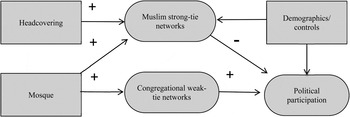
Figure 1 illustrates the theorized relationship between headcovering and formal political participation. It elaborates on the anticipated relationship between strong social ties created within Muslim friend networks, the weak ties in congregational networks facilitated by mosque attendance, and political participation.Footnote 4 Despite the arrows in Figure 1 suggesting a direct relationship between headcovering and Muslim friend networks and between networks and political participation, we want to be clear that headcovering and social network composition do not automatically link to one another in a sequential causal manner. Rather, we hypothesize a mediated relationship between headcovering and political participation: headcovering is a marker that orients integration into certain types of social networks, and the networks’ composition (i.e., strong vs. weak ties) conditions our respondents’ level of engagement with the American political system.
Flow chart of expected relationships.

MEASUREMENT AND METHODOLOGY
Our research design aims to model the dynamic process underlying our respondents’ political participation as it relates to their immediate and extended social environment. Importantly, we hypothesize that these social networks and political participation are conditioned through the practice of headcovering. The design draws on several variables derived from an online survey we conducted in 2012 across 1,917 women in 49 states. Participants were recruited for an online survey via snowball sampling by contacting more than 1,300 mosques, Islamic centers, Islamic organizations, Muslim Student Associations, and vendors of Islamic dress and headcoverings via email or online post across the 50 states (see Atkinson and Flint Reference Atkinson and Flint2001; Heckathorn Reference Heckathorn1997; Reference Heckathorn2002 re. “snowball sampling”). An online solicitation requested they forward the email and the survey link to Muslim-American women. Potential survey participants were provided with a website link to an online survey (see Appendix A for more details).Footnote 5
Because headcovering both influences and is influenced by the socio-political context, we model the indirect relationship between covering and our respondents' formal political participation via a simultaneous equation model. This model captures the simultaneous interdependence between the strong ties created by our participants’ religious friend networks, the lived experience of the headscarf that conditions their inclusion into such networks, and, ultimately, how the networks impact their formal political participation.Footnote 6 Furthermore, a simultaneous equation is less likely to result in the imposition of our biases on the data, because the models allow the data to reveal whether two dependent variables might simultaneously determine each other — the dependent variables from one equation are included as an independent variable in the other equation, allowing for simultaneous causation, rather than a uni-directional model with one exclusively dependent variable. Many scholars have suggested that social networks influence political behaviors, as we hypothesize, but it is also theoretically possible that political behaviors determine the strength of Muslim social networks. The simultaneous equations allow us to examine both of these possibilities.
Our model contains two equations: the first predicting the strong religious ties within our respondents' friend networks and the second predicting their formal political participation. We believe the headcovering mediates our respondents’ inclusion into specific friend networks, making the formation of strong ties more likely, and that it therefore indirectly impacts political participation. The endogenous variables are the friend networks and our indicators of formalized political participation, while the exogenous variables are composed of whether our respondents’ cover, our respondents’ reported mosque attendance, whether the respondent is a convert, and an array of control variables.Footnote 7
 $$\eqalign{& y_1\left( {\hbox{Muslim strong} - \hbox{tie Networks}} \right) \cr &= \gamma _1 {y_2} + {\rm \beta}_1\left( {\hbox{Predicted values for Formal Political Participation}} \right) \cr & \quad + {\rm \beta}_2\left( {\hbox{Headcovering}} \right) + {\rm \beta}_3\left( {\hbox{Mosque Attendance}} \right) \cr & \quad + {\rm \beta}_4\left( {\hbox{Religiosity Index}} \right) + {\rm \beta}_5\left( {\hbox{Convert}} \right) \cr & \quad + {\rm \beta}_6\left( {\hbox{Education}} \right) + {\rm \beta}_7\left( {\hbox{Employed}} \right) \cr & \quad + {\rm \beta}_8\left( {\hbox{Foreign Born}} \right) + {\rm \beta}_9\left( {\hbox{Married}} \right) + e} $$
 $$\eqalign{& y_2\left( {\hbox{Formal Political Participation}} \right) \cr &= \gamma _2 {y_1} + {\rm \beta}_1\left( {\hbox{Predicted values for Muslim strong-tie Networks}} \right) \cr & \quad + {\rm \beta}_2\left( {\hbox{Mosque attendance}} \right) + {\rm \beta}_3\left( {\hbox{Education}} \right) \cr & \quad + {\rm \beta}_4\left( {\hbox{African American}} \right) + {\rm \beta}_5\left( {\hbox{Age}} \right) \cr & \quad + {\rm \beta}_6\left( {\hbox{Employed}} \right) + {\rm \beta}_7\left( {\hbox{Foreign Born}} \right) + e}$$
In the first equation, the Muslim strong-tie networks are measured with an additive index combining our respondents' estimation of the proportion of their closest friend group that is Muslim, and the proportion of their closest friend group that wears a headcovering. Each variable is ranked on a five-point scale, resulting in an index with scores ranging from zero to eight, then standardized to range from 0–1.Footnote 8 While this measurement of strong ties is not ideal because the networks are anonymous, the inclusion of the phrase “closest friends” in the survey question allows the respondent to determine their own strong-tie network, and then designate the proportion that is Muslim and/or wearing a headcovering.
A facilitator of social networks is approximated with the frequency of mosque attendance. As indicated in Figure 1, mosque attendance can expose individuals to both weak and strong ties within the religious community. Mosque attendance can facilitate the creation and maintenance of strong ties as a person forms intimate friendships with people from the mosque community, and weak ties are generated from acquaintance relationships within the mosque and through the mosque's potential role as a social agent, connecting congregants to the wider community through service work, interfaith events, or community resources. We model the strong ties as mediated through our Muslim strong-tie network variable, and trust that the effect of weak ties would manifest in a more direct relationship with political participation. Therefore, we include it in both equations as a predictor of Muslim strong-tie networks and political participation. Like the measurement of Muslim strong-tie networks, the mosque measurement is imprecise.
Our primary independent variable in the first equation measures whether our individual respondents wear an Islamic headcovering or not.Footnote 9 We expect headcovering to be positively associated with the religious homogeneity of our respondents' friend networks (strong ties), due to its role as a group identifier and simultaneous marker of religious values. The equation also includes controls for whether the respondent is a convert, because converts to Islam should have less direct or immediate access to the familial or ethnic networks (strong ties) that connect an individual to Muslim networks. Finally, we control for individualized religiosity using an indexed variable composed of indicators reflecting whether our respondents eat pork, drink alcohol, perform daily prayers, and fast during Ramadan on a five scale from “never” to “always.” The inclusion of the index allows us to tease out whether headcovering proxies for religiosity or is capturing some other phenomena.
In the second equation of our model, political participation is captured through a series of binary variables reflecting whether our respondents’ voted in the 2008 and 2012 presidential elections, and whether they identified with any political party.Footnote 10 Sixty-five percent of our respondents reported voting in the 2008 presidential elections, while 72.7% voted in the 2012 presidential election. This is similar to general voting trends in the United States population where 63.6% of the population voted in 2008 presidential election and 61.8% voted in the presidential election of 2012 (McDonald Reference McDonald2013).Footnote 11
For our third measure of political participation, we measure whether our respondents identify with any political party, rather than measuring party identity through membership in the Democratic or Republican Party because our subjects who identify with a political party are almost universally Democrats. Previous research affirms that this party bias is not merely a feature of our data.Footnote 12 The policies following the events of September 11th and the subsequent perceived marginalization of Muslim-Americans by the Republican Party significantly reshaped their party support (Ayers Reference Ayers2007; Djupe and Green Reference Djupe, Green and Wilson2007). Recent scholarship on the political engagement of Muslim Americans demonstrates a shift from supporting Republican to supporting Democratic candidates after the 2000 presidential elections (Ayers Reference Ayers2007; Cho, Gimpel, and Wu Reference Cho, Gimpel and Wu2006; Baretto and Bozonelos Reference Barreto and Bozonelos2009; Djupe and Green Reference Djupe, Green and Wilson2007; Read Reference Read2007). In the 2000 presidential elections, 40% of Muslim Americans supported George W. Bush for president elect. By 2004, that number had dramatically shifted to only 7% of Muslims, while 86% supported presidential candidate, John Kerry (Ayers Reference Ayers2007, 191; Read Reference Read2007, 1075). Subsequent presidential elections have shown higher levels of support for the Democratic Party, which demonstrates a transition away from Muslims’ historical preference for more socially conservative policies (Baretto and Bozonelos Reference Barreto and Bozonelos2009; Bukhari and Nyang Reference Bukhari and Nyang2004; Council on American-Islamic Relations 2006; 2008; Cho, Gimpel, and Wu Reference Cho, Gimpel and Wu2006; Djupe and Green Reference Djupe, Green and Wilson2007; Pew Research Center 2007).
In spite of the shift away from the Republican Party, Muslim Americans do not feel sufficiently represented by the Democratic Party, either. Many Muslim-Americans opt not to identify with any party (Barreto and Bozonelos Reference Barreto and Bozonelos2009) despite reported rates of registration and voting that are comparable to the general public (Kohut, Keeter, and Smith Reference Kohut, Keeter and Smith2007). In fact, Barreto and Bozonelos (Reference Barreto and Bozonelos2009) find that religiosity influences political party identification differently in Muslims than in American Protestants, Jews, or Catholics — namely, it is associated with increased disaffection from the major parties. Both the Democratic and Republican parties are known to actively encourage Judeo-Christian religiosity while they are either silent on Muslim religiosity or sometimes even opposed to it, a dynamic underlining the lack of identification with either party by a growing number of Muslim Americans. This is reflected in our data where 31.25% of our total respondents (and 37.2% of covered participants) do not identify with either political party.
Table 1 illustrates the breakdown of the political participation dependent variables by headcovering behavior, revealing a turnout gap of approximately 10% and a party affiliation gap of approximately 8% between those who do and do not cover, a finding which affirms our expectations about the link between headcovering and political participation, at least at face value.
Headcovering and formal political participation

In the second equation, our primary variable of interest is the instrumented endogenous variable of Muslim strong-tie friend networks, modeled in the first equation. We include mosque attendance in this equation, anticipating that it captures weak ties within the congregation.Footnote 13 We also draw on a range of control variables from our survey to represent the political, religious, and social explanations for the Muslim strong-tie networks in our first equation and political participation in our second equation. Employment, whether our respondent was African-American, whether our respondent is married, and whether they are foreign born are all coded as dummy variables. Education is included in both equations, and measured with an 11-point scale for highest level of education completed. We expect employment and education to be negatively associated with the religious homogeneity of our respondents' friend networks, because employment or attending educational institutions generally exposes individuals to a wider variety of potential friends. They are both included in the second equation as a socio-economic controls. We control for whether our respondents identify as African American in the second equation due to the communities’ role in forging a racialized political Islam in the United States through the teachings of Elijah Mohammad and Wallace Fard Mohammad (Simmons Reference Simmons and Nieuwkerk2006). Whether a respondent is foreign born could matter for the religious homogeneity of our respondent's strong-tie friend networks if our respondent is connected to religious immigrant networks. Similarly, if our respondent has immigrated, they might not have the linguistic or cultural access to diverse weak-tie networks or avenues for political socialization. Whether our respondent is married is included in the first equation predicting religious homogeneity of strong-tie friend networks, because we expect marriage and family life to change the structure of a woman's social interaction. We expect marriage to be positively associated with the religious homogeneity of the woman's strong-tie friend networks, since the idea that “similarity breeds connection” may determine marriage and other important relationships (McPherson, Smith-Lovin, and Cook Reference McPherson, Smith-Lovin and Cook2001), and trends in increased interdependence between a husband and wife's social networks after marriage (Kearns and Leonard Reference Kearns and Leonard2004). Age, measured in years, is included in the second equation predicting political participation since the elderly are more likely to participate in formal politics in the United States (Campbell Reference Campbell2003).
Since our first equation contains an endogenous variable that is continuous and our second equation contains an endogenous variable that is discrete, we use a least squares regression and a probit least squares model, along with the Keshk (Reference Keshk2003) correction to obtain consistent estimates of the coefficients and correct for standard errors while estimating the simultaneous equations.Footnote 14
RESULTS
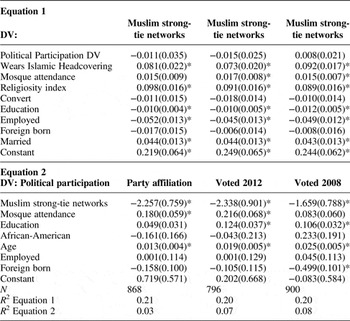
Table 2 displays the structural parameter estimates from the simultaneous equation models. We ran three models, represented in three columns, because we have three indicators of political participation. Within each column there are estimates from two equations that were run simultaneously. Equation 1 predicts the formation of Muslim strong-tie networks, while equation 2 predicts political participation.
Structural parameter estimates of simultaneous equation system (SIM)

*p < 0.05
Our findings confirm hypothesis one and demonstrate that the headcovering positively and significantly increases the likelihood of having more strong ties with Muslims across all three models. The relationship between headcovering and Muslim networks has the second highest magnitude of all the variables included in the model, and is independent of more generalized individual religiosity controlled for in the model featuring the religiosity index and mosque attendance. Being married shares a positive relationship with Muslim strong-tie networks. Higher levels of education and employment are negatively associated with the homogeneity of Muslim networks in all three models. Regular mosque attendance increases the likelihood of possessing more strong-tie Muslim networks across the two models in the first equation, even when controlling for individualized religiosity, which also shares a positive significant relationship with homogenous religious social networks. All of the statistically significant relationships confirm our expectations. Because our model is a reduced form equation, we do not attempt an interpretation of the results from Table 2.
When the membership in these Muslim networks is converted into an “endogenous” independent variable in the second equation, it has a statistically significant and negative impact on the likelihood of our respondents identifying with any political party and voting in the 2008 and 2012 presidential election. This finding confirms hypothesis two, which predicted that the relationship between Muslim strong-tie networks and political participation should be negative. We can confidently assert that the relationships are directional and not endogenous through the simultaneous equation model, as the instrumented endogenous political participation variables do not share a significant relationship with Muslim networks in any of the models.
Our results demonstrate that there is indeed an indirect process at hand, allowing the headscarf to serve as an entry point for our survey participants into strong-tie relationships with Muslims, and these same networks are negatively associated with political engagement in the second equation. The headscarf may help women identify like-minded people and form similar friend networks, but these networks most likely do not provide the benefits of weak-tie networks (wide-ranging information, diversity, learning, and opportunity) resulting in less political engagement overall.Footnote 15 Furthermore, perhaps the discrimination or marginalization of Muslims in the current political climate further contributes to a slight disengagement from the political system for those with more religiously homogenous friend groups and possibly motivates their inclusion in easily “identifiable” strong-tie networks.
Finally, our results confirm hypothesis three by revealing differences in the types and levels of associational life of our respondents and how they impact our respondents’ formal political participation. While the strong-tie Muslim friend networks have a negative impact on voting and party affiliation, weak ties formed via congregational networks measured through mosque attendance increase the likelihood of identifying with any political party and voting in 2012. This finding is confirmed in the literature that connects attendance of religious institutions with increased political participation (Calhoun-Brown 1996; Greenberg 2000; Jamal Reference Jamal2005a; Jelen 1991; Jelen and Wilcox Reference Jelen and Wilcox1995; Wilcox and Larson Reference Wilcox and Larson2006), and suggests that mosques, like churches and other religious organizations, can enhance political participation, especially if they promote the formation of weak ties with the wider community.
CONCLUSION
Within our sample of Muslim-American women we find evidence suggesting that the headcovering and mosque attendance can depress political engagement if they promote strong ties to a core in-group of co-religionists and friends, but they can facilitate political participation under conditions that promote ties to the wider Muslim and non-Muslim community. More diverse community ties enable individual access to networks, information, resources, and opportunities relevant for political mobilization. Therefore, anything that depresses these expansive social links (like discrimination or segregation, for example) may compromise political engagement.
Since the headcovering is a visual marker for Islamic identity, it potentially exposes covered Muslim women to social marginalization or even discrimination by non-Muslims. Of our covered survey respondents, some 69.57% reported experiencing non-Muslims behaving “differently” around them because of the headscarf. Consequently, women who choose to cover may be more likely to gravitate toward exclusively Muslim friend-groups in the face of growing Islamophobia, thereby impacting their political engagement. The insularity of these networks may be a product of outward hostility toward Muslims, rather than a natural impulse to form homogenous friend groups within a given religious community.
Despite our finding indirectly linking headcovering to reduced levels of political participation under specific social circumstances, we do not believe headcovering is a problematic practice within democratic society. Headcovering can be seen as a democratic action in itself, as an expression of free speech and religious practice. For Muslims, it is an external expression of their piety, though it also serves as a marker around which to integrate the wearer into a network of like-minded people. If a person's network is homogenous, there is a risk that political participation may be suppressed. This is where mosque attendance may be key. We find that the role of the mosque in promoting political participation varies depending on the structure of a congregant's social networks. Weak-tie congregational networks may increase political participation, while strong-tie networks may suppress it. In some ways this is akin to saying more diverse mosques promote political engagement, though more research on this subject is required.
Our findings on the effects of mosque attendance on political engagement could help explain the conflicting results on the mobilizing effect of Muslim-American religious institutions uncovered by Cho, Gimpel, and Wu (Reference Cho, Gimpel and Wu2006), Jamal (Reference Jamal2005a), and Djupe and Green (Reference Djupe, Green and Wilson2007). Ultimately, this article offers a correction to the general literature on congregational involvement. We suggest that a deeper analysis of the “strength” of congregants’ social networks would go a long way toward gauging whether and how religious institutions politically mobilize their adherents and hope our insights from the Muslim case will nuance further research across other religious minorities.
APPENDIX A. RESPONDENT SELECTION
This article uses data derived from an online survey we conducted in 2012 across 1,917 women in 49 states. We used a snowball sampling mechanism, which is a technique for finding research subjects by referral from one subject to the next (Atkinson and Flint Reference Atkinson and Flint2001; Heckathorn Reference Heckathorn1997; Reference Heckathorn2011). We adopted snowball sampling as our recruitment mechanism due to the difficulty of accessing Muslim-American populations. The American Census has no clear estimate on how many Muslims currently live in the United States since it does not collect religious data. Statistics on the size of the Muslim-American population are usually garnered from privately and publically administered surveys by organizations such as the General Social Survey (GSS), the Religious Landscape Survey by the Pew Research Group, the Gallup and newly IPSO Mori polling agencies, and many others with estimates ranging from between two to seven million Muslims. In 2011, the GSS ventured there were approximately 1.2 million Muslims while the Pew Research Group calculated some 2.75 million in the United States. The Council on American Islamic Relations put the number closer to 7 million (Simmons Reference Simmons2008; Pew Research Center 2011).
Participants were recruited for an online survey by contacting more than 1,300 mosques, Islamic centers, Islamic organizations, Muslim Student Associations, and vendors of Islamic dress and headcoverings via email or online post across the 50 states. An online solicitation requested they forward the email and the survey link to Muslim-American women. Potential survey participants were provided with a website link to an online survey.
Upon entering the survey via the link and consenting to be surveyed, participants were asked to identify themselves as either a Muslim man or Muslim woman. Only women were directed to the remainder of the survey. Survey participants were first led through a series of demographic questions, after which they were asked to agree or disagree with seven potentially controversial statements about covering one's head. They were then asked to identify whether or not they wear a headcovering. Twenty-two percent or 415 participants do not cover in our sample, while 77% or 1416 of respondents wear the headcovering. Those responding in the affirmative were directed to a number of questions about the practice of covering their head. Those who do not cover were directed to a series of questions about their personal history with the practice of headcovering. All respondents completed questions about the beliefs and practices of Islam and headcovering by friends and family members, and finished the survey with questions about their other Islamic practices. Questions about religiosity concluded the survey in order to avoid priming the responses to the earlier questions about headcovering.
Participants had the option to discontinue participation at any time during the survey. They were not required to answer every question. For some survey questions, nearly a quarter of our respondents did not provide any information. Because our statistical models may only include data for respondents with observations for each included variable, the number of respondents in the statistical models is typically substantially lower than 1,847 respondents.
APPENDIX B. COMPARISON OF SURVEY RESPONDENT CHARACTERISTICS TO THOSE FROM PEW SURVEYS
Though neither representative of the Muslim population generally nor conducted with a probability sample, our survey demographics compare favorably with the large-scale Pew Surveys of Muslim-Americans conducted in 2007 and 2011, which provide a validity check for our survey sample. In 2007 and 2011, The Pew Research Center conducted interviews with respectively 1,050 and 1,033 Muslim-American adults 18 years or older from a probability sample consisting of two sampling frames. Interviews were conducted by phone, and interview subjects were identified through random digit dialing (the list contained landlines for the 2007 survey, and landlines and cellular phones for 2011) and by re-contacting self-identified Muslim households from previous Pew studies. The Pew surveys set appropriate demographic benchmarks, because the Pew research design was careful to yield a probability sample, meaning that each adult in the United States had a known probability of being included in the sample, allowing for important statistical adjustments to make the sample representative. Pew estimates the sampling error of their interviews as ± 5%. We are able to isolate the female population for both studies. The 2007 study included 495 women out of 1,050 American-Muslim respondents. When the 2011 dataset was released, were be able to compare demographics of 495 American-Muslim women in 2007 with 461 women in 2011. In order to check the validity of our sample, Appendix C compares basic demographic information (age, education, employment, citizenship, marital status, and race) of our survey participants to information available to date of the nationally recognized 2007 and 2011 Pew Muslim-American Studies surveys.
Generally, the participants in our survey are slightly younger, more educated, more likely to be employed in part-time labor, and more likely to be United States citizens than the female participants of the previous studies conducted by Pew. African-American Muslims are significantly under-represented in our survey constituting only 8% of the sample, which is not reflective of their size in the general population, nor in the Pew or Gallup Surveys of Muslims. Conversely, the size of the white and Asian populations in our sample is over-represented, compared to the Pew samples. Gallup maintains the most numerous ethnic group among Muslim-Americans are African-Americans (35%), while according to Pew the plurality (over 30%) of their respondents identified themselves as “white” both in 2009 and 2011 (Hodges Reference Hodges2009; Keeter Reference Keeter2009). Ultimately, there is no clear consensus on the exact size of the specific ethnic groups underlying the Muslim-American population even across Pew and Gallup.
The differences in the demographic profile can be explained by several factors, the most important of which are likely attributable to the online survey method, which may not be equally accessible across all socio-economic and generational strata in the Muslim-American survey population. Online survey distribution requires potential participants to have access to a computer and the internet. According to the 2010 United States Census, populations under the age of 44 have wide access to the internet, and internet usage rises with both age and school enrollments as well as household incomes (United States Census 2010). This makes our relatively young survey respondents likely to have accessed our survey through their educational networks and/or their socio-economic positioning. For example, Muslim Student Associations provided frequent assistance in distributing our survey, leading to the overrepresentation of college-age survey participants.
APPENDIX C. COMPARISON OF SURVEY PARTICIPANT DEMOGRAPHICS TO PEW SURVEYS FROM 2007–2011