Introduction
The taxonomic position of Anoplotaenia dasyuri Beddard, Reference Beddard1911 (Cestoda) has been uncertain since its initial description by Beddard (Reference Beddard1911). Described from specimens collected from a deceased captive Tasmanian devil [Sarcophilus harrisii (Boitard, 1842)] at the London Zoo, characteristics of the cestode placed it close to Oochoristica Lühe, 1898, Taenia Linneaus, 1758 or Bertiella Stiles & Hassall, 1902 (Beddard, Reference Beddard1911). The lack of armature on the scolex was considered sufficient to place it in the Anoplocephalidae (Beddard, Reference Beddard1911), but it has since been placed in the Taeniidae (Baer, Reference Baer1925; Sandars, Reference Sandars1957; Beveridge et al., Reference Beveridge, Rickard, Gregory and Munday1975), although the development of the metacestode larval stage was more akin to the family Linstowiidae (Beveridge et al., Reference Beveridge, Rickard, Gregory and Munday1975).
Despite the accepted validity of Anoplotaenia Beddard, Reference Beddard1911 as a genus, it is currently listed as incertae sedis within the Cyclophyllidea (Jones et al., Reference Jones, Bray, Khalil, Khalil, Jones and Bray1994). An analysis, based on the morphological features of the development of the uterus, by Beveridge (Reference Beveridge, Combes and Jourdane2003), did not resolve the phylogenetic placement of the genus. The pattern of uterine development was closest to the Metadilepididae, although Beveridge (Reference Beveridge, Combes and Jourdane2003) noted that there were genera and species within the Paruterinidae and Gryporhynchidae that also had a similar pattern of development.
The Tasmanian devil is the largest living carnivorous marsupial and is restricted to the islands of Tasmania, Australia (Rose et al., Reference Rose, Pemberton, Mooney and Jones2017). Six species of cestodes have been reported from the Tasmanian devil, of which four species are most likely to have been introduced with their eutherian mammalian hosts when these were also introduced to Australia (Wait et al., Reference Wait, Peck, Fox and Power2017). The remaining two cestodes are A. dasyuri and Dasyurotaenia robusta Beddard, 1912. Anoplotaenia dasyuri usually occurs at high prevalence in Tasmanian devils but causes few pathological changes (Wait et al., Reference Wait, Peck, Fox and Power2017). Dasyurotaenia robusta, however, is rarely encountered and, like its host, is considered endangered (Wait et al., Reference Wait, Peck, Fox and Power2017).
Specimens of A. dasyuri were collected during a survey of the parasites of the Tasmanian devil. This manuscript details the molecular characterization of A. dasyuri for the first time and the results of phylogenetic analyses utilizing both the 18S and 28S rRNA sequences.
Materials and methods
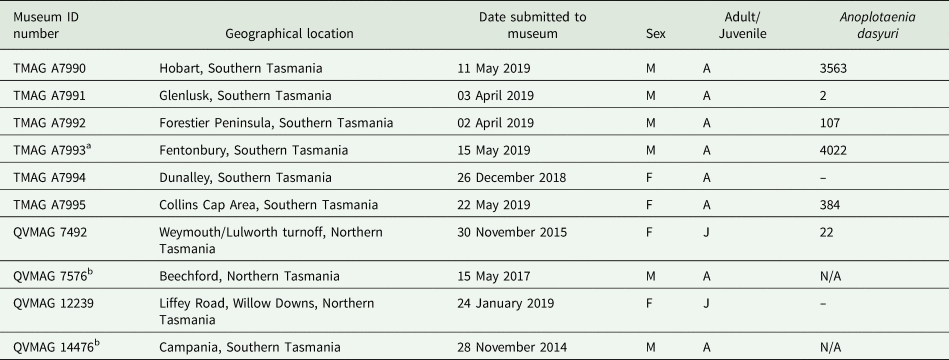
Road-killed Tasmanian devil carcasses had been opportunistically collected and donated to the Tasmanian Museum and Art Gallery, Hobart (TMAG) and the Queen Victoria Museum and Art Gallery, Launceston (QVMAG) from November 2014 to May 2019 (Table 1). Carcasses were frozen whole until they were made available for dissection in October 2019.
Collection information and cestodes collected for the Tasmanian devil carcasses examined in this study

a Devil was also infected with facial tumour disease.
b Specimen not dissected due to degradation of carcass.
A longitudinal incision was made from the neck area to pubis, exposing the abdominal and thoracic cavities. All internal organs and the alimentary system were removed, separated and examined under a dissecting microscope.
All parasites found were collected, individually counted and fixed in 70% ethanol. Parasite prevalence and mean intensity of infection were calculated as per Bush et al. (Reference Bush, Lafferty, Lotz and Shostak1997). At the time of examination, cestode specimens were individually counted and examined to ensure that there were no specimens of D. robusta, a rarely encountered cestode reported from Tasmanian devils previously. Representative specimens from each host were stained with Aceto-Carmine and mounted in Canada Balsam for examination under light microscopy. Specimens were identified based on morphological features identified in the literature (Sandars, Reference Sandars1957; Beveridge, Reference Beveridge, Combes and Jourdane2003). Illustrations were made using a drawing tube. Photographs of mounted specimens were taken using a 9-MP microscope digital camera (AmScope Model MU900).
All specimens were returned to their home institution, either TMAG or QVMAG (see Table 1).
Genomic DNA was isolated from samples using DNeasy Blood and Tissue Kits (Qaigen, Australia). The 28S rRNA region was amplified using primer pairs LSU-5m/ECD2m and 300Fm/1500Rm (Olson et al., Reference Olson, Cribb, Tkatch, Bray and Littlewood2003), while the 18S rRNA region was amplified using primer WormAm/1270Rm and 1100Fm/wormBm (Littlewood and Olson, Reference Littlewood, Olson, Littlewood and Bray2000). Cycling conditions for all polymerase chain reactions (PCRs) were 95°C denaturing for 3 min, followed by 40 cycles of 95°C for 30 s, 50°C for 30 s and 72°C for 45 s. The cycle was completed by a final extension at 72°C for 10 min.
PCR products were bidirectional Sanger sequenced by Australian Genome Research Facility (Brisbane). Sequences were quality checked and two sequenced fragments of the same gene region were assembled into a single sequence using SeqMan Pro. ver 8.1 (DNASTAR Inc.). The generated consensus sequences were aligned using BioEdit (Hall, Reference Hall1999) and primer sequences were removed for phylogenetic analysis.
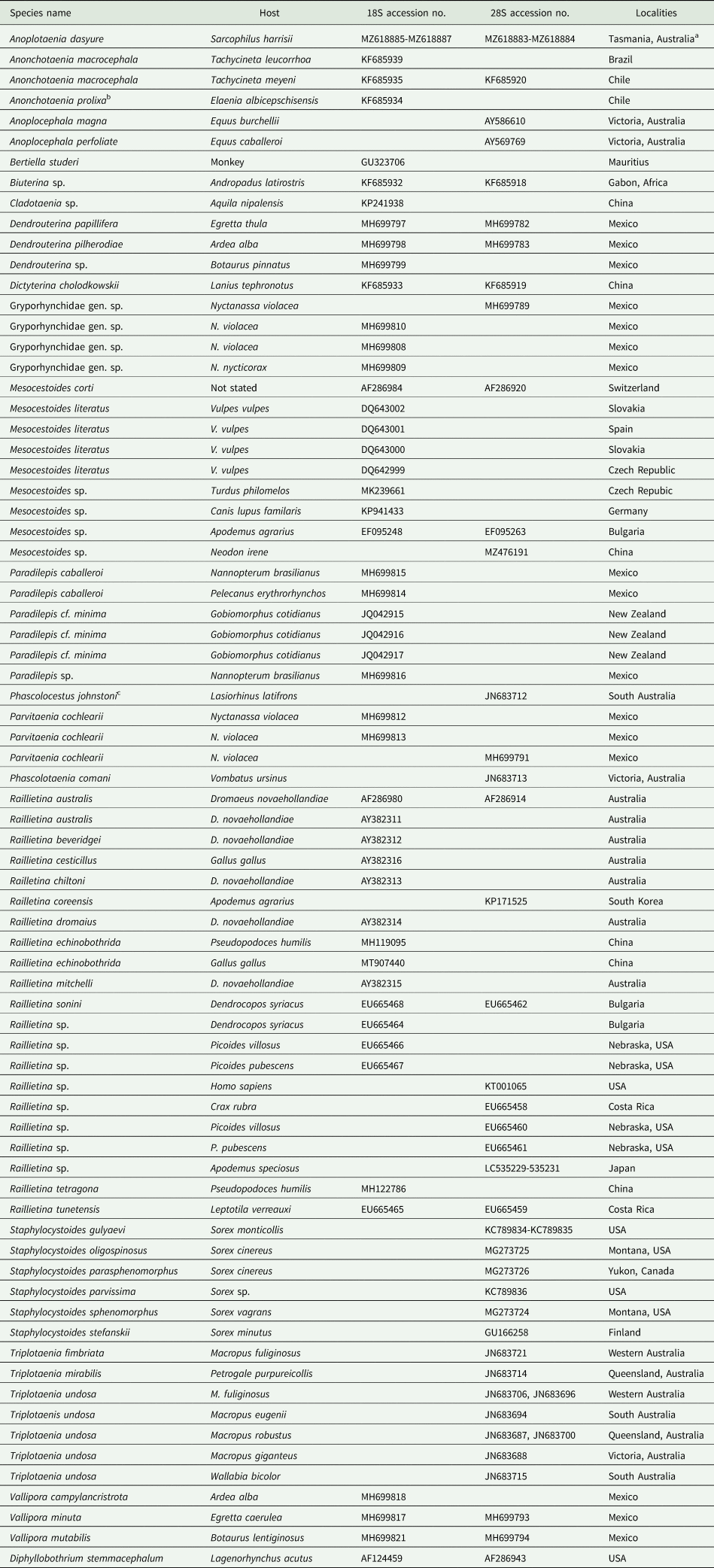
Representative sequences with comparable length of the order of Cyclophyllidea were downloaded from GenBank for phylogenetic analysis (Table 2). Diphyllobothrium stemmacephalum Cobbold, 1858 (AF124459 and AF286943), a species belongs to the order Diphyllobothriidea, but the same subclass of Eucestoda as Cyclophyllidea was selected as outgroup. MrBayes v 3.2.7 (Ronquist and Huelsenbeck, Reference Ronquist and Huelsenbeck2003) was used to calculate a Bayesian phylogenetic tree. The best fitted evolutionary model HKY + G and GTR + I + G for 18S and 28S rRNA sequences, respectively, were chosen by JmodelTest2 (Darriba et al., Reference Darriba, Taboada, Doallo and Posada2012). Parameters for Bayesian analysis were set at Temp = 0.01 for 4 000 000 generations until the average standard deviation less than 0.01. Other parameters were set as default. The first 50% samples from the Markov chain Monte Carlo algorithm were discarded as burnin. The tree was visualized using Figtree v 1.4.3 (Rambaut, Reference Rambaut2014). Posterior probabilities over 0.90 are shown on the nodes.
18S and 28S molecular sequences of cestodes used in this study

NA: not available.
a Sequences obtained in this study.
b Listed in Genbank as Anonchotaenia sp. but described as A. prolixa in Phillips et al. (Reference Phillips, Georgiev, Waeschenbach and Mariaux2014).
c Listed in Genbank as Paramoniezia johnstoni but changed to Phascolocestus johnstoni by Beveridge (2014)
Results
A total of 8100 (mean intensity 1012.5) cestodes were collected from six of the eight Tasmanian devils examined (Table 1). All cestodes encountered were identified as A. dasyuri, based on morphological features.
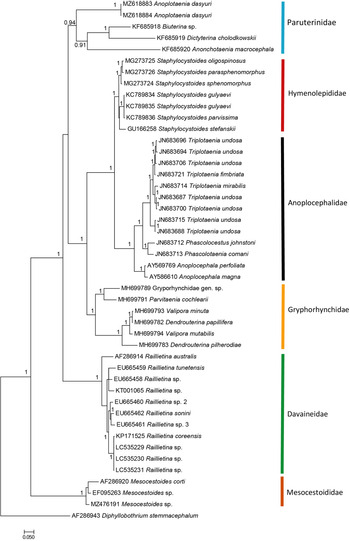
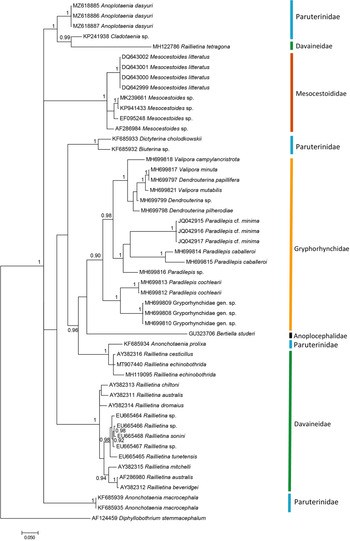
28S and 18S rRNA sequences were obtained from two and three specimens, respectively (Figs 1 and 2). All sequences of the same gene regions were identical. In both analyses, the sequences for A. dasyuri formed a clade separate from the other available sequences. Although not shown on the final phylogenetic trees due to distance between the groups, the sequences for A. dasyuri showed no similarity with cestodes from the family Taeniidae. The genetic distances of the sequences are shown in Supplementary Tables S1 and S2.
Phylogenetic analysis of the 28S rRNA sequences Anoplotaenia dasyuri and representative Cyclophyllidea species from GenBank.

Phylogenetic analysis of the 18S rRNA sequences Anoplotaenia dasyuri and representative Cyclophyllidea species from GenBank.

The phylogenetic tree of the 28S rRNA sequences placed A. dasyuri basal to the clade containing representatives of the Paruterinidae. All of the species included within the Paruterinidiae were collected from passerine birds (swallows and shrikes). The sister clade to this included the Hymenolepididae (collected from shrews), Anoplocephalidae (from wallabies and wombats) and Gryporhynchidae (fish eating birds). External to these clades were representatives of the family Davaineidae, all belonging to the genus Raillietina Fuhrman, 1920, which have been collected from a number of different bird groups (emu, currasow, dove and woodpecker) and mice. Representatives of the Mesocestoididae (collected from mammals) grouped separate to the rest of the families.
The phylogenetic tree of 18S rRNA sequences placed A. dasyuri closest to Cladotaenia sp., collected from an eagle from China. The other species included in this group was Raillietina tetragona (Molin, 1858), collected from a passerine bird in China. The species that had grouped with A. dasyuri in the 28S tree were now separated; however, no 28S genetic sequences of Cladotaenia Cohn, 1901 were available, which may impact the topology of the tree.
Within the remainder of the 18S phylogenetic tree, the families Paruterinidae and Davaeinidae were apparently polyphyletic, with representatives occurring in separate clades. Members of the genus Railletina, in particular R. tetragona, R. cesticillus Molin, 1858 and R. echinobothrida Mégnin, 1880, grouped with representatives of different families. All of these sequences have not been published to enable confirmation of the species identity through morphology.
In both analyses, the combined clades of Paruterinidae and Davaineidae were distinct from the remaining sequences of Gryporhynchidae, Mesocestoididae and Anoplocephalidae.
Discussion
This paper presents the first molecular sequences for specimens of A. dasyuri. Results of the phylogenetic analyses, using both 18S and 28S showed that A. dasyuri has its closest affinity with the family Paruterinidae, especially members of the genus Cladotaenia. However, the lack of available sequences for many members of this family prevents a conclusion that A. dasyuri belongs within the family Paruterinidae, although it is obviously closely related to it.
The family Paruterinidae is a heterogeneous group, unified by the possession of paruterine organs (Georgiev and Kornyushin, Reference Georgiev, Kornyushin, Khalil, Jones and Bray1994). A paruterine organ is a fibrous or granular appendage to the uterus that receives the eggs after fertilization and retains them in a common capsule (Georgiev and Kornyushin, Reference Georgiev, Kornyushin, Khalil, Jones and Bray1994). The possession of paruterine organs, however, is also found in representatives of a number of other families, including the Anoplocephalidae, Davaineidae, Mesocestoididae and Nematotaenididae (Foronda et al., Reference Foronda, Casanova, Valladares, Martinez and Felin2004). From the results of the analyses in this study, A. dasyuri is not a member of the Anoplocephalidae, Davaineidae, nor Mesocestoididae. Sequences of representatives of the Nematotaenididae were not comparable in gene region; therefore, the relationship between the Paruterinidae and the Nematotaenididae cannot be confirmed.
Members of the family Paruterinidae are primarily parasites of non-aquatic birds, although some species have been found in amphibians, aquatic birds and mammals (Georgiev and Kornyushin, Reference Georgiev, Kornyushin, Khalil, Jones and Bray1994). In the results for the 18S sequences, the included representatives of the family Paruterinidae were primarily collected from passerine birds, with the exception of Cladotaenia sp. which was collected from the steppe eagle [Aquila nipalensis (Hodgson, 1833)].
Beveridge et al. (Reference Beveridge, Rickard, Gregory and Munday1975) suggested that A. dasyuri was similar to Cladotaenia based on similarities in the larval stage, the metacestode. Additionally, members of Cladotaenia have a uterus with a median stem and lateral branches (Georgiev and Kornyushin, Reference Georgiev, Kornyushin, Khalil, Jones and Bray1994), which is similar to A. dasyuri (Beveridge, Reference Beveridge, Combes and Jourdane2003), although species of Cladotaenia do possess a paruterine organ (Georgiev and Kornyushin, Reference Georgiev, Kornyushin, Khalil, Jones and Bray1994), whereas A. dasyuri does not (Beveridge, Reference Beveridge, Combes and Jourdane2003). It has been recognized, however, that many of the morphological features used to classify cestodes appear to be due to convergent evolution (Georgiev and Kornyushin, Reference Georgiev, Kornyushin, Khalil, Jones and Bray1994; Rausch, Reference Rausch, Khalil, Jones and Bray1994; Beveridge, Reference Beveridge, Combes and Jourdane2003; Foronda et al., Reference Foronda, Casanova, Valladares, Martinez and Felin2004) and that most families are polyphyletic in origin (Beveridge, Reference Beveridge, Khalil, Jones and Bray1994; Bona, Reference Bona, Khalil, Jones and Bray1994; Georgiev and Kornyushin, Reference Georgiev, Kornyushin, Khalil, Jones and Bray1994; Jones and Bray, Reference Jones, Bray, Khalil, Jones and Bray1994).
Anoplotaenia dasyuri is unique to Australia and is found in a number of carnivorous marsupials, as well as in feral cats and rural dogs in Tasmania (Gregory et al., Reference Gregory, Munday, Beveridge and Rickard1975). The life cycle of A. dasyuri involves the metacestode larval stage in the muscles, heart and lungs of various medium-sized macropodids [but especially Notamacropus rufogriseus (Desmarest, 1817) and Thylogale billardieri (Desmarest, 1822)] (Gregory et al., Reference Gregory, Munday, Beveridge and Rickard1975). Metacestodes collected from the now-extinct Tasmanian tiger, Thylacinus cynocephalus (Harris, 1808), were originally identified as Dithyridium cynocephali Ransom, 1905, but were found to be morphologically indistinguishable from metcaestodes of A. dasyuri (Obendorf and Smith, Reference Obendorf and Smith1989). However, without either experimental infections (now impossible) or genetic verification (highly unlikely) confirmation of this is unavailable (Obendorf and Smith, Reference Obendorf and Smith1989). Interestingly, metacestodes of A. dasyuri have never been reported from Tasmanian devils (Obendorf and Smith, Reference Obendorf and Smith1989), although metacestodes, identified as Cladotaenia were listed from the related Dasyurus hallucatus Gould, 1842 (northern quoll) (Spratt and Beveridge, Reference Spratt and Beveridge2016). No other metacestodes of Cladotaenia were reported from any Australian marsupials or monotremes by Spratt and Beveridge (Reference Spratt and Beveridge2016), potentially indicating that other mammals, such as rodents, are more likely to be acting as intermediate hosts.
Three possible sources of A. dasyuri in carnivorous marsupials in Australia have been variously postulated (Beveridge et al., Reference Beveridge, Rickard, Gregory and Munday1975). Firstly, A. dasyuri evolved from cestodes (most likely Anoplocephalidae) from an original didelphoid ancestor. This was discounted as A. dasyuri has no obvious anoplocephalid characteristics and is supported in this study by the fact that the anoplocephalid cestodes formed separate clades distinct from A. dasyuri. Spratt and Beveridge (Reference Spratt and Beveridge2016), in fact, found that no ancestral carnivorous or omnivorous marsupial group, such as the Dasyuroidea, are known to harbour any anoplocephaline cestode.
The second theory involved a eutherian mammal, infected with an ancestor to A. dasyuri, having contact with ancient marsupial carnivores on the Gondwanan landmass prior to the separation of the Australian continent (Beveridge et al., Reference Beveridge, Rickard, Gregory and Munday1975). A similar theory was presented by Sprent (Reference Sprent1970) for the origins of the ascarid nematode, Baylisascaris tasmaniensis, also a parasite of the Tasmanian devil, whose closest relations are in eutherian mammals of the families Mustelidae, Ursidae and Procyonidae, none of which occur on the Australian continent today (see Sprent, Reference Sprent1970). However, the majority of the closely related cestodes in the results presented in this study were primarily parasites of birds, with a few species parasitic in rodents. The Taeniid cestode parasites of eutherian carnivores, all of which have been introduced to Australia (Rausch, Reference Rausch1985), were found to be very distantly related to A. dasyuri in the results of this study, thus failing to support the second theory of Beveridge et al. (Reference Beveridge, Rickard, Gregory and Munday1975).
The third theory (Gregory et al., Reference Gregory, Munday, Beveridge and Rickard1975) suggested that, once Australia was an isolated continent, there was a transfer of cestodes from a completely unrelated group of animals to the carnivorous marsupials, similar to that suggested for Anoplocehaline cestodes by Hardman et al. (Reference Hardman, Haukislami and Beveridge2012). Beveridge et al. (Reference Beveridge, Rickard, Gregory and Munday1975) suggested that cestodes from accipitiform birds, which utilize small mammals as intermediate hosts, were probably the origin. The results of this study support this theory as the closest related species, in the 18S analysis, was Cladotaenia sp., a parasite of an eagle from China.
Few cestodes have been reported from birds of prey in Australia and of those identified to genus, Cladotaenia sp. has been reported from harriers and falcons in southern Australia (but not Tasmania) (Mawson et al., Reference Mawson, Angel and Edmonds1986). A number of unidentified cestodes, however, are also listed from various birds of prey (Mawson et al., Reference Mawson, Angel and Edmonds1986), although there does not appear to be any recent work on the cestodes of this host group in Australia. Of the birds of prey present in Tasmania, the wedge-tailed eagle, Aquila audax (Latham, 1801), is most similar to the Tasmanian devil, overlapping in diet, with both consuming medium and large-sized mammals, as well as carrion (Olsen et al., Reference Olsen, Judge, Fuentes, Rose and Debus2010; Rose et al., Reference Rose, Pemberton, Mooney and Jones2017).
Whatever the origin of A. dasyuri in the Tasmanian devil, it is obviously a successful parasite of this host, with high intensity infections common, but without any reported pathological changes associated with the infections (Gregory et al., Reference Gregory, Munday, Beveridge and Rickard1975; Wait et al., Reference Wait, Peck, Fox and Power2017; Peck et al., Reference Peck, Michael, Knowles, Davis and Pemberton2019; this study). In this study, Tasmanian devils collected from the southern part of Tasmania (TMAG) were more heavily infected than the northern devils (QVMAG). However, this data is from a small host sample and it is possible that different host collection methodologies (two of the four Tasmanian devils collected by QVMAG were too decomposed for examination) may have impacted the infection levels.
The phylogenetic patterns found in the remainder of the trees were similar to previous studies (Al-Quraishy et al., Reference Al-Quraishy, Abdel-Gaber, Dkhil, Abdel-Baki, Alotaibi, Alhafidh and Al-Houshany2020), with Cladotaenia sp., Dictyterina cholodkowskii (Skrjabin, 1914), Biuterina sp. and Anonchotaenia macrocephala Fuhrmann, 1908 separate to species of Raillietina. However, there was inconsistency in the patterns between the two phylogenetic trees. For the 28S tree, An. macrocephala, D. cholodkowskii and Biuterina sp. all grouped in a single clade with A. dasyuri; as discussed above, however, no 28S sequences for Cladotaenia sp. were available for comparison. For the 18S tree, Cladotaenia sp. grouped with A. dasyuri and the other sequences were separate. The few sequences of members of the Paruterinidae available prevents a meaningful conclusion on the relationships within this family.
Raillietina is a large group with a complicated taxonomic history (Jones and Bray, Reference Jones, Bray, Khalil, Jones and Bray1994), however a number of sequences utilized in the phylogenetic analyses in this study have been mis-identified and require re-examination/re-identification. Raillietina tetragona (18S; MH122786) collected from a small passerine bird [Pseudopodoces humilis (Hume, 1871)] from China (unpublished sequence) was placed with Cladotaenia sp., clearly separated from the other sequences of Raillietina. The sequences for Raillietina echinobothrida [18S; MH119095 from P. humilis, China; MT907440 from Gallus gallus (Linneaus, 1758), China] both placed in a clade with Raillietina cesticillus (AY382316 from G. gallus, Australia) and Anonchotaenia prolixa Phillips, Georgiev, Waeschenbach and Mariaux, Reference Phillips, Georgiev, Waeschenbach and Mariaux2014 (KF685934 from Eleania albiceps chilensis Hellmayr, 1927 from Chile). Anonchotaenia prolixa was considered unique among the Anonchotaenia Cohn, 1900 due to the possession of an armed cirrus (Phillips et al., Reference Phillips, Georgiev, Waeschenbach and Mariaux2014). The R. tetragona and R. echinobothrida specimens are from unpublished studies and the identification technique for R. cesticillus was not stated (O'Callaghan, Reference O'Callaghan2004). Thus, it is possible that these specimens were mis-identified and could belong to a different genus, the latter grouped with An. prolixa, for which sequences were obtained from published described specimens. Raillietina cesticillus has been classified within the subgenus Skrjabinia Fuhrmann, 1920, which was raised to generic level by Jones and Bray (Reference Jones, Bray, Khalil, Jones and Bray1994), although this is often not recognized (Sapp and Bradbury, Reference Sapp and Bradbury2020). The grouping of these sequences of R. cesticillus with the R. echinobothridia, separate to the other Raillietina species, needs to be further examined to determine if Skrjabinia may be valid. Although it is possible that these specimens show the potential polyphyly of Raillietina, the lack of published sequences with corresponding specimens for re-examination is worrying. In a group of parasites with such a complicated and confused history, an identification of a cestode cannot be taken for granted and must have a corresponding morphological specimen for confirmation. Until these identifications of the Raillietina spp. can be confirmed, these sequences should be treated as mis-identifications.
This study has provided the first-genetic sequences for A. dasyuri collected from Tasmanian devils and has placed the genus close to the family Paruterinidae with regards to its phylogenetic relationships. This placement corresponds with previous suggestions raised from morphological and life cycle studies. However, much more work is required on the sequencing of cestodes from many of the families discussed in this manuscript.
The combination of an unusual host type (carnivorous marsupial) and an isolated location [Tasmania, following extinction from the Australian mainland approximately 3000 years ago (Rose et al., Reference Rose, Pemberton, Mooney and Jones2017)] appears to have created a unique environment for the parasites of the Tasmanian devil and have also created a unique dilemma for determining their origins and phylogenetic positions. For example, the nematode, B. tasmaniensis Sprent, Reference Sprent1970, is also a common parasite of the Tasmanian devil and is also an anomaly (Sprent, Reference Sprent1970). All other members of Baylisascaris are parasites of eutherian mammals (Sprent, Reference Sprent1970). The possible evolutionary history of B. tasmaniensis in the Tasmanian devil remains unknown (Sprent, Reference Sprent1970). Additionally, an oxyurid nematode, Sarcophiloxyuris longus Barton, Smales & Lee, Reference Barton, Smales, Lee, Zhu and Shamsi2021, was reported from the same Tasmanian devil specimens as examined in this study (Barton et al., Reference Barton, Smales, Lee, Zhu and Shamsi2021). Oxyurid nematodes are common parasites of herbivorous marsupials, but this was the first record from a carnivorous marsupial.
Supplementary material
The supplementary material for this article can be found at https://doi.org/10.1017/S0031182021001499
Data
Availability of data and material: Specimens have been deposited in recognized museum collections; molecular sequences have been deposited in GenBank.
Acknowledgements
The authors are indebted to Belinda Bauer (TMAG), Sarah Peck (Department of Primary Industries, Parks, Water and Environment, Tasmania) and David Maynard & Judy Rainbird (QVMAG) for access to Tasmanian devil specimens and facilities for dissection of specimens. This project was undertaken as part of an Honours project (VL). No approval of research ethics committees was required for this study as all specimens had been collected previously.
Author contributions
DPB, SS and VL conceived and designed the study. DPB and VL conducted data gathering. XZ and VL conducted genetic analyses. All authors contributed to the writing of the article.
Financial support
This project was partly funded by Charles Sturt University (A512-828-xxx-66770 awarded to SS).
Conflict of interest
The authors declare that they have no conflicts of interest or competing interests.
Ethical standards
As the Tasmanian devil specimens had been previously collected by registered museums, no animal ethics permit was required.