




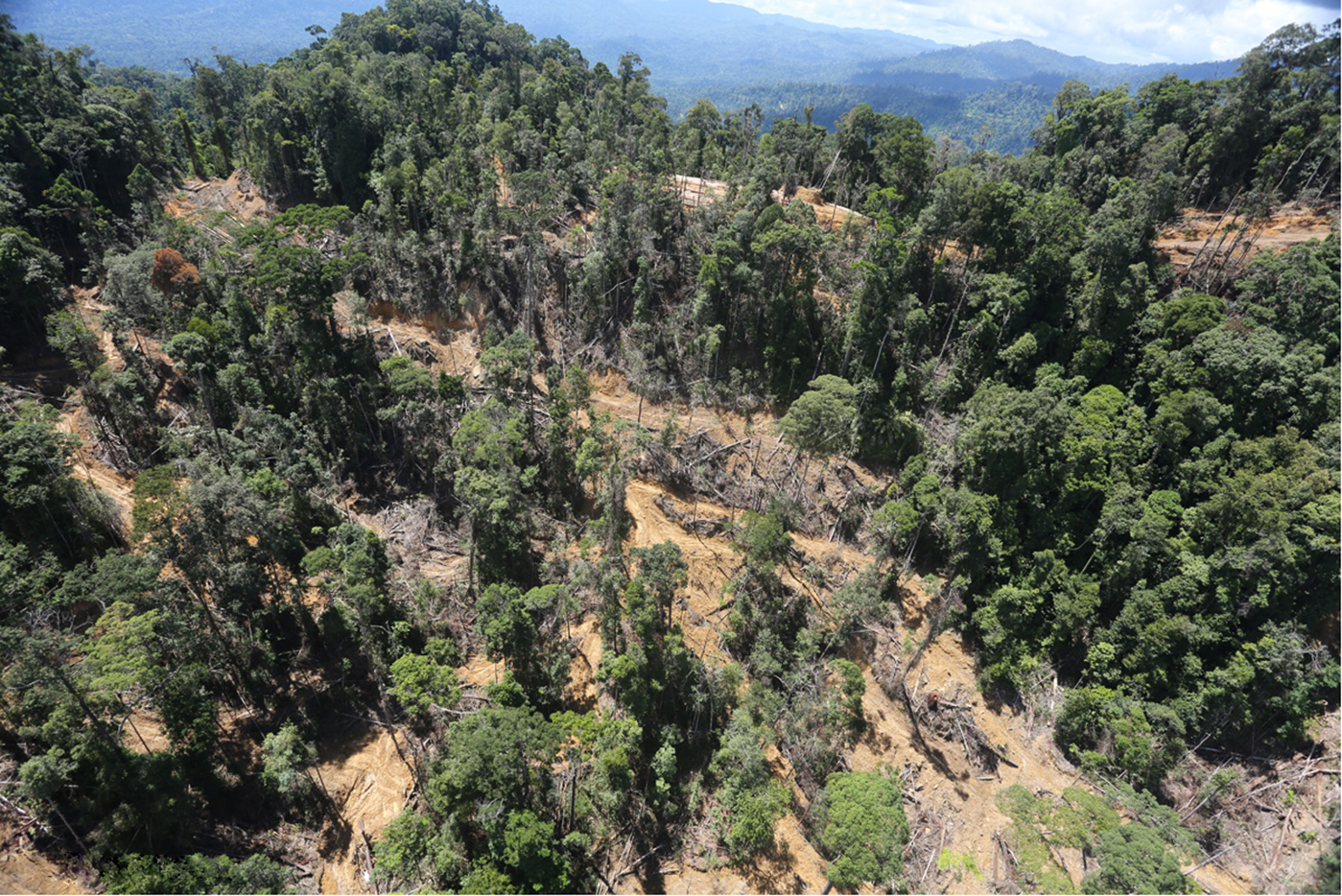
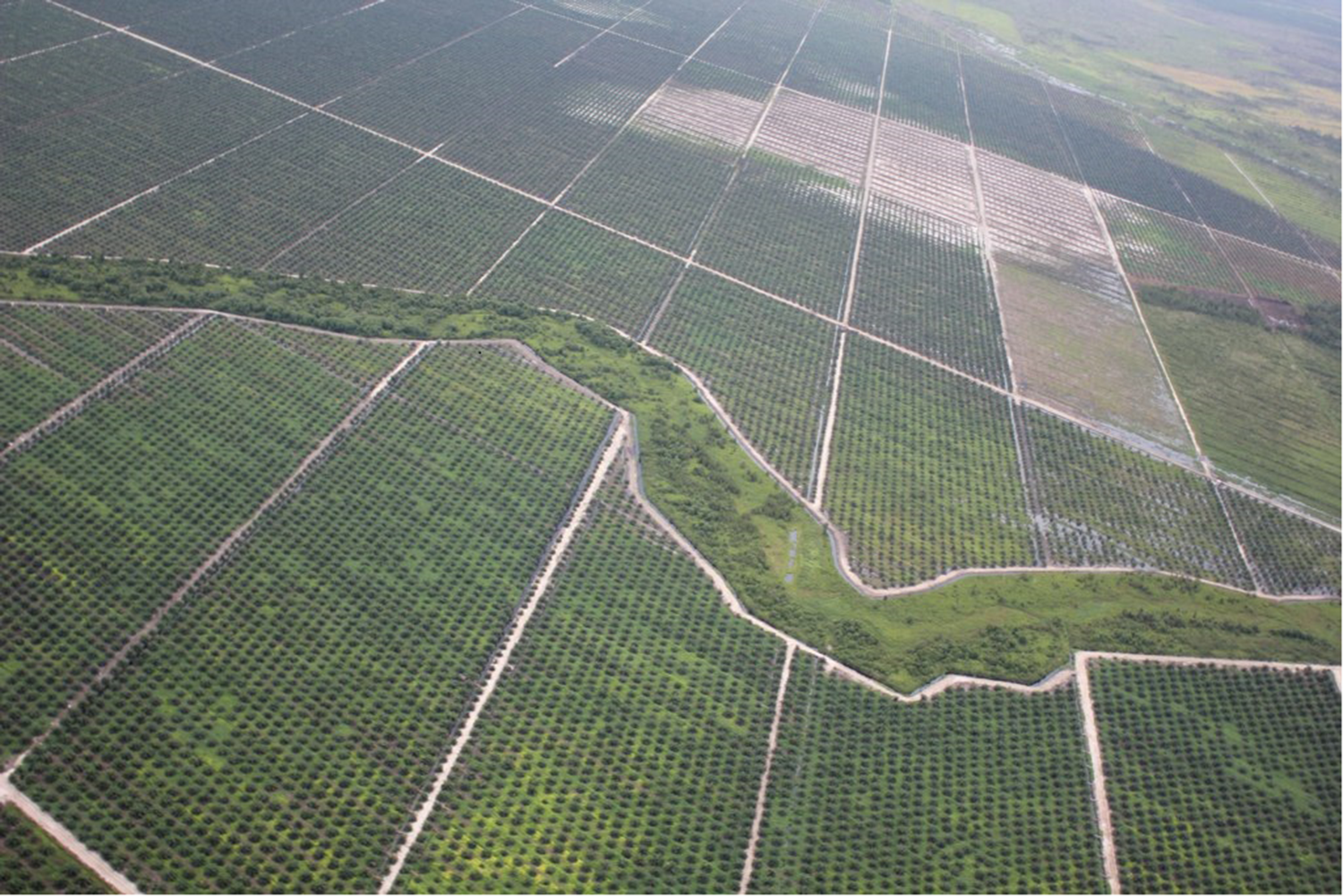
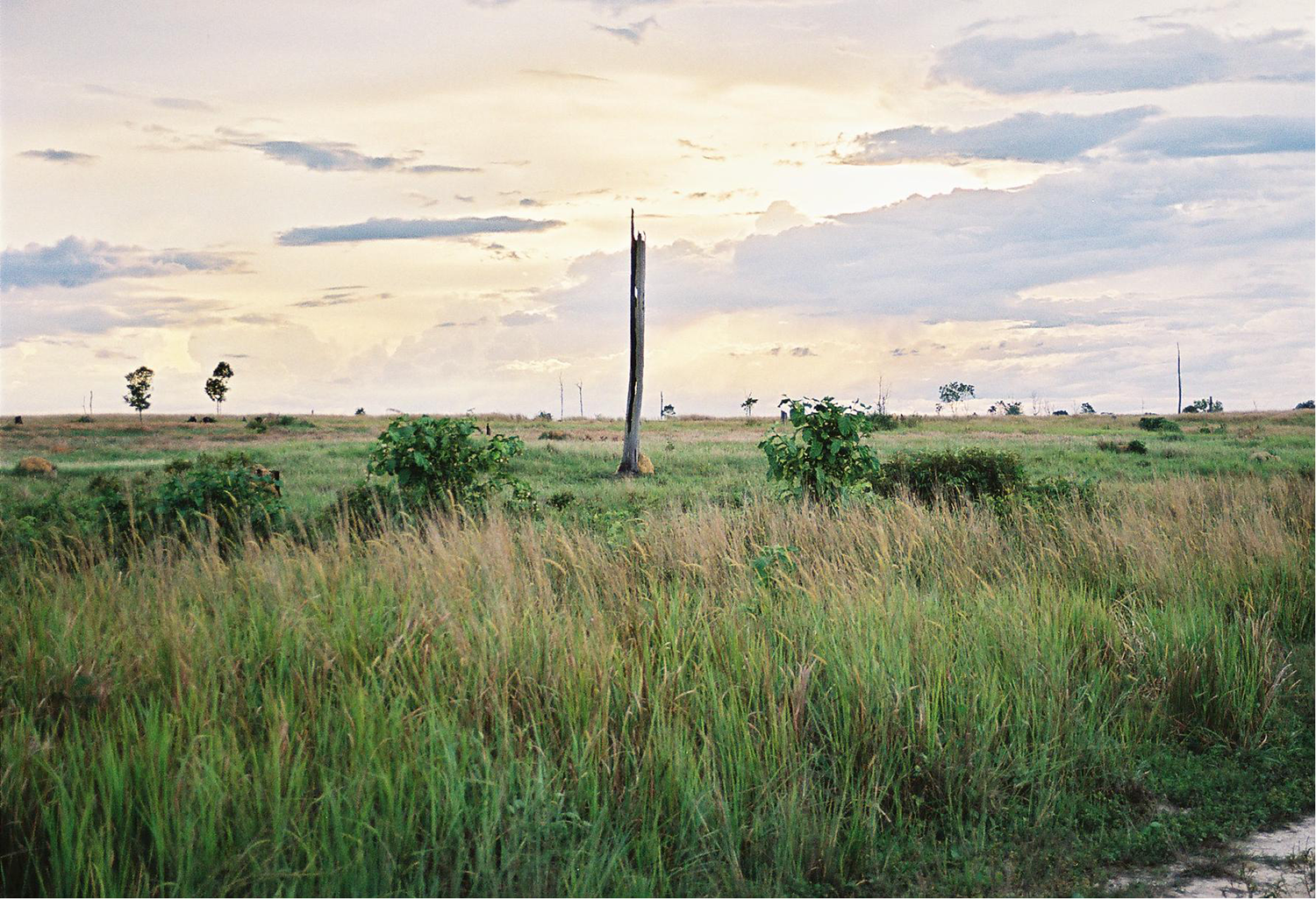
The name of Borneo may still have connotations of exotic wilderness, but in reality the majestic rainforests which blanketed the world’s third largest island half a century ago are now mostly gone. In their place are new anthropogenic landscapes: earth-scarred remains of recently logged forest; silent, geometrically arrayed oil palm monocultures; fire-climax scrub- and grasslands; black open-cast coal pits in different stages of exploitation and abandonment; processions of giant coal barges on muddy rivers; towering hydroelectric dams (Figures 1, 2, 4, 5, 6, 8). And tucked away in the shrinking remnants of forest: animal rehabilitation centres, eco-tourism lodges, and cameras placed by researchers to record the passage of ever-scarcer fauna. Borneo is a microcosm and symbol of the world’s rush into an anthropocene era: a future in which what now remains of wild nature is either swept away by human activity, or reduced to reservations that survive only thanks to human restraint. Borneo is also a key battleground in the ethical and political struggle to induce people to show such restraint.
Logged forest in Sabah. Rhett Butler, 8 Nov. 2012 (by permission)

Figure 1 Long description
The image shows an aerial view of a forested area with visible signs of logging. There are scattered trees remaining amidst cleared patches of land. The terrain appears uneven, with some areas showing exposed soil and others covered with vegetation. The background includes distant mountains under a clear sky, providing a sense of depth to the landscape.
Recently planted oil palm plantation in Central Kalimantan. Glenn Hurowitz, 28 Feb. 2012

Figure 2 Long description
The image shows an aerial view of a recently planted oil palm plantation. The landscape is organized into geometric rows, creating a grid-like pattern across the area. A winding path or waterway runs through the plantation, dividing the rows of palm trees. The surrounding area includes patches of different vegetation and terrain, indicating variations in land use or natural features.
The environmental importance of Borneo is well known. The island is richer in plant species than the whole of Africa, and a single hectare of its rainforest typically contains more tree species than the British Isles.Footnote 1 Although smaller in area than the equatorial forests of the Amazon and Congo basins, its importance as a reservoir of carbon and generator of rainfall, and therefore for limiting global climate change, is great. Per hectare, Borneo‘s rainforests produce 50 per cent more wood, and cycle 50 per cent more carbon, than their counterparts in Amazonia.Footnote 2 The story of their loss is an important part of the global story of how we are not being good ancestors to future generations. It is also a story of waste and injustice. Much of the timber from the often centuries-old trees felled in Borneo was made into plywood panels used for moulding concrete on Japanese construction sites, where it was thrown away or burned after two or three uses.Footnote 3 Scores of people have been killed or wounded on Borneo in hundreds of conflicts between palm oil companies and local people over land.Footnote 4 When Indonesia’s top palm oil magnate Eka Tjipta Widjaja, founder in 1962 of the Sinar Mas group of companies, died in Jakarta in 2019, his personal net worth was estimated at more than eight billion US dollars.Footnote 5
Environmental degradation in Borneo is the subject of much media attention and, wholly or in part, of many publications, reports and policy documents.Footnote 6 However, the literature is mostly fragmented. An exception is Chun Sheng Goh and Lesley Potter’s recent Transforming Borneo (2023), with its informative background chapter sketching major trends of the period 1970–2020 from a geographical and statistical perspective.Footnote 7 Our overview aims to complement theirs by telling the same story as history, with particular attention to human institutions, actors, and choices, and to the reasons for those choices. It is an unvarnished narrative and a political one, with an eye for vested interests and for the individuals and organisations both driving and resisting environmental change. To that end we make much use of sources produced by civil society groups such as Greenpeace, and of critical journalism such as that of the conservation news portal Mongabay. While not always balanced, these are invaluable for their willingness to name people and organisations where official and academic sources often prefer to deal in policies and abstractions.Footnote 8
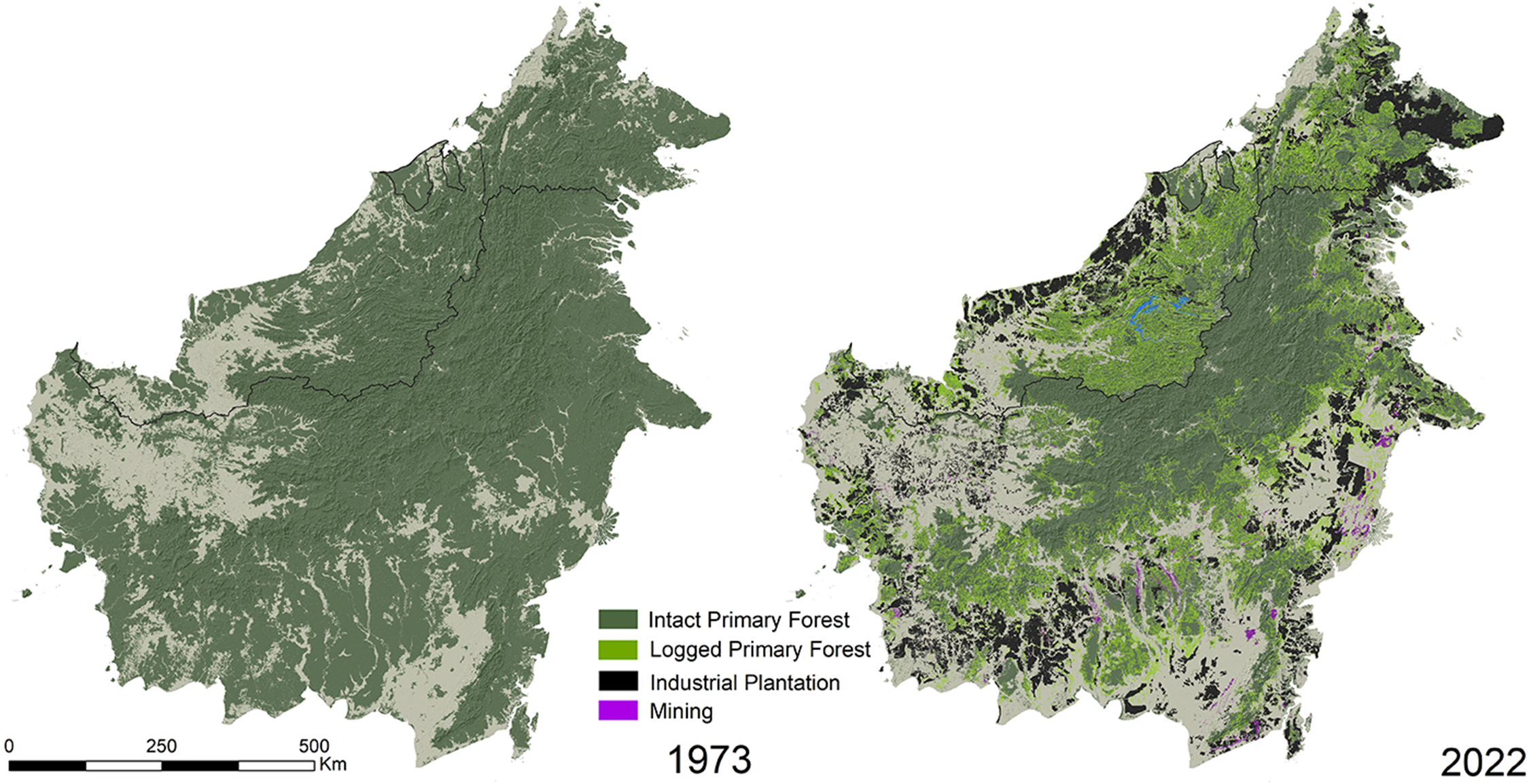
The structure of the article is partly chronological, partly thematic. Individual sections deal with, among other things, logging, fires, land grabbing, popular resistance, the internationalisation and monetisation of conservation, the uneven slowdown of environmental change since the turn of the millennium, and the current prospect. We attempt to cover the whole of Borneo, including Indonesian Kalimantan and the Malaysian states of Sarawak and Sabah, highlighting parallels between their trajectories. We note an important contrast with that of Borneo’s fourth political unit, the small sultanate of Brunei Darussalam, where deforestation has been more limited. The chronology begins around 1970 with the onset of the modern timber boom; the much slower deforestation of about one quarter of the island that took place in earlier times, mostly as a result of traditional shifting cultivation in combination with forest fires and grassland burning, is not described.Footnote 9 Land cover maps based on satellite imagery are available for the whole island from 1973 onward, and we include the earliest and the most recent (2022) of them here as points of reference for the narrative (Figure 3).
Borneo: land cover, 1973 and 2022. Compiled from remote sensing sources by David Gaveau/Nusantara Atlas. Industrial plantations (black) include oil palm and pulpwood (mainly acacia and eucalyptus species) monocultures. The Bakun and Murum dams (Sarawak) are shown in blue. In the absence of more recent digitalisation of data on logging roads, the boundaries between intact and logged primary forest on the 2022 map refer to the situation in 2010 - see Gaveau, ‘Four decades of forest persistence, clearing and logging’, Figure 3. This means that the area of still intact primary forest is to some extent exaggerated here; see, however, the main text of the present article under the headings ‘Internationalisation’ and ‘Slowdown’

Figure 3 Long description
A) The map from 1973 shows Borneo's land cover with a focus on intact primary forest, which dominates the landscape. The legend indicates intact primary forest in dark green, with no other categories visibly marked. B) The map from 2022 illustrates significant changes in land cover. The legend includes intact primary forest (dark green), logged primary forest (lighter green), industrial plantations (black) and mining areas (purple). Intact primary forest is concentrated in the central and northern regions. Logged primary forest is widespread, particularly in the southern and eastern areas. Industrial plantations are scattered, with notable concentrations in the western and southern parts. Mining areas are marked in purple, appearing in isolated spots across the map. The scale bar at the bottom left indicates distances in kilometers, providing a reference for spatial extent.
In disciplinary terms the article represents an intersection between our respective areas of expertise: area studies and historical geography (Henley); landscape ecology and geospatial analysis (Gaveau); and forest management and conservation planning (Meijaard). As a case study in Southeast Asian environmental history it follows in the tradition of the EDEN research project, dealing with the period from 1500 to 1950, in which Henley participated.Footnote 10 Its substance and tone however reflect the great acceleration of environmental change since 1950, the rise of environmental planning and activism, and the use of sources, such as satellite imagery and environmental journalism, not available for earlier periods. In its critical aspect and frank attention to ethical issues, our piece also reflects a tradition of critical scholarship on environmental topics within Southeast Asian Studies.Footnote 11
The main argument is as follows. In the 1960s the emergence of a large and profitable international market for tropical timber changed the ecological fate of Borneo. The very slow rate of natural renewal of this resource — the ‘tyranny of time’, as geographer Ooi Jin Bee put it — made it impractical for commercial interests to attempt to manage it sustainably.Footnote 12 Timber miners rather than foresters, they treated the boom as a gold rush. The logic of deforestation became the more compelling when the possibility of converting forest to fast-growing oil palm and pulpwood plantations raised the opportunity costs of leaving trees standing. Governments, meanwhile, succumbed to the same logic, the more so as their interests became intertwined with those of commercial actors and they took on the character, on both sides of the border, of resource oligarchies.
Twenty years ago one of the present authors (Henley), in a broad survey of lessons for natural resource management from Indonesian history, concluded that ‘when it comes to forestry and nature conservation, there is no detour around a capable state’.Footnote 13 If that had remained true, then the prospects today would be truly desperate. In recent years, however, partial detours around the limited capabilities of the Malaysian and Indonesian states in this domain have after all appeared as a result of globalisation. Consumer behaviour and trade policies in developed countries, influenced by international conservation groups, have put commercial pressure on companies operating in Borneo to desist from forest destruction. International civil society has supported local movements on the island that oppose deforestation. Concerns about climate change and biodiversity have led the international community to provide the Indonesian and Malaysian governments with financial incentives to take forest protection more seriously.
This multi-pronged globalisation and monetisation of conservation is one reason why a slowdown in the rate of forest loss has taken place since the beginning of the twenty-first century. However, a geographic and economic factor, the near-exhaustion of unlogged forest in accessible lowland areas, and the growing scarcity of land suitable for conversion into oil palm or wood fibre plantations, is also at work here. The conservation standoff is in any case fragile, and Borneo is not yet approaching a point of forest transition at which the deforestation trend reverses. Even if some ecosystem restoration can now be envisaged, the fact that it seems most likely to take place under the ‘stewardship’ of big business raises uncomfortable ethical and political questions.
Compression
In 1973, three quarters of Borneo was still covered with primary or old-growth forest: a rainforest approximately the size of France. By 2022 more than a third of this forest, an area larger than Greece, had been completely cleared of trees, and another third degraded by selective logging. As a result, less than a third of the forest that existed 50 years ago, and less than a quarter of the island’s total area, remains in intact, unlogged state. Even including selectively logged forests, less than half of Borneo is now forested (Figure 3).Footnote 14 Of the richest ecosystems, the lowland rainforests below 500 metres, only fragments still exist in unlogged condition.
Developed countries, as political and business leaders in Indonesia and Malaysia are quick to point out, have destroyed their forests too. In 1987, Malaysian prime minister (1981–2003) Mahathir Mohamad wrote to a ten-year old British child who had sent him a letter protesting rainforest destruction that the adults who had ‘used’ the boy, rather than criticising Malaysia, ‘should expel all the people living in the British countryside and allow secondary forests to grow and fill these new forests with wolves and bears’.Footnote 15 But the analogy was not entirely convincing. In Borneo a process which in Europe had taken millennia was compressed into two generations, and at the cost of richer and more diverse ecosystems, and in a time of much greater awareness of their value, and most likely with more unequal distribution of the spoils. A generation on, we may also wonder whether Malaysians will ever come to regard the green desert of their oil palm plantations with the same affection felt in Britain for (parts of) the British countryside.
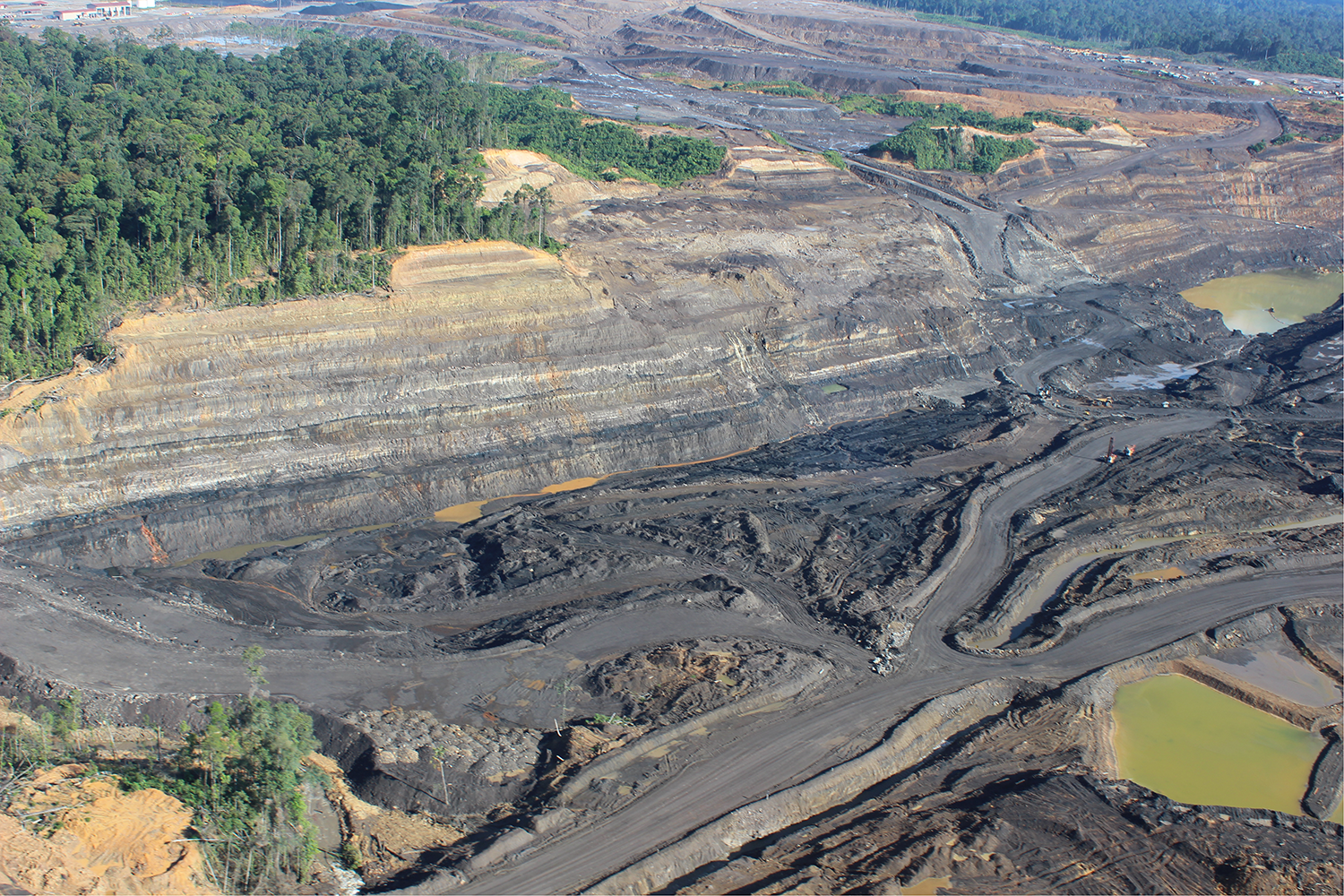
It was timber corporations that led the initial assault, taking out the largest and most valuable trees. In their wake they left degraded forests which, although capable of rejuvenation, were also vulnerable to further degradation by informal logging, fire, and agricultural settlement, often facilitated by official rezoning for agricultural use. Then beginning in the 1990s, and explosively after 2000, oil palm and pulpwood estates spread across the lowland landscape. In Indonesia most were laid out on already deforested land, but in Sarawak and Sabah, plantation expansion became the primary cause of forest loss.Footnote 16 In the same period, open-cast coal mines were carved out of both forested and deforested land in East, South, and Central Kalimantan (Figure 4).Footnote 17
Open-cast coal mine, Central Kalimantan. Rona Dennis, 12 Dec. 2012 (by permission)

Figure 4 Long description
The image shows an aerial view of an open-cast coal mine. The landscape is marked by large, earth-scarred areas with visible layers of soil and rock. Several winding paths and roads traverse the mine, leading to different sections. Pools of water are visible in some areas of the mine. Surrounding the mine, there is a dense forest, providing a stark contrast to the mined area. The forest appears lush and green, while the mine is characterized by dark, exposed earth.
Influx
Like the African and South American parts of the permanently wet tropics, Borneo was in the past only sparsely settled by humans. But between 1970 and 2010 its population more than tripled, from 7 to 23 million.Footnote 18 The expanding population was accommodated partly on the lowland rainforest frontier, where migrants as well as Dayaks and other indigenous people planted smallholder rubber and cocoa trees and worked in the logging and, later, plantation industries. They also practiced freelance woodcutting and chainsaw-aided shifting cultivation of commercial crops like pepper, as well as rice and maize, in logged-over areas.Footnote 19
Within the island there was a movement of people out of the uplands, which due to favourable health conditions and suitability for subsistence agriculture had historically been the most populous areas, to the new centres of economic activity on the plains. This internal migration helped set the scene for an upland/lowland ecological divergence or bifurcation, of which more will be said further on.Footnote 20 A more important part of the population increase in the lowlands, however, was due to migration from outside the island. In 1990 a quarter of Sabah’s inhabitants were international migrants from the Philippines and Indonesia, and a quarter of East Kalimantan’s had been born outside that province.Footnote 21 In the Indonesian provinces the newcomers included more than a million settlers from Java and Madura brought in under Indonesia’s official state-sponsored transmigration programme.Footnote 22 Many of the settlement projects created for transmigrants were poorly conceived due to overoptimistic assessments of soil fertility. In Central Kalimantan a million-hectare (10,000 km2) ‘Mega Rice Project’ (1995–99) on peat forest soils, a pet project of Indonesian president (1967–98) Suharto, collapsed after drainage failed to make the land suitable for wet rice cultivation, and primed the peat for catastrophic fire.Footnote 23 Mass migration also set the scene for the violent ethnic conflict that affected parts of Kalimantan from 1997 to 2001.Footnote 24
Extraction
Borneo has long exported natural resources: gold and diamonds for centuries, coal and mineral oil since the industrial revolution. Minor forest products, such as tree resins and rattan, were also exploited for export. Forest trees themselves, however, did not become commercially important until after the Second World War when new technology, including chainsaws for felling and trimming, bulldozers for the rapid construction of access roads, and outboard motors for river transport, made it cheap to harvest and move them. New preservative treatments also improved the durability of tropical timbers, only the heaviest of which had previously been suitable for structural use.Footnote 25 These developments combined with high demand for wood from postwar Japan to make logging a source of windfall profits for anyone with control over rainforest. Capital wealth was not a prerequisite: Japanese trading companies, often supported by the Japanese government, offered plentiful credit.Footnote 26 Borneo, with huge forests rich in newly valuable dipterocarps, soon overtook the Philippines and peninsular Malaysia as the main supplier, with Sabah leading the way in the 1960s, followed by Sarawak and Kalimantan in the 1970s and 80s.
The last colonial foresters, bureaucratically insulated from both economic and political forces, had planned to harvest blocks of forest just once every 70, 80 or even, for heavy hardwoods, 140 years.Footnote 27 Their successors favoured, or were forced by politicians to accept, selective logging of trees exceeding a certain minimum girth on cycles of 35 years or less, the theoretical sustainability of which was dubious and the practical implementation inadequate or fictitious.Footnote 28 One of the most vociferous defenders of this system was Sarawak businessman, politician, and pioneer of mechanised logging James Wong (1922–2011), who in the 1980s and 90s claimed repeatedly to be practising it in such a way as to preserve the forest ‘in perpetuity’.Footnote 29 But when his 60-year, 1,240 km2 concession expired in 2009, satellite imagery showed it to consist largely of plantations and ‘severely degraded’ forest.Footnote 30 Logging roads, each representing a 1.5 kilometre-wide corridor of extraction, had meanwhile fanned out in intricate networks across most of the island, opening it up to farmers and woodcutters as well as company lumbermen. By 2010 the combined length of these roads was sufficient to reach seven times around the earth.Footnote 31 In Sarawak, primed by the local boom, family logging companies like Yaw Teck Seng’s Samling (founded 1963) and Tiong Hiew King’s Rimbunan Hijau (1975) grew into international conglomerates, felling trees legally and illegally from Brazil to the Pacific.Footnote 32
Combustion
Fire has always been a tool of Borneo’s farmers, and Borneo’s rainforests were always more prone to accidental burning than were their counterparts in Africa and the Americas because, with the Pacific Ocean to their east, they are subject once every two to seven years to a pronounced drought caused by the El Niño climatic oscillation.Footnote 33 The onset of industrial logging, however, greatly exacerbated the fire danger arising from this natural variation. During the El Niño of 1982-83, following a decade of timber extraction, 32,000 km2 of lowland East Kalimantan caught fire, igniting coal seams and reducing secondary forest to grasslands and scrub (Figure 5).Footnote 34 During the 1970s this province had been at the heart of the early logging boom in Kalimantan, producing half of all Indonesia’s timber exports.Footnote 35 As the industry spread, more conflagrations followed in its wake. The progressive loss of tree cover made local climates hotter and drier, aggravating the fire risk and setting up a vicious circle of deforestation.Footnote 36
Fire-climax grassland, Muara Wahau, East Kalimantan, 2005. Until the fires of 1982–83, this was dense tropical forest. Rona Dennis, 29 Oct. 2005 (by permission)

The climax came with the great Borneo fires of 1997–98, possibly the largest in human history. This time the epicentres were in West and Central Kalimantan, including the area of former peat swamp drained and desiccated by the Mega Rice Project. In October 1997 a visiting British journalist described this as ‘one of the most desolate spots on earth — a vast, stinking, blackened, smouldering and toasted place’.Footnote 37 Then in early 1998, East Kalimantan, still recovering from 1982–83, burned all over again.Footnote 38 Many of the fires were deliberately lit to clear land for plantations. Only Sarawak, thanks to its exceptionally wet climate, was partly spared. Altogether some 85,000 square kilometres were burned, more than a tenth of the entire island, releasing carbon into the atmosphere from peat and vegetation equivalent to perhaps one quarter of worldwide annual emissions from the burning of fossil fuels.Footnote 39 Smoke and haze blanketed parts of the Philippines and Thailand as well as Indonesia, Malaysia and Singapore, affecting the health of millions and making headlines around the world. ‘Southeast Asia chokes on Indonesia’s forest fires’, announced the New York Times. Footnote 40 Estimates of the cost of the fires, more than two thirds of which took place in Kalimantan, range up to seven per cent of Indonesia’s annual GDP.Footnote 41 The realisation that deforestation had short-term as well as long-term costs, and internationally as well as domestically, initiated a change, albeit slow at first, in the attitude of political leaders in Jakarta to the issue.Footnote 42
Enclosure
As timber and palm oil boomed, Borneo was carved up into blocks of territory to which logging and plantation companies enjoyed exclusive rights. Unlike the historical enclosures of Europe, this great partition did not, strictly speaking, result in privatisation of the land. The foundational land grab, indeed, was the work of governments, which on the eve of the great deforestation established state control over all forested land, typically to the exclusion of any customary rights previously held by individuals or communities. ‘There are no native land rights’, James Wong flatly informed an inquisitive American visitor in Kuching in 1990.Footnote 43 In Sarawak this had effectively been accomplished as early as 1958, when a new Land Code made any clearance of forest, even by indigenous Dayaks, illegal unless with explicit state permission.Footnote 44 In Indonesian Borneo the principle of state ownership was formalised by the Basic Forestry Law of 1967, in Sabah by the Forest Enactment of 1968.Footnote 45 Having secured control of the forest, however, governments wasted little time renting it out, for periods ranging from 20 to 60 years, to the private sector: specifically, to parts of that sector favoured by, and linked with, the political incumbents. In Kalimantan, many of the concessions initially went to military-linked companies as part of President Suharto’s effort to consolidate his support in the armed forces.Footnote 46 Later the preference was for ethnic Chinese tycoons who provided off-budget finance for presidentially favoured development projects.Footnote 47 On the Malaysian side, allocations were similarly opaque and personalistic.
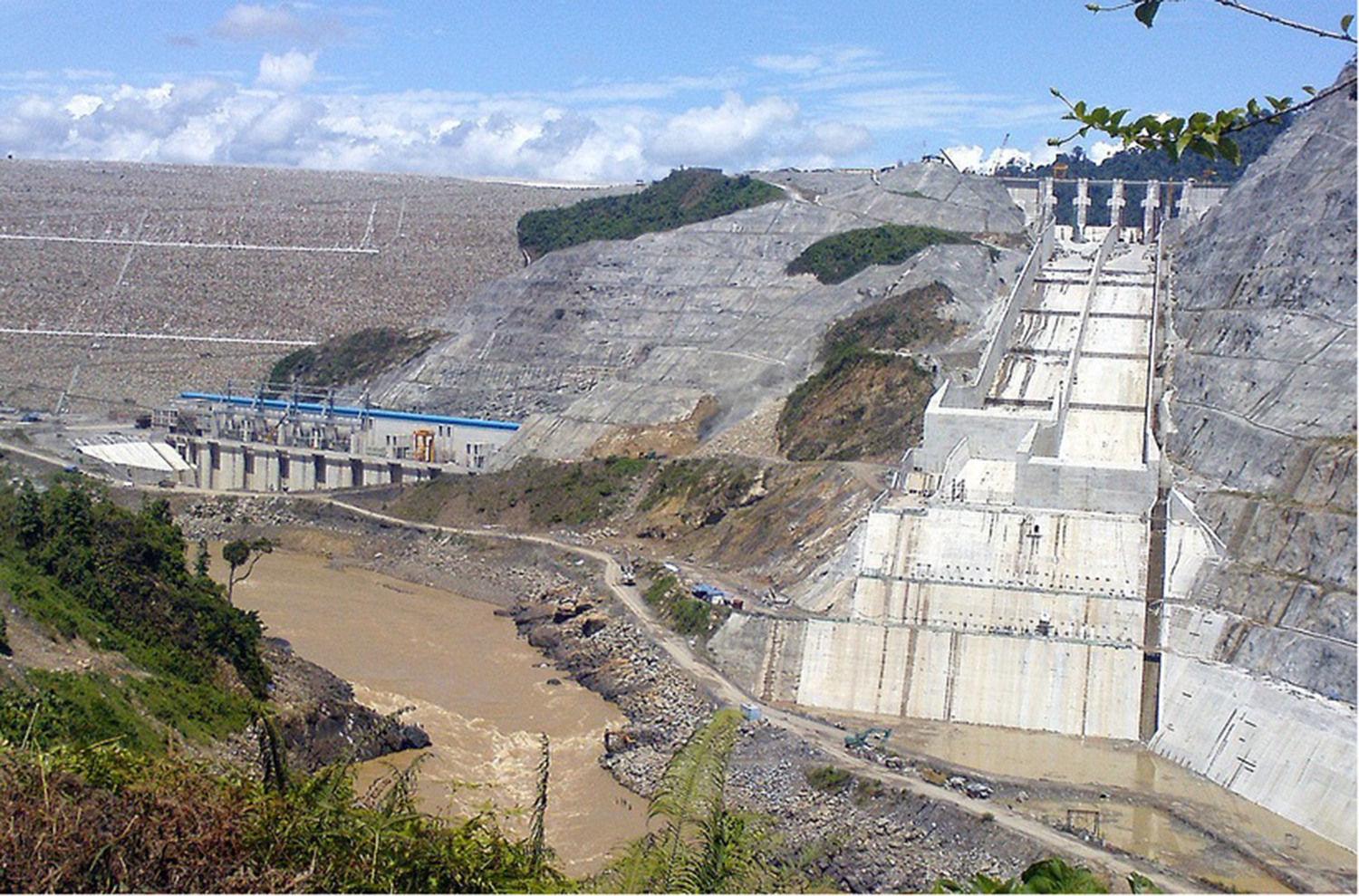
Bakun Dam under construction, Sarawak, 27 June 2009

Figure 6 Long description
A large dam is under construction, featuring a prominent spillway structure on the right side. The spillway consists of multiple concrete chutes leading down to a river. The surrounding landscape includes exposed earth and vegetation, with a partially filled reservoir visible on the left. Construction equipment and facilities are present near the base of the dam. The area is surrounded by hills and a partly cloudy sky is visible above.
As the frontier of unlogged forest advanced, many logging areas were reclassified as plantation concessions.Footnote 48 By 2010, 53 per cent of Sarawak’s land area was under timber licenses and another 32 per cent leased to plantation companies, leaving only 15 per cent outside corporate control.Footnote 49 In addition, a new hydroelectric dam at Bakun (Figure 6) had flooded an area of 700 km2, displacing 10,000 people outright, and a second was under construction on the Murum river. In Indonesian Borneo, timber and plantation concessions covered respectively 22 and 20 per cent of all land, with mining concessions accounting for almost another 10 per cent.Footnote 50 Small farmers and informal forest users, mostly powerless to prevent the enclosures, found themselves squeezed between the big business fiefs. Many went to work on the plantations as a rural proletariat, their lives subjected to managerial discipline in a loss of autonomy that can be seen as the ultimate stage of enclosure, characterised by Tania Li and Pujo Semedi as ‘life under corporate occupation’.Footnote 51
Oligarchy
The Borneo timber boom created a generation of politically powerful or politically connected billionaires. One of them, West Kalimantan-born Prajogo Pangestu of Barito Pacific Timber (founded 1979), was said in 1994 to control more tropical rainforest than any other person on earth.Footnote 52 When Pangestu’s son married in Jakarta in 2017, four Indonesian presidents, including the incumbent (2014–24), Joko Widodo, attended the reception, as did the CEO of Singapore’s national sovereign wealth fund, Ho Ching, who was also the wife of Singapore’s prime minister.Footnote 53 Meanwhile a new generation of palm oil tycoons had joined the timber barons. In 2015 they included six of the ten richest individuals in Indonesia, and 14 of its 32 billionaires.Footnote 54 By 2024 the richest 50 Indonesians also included nine whose fortunes came from coal mining, mostly in Borneo.Footnote 55
Democratisation and decentralisation after 1998 gave local officials in Kalimantan more power over local resources. To fund their election campaigns, they turned to timber and palm oil concerns eager for concessions.Footnote 56 Some local entrepreneurs and politicians became resource oligarchs in their own right. In Central Kalimantan, logging boss Abdul Rasyid grew rich processing and smuggling valuable ramin (Gonystylus spp.) timber looted from Tanjung Puting National Park. He funded a successful candidate for the governorship of the province, and was himself elected to the national parliament.Footnote 57 He re-invested in oil palms, and became a billionaire.Footnote 58 In 2015, and again in 2020, his nephew, with his support, was elected provincial governor.
South Kalimantan’s post-New Order provincial godfather, coal mining, palm oil and transport entrepreneur Haji Isam (Andi Syamsuddin Arsyad), was to emerge on the national stage as one of Indonesia’s most powerful oligarchs.Footnote 59 In 2014 he supported Joko Widodo’s successful campaign for the presidency, and his cousin Amran Sulaiman was appointed Minister of Agriculture. When Prabowo Subianto succeeded Widodo in 2024, four of Isam’s close associates became government ministers, including Amran and a former head of the South Kalimantan forestry service, Hanif Faisol Nurofiq, who was named Minister of the Environment.Footnote 60
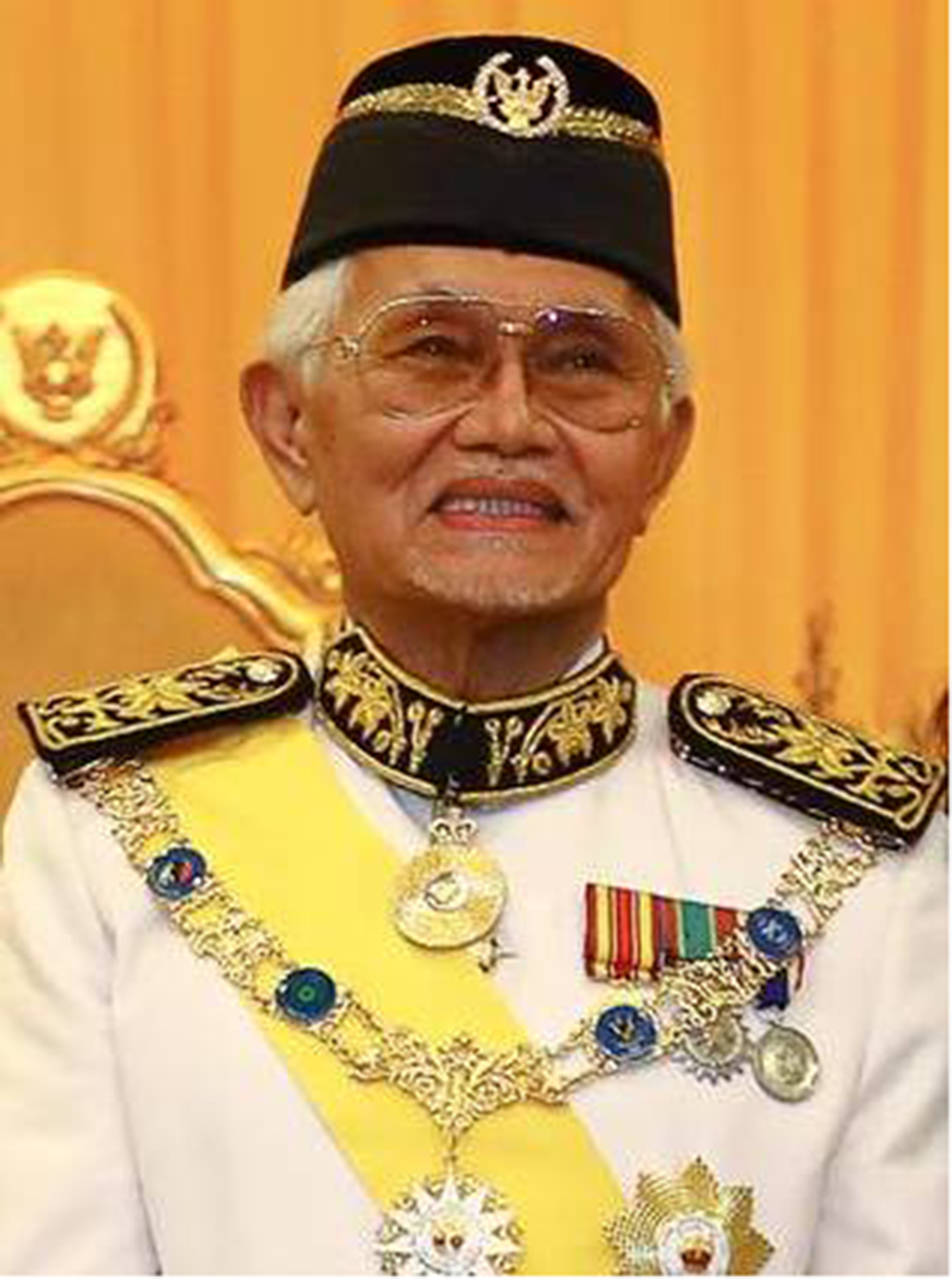
Abdul Taib Mahmud, 2017

Figure 7 Long description
Abdul Taib Mahmud is wearing a formal white uniform adorned with various medals and decorations. A yellow sash crosses his chest and several medals are pinned to the sash and uniform. The uniform features intricate embroidery on the shoulders and collar. He is seated in front of a golden chair with ornate detailing. A black cap with an emblem is worn on his head.
In Sarawak the quintessential timber oligarch, Abdul Taib Mahmud (Figure 7), crafted a whole political system based on the distribution of patronage from logging and used it to stay in power as Chief Minister of the state for 33 years (1981–2014), remaining governor (ceremonial head of state) until his death in 2024.Footnote 61 A cousin of Taib’s chaired one of Sarawak’s big six timber corporations, Ta Ann, and from 1987 to 2001 Taib’s ‘environment minister’ was the logging company owner James Wong. Taib himself took the post of minister of forestry, alongside his chief ministership. Through ownership, contracts and kickbacks, he and his family became among the richest people in Southeast Asia. Their methods were replicated in part by Sabah Chief Minister (2003–18) Musa Aman, and mirrored the descent of Malaysia’s national leadership into kleptocracy under prime minister (2009–18) Najib Razak.
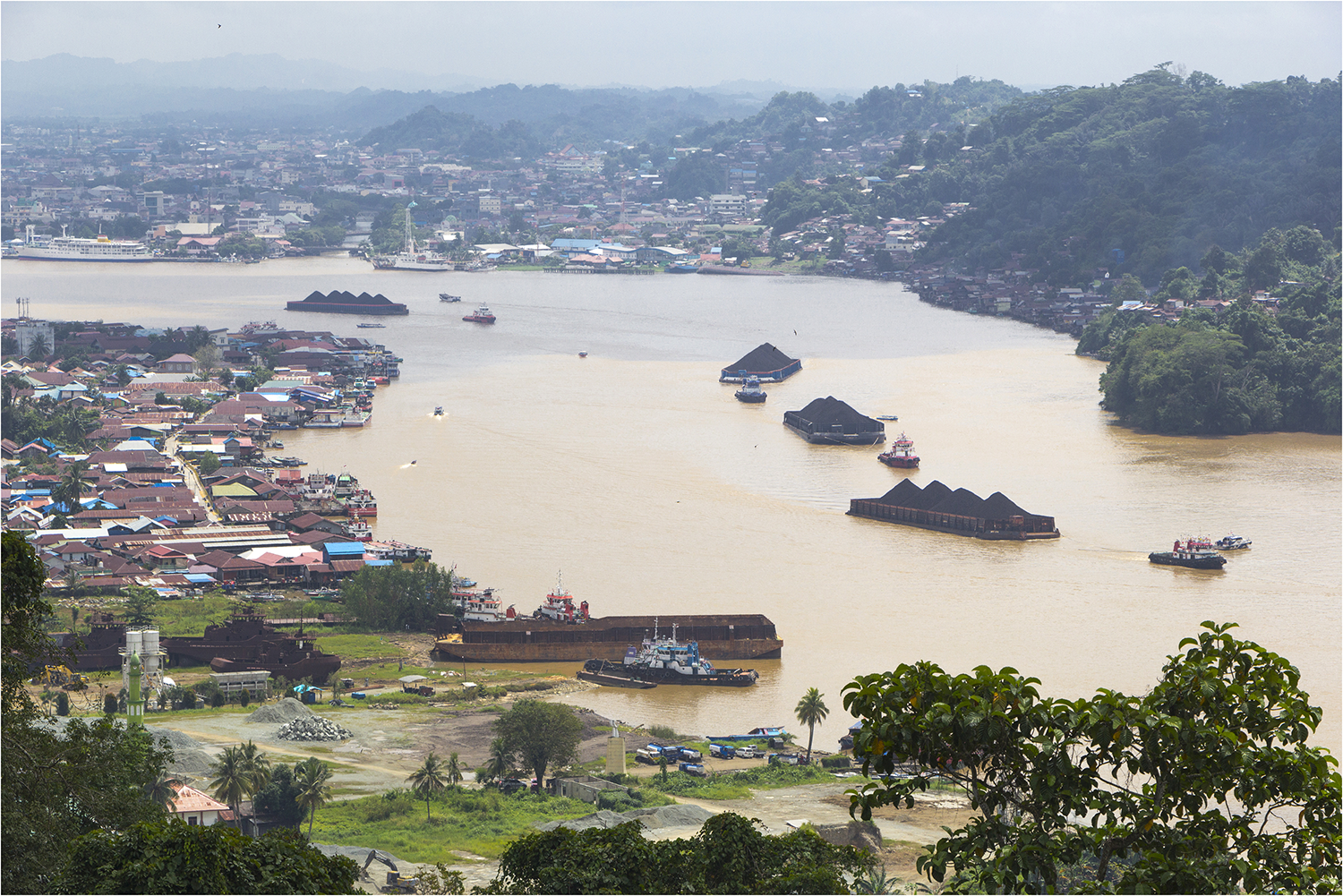
Coal barges on the Mahakam at Samarinda, East Kalimantan. Herusutimbul, 13 Aug. 2020

Figure 8 Long description
Several coal barges are visible on a wide river, moving in a line. The river is bordered by a town with numerous buildings and structures. In the background, hills rise up, providing a natural backdrop to the scene. The barges are loaded with coal and the river appears to be a busy waterway. The landscape includes both urban and natural elements, with greenery visible in the foreground and hills in the distance.
In both countries land was the main resource controlled by local and regional elites, and they exploited it to the full. Only in Brunei, where revenue from offshore oil (denied to neighbouring Sarawak and Sabah by federal law since 1975/76) occupied the attention of the state, and where hereditary succession perhaps gave its monarch, Hassanal Bolkiah, a unique incentive to take the long view, were lowland forests largely spared. In 2010, 74 per cent of Brunei Darussalam was still covered with forest, and 59 per cent with intact, unlogged forest.Footnote 62
Trickle-down
Key elements of Borneo’s resource boom were fundamentally unsustainable: stripping the forest of centuries-old trees, and the ground of irreplaceable coal. Experts doubted whether the ‘resource rents’ from drawing down such natural capital were being invested in man-made capital (infrastructure, equipment, skills, knowledge) fast enough to prevent an eventual economic collapse.Footnote 63 In view of the unknown costs associated with biodiversity loss, climate change, fire, and flooding, one of the present authors (Meijaard) has characterised the whole process as a ‘trillion dollar gamble’.Footnote 64 For the time being, nevertheless, there was certainly growth. From 1970 to 1990 alone, per capita GDP in Sarawak and Sabah more than tripled; in the Kalimantan provinces the gains were greater still.Footnote 65 By 2010 the resource-rich province of East Kalimantan was, according to national statistics, the most prosperous in Indonesia, more so even than Jakarta in terms of the average income of its inhabitants.Footnote 66 Its recorded poverty rate was also well below the national average, and the same was true of the other Kalimantan provinces.Footnote 67 Only in Sabah, where accessible land and resources had already begun to grow scarce in the 1990s, did mean incomes fall substantially behind the national average (in Sabah’s case, the Malaysian average) after 2000.Footnote 68
The distribution of the benefits from resource-based economic growth was hugely unequal, and much wealth left the island altogether; but enough ‘trickled down’ locally to keep the material welfare of most people in Borneo improving. The extractive industries provided work: in 1984, almost 10 per cent of Sarawak’s workforce was directly employed in the timber sector.Footnote 69 Beyond that there were numerous opportunities for informal entrepreneurship in transport, illegal woodcutting and mining, trade, and retailing, both rural and urban. ‘It’s a good life making money here’, a Javanese migrant told anthropologist Anna Tsing on the South Kalimantan frontier in 1997.Footnote 70 Oil palm, in terms of inclusive development, is an unpromising crop, its economics favouring industrial plantations over smallholders and capital over labour.Footnote 71 Almost 80 per cent of Borneo’s palm oil comes from large estates.Footnote 72 Yet even plantation work, for all its indignities, was welcomed in those cases where it provided job security, housing and pensions.Footnote 73
Logging and mining companies, meanwhile, placated dispossessed communities, or at least their leaders, with small informal gratuities, and politicians distributed largesse to win or retain power. The logging industry was only lightly taxed, at least in formal terms.Footnote 74 Nevertheless the fact that it did help to finance public spending, combined with trickle-down effects and federal/national development efforts, enabled oligarchs like Taib Mahmud to cast themselves, no doubt in some degree see themselves, as benevolent developmental leaders. In a meeting with journalists posing as oil palm investors, secretly filmed in 2013, a Sarawak crony businesswoman justified Taib’s (and her own) corruption in terms of ‘the good he’s done for the state’.Footnote 75
Resistance
Despite the trickle-down, not everybody in Borneo was acquiescent in the sweeping changes that overtook the island from the 1960s onward. Conflicts between indigenous people and migrants were common in West Kalimantan in the 1970s, and anti-logging protest in Sarawak began in the same period.Footnote 76 But the struggle that most clearly involved the protection of the natural environment, and the first in Borneo to attract international attention, was that waged from 1986 onward by small groups of nomadic Penan, some of the last people on earth to live as forest hunter-gatherers, to deny loggers access to their homelands in northern Sarawak.Footnote 77 Of all the Borneo peoples, it was the Penan whose livelihoods and culture were most intimately connected with the rainforest. ‘What should we live off if not the forest?’, a Penan militant asked a police chief intent on tearing down a roadblock in 1987. ‘It has fed us for generations long before you even set foot in this country’.Footnote 78
The Penan anti-logging campaign was supported by elements of Malaysian civil society, notably a local Friends of the Earth (Sahabat Alam Malaysia) branch founded in 1980 by Kayan activist Harrison Ngau. It coincided with, and contributed to, an upsurge of concern over tropical deforestation in the developed countries, marked by the birth of NGOs such as the Rainforest Action Network (1985) and Rainforest Alliance (1987). It directly inspired the creation of others: The Borneo Project (1991) in the USA, and the Bruno Manser Fund (1991) in Switzerland, the latter named after a Swiss idealist who, living among the Penan, played an important role in their campaign.
In the face of government intransigence and the sedentarisation — not all of it involuntary — of the remaining nomads, this episode of resistance gradually subsided after 1993.Footnote 79 Never again would indigenous rights activism and environmentalism be quite so perfectly aligned. But the Penan campaign would later be revived in a different form, and it was the prelude to many other alliances between local protest groups, pitted increasingly against oil palm and mining as well as logging interests, and civil society organisations. Support came from international groups like Greenpeace (founded 1971), but also from a growing number of domestic environmental NGOs. In Indonesia these included WALHI (Indonesian Forum for the Environment, 1980), SKEPHI (Indonesian NGO Network for Forest Conservation, 1982), JATAM (Mining Advocacy Network, 1995), Forest Watch Indonesia (1997), Telapak (1997), Sawit [oil palm] Watch (1998), and the environmental investigation and advocacy foundation Yayasan Silvagama (2009, renamed Auriga Nusantara in 2014).
Internationalisation
Faced with the power of oligarchic interests, the weakness of their own positions under existing legislation, and the weakness of the rule of law itself in both Indonesia and Malaysia, campaigns by local communities and domestic NGOs against logging, oil palm and mining in Borneo have seldom by themselves achieved success.Footnote 80 The complementary involvement of international organisations and international civil society, however, began in the early twenty-first century to deliver some promising signs of progress. In 2006 a ‘mega-project’ involving the creation of the world’s largest oil palm plantation along the Kalimantan-Sarawak-Sabah border was cancelled by the Indonesian government to make way for the establishment in 2007, on the initiative of the World Wide Fund for Nature (WWF), of a transnational ‘Heart of Borneo’ conservation zone straddling Indonesia, Malaysia and Brunei.Footnote 81 In 2009, Indonesian president (2004–14) Susilo Bambang Yudhoyono, speaking at a G20 meeting amid international concern about climate change, promised a large cut in Indonesia’s carbon emissions by 2020. In 2010 the government of Norway, under the auspices of the United Nations REDD+ (Reducing Emissions from Deforestation and forest Degradation) programme, helped him follow up on this pledge by agreeing to pay Indonesia a billion US dollars over an undefined period in return for, among other things, a national moratorium on the conversion of intact, unlogged natural forest to other land uses.Footnote 82 The moratorium was duly announced in 2011, and declared permanent in 2019. In 2013, in partnership with the European Union, Indonesia also agreed to introduce a verification system to ensure that timber exports to Europe included no wood from protected forests.Footnote 83
Meanwhile the private sector began to make its own no-deforestation commitments. An aggressive international campaign of brand-bashing or negative advertising by Greenpeace against soap maker Unilever in 2008, and then against food concern Nestlé in 2010, prompted Nestlé and Unilever supplier Golden Agri-Resources (GAR), a branch of the Widjaja family’s Sinar Mas group, to become in 2011 the first major Asian oil palm grower to make such a pledge.Footnote 84 Singapore-based giant Wilmar International, controlling more than a third of the world’s palm oil trade, followed in 2013, and Malaysia’s largest plantation concern, Sime Darby, in 2014.Footnote 85 Few of these deals and promises were unproblematic; they would be evaded, broken, renegotiated. Nevertheless, powerful new forces for conservation were in play. The modern deforestation of Borneo had always been driven by global demand; now, resistance to it had been globalised too.
Slowdown
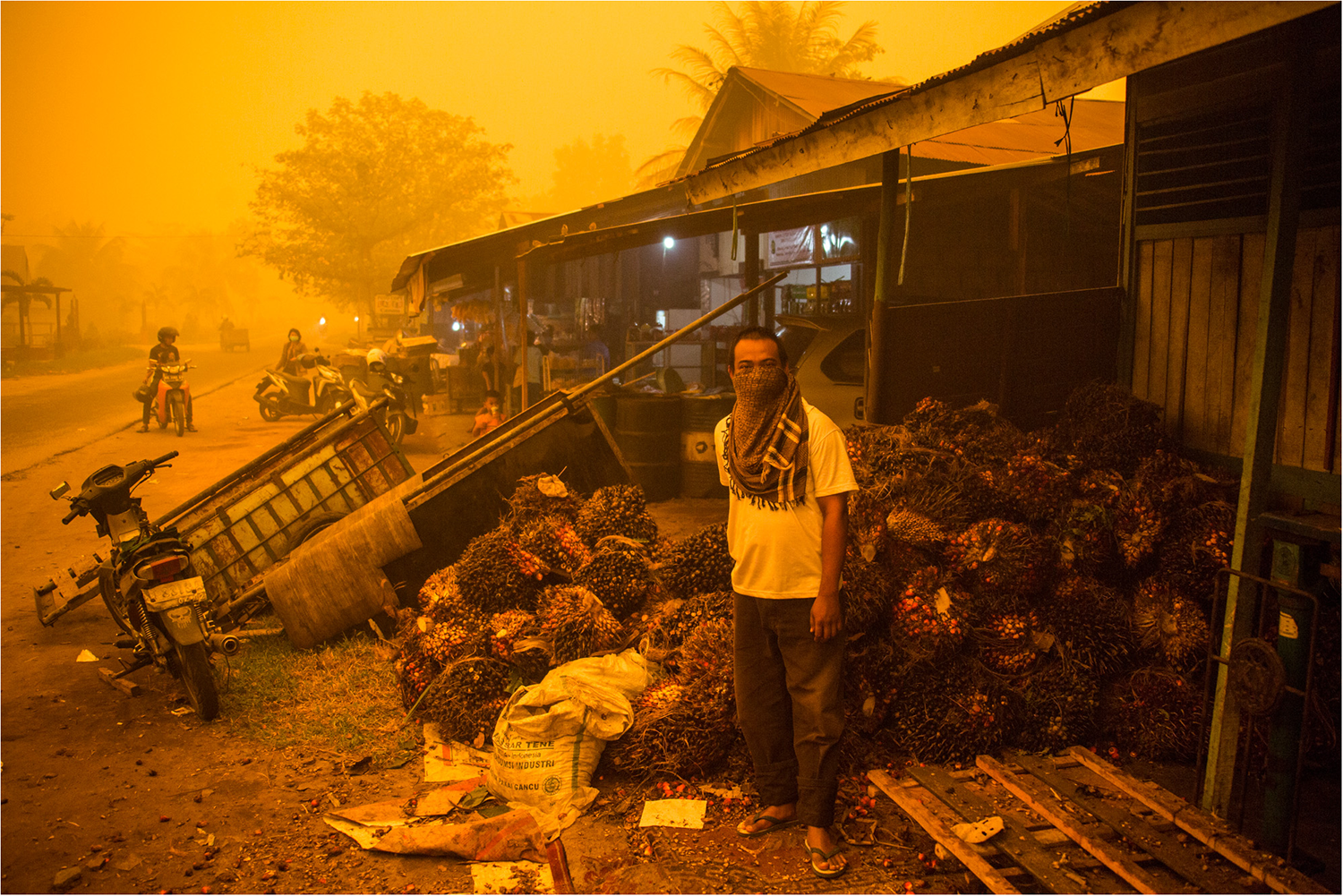
Although the human assault on Borneo’s forests is still very much in progress today, it is proceeding less rapidly now than in the recent past. For many parts of the island the peak years were the 1990s, when logging frontiers swept across the lowlands and the great forest fires raged.Footnote 86 At the turn of the century, deforestation rates fell as political turmoil and the Asian financial crisis slowed investment, the availability of burned-over land reduced the need for new forest clearing for agriculture in Kalimantan, and the limits of unsustainable timber exploitation began to be reached in Sabah and Sarawak. From 2000 to 2010, the length of new logging roads built on Borneo was less than half that built in the previous decade.Footnote 87 Forest loss, nevertheless, picked up again and accelerated as the Indonesian economy recovered and palm oil boomed. Then in the decade 2010-20, oil palm expansion and associated forest conversion also slowed down.Footnote 88 From 2010 to 2022 the average area of forest lost annually was about 2,900 km2, against 4,500 km2 per year between 1973 and 2010.Footnote 89 Most of what was still being lost after 2010 was logged rather than intact forest. The early twenty-first century continued to see regular seasonal fires and haze, including a major event in the El Niño year 2015 (Figure 9). But because of slower logging and the conversion of fire-prone logged land to managed plantations, the disaster of 1997-98 has not been matched in scale.Footnote 90
Fire haze in Palangkaraya, Central Kalimantan, 2015. Harvested oil palm fruit bunches in foreground. Björn Vaughan, 16 Oct. 2015 (by permission)

Figure 9 Long description
A man is standing beside a large pile of harvested oil palm fruit bunches. The setting is a hazy environment, possibly due to smoke or fog, affecting visibility. In the background, there are structures resembling a market or shop, with people visible near motorcycles. The scene includes various items scattered on the ground and the overall atmosphere is affected by the haze.
Part of the slowdown has to do with geography. As forest exploitation and conversion have progressed, commercially attractive timber stands, and land suitable for large-scale agricultural use in accessible lowland locations, have become scarcer. Distance matters in the logging industry, where road construction and maintenance can account for 60 per cent of production costs.Footnote 91 On mountainous terrain, higher roadbuilding expenses and lower densities of valuable wood make operations less profitable.Footnote 92 Oil palm too grows best on level ground at low altitude; part of the reason for the abandonment of the borderline oil palm mega-project in 2006 was that with much of the border running along Borneo’s mountain spine, the scheme was commercially misconceived.Footnote 93 From 1973 to 2010, 97 per cent of all Borneo deforestation (not including forest degradation) occurred at elevations below 500 metres.Footnote 94 A 2025 study of the deforestation slowdown in Indonesia since 2015 concludes on statistical grounds that nationwide, up to one third of the slowdown ‘can be explained by forest scarcity’: that is, by an inverse correlation at provincial level between deforestation rates and the proportion of each province still under tree cover. Within Borneo the slowdown between 2005 and 2022 was greatest in the already most deforested province, South Kalimantan.Footnote 95
In the decade 2010–20 a complementary factor was that world palm oil prices, after a period of rapid increase, showed a falling trend (although they have since rebounded).Footnote 96 Malaysian and Indonesian plywood and other timber products likewise faced adverse market conditions in these years. Faltering overseas demand exacerbated structural domestic problems of unsustainable supply, leading in Kalimantan to more and more logging concessions becoming inactive.Footnote 97 Alongside growing competition from producers in other tropical countries, and the replacement of tropical plywood in some of its applications by other products, the reasons for reduced exports from Indonesia included ‘lost sales because of concerns about the legality of Indonesian supply in major markets’.Footnote 98 This is a reminder that besides geography and economics, another part of the deforestation slowdown has to do with various kinds of deliberate human action, choice, and restraint.
While the commitment of the Indonesian and Malaysian governments to reducing carbon emissions has sometimes played an enabling role for other actors, the extent to which national policies are in themselves responsible for the slowdown should not be overestimated. Fully 80 per cent of the territory covered by the 2011 national forest moratorium in Indonesia was already protected by law, albeit ineffectively, before that date; in Kalimantan only some previously ungazetted peatland forests, and a few others in remote upland areas, were added to the inventory.Footnote 99 Deforestation within the moratorium area, moreover, continued apace, partly due to retrospective redrawing of its boundaries to the benefit of parties seeking new concessions. One study comparing actual trends in the period 2011–18 with counterfactual ‘business as usual’ projections found only marginal amounts of avoided deforestation in dry land areas as a result of the moratorium, and none at all on peatlands.Footnote 100
Probably more important were the efforts of the private sector, particularly palm oil traders and producers which, as noted, had come under pressure from international consumers and civil society organisations. The pioneer pledges by GAR and Wilmar triggered a snowballing of similar promises across the industry. By 2022, 85 per cent of Indonesia’s palm oil exports, and 83 per cent of all palm oil refining capacity in Indonesia and Malaysia, were in principle covered by no-deforestation policies.Footnote 101 Typically these policies feature liberal definitions (not limited to climax vegetation) of what constitutes forest, as well as specific provisions with respect to peatland. Their scope includes the substantial enclaves of forest and peat — in 2017, an estimated 29 per cent of the total licensed area — which are ‘stranded’ within existing palm oil concessions.Footnote 102 Adherence to zero-deforestation commitments is monitored by third party organisations, notably US-based, business-oriented advocacy group Mighty Earth, founded in 2016 by activist-entrepreneur Glenn Hurowitz, with its ‘rapid response monitoring system’ based on satellite imagery.Footnote 103
Opinions vary as to the degree of effectiveness of these arrangements on the ground. Across Kalimantan, according to one recent study, only a quarter of local palm oil mills really offer ‘high-quality’ no-deforestation assurances to refiners and traders.Footnote 104 Nevertheless their impact is significant. So too is that of another corporate initiative, the international Roundtable on Sustainable Palm Oil (RSPO) certification scheme, launched in collaboration with the WWF in 2007 and signed up to by growing numbers of Malaysian and Indonesian producers from 2008 onward.Footnote 105 In 2018, RSPO extended its no-deforestation clause to include secondary as well as primary forest.Footnote 106 It is telling that when palm oil prices rebounded in 2021 and 2022, deforestation rates did not immediately do likewise.Footnote 107 ‘Mandatory and voluntary commitments’, reported the World Resource Institute on Indonesia’s forest cover situation in 2022, ‘appear to be working’.Footnote 108
Standoff
Despite the slowdown, Borneo is not yet approaching a point of ‘forest transition’ at which deforestation turns to reforestation.Footnote 109 Exploitable and convertible forest may be scarcer than in the past, but it still exists, and the gains which have been made in the domain of human restraint rest on fragile standoffs between parties whose interests are divergent. In 2019, Greenpeace ended its landmark alliance with palm oil giant Wilmar following revelations of deforestation by a closely linked company, Gama, and because of disagreements over monitoring arrangements.Footnote 110 In 2018 it had already renounced a similar cooperation with Sinar Mas wood pulp subsidiary Asia Pulp and Paper (APP) over violations in Kalimantan of a 2013 no-deforestation commitment.Footnote 111 In the 2020s, Greenpeace Indonesia has reduced its corporate engagement in favour of more adversarial activities. Continuing efforts by some businesses to conceal environmentally destructive operations have appeared to vindicate this change of strategy.Footnote 112 Particularly problematic has been the wood pulp industry, which expanded substantially in Borneo from 2017 to 2023.Footnote 113 The large and rising proportion of both wood pulp and palm oil sold to developing countries, where public concern about their provenance is as yet limited, poses a structural threat to conservation strategies based on the ‘market discipline’ of ‘responsible’ consumers.Footnote 114
State-to-state conservation partnerships have been equally fraught. A decade into Indonesia’s REDD+ partnership with Norway, the effectiveness of its moratorium on primary forest clearance was increasingly in doubt. Progress on enforcing laws against illegal logging and ‘related forest crimes’, as set down in the 2010 agreement, was also disappointing.Footnote 115 In 2015, meanwhile, Indonesia had demoted to a position within a new hybrid environment and forestry ministry (the two were merged in 2014) the REDD+ coordinating agency which, according to the agreement, was supposed to have been an independent body ‘reporting directly to the president’.Footnote 116 Trust was low and Norway’s payments were delayed, leading Indonesia to pull out of the deal in 2021, although Norwegian reluctance to abandon it altogether meant that in 2022 it was revived in a different form.Footnote 117
Concessions won from governments by civil society, likewise, have often proved ephemeral. In 2014 a new Chief Minister of Sarawak, Adenan Satem, unexpectedly declared his support for the Baram Peace Park, a reserve proposed in 2009 by Penan communities and the Bruno Manser Fund to protect some of the last remnants of the state’s primary forest.Footnote 118 In 2016, Sarawak also cancelled, following local and international protest, a hydroelectric scheme involving 12 dams on the Baram river.Footnote 119 Seven years later, however, the state announced new plans for a series of dams on the Tutoh, a tributary of the Baram, and in 2024 it cancelled the Peace Park project (officially, the UBFA or Upper Baram Forest Area) amid conflicts with the NGOs involved, which reported that the scheme had been hijacked by logging interests linked to state premier Abang Johari.Footnote 120 In 2015, Sabah announced an ambition to have all palm oil produced within its borders RSPO-certified for sustainability, including non-destruction of natural forest. But a decade later this pioneering ‘jurisdictional’ (as opposed to value-chain) certification project is still far from its goal, not least because when it comes to implementation, ‘actors with an interest in forest conversion and exploitation use their political power to influence authorities’ decisions’.Footnote 121
Visions
Perhaps because its size and remoteness foster a sense of infinite possibilities, Borneo has always attracted overambitious schemes. The Central Kalimantan Mega Rice Project, recently revived in part, despite all past experience, under the auspices of a national Food Estate programme, is a case in point.Footnote 122 The dream of building a new Indonesian capital city in Borneo, conceived by president Sukarno in the 1950s, began to become reality in 2019 when a site in East Kalimantan was chosen for a ‘green, sustainable’ administrative metropolis to replace Jakarta. The plans for this utopian ‘forest city’ seem to mock the degraded landscapes around it, as do the centrepieces of Taib Mahmud’s vision for Sarawak’s post-timber economy, giant dams producing ‘clean’ hydroelectricity for power-hungry industries.Footnote 123
Whereas in the past ‘development’ alone provided the justification for such schemes, today the official framing is also about sustainability: ‘Sarawak Corridor of Renewable Energy’ (2008), ‘Sarawak Sustainability Blueprint 2030’ (2025). In 2009, East Kalimantan governor Awang Faroek Ishak, inspired by a meeting with California governor and celebrity environmentalist Arnold Schwarzenegger, pledged to make East Kalimantan a ‘Green Province’, commissioning a 100-page provincial Sustainable Development Strategy and triggering a flurry of foreign-funded conservation projects.Footnote 124 These included, from 2015, a ‘jurisdictional REDD+’ scheme under which the World Bank’s Green Climate Fund pays the provincial government directly for preventing deforestation in order to reduce carbon emissions.Footnote 125 As at the national level, however, the gap between aspiration and reality remained wide – not least because palm oil was accommodated within the new ideology as a ‘green’ industry, on account of being based (unlike, for instance, coal), on ‘renewable, sustainable production’.Footnote 126 As elsewhere the deforestation rate fell slightly, but apparently no more than in West or Central Kalimantan, which did not have Green Province programmes.Footnote 127
While politicians and planners pursue grand visions framed in the language of environmentalism, environmentalists themselves have been obliged to moderate their ambitions for Borneo. In the past, many of them hoped to persuade governments to keep much of the island’s forest intact, complete with indigenous peoples living in harmony with it. Today they know that rent-seeking politicians and bureaucrats are the greatest enemies of conservation, and that even national parks, with in principle the highest degree of state protection, are in practice not safe from deforestation. Tanjung Puting, where Abdul Rasyid made his illegal timber fortune, lost 13 per cent of its forest cover in the years 2012–17 alone.Footnote 128 What has also become clear is that indigenous communities themselves — even the Penan, once sedentarised — are often ambivalent about forest protection unless it brings them clear material benefits.Footnote 129
Faced with the incapacity of states and the pragmatism of local people, the Borneo conservation community, in a microcosm of the global trend that led Greenpeace to partner with palm oil companies, has increasingly sought to engage directly with the private sector. ‘A logged forest in Borneo is better than no forest at all’, wrote one of the present authors (Meijaard) together with forest scientist Douglas Sheil in Nature in 2007, and ‘timber companies have the capacity to manage and protect large areas of forest’.Footnote 130 In 2008 a pioneer of Forest Stewardship Council (FSC) timber certification in Europe in the 1990s, Jesse Kuijper, founded a non-profit called The Borneo Initiative to promote FSC sustainability standards and certification in the Kalimantan logging industry. As with the RSPO, the financial incentive is access to premium markets. Although uptake has been limited, research indicates that FSC certification in Kalimantan is effective in reducing the risk of selective logging leading to outright deforestation.Footnote 131 Other market-driven initiatives also show promise. From 2007 onward the well-known primatologist Biruté Galdikas, based since 1971 in Central Kalimantan, worked with the world’s first commercial carbon enterprise, Rimba Raya, to set up a 640 km2 biodiversity reserve funded by the sale of carbon emission offset credits to international business.Footnote 132 Another green business model was pioneered in Sabah from 2008 by the Malua Biobank, a public-private partnership initiated by a US-Malaysian NGO.Footnote 133 Here the product is biodiversity itself, in the form of conservation credits which corporate buyers can use to communicate environmental responsibility to customers and investors.
Icons
Like other tropical rainforest regions, Borneo is not rich in large animals. Nevertheless one species, the orangutan which brought Galdikas to the island, is iconic enough to have become a symbol, mascot, and instrument of international conservation efforts. Greenpeace’s highly effective campaign against Nestlé in 2010 featured a satirical ‘advertisement’ involving a severed, bloody orangutan finger in a KitKat chocolate wrapper (Figure 10). In 2018 a commercial for palm oil-free products of the British supermarket chain Iceland, made in cooperation with Greenpeace and featuring an orphaned orangutan in a child’s bedroom, was banned from TV stations for its ‘political’ content, but viewed by millions online.Footnote 134
Spoof Kitkat ‘advertisement’ video by Greenpeace, 2010.

Figure 10 Long description
The image shows a KitKat chocolate wrapper on a wooden surface. Next to the wrapper, there is a chocolate bar and a severed orangutan finger, which is placed on a pool of red liquid. The finger is partially covered in chocolate, mimicking the appearance of a KitKat bar. A play button is overlaid on the image, indicating it is a video screenshot.
Among the Malaysian and Indonesian public, concern for orangutan conservation is correlated with socioeconomic status, which may bode well for the future if incomes continue to rise.Footnote 135 So far, however, the iconic status of the species has done little to halt its decline. Between 2000 and 2020 nearly a billion US dollars were spent on orangutan conservation by governments, NGOs, companies and communities, but in Borneo more than 100,000 orangutans, about half of the remaining population, nevertheless perished, due to hunting and other deliberate killing as well as habitat destruction.Footnote 136
Another famous Borneo mammal fared even worse. In 2019 the last two Sumatran rhinos in Sabah died in captivity, leaving two individuals in East Kalimatan, both females, as the only known survivors of the Borneo subspecies.Footnote 137 This tragedy follows 25 years of attempts to capture and breed the few rhinos that had survived decades of hunting and habitat loss, rather than concentrating on conserving their habitat and guarding them from poachers.Footnote 138 The captive breeding programme was financed partly by Malaysian palm oil giant Sime Darby.Footnote 139 Animal icons can serve corporate interests as well as the interests of anticorporate activists.
Reasons
Part of the romance and tragedy of Borneo lies in the idea of a fall from grace. Indigenous peoples, it is often imagined, lived in harmony with the rainforest, whereas modernity has brought greed and destruction. In reality, however, most indigenous Borneans were farmers, some of them well known for felling virgin forest; and even hunter-gatherers, while their livelihoods may have been sustainable at very low population densities, did not necessarily have a ‘conservation mentality’.Footnote 140 What modernity has undeniably brought are new tools of destruction: chainsaws, bulldozers, and the means for some people to deploy mobile capital in order to profit from resource exploitation. But why should such people show so little concern for their or their descendants’ future ability to keep doing the same thing?
One common answer invokes a ‘tragedy of the commons’, in which a scramble breaks out for open-access resources. In Borneo this often happens when forests claimed by the state, but not under active management or protection, are competitively hunted, logged and cleared by local people and entrepreneurs: ‘my lesson from Indonesia’, concluded one of the present authors (Meijaard) in 2019, ‘is that forests that are unmanaged are ultimately cut down’.Footnote 141
Much deforestation, however, has also taken place under monopoly conditions in managed concessions controlled by big business. Here the deciding factor has been a tendency to discount future profits steeply in relation to current ones, in combination with the slow growth rate of rainforest trees. Despite all talk of sustainable logging, it is not clear that tropical forests, in anything like their natural form, can really be managed for their timber or other products in any way that is both sustainable and commercially viable.Footnote 142 Even the least intensive modern logging regimes, concludes one review, ‘are several hundred years out of sync with the life cycles of high-value timber trees in the tropics’.Footnote 143 ‘I don’t care what anybody says, no one can wait 100 years for trees to grow’, as one timber company manager in Sabah frankly told a journalist in 1986. ‘Natural regeneration is just nonsense’.Footnote 144
Besides the problem of slow regrowth, there was always also uncertainty about how long a given opportunity for profit would last. ‘We have to pray hard and we need a lot of luck to succeed’, complained Rimbunan Hijau owner Tiong Hiew King in 1999.Footnote 145 Prices and trading conditions could quickly change, while political risks also had to be taken into account. ‘As there are elections every five years, and those affiliated with the losing party risk having their licenses revoked’, observed Bruno Manser in Sarawak, ‘they try to make as much profit as possible in the least time’.Footnote 146
Against this stood the quicker yields of oil palm, beginning as soon as three years after planting, and of course the certainty, fundamental to capitalism, that money earned now could be banked and invested later elsewhere. Yet with the traditional solution to such problems, good governance, often out of reach, the best hope for the environment in Borneo today may ironically lie in an appeal to the interests, and perhaps the consciences, of the very capitalists most directly responsible for damaging it.
People
In 2001, political scientist Michael Ross influentially ascribed forest depletion in Southeast Asia to ‘rent-seizing’ state actors who dismantled existing institutional protections in order to take advantage of the timber bonanza. Ultimately, Ross argued, it is ‘international commodity markets’ that ‘damage the institutions and policies of developing states’ by exposing power-holders in those states to the rent-seizing temptation.Footnote 147
Dependence on land-based export commodities certainly seems to have placed a species of ‘resource curse’ on Borneo, encouraging both deforestation and corruption.Footnote 148 And of course without markets for such commodities, most Borneo deforestation would not have happened. Ross’s explanation in terms of exogenous ‘positive trade shocks’, however, seems to belie both the endemicity of institutional failure in Indonesia and Malaysia, and the real challenges to economic rationality, regardless of any ‘shocks’, that are involved in sustainably managing a crop that takes a human lifetime to become harvestable. Just as importantly, it threatens to obscure the personal agency and responsibility of key actors in Borneo’s environmental story, which is a story of human characters and choices as well as institutional constraints.
Of the ruthless Abdul Taib Mahmud, it has been said that Bruno Manser ‘picked the wrong man in Taib to test his naive belief in the universal good of human beings’.Footnote 149 But Taib’s successor as Sarawak Chief Minister, Adenan Satem, cut a different figure when he cancelled the Baram dams and declared his support for the Baram Peace Park. Adenan’s death in 2017, after less than three years in office, was a blow to the cause of forest conservation in the state. Across the border in Central Kalimantan, that cause had suffered a similar setback when Abdul Rasyid’s nephew Sugianto Sabran replaced a more conservation-minded provincial governor, the Ngaju Dayak Teras Narang, in 2016.Footnote 150
Peter Kallang, 2019. The Borneo Project, 6 July 2019 (by permission)

Besides ministers and governors, the cast of influential characters also features indigenous activists like Peter Kallang (Figure 11), who led the successful campaign against the Baram dams, and his legal adviser Harrison Ngau, veteran of the original Penan anti-logging protest of the 1980s.Footnote 151 Indirectly, the dramatis personae also include a variety of international business leaders responsible for sustainability initiatives. Perhaps the most important is Singaporean tycoon Kuok Khoon Hong (born 1949), chairman of Wilmar International. In 2013 Kuok was persuaded by activists Glenn Hurowitz (the later Mighty Earth founder), Scott Poynton (of The Forest Trust, now Earthworm Foundation) and Bustar Maitar (Greenpeace Indonesia) to commit, in what appears to have been a genuine change of heart, to eliminating deforestation from Wilmar’s supply chains.Footnote 152 ‘I would consider myself an environmentalist today’, said Kuok in 2015.Footnote 153 Although Greenpeace later broke with Kuok and Wilmar, others did not. ‘It’s difficult for me to imagine the enormous progress in the palm oil industry without Wilmar’, declared Hurowitz in 2021.Footnote 154
Other pioneers of green entrepreneurship in Borneo include American investor Todd Lemons, whose Hong Kong company Infinite Earth was behind the Rimba Raya forest carbon project, and Indonesian businessmen Hartono Dharsono and Rezal Kusumaatmadja, who at almost the same time started a second such project, Katingan Mentaya, in Central Kalimantan. Both schemes were businesses, intended to make money for their owners; whether they benefited the people living in and around their concessions is questionable.Footnote 155 Yet they were not purely matters of calculating self-interest. Their profit margins were impossible to predict, and bureaucratic and certification hurdles meant that from their conception in 2007 it took six and ten years respectively before they were able to sell their first carbon credits. Such uncertainty demanded what Hartono has described as a ‘leap of faith’. ‘If everybody had focused on risk-adjusted returns’, he reflected in a 2023 interview, ‘we never would have launched the Katingan Mentaya Project, because it was all risk and no return’.Footnote 156
Outsourcing
Borneo’s politicians and activists may not be without individual agency, but they are more than ever part of global processes and dynamics.Footnote 157 Peter Kallang’s NGO, SAVE Rivers, is linked to an international network of environmental and indigenous rights organisations. In 2015 it hosted a World Indigenous Summit on Environment and Rivers, attended by delegates from seven countries including Indonesia, Brazil and the USA.Footnote 158 In 2021 the Swiss canton of Basel, birthplace of Bruno Manser, donated USD 200,000 to the Baram Peace Park, with a further 0.6 million to come from other foreign sources.Footnote 159 Elsewhere, conservation organisations in the area of wildlife protection have been set up with foreign funding and local participation: Hutan in Sabah (1998), the Pro Natura Foundation in East Kalimantan (2013), the Borneo Nature Foundation in Central Kalimantan (2016). In East Kalimantan, with its green ambitions and openness under governor (2008–18) Awang to non-commercial foreign funding opportunities, US charity The Nature Conservancy (TNC) achieved significant political influence, sponsoring a provincial Green Growth Compact involving ‘sustainability leaders across government, the private sector, and civil society’.Footnote 160
Not all forms of international ‘partnership’ for conservation are so consensual. In so far as logging and palm oil companies are less keen to destroy Borneo’s rainforest than in the past, it is largely (personal conversions like Kuok’s aside) because they are enmeshed in a web of commitments, certification and surveillance spun by overseas consumers, NGOs and governments that have the ability to affect their profits. In so far as the Indonesian and Malaysian states also play a part in restraining the private sector, they do so largely because they too are responsive to financial and reputational incentives created by the international community. This is not to deny the endogenous commitment of some state agencies, as well as many courageous local activists and journalists, to environmental protection. Sabah’s Forestry Department, for instance, is often praised in that respect.Footnote 161 Nevertheless it is hard to avoid the conclusion that, in reality, the task of forest conservation in Borneo has largely been outsourced to foreign entities.
The overseas and transnational organisations have two major advantages for conservation purposes. In the first place, they supply external funding. This is as it should be: if Borneo’s nature is a global asset, then the costs of its protection should be borne globally, and more by rich people than by poor people, and certainly not by the poor of Borneo itself. The second gain from internationalisation relates to efficacy and efficiency. Transnational conservation bodies and certification schemes are far from free of conflicts of interest.Footnote 162 Nevertheless, they are generally less susceptible to abuse and corruption than are domestic agencies such as the Malaysian Timber Certification Council or Indonesia’s Timber Legality Verification System.Footnote 163
While the globalisation of conservation is in these respects expedient, it also creates a political vulnerability. Domestic actors may adopt international values and standards, or they may reject them, or at least the organisations purveying them, out of concern for national sovereignty. This is clearest in the case of activist groups like Greenpeace, sometimes denounced in Malaysia and Indonesia as a Western proxy hostile to national development in the global South.Footnote 164 But the governments of both countries have also had difficulty with international corporate certification programmes like FSC and RSPO, which, citing issues such as barriers to smallholder participation, they have tried to replace with their own less rigorous schemes.Footnote 165 In 2016 a private-sector initiative called the Indonesian Palm Oil Pledge (IPOP), going further than all earlier sustainability commitments and involving six of the biggest firms in the sector, was forced to disband after politicians accused it of serving Western interests and constituting a cartel.Footnote 166
Prospect
The power of nature to regenerate itself is great, and rainforests, as Robin Chazdon has shown on evidence from across the tropics, are capable of ‘second growth’.Footnote 167 The problem is that in an age of commodity booms the opportunity cost, calculated at any reasonable interest rate, of leaving trees standing on land that could instead be planted with oil palm or acacia, or stripped away to mine coal or gold, is high.Footnote 168 Yet if that cost could be covered by–for instance–international carbon or biodiversity credits, and if independent agencies could make payment of the credits credibly contingent on non-deforestation and verified improvement in wildlife conditions, then forest concession holders, and plantation concession issuers, would surely spare the forest.
Since private sector actors currently seem more capable than states of protecting forests from illegal incursion, a privatised conservation regime, in which businesses act as ‘stewards’ of regenerating rainforests, has practical appeal. From 2004 to 2022 a system of ‘Ecosystem Restoration Concessions’ (ERC) supported just such arrangements in Indonesia. Over-regulation, as well as unpredictable revenues, limited its success and in Kalimantan only five units, none of them large on the insular scale, were established.Footnote 169 They included, however, the two biggest private-sector forest-based carbon credit enterprises in the world, Rimba Raya and Katingan Mentaya, with Volkswagen, Shell, and Delta Airlines among their clients.Footnote 170 In East Kalimantan another ERC was managed from 2010 by a company linked to the Borneo Orangutan Survival (BOS) Foundation, an internationally funded charity founded by conservationist Willy Smits.
Relations between government and the carbon entrepreneurs were for a long time uneasy, the more so after Indonesia’s signing of the Paris climate agreement in 2015 raised the thorny question of how carbon credits exported for profit on the basis of avoided deforestation relate to Indonesia’s Nationally Determined Contribution (NDC) to global emissions reduction.Footnote 171 In 2021 the state imposed a moratorium on carbon credit sales, and in 2023-24 Rimba Raya briefly had its operating license revoked.Footnote 172 In 2025, however, national policy changed, the moratorium was lifted, Indonesia signed ‘mutual recognition agreements’ with international carbon credit certification agencies Gold Standard and Verra, and interest surged from many business quarters in potential carbon enterprises under a unified system of forest utilisation business licenses (PBPH) introduced in 2022.Footnote 173 A similar liberalisation was meanwhile underway in Malaysia, which signed a memorandum of understanding with Verra in 2024.Footnote 174
The green light for forest-based carbon trading is not the only recent glimmer of conservation hope from the public sector. In 2012 Indonesia’s Constitutional Court surprisingly ruled that the ‘customary forests’ (hutan adat) of local communities should not have been classified as state land, and 2023 saw the largest official recognition of customary forest rights to date, covering an area of 700 km2 on the upper Kahayan river in Central Kalimantan.Footnote 175 Smaller parcels of forest land have also been transferred from state to village or cooperative ownership under several other types of ‘social forestry’ programme.Footnote 176
Local control, however, does not necessarily equate to forest conservation.Footnote 177 More importantly, there is little chance that the Indonesian or Malaysian states will any time soon give environmental protection the kind of absolute political priority which in the past they gave to pro-poor economic development, and which enabled them to achieve this in the face of problems of cronyism and corruption similar to today’s.Footnote 178 As far as forest conservation is concerned, most signs point in the opposite direction. Between 2019 and 2022 Indonesia terminated a restoration concession held by WWF in Sumatra, excluded foreign scientists critical of its environmental record, lifted a blanket oil palm license moratorium introduced in 2018, weakened environmental impact assessment requirements for investors, and replaced penal sanctions for infractions of forestry laws with administrative fines.Footnote 179 In 2024, newly elected president Prabowo Subianto assured Indonesians that they need not worry about deforestation by the palm oil industry because ‘oil palms are after all trees, they have leaves, don’t they?’Footnote 180
A more plausible positive scenario for Borneo is that geography and logistics continue to slow deforestation down, while forces in the global political economy, including carbon markets, certification schemes, and the long-awaited European Union Deforestation Regulation (EUDR, a comprehensive set of import prohibitions), act to align the material interests of powerful domestic actors, at least to some extent, with the interests of conservation. By giving capital a freer hand vis-à-vis the state, the otherwise so problematic ‘oligarchisation’ of Indonesian politics is likely to create new scope for market-oriented corporate conservation. Upcoming resource oligarchs like Kalimantan-born Haji Isam may be remote from the culture of environmental concern and corporate social responsibility that has helped shape cosmopolitans like Kuok and Hartono, but they too will no doubt be pleased to make money out of conservation, if there is enough to be made.
Conclusion
People, it has been said, are an invasive species, their history marked by the expansive colonisation and transformation of new ecosystems.Footnote 181 Borneo, lacking either plentiful big game for hunting or fertile soils for food crop cultivation, largely escaped this fate as long as human livelihoods depended on local production and consumption. But as soon as commerce and technology made it possible in the 1960s to transform the island’s heat, rain and natural biomass into bulk products for international markets, an almost uniquely rapid process of environmental destruction began. Terrain geography, timber and land exhaustion, stagnating palm oil prices (2010–20), and an internationalisation and monetisation of conservation efforts have slowed the rate of deforestation since the peak years of the 1990s. But the deep and in many cases deepening involvement of Indonesian and East Malaysian political elites in extractive industries makes it unlikely, other things remaining equal, that a reversal is imminent.
At present the upland heart of Borneo, comprising between a fifth and a quarter of the island, remains in better ecological shape than the rest. In 2015 almost 90 per cent of historical upland forest (albeit part of it degraded by selective logging and unsustainable hunting and collecting), and almost all hill and montane forest (above 800 metres), was still in existence.Footnote 182 For this zone it is perhaps still possible to think about effective protected areas, ‘eco-economies’ based on tourism, or community-based conservation. Such a future would be in line with a global trend of bifurcation whereby some tropical upland forests, shielded by their relatively limited commercial value, remain in the hands of states and communities, while the fate of their lowland counterparts depends increasingly on big business.Footnote 183 However the recent collapse of the Baram Peace Park/UBFA in Sarawak, under pressure from continued logging operations on the upland frontier, does not bode well for the community-based model. The fact that in Kalimantan some of the sites now being eyed for commercial forest carbon projects are in mountainous areas confirms that the heart of Borneo will not escape the attentions of the corporate sector.Footnote 184
In lowland Borneo, already largely deforested and under corporate control, any future environmental turnaround is likely to depend not on weakening that control, but on finding ways to pay corporations for preserving and restoring the forest. With the current expansion of international climate change mitigation funding, carbon emission offset trading, and biodiversity credit schemes, and with the international Tropical Forest Investment Fund launched at Belém in 2025, the financial means to do this may be within reach. The ethics of ‘green enclosure’ by the private sector are, of course, another question.Footnote 185 And it remains to be seen whether the economics of commercial conservation will ever really be attractive enough to turn the tide of decades of deforestation. Whatever happens, it will happen not primarily as a result of interactions between states and citizens in Indonesia and Malaysia, but as a matter of transnational resource governance, involving international capital, international markets, international organisations, and global civil society.



 Open access



