INTRODUCTION
Perhaps the most conspicuous finding concerning reading development is that measures of phonological awareness are among the best predictors of progress in reading achievement in elementary school grades (Torgesen, Wagner & Rashotte, Reference Torgesen, Wagner and Rashotte1994). Other studies have suggested that the language basis of reading may extend beyond phonological processing to broader language domains (Catts & Hogan, Reference Catts and Hogan2003). In the current study, a distinction has been made between tasks that tap primarily phonological skills and those that depend on broader aspects of language such as semantics, morphology and syntax (referred to as general language skills throughout this paper). A number of researchers have found that general language deficits impair the development of reading comprehension, as well as affect specific aspects of word recognition (Catts & Hogan, Reference Catts and Hogan2003; Nation & Snowling, Reference Nation and Snowling1998). Also, it has been found that early general language skills predict reading achievements during early school grades (Catts & Hogan, Reference Catts and Hogan2003). From a developmental perspective, it has been suggested that linguistic abilities are differentially weighted in reading development. In its early stages, reading acquisition involves routing attentional resources in order to implement stable connections between the orthographic and phonological channels; thus, phonological skills carry greater weight as determinants of beginning reading ability than do semantic and syntactic skills. As development proceeds, skilled reading entails on-line comprehension of meaning from running text; thus, in more advanced readers semantic and syntactic skills carry greater weight (Snowling, Bishop & Stothard, Reference Snowling, Bishop and Stothard2000).
However, most of the studies reporting connections between reading on the one hand, and phonological awareness and general language skills on the other, have concentrated on reading accuracy and reading comprehension (e.g. Catts & Hogan, Reference Catts and Hogan2003). Therefore, the purpose of the present study is to explore the contribution of language skills to reading fluency.
Reading fluency
Recently it has been suggested that oral reading fluency may serve as an indicator of overall reading competence. Traditionally, fluent reading has been defined as the ability to read text accurately, quickly and with adequate expression, wherein decoding is relatively effortless and attention can be allocated to comprehension (Meyer & Felton, Reference Meyer and Felton1999). This approach to fluency stresses the importance in reaching automaticity in all bottom-up subskills of word reading, in order to shift the attention from lower level decoding to higher level comprehension skills. However, although this approach to fluency includes the end goal of fluency (i.e. effortless reading with good comprehension), it does not explore all components underlying fluency, including the development of fluency. Wolf & Katzir-Cohen (Reference Wolf and Katzir-Cohen2001) have suggested a new definition of reading fluency which integrates both developmental and componential approaches to fluency. They define reading fluency as the product of the initial development of both accuracy and automaticity in the processes and systems that underlie reading at the levels of letter, word and connected text. According to their definition, achieving reading fluency involves the successful integration of information from the phonological, orthographic, semantic, syntactic and morphological processes. One of the premises of this approach is that multiple processes contribute to fluency development, highlighting the potential importance of general language skills in reading fluency.
The Orthographic Depth Hypothesis
Of particular interest to us was the examination of the extent to which language skills contribute to reading fluency with respect to the orthographic system used by the reader. There is evidence that the relative importance of reading-related skills in reading varies in accordance with the demands of different orthographies and scripts. Thus, for example, word identification problems and deficiencies in phonological skills are more prominent in children learning to read in deep orthographies (i.e. scripts such as English, in which mappings between orthography and phonology are inconsistent), than in more shallow orthographies (i.e. scripts such as German and Finnish, in which mappings between orthography and phonology are highly consistent) (Holopainen, Ahonen & Lyytinen, Reference Holopainen, Ahonen and Lyytinen2001; Wimmer, Mayringer & Landerl, Reference Wimmer, Mayringer and Landerl1998).
The Chinese writing system, for example, contains a large number of visual symbols or characters that represent units of meaning (morphemes) rather than phonemes, as in an alphabet. During reading skill acquisition, Chinese children with dyslexia display multiple language deficits, whereas American children with dyslexia show core phonological deficits (Ho, Chan, Tsang & Lee, Reference Ho, Chan, Tsang and Lee2002). These findings provide support for what Katz & Frost (Reference Katz, Frost, Katz and Frost1992) have termed the Orthographic Depth Hypothesis. According to this hypothesis, the more transparent the orthography, the more likely the reader is to rely on prelexical processes, whereby the phonological lexicon is accessed by assembling subword orthographic-to-phonological segments. It is probably the case that all alphabetic orthographies require use of both phonological and general language strategies during reading, but their relative contribution differs according to the specific characteristics of the script (Share, in press).
The existence of two Hebrew orthographies with rich morphology systems gives us an interesting opportunity to study whether the nature of the orthography (orthographic depth) influences the nature of relationships between reading and language skills.
Hebrew orthography and morphology
In Hebrew orthography, letters represent mostly consonants, while vowels are represented mostly by diacritical marks placed below, within or above the letter. Hebrew employs two versions of the same orthography: pointed (i.e. fully vowelized) and unpointed (i.e. partially vowelized). Pointed Hebrew is considered shallow orthography as the phonemic structure of the printed word can be easily assembled using simple grapheme-to-phoneme conversion rules. Unpointed Hebrew is considered deep orthography, as the relation of orthography to phonology is more opaque. For example, when vowels are not represented by diacritical marks, four or more different meanings may be possible for the same string of letters. Thus, the unpointed written string  may be read as any of the following: sefer ‘book’, safar ‘counted’, sapar ‘hairdresser’ and sfar ‘border area’ (Schiff, Reference Schiff2003). In this particular case, not only do vowels make a difference in the meaning of the string; so do the consonants p and f, which are differentiated by a dot in the middle of the letter
 .
Early reading acquisition takes place within the context of pointed texts and continues to serve as the medium of instruction from first grade until the end of third grade. Proficiency in decoding pointed Hebrew is usually attained by the end of first grade. Grapheme–phoneme regularity provides a straightforward explanation for the rapid mastery of Hebrew decoding (Share & Levin, Reference Share, Levin, Harris and Hatano1999). Yet, diacritical marks are gradually omitted from school texts, starting at the beginning of third grade, and by fourth grade children are expected to be fluent readers of unpointed Hebrew texts (Share & Levin, Reference Share, Levin, Harris and Hatano1999). Eventually, unpointed Hebrew becomes the more common mode of writing, while pointed Hebrew is reserved only for reading and writing instructions, children's books and Biblical and poetic texts. Shimron & Sivan (Reference Shimron and Sivan1994) estimated that almost one-quarter of the Hebrew words appearing in regular texts are homographic when presented out of context. However, when words are presented in context, proficient adult readers read pointed and unpointed Hebrew words with the same speed and accuracy. The main assumption is that while the pointed script allows the reader to employ prelexical processes and relies more on phonological information, the unpointed script forces the reader to rely more on lexical and supralexical processes, such as semantic–contextual information (Share, in press).
It is important to point out that although English and Hebrew are both considered deep orthographies, their ‘depth’ is different in character. In English, the opaque relations of spelling-to-sound are related to the inconsistency of letter clusters, whereas in Hebrew, opaque spelling-to-sound connections arise simply from missing phonemic information, mainly vowel information (Frost, Reference Frost2006).
Another important characteristic of Hebrew concerns the process of word formation and derivation. In Hebrew, all verbs and the majority of nouns and adjectives consist of a combination of a consonantal root and a vocalic pattern. The root itself is never a word nor a distinct phonological unit, but rather a type of linguistic entity, usually represented by a sequence of three phonemes (consonants). For example, verb and noun forms derived from the root klt include: kalat ‘he grasped’, niklat ‘was grasped’, miklat ‘shelter’ and maklet ‘receiver’ (Share & Levin, Reference Share, Levin, Harris and Hatano1999). In many cases, the specific meaning of the word conveyed by its root is transparent to the reader. Yet the specific meaning of the word cannot be accessed unless the word is formed by combining its root with a particular word pattern.
Finally, in Hebrew there is a rich and complex inflection system. As in other languages, inflectional variants are formed by attaching prefixes and suffixes to real words. Verbs are inflected for person, number, gender and tense; adjectives are inflected for number and gender. In addition to number and gender, nouns are also inflected for relations, such as locative and possessive. In many cases, while reading unpointed words, the Hebrew reader is constantly obliged to segment multimorphemic strings into constituent morphemes. Moreover, in order to produce the correct segmentation the reader must rely on context, i.e. words or phrases that precede or follow the target word. Thus, for example, the unpointed written string ‘ ’ can be read as kudamnu or kodmenu and represents the phrase ‘we were promoted’ as well as the phrase ‘our predecessor’. The suffix nu indicates we or our, the root kdm indicates first, before, previous, predecessor, promote or advance. The letter between the letters k and d represents two possible vowels, either /u/ or /o/, with the two vowels making the main difference in the meaning of the target word. Clearly, when the string of letters ‘
 ’ stands alone, it is difficult to determine the meaning of the word, as well as the phrase it represents.
Most studies of cognitive and psycholinguistic factors associated with reading in Hebrew have focused on early reading and examined children in kindergarten and first or second grades (Share & Levin, Reference Share, Levin, Harris and Hatano1999). To date, the most comprehensive data on reading acquisition in Hebrew come from a longitudinal study of 349 Hebrew-speaking children, conducted by Shatil & Share (Reference Shatil and Share2003). These researchers examined the preschool antecedents of word recognition among readers who were followed from kindergarten to the end of first grade. They found that word recognition was predicted by isolable domain-specific factors such as phonological processing, visual–orthographic processing and early literacy knowledge, as opposed to higher order language (i.e. early semantic–syntactic deficits) which were weakly related to word recognition processes involving reading words and pseudo-words. A major issue of concern is the fact that results obtained from very young children may not tell us much about the reading skills that are needed to decode and comprehend texts used at the end of elementary school. Indeed, not only are the texts that children have to read in higher grades unpointed, they are also typically more complex morphologically and syntactically, and they contain a higher percentage of unfamiliar and rare words, compared to texts read by children in early grades. Since prior work has been done with beginning readers reading only shallow pointed texts, the inclusion of proficient readers in the current study may shed light on these questions. It is generally agreed that phonological awareness facilitates reading, particularly reading acquisition. However, the role of general language skills in reading is still not clear.
THE CURRENT STUDY
The purpose of the present study is to explore the contribution of phonological and general language processing skills to reading of pointed and unpointed Hebrew scripts. To achieve these goals, proficient readers read both pointed and unpointed texts, in addition to performing oral language and memory tasks. The language tasks included tasks that tapped primarily phonological skills as well as tasks that depended on broader aspects (semantics, morphology and syntax) of language. In order to avoid a direct influence upon reading abilities, all language tests were administered by means of oral presentation. Each test was chosen to provide a degree of specificity of the students’ language not provided for in the other tests. A memory task was included to control for the possible contribution of memory abilities to both reading and language skills, since there is considerable evidence that temporary storage of verbal information plays a major role in both reading and native language learning (Baddeley, Reference Baddeley2003).
The predictions were as follows:
(1) General language skills will contribute to variance in reading fluency beyond phonological and memory skills among proficient Hebrew readers.
(2) The relative contribution of phonological and general language skills to reading fluency will differ according to the specific characteristic of the script. Thus, reading pointed Hebrew (i.e. shallow orthography) will rely more strongly on phonological processes than will reading unpointed Hebrew script (i.e. deep orthography). In contrast, reading unpointed Hebrew will rely more strongly on general language skills than will reading pointed Hebrew.
METHOD
Participants
The population study consisted of 48 fifth graders, made up equally of boys and girls, ranging from 10 ; 0 to 11 ; 1 years of age, with a mean age of 10 ; 7 (SD=3·84 months). All participants were monolingual native speakers of Hebrew and came from several regular elementary schools serving lower- to middle-class neighborhoods. The children were typical of suburban public school pupils: some from immigrant families, most white, and all fluent speakers of Hebrew. Based on teacher review, none of the children had any speech, language or hearing difficulties and all exhibited normal school performance. For reading level verification, all participants were given two reading diagnostic tests (Shani, Lachman, Shalem, Bahat & Zaiger, Reference Shani, Lachman, Shalem, Bahat and Zaiger2006): the Pseudo Word Decoding Test, which includes 33 pointed pseudo-words, and the Word Identification Test containing a list of 50 pointed real words. In both tests, participants were asked to read each word aloud separately. The standard scores for all participants fell between −1·35 and 0·78 (Mean score=−0·15) for pseudo-word reading, and between −0·84 and 0·69 (Mean score=0·16) for word reading. Due to public school confidentiality policies, other detailed information about the individual children was not available.
Measures
(I) Reading fluency tests (Shani et al., 2006)
(1) Pointed text
This test comprised a passage of text containing 100 pointed words. The text was taken from a fifth-grade reading book. Participants were asked to read aloud the entire text. Scores represent reading fluency by correct words per minute.
(2) Unpointed text
This test comprised a passage of text containing 102 unpointed words, also taken from a fifth-grade reading book. Participants were asked to read aloud the entire text. Scores represent reading fluency by correct words per minute.
(II) Oral language tasks
(1) Ambiguity
Semantic ambiguity refers to words associated with multiple meanings, such as bank in English. The task is a subtest from the MAASE test by Rom & Morag (Reference Rom and Morag1999) – a standardized test that examines lexical–semantics in school-age Hebrew-speaking children. In this semantic task, the child was asked to give two or three different lexical meaning to homophones. These words were embedded in sentences that suit a particular meaning. For example, the Hebrew word achot has two meanings: ‘nurse’ and ‘sister’. The sentences that the participants heard were: yeSh li achot Shovava ‘I have a mischievous sister’ and haachot bodeket et hayeled ‘The nurse is examining the child’. The child was asked to explain the two meanings of the word. The correct answer includes both meanings. The test includes ten Hebrew words that have dual meaning and scores were based on the percentage of items correctly produced.
The inclusion of this ambiguity task in the current study allows us to measure a deep level of word knowledge. Moreover, Cairns, Waltzman & Schlisselberg (Reference Cairns, Waltzman and Schlisselberg2004) found that the detection of ambiguity in lexically ambiguous sentences developed by preschool children correlated highly with reading readiness measures and was a strong predictor of second-grade reading ability.
(2) Possessive nouns
This task is based on the tests developed and published by Levin, Ravid & Rapaport (Reference Levin, Ravid and Rapaport2001). In addition to various obligatory inflectional affixes (such as the plural affixes on nominals, and subject agreement affixes on verbs), Hebrew has a paradigm of optional inflectional affixes: the genitive suffixes on nouns. These suffixal forms exist side by side with analytic, syntactic counterparts; for example, the analytic form of the genitive noun ‘my friend’ is chaver Seli and the bound form is chaveri (for more examples see Levin et al., Reference Levin, Ravid and Rapaport2001). Bound morphological forms are denser and more opaque than their analytic counterparts. Experimental studies testing the development of genitive forms found that Hebrew-speaking children are capable of understanding and producing such forms between the age 6 ; 0 and 10 ; 0 (Ravid, Reference Ravid and Berman2004). These forms are usually considered as a highly language-specific diagnostic of more sophisticated language knowledge.
The bound morphological task included 38 possessive noun items with internal consistency of Cronbach's α=0·86. In this morphological task, the child was given the noun base and a separate possessive pronoun, and asked to say them together in one word. The task items required suffixation expressing number, person and gender, specifically, -o for singular third person masculine, -a for singular third person feminine, -i for singular first person, -am for plural third person masculine, -chem for plural second person masculine, and -nu for plural first person (indistinguishable by gender). Scores were based on the percentage of items correctly produced.
(3) Sentence–picture matching
A subtest from the TACL-3 (Carrow-Woolfolk, Reference Carrow-Woolfolk1999) was modified for testing in Hebrew by a group of speech and language therapists from the University of Haifa Communication Disorders Clinical Center. As yet, no normative data is available. The purpose of the task was to assess comprehension of compound and complex sentences. The task included 20 sentences with internal consistency of Cronbach's α=0·61. In this task, the child heard a sentence and was asked to identify one picture (out of three) that matched the sentence. Scores were based on the percentage of items correctly identified.
(III) Phonological abilities
Phoneme omission test (Shani et al., Reference Shani, Lachman, Shalem, Bahat and Zaiger2006)
The test includes 16 mono- and bisyllable words. The experimenter read each word aloud and asked the participants to produce a pseudo-word obtained by omitting a designated phoneme, located at the beginning, middle or end of the word. Scores were based on the percentage of items correctly produced.
(IV) Verbal memory
Forward digit span (Wechsler, Reference Wechsler1991 )
In this task sequences comprise random digits presented verbally one after another. Participants were required to verbally repeat these digits in the order presented. Scoring was based on the number of correct items recalled.
Procedure
All tasks were carried out in a quiet room in local schools, individually administered in one-hour sessions. Children were given short breaks between the tasks. The tasks were performed in a counterbalanced fashion across participants. The participants were recorded during reading and performing the possessive nouns and the ambiguity tasks. All data was analyzed and encoded on the same day of recording by two speech–language pathologists with 100% agreement between them.
Results
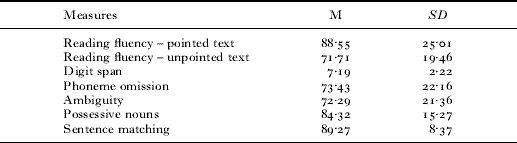
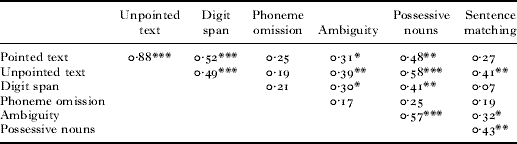
The means and standard deviations for the measures employed in this study are listed in Table 1. In order to investigate the relationships between the different reading, language and memory skills, Pearson correlations were conducted. The correlations are displayed in Table 2. Significant correlations were found between each of the general language measures (i.e. ambiguity, possessive nouns and sentence matching) and both reading fluency measures (i.e. pointed and unpointed text), the sole exception being a non-significant correlation between sentence matching and reading fluency of pointed text. Also, significant correlations were found between the verbal memory measure and both reading and language measures (except for sentence matching). In contrast, the phoneme omission test was not significantly correlated with any of the other measures.
Means and standard deviations (SDs) results of the language, reading and memory measures for all participants (n=48)

notes: Reading fluency was calculated by correct words per minute; digit span was calculated by number of correct items; phoneme omission, ambiguity, possessive nouns and sentence matching were calculated by % correct items.
Pearson correlation coefficients between language, memory and reading measures (n=48)

notes: * p<0·05; ** p<0·01; *** p<0·001.
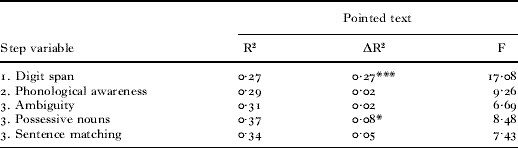
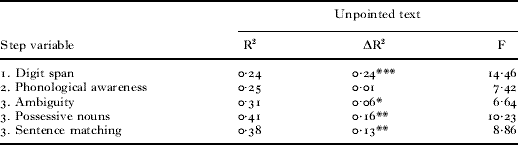
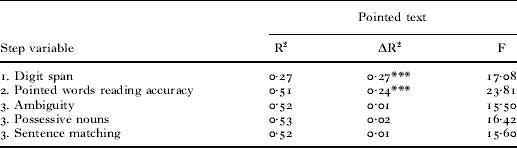
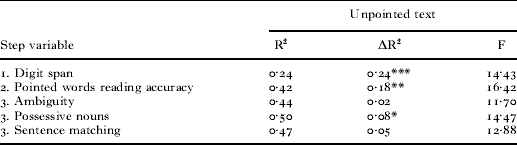
Hierarchical regression models were constructed in order to assess the unique contribution of the general language skills to the variance in reading fluency beyond phonological and memory skills. For each of the criterion variables (i.e. reading of pointed and unpointed texts), three potential predictor variables were entered into the regression in three steps. In the first step, the memory score was entered; in the second step, the phoneme awareness score was entered; and in the third step, a different general language skill was entered each time (see Table 3). We have chosen to conduct separate regression analyses for each one of the general language measures due to the relatively small sample of children. Furthermore, it is not the scope of the present study to determine whether any of the predictor variables contribute unique variance to fluency beyond the other question predictors (i.e. ambiguity, possessive nouns and sentence matching).
Hierarchical regressions of memory, phonological and general language tasks predicting reading fluency of pointed and unpointed texts
(A)

(B)

notes:* p<0·05; ** p<0·01; *** p<0·001.
As can be seen from Table 3, for reading fluency of unpointed text, after both memory and phonological awareness have been entered into the equation, each of the general language scores contributed a significant unique variance (6%, 16% and 13% respectively). As for the reading fluency of pointed texts, only the morphological task was a significant predictor (8%).
In order to examine whether general language measures contributed to reading fluency beyond the contribution of single word reading, further hierarchical regressions were conducted. This time we entered the memory score to the regression in the first step, the single word measure in the second step (the one used to select the participants); and in the third step, each one of the general language measures. As can be seen from Table 4, for reading fluency of unpointed texts after the single word measure had been entered into the equation, the morphological measure still contributed a small but significant unique variance (8%).
Hierarchical regressions of memory, pointed words reading accuracy and general language tasks predicting reading fluency of pointed and unpointed texts
(A)

(B)

notes:* p<0·05; ** p<0·01; *** p<0·001.
DISCUSSION
The fundamental purpose of this study is to explore the relative contribution of general language skills to individual differences in reading Hebrew among children toward the end of elementary school. In support of our first hypothesis, the pattern of results from the regression analyses shows that general language skills make a significant independent contribution to performance in reading fluency. In addition, in line with our second hypothesis, general language tasks contribute mainly to reading fluency of unpointed Hebrew texts. Moreover, the morphological skill continues to contribute to reading fluency at the connected unpointed word level, even after single word reading has been factored out. This unique contribution of the morphology factor to fluency gives further support to the component-based conceptualization of fluency (Wolf & Katzir-Cohen, Reference Wolf and Katzir-Cohen2001), assuming fluency is more than just proficiency in accuracy; that it also involves proficiency in several underlying reading components. Yet, in line with the orthographic depth hypothesis (Katz & Frost, Reference Katz, Frost, Katz and Frost1992) this relative contribution differs according to the specific characteristics of the script.
In Hebrew, Semitic language morphology plays a special role in learning how to read and write. Recent findings from 150 native monolingual Hebrew speakers in second, fourth and sixth grade have shown that morphology complexity influences word identification accuracy and rate (Schiff, Reference Schiff2003). Also, several studies have demonstrated a certain sensitivity of Hebrew readers to the existence of roots and patterns with both lexical decision and naming tasks (Frost, Forster & Deutsch, Reference Frost, Forster and Deutsch1997). In the absence of pointing, the context of a sentence constitutes the primary source of phonological constraints on reading. The assumption is that the text provides morphosyntactic clues regarding the identity of nominal or verbal patterns of the printed words, and these allow the reader of Hebrew to retrieve the correct sequence of vowels (Frost, Reference Frost2006).
Our results concerning the contribution of semantic and syntactic skills to reading fluency are less suggestive. On the one hand, we found that semantic and syntactic processes contributed to reading fluency of unpointed texts. On the other hand, however, after we entered the single word reading measure to the regression equation, we found that their relative contributions were no longer significant. These findings may indicate that although pointed word reading accuracy and unpointed word reading fluency evidently share variance with both the semantic ambiguity and syntactic comprehension measures as well as with each other, these latter measures have no direct effect on unpointed word reading fluency and may not be causally related to the latter variable. This failure to reach statistical significance may be due to the high correlation between pointed word reading accuracy and unpointed word reading fluency, which simply reduced the unique contribution of syntax and semantics to the prediction of fluency. At this point we are unable to interpret these findings, although we had initially anticipated that both syntactic and semantic skills would contribute to reading fluency of unpointed texts. Further research with a larger subject population may provide more statistical power to indicate the presence or absence of such contributions.
Nevertheless, our results revealed that syntactic and semantic skills were correlated mainly to the unpointed Hebrew (i.e. opaque orthography) and not to the pointed Hebrew (i.e. transparent orthography). These findings are consistent with Share's (in press) overview results from different orthographies around the world. He summarized that in regular orthographies when spelling–sound relations are straightforward, semantic and syntactic factors were superfluous. However, in more phonologically opaque scripts, in order to overcome the decoding uncertainties of spelling, there is greater degree of lexical and supralexical involvement. The connection between semantic processing and reading has previously been pointed out in studies examining the process involved in reading real words in English (Snowling et al., Reference Snowling, Bishop and Stothard2000; Nation & Snowling, Reference Nation and Snowling1998). Nation & Snowling (Reference Nation and Snowling1998), for example, found that poor comprehenders, despite having had adequate phonological decoding skills, were worse at reading words with irregular spelling patterns and low-frequency words that are typically read with support from semantics. Cairns et al. (Reference Cairns, Waltzman and Schlisselberg2004) found that knowledge about multiple meanings of a word was correlated with reading measures and was a strong predictor of second-grade reading ability. They explained that when processing ambiguous lexical items, multiple meanings are retrieved since all are associated with the same phonetic representation. The individual rapidly selects one meaning, using relevant context, if available, and inserts it into the sentence being processed. Thus, both reading and ambiguity detection requires speed and efficiency of lexical access along with processing sentence structures.
In regards to syntactic processing, studies have yielded considerable evidence of a link to reading skills (Bentin, Deutsch & Liberman, Reference Bentin, Deutsch and Liberman1990). However, the interpretation of these data is still controversial. Some researchers have assumed that language deficits impair the development of reading comprehension and affect specific aspects of word recognition (Nation & Snowling, Reference Nation and Snowling1998). Others have argued that difficulties in processing complex verbal information are epiphenomena of phonological processing problems (e.g. Gottardo, Stanovich & Siegel, Reference Gottardo, Stanovich and Siegel1996). The results from the present study support the former assumption as they show the influence of syntactic knowledge on reading to be significant even after phonological awareness and verbal short-term memory are taken into account.
Finally, in the current study, there were no statistically significant correlations between phonological awareness and the measures assessing reading fluency in both pointed and unpointed texts. This finding was unexpected since we had anticipated finding some phonological involvement, in particular in reading pointed Hebrew. However, our results are consistent with the findings regarding the limited success of phonology-based reading intervention programs for achieving improvements in fluency and comprehension (Lyon & Moats, Reference Lyon and Moats1997).
Several explanations might be postulated. First, most of the studies that have reported connections between reading and phonological skills concentrate on word reading accuracy (Lyon & Moats, Reference Lyon and Moats1997) and not on reading fluency. When examining reading fluency, Katzir, Breznitz, Shaul & Wolf (Reference Katzir, Breznitz, Shaul and Wolf2004) found that within a dyslexic sample of 123 children in second and third grades, rapid naming, orthographic pattern recognition and word reading fluency predict different dimensions of connected-text reading (i.e. rate, accuracy and comprehension), whereas phonological awareness contributes only to the comprehension dimension of connected-text reading. Their conclusion was that while phonological awareness is necessary for word-level reading, it is not sufficient for connected-text reading, which is serial in nature and requires higher-order processing.
Second, although phonological awareness plays a significant role in pointed Hebrew word recognition among beginning readers, it plays a diminished role relative to English (Shatil & Share, Reference Shatil and Share2003). For example, Share, Jorm, Maclean & Matthews (Reference Share, Jorm, Maclean and Matthews1984) found that phonemic awareness at school entry correlated 0·66 with end-of-first-year reading ability in a large unselected sample of over 500 Australian children. By contrast, in a similar longitudinal study conducted in (pointed) Hebrew, Shatil & Share (Reference Shatil and Share2003) obtained a correlation of only 0·28. The major reason suggested for this concerns the syllabic structure of pointed Hebrew which includes only two kinds of forms: a CV blend and a CVC blend. Thus, although spoken Hebrew has at least five types of syllabic structures (VC, CV, CVC, CCV and CCVC), written Hebrew is a continual succession of highly regular and predictable graphemic CV or CVC blends. The assumption is that reading can proceed without relying heavily on intra-syllabic phonemic awareness. The regular syllable structure in pointed script eliminates the need to deal with complex onsets or diphthongs that appear in other languages, like English, and require greater phonemic manipulation skills.
Third, measures of phoneme awareness explain less variance in measures of word identification among more advanced readers than in beginning readers (for a review see Share, in press). This is explained by the reduction in variability in measures of phoneme awareness, as a function of both experience in phoneme segmentation and experience in reading, spelling and writing, given the reciprocal relationship between phoneme awareness and emergent skills.
In sum, results from the present study have shown that among proficient readers of Hebrew, general language skills play a greater role than phonological processing in reading fluency. However, these results are based on a relatively small number of participants. Consequently, our findings thus far should be considered preliminary and their interpretation tentative. Further research must focus on a much larger subject population, with comprehensive samples of beginning and proficient readers, employing both word accuracy and fluency measures in order to gain a more fine-tuned picture of the relationship between language and reading.
To conclude, it seems that the emphasis on phonological processing as the core mechanism in reading may be appropriate for some languages, but not others. In order to fill in the missing vowel information in reading unpointed Hebrew texts, fluent reading requires heavy reliance on contextual information, especially morphology.
Clinically, if general language skills are important for reading fluency, educators and clinicians should routinely include measurements of language abilities beyond phonological skills for optimal assessment of reading competencies and disabilities. Moreover, treatment and training of children with reading problems should similarly include methods to help enhance and develop specific language skills relevant to the particular reading difficulty.