

Introduction
One of the quests in ecology is to understand which factors drive mutualistic interactions, and the consequences of these interactions. In a key ecological interaction, seed dispersal by birds (Jordano et al. Reference Jordano, Forget, Lambert, Böhning-Gaese, Traveset and Wright2011), where each species is important in different ways, to identify the roles of each species may be challenging. Some fruit-eating birds might be important because they establish highly specialized interactions, dispersing a subset of plants with unique fruit traits (Blendinger et al. Reference Blendinger, Martín, Acosta, Ruggera and Aráoz2016). However, fruit-eating birds that interact with many different plant species may have a disproportionate effect on network stability (Memmott et al. Reference Memmott, Waser and Price2004) and functioning (Martín González et al. Reference Martín González, Dalsgaard and Olesen2010). Other fruit-eating birds may be able to forage on plant species with different traits and may connect the different parts of a network (Mello et al. Reference Mello, Rodrigues, Costa, Kissling, Sekercioğlu, Marquitti and Kalko2015). These birds are important to the maintenance of network cohesiveness (Nooy et al. Reference Nooy, Mrvar and Batagelj2005). Fruit choice and interaction establishment are thus reflected in the roles of each species in a network.
In dispersal networks, interaction establishment is influenced by fruit abundance (González-Castro et al. Reference González-Castro, Yang, Nogales and Carlo2015), because plant productivity determines the spatial and temporal distribution of frugivores (Crampton et al. Reference Crampton, Longland, Murphy and Sedinger2011, Levey Reference Levey1988). Besides that, species interactions are constrained by morphological mismatching between each other (Bascompte & Jordano Reference Bascompte, Jordano, Pascual and Dunne2007, Olesen et al. Reference Olesen, Bascompte, Dupont, Elberling, Rasmussen and Jordano2011), especially gape and fruit width for seed-dispersal interactions (Burns Reference Burns2013, Eklöf et al. Reference Eklöf, Jacob, Kopp, Bosch, Castro-Urgal, Chacoff, Dalsgaard, Sassi, Galetti, Guimarães, Lomáscolo, Martín González, Pizo, Rader, Rodrigo, Tylianakis, Vázquez and Allesina2013, Wheelwright Reference Wheelwright1985). Although many plant traits have been investigated in seed-dispersal interactions, as fruit colour (Valido et al. Reference Valido, Schaefer and Jordano2011) and nutritional content (Blendinger et al. Reference Blendinger, Giannini, Zampini, Ordoñez, Torres, Sayago, Ruggera and Isla2015, González-Castro et al. Reference González-Castro, Yang, Nogales and Carlo2015, Valido et al. Reference Valido, Schaefer and Jordano2011), we still do not know how these traits are related to species roles in interaction networks. There are strong indications that the nutritional requirements of birds vary with the dietary specialization (for more details on methods, please see Jordano Reference Jordano and Fenner2000, Kissling et al. Reference Kissling, Böhning-Gaese and Jetz2009), with a potential influence on species’ roles in a network. Few studies have examined which processes influence the selection of fruits and thereby the role of frugivorous birds in a plant–frugivore network (Mello et al. Reference Mello, Rodrigues, Costa, Kissling, Sekercioğlu, Marquitti and Kalko2015, Schleuning et al. Reference Schleuning, Blüthgen, Flörchinger, Braun, Schaefer and Böhning-Gaese2011). These studies focus either on animal traits (Mello et al. Reference Mello, Rodrigues, Costa, Kissling, Sekercioğlu, Marquitti and Kalko2015) or on animal and plant traits (Schleuning et al. Reference Schleuning, Blüthgen, Flörchinger, Braun, Schaefer and Böhning-Gaese2011), but none has included the effect of fruit nutritional quality and fruit colour on species roles in seed-dispersal networks.
Here we investigated which plant traits lead a frugivorous bird species to have a role in a neotropical seed-dispersal network. We also tested if these relationships vary with the dietary specializations of the birds. The following hypotheses were considered: (1) the most widely generalist fruit-eating birds will interact with more vividly coloured fruits (red fruits), because red and black fruits are the most common (Schaefer & Schmidt Reference Schaefer and Schmidt2004) and red fruits are more easily detected by birds (Cazetta et al. Reference Cazetta, Schaefer and Galetti2009, Schaefer & Schmidt Reference Schaefer and Schmidt2004); (2) more-selective fruit-eating birds will interact with fruits that are richer in lipids and protein (Howe Reference Howe1993, McKey Reference McKey, Gilbert and Raven1975); and (3) fruit-eating birds with different dietary specializations will show differences in fruit choice, and these differences will be reflected in their roles in the network. Specifically, we expect that obligate fruit-eating birds will have fewer partners and higher selectivity than partial and opportunistic fruit-eating birds (Howe Reference Howe1993, McKey Reference McKey, Gilbert and Raven1975) because opportunistic species can obtain resources from other food sources (Jordano Reference Jordano and Fenner2000, Mack Reference Mack1990).
Methods
Study site and sampling design
The study was conducted in the Reserva Natural Salto Morato (RNSM) and the Reserva Natural Papagaio-da-cara-roxa (RNP), Paraná, Brazil, in the Atlantic Forest. The RNSM (25°10’S, 48°17’W) covers 2340 ha and the RNP (25°14’S, 48°27’W) covers 6653 ha. The regional climate is humid subtropical, with a mean annual temperature between 19–21ºC and a mean annual precipitation of 2403 mm (Vanhoni & Mendonça Reference Vanhoni and Mendonça2008).
We observed interactions between frugivorous birds and fruiting plants from April 2011 to October 2012 in 48 plots of 100 × 10 m (0.1 ha) each. Plots encompassed a range of successional stages (from 18- to almost 100-y-old post-disturbance forests that had undergone either clear-cutting or selective logging) and altitudes (from 20 to 270 m) (Machado-de-Souza et al. Reference Machado-de-Souza, Campos, Devoto and Varassin2019), reflecting the landscape heterogeneity of the northern coastal forests of Paraná (Kauano et al. Reference Kauano, Torezan, Cardoso and Marques2012). This distribution of plots allowed us to construct a regional bird–seed dispersal network that included all available forest habitats and a succession in age structure. Once per month, each of the eight to 13 plots was sampled for 10 h. In each sampling, two observers recorded the interactions between plants and fruit-eating birds.
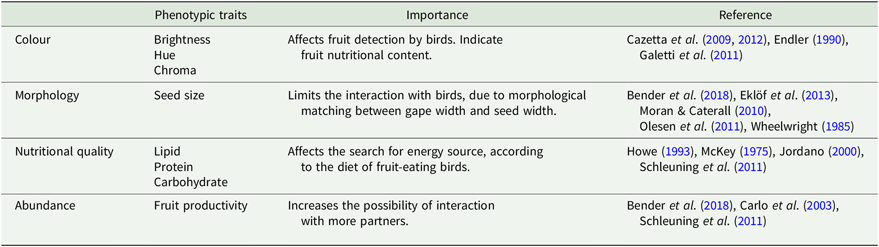
For each fruiting species, we selected three individuals and observed each of them for at least 10 min. After 10 min, observations continued until all individual birds recorded during the census had left the plant. When three individuals of a given plant species were not available, we extended the observation time until a comparable sampling effort among species was achieved. We sampled the plots in a way that after one sampling day, the plants with fruits had been observed for an average of 1 h d–1. We did not include the interactions with bird species considered as seed predators (e.g. Psittacidae), as well as those birds that did not swallow the seeds (i.e. pulp-pecking birds) or when fruits were only partly consumed. For each species, we recorded fruit traits based on their importance to the interaction with birds (Table 1).
Phenotypic traits of fruits used in the analyses, from 14 plant species in a frugivore–fruiting plant network from the southern Atlantic Forest in Brazil, and their respective importance in the interaction with fruit-eating birds.

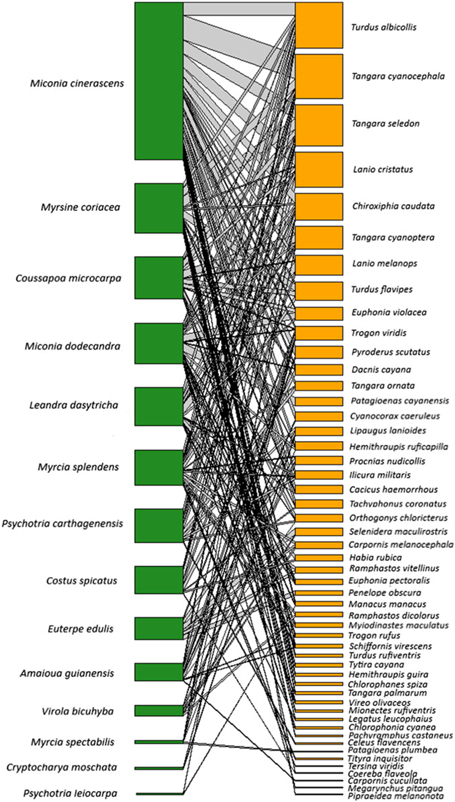
Given the complexity of nutritional analyses, we were able to work only with a limited number of plant species from the network. We selected 14 plant species (Figure 1) based on the following criteria: (1) plants from different families (maximum three per family), since phylogenetically related species tend to be ecologically similar (Burns & Strauss Reference Burns and Strauss2011) and may possess similar traits (Pigot et al. Reference Pigot, Bregman, Sheard, Daly, Etienne and Tobias2016, Symonds & Blomberg Reference Symonds, Blomberg and Garamzegi2014); (2) plants from different strata, since fruit-eating birds with distinct dietary specializations forage in different strata (Schleuning et al. Reference Schleuning, Blüthgen, Flörchinger, Braun, Schaefer and Böhning-Gaese2011); (3) plant species that produced enough fruits to permit all the proposed nutritional analyses. These species comprised 15% of the 90 species of plants that interacted with birds (Appendix 1). Based on the different levels of bird dependence on fruits, and the different proportions of fruits in their diets, the dietary specialization of fruit-eating birds was categorized following Kissling et al. (Reference Kissling, Böhning-Gaese and Jetz2009): (1) obligate fruit-eating birds (diet restricted to fruits); (2) partial fruit-eating birds (i.e. fruits dominate in the diet, but other food items are also consumed); and (3) opportunistic fruit-eating birds (fruits only supplement the diet). For this categorization, we used data from field observations and information from the World Handbook of Birds (Hoyo et al. Reference Hoyo, Elliott and Christie2010).
Interaction network between fruit-eating birds and the plant species with the most interactions in the southern Atlantic Forest, Brazil. Green boxes represent plant species, orange boxes fruit-eating bird species. The thickness of the links connecting pairs of boxes indicates the strength of the interaction between species.

Fruit productivity and size
Fruit productivity, i.e. the number of ripe fruits produced by each species, was estimated from April 2011 to March 2012. Whenever possible, we based our counts on three plants of each species, and for this we chose the plants with the most-visible fruits. The phenology of each plant was observed from the beginning of fruit maturation until the end of fruit availability (Sun & Moermond Reference Sun and Moermond1997). We estimated the number of ripe fruits on each plant by the visual-count method (adapted from Chapman et al. Reference Chapman, Chapman, Wangham, Hunt, Gebo and Gardner1992). We then evaluated the cumulative total of each individual across months and calculated the mean production of ripe fruit for the three individuals of each species.
To estimate the mean seed width for each plant species, we collected seeds from three individuals of each species, whenever possible, and measured 10 seeds from each individual. When we could not find three individuals, we collected more seeds from each individual, for a total of 30 seeds. We measured seed size with the software Image J from photographs of seeds laid on graph paper with a millimetre scale.
Fruit colour
Three aspects of fruit colour were assessed: brightness, hue and chroma. The reflectance spectra of the pericarp were measured in a HunterLab MiniScan XE Plus portable reflectance spectrophotometer, previously calibrated using colour standards provided by the manufacturer. The observer angle was set at 10° and a D65 illuminator, which simulates daylight, was used. Brightness, colour saturation (chroma) and hue, three variables that characterize the reflectance spectrum, were calculated (Endler Reference Endler1990) based on the CIELAB colour sphere (Cárdenas-Pérez et al. Reference Cárdenas-Pérez, Chanona-Pérez, Méndez-Méndez, Calderón-Domínguez, López-Santiago, Perea-Flores and Arzate-Vázquez2017, Guida et al. Reference Guida, Ferrari, Pataro, Chambery, Di Maro and Parente2013). The CIE coordinates L* a* b*, belonging to a dimensional system of numerical representation of colour, were recorded (Cárdenas-Pérez et al. Reference Cárdenas-Pérez, Chanona-Pérez, Méndez-Méndez, Calderón-Domínguez, López-Santiago, Perea-Flores and Arzate-Vázquez2017, Guida et al. Reference Guida, Ferrari, Pataro, Chambery, Di Maro and Parente2013). To calculate the colour hue (h) and the chroma (C*), related to colour saturation, the following equations were used: h = tan / 1 (b* / a*) and C* = [(a*) 2 + (b*) 2 ] 0.5 (Cárdenas-Pérez et al. Reference Cárdenas-Pérez, Chanona-Pérez, Méndez-Méndez, Calderón-Domínguez, López-Santiago, Perea-Flores and Arzate-Vázquez2017, Guida et al. Reference Guida, Ferrari, Pataro, Chambery, Di Maro and Parente2013). Hue values close to 180° represent fruits that are greener, values closer to 90° are yellower, and values closer to 0° are redder (Cárdenas-Pérez et al. Reference Cárdenas-Pérez, Chanona-Pérez, Méndez-Méndez, Calderón-Domínguez, López-Santiago, Perea-Flores and Arzate-Vázquez2017, Guida et al. Reference Guida, Ferrari, Pataro, Chambery, Di Maro and Parente2013). The chroma defines the intensity of colour (Cárdenas-Pérez et al. Reference Cárdenas-Pérez, Chanona-Pérez, Méndez-Méndez, Calderón-Domínguez, López-Santiago, Perea-Flores and Arzate-Vázquez2017, Guida et al. Reference Guida, Ferrari, Pataro, Chambery, Di Maro and Parente2013), with values near zero for neutral colours (grey) and around 60 for vivid colours. From this point on, chroma will be referred to as colour intensity.
Nutritional analysis
The fruit pulp or aril from seeds was frozen and then dried in a lyophilizer. The pulp and aril were used to evaluate the protein, lipid and low-mass carbohydrate contents. Due to the difficulty of separating the seeds of Miconia dodecandra and Leandra dasytricha without pulp loss, the entire fruit with seeds was used. The nutritional analyses were performed three times, i.e. using three independent samples. Proteins were determined according to the Kjeldahl method (AOAC 1990, Vogel Reference Vogel, Jeffery, Basset, Mendham and Denney1989). For lipid extraction, dried and pre-weighed samples were extracted with ethyl ether, using a Soxhlet extractor, and lipid content was determined by calculating the difference in weight between the initial and the defatted samples (AOAC 1990). To determine the amount of low-mass carbohydrates (glucose, fructose and sucrose, hereafter carbohydrates), the samples were extracted with 80% ethanol at 60°C, for 1 h, two consecutive times. The material was centrifuged for 20 min at 4°C and 12 000 rpm to recover the extract containing the carbohydrates, and the insoluble plant material was discarded. The extracts were frozen and lyophilized and then were diluted in ultrapure water and quantified using High-Performance Liquid Chromatography (HPLC) (Chaplin & Kennedy Reference Chaplin and Kennedy1994). The HPLC analysis was conducted in a Shimadzu (Japan) system with a CBM-10A control unit, a CTO-10A oven, an LC-10AD pump and a RID-10A refractive-index detector. A Supelcogel Pb (Supelco, USA) column, 30 cm × 7.8 mm, with a Supelcogel Pb pre-column, 5 cm × 4.6 mm were used. The temperature was set to 80°C and the flow to 0.5 mL min–1, using water as eluent. The quantification was based on calibration curves previously constructed using glucose, fructose and sucrose standards. The lipid, protein and carbohydrate concentrations were expressed as g per 100 g of dry pulp. In the case of two species, Miconia dodecandra and Leandra dasytricha, the fruits were processed together with the seeds, which could increase the estimate of the mean protein concentration. To test this processing procedure, we compared the protein concentrations from M. dodecandra (4.6%) and L. dasytricha (6.8%) to the mean of most species (X = 5.6% ± 1.8%). As the protein concentrations found were similar to this mean, we included the data for these two species in all the analyses. For this comparison, we decided to remove only four species with protein concentrations above 10%, in order to be more conservative.
Data analysis
Species roles may be defined by network metrics and may vary according to species traits (Mello et al. Reference Mello, Rodrigues, Costa, Kissling, Sekercioğlu, Marquitti and Kalko2015). We chose different metrics to assess different roles of fruit-eating birds, because each metric represents a different concept (Landherr et al. Reference Landherr, Friedl and Heidemann2010). The degree (k), centrality (closeness, betweenness) and interaction specialization index or selectivity (d’) of fruit-eating birds were measured from the complete bipartite network by Machado-de-Souza (Reference Machado-de-Souza, Campos, Devoto and Varassin2019). Degree (k) is the number of interactions established by a species (Mello et al. Reference Mello, Rodrigues, Costa, Kissling, Sekercioğlu, Marquitti and Kalko2015). Species with higher k values are more generalist than species with low k values. Centrality in interaction networks is defined as the relative position of a species within a network, and this position is given by the number of links that it has and how these links are distributed across different parts of the network (Nooy et al. Reference Nooy, Mrvar and Batagelj2005). Closeness centrality measures the proximity between two species in the same network, which corresponds to the number of links that separate them (Martín González et al. Reference Martín González, Dalsgaard and Olesen2010, Mello et al. Reference Mello, Rodrigues, Costa, Kissling, Sekercioğlu, Marquitti and Kalko2015). A fruit-eating bird that consumes fruits that are also consumed by many other species shows a high closeness centrality. A species with a high value of closeness centrality can be considered a hub, and is an important element in maintaining the stability of the network (Martín González et al. Reference Martín González, Dalsgaard and Olesen2010, Mello et al. Reference Mello, Rodrigues, Costa, Kissling, Sekercioğlu, Marquitti and Kalko2015). Betweenness centrality measures the importance of a species as a connector between two other species. A species with a high value of betweenness centrality can be considered a connector and is an important element that keeps different parts of the network together (Martín González et al. Reference Martín González, Dalsgaard and Olesen2010, Mello et al. Reference Mello, Rodrigues, Costa, Kissling, Sekercioğlu, Marquitti and Kalko2015) and maintains network cohesiveness (Nooy et al. Reference Nooy, Mrvar and Batagelj2005). We decided to use closeness and betweenness centrality because these metrics represent conceptual information that is more appropriate for our interest and hypothesis (i.e. the focus on species acting as hubs or connectors). The interaction specialization index (d’), here referred to as selectivity, ranges from 0 to 1; 0 indicates no selectivity, whereas 1 indicates extreme selectivity (Blüthgen et al. Reference Blüthgen, Menzel and Blüthgen2006). All network metrics were calculated in the bipartite package R Version 3.3.2 (Dormann Reference Dormann2011).
The variations in degree (k), closeness centrality and betweenness centrality, and selectivity (d’) among groups of fruit-eating birds were tested with respect to different fruit traits. We used the mean of fruit traits in the analysis, weighted by the number of fruits consumed by each species of bird, because this weighted mean is strongly influenced by the traits of fruits that are most often consumed by a given bird, and so the mean represents the fruit traits preferred by the bird species (i.e. fruit selection) and synthesizes the information from a range of species in a single value. To avoid including strongly correlated predictor variables, the correlation among fruit traits was tested (Appendix 2). Brightness was strongly correlated to all variables; hue was more strongly correlated to carbohydrates, productivity and protein (0.64; 0.77; 067); and protein was more strongly correlated to carbohydrates, hue, lipids, productivity and seed size (0.61; 0.67; 0.63; 0.62 and 0.62); therefore, these traits were omitted from the analysis. The remaining variables were chroma, carbohydrate, lipids, productivity and seed size (Appendix 2). In addition, to determine if the number of interactions, species centrality, and the selectivity in the diet of birds change according to dietary specialization (Kissling et al. Reference Kissling, Rahbek and Böhning-Gaese2007, Reference Kissling, Böhning-Gaese and Jetz2009), the different levels of dietary specialization were taken into account in the analyses.
Generalized linear models (GLM) with a maximum-likelihood approach were used to assess the relationships of the degree (k), closeness and betweenness centrality and selectivity (d’) metrics of fruit-eating birds (response variable), to the means of the fruit traits (productivity; nutritional content, i.e. lipids and carbohydrates; colour intensity, i.e. chroma; size, i.e. seed width) and the bird groups (obligate, partial and opportunistic fruit-eating birds) as predictor variables. GLMs were calculated by the glm function in the MASS package (Venables & Ripley Reference Venables and Ripley2002). The quasi-Poisson distribution was used to assess k and betweenness centrality, since the data were composed of count numbers and showed overdispersion. The Gaussian distribution was used to assess d’ and closeness centrality, since these variables were distributed normally. The models were validated based on residual analysis. The process used to select the optimum model for the GLM analyses was the function drop1 (i.e. the hierarchy is respected when considering terms to be added or dropped: all main effects contained in a second-order interaction must remain) of the stats package in R Version 3.3.2 (Dormann Reference Dormann2011).
Results
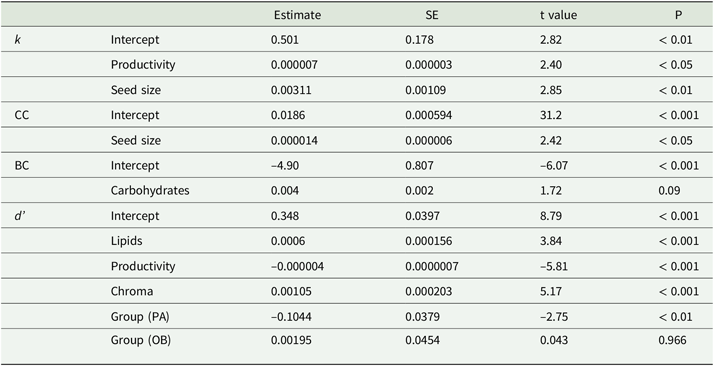
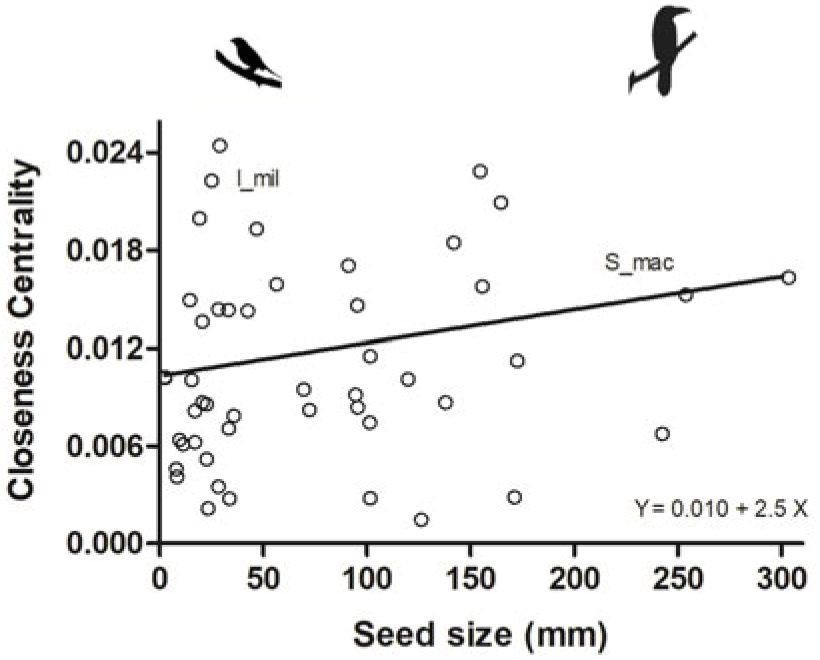
The 14 species of plants chosen for the analyses (15% of all plant species, n = 90, Appendix 1) were dispersed by 52 bird species, which consumed 2199 fruits. This corresponds to 76% (n = 67, Appendix 1) of the bird species sampled in the entire network and 35% of the total fruits consumed (n = 6215, Appendix 1). All groups of fruit-eating birds showed a higher degree of interaction (k) with plants (Appendix 1) that produced more fruits as Miconia cinerascens (n = 4019, Figure 1) and were, on average, larger-seeded as Myrcia splendens (6 mm, Table 2). Fruit-eating birds interacting with larger-seeded plants (e.g. Virola bicuhyba = 15 mm and Euterpe edulis = 14 mm) were more central, i.e. had higher closeness centrality, especially obligate fruit-eating birds such as Selenidera maculirostris; although some central species such as Ilicura militaris consumed, on average, smaller seeds as M. cinerascens (1.4 mm) and Psychotria carthagenensis (4 mm) (Table 2, Figure 2). Betweenness centrality was not related to any plant trait or dietary specialization group in the models (Table 2).
Summary of the best generalized linear models to evaluate the effects of fruit traits and dietary specialization on fruit-eating bird species (degree, k), closeness centrality (CC), betweenness centrality (BC) and selectivity (d’), for 14 plant species of a frugivore–fruiting-plant network in the southern Atlantic Forest, Brazil. Legend of fruit-eating bird dietary specialization (groups): OB = obligate, PA = partial

Relationship between seed size and closeness centrality of fruit-eating birds in the southern Atlantic Forest, Brazil. Legend: I_mil = Ilicura militaris and S_mac = Selenidera maculirostris.

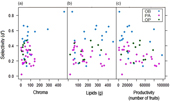
Fruit-eating birds were more selective (d’) when interacting with fruits that, on average, had a higher colour intensity, lipid content and productivity (Table 2). Fruit-eating bird groups differed in their selectivity (d’) (F = 14.7, df = 2, P < 0.001); obligate fruit-eating birds were more selective (higher d’ values, e.g. Patagioenas plumbea with 0.8) than were partial and opportunistic fruit-eating birds (respectively, β = −0.233, SE = 0.043, t = −5.41, P < 0.001 and β = −0.164, SE = 0.054, t = −3.05, P < 0.05). Partial and opportunistic fruit-eating birds had the same levels of selectivity (β = −0.070, SE = 0.049, t = −1.40, P = 0.346). Obligate fruit-eating birds selected more fruits that were richer in lipids (Figure 3). Obligate and opportunistic fruit-eating birds consumed fruits with lower colour intensity and from less-productive plants (Figure 3). Partial fruit-eating birds, in contrast, were less selective, consuming fruits that were poorer in lipids, with lower colour intensity and from plants with various productivity levels (Figure 3).
Fruit-eating bird species selectivity (d’) according to fruit traits, i.e. chroma (colour intensity) (a), lipids (concentration g per 100 g dry pulp) (b) and productivity (number of fruits) (c), and according to fruit-eating bird dietary specialization in the southern Atlantic Forest, Brazil. Legend for fruit-eating bird dietary specialization: OB = obligate, PA = partial, OP = opportunistic. We used the mean of fruit traits in the analysis, weighted by the number of fruits consumed by each species of bird.

Discussion
We demonstrated that different plant traits determine the different network roles of fruit-eating birds in a southern Atlantic Forest in Brazil. Fruit-eating bird interaction generality (k) is influenced by resource abundance and morphology. Network stability is maintained by fruit-eating birds that interact with larger-seeded plants, and these birds can be considered as a hub in our network due to their greater centrality (CC). Interaction selectivity (d´) was higher for birds that feed on fruits from less-productive plants and on fruits with more lipids and higher chroma. We also found that fruit-eating birds with distinct dietary specializations responded differently to the factors that influence selectivity.
Fruit productivity is important for the number of partners of a given species (degree). The positive relationship found in this study between the abundance of fruits and fruit-eating bird species agrees with findings of previous studies (Gleditsch & Carlo Reference Gleditsch and Carlo2011, Moegenburg & Levey Reference Moegenburg and Levey2003, Saracco et al. Reference Saracco, Collazo and Groom2004). Since the inclusion of fruits in a bird’s diet depends on the diversity and abundance of this resource in the bird’s foraging environment (Whelan et al. Reference Whelan, Schmidt, Steele, Quinn and Dilger1998), plants that produce more fruits will have a greater chance to be included as a partner. Plants with abundant fruits do have more interactions with fruit-eating birds (Carlo et al. Reference Carlo, Collazo and Groom2003, Loiselle & Blake Reference Loiselle and Blake1990, Schleuning et al. Reference Schleuning, Blüthgen, Flörchinger, Braun, Schaefer and Böhning-Gaese2011), which reinforces the idea that fruit abundance is one of the most important factors determining the number of a plant’s interactions with birds.
The bird species studied here, independent of frugivory level, showed more interactions (k) with fruits that have larger seeds. Besides that, more central fruit-eating birds (CC) tended to share their interactions with larger-seeded plants with many other bird species. This indicates that fruit-eating birds show a higher niche overlap when interacting with larger-seeded plants, probably due to the direct relationship between seed size and the gape width of these birds (Galetti et al. Reference Galetti, Pizo and Morellato2011, Jordano Reference Jordano1995, Wheelwright Reference Wheelwright1985). Birds with narrow gapes, for instance Tangara cyanocephala, can exploit only small-seeded species, but birds with wider gapes, for instance Selenidera maculirostris, which although on average feed on fruits with large seeds, can exploit both small- and large-seeded species, resulting in an overlapping resource use with other birds and increasing their centrality. Therefore, fruit-eating bird species with large gapes can make use of fruit resources more efficiently than other fruit-eating birds (Dehling et al. Reference Dehling, Töpfer, Schaefer, Jordano, Böhning-Gaese and Schleuning2014, Fleming Reference Fleming1979). This relationship between seed size and gape width agrees with and reinforces the hypothesis that size matching has an influence on ecological interactions (Bender et al. Reference Bender, Kissling, Blendinger, Böhning-Gaese, Hensen, Kühn, Muñoz, Neuschulz, Nowak, Quitián, Saavedra, Santillán, Töpfer, Wiegand, Dehling and Schleuning2018, Dehling et al. Reference Dehling, Töpfer, Schaefer, Jordano, Böhning-Gaese and Schleuning2014, Olesen et al. Reference Olesen, Bascompte, Dupont, Elberling, Rasmussen and Jordano2011, Sebastián-González et al. Reference Sebastián-González, Pires, Donatti, Guimarães and Dirzo2017). On average, fewer species of fruit-eating birds were observed eating large-seeded fruits than fruits with smaller seeds. An alternative explanation is that these bird species could interact with small-seeded fruits, because they are looking for the best energy: weight ratio, which would explain the high degree (k) of Miconia cinerascens (Figure 1).
Our results reinforce the hypotheses proposed in the early 1970s, related to frugivore selection of plants that produce fruits with a higher energy content, such as lipids. These ideas propose that plants with higher energy contents would be sought by more-specialized birds, such as obligate fruit-eaters (McKey Reference McKey, Gilbert and Raven1975, Snow Reference Snow1971), since they consume a wide variety of fruits to satisfy their daily nutrient requirements (Moermond & Denslow Reference Moermond and Denslow1985). Obligate fruit-eating birds are more selective (d´) for fruits with a higher lipid content, probably because fruits are their only source of lipids, compared with other groups of fruit-eating birds that only supplement their diets with fruit (Howe Reference Howe1993, McKey Reference McKey, Gilbert and Raven1975, Schleuning et al. Reference Schleuning, Blüthgen, Flörchinger, Braun, Schaefer and Böhning-Gaese2011, Reference Schleuning, Ingmann, Strauß, Fritz, Dalsgaard, Dehling, Plein, Saavedra, Sandel, Svenning, Böhning-Gaese and Dormann2014; Stiles Reference Stiles1993). Obligate fruit-eating birds select plant species that produce fewer fruits, indicating greater partitioning in the use of these plant resources, for example Myrcia splendens, which also has less vividly coloured fruits.
The lower interaction overlap with species that produce fruits richer in lipids, and the higher degree of partitioning with less-productive species supports the idea that the establishment of an interaction with an obligate fruit-eating bird is driven by fruit quality rather than quantity. This agrees with the idea that obligate fruit-eating birds choose fruits with more proteins and lipids (Fleming et al. Reference Fleming, Venable and Herrera1993, Howe Reference Howe and Murray1986). The similarity in the selectivity of the interactions between opportunistic and obligate fruit-eating birds might be due to the opportunistic aspect of this interaction. Even though the diet of opportunistic fruit-eating birds includes invertebrates (Jordano Reference Jordano and Fenner2000), when they forage on fruits, these birds might be looking for specific traits such as lipids, although in smaller amounts, to supplement their diet (Howe Reference Howe1993).
The lower selectivity of partial fruit-eating birds with respect to plants that are more productive and have a lower lipid content may be associated with their response to the peaks in abundance of their preferred fruits (Carlo et al. Reference Carlo, Collazo and Groom2003). When a plant is producing large amounts of fruit, all partial fruit-eating birds share this resource. Partial fruit-eating birds might overlap in their interactions with plants that produce a large quantity of fruit, even if these fruits have a low lipid content, since these birds can rely on other sources of lipids (Jordano Reference Jordano1987, Schleuning et al. Reference Schleuning, Ingmann, Strauß, Fritz, Dalsgaard, Dehling, Plein, Saavedra, Sandel, Svenning, Böhning-Gaese and Dormann2014). It is also possible that by consuming many of the fruits that are abundant, these birds may satisfy their requirement for lipids. The interesting observation that all the groups of fruit-eating birds selected fruits with lower colour intensity may be related to the abundance or nutritional quality of the fruits in the forest. The nutritional content may be indicated by visual signals (Schaefer & Ruxton Reference Schaefer and Ruxton2011), and a low colour intensity in fruits is often associated with darker shades and a higher sugar content, as documented by Cazetta et al. (Reference Cazetta, Galetti, Rezende and Schaefer2012). Besides this, since in the Americas black fruits are more common, a fruit-eating bird is more likely to interact with black fruits (Schaefer & Ruxton Reference Schaefer and Ruxton2011, Schmidt et al. Reference Schmidt, Martin Schaefer and Winkler2004, Wheelwright & Janson Reference Wheelwright and Janson1985).
We found a combination of abundance and phenotypic plant traits that influenced the relationships of the fruit traits to the topological roles played by species of fruit-eating birds in the interaction network. This indicates that both neutral- (abundance) and niche-based (phenotypic traits) processes are involved in mutualistic interactions. Indeed, the current consensus is that a combination of neutral- and niche-based processes is responsible for the pairwise interactions in seed-dispersal networks (Burns Reference Burns2006, González-Castro et al. Reference González-Castro, Yang, Nogales and Carlo2015). In particular, we found that productivity (abundance of fruits) influenced the degree and the selectivity of the bird species in this network, supporting the suggestion that the establishment of interactions between plants and fruit-eating birds is driven by fruit abundance (Whelan et al. Reference Whelan, Schmidt, Steele, Quinn and Dilger1998). On the other hand, phenotypic traits were also important, probably because morphological coupling between seed sizes and bird gapes fundamentally affects the centrality of fruit-eating birds. Morphological coupling has been identified as one of the predictors of increases in interaction frequency (Bender et al. Reference Bender, Kissling, Blendinger, Böhning-Gaese, Hensen, Kühn, Muñoz, Neuschulz, Nowak, Quitián, Saavedra, Santillán, Töpfer, Wiegand, Dehling and Schleuning2018, Olesen et al. Reference Olesen, Bascompte, Dupont, Elberling, Rasmussen and Jordano2011, Vizentin-Bugoni et al. Reference Vizentin-Bugoni, Maruyama and Sazima2014).
We found that nutritional content, colour intensity, seed size, fruit productivity and dietary specialization are important drivers of birds’ roles in the network in the Brazilian Atlantic Forest. Our study demonstrated that the number of partners (degree), the relative importance of a species to the community structure (centrality), and the selectivity (d´) of different feeding groups of fruit-eating birds responded in different ways to plant traits. Any change in the fruiting period or fruit productivity will probably impact groups of fruit-eating birds in different ways, since the nutritional dependence is distinct in each group. This change may impact the whole network, given that the roles of the different bird groups depend on fruit traits, and fruit-eating birds with high levels of frugivory are important for the structural robustness of ecological communities (Kissling et al. Reference Kissling, Böhning-Gaese and Jetz2009, Mello et al. Reference Mello, Rodrigues, Costa, Kissling, Sekercioğlu, Marquitti and Kalko2015, Ruggera et al. Reference Ruggera, Blendinger, Gomez and Marshak2016). Lastly, our results stress that the understanding of the functions performed by the species in a network should include multiple metrics.
Author ORCIDs
Marcia L. Malanotte https://orcid.org/0000-0002-8104-8860
Acknowledgements
We thank Mariano Devoto and Thais Zanata for comments, and the Fundação Grupo Boticário de Proteção à Natureza (Reserva Natural Salto Morato) and the Sociedade de Pesquisa em Vida Selvagem e Educação Ambiental (SPVS) for field support and access to the study sites. We also thank Mater Natura – Instituto de Estudos Ambientais, especially Helena Zarantonieli and Paulo Pizzi, for administrative support.
Financial support
This research was supported by the Fundação Grupo Boticário de Proteção à Natureza (FGBPN, project number 0875) and TFCA, Capes BEX 8971/11-0 and 309453/2013-5 scholarship to I.G.V. and Capes scholarships to M.L.M., T.M.-de-S. and R.P.C.
Appendix 1
Complete frugivore–fruiting plant network from the southern Atlantic Forest, Brazil (Machado-de-Souza et al. Reference Machado-de-Souza, Campos, Devoto and Varassin2019) before the selection of plants for the data analysis. Green nodes represent plant species, orange nodes bird species. The thickness of the links connecting pairs is proportional to the number of fruits dispersed. Label sizes are related to the number of interactions (degree).

Appendix 2
Fruit traits of 14 species from a frugivore-fruiting plant network in the southern Atlantic Forest, Brazil. Pearson correlation matrix between fruit variables (Bright = brightness, Carb = carbohydrates, Product = productivity, Seed = seed size) and P-values used to choose the traits included in the analyses. Brightness, hue and protein content were omitted from the analyses because they were strongly correlated.

* P < 0.01, ** P < 0.001.