Stress has long been associated with psychosis (Bebbington et al., Reference Bebbington, Wilkins, Jones, Foerster, Murray, Toone and Lewis1993). Often, stress is presumed to play a contributory role in the onset and relapse of psychotic disorders. This is consistent with the diathesis-stress and vulnerability models of psychosis, both of which posit that life events (LEs) ‘activate’ a clinical or genetic vulnerability (Lukoff, Snyder, Ventura, & Nuechterlein, Reference Lukoff, Snyder, Ventura and Nuechterlein1984; Nuechterlein & Dawson, Reference Nuechterlein and Dawson1984; Nuechterlein et al., Reference Nuechterlein, Dawson, Ventura, Gitlin, Subotnik, Snyder and Bartzokis1994; Walker & Diforio, Reference Walker and Diforio1997). This model has been supported by research showing that LEs often occur shortly before the onset of psychosis (Beards et al., Reference Beards, Gayer-Anderson, Borges, Dewey, Fisher and Morgan2013; Bebbington et al., Reference Bebbington, Wilkins, Jones, Foerster, Murray, Toone and Lewis1993; Day et al., Reference Day, Nielsen, Korten, Ernberg, Dube, Gebhart and Olatawura1987; Ira et al., Reference Ira, De Santi, Lasalvia, Bonetto, Zanatta, Cristofalo and Gardellin2014; March-Llanes, Marqués-Feixa, Mezquita, Fañanás, & Moya-Higueras, Reference March-Llanes, Marqués-Feixa, Mezquita, Fañanás and Moya-Higueras2017; Trotman et al., Reference Trotman, Holtzman, Walker, Addington, Bearden, Cadenhead and Mathalon2014), even when limited to fateful events unrelated to a person's symptoms and behavior (Bebbington et al., Reference Bebbington, Wilkins, Jones, Foerster, Murray, Toone and Lewis1993; Malla, Cortese, Shaw, & Ginsberg, Reference Malla, Cortese, Shaw and Ginsberg1990; Raune, Kuipers, & Bebbington, Reference Raune, Kuipers and Bebbington2009). There are several hypotheses regarding the mechanism of this relationship. The stress-generation model holds that the presence of symptoms increases the likelihood of experiencing LEs (Hammen, Reference Hammen1991, Reference Hammen2006), described by Zubin and Spring (Reference Zubin and Spring1977) as a ‘stress-prone pattern of living’. This pattern is supported by research showing LEs can be predicted by earlier symptoms and illness characteristics (Brown & Birley, Reference Brown and Birley1968; Lukoff et al., Reference Lukoff, Snyder, Ventura and Nuechterlein1984; March-Llanes et al., Reference March-Llanes, Marqués-Feixa, Mezquita, Fañanás and Moya-Higueras2017; Shakoor et al., Reference Shakoor, Zavos, Haworth, McGuire, Cardno, Freeman and Ronald2016).
While the relationship between LEs and illness onset is well-established, fewer studies have tracked LEs and symptom relapse or exacerbation. Brown and Birley's (Reference Brown and Birley1968) seminal work demonstrated a link between retrospectively assessed LEs and relapse in schizophrenia. Multiple prospective studies of psychotic disorders have confirmed that LEs increase prior to relapse (Hirsch et al., Reference Hirsch, Bowen, Emami, Cramer, Jolley, Haw and Dickinson1996; Malla et al., Reference Malla, Cortese, Shaw and Ginsberg1990; Nuechterlein et al., Reference Nuechterlein, Dawson, Ventura, Gitlin, Subotnik, Snyder and Bartzokis1994; Ventura, Nuechterlein, Lukoff, & Hardesty, Reference Ventura, Nuechterlein, Lukoff and Hardesty1989), where relapse is defined as an episode requiring hospitalization (Castine, Meador-Woodruff, & Dalack, Reference Castine, Meador-Woodruff and Dalack1998), or as a significant exacerbation in psychotic symptoms (Doering et al., Reference Doering, Müller, Köpcke, Pietzcher, Gaebel, Linden and Schüssler1998). One particularly large prospective study, however, failed to replicate the association between LEs and relapse (Hirsch et al., Reference Hirsch, Bowen, Emami, Cramer, Jolley, Haw and Dickinson1996), and in a review of the literature, Fallon (Reference Fallon2008) concluded that the association between LEs and relapse was unresolved.
These inconsistent findings could be explained by the unique effects of LEs on specific symptom domains, which are obscured when the outcome is relapse. Relapse implies positive symptoms are present, but could involve multiple symptom domains. Furthermore, utilizing a categorical (i.e. relapse or no relapse) rather than dimensional outcome measure may have obscured relationships present across the spectrum of symptom severity. Psychotic disorders manifest in diverse symptoms, including reality distortion (hallucinations and delusions), disorganization, negative symptoms, depression, and mania (Reininghaus et al., Reference Reininghaus, Böhnke, Hosang, Farmer, Burns, McGuffin and Bentall2016, Reference Reininghaus, Böhnke, Chavez-Baldini, Gibbons, Ivleva, Clementz and Tamminga2019; Stochl et al., Reference Stochl, Jones, Plaistow, Reininghaus, Priebe, Perez and Croudace2014). However, few studies have investigated the effect of LEs on these domains. One of the first, a retrospective study of patients with schizophrenia, found that those whose psychosis was rated as being ‘reactive to life events’ had fewer negative symptoms than other patients (Fenton & McGlashan, Reference Fenton and McGlashan1991). More recently, a prospective study of individuals with schizophrenia spectrum disorders showed that LEs and emotional reactivity together predicted increases in positive symptoms, but not negative or mood symptoms (Docherty, St-Hilaire, Aakre, & Seghers, Reference Docherty, St-Hilaire, Aakre and Seghers2008). Similarly, a longitudinal study of adolescents with schizotypal personality disorder showed that LEs predicted reality distortion but not negative symptoms (Tessner, Mittal, & Walker, Reference Tessner, Mittal and Walker2009), and a study of community adolescents found that LEs were positively correlated with psychotic experiences, but negatively correlated with anhedonia (Shakoor et al., Reference Shakoor, Zavos, Haworth, McGuire, Cardno, Freeman and Ronald2016). The apparent inverse relationship between LEs and negative symptoms appears contrary to the well-established literature linking LEs and depression (Kessler, Reference Kessler1997; Stroud, Davila, & Moyer, Reference Stroud, Davila and Moyer2008; Tennant, Reference Tennant2002), which is often confounded with negative symptoms. In a retrospective analysis of patients with schizophrenia, LEs were more strongly associated with depression than psychotic symptoms, and uncorrelated with negative symptoms (Schwartz & Myers, Reference Schwartz and Myers1977). Negative LEs have also been associated with the onset or relapse of bipolar disorder (Ellicott, Hammen, Gitlin, Brown, & Jamison, Reference Ellicott, Hammen, Gitlin, Brown and Jamison1990; Hammen & Gitlin, Reference Hammen and Gitlin1997; Hunt, Bruce-Jones, & Silverstone, Reference Hunt, Bruce-Jones and Silverstone1992; Johnson & Roberts, Reference Johnson and Roberts1995). Several studies have shown negative LEs precede manic episodes, but others fail to replicate this effect (for a review, see Johnson, Reference Johnson2005). Furthermore, several longitudinal studies suggest that negative LEs are not predictive of increased manic symptoms (Johnson, Reference Johnson2005; Mcpherson, Herbison, & Romans, Reference Mcpherson, Herbison and Romans1993; Reilly-Harrington, Alloy, Fresco, & Whitehouse, Reference Reilly-Harrington, Alloy, Fresco and Whitehouse1999; Reilly-Harrington, Fresco, Whitehouse, & Zechmeister). Overall, evidence suggests that LEs predict exacerbation of reality distortion and depression symptoms in psychotic disorders, but the role of stress in disorganization, negative symptoms, and mania in the context of psychotic disorders is uncertain.
Finally, the research on LEs has generally focused on negative LEs, either ignoring positive LEs or treating them as equivalent, potentially conflating two opposite effects. For instance, Beards et al.'s 2013 meta-analysis identified only one study which distinguished positive and negative LEs. That study found that negative, but not positive LEs, predict the onset of acute or transient psychosis (Chakraborty, Chatterjee, Choudhary, Singh, & Chakraborty, Reference Chakraborty, Chatterjee, Choudhary, Singh and Chakraborty2007). Outside of the psychosis literature, several studies have shown that positive events may reduce psychopathology (Cohen & Hoberman, Reference Cohen and Hoberman1983; Cohen, McGowan, Fooskas, & Rose, Reference Cohen, McGowan, Fooskas and Rose1984; Dixon & Reid, Reference Dixon and Reid2000), or at least buffer against the effect of negative LEs (Davidson, Shahar, Lawless, Sells, & Tondora, Reference Davidson, Shahar, Lawless, Sells and Tondora2006), but these findings must be interpreted carefully, as individuals with psychotic disorders may respond differently to LEs than healthy individuals. Studies of bipolar disorder in particular have suggested increased manic symptoms following goal-attainment, but not other positive events (Johnson et al., Reference Johnson, Sandrow, Meyer, Winters, Miller, Solomon and Keitner2000), suggesting that in some instances positive LEs may precede worsening of symptoms. Overall, compared to negative LEs, the research on positive LEs is sparse, and the effects of positive LEs on symptoms in psychotic disorders is unclear.
The present study seeks to address these gaps by examining the impact of LEs on change in specific symptom domains of psychotic disorders, using both within- and between-person analyses. We further examined the directionality of these effects; whether LEs predict symptoms or symptoms predict LEs. Specifically, we utilized a cohort of individuals with psychotic disorders who were followed for 10 years after first psychiatric hospitalization. We examined the impact of positive and negative LEs on reality distortion, disorganization, negative symptoms, depression, and mania. We hypothesized that negative LEs would exacerbate symptoms of psychosis, disorganization, depression, and mania. We also examined the impact of positive LEs, an exploratory aim given the limited knowledge in this area. Finally, there is mixed support for a stress generation model positing that symptoms can elicit LEs, and thus we further sought to examine whether symptoms lead to increased LEs at subsequent timepoints.
Methods
Participants
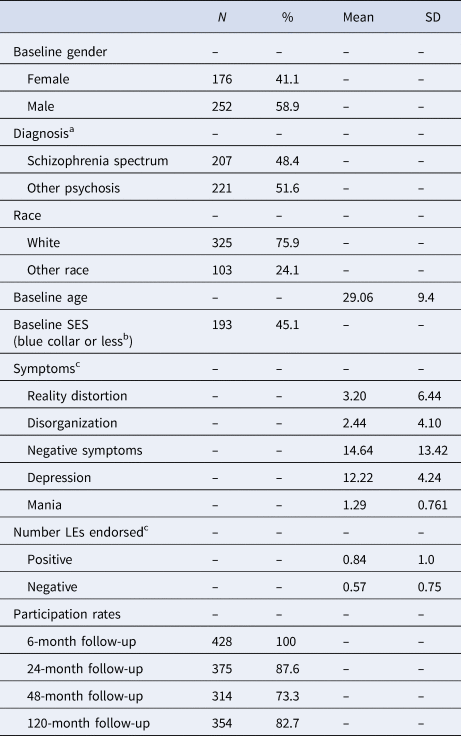
Participants are from the Suffolk County Mental Health Project (SCMHP; Bromet et al., Reference Bromet, Schwartz, Fennig, Geller, Jandorf, Kovasznay and Rich1992), an epidemiological study of first-admission psychosis. This study follows a cohort of individuals with schizophrenia, schizoaffective disorder, bipolar disorder with psychosis, major depressive disorder with psychosis, drug-induced psychosis, and psychotic disorders not otherwise specified. Data utilized in the present analyses were collected at 6-, 24-, 48-, and 120-month follow-up. Recruitment and inclusion criteria are described in further detail by Bromet et al. (Reference Bromet, Schwartz, Fennig, Geller, Jandorf, Kovasznay and Rich1992). All participants were consenting adults or assenting minors for whom parental consent was obtained; full participant demographics are presented in Table 1. This study was approved by the Stony Brook University Institutional Review Board (IRB). The authors assert that all procedures contributing to this work comply with the ethical standards of the relevant national and institutional committees on human experimentation and with the Helsinki Declaration of 1975, as revised in 2008.
Sample characteristics
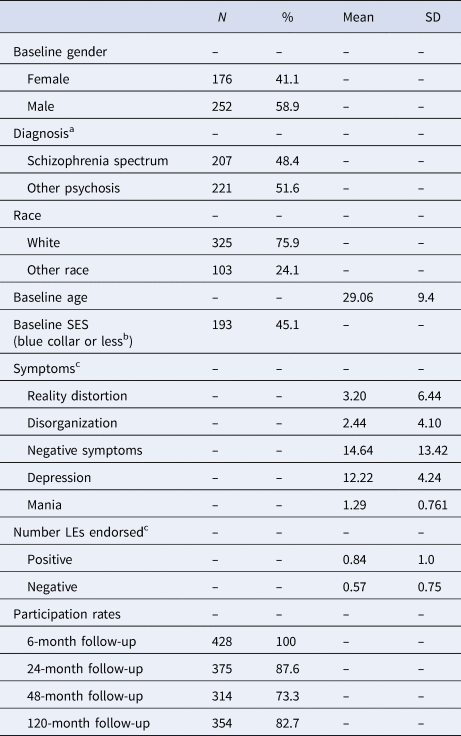
a Diagnosis assessed at most recent study wave. Schizophrenia spectrum includes schizophrenia and schizoaffective disorder.
b SES of household primary breadwinner.
c Distribution across four study intervals.
Measures
Life events
Both positive and negative LEs were assessed using the Life Chart (adapted from McGonagle & Kessler, Reference McGonagle and Kessler1990), a checklist-based approach to assessing LEs. Interviewers rated LEs based on information obtained from participants during interviews, interviews with significant others, and review of medical records. Negative LEs from 13 categories and positive events from nine categories were evaluated. Specific categories of events are included in online Supplementary Table S1. Composites were scored at each follow-up by counting the number of LEs in each category (positive and negative) endorsed by the participant as occurring during the previous 6 months.
Symptoms
Symptoms were assessed using the Scales for the Assessment of Positive Symptoms (SAPS; Andreasen, Reference Andreasen1984) and the Scales for the Assessment of Negative Symptoms (SANS; Andreasen, Reference Andreasen1989). Prior factor analysis of the SAPS and SANS in this sample indicated that the SANS may best be scored as a single index of negative symptoms, whereas the SAPS is best broken down into reality distortion and disorganization scales (Kotov, Guey, Bromet, & Schwartz, Reference Kotov, Guey, Bromet and Schwartz2010). Mania was assessed using the excitement rating of the Brief Psychiatric Rating Scale (BPRS; Huber et al., Reference Huber, Schöttle, Lambert, Hottenrott, Agorastos, Naber and Schroeder2012; Overall, Reference Overall1974) and depression using the sum of nine symptoms of current depression from the Structured Clinical Interview for DSM-IV (SCID-IV, First, Spitzer, Gibbon, & Williams, Reference First, Spitzer, Gibbon and Williams2002) as described previously (Kotov et al., Reference Kotov, Fochtmann, Li, Tanenberg-Karant, Constantino, Rubinstein and Carlson2017). All clinical variables were rated for the month preceding interview.
Analyses
Multilevel models
In order to evaluate dynamic relationships within people over time, multilevel models were fit to the data using SAS (Version 9.4). The five symptom domains were the outcomes, predicted by either the positive or negative LE composite, for a total of 10 models. Random intercepts and slopes were included, estimating individual trajectories for each participant. Time-point of data collection was entered as a categorical covariate to control for any differences between follow-ups. Residual autocorrelations were estimated using an unstructured covariance matrix. All symptom and LE variables were grand mean standardized to facilitate interpretability.
Structural equation models
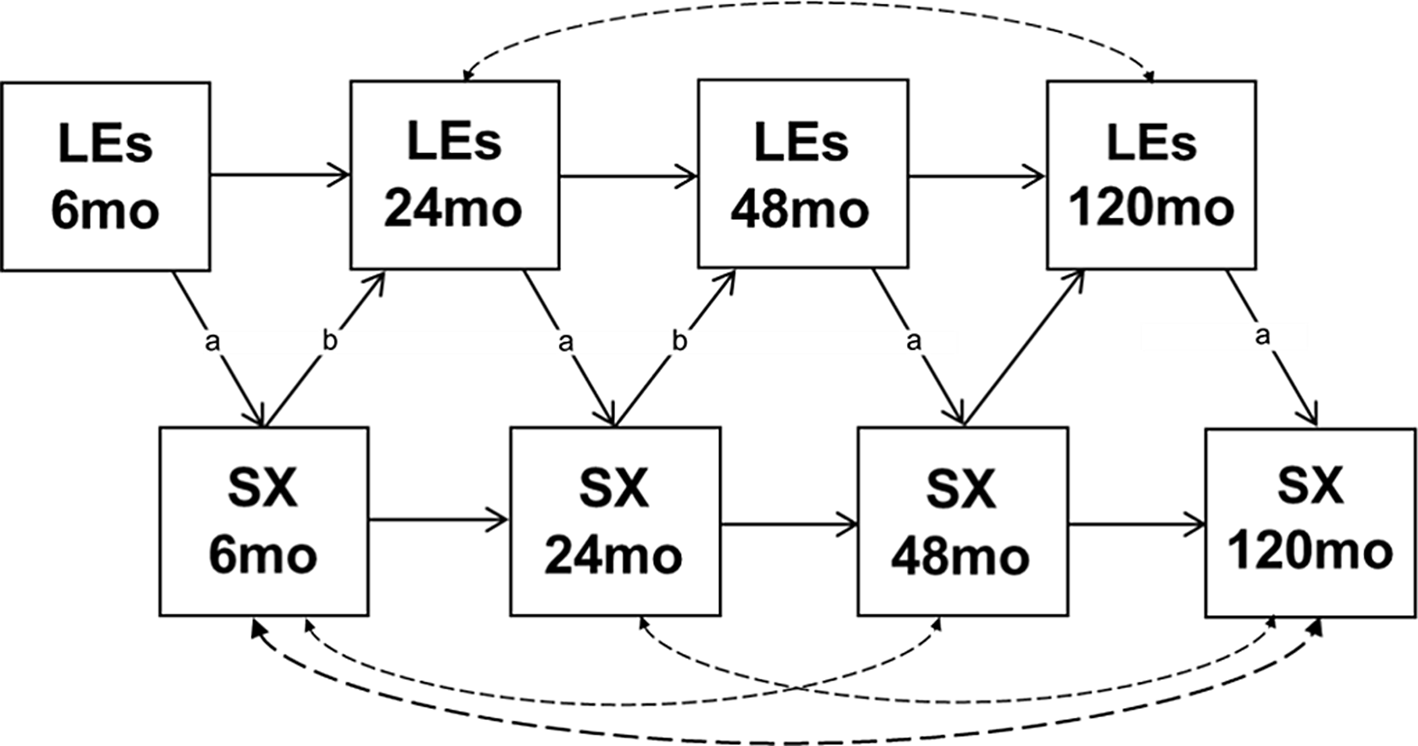
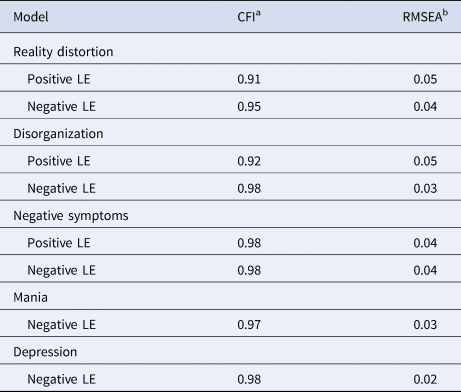
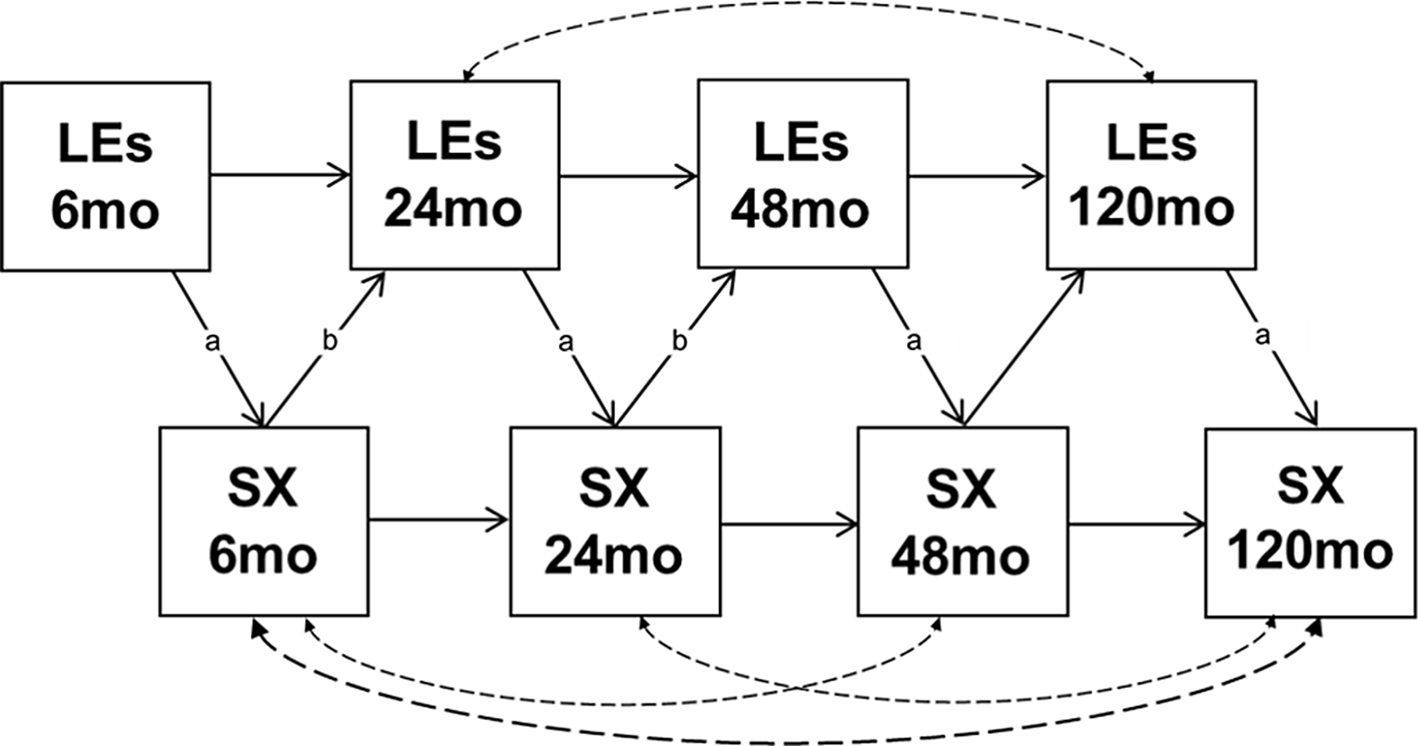
Structural equation modeling was used to determine the direction of effects. These analyses employed a cross-lagged model, in which symptoms at each timepoint were predicted by both LEs preceding that timepoint and symptoms at the previous timepoint; likewise, LEs were predicted by previous LEs and symptoms (Fig. 1). The model therefore tested the impact of LEs on future symptoms above and beyond previous symptoms, and the impact of symptoms on future LEs above and beyond previous LEs. For both positive and negative LEs, paths were constrained to be equal from symptoms to LEs and LEs to symptoms at each wave, save for between 48 and 120 months – due to the substantial difference in time between these study waves, no constraints were placed on these paths. Disturbances on symptoms at non-adjacent waves were allowed to correlate, as symptom stability did not follow a simple autoregressive model. The addition of these correlations improved fit of all models. In evaluating the model, we considered Comparative Fit Index (CFI) >0.90 and Root Mean Square Error of Approximation (RMSEA) <0.08 to indicate good fit; and CFI >0.95 and RMSEA <0.05 to indicate excellent fit (Hu & Bentler, Reference Hu and Bentler1999; Marsh, Hau, & Wen, Reference Marsh, Hau and Wen2004). Structural equation models were estimated using SAS version 9.4. Fit statistics are presented in Table 2.
Model of between-subjects effects. Cross-lagged structural equation models of the interplay between LEs and symptoms between-subjects. Paths with the same label were constrained to be equal. The same model was fit for all SX/LE combinations reported in Tables. LE, life events; SX, symptoms. Dashed lines indicate correlations included to improve model fit and not described in tables.
Fit indexes across structural equation models
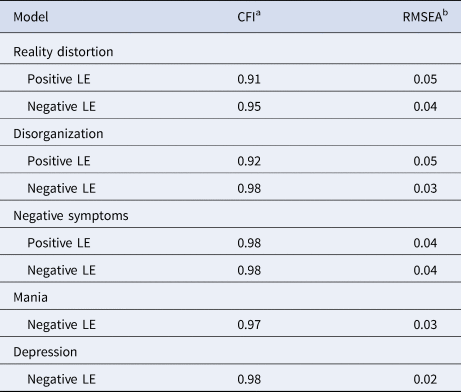
a Comparative fit index.
b Root mean square error of approximation.
Data were 86% complete across waves, and 1471 observations were available for analyses. Analyses used Full Information Maximum Likelihood, which allowed us to retain all available observations.
Results
Sample characteristics
Participants were predominantly male, and 29 years of age at study entry on average. About half had a schizophrenia spectrum disorder (Table 1). Participants experienced on average fewer than one LE at each timepoint (mean negative = 0.57; mean positive = 0.84).
Within-person effects of LEs on symptoms
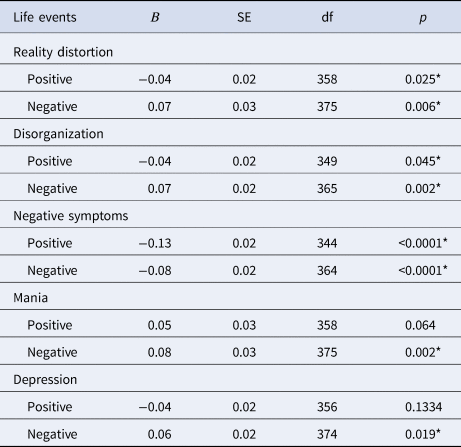
Multilevel models were fit to the data in order to examine the effects of LEs on symptoms over time. Results are presented in Table 3. We observed significant within-person effect of negative LEs on increases in reality distortion, disorganization, mania, and depression. This indicates that when a person experienced more LEs relative to their own average, reality distortion, disorganization, mania, and depression were elevated, compared to intervals with fewer LEs. Negative LEs also predicted a decrease in negative symptoms. Effects of adverse LEs on symptoms remained consistent after controlling for demographic characteristics (online Supplementary Table S2). The impact of demographic factors on slopes of the adverse LE – symptom relationships are presented in online Supplementary Table S3 and Supplementary Figures S1 and S2.
Within-person effects of LEs across multi-level models
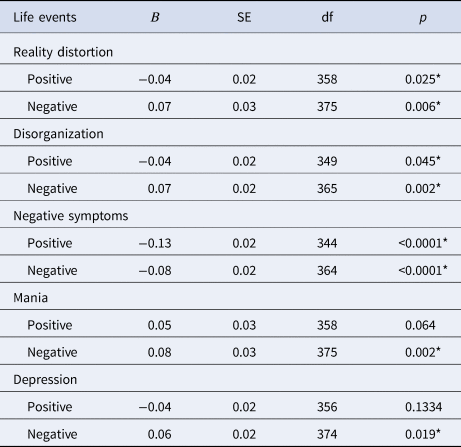
*Indicates significance p < 0.05.
Positive life LEs predicted decreases in reality distortion, disorganization, and negative symptoms. After a person experienced more positive LEs relative to their own average, levels of these three symptom dimensions decreased compared when they had fewer positive LEs than their own average. Positive LEs were not significantly associated with the symptoms of depression or mania.
Direction of effects
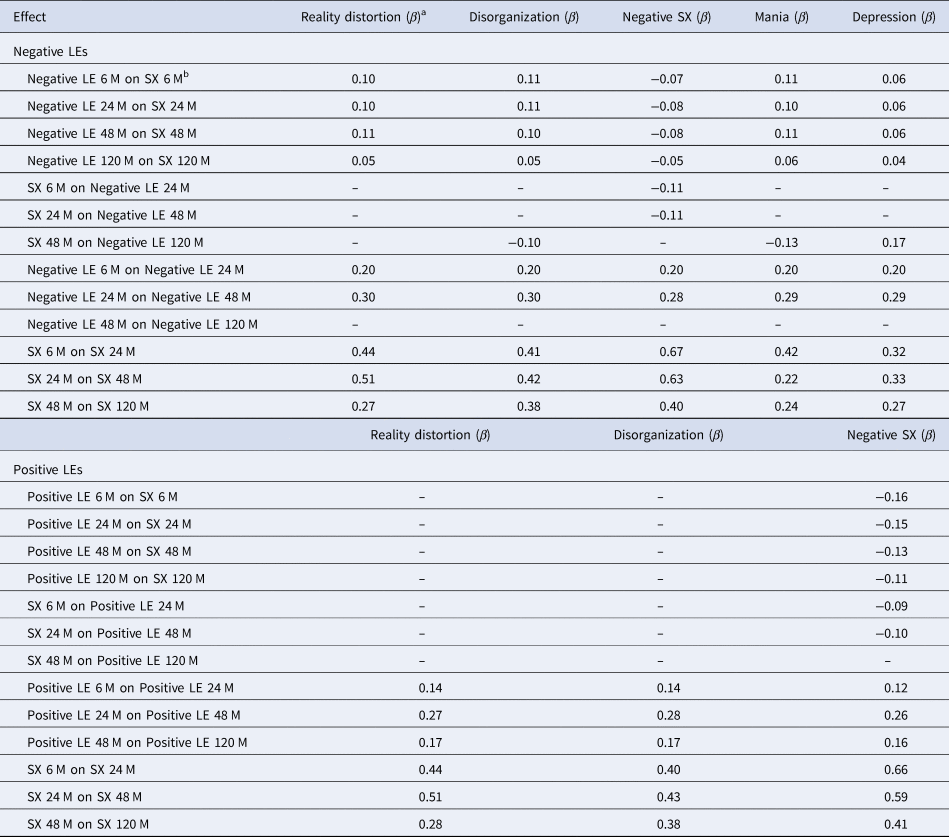
Structural equation models were used to test the directions of the LE–symptom associations observed in multilevel models. Path effects are presented in Table 4. Structural equation models are illustrated in Fig. 1. Across models, all paths from negative LEs to later symptoms were significant, with negative LEs predicting exacerbation in all domains save for negative symptoms, in which LEs predicted a reduction in symptom severity. Symptoms did not consistently predict the occurrence of negative LEs, except for negative symptoms which predicted fewer LEs in the first 48 months of the study.
Path effects in structural equation models of Les
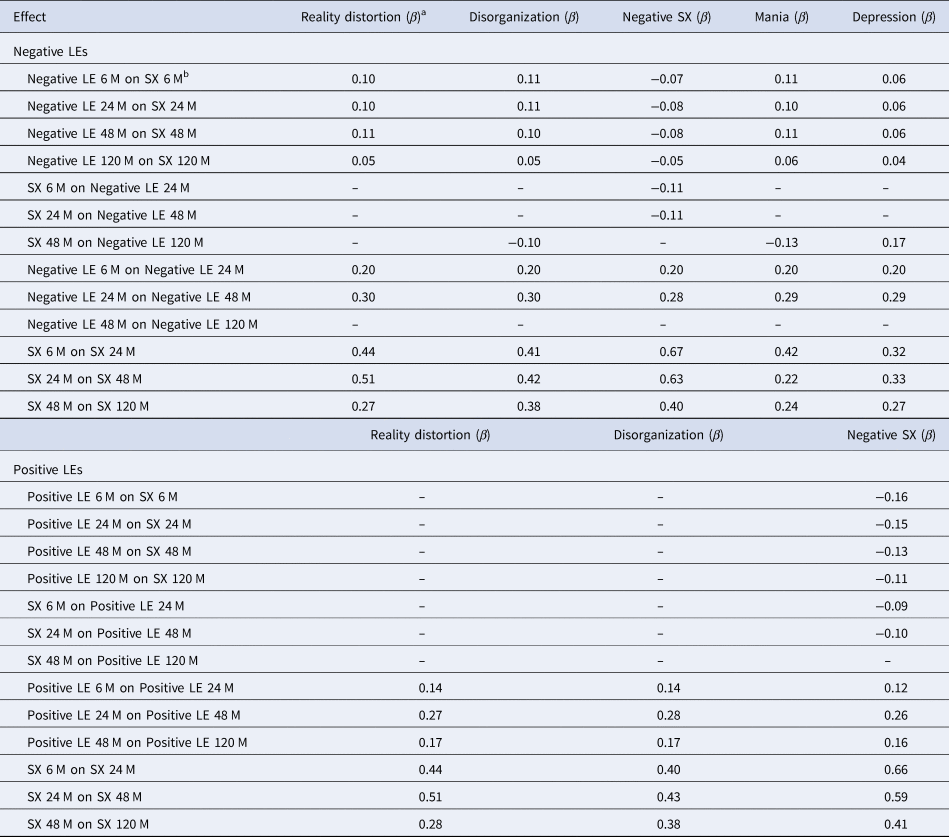
a Effect sizes reported for all p < 0.05 significant paths; correlations among disturbances on symptoms at non-adjacent waves are not shown.
b LE, life events; SX, symptoms.
Positive LEs showed few significant effects on symptoms (Table 4). The only consistent effect was for greater positive LEs predicting a reduction in negative symptoms. This effect was largely bidirectional, with reduced negative symptoms predicting increased positive LEs at most timepoints. Given the potentially confounding effects of depressive symptoms and antipsychotic medication on negative symptoms, two additional models were fit controlling for these effects. In both negative and positive LE models, results remained robust to the impacts of depression and antipsychotic medication (online Supplementary Table S4).
Discussion
The present study advances the understanding of the relationship between LEs and psychosis, discriminating between positive and negative LEs, examining the effects on specific symptom domains, and tracking this interplay over 10 years. By utilizing both between (SEM) and within (MLM) subjects analyses, we demonstrate paths from LEs to symptoms, and illustrate how this dynamic unfolds for a typical patient. We found that across illness course, negative LEs were associated with subsequent increases in reality distortion, disorganization, mania, and depression. The direction of these effects is from negative LEs to symptoms, supporting the vulnerability model rather than the stress-generation model. In fact, only with negative symptoms was the inverse relationship present, in which more severe negative symptoms predicted fewer LEs, both negative and positive. Outside of this counterintuitive effect, positive LEs were largely unrelated to symptoms.
The observed effect of negative LEs on positive symptoms echoes previous findings that LEs trigger a relapse of psychosis (Brown & Birley, Reference Brown and Birley1968; Doering et al., Reference Doering, Müller, Köpcke, Pietzcher, Gaebel, Linden and Schüssler1998; Hirsch et al., Reference Hirsch, Bowen, Emami, Cramer, Jolley, Haw and Dickinson1996; Malla et al., Reference Malla, Cortese, Shaw and Ginsberg1990; Nuechterlein et al., Reference Nuechterlein, Dawson, Ventura, Gitlin, Subotnik, Snyder and Bartzokis1994; Ventura et al., Reference Ventura, Nuechterlein, Lukoff and Hardesty1989) and is consistent with prior literature examining relationships between stress and psychotic symptoms in the general population (Shakoor et al., Reference Shakoor, Zavos, Haworth, McGuire, Cardno, Freeman and Ronald2016) and in schizotypy (Tessner et al., Reference Tessner, Mittal and Walker2009). Present findings are also consistent with research detailing the impact of expressed emotion (interpersonal stress in the family environment) and relapse in psychotic disorders (Butzlaff & Hooley, Reference Butzlaff and Hooley1998; Stirling et al., Reference Stirling, Tantam, Thomas, Newby, Montague, Ring and Rowe1991). Our findings further suggest that these symptoms have little effect on risk for LEs, consistent with a diathesis-stress, rather than stress-generation, model of psychotic symptoms. Previous literature has provided mixed support for a stress-generation in psychosis (Horan et al., Reference Horan, Ventura, Nuechterlein, Subotnik, Hwang and Mintz2005; Lukoff et al., Reference Lukoff, Snyder, Ventura and Nuechterlein1984); the present study provides clarity, supporting this model only for negative symptoms.
Similar results were observed for depression and mania. Negative LEs predicted escalation of depression, consistent with prior research on the onset of depression (Kessler, Reference Kessler1997; Tennant, Reference Tennant2002; Ventura, Nuechterlein, Subotnik, Hardesty, & Mintz, Reference Ventura, Nuechterlein, Subotnik, Hardesty and Mintz2000), as well as depression in psychotic disorders (Schwartz & Myers, Reference Schwartz and Myers1977). Negative LEs also predicted worsening of manic symptoms. This has been previously implied by studies of recurrence in bipolar disorder, in which LEs are shown to precede episodes which could be either manic or depressive (Ellicott et al., Reference Ellicott, Hammen, Gitlin, Brown and Jamison1990; Hunt et al., Reference Hunt, Bruce-Jones and Silverstone1992; Johnson & Roberts, Reference Johnson and Roberts1995). Here, we show that this is in fact the case, and extend this finding to mania in the context of a psychotic disorder. We found no evidence of depressive or manic symptoms eliciting LEs, contrary to the literature on depression, in which the stress-generation model has been supported (for a review, see Liu & Alloy, Reference Liu and Alloy2010). The relatively long intervals between follow-ups may have prevented us from capturing this effect, as well as the relatively mild nature of depressive symptoms in our sample. Future studies should examine these relationships in psychotic disorders with more frequent follow-up assessments.
Negative symptoms were the exception to the rule, bearing an inverse relationship to LEs, such that both positive and negative LEs were associated with a reduction in negative symptoms. The converse relationship also held: greater negative symptoms were associated with fewer LEs. These effects are the opposite of those implied by both the vulnerability and stress-generation models. While this is inconsistent with some previous studies (Docherty et al., Reference Docherty, St-Hilaire, Aakre and Seghers2008; Tessner et al., Reference Tessner, Mittal and Walker2009), other research has alluded to an inverse association with negative symptoms (Fenton & McGlashan, Reference Fenton and McGlashan1991; Shakoor et al., Reference Shakoor, Zavos, Haworth, McGuire, Cardno, Freeman and Ronald2016). It is possible that severe negative symptoms prevent individuals from engaging in the kinds of activities that would precipitate either positive or negative LEs. For instance, one is less likely to experience the beginning or end of a romantic relationship if one is sexually and socially disinterested.
Thus far, no studies to our knowledge have examined the relationship between positive LEs and specific symptoms in psychosis (Seeman, Reference Seeman2017). In the present analyses, the effects of positive LEs were weak and inconsistent, except for their inverse association with negative symptoms. Interventions such as social skills training may impact negative symptoms via increasing positive LEs, although these data suggest that such a change in negative symptoms would be accompanied by a further increase in both positive and negative LEs.
A strength of the present study is our large first-episode sample of psychotic disorders, with a wide range of clinical presentations, and course observed over 10 years. Furthermore, we tested both within- and between-subject effects, and provided support for a relationship between LEs and symptoms across both. A limitation of this study is that assessment points were spaced years apart. Further, symptoms measured burden in the past month rather than a discrete episode onset; while conversely, LEs were rated for the preceding 6 months. This likely enhanced the effects of LEs on symptoms compared to the effects of symptoms on LEs. Consequently, we cannot be certain that symptom change followed LEs rather than preceded them. Furthermore, data on the dependence of LE on an individual's behavior were systematically coded only at year 10, and we were unable to test the temporal associations of dependent and independent LE separately, although they may have different patterns of interplay with symptoms. Nevertheless, the lack of evidence for stress generation in these data suggests that this confounding is likely to be small. Another limitation is that this study utilized an interview-based structured LEs assessment, rather than a semi-structured life stress interview allowing for the weighing of context for each event. Finally, since the start of this study, several concerns have been raised regarding the SANS, including that some items may reflect secondary symptoms, emerging perhaps as a result of depression or antipsychotic medication (Kirkpatrick, Fenton, Carpenter, & Marder, Reference Kirkpatrick, Fenton, Carpenter and Marder2006; Whiteford, Riney, & Csernansky, Reference Whiteford, Riney and Csernansky1987). However, present results are demonstrated to be robust to such confounding effects. Similarly, some items in this scale are influenced by the frequency of interactions; thus, there may be some degree of overlap between certain negative symptom items and particular LEs. Future work may choose to more specifically parse negative symptoms assessed to investigate these potential confounds. Despite these limitations, present findings are consistent with the results of short-term studies that had more frequent and detailed assessments (Schwartz & Myers, Reference Schwartz and Myers1977; Ventura et al., Reference Ventura, Nuechterlein, Lukoff and Hardesty1989), and extend them to a 10-year time span, supporting the impact of LEs on the long-term course of psychotic disorders.
In sum, negative LEs appear to contribute to exacerbations of reality distortion, disorganization, depression, and mania. Positive LEs show weaker effects but may offer some protection against negative symptoms. Contrary to what is hypothesized by the stress-generation model, symptoms did not generally predict future LEs, save for relationships between more severe negative symptoms and fewer future LEs, both positive and negative. This pattern helps to inform the models of illness course in psychotic disorders, and highlights that patients who were recently exposed to a negative LE could benefit from additional monitoring and services.
Supplementary material
The supplementary material for this article can be found at https://doi.org/10.1017/S0033291720003992.
Acknowledgements
The authors gratefully acknowledge the support of the participants and mental health community of Suffolk County for contributing their time and energy to this project. They are also indebted to dedicated efforts of study coordinators, interviewers for their careful assessments, and to the psychiatrists who derived the consensus diagnoses. Special thanks to Janet Lavelle for her many contributions to the study.
Financial support
This work was supported by the National Institutes of Health (grant number MH 44801 to E. J. B.; grant numbers MH094398 and MH110434 to R.K.).
Conflict of interest
None.