1. Introduction
The Appellate Body's report (AB report) in the Korea–Radionuclides decision provided Korea with a legal victory in its dispute with Japan regarding SPS measures on the imports of seafood. The dispute dates back to the Fukushima Dai-ichi nuclear power plant meltdown in 2011. The Korean government imposed several measures, including a ban on the import of seafood from Fukushima and seven other neighboring prefectures, due to concerns with radioactive contamination from the power plant. Other governments similarly imposed restrictions of varying strictness on imports from this region. Currently, 21 countries continue to maintain some measures restricting imports from the Fukushima area, including some of Japan's largest seafood export markets: China, Korea, Hong Kong (China), and Taiwan.
Korea's legal victory rested on largely procedural grounds. The Appellate Body reversed the panel report's most important findings for Japan that Korea's SPS measure was more restrictive than necessary. The Appellate Body reversal was not based on the merits but on the panel's procedural failure to fully consider Korea's claim that its appropriate level of protection included both qualitative and quantitative elements. As a result, the AB report nullified the panel report's findings without deciding whether the Korean measures were consistent with the SPS Agreement or not. Japan effectively lost this case because of the erroneous findings of the panel, not because the Appellate Body found the Korean measures to be justified under WTO rules.
Nonetheless, the AB report may not detract from Japan's bargaining leverage with other trade partners who maintain restrictions on Japanese seafood exports from the affected prefectures. The panel report was not repudiated on substantive grounds, so Japan may still be able to prevail in claims against other WTO members. This possibility may make some countries more willing to lift restrictions on Japanese imports through negotiations rather than engage in WTO adjudication, although the effects of the continued clean-up of the Fukushima Dai-ichi nuclear power plant may complicate these negotiations.
The AB report also raises questions about how concrete an appropriate level of protection must be for WTO review. This issue may become more relevant as China, and possibly other states, impose new restrictions on food imports based on COVID-19 risks. The report also highlights whether dispute settlement reform (if any is forthcoming) should include a consideration of expanding the power of the Appellate Body to make the factual determinations necessary in order to complete its legal analysis.
2. The Fukushima Disaster and Subsequent Trade Measures
On 11 March 2011, a powerful earthquake triggered a tsunami that hit Japan. In addition to the staggering loss of life and property damage, the tsunami precipitated a meltdown at the Fukushima Dai-ichi nuclear power plant. The meltdown released radioactive material into the surrounding areas. In the wake of the reactor meltdown, the Japanese government and other WTO member governments adopted SPS measures to address the threat that contaminated food would be a health risk to consumers.
Korea initially applied a radiation testing regime to most food products originating in any part of Japan (Cai and Kim, Reference Cai and Kim2019). In 2012, it imposed an import ban on Pacific cod and Alaska pollack from five of the affected prefectures. In 2013, Korea imposed an import ban on fishery products from eight of the affected prefectures and established additional radiation testing for fishery products from the non-affected prefectures of Japan. Korea's SPS measures were not dramatically different than other neighboring countries’ measures. China and Taiwan also banned the import of many products, including fisheries products, from the affected parts of Japan (Loew, Reference Loew2019). China has placed import bans on nearly all food products from the affected prefectures, only recently lifting the ban on rice from Niigata prefecture.Footnote 1 Taiwan also maintains similar bans on fisheries imports. Other countries adopted less restrictive measures. The United States imposed an import alert for certain products from Japan, resulting in testing only if the food was likely to be contaminated.Footnote 2 The European Union opted for a more restrictive approach in which all products coming from affected prefectures are subject to mandatory testing (European Commission Press Release, 2011). Neither the US nor the EU ever banned fish imports. In total, 54 countries imposed some type of SPS measure on Japanese exports after the disaster (The Japanese Times, 2019). Twenty-one countries currently maintain some restrictions, including import bans for fish from the affected prefectures in China and Taiwan.
The fishing industry in Fukushima and the surrounding prefectures was devasted by the SPS measures. The Japanese government suspended fishing for a year and only began to allow trial fishing operations in June 2012. In Fukushima, the fishing industry is only catching 15% of the volume that it was catching in 2011 (5900 tons compared to 38,600 tons) and this catch has only 7.3% of the value of pre-earthquake totals (¥796 million compared to ¥10 billion).Footnote 3
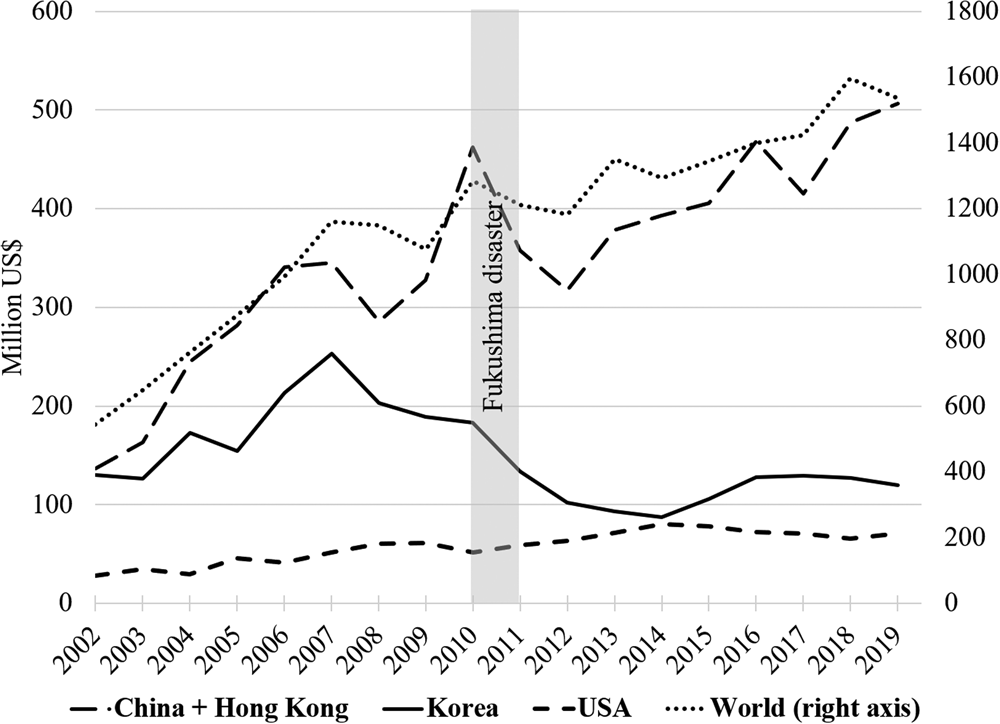
In the three years before the earthquake, Korea was the one of the largest importers of Japanese fishery products with a 16% share, along with China (21%), the United States (15%), and Hong Kong (10%).Footnote 4 However, Korean imports of Japanese fish production were already on the decline due, for example, to increased domestic supply (Cai and Kim, Reference Cai and Kim2019). In the three years after the earthquake, Japan's seafood exports to Korea fell by 42% compared to a 15% reduction to China, a 10% increase to the United States, and a 26% increase to Hong Kong (which re-exports 30–40% of its seafood imports, largely to China). To date, Korea is the only market to which exports of Japanese fish products have not recovered. Figure 1 depicts Japanese seafood exports to its major markets from 2002 to 2019.Footnote 5
Annual value of Japanese exports of fish products to major markets.

After the Fukushima meltdown, the Japanese government instituted a testing procedure for fish in the coastal waters near the reactor. Fish and shellfish were tested for radiation with a ceiling of 100 Becquerels per kilogram of cesium as the maximum safe limit. By January 2018, over 50,000 samples had been tested, with only two specimens testing above the 100 Becquerels limit after 2013.Footnote 6
Based on the results of these tests, the Japanese began negotiating with trade partners to remove their SPS measures to fishery exports. Japan argued that the public perception that fish from the seas near Fukushima were unsafe was not supported by the science. Several states did lift their SPS measures for Japanese seafood, but some major export markets, including China, Taiwan, and Korea, continued their import bans on fishery products from the affected prefectures.
In May 2015, Japan formally requested consultations through the WTO's Dispute Settlement System regarding the Korean SPS measures. After the consultations failed to bring about a resolution, Japan requested the creation of a panel to hear the dispute in August 2015. The panel report was subsequently circulated in February 2018.
Japan's decision to select Korea as a respondent, rather than China, which had overtaken Korea as its largest seafood export market, hints at some of the political factors that governments take into consideration when deciding to initiate dispute settlement proceedings at the WTO. As Bown (Reference Bown2005) discusses, WTO claimants consider multiple factors in selecting a respondent in a WTO legal case. First, Japan would want to select an important export market. Governments generally want to receive the greatest return on their investment in WTO adjudication, so Japan would want to select a respondent state where the return of market access would significantly help the affected industry (Cai and Kim, Reference Cai and Kim2019). Second, a legal victory could bring greater bargaining leverage in negotiations with other trading partners with similar measures. However, a legal defeat would hurt the government's bargaining leverage. Thus, Japan would want to select a respondent with SPS measures that Japan was confident it could successfully challenge. Finally, filing legal claims at the WTO can raise diplomatic tensions. Japan would most likely consider which of states maintaining strong SPS measures would generate the lowest marginal diplomatic consequences.
Japan's choice of Korea as a respondent for testing the validity of these SPS measures seems to be a reasonable one. Korea had been Japan's primary export market for fishery products before the earthquake, and Japan could expect a significant export gain in regaining market access there. While we cannot definitively make a comparative assessment of the strength of the potential legal cases, the measures imposed by China, Korea, and Taiwan appear to be quite similar so this factor may have not been influential in the choice of a respondent. Finally, Japanese relations with Korea were already in decline by the time that Japan requested consultations. In 2014, the two countries were in a row over fishing, each blocking the other's fishing boats from entering the country's exclusive economic zones. Japan accused Korea of illegally fishing in its waters while Korea maintained that the real dispute involved Japan's insistence that larger fishing vessels be allowed into Korean waters (Sekiguchi and Jun, Reference Sekiguchi and Jun2014).Footnote 7 Japan could have thus viewed the marginal additional loss of good diplomatic relations with Korea from a WTO case to be relatively small, particularly compared with bringing a case against China, the most important regional power.
3. The Panel and Appellate Body Reports
Japan challenged Korea's restriction of Japanese fishery products under the WTO Agreement on the Application of Sanitary and Phytosanitary Measures (SPS Agreement). The most important substantive dispute was whether Korea's measures were more restrictive than necessary to achieve the country's health and safety goals. Specifically, Japan challenged that Korea's measures in 2011 and additional measures in 2013 regarding product-specific bans, blanket import bans, and additional testing requirements were unnecessary and thus represented a WTO-inconsistent restriction on trade.
Under the SPS Agreement, governments are allowed to impose measures to protect the health and safety of humans, animal, and plant life in their territories (Article 2.1). The Agreement leaves room for applying the precautionary principle, which allows for measures to be taken in the absence of full scientific certainty to avoid serious and irreversible threats. In establishing SPS measures, governments determine what level of protection they would like. This ‘appropriate level of protection’ (ALOP) then serves as the basis for the SPS measure, such as additional testing or an import ban. The measure must not be more restrictive than necessary to achieve the country's ALOP (Article 5.6).
At the panel, Korea maintained that its ALOP ‘consists of both qualitative and quantitative aspects concerning radioactivity levels in food consumed by Korean consumers, namely: (i) the levels that exist in the ordinary environment; (ii) ALARA [as low as reasonably achievable]; and (iii) the quantitative dose exposure of 1 mSv/year’ (para. 5.26). The panel accepted Korea's ALOP but found that this ALOP could be satisfied by the less restrictive measure that Japan proposed, of allowing the import of fishing products with less than 100 Bq/kg of cesium. The panel noted that this less restrictive SPS measure would result in Korean consumers being exposed to less than 1 mSv/year dose limit, even if Korean consumers exclusively ate food of Japanese origin (para. 5.12). The panel reasoned that as the less restrictive measure of testing would not exceed the 1 mSv/year dose in the Korean ALOP, Japan had established that Korea's current measures were more restrictive than necessary and therefore in breach of Article 5.6. The panel thus concluded that Korea's measures adopted in 2013 and maintained since that time were inconsistent with WTO law.
The Appellate Body reversed the panel's finding because it found that the panel had insufficiently considered whether the less restrictive trade measure met Korea's ALOP. More precisely, the Appellate Body found that the panel did not consider how the qualitative and the quantitative elements ‘represented a distinctive component of Korea's ALOP, and how they interact as parts of Korea's overall ALOP’ (para. 5.29).
The Appellate Body noted that every member has the right to adopt its own ALOP but that the ALOP must be formulated with sufficient precision to enable its application to an SPS measure (para. 5.23). As such, ALOPs cannot be overly vague with regards to how the ALOP should be implemented into trade restrictions. The Appellate Body emphasized that panels must accord weight to the country's ALOP but do not need to defer completely to the respondent's characterization of its ALOP, particularly if it is not presented with sufficient precision (para. 5.24). If the panel accepts the country's ALOP as the country characterizes it, then the panel must fully consider all aspects of the ALOP in determining whether the relevant SPS measures are more restrictive than necessary. The Appellate Body found that the panel had accepted Korea's ALOP as Korea characterized it (containing a mix of qualitative and quantitative elements) but that the panel had essentially reduced Korea's ALOP to the lone quantitative aspect when determining whether Korea's SPS measures were more restrictive than necessary (paras. 5.31–5.33). Given that the panel failed to give Korea the full analysis it was due, the Appellate Body reversed the panel's findings on this issue.
The Appellate Body analysis hinted that the panel may have been justified in rejecting Korea's ALOP as insufficiently precise to be accepted for the purposes of SPS review. The Appellate Body report notes that the panel cited evidence that the ALARA element involved implementation of measures and was not itself a health and safety goal (para 5.35). The report also identified parts of the panel report that questioned whether the other qualitative standard of desiring no more radioactivity than what is in the ordinary environment is precise enough to be a meaningful ALOP (para 5.35). The Appellate Body did not make any findings on these issues, instead noting that once the panel accepted the ALOP, the panel was obligated to conduct a full analysis of how all of the ALOP's elements would interact to inform its SPS measures.
Sohlberg and Yvon (Reference Sohlberg and Yvon2019) describe this outcome as a ‘hung jury.’ The Appellate Body report does not answer the question of whether Korea's measures are consistent with the SPS Agreement. The report concludes that Korea did not receive a full hearing of its arguments that its measures are the least trade restrictive means of implementing its chosen ALOP. Korea is entitled to such a hearing as a matter of right and thus cannot be found to be in violation of WTO rules based on the panel's insufficient analysis. Japan failed to achieve a legal victory not because the WTO adjudication process found that the Korean measures were justified but because the panel erred in its legal analysis. The Appellate Body did not complete the analysis because it can only review issues of law and not make any factual determinations.Footnote 8
In the end, the Appellate Body report leaves open the possibility that Japan could reinitiate dispute settlement proceedings to evaluate Korean SPS measures again. In the short term, however, Japan's initial victory at the panel level was overturned by the Appellate Body's findings that the panel had not completed a full enough analysis of the relationship between Korea's SPS measures and its ALOP.
4. Implications for Japanese Bargaining to Lift Other Country's SPS Measures
From the Japanese perspective, more important than the legal ruling is how the Appellate Body decision will influence its negotiations with WTO members to reduce their SPS measures on Japanese fishery products without bringing more legal challenges. Here, Japan may not actually have lost much bargaining leverage with other WTO members, notwithstanding the loss at the Appellate Body's reversal of the panel's analysis. It is certainly true that the headlines announcing a Korea win at the WTO Appellate Body is a setback. On first impression, it may even lead some government officials to feel less pressure to accede to Japanese requests to reconsider their SPS measures. However, a full analysis of the Appellate Body's report by government lawyers or policy analysts in trade ministries might change that initial impression.
The Appellate Body report does not, in fact, provide substantial legal cover for Korea's measures. The Appellate Body report did not reject Japan's challenge to Korea's measures on a legal or factual basis. It is quite possible that if the panel had fully analyzed Korea's full justification for its SPS measures that this Appellate Body report would have been more supportive of the Japanese claim. The panel could have fully evaluated the qualitative aspects of Korea's measures and either found (1) that the qualitative element was too vaguely formulated to serve as an ALOP or (2) that the qualitative and quantitative aspects of the ALOP could have been satisfied with a less strict SPS measure. The Appellate Body's ruling did not endorse the current Korean SPS measures. Instead, the Appellate Body report permitted the measures to remain because Korea was entitled to have its measures assessed on both the quantitative and qualitative levels of protection. It remains an open question whether future analyses of SPS measures against Japanese fish products would similarly survive WTO review. Policymakers in countries with similar measures may recognize that their SPS measures are still open to legal challenge and may be willing to make some concessions to prevent a WTO claim.Footnote 9
The one country that is almost certain not to make any concession to Japan at this point is Korea. Diplomatic relations between Japan and Korea are at a low point. Besides this dispute, Japan and Korea are engaged in WTO dispute over Japanese export restrictions on semiconductor materials. Japan claims that these restrictions are driven by national security concerns, but they are widely believed to be retaliation for Korea's push to hold Japanese companies accountable for actions taken during World War II (Brazinsky, Reference Brazinsky2019; Harding and White, Reference Harding and White2019). Korean consumers have further ratcheted up the trade dispute by boycotting Japanese exports, leading to a 58% decrease in food imports from Japan (British Broadcasting Corporation (BBC), 2019). Given the conditions of relations between the two countries, Korea is unlikely to back away from its SPS measures short of a broader agreement to resolve all of the WTO disputes between the countries.
The more pressing problem for Japan is probably not the Appellate Body report but the continued cleanup of the Fukushima Dai-ichi nuclear power plant. The nuclear plant still contains over one million tons of water contaminated with radioactive material (McMurray, Reference McMurray2019; Rich and Inoue, Reference Rich and Inoue2019). The plant operators pumped in huge quantities of water to cool the reactor after the fuel melted. That water is currently stored in tanks at the power plant, but the Japanese Ministry of Economy, Trade, and Industry plans to release the water into the Pacific Ocean as part of the final cleanup. The power company has been trying to decontaminate the water as much as possible but acknowledges that about 75% of the water contains radioactive material at levels that are a threat to human health (Rich and Inoue, Reference Rich and Inoue2019). Nonetheless, the power company says that release can be done safely if the water is further filtered. If the government goes forward with the current plan, the contaminated water would be released in around 2022 (The Japanese Times, 2020). Local fishing communities in Japan are opposing the government's plan to release the contaminated water. The communities naturally fear that the release of radioactive materials into the Pacific Ocean will harm the fishing industry.
Given the uncertainty of the effects of the release of contaminated water into the Pacific Ocean, few countries will be likely to roll back their SPS measures for fishery products from the relevant prefectures in the near term if the Japanese government follows through. The release of the water would be an independent justification for imposing SPS measures until the effects of the release on marine life could be evaluated. Beyond SPS measures, the release of contaminated water could further damage the reputation of fish from the Fukushima area among consumers and continue to depress demand for products from the region.
5. Implications for the Precautionary Principle, COVID-19 Measures and DSU Reform
The Appellate Body's focus on fully evaluating a government's appropriate level of protection could be raised again when dealing with possible new restrictions on food imports related to the COVID-19 pandemic. The Chinese government has suspended meat imports from processing plants in the United States, Brazil, and the European Union based on COVID-19 outbreaks among plant employees (Cramer and Bunge, Reference Cramer and Bunge2020). China has also begun to adopt testing measures on frozen food imports due to concern about the virus (Shepard and Zhou, Reference Shepard and Zhou2020). Thus far the Chinese government claims to have found nine instances where frozen or refrigerated food imports contained the coronavirus. As in Korea after Fukushima, such stories can raise alarm among consumers and calls for trade bans, despite a lack of scientific evidence of an actual threat: According to the CDC, ‘Currently, there is no evidence to suggest that handling food or consuming food is associated with COVID-19.’Footnote 10 Still, China appears to be viewing food imports as a potential weak spot for its recovery from the COVID-19 pandemic. At the moment, COVID-19 related SPS measures are not particularly widespread and do not have wide ranging trade impacts, but the potential for broad SPS measures for this or other pandemics is present.
More generally, this case raises important questions about how WTO members formulate their appropriate levels of protection and to what extent they should be based on science. Indeed, the concept of the precautionary principle arose as an exhortation to governments not to use the excuse of scientific uncertainty to take too few measures to protect against irreversible risks.Footnote 11 Although competitive markets are likely to offer too little precaution (Treich, Reference Treich2001), that fact does not imply that governments will not want to offer too much, particularly if such measures confer a political or trade advantage. Countries may develop ALOPs that weave together qualitative and quantitative elements into multifaceted measures for sincere and strategic reasons. On the sincere side, the ALOP might best represent the country's concerns and desire for precaution. On the strategic side, these multi-element ALOPs increase the difficulty of evaluating how the state's actual SPS measures are related to the desired level of protection from risk as opposed to protection from trade. Additionally, based on the Appellate Body's report, this case provides more legal pitfalls where panels may err in evaluating the respondent state's measure and, thereby, prevent a resolution of the legal matter being adjudicated. As it stands, the case offers little new insight into reconciling the roles of precaution and scientific justification in WTO-compliant SPS measures.Footnote 12
The case casts a spotlight on how the Appellate Body's inability to complete the analysis of some panel reports results in a de facto victory for the respondent state without fully resolving the claims involved. Japan could restart the process by again challenging Korea's measures at the WTO, but this obviously puts off a resolution for at least a couple of years and is expensive for the parties.
The issue of dispute settlement understanding (DSU) reform is currently on the table at WTO. The recent study of government officials concerning the new Director General election identified reforming the dispute settlement as a high priority (Fiorini et al., Reference Fiorini, Hoekman, Mavroidis and Nelson2020). If reform negotiations are broad ranging, expanding the power of the Appellate Body to conduct its own factual analysis where necessary to complete their legal analysis could be a useful issue to raise. Currently, the Appellate Body is limited to considering ‘issues of law covered in the panel report and legal interpretations developed by the panel’.Footnote 13 Updating the DSU to allow the Appellate Body to complete the analysis with its own fact findings would expand the power of the Appellate Body, which some WTO members might resist. But it might be an area for compromise, as this power serves the interests of all parties for the efficient and effective resolution of WTO legal claims. Having claims remain unresolved after a panel report and an appeal slows the resolution of live disputes as well as creating uncertainty in WTO legal obligations. It also makes the system of multilateral dispute settlement look ineffective to have de facto victories for respondent states without the relevant legal claims adjudicated. Allowing the Appellate Body to complete its own analysis would complicate the review process (and most likely take longer than 90 daysFootnote 14) but it would permit a full resolution of the legal claims in a more expeditious manner.
This greater power to the Appellate Body on fact finding might also be politically palatable because it does not involve expanding the Appellate Body's interpretative powers. While fact finding undoubtedly involves discretionary judgments that can be controversial, it is generally considered more objective and less contentious than a ‘law declaring’ function of treaty interpretation. Fact finding tends to be case-specific while treaty interpretation implicates a broader range of legal disputes and can influence government policymaking in the shadow of legal rules. Thus, even states that would prefer to reform dispute settlement in a more constrained manner may be willing consider this reform proposal. It would improve the dispute settlement system's capacity to vindicate WTO rights without granting substantially more rulemaking power to the supranational level.