INTRODUCTION
The price of grain-based concentrates for animal feed has risen steadily in recent years leading to increased cost of animal production, and finding substitutes for this type of feed has become a priority for livestock producers. In this context, crop residues, agricultural wastes and agroindustrial by-products of local origin are gaining renewed interest as alternatives to reduce feeding costs of ruminants. One important source of agricultural waste and agroindustrial by-products in Mediterranean countries is greenhouse horticulture, with Spain being one of the main producers in this area (MARM 2011). Within the wide range of greenhouse products produced in Spain, tomato (Lycopersicum esculentum) and cucumber (Cucumis sativus) are two of the most important and have the advantage of being available in large amounts throughout the year. Part of tomato and cucumber production is discarded because the appearance of the fruits does not meet the grading standard for sale in the fresh market or for processing (Wadhwa & Bakshi Reference Wadhwa and Bakshi2013). Moreover, the storage of these fruits, which are easily spoiled, generates economic costs and contributes further to environmental pollution. Several studies (Fondevila et al. Reference Fondevila, Guada, Gasa and Castrillo1994; Denek & Can Reference Denek and Can2006; Aghajanzadeh-Golshani et al. Reference Aghajanzadeh-Golshani, Maheri-Sis, Mirzaei-Aghsaghali and Baradaran-Hasanzadeh2010) have investigated the nutritive value of by-products from industrial tomato processing (pulp, pomace, etc.) for ruminants, but information on the use of tomato and cucumber waste fruits in ruminant feeding is very limited. Previous studies (Romero-Huelva et al. Reference Romero-Huelva, Ramos-Morales and Molina-Alcaide2012; Romero-Huelva & Molina-Alcaide Reference Romero-Huelva and Molina-Alcaide2013) have assessed the effects of replacing barley grains with tomato and cucumber waste fruits in feed blocks for goat feeding, and showed that tomato fruits reduced microbial nitrogen (N) flow in dairy goats. However, the inclusion of these waste fruits in the feed blocks did not influence either dry matter (DM) and N intake or total tract apparent diet digestibility, which may suggest a negative effect on microbial growth in the rumen. The objective of the current study was to investigate, by using in vitro systems inoculated with rumen fluid from goats, the effects of including increased amounts of tomato and cucumber waste fruits in the substrate on rumen fermentation and microbial populations.
MATERIALS AND METHODS
Animals, waste fruits and substrates
Three adult dry non-pregnant and rumen-fistulated Murciano-Granadina goats (46·9±2·15 kg body weight) were used as rumen fluid donors for the in vitro incubations. Animals were placed in individual pens with free access to water and a mineral–vitamin mixture, and were fed alfalfa hay at energy maintenance level (Prieto et al. Reference Prieto, Aguilera, Lara and Fonollá1990). Animal management and rumen content sampling were carried out in accordance with the Spanish guidelines for experimental animal protection (Royal Decree 1201/2005 of 10 October on the protection of animals used for experimentation or other scientific purposes) in line with the European Convention for the protection of vertebrates used for experimental and other scientific purposes (European Directive 86/609).
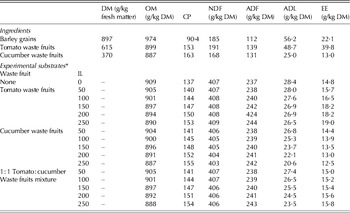
Tomato and cucumber fruits were collected at the Waste Treatment Factory in Motril (Granada, Spain), homogenized using a commercial blender (model TR330; Danamix, Fordingbridge, UK), frozen and freeze dried. A control (CON) substrate was formulated containing wheat straw, barley grain, alfalfa hay, sunflower meal, wheat bran and a vitamin–mineral mixture (300, 250, 220, 150, 50 and 30 g/kg DM, respectively). Fifteen other substrates were formulated by replacing 50, 100, 150, 200 or 250 g of barley grain/kg of CON substrate (DM basis) with the same amount of tomato, cucumber or a 1 : 1 mixture of tomato and cucumber. The chemical composition of barley grains, tomato and cucumber fruits and the 16 experimental substrates is given in Table 1. Samples of barley grains, tomato and cucumber fruits were also analysed for condensed tannin content. Free, fibre-bound and protein-bound condensed tannin content was 8·53, 0·18 and 2·01 g/kg DM for barley grain, 4·71, 4·47 and 1·73 g/kg DM for tomato fruits and 15·0, 20·6 and 15·0 g/kg DM for cucumber fruits, respectively.
Dry matter (DM), organic matter (OM), crude protein (CP), neutral-detergent fibre (NDF), acid detergent fibre (ADF), acid detergent lignin (ADL) and ether extract (EE) content of barley grains, tomato fruits, cucumber fruits and the experimental substrates used in Expt 1 including barley grains or increased levels (IL; 50, 100, 150, 200 and 250 g/kg of substrate DM) of tomato or cucumber waste fruits or a 1 : 1 mixture of both fruits

* Chemical composition of experimental substrates was calculated from analysed composition of individual ingredients.
Experimental design and sampling
Two in vitro experiments were conducted. In Expt 1, the 16 experimental substrates were incubated in batch cultures of rumen micro-organisms and final pH, volatile fatty acid (VFA) production, ammonia-nitrogen (NH3-N) concentration and substrate degradability were measured after 24 h of incubation. Rumen content from each donor goat was obtained immediately before the morning feeding, pooled, strained through four layers of cheesecloth and mixed with a buffer solution (Goering & Van Soest Reference Goering and Van Soest1970) in a 1 : 4 ratio (vol/vol) at 39 °C under continuous flushing with carbon dioxide (CO2). Samples (500 mg DM) of each substrate were weighed into 120 ml serum bottles and 50 ml of buffered rumen fluid were anaerobically added into each bottle. Bottles were sealed with butyl rubber stoppers and aluminium caps and incubated at 39 °C in a water bath. The headspace pressure and volume of gas produced at 8 h of fermentation were measured using a Wide Range Pressure Meter (Sper Scientific Ltd., Scottsdale, AZ, USA) and a calibrated syringe, respectively, and the gas was liberated to prevent gas accumulation. After 24 h of incubation, the volume of gas produced was measured, bottles were uncapped, the pH was measured immediately with a pH meter and the fermentation was stopped by swirling the bottles in iced water. One millilitre of the bottles’ content was added to 1 ml of deproteinizing solution (20 g metaphosphoric acid and 4 g of crotonic acid per litre of 0·5 m HCl) for VFA analysis and 1 ml was added to 1 ml of 0·5 m HCl for NH3-N analysis. The remaining content of each bottle was freeze dried, the DM residue determined and analysed for neutral-detergent fibre (NDF) to calculate true DM degradability (DMD; Van Soest et al. Reference Van Soest, Wine and Moore1966) and NDF degradability (NDFD). The incubation was repeated on 3 non-consecutive days to get three replicates per experimental treatment. In each incubation run, 16 bottles with substrate (one bottle per substrate) and two additional bottles without substrate (blanks) were incubated to correct gas production values for gas released from fermentation of endogenous substrates.
In Expt 2, eight single-flow continuous-culture fermenters, following the design of Miettinen & Setälä (Reference Miettinen and Setälä1989), with an effective volume of 1 l were used. Flow through the fermenters was maintained by continuous infusion of artificial saliva (McDougall Reference Mcdougall1948) at a rate of 40 ml/h, CO2 was continuously infused to maintain anaerobic conditions, and the effluent from each fermenter was collected into a vessel maintained at 3 °C in a water bath to prevent microbial growth. From the results of Expt 1, four substrates were selected to be further evaluated in fermenters: CON substrate and three substrates containing 250 g/kg substrate DM of tomato (T250), cucumber (C250) and the 1 : 1 tomato : cucumber mixture (M250). Two identical 8-day incubation runs were carried out and in each of them two fermenters received one of the four experimental substrates to obtain four replicates per substrate. On the first day of each incubation run, rumen contents were obtained from the fistulated goats as described in Expt 1, and 700 ml were anaerobically inoculated into each fermenter within 30 min of collecting the rumen contents. Each fermenter received 30 g of DM from the corresponding substrate daily, in two equal portions at 09·00 and 16·00 h. At each time, pH was measured immediately before feeding.
Each incubation run consisted of 5 days for substrate adaptation and 3 days for sample collection. On days 6, 7 and 8 the effluents were removed, weighed and sampled for VFA, NH3-N and total N analyses as described in Expt 1. Each sampling day, 500 ml of effluent was used to isolate bacterial pellets by differential centrifugation as described by Molina-Alcaide et al. (Reference Molina-Alcaide, Martín-García, Moumen and Carro2010). Bacterial pellets were lyophilized, pooled by fermenter and analysed for purine bases (PB) and N content. The remaining effluents were frozen at −20 °C, lyophilized, pooled by fermenter and analysed for DM, ash, ether extract (EE) and PB. Additionally, on day 6 c. 40 ml was taken from each fermenter, placed into sterile flasks and freeze dried for DNA extraction.
Assessment of microbial abundances in fermenters
Lyophilized samples of fermenters content (50 mg) were homogenized with steel beads (2·3 mm) in a Mini-Bead-beater 8 (BioSpec Inc, Bartlesville, OK; USA) before DNA extraction following the procedure of Yu & Morrison (Reference Yu and Morrison2004) and using the QIAmp® DNA Stool Mini Kit columns. The numbers of total bacteria and relative proportions of Fibrobacter succinogenes, Ruminococcus flavefaciens, fungi, methanogenic archaea and protozoa were quantified by real-time quantitative polymerase chain reaction (qPCR). Primers used for F. succinogenes, R. flavefaciens and fungi have been described by Denman & McSweeney (Reference Denman and McSweeney2006) and those used for total bacteria, protozoa and methanogenic archaea have been described by Maeda et al. (Reference Maeda, Fujimoto, Haruki, Maeda, Kokeguchi, Petelin, Arai, Tanimoto, Nishimura and Takashiba2003), Sylvester et al. (Reference Sylvester, Karnati, Yu, Morrison and Firkins2004) and Denman et al. (Reference Denman, Tomkins and McSweeney2007), respectively. Optimal concentrations of reagents for qPCR were 0·4 μ m (final concentration) of each primer, 1X iQ™ SYBR® Green Supermix (Bio-Rad Laboratories Inc., Hercules, CA, USA) containing 100 mm potassium chloride (KCl), 40 mm Tris-hydrochloride (HCl) (pH 8·4), 0·4 mm of each deoxyribonucleotide triphosphate (dNTP), 6 mm magnesium chloride (MgCl2), 20 nm fluorescein, SYBR Green I, stabilizers and 0·05 U/μl iTaq DNA polymerase and 10–75 ng of template DNA in a final volume of 25 μl. Amplification of each target group was carried out with the following programme: one cycle at 95 °C for 5 min, 40 cycles at 95 °C for 15 s, 60 °C for 30 s for annealing, 72 °C for 55 s for elongation and 75 °C for 6 s to measure the fluorescence emission. All qPCR analyses were conducted in triplicate. The melting curve was built by measuring the decrease in fluorescence emissions with increased temperature from 55 to 95 °C with ramps of 0·5 °C set every 10 s. The absolute amounts of each group of micro-organisms were expressed as the corresponding gene copies/g fresh matter sample, and to attain normality, data on gene copies/g fresh matter were transformed using log10 before statistical analysis.
Chemical analyses
DM (method ID 934.01), ash (method ID 942.05), EE (method ID 7.045) and total N (method ID 984.13) were analysed according to the AOAC (2005) procedures. The NDF and acid detergent fibre (ADF) analyses were carried out according to Van Soest et al. (Reference Van Soest, Robertson and Lewis1991) using an ANKOM Model 220 Fibre Analyser (ANKOM Technology, Macedon, NY, USA). The α-amylase was used for NDF analysis. Acid detergent lignin (ADL) was determined by solubilization of cellulose with 72% sulphuric acid. NDF, ADF and ADL were expressed minus residual ash content. Free, protein-bound and fibre-bound condensed tannins in barley grain, tomato and cucumber samples were sequentially extracted following the procedure described by Perez-Maldonado & Norton (Reference Perez-Maldonado and Norton1996) and using condensed tannins from quebracho powder (Roy Wilson Dickson Ltd., Mold, UK) as a standard.
Concentrations of NH3-N were determined using a spectrophotometer by the method of phenol–hypochlorite (Weatherburn Reference Weatherburn1967) and those of VFA by gas chromatography as described by Isac et al. (Reference Isac, García, Aguilera and Molina-Alcaide1994). Analysis of PB content in bacterial pellets and effluent samples was carried out following the procedure of Balcells et al. (Reference Balcells, Guada, Peiró and Parker1992).
Calculations and statistical analyses
The amount of VFA in each batch culture after 24 h of incubation was corrected for the base level pre-inoculation. The output of nutrients in the fermenters was calculated from the amount and concentration of daily effluent. The apparent degradability of total carbohydrates (CHO) in the fermenters was calculated from the input of CHO, estimated as the input of total organic matter (OM) − (crude protein (CP)+EE), and the output of CHO corrected for the amount of hexoses in the VFA produced (Demeyer & van Nevel Reference Demeyer and Van Nevel1979). Daily microbial N synthesis in fermenters was estimated by multiplying total non-ammonia N production in the effluents by the ratio PB : N in effluents/PB : N in bacterial pellets. The efficiency of microbial N synthesis was calculated by dividing the daily microbial N synthesis by the amount of degraded CHO.
Data from Expt 1 were analysed separately for each waste fruit using the PROC MIXED procedure of SAS (2002). The level of waste fruit inclusion (0, 50, 100, 150, 200 and 250 g/kg of substrate DM) was included in the model as a fixed effect, whereas incubation day was considered as a random effect. Non-orthogonal polynomial contrasts were used to test for linear and quadratic effects of inclusion level.
Data from Expt 2 were analysed as a mixed model using the PROC MIXED of SAS (2002). The effects of substrate (CON, T250, C250 and M250) and incubation period were considered fixed, and fermenter effect was considered random. When a significant effect of substrate (P<0·05) was detected, differences among means were tested using the Tukey's multiple comparison test.
RESULTS
Chemical composition of tomato and cucumber waste fruits was in the range of values previously published (ANSES 2008; Ventura et al. Reference Ventura, Pieltain and Castanon2009; Wadhwa & Bakshi Reference Wadhwa and Bakshi2013), and both waste fruits were characterized by low DM (<650 g/kg) and NDF (<200 g/kg DM) content. Increased amounts of tomato, cucumber or the tomato–cucumber fruits mixture resulted in increased levels of CP in the substrate with a little change in NDF and ADF contents (Table 1). The inclusion of tomato slightly increased the EE content of substrates (from 14·8 in CON substrate up to 19·0 g/kg DM in T250 substrate), whereas the inclusion of cucumber decreased their ADL content (from 28·4 in CON substrate to 20·6 g/kg DM in C250 substrate).
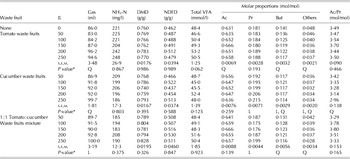
Values of final pH in batch cultures (Expt 1) ranged from 6·67 to 6·73 and were considered adequate for optimum rumen fermentation. Increasing amounts of tomato, cucumber and the mixture of both fruits in the substrate increased gas production (quadratic for tomato and cucumber and linear for the tomato : cucumber mixture; P<0·05; Table 2), but there was no effect on final NH3-N concentrations, DMD, NDFD and total VFA production. Where tomato fruits were included in the substrate there was a trend (P=0·062) for increased VFA production.
Effect of inclusion levels (IL; 0, 50, 100, 150, 200 and 250 g/kg of substrate DM) of tomato and cucumber waste fruits and a mixture of both on final gas production, NH3-N concentration, true dry matter (DMD) and neutral detergent (NDFD) degradability, total volatile fatty acid (VFA) production, molar proportions of acetate (Ac), propionate (Pr), butyrate (But) and others (isobutyrate plus isovalerate plus valerate) and acetate/propionate ratio (Ac/Pr) after 24 h fermentation of substrates including barley grains or increased levels (IL; 50, 100, 150, 200 and 250 g/kg of substrate DM) of tomato or cucumber waste fruits or a 1 : 1 mixture of both fruits in batch cultures (Expt 1) of ruminal micro-organisms (n=3)

* L and Q, linear and quadratic effect (P<0·05) of by-product inclusion level, respectively.
Increased amounts of tomato fruits in the substrate resulted in higher (P<0·05; quadratic) acetate proportions at the expenses of butyrate and other minor VFA (P<0·05; quadratic decrease), without significant changes in propionate proportion or acetate : propionate ratio. In contrast, no effects on acetate proportion were detected for cucumber or the tomato : cucumber mixture, but increasing amounts of both waste fruits raised (P<0·05) propionate proportion linearly and decreased (P<0·05) the proportion of butyrate and other minor VFA.
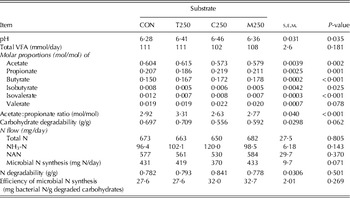
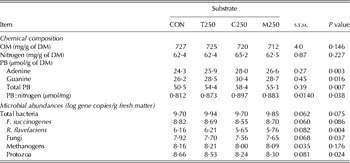
Fermentation parameters and microbial abundance in continuous-culture fermenters (Expt 2) fed the experimental substrates are shown in Tables 3 and 4, respectively. The pH values in fermenters receiving T250, C250 and M250 substrates were numerically higher than those in CON-fed fermenters, but differences were only significant (P<0·05) for C250 substrate. Total VFA production did not differ among substrates, but there were differences in VFA profile. Molar proportions of propionate, isobutyrate and isovalerate were lower (P<0·05) and acetate : propionate ratio was higher for T250 compared with CON substrate. Fermentation of substrates containing cucumber (C250 and M250) resulted in lower (P<0·05) proportions of acetate, isobutyrate and isovalerate and acetate : propionate ratio, but higher (P<0·05) butyrate proportions than that of CON substrate. The degradability of carbohydrate tended (P<0·10) to be lower for substrates containing cucumber than for CON and T250. There were no differences among substrates on daily flows of total N, NH3-N and NAN, but microbial N synthesis tended (P<0·10) to be lower for C250 compared with CON substrate.
Mean values (n=4) of pH, total VFAs production, molar proportions of individual VFA, acetate : propionate ratio, carbohydrate digestibility, daily flows of total, ammonia (NH3-N) and non-ammonia (NAN) nitrogen, microbial N synthesis, degradability of N and efficiency of microbial N synthesis in single-flow continuous-culture fermenters (Expt 2) fed substrates containing 250 g/kg of substrate (DM basis) of barley grains (CON), tomato (T250) or cucumber (C250) waste fruits or a 1 : 1 mixture of both fruits (M250)

Mean values (n=4) of OM, nitrogen, purine bases (PB) and PB : N ratio content in bacterial pellets isolated from fermenters effluent and abundances of total bacteria, the cellulolytic species Fibrobacter succinogenes and Ruminococcus flavefaciens, methanogens, fungi and protozoa in single-flow continuous-culture fermenters (Expt 2) fed substrates containing 250 g/kg of substrate (DM basis) of barley grains (CON), tomato (T250) or cucumber (C250) waste fruits or a 1 : 1 mixture of both fruits (M250)

There were no differences among substrates in OM and N content of bacterial pellets, although those isolated from fermenters fed C250 and M250 substrates had higher (P<0·05) adenine, guanine and total PB content and greater PB : N ratio than those isolated from CON-fed fermenters. There were no differences between CON and T250 substrates, either in chemical composition of bacterial pellets or in the abundance of any of the analysed micro-organisms. In contrast, fermenters fed C250 and M250 substrates had lower (P<0·05) abundances of R. flavefaciens, fungi and protozoa in comparison with those fed substrates CON and T250.
DISCUSSION
The current study attempted to assess the suitability of including increasing amounts of the two waste fruits in the diet of ruminants using a rapid and versatile in vitro approach (batch culture, Expt 1). This was followed by the selection of the most promising substrates for further testing (Expt 2) under longer incubation times in continuous-culture fermenters, which better simulate rumen fermentation (Rymer et al. Reference Rymer, Huntington, Williams and Givens2005).
The results obtained in Expt 1 indicate that none of the waste fruit levels negatively affected the rumen fermentation, although fermentation pattern was changed. The inclusion of tomato, cucumber or their mixture at 250 g/kg of substrate DM increased gas production compared with CON substrate, which might suggest a stimulation of rumen fermentation, but total VFA production was unaffected. Strong positive correlations between gas and total VFA production in batch cultures have been observed (Blümmel & Ørskov Reference Blümmel and Ørskov1993; Getachew et al. Reference Getachew, Robinson, DePeters and Taylor2004), but gas production is also affected by the proportions of the individual VFA, and in the current study the inclusion of waste fruits in the substrate influenced the VFA profile. The inclusion of tomato fruits in the substrate increased the proportion of acetate and decreased that of butyrate, whereas cucumber fruits increased the proportion of propionate and decreased that of butyrate, indicating different changes in fermentation pattern. A common change observed with all the experimental substrates containing the waste fruits was the reduction of the proportion of isobutyrate plus isovalerate compared with the CON substrate (results not shown; P=0·025, 0·008 and 0·01 for the analysis of variance (ANOVA) of results from substrates including tomato, cucumber and tomato : cucumber mixture, respectively). This might be explained by a lower degradation of substrate protein because both isobutyrate and isovalerate are produced by the fermentation of branched-chain amino acids (Wallace et al. Reference Wallace, Onodera, Cotta, Hobson and Stewart1997). Previous studies (Fondevila et al. Reference Fondevila, Guada, Gasa and Castrillo1994; Ventura et al. Reference Ventura, Pieltain and Castanon2009) have reported low degradability values (range 0·20–0·37) for tomato protein, but to our knowledge there is no published information on rumen degradability of protein from cucumber.
The largest inclusion levels as possible of waste fruits in the diet are desirable to reduce feeding costs and to maximize their recycling. As results from Expt 1 indicated that the replacement of barley grain with tomato, cucumber or a mixture of both up to 250 g/kg substrate DM did not have any detrimental effect on rumen fermentation, the substrates including 250 g/kg of fruits were selected for incubation in continuous-culture fermenters. As observed in batch cultures, total VFA production in fermenters was not affected by waste fruits inclusion in the substrate. Compared with the CON substrate, the fermentation of T250 substrate resulted in a lower propionate proportion and higher acetate : propionate ratio, changes that were not observed in the batch cultures. This difference may have been due to shifts in certain microbial populations over the longer incubation period in fermenters. There were no differences between CON and T250-fed fermenters in the abundance of any of the microbial populations analysed in the current study, although other microbes not analysed may have been affected. The fermenters fed substrate including cucumber (C250 and M250) had lower abundances of R. flavefaciens, fungi and protozoa compared with those fed the CON substrate. The results are consistent with the differences observed between C250 and M250 substrates and the CON substrate in the PB content of isolated bacterial pellets, as changes in PB concentration in bacterial pellets have been associated with the presence of different bacterial species showing different growth rates (Obispo & Dehority Reference Obispo and Dehority1999), and clearly indicate that fermentation of cucumber induced shifts in the microbial populations developed in the fermenters.
In agreement with the results observed in the batch cultures, feeding T250, C250 and M250 to fermenters resulted in lower proportions of isobutyrate and isovalerate compared with CON substrate, which may be attributed to a lower degradation of certain amino acids in the substrates including the waste fruits (Wallace et al. Reference Wallace, Onodera, Cotta, Hobson and Stewart1997). Nonetheless, N degradability was similar for all the substrates, suggesting that the inclusion of waste fruits at 250 g/kg of substrate DM did not reduce N availability for rumen microbes. This is also indicated by the lack of difference among substrates in total N and NAN flow, NH3-N concentrations and microbial N synthesis. Moreover, although the inclusion in the substrate of tomato and/or cucumber fruits reduced the proportion of isobutyrate and isovalerate, the concentrations of these VFA were over the level considered to be limiting for the growth of cellulolytic bacteria (Hume Reference Hume1970). Values of efficiency of microbial growth were similar for all the substrates in Expt 2 and were in the range of those previously reported in continuous-culture fermenters for substrates including different agricultural wastes and agroindustrial by-products (Ariza et al. Reference Ariza, Bach, Stern and Hall2001; Moumen et al. Reference Moumen, Yáñez-Ruiz, Martín-García and Molina-Alcaide2008).
In conclusion, substitution of dietary barley grain with tomato, cucumber or a mixture of both up to 250 g/kg of substrate DM did not have any adverse effect on in vitro rumen fermentation in batch cultures. In continuous-culture fermenters, the complete substitution of barley grain with tomato did not affect most fermentation parameters, microbial N synthesis or the abundance of some major microbial populations, but increased acetate : propionate ratio, which could be a potentially beneficial shift for dairy animals. In contrast, the inclusion of cucumber at 250 g/kg of substrate DM decreased the acetate : propionate ratio, and reduced the abundance of R. flavefaciens, fungi and protozoa although without any effect on total VFA production. Further research is required to assess the production conditions in which diets including tomato and cucumber fruit have the potential of being optimized.
Funding for this study was provided by Junta de Andalucía (Excellence Programme, Project P05-AGR-00408), and the Spanish National Research Council (‘Proyecto Intramural’-CSIC-200740I021) and the Science and Innovation Spanish Ministry (Project AGL2011-22628). E. C. Soto acknowledges support from CSIC for the I3P grant. Thanks to Planta de Tratamiento de Residuos Vegetales de Motril (Granada, Spain) for providing us with greenhouse wastes and to J. Fernández and T. García for technical assistance.