Introduction
There are various surgical techniques for tympanic membrane perforation repair, with high success rates.Reference Iacovou, Vlastarakos, Papacharalampous, Kyrodimos and Nikolopoulos1 However, in large series, it has been reported that anteriorly located tympanic membrane perforations can negatively affect surgical success rates.Reference Nardone, Sommerville, Bowman and Danesi2 It has been suggested that failure of anterior quadrant repair is primarily a result of inadequate blood supply to the area and difficulties encountered during surgical repair.Reference Potsic, Winawer and Marsh3 The main surgical difficulty is the inability to expose the remnant tympanic membrane and annulus fully. This difficulty can be eliminated by performing the repair via a post-auricular approach under a microscope and/or by canalplasty.Reference Lade, Choudhary and Vashishth4, Reference Furukawa, Watanabe, Ito, Kubota and Kakehata5 However, this leads to extended operating times and longer post-operative recovery.
In recent years, transcanal endoscopic ear surgery has become the preferred method for reaching areas that are hard to access with microscopes. This less invasive procedure uses angle lenses and is able to magnify a larger area.Reference Khan, Jan and Shahzad6
Triple-C (composite chondroperichondrial clip) tympanoplasty, which Tos classifies as a special cartilage tympanoplasty method, has been described by Fernandes as an alternative method in non-marginal perforation repair that avoids retroauricular and endaural scars.Reference Tos7, Reference Fernandes8 Though there have been reports of the successful implementation of this method in central perforation repairs, there have been no previous reports of its use in anterior perforation repairs.Reference Ahmed, Raza, Ullah and Shabbir9, Reference Parelkar, Nagle, Jagade, Thorawade, Khairnar and Attakil10
This study aimed to present, using our case series results, endoscopic triple-C tympanoplasty as an alternative method in the repair of tympanic membrane anterior quadrant perforations.
Materials and methods
This retrospective study was approved by the local hospital ethics committee. The study comprised patients aged over 10 years who had a tympanic membrane perforation of greater than 3 mm, who had undergone endoscopic triple-C (composite chondroperichondrial clip) tympanoplasty. Those included had an anterior quadrant dominant perforation where the anterior portion could not be seen during microscopic examination. All patients had an averaged air conduction hearing threshold (at 0.5, 1, 2 and 4 kHz) of 50 dB HL or less.
There was no suspicion of mastoid or middle-ear cholesteatomas on temporal bone computed tomography. This study did not include patients with total or marginal perforations, patients who had undergone epithelium suction from the medial aspect of the remnant, and patients whose ossicular chain movement could not be discerned directly or indirectly by observing the round window.
Surgical method
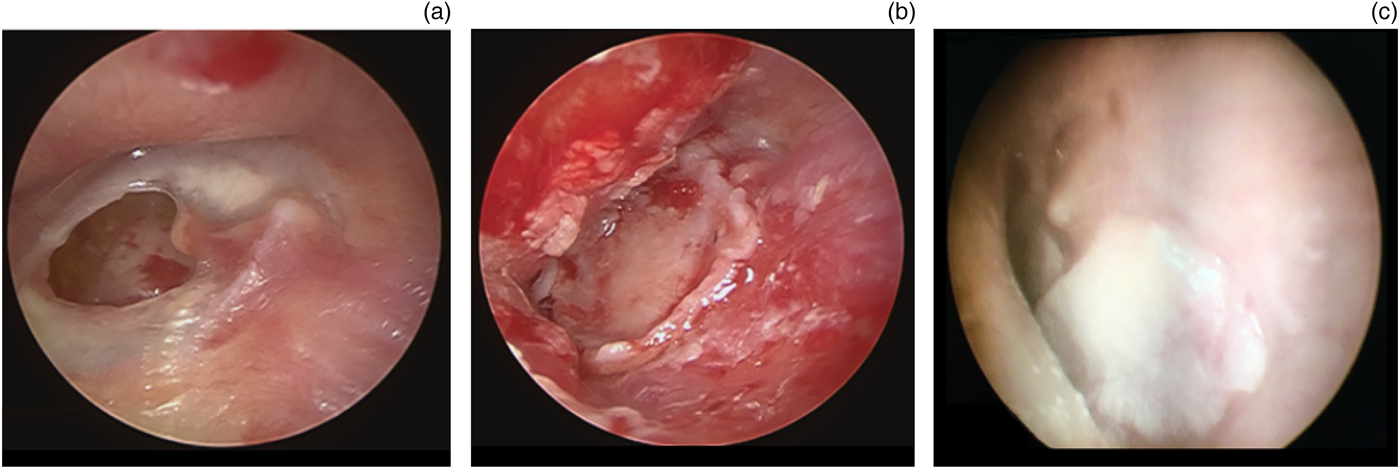
Each patient was operated on under general anaesthesia by one surgeon. A 3 mm, 0- or 30-degree rigid endoscope was used with reference to the external ear structure. The edges of the perforation were de-epithelialised circumferentially without infiltration anaesthesia, and a 1–2 mm squamous epithelial portion of the remnant close to the perforation was removed from the fibrous layer with suction (Figure 1a).Reference Rizer11 Ossicular chain movement was discerned directly or indirectly by observing the round window reflection.
The repair of the left tympanic membrane anterior quadrant dominant perforation using the endoscopic triple-C (composite chondroperichondrial clip) tympanoplasty method (a & b) and its appearance at six months post-operatively (c).

A graft was prepared as described elsewhere,Reference Ahmed, Raza, Ullah and Shabbir9 and was harvested from the ipsilateral tragus. Perichondrium far from the canal was taken, and perichondrium on the canal side was elevated off the cartilage while preserving its linkage with the cartilage in a 2 mm area in the mid-portion. A cartilage incision 1 mm larger than the perforation was made. A small, absorbent sponge was placed in the middle ear, and then a circular clip was placed in a position such that the cartilage portion of the graft was left under the remnant and perichondrium was left above the remnant of the tympanic membrane (Figure 1b). The graft was supported laterally by an antibacterial, absorbent sponge gel.
Post-operative follow up
The patients were discharged post-operatively, the day after they were prescribed local antibacterial and steroid eardrops. The patients underwent endoscopic assessments during weeks 1, 3 and 8 post-operatively. An average of hearing thresholds at 0.5, 1, 2 and 4 kHz was accepted as the pure tone average (PTA). At month six, the patients were examined to check the condition of the graft and assess for cholesteatoma. Treatment was considered successful in those patients with intact grafts and without cholesteatomas (Figure 1c).
Statistics
The software SPSS version 15 was used for statistical analysis. The available data were compared statistically using a paired t-test. The continuous variables were shown as means and the categorical variables were shown as percentages. A p-value of less than 0.05 was considered statistically significant.
Results
Twenty-five patients (13 females and 12 males), aged 12–55 years (mean, 28.7 years), were included in the study. Perforation size was calculated to be 3–6 mm (mean, 4.8 mm). The operating time was 30–79 minutes (mean, 46.6 minutes).
The post-operative graft success rate at month six was 92 per cent (23 out of 25). The pre-operative PTA was 31.1 ± 9.3 dB and the post-operative PTA was 21.9 ± 8.1 dB; the difference was statistically significant (p < 0.001). Mean post-operative follow-up duration was 21.5 ± 7.3 months (range, 11–40 months). No cases of intratympanic cholesteatoma were observed.
Discussion
The main aim of tympanoplasty is to access the pathological area, with minimal soft tissue damage, and eradicate the problem. Following this rationale, and by using a transcanal endoscopic approach, we managed to control the anterior quadrant dominant pathological area, without endaural or retroauricular incisions or canalplasty, in every patient. Previous studies reported that in 73 per cent of patients with an anterior quadrant dominant perforation, the anterior edge could not be seen in its entirety under the microscope, and, thus, 20 per cent of the patients required canalplasty.Reference Lade, Choudhary and Vashishth4, Reference Ayache12, Reference Harugop, Mudhol and Godhi13
Endoscopic techniques used for the repair of tympanic membrane anterior perforations, such as conventional and modified butterfly,Reference Eren, Tugrul, Ozucer, Veyseller, Aksoy and Ozturan14, Reference Kaya, Benzer, Gode, Bilgen and Kirazli15 inlay fascia or perichondrium techniques,Reference Tseng, Lai, Wu, Yuan and Ding16 have resulted in shorter operation times, decreased post-operative care time and higher graft success rates. Endoscopic triple-C (composite chondroperichondrial clip) tympanoplasty is different from the conventional butterfly,Reference Eavey17 modified butterflyReference Shrestha18 and butterfly cartilage tympanoplasty techniques,Reference Kaya, Benzer, Gode, Bilgen and Kirazli15 which are recommended for small-sized central perforations. In the conventional butterfly technique, there is cartilage on both sides of the remnant, and the technique uses a graft that is much thicker than the normal tympanic membrane. In a butterfly cartilage tympanoplasty, perichondrium is excised from both sides of the remnant. In the modified inlay technique, perichondrium is removed from one side, but the clip is formed from the cartilage.
In a triple-C tympanoplasty, perichondrium is preserved only on one side. In the process of removing the contralateral perichondrium, a portion of the cartilage is also removed. The cartilage becomes thinner, and a clip is created between the perichondrium and the thinned-out cartilage. As cartilage thinner than 0.5 mm may show acoustic features similar to those of the tympanic membrane, our selection of the graft material was appropriate.Reference Zahnert, Hüttenbrink, Mürbe and Bornitz19 Additionally, we believe that using this technique, perichondrium overhangs cartilage, especially in large perforations; the cartilage underlays the remnant and the perichondrium overlays the remnant.
In the endoscopic repair of tympanic membrane anterior perforations, the graft success rate has been reported to be over 90 per cent.Reference Tseng, Lai, Wu, Yuan and Ding16 In this study, a 92 per cent success rate was achieved for anterior quadrant perforations. These results are in accordance with the results of transcanal triple-C tympanoplasty completed under microscope-viewing in the repair of central perforations or in perforations that did not exceed half of the tympanic membrane's surface area.Reference Fernandes8, Reference Ahmed, Raza, Ullah and Shabbir9
In triple-C tympanoplasty, the primary cause for concern is the possibility of intratympanic cholesteatoma development due to the perichondrium on the lateral side of the remnant. In our study, we did not observe cholesteatoma in any subject. Similarly, there have been no reports of cholesteatoma development in the literature.Reference Fernandes8, Reference Ahmed, Raza, Ullah and Shabbir9 This outcome is in accordance with the theory that the tympanic membrane heals from the fusion of the graft with the tympanic membrane lamina propria.Reference Eavey17, Reference Levinson20, Reference Dornhoffer21 We observed that excess perichondrium on the lateral side of the remnant suspended the graft in the beginning and then became necrotic. In one case, moisture was observed for nearly two months on the tympanic membrane because the perichondrium on the lateral side was inadequately cleaned, and soft tissue remained. However, the problem was solved with serial suction. Thus, soft tissue should be thoroughly cleaned from the perichondrium.
• Tympanoplasty aims to access the pathological area, with minimal soft tissue damage, and eradicate the problem
• Endoscopic triple-C (composite chondroperichondrial clip) tympanoplasty is a comfortable, minimally invasive method to repair anterior tympanic membrane perforations
• The anterior quadrant dominant pathological area was treated without endaural or retroauricular incisions or canalplasty
• A 92 per cent graft success rate was achieved, with no intratympanic cholesteatoma
• The tympanic membrane heals from the fusion of the graft with the tympanic membrane lamina propria
Conclusion
Endoscopic triple-C (composite chondroperichondrial clip) tympanoplasty is a comfortable, minimally invasive alternative method to repair anterior tympanic membrane perforations. The graft success rate and the degree of recovery from hearing loss were in accordance with the literature. However, more reliable results may be obtained in a larger series with longer follow-up times.
Competing interests
None declared