To optimize dairy production it is extremely important to understand the culling process in dairy herds and its consequences (Hadley et al. Reference Hadley, Wolf and Harsh2006). Involuntary culling is when a cow leaves the herd for reasons that are not of the farmer's choice. Unlike voluntary culling where a farmer chooses to sell a cow to obtain the cow's beef value, involuntary culling occurs without conscious control or direction from the farmer. On the one hand, culling voluntarily due to age, low milk production and/or to maintain a herd size aims at maximizing returns. On the other hand involuntary culling is a cost to the farmer. One of the factors attributed to involuntary culling is the deterioration of fertility in dairy cows which is a negative correlated response to selection for higher milk (Lãvendahl & Chagunda, Reference Løvendahl and Chagunda2006). Indicators of reduced reproductive performance such as a lower conception rate which increases involuntary culling rates are also evident (Waiblinger et al. Reference Waiblinger, Menke, Korff and Bucher2004; Wathes et al. Reference Wathes, Brickell, Bourne, Swali and Cheng2007; Cozler et al. Reference Cozler, Peccatte and Delaby2009). The major reported reasons for culling in dairy herds include fertility, lameness and udder health (Bascom & Young, Reference Bascom and Young1998; Cozler et al. Reference Cozler, Peccatte and Delaby2009; Orpin & Esslemont, Reference Orpin and Esslemont2010). Fertility challenges are associated with both the genetic value for milk production of the cows (Mulligan et al. Reference Mulligan, Grady, Gath, Rice and Doherty2007; Wathes et al. Reference Wathes, Brickell, Bourne, Swali and Cheng2007; Knop & Cernescu, Reference Knop and Cernescu2009) and metabolic disorders (Gillund et al. Reference Gillund, Reksen, Grohn and Karlberg2001) while lameness incidences are mostly linked with housing condition (Rushen & de Passille, Reference Rushen and de Passille2006). Since the introduction of machine milking, udder health in dairy cows has also generally deteriorated (Hovinen & Pyörälä, Reference Hovinen and Pyörälä2010). Assisted calving, abortion and mastitis are also some of the risk factors associated with culling (Bell et al. Reference Bell, Wall and Russell2010). However, examining the factors behind the specific reasons of culling in dairy herds would be a useful way to better understand the processes and consequences and hence help to derive more effective solutions than not (Hadley et al. Reference Hadley, Wolf and Harsh2006). This could be aided by identifying practical indicator traits that could be used to identify cows at an increased risk of being culled. The present study was conducted to determine factors that increased the vulnerability of dairy cows to involuntary culling before finishing their reproductive and productive life in different dairy systems. Specifically, the objective was to quantify factors resulting in an increased risk of involuntary culling in a Holstein–Friesian dairy herd with particular focus on metabolic imbalance.
Materials and Methods
Data
Data used in the present study were for cows which had calved between September 2003 and August 2010 sourced from the Scotland's Rural College (SRUC) database for the Langhill herd. The animals were part of the long-term 2 × 2 factorial, genotype × feeding regime Holstein–Friesian dairy cow research herd described earlier (Bell & Roberts, Reference Bell and Roberts2006). The two feeding systems were high forage system (HF) and low forage (LF). In the HF system, the cows grazed when sufficient herbage was available and were fed a complete diet containing 70–75% forage in the dry matter (DM) when grass heights fell below set values and in the winter months. In the LF system, the cows were housed throughout the year and were fed a complete diet containing 45–50% forage in the DM. Each feeding system consisted of cows that belonged to one of the two genetic lines (Select and Control) based on merit for kilograms milk fat plus protein (Chagunda et al. Reference Chagunda, Romer and Roberts2009). Control line had cows with average UK genetic merit for fat plus protein while Select cows were the top 5% of UK genetics based on fat and protein. Thus the study had four production systems: high forage control (HFC), high forage select (HFS), low forage control (LFC) and low forage select (LFS). All cows on the high-forage diet were at grass during the summer whilst cows on the low-forage diet were housed in free stalls throughout the year. One total mixed ration was used for each group throughout the lactation. Cows were milked three times a day and assessed for body condition weekly. Body condition scoring was performed by two persons and was based on a 5-point scale over the period of the study in alternation. The same individuals were involved in body condition scoring of the cows over the 7-year period. These were experienced permanent employees trained to body condition score as part of routine management practice. For quality assurance reasons, staff alternated weekly to avoid individual bias.
To identify the main reasons for involuntary culling in the herd, cows were classified depending on the herd recorded reasons for culling. All animals that were culled because they were not seen on heat, repeat breeders and all those that had reproductive disorders were classified as being culled due to infertility. Cows with lost quarters, mastitis, high somatic cell counts (SCC) (equal to or greater than 400 000 cells/ml), damaged udder and poor udder conformation were classified as udder problems. Cows that were culled because of sole ulcers, digital dermatitis, heel erosion and leg fracture were classified as cows with foot or leg problems. Cows that were culled due to accidental injury and deaths were identified as a separate group. There were also cows that were recorded as being culled due to either unknown or other reasons. These were classified as such. Based on the total number of cows culled per reason, infertility and udder problems were the major reasons for involuntary culling in the Langhill dairy cow herd.
Variables evaluated
Variables in each of the three models fitted were prior assessed for correlation to prevent multicolinearity. Mean daily milk yield within the lactation in which the cow was culled, age at first calving, metabolic calving weight (calculated as pre-calving body weight0·75), calving ease, body condition score (BCS) at calving (week of calving), BCS at last service, genetic line, feeding system, mastitis incidence, milk protein yield at day 60(±5), calving season and calving year were variables assessed for increased risk of involuntary culling cows due to infertility. A cow with a normal calving had a response variable 0 and 1 for cows with abnormal calving. Mastitis was a class variable, with value 1 if diagnosed with mastitis and value 0 if not in the lactation of the culled animal. BCS at last service used in the analysis was the score recorded at successful service or the last service if the cow was culled before confirmed to be in-calf. Code 1 of the UK season was for spring and 2, 3 and 4 for summer, autumn and winter, respectively. Calving year had values from 1–8 for 2003–2010. A further binary logistic regression analysis was conducted on first lactation heifers culled due to fertility reasons because infertility was the predominant reason for involuntary culling first lactation heifers.
Variables evaluated for an increased risk of involuntary culling cows due to udder problems were: duration of milking per milking time in a day, peak milk flow rate (recorded by the machine), parity number, diseases and milk yield acceleration (calculated as change in milk yield over change in days in milk). Milk yield acceleration is a way of combining milk yield and days from calving. This crystallizes the components of these two factors into an index that is designed to reflect the physiological stress being experienced by the cow (Ingvartsen et al. Reference Ingvartsen, Dewhurst and Friggens2003; Chagunda et al. Reference Chagunda, Friggens, Rasmussen and Larsen2006). The rate at which a cow performs, either in absolute terms or relative to a potential maximum, is generally agreed to be an important factor in determining that animal's ability to cope with metabolic load (Kronfeld, Reference Kronfeld1976; Knight et al. Reference Knight, Beever and Sørensen1999). The majority of stress-induced diseases occur substantially earlier than the peak of milk production. As such Ingvartsen et al. (Reference Ingvartsen, Dewhurst and Friggens2003) argued that milk yield acceleration, whose maximum occurs just after calving, may be a better indicator of physiological stress. Milk yield acceleration is the first derivative of daily milk yield (l/d); hence, the units for milk yield acceleration are l/d per d. Milk yield acceleration was calculated based on first recorded milk yield after calving and peak milk yield for each individual cow.
Class variable diseases had variable 1 if the cow had a history of being diagnosed with any of the following in the lactation of the culled cow: teat blockage and contusion, hard quarters, teat injury, retained placenta, ketosis and milk fever and variable 0 if not.
Statistical analysis
In the analysis, culled cows were matched with their cohorts that survived in the same lactation in which the cow was culled. Further matching was based on age at first calving, feeding system and genetic line. Differences in mean values of variables between culled and control cows were analysed using ANOVA. To quantify predisposing factors, a backward stepwise multiple regression binary logistic model was applied. Both CATMOD procedure and logistic procedure were used. All the analyses were conducted using Statistical Analysis Systems (SAS) version 9.2 (SAS, 2008). The dependent variable, the fate of being culled, was a discrete variable with only two outcomes. The value 1 represented cows that were not culled and 0 otherwise. Fit models were isolated based on likelihood ratio goodness-of-fit test in the CATMOD procedure output. The process of fitting the models involved manually removing variables from each model starting with variables that were not significant until the likelihood ratio indicated goodness-of-fit for the model at 5% confidence level. The model automatically excluded all the records with missing values in one of the variables. This resulted in only cows with complete records being included in the analysis.
Results
Reasons for involuntary culling
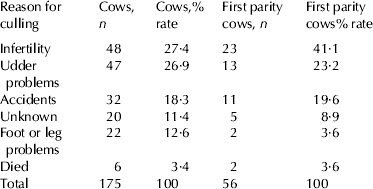
During a 7-year period, 175 animals were culled for various reasons, representing a 33·7% herd culling rate. The predominant reasons for involuntary culling were infertility (27·4%) and udder problems (26·9%) (Table 1).
Summary of number of cows culled per reason in a Holstein–Friesian dairy herd over a 7-year period
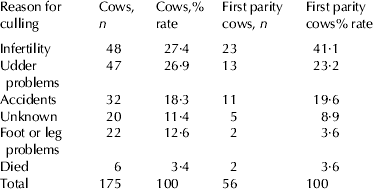
The involuntary culling rate in first lactation heifers was at 32% with more cows (23) culled due to fertility reasons than the rest of the reasons individually. Within all cows culled due to infertility, 87·5% were repeat breeders, 10·4% had reproductive disorders and 2·1% were not seen in heat. For cows culled due to udder problems, 53% were culled due to mastitis, 17% poor udder conformation, 15% lost quarter, 11% high SCC and 5% damaged udder.
The highest involuntary culling rate by production system was recorded for select line cows on low-forage diet regardless of parity. The overall culling rate was 33·1 and 10·3% in first parity cows. The overall culling rates for LFC, HFS and HFC production systems were 27·4, 21·1 and 18·3%, respectively. In first parity cows LFC and HFS systems had both 6·9% culling rate which was lower than in HFC system (8·0%).
Predisposing factors
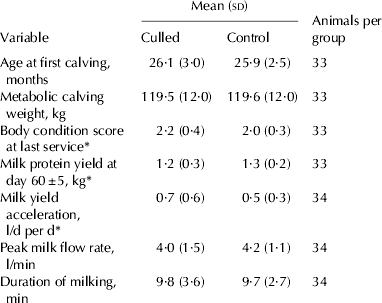
The variations in means between the culled and control cows for the variables BCS at last service, milk protein yield at around day 60 and milk yield acceleration were significantly different (P < 0·05). The rest of the variables were not statistically different. Table 2 details the average values of variables included in the final fitted models except those with numerical codes such as mastitis and calving season.
Descriptive statistics of some of the variables in fitted binary logistic models of predicting the risk of culling in a Holstein–Friesian dairy herd
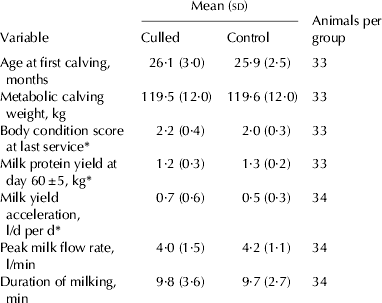
* Significantly different (P < 0·05)
Culls included in the analysis had a daily average milk yield of 27. 6 l (sd = 6·3) similar to their counterparts (27·6 l, sd = 6·0). However, the highest producing cow recorded was a cull producing 41 l/d.
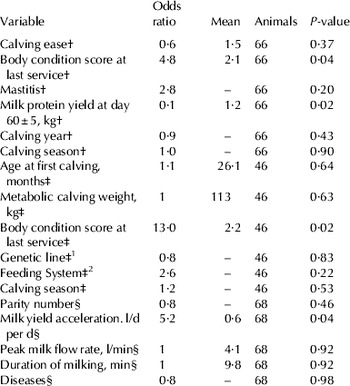
The fitted models indicated that, for cows culled due to fertility reasons, a high BCS at last service and low milk protein yield around day 60 in lactation significantly (P = 0·04 and 0·02, respectively) increased the likelihood of culling, presented in Table 3. Variables such as mean daily milk yield, metabolic calving weight and BCS at calving did not significantly increase the risk of involuntary culling and were eliminated in the process of fitting the model for predicting the risk of culling cows due to infertility.
Variables in fitted binary logistic models used to predict the risk of culling in a Holstein–Friesian dairy herd when the likelihood ratio of goodness-of-fit for the model turned non-significant at the 5% confidence level

† Variables in a model for culling dairy cows due to infertility
‡ Variables in a model for culling first parity dairy cows due to infertility
§ Variables in a model for culling dairy cows due to udder problem
1 There were two genetic lines; animals selected for fat plus protein (select) and those selected to remain close to average genetic merit for fat plus protein (control) as evaluated in the United Kingdom
2 Animals were fed either high forage (70–75%) or low forage (45–50%) diet on dry matter basis
Cows with a higher than average BCS at last service were five times [Odds Ratio (OR) = 4·8] more likely to be culled due to fertility reasons. Cows with low milk protein yield at around 60 days in milk were ten percent less likely to be culled (OR = 0·1). In first parity cows only BCS at last service significantly (P = 0·02) increased the risk of culling due to infertility. The predicted risk of culling in first lactation cows was heavily pronounced because first parity cows with a higher than average BCS at last service were 13-times more likely to be culled.
The acceleration of milk yield showed that it had a significant effect on increasing the risk of culling cows due to udder problems (P = 0·04). The risk was five times higher in cows with a high rate of acceleration. Thus cows that had high rate of increase in their daily milk yield were predicted to be at higher risk of being culled than their counterparts.
Discussion
The current study demonstrated that traits indicating metabolic imbalance contribute significantly to the risk of cows being culled from the herd. Although previous studies have shown that these factors are indeed associated with culling in dairy herds (Esslemont & Kossaibati, Reference Esslemont and Kossaibati1997; Bascom & Young, Reference Bascom and Young1998; Cozler et al. Reference Cozler, Peccatte and Delaby2009; Orpin & Esslemont, Reference Orpin and Esslemont2010) the current study has shown that these factors are associated with both cows culled due to infertility and also due to udder health problems. Abnormal mobilization of body reserves is directly measurable, with reasonable precision, using energy and nitrogen balance techniques. However, the on-farm application of these techniques is not currently realistic (Ingvartsen at al. 2003). The alternative direct measurement of body mobilization based on changes in live weight and BCS give estimates which compare favourably with energy balance calculations (Coffey et al. Reference Coffey, Emmans and Brotherstone2001). Excessive body condition in dairy cows such as a high BCS at last service instigate health challenges (Ferguson et al. Reference Ferguson, Galligan and Thomsen1994). Cows with a higher than average BCS score (≥3·5 on a 5-point scale) are susceptible to metabolic disorders in early lactation (Roche et al. Reference Roche, Friggens, Kay, Fisher, Stafford and Berry2009). For instance, cows developing ketosis tend to have a higher BCS than healthy cows, and a history of ketosis before service risks decrease in likelihood to conceive to that service (Gillund et al. Reference Gillund, Reksen, Grohn and Karlberg2001). In first lactation heifers BCS outside the range 2·75–3·5 (5-point scale) increases the possibilities of calving difficulties (Mee, Reference Mee2007) which negatively affect performance in first parity than subsequent parities (Lopez et al. Reference Lopez, Ugarte and Gonzalez-Recio2007). Similarly to a commercial set up of a dairy herd with strict controlled feeding system, in the current study cows were fed total mixed ration ad libitum, as a result there were few animals with excessive thin bodies at time of service. Since the body condition of cows increases with time in lactation (Roche et al. Reference Roche, Friggens, Kay, Fisher, Stafford and Berry2009), repeat breeders, cows not seen on heat and cows with reproductive disorders ended up having a high BCS at time of last service. Thus the results suggested that monitoring of body condition is important for timely detection of cows likely to have abnormal body conditions at the time of service.
The recorded high culling rate in LFS production system could be a function of both genetic value for milk production and nutrition of animals. However, there was no direct evidence to support the claim. It should be indicated that, for more than a decade, low milk production has ceased to be a common sole primary reason of culling in dairy herds as reported by Bascom & Young (Reference Bascom and Young1998). On the contrary, high-producing cows tend to be more susceptible to excessive negative energy balance (Heuer et al. Reference Heuer, Straalen, Schukken, Dirkzwager and Noordhuizen2000; Wathes et al. Reference Wathes, Brickell, Bourne, Swali and Cheng2007) and in times of energy deficit the milk biochemical characteristics, in particular protein proportion, tends to decrease (Cejna & Chladek, Reference Cejna and Chladek2005; Tena-Martinez et al. Reference Tena-Martinez, Val-Arreola, Hanks and Taylor2009). The proxy characteristic for milk sold composition used in the analysis was milk protein yield at around day 60 in lactation. Though the primary body reserve mobilized is fat during a time of energy deficit, cows may tap into protein or mineral reserves as well (Bewley & Schutz, Reference Bewley and Schutz2008). Therefore, although culling risk was ten percent less, potentially body energy levels contributed to culling. The greater impact in first lactation animals could be because cows in parity one were still growing as compared with cows in at least second lactations. On the other hand, previous studies (Wathes et al. Reference Wathes, Brickell, Bourne, Swali and Cheng2007; Cozler et al. Reference Cozler, Peccatte and Delaby2009; Frelich et al. Reference Frelich, Slachta and Kobes2010) substantiate high culling rate in first parity cows due to infertility also observed in this study. This indicated the importance of this group of cows and probably one of the reasons infertility continues to be an increasingly important challenge to the dairy production.
The stress on the udder before peak lactation and the physiological stress being experienced by the cow increased the risk of being culled. Cows with high milk yield acceleration were likely to have been under physiological pressure to satisfy the increased demand for milk production due to the rapid increase in yield. This stress increased the susceptibility of cows to diseases and udder conformation related problems. Elevated SCC and mastitis incidence in some cases are resultants of energy deficit (Banos et al. Reference Banos, Coffey, Wall and Brotherstone2006) but it cannot be concluded that energy deficit influenced culling in respect to udder problems in this study. The incidences of high SCC, mastitis and the udder disorders could be related to milking practice in addition to physiological stress on the udder.
The results of the study suggested that regular monitoring of metabolic imbalance such as BCS, milk protein yield at peak lactation, and milk yield acceleration could help identify cows at high risk of being culled. Body condition scoring is used to achieve good feeding efficiency by making proper adjustments in respect to herd nutrition status (Waltner et al. Reference Waltner, McNamara and Hillers1993). Thus through consistent monitoring of the traits that indicate metabolic imbalance and properly feeding lactating dairy cows, the risk of involuntary culling in dairy herds due to fertility reasons and udder health problems can be minimized.
The authors gratefully acknowledge funding from The Scottish Government (International Development Fund).