
1. Introduction
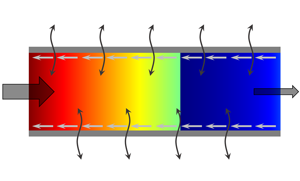
Choked nozzles and supersonic diffusers are used widely in numerous engineering devices, such as aircraft, gas turbines, wind tunnels (Moase, Brear & Manzie Reference Moase, Brear and Manzie2007) and rockets (Goethert Reference Goethert1962). Supersonic combustors can experience choking (Baccarella et al. Reference Baccarella, Liu, McGann, Lee and Lee2021) from different factors that act at the same time, such as heat release (thermal choking), mass addition, area blockage and irreversibility produced by shocks, turbulent dissipations, as well as friction (Riggins et al. Reference Riggins, Tackett, Taylor and Auslender2006). Choking becomes crucial when a high-speed train travels inside a tube, due to the acceleration of the bypass flow in the converging part enclosed between the train and the tunnel. In fact, for certain tube and pod sizes, the Kantrowitz limit (Kantrowitz & Donaldson Reference Kantrowitz and Donaldson1945) imposes a maximum pod speed after which the flow in the convergent part reaches a choked condition. When the train speed surpasses this limit, the train starts to behave like a supersonic piston, thereby causing an increase in the pressure in front of it, which in turn leads to an augmented drag force with respect to the non-choked working condition (Bizzozero, Sato & Sayed Reference Bizzozero, Sato and Sayed2021).
Shapiro (Reference Shapiro1953) theoretically determined that a choking condition is always reached for three different simple one-dimensional compressible flows (i.e. the flow through a nozzle, the viscous adiabatic Fanno flow and the diabatic inviscid Rayleigh flow) when the Mach number becomes equal to one. Bernstein, Heiser & Hevenor (Reference Bernstein, Heiser and Hevenor1967) presented a new theory based on the compound-compressible nozzle flow. An arbitrary number of parallel streams are considered inside a de Laval nozzle (propulsion engines often exhaust different streams of gas side by side through a single nozzle) and it is assumed that the static pressure can only vary along the nozzle axis, although the other properties can also change from stream to stream across each nozzle section. By applying the classic Shapiro theory to each one-dimensional stream, a more general set of results can be obtained, since this approach can even be applied to flows with different stagnation properties at the inlet (i.e. multistream non-mixing flows). Bernstein introduced the compound-choking condition and found that choking is always reached in correspondence to the minimum cross-section area, but the Mach number of the individual streams are different from unity if the inlet stagnation conditions of the streams are different. For example, in a flow involving two streams characterised by different stagnation conditions, the compound-choking condition is reached if one stream is subsonic and the other is supersonic. In general, the flow must be compound subsonic in the convergent part of the nozzle, compound sonic at the throat and compound supersonic in the divergent part of the nozzle.
Apart from the theoretical treatments, different experimental and numerical works have been devoted to analysing choking flow conditions. Kubo, Miyazato & Matsuo (Reference Kubo, Miyazato and Matsuo2010), on the basis of the work of Miyazato, Yonamine & Masuda (Reference Miyazato, Yonamine and Masuda2005), investigated the effect of the boundary layer on a convergent nozzle connected to a straight exit pipe. They observed that, when a convergent nozzle operates below the choking pressure ratio, the free-stream Mach number, i.e. the one that is not affected by the boundary layer, becomes higher than one at the straight duct exit, while the actual throat section that presents the main sonic flow moves backwards. In fact, the boundary layer thickness initially grows along the pipe but close to the duct extremity becomes thinner. Therefore, a sort of converging–diverging nozzle that drives the Mach number over unity is obtained (Afroosheh, Vakilimoghaddam & Paraschivoiu Reference Afroosheh, Vakilimoghaddam and Paraschivoiu2017). Lijo, Kim & Setoguchi (Reference Lijo, Kim and Setoguchi2010) observed in numerical simulations that the boundary layer can be disturbed by the vorticity close to the pipe outlet, which leads to a reduction in the boundary layer thickness.
Miyazato, Sakamoto & Matsuo (Reference Miyazato, Sakamoto and Matsuo2007), who conducted experimental tests on a supersonic Fanno flow, showed that, when the choking condition is reached, the normal shock contemplated by the Fanno theory should be substituted by a pseudo-shock (Crocco Reference Crocco1958). In fact, a simple normal shock pattern rarely occurs as a result of the existence of a viscous boundary layer, and the shock structure is spread over a series of oblique shocks. Even though the pseudo-shock still leads to a subsonic flow downstream, the corresponding Mach number is greater than the one obtained by a conventional normal shock, and this may be ascribed to the existence of the boundary layer upstream from the shock, to wall friction and to turbulence mixing loss that occurs inside the pseudo-shock pattern (Matsuo, Miyazato & Kim Reference Matsuo, Miyazato and Kim1999). As a consequence, the real Mach number at the duct exit of a fixed pipe length is higher than the theoretical one, thereby justifying the reduction in the effective pipe length that leads to the choking condition.
Laurence et al. (Reference Laurence, Karl, Martinez Schramm and Hannemann2013) numerically analysed the nature of thermal choking in scramjet engines. They found that a simple Rayleigh-type analysis cannot provide an adequate prediction of thermal choking, due to the one-dimensional approximation. Numerical simulations showed that, contrary to the assumption of a uniform flow condition across the duct, the heat release occurs in a limited portion of the overall cross-sectional area of a supersonic flow (the ‘local’ thermal choking concept is thus introduced). Therefore, if the stream tube containing this main combustion region is considered, a more pronounced reduction of the Mach number can be detected than the one predicted by the Rayleigh flow, where a uniform heat release occurs over the entire pipe. Hence, an earlier onset of thermal choking can be detected.
There is lack of information in the literature regarding the choking behaviour of complex flows (when several flow variation factors act simultaneously), compared with simple flows, and this may be justified by the absence of exact solutions. In the present work, the choking condition of a diabatic flow with wall friction has been theoretically characterised by means of the exact solution recently obtained by Ferrari (Reference Ferrari2021a). The entropy–enthalpy curves have been interpreted and the physical conditions that lead to choking have been determined. The procedure is presented for either an initially subsonic flow and an initially supersonic one.
2. Governing equations
The analytical solution of the one-dimensional steady-state compressible diabatic flow, with wall friction, of a perfect gas through a constant cross-section area pipe presented by Ferrari (Reference Ferrari2021a) was obtained, starting from the generalised Euler equations for a one-dimensional (1-D) steady flow (Emmons Reference Emmons1958)
 \begin{equation} \left. \begin{gathered} \displaystyle\frac{{\rm d} \dot{m}}{{\rm d}x}=0,\\ \displaystyle A\frac{{\rm d}p}{{\rm d}x}+\dot{m}\frac{{\rm d} u}{{\rm d}x}=-{\rm \pi} D\tau_w,\\ \displaystyle \dot{m}\frac{{\rm d}h^0}{{\rm d}x}={\rm \pi} D \dot{q}_f, \end{gathered}\right\}\end{equation}
where  $x$ represents the spatial coordinate,
 $p$ and
 $u$ stand for the cross-sectionally averaged 1-D pressure and velocity, respectively,
 $D$ is the pipe diameter (
 $A={\rm \pi} D^2/4$ represents the pipe cross-section area),
 $\dot {m}$ is the mass flow rate,
 $h^0$ is the stagnation enthalpy (
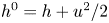 $h^0=h+u^2/2$, where
 $h$ is the enthalpy),
 $\tau _w$ is the wall friction shear stress and
 $\dot {q}_f$ is the convective heat flux exchanged by the fluid with the walls (
 $\dot {q}_f>0$, if the constant heat is supplied to the fluid by the walls). The proposed solution is explicit (Ferrari Reference Ferrari2021a) and is written as the function
 $x=x(u^2/2)$:
 \begin{align} x&=-\dfrac{\dot{m}h_1^0}{\dot{q}_f{\rm \pi} D}+\left\{C-\dfrac{\gamma+1}{\gamma}\dfrac{D}{4f}\ln\left[\dfrac{\sqrt{\dfrac{u^2}{2}}+\sqrt{\dfrac{u^2}{2}+\dfrac{\gamma-1}{\gamma}\dfrac{\dot{q}_f{\rm \pi} D^2}{4f\dot{m}}}}{\sqrt{\dfrac{\gamma-1}{\gamma}\dfrac{|\dot{q}_f|{\rm \pi} D^2}{4f\dot{m}}}}\right] \right\}\nonumber\\ &\quad \times \dfrac{\sqrt{\dfrac{u^2}{2}}}{\sqrt{\dfrac{u^2}{2}+\dfrac{\gamma-1}{\gamma}\dfrac{\dot{q}_f{\rm \pi} D^2}{4f\dot{m}}}} , \end{align}
where  $\gamma$ is the ratio of the constant pressure specific heat (
 $c_p$) to the constant volume specific heat (
 $c_v$),
 $f$ is the friction coefficient (the wall friction shear stress is expressed using the Darcy–Weisbach formula in (2.1)) and
 $C$ is a constant value that can be calculated if the value of
 $u$ at
 $x=x_1=0$, namely
 $u_1$ (the subscript
 $1$ stands for the pipe-inlet conditions), is known. Equation (2.2) is valid if
 $\dot {q}_f>-(2u^2 \gamma f\dot {m})/({\rm \pi} D^2 (\gamma -1) )=\dot {q}_{thr}$ (therefore
 $\dot {q}_{thr}$ is a function of
 $u$). The 1-D temperature (
 $T$) distribution with respect to
 $x$ can then be expressed in parametric form, on the basis of (2.2)
 \begin{equation} \left. \begin{gathered} \displaystyle T=T_1^0+\frac{\dot{q}_f{\rm \pi} D}{\dot{m}c_p}x\left(\frac{u^2}{2}\right)-\frac{u^2}{2 c_p},\\ \displaystyle x=x\left(\frac{u^2}{2}\right), \end{gathered}\right\} \end{equation}
where  $T_1^0$ represents the stagnation temperature at the pipe inlet. The density (
 $\rho$) vs
 $x$ distribution can be determined by means of the steady-state continuity equation, taking (2.2) into account, and, consequently, the pressure distribution with respect to
 $x$, namely
 $p(x)$, can be obtained by applying the perfect gas equation of state. Finally, the Mach number (Ma) vs x distribution can be determined by means of the
 ${Ma}=\sqrt {(u^2 /(\gamma RT))}$ formula, where
 $r$ represents the specific gas constant (defined as
 $r=R/M$, where
 $R$ is the gas constant and
 $M$ is the gas molar mass). The entropy (
 $s$) can be calculated by applying the
 $s=c_p\ln (T/T_1^0)-R\ln (\,p/p_1^0 )$ equation of state, where
 $p_1^0$ stands for the stagnation pressure at the pipe inlet and
 $s(\,p_1^0,T_1^0 )=0\ \mathrm {J}\ (\mathrm {kgK})^{-1}$.
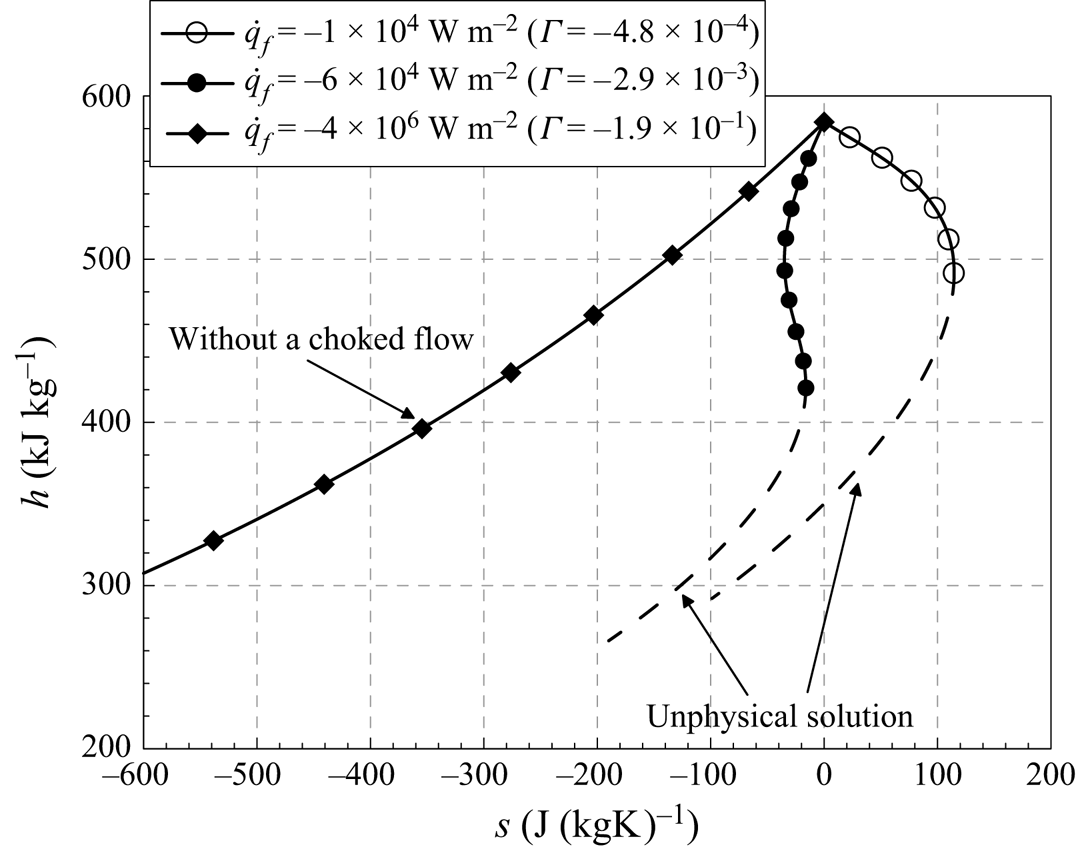
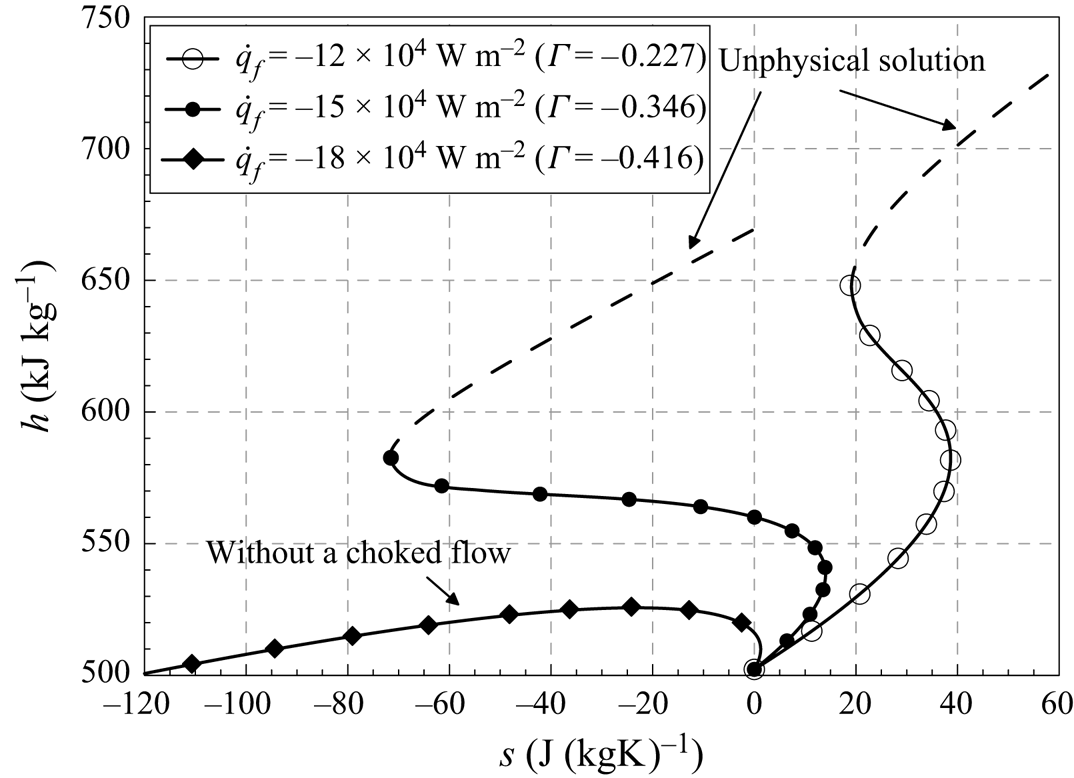
Figures 1 and 2 show the entropy–enthalpy curves ( $h=c_pT$) of an initially subsonic flow and an initially supersonic one, respectively, for the
 $\dot {q}_f<0$ case (air is considered, for which
 $\gamma =1.4$,
 $r=287\ \mathrm {J}\ (\mathrm {kgK})^{{-1}}$). The pipe-inlet conditions (in terms of
 ${Ma}_1$,
 $T_1^0$ and
 $p_1^0$) and the friction factor,
 $f$, are kept constant, and their values are reported in the figure captions. Hence, all the curves in each diagram start from the same point, while the different curves refer to different values of
 $\dot {q}_f$, which are quoted in the legend (the effectiveness of the dimensionless parameter
 $\varGamma$, defined as
 $\varGamma =\dot {q}_f{\rm \pi} D^2/(4f\dot {m}h_{1}^0)$ will be clarified in § 6).
Entropy–enthalpy curves for an initially subsonic flow with distinct  $\dot {q}_f$ values. Here,
 $D=7$ mm,
 $p_1^0=6$ bar,
 $T_1^0=600$ K,
 ${Ma}_1=0.4$,
 $f=0.003$,
 $\gamma =1.4$,
 $r= 287\ \mathrm {J}\ (\mathrm {kgK})^{-1}$.

Entropy–enthalpy curves for an initially supersonic flow with distinct  $\dot {q}_f$ values. Here,
 $D=3$ cm,
 $p_1^0=2$ bar,
 $T_1^0= 900$ K,
 ${Ma}_1=2$,
 $f=0.003$,
 $\gamma =1.4$,
 $r= 287\ \mathrm {J}\ (\mathrm {kgK})^{-1}$.

The entropy for the cases reported in figures 1 and 2, when  $\dot {q}_f<0$, does not generally have a monotonic trend, as can be inferred from the entropy equation
 \begin{equation} T\,{\rm d}s=\delta q+\delta l_w =\left(\frac{\dot{q}_f{\rm \pi} D}{\dot{m}}+\frac{2f}{D}u^2\right){{\rm d}x} . \end{equation}
The negative heat release,  $\delta q$, can prevail over
 $\delta l_w$ during the flow evolution (
 ${\textrm {d}x}>0$), which leads to a reduction in entropy, but the opposite happens if
 $|\delta l_w|>|\delta q|$. The
 $\dot {q}_f$ value at which this change of behaviour occurs can be determined by imposing
 $\delta q =-\delta l_w$, from which one obtains
 $0 > \dot {q}_f=-(2f\dot {m}u^2)/({\rm \pi} D^2)>\dot {q}_{thr}$. This situation can only exist in the presence of friction and of heat flux from the fluid to the wall: the term inside the brackets is always different from zero for Fanno and Rayleigh flows, or for a flow with wall friction coupled to a heat flux going from the wall to the fluid. When the flow reaches the velocity in correspondence to which the brackets in (2.4) are equal to zero, the entropy–enthalpy curve presents a point that features a vertical tangent: if the negative heat flux initially prevails over the friction work, the point will be a local minimum of entropy (cf. the curve with
 $\dot {q}_f=-6\times 10^4\ \mathrm {W}\ \mathrm {m}^{-2}$ in figure 1, when
 $h\approx 500\ \mathrm {kJ}\ \mathrm {kg}^{-1}$). Vice versa, if the friction work prevails at the duct inlet over the heat flux, the point will be a local maximum of entropy (cf. the curve with
 $\dot {q}_f=-12\times 10^4\ \mathrm {W}\ \mathrm {m}^{-2}$ in figure 2, the point at which
 $h\approx 580\ \mathrm {kJ}\ \mathrm {kg}^{-1}$). The other condition that leads to
 $\textrm {d}s=0$ in (2.4) is given by
 ${\textrm {d}x}=0$ (
 $x$ reaches a local maximum): by calculating the derivative of (2.2), with respect to
 $u^2/2$, and by imposing it equal to zero, one obtains
 \begin{align} &\sqrt{\dfrac{u^2}{2}}\sqrt{ \dfrac{u^2}{2} + \dfrac{\gamma-1}{\gamma} \dfrac{\dot{q}_f{\rm \pi} D^2}{4 f \dot{m}} } + \dfrac{\gamma-1}{\gamma} \dfrac{\dot{q}_f{\rm \pi} D^2}{4 f \dot{m}} \ln\left[ \dfrac{ \sqrt{\dfrac{u^2}{2} } + \sqrt{\dfrac{u^2}{2} +\dfrac{\gamma-1}{\gamma} \dfrac{\dot{q}_f{\rm \pi} D^2}{4 f \dot{m}} } }{\sqrt{\dfrac{\gamma-1}{\gamma} \dfrac{|\dot{q}_f|{\rm \pi} D^2}{4 f \dot{m}}} } \right]\nonumber\\ &\quad -C\dfrac{\gamma-1}{\gamma+1}\dfrac{\dot{q}_f{\rm \pi} D}{\dot{m}}=0 , \end{align}
which gives the  $u$ values for which
 ${\textrm {d}x}/\textrm {d}(u^2/2)=0$. When (2.5) is satisfied, it has been proved that the flow reaches a critical state (
 ${Ma}=1$). According to (2.4), further evolution beyond such a critical state would lead to a non-physical solution (
 ${\textrm {d}x}<0$) that can be disregarded by considering the second law of thermodynamics (in fact
 ${\textrm {d}x}<0$ gives an inconsistent sign of
 $\textrm {d}s$ in (2.4)): figures 1 and 2 show such unphysical solutions plotted as dashed lines. Therefore, (2.5) identifies a choked flow condition.
As far as the Fanno and the Rayleigh flows are concerned, an analogous result can easily be obtained by considering how  $x$ varies with respect to the flow velocity
 $u$. For the Fanno flow, one obtains (Shapiro Reference Shapiro1953)
 \begin{equation} \frac{{\rm d}x}{{\rm d}(\ln u)}=\frac{D}{4f}\frac{2(1-{Ma}^2)}{\gamma{Ma}^2} ,\end{equation}
while, for the Rayleigh flow, one obtains (Shapiro Reference Shapiro1953)
 \begin{equation} \frac{{\rm d}x}{{\rm d}(\ln u)}=\frac{Tc_p\dot{m}}{\dot{q}_f{\rm \pi} D}(1-{Ma}^2). \end{equation}
From both (2.6) and (2.7),  ${\textrm {d}x}=0$ when
 ${Ma}=1$ (it can be seen that
 $x$ reaches a local maximum) and, hence, a choked flow occurs. All of the different situations that both a subsonic flow and a supersonic one, characterised by simultaneous wall friction and a negative constant heat flux, can experience are analysed hereafter.
3. Cooled subsonic flow ( ${\dot {q}_f<0}$)

Two different cases can be identified, on the basis of the value of  $\dot {q}_f$. If one has
 $0>\dot {q}_f>\dot {q}_{thr}$
 $\forall x$, the solution is represented by (2.2), while
 ${\textrm {d}x}/\textrm {d}(u^2/2)\geq 0\ \forall x$, and a flow velocity value, which satisfies (2.5), always exist. Therefore, a subsonic cooled flow with wall friction can experience the choking if
 $\dot {q}_f>\dot {q}_{thr}^*=-2u_1^2\gamma f\dot {m}/[(\gamma -1){\rm \pi} D^2]\geq \dot {q}_{thr}$, since
 $u$ increases along the duct (referring to data in figure 1, one has
 $\dot {q}_{thr}^*\approx -2.24\times 10^6\ \mathrm {Wm}^{-2}$). A particular length
 $L_{chok}$ makes the flow reach the
 ${Ma}_2 = 1$ condition at the pipe outlet (subscript
 $2$ refers to the flow condition at the end of the pipe). If the pipe length,
 $L$, exceeds
 $L_{chok}$, the steady solution is obtained by reducing
 ${Ma}_1$, and this solution features a decreased mass flow rate keeping
 ${Ma}_2=1$. Instead, if
 $\dot {q}_f<\dot {q}_{thr}$, (2.2) should be substituted by (Ferrari Reference Ferrari2021a)
 \begin{equation} x=\dfrac{\dot{m}h_1^0}{|\dot{q}_f|{\rm \pi} D}+\left\{C+\dfrac{\gamma+1}{\gamma}\dfrac{D}{4f} \arcsin\left[ \dfrac{\sqrt{\dfrac{u^2}{2}}}{\sqrt{\dfrac{\gamma-1}{\gamma}\dfrac{|\dot{q}_f|{\rm \pi} D^2}{4f\dot{m}}}} \right] \right\}\dfrac{\sqrt{\dfrac{u^2}{2}}}{\sqrt{\dfrac{\gamma-1}{\gamma}\dfrac{|\dot{q}_f|{\rm \pi} D^2}{4f\dot{m}}}}. \end{equation}
In this case, the flow velocity decreases along the duct, in a similar way to the temperature: the derivative of  $x$, with respect to
 $u^2/2$, is never null, and the flow therefore cannot experience choking conditions (like a cooled subsonic Rayleigh flow). In this case, the physical limit is represented by
 $T_2= 0$ K, which is another constraint related to the second law of thermodynamics through Nernst's theorem.
4. Cooled supersonic flow ($\dot {q}_f<0$)

When  $0>\dot {q}_f>\dot {q}_{thr}\ \forall x$ for an initially supersonic flow, the flow velocity reduces along the pipe according to (2.2), while, if
 $\dot {q}_f<\dot {q}_{thr} < 0\ \forall x$, the flow behaviour, which follows (3.1), is similar to that of a cooled supersonic Rayleigh flow, the speed increases with
 $x$, and the flow will never be choked.
If  $\dot {q}_f>\dot {q}_{thr}\ \forall x$, all the inlet conditions (in
 $p_1^0$,
 $T_1^0$ and
 ${Ma}_1$ terms) are selected and
 $f$,
 $D$ and
 $\gamma$ are fixed, (2.5) provides the flow velocity (and, thus, according to (2.2), a certain pipe length) at which choking occurs. The inferior limit of
 $\dot {q}_f$ for which choking can be experienced, namely
 $\dot {q}_{thr}^*$, is the value of
 $\dot {q}_{thr}$ that corresponds to
 ${Ma}_2=1$ and which makes
 $u^2/2$ in correspondence to the choking condition approach the value represented by
 $-(\gamma -1)/\gamma (\dot {q}_{thr}^* {\rm \pi}D^2)/(4f\dot {m})$. If such a flow speed is inserted into (2.5), the latter reduces to
 $C=0$. If one poses
 $x_1=0,\ u=u_1\ {\rm and}\ \dot{q}_f=\dot{q}_{\mathit{thr}}^*$, from (2.2) and
 $C=0$ one finally obtains that
 \begin{equation} C(\dot{q}_{thr}^*,\gamma,\dot{m},u_1,f,D,h_1^0)=0. \end{equation}
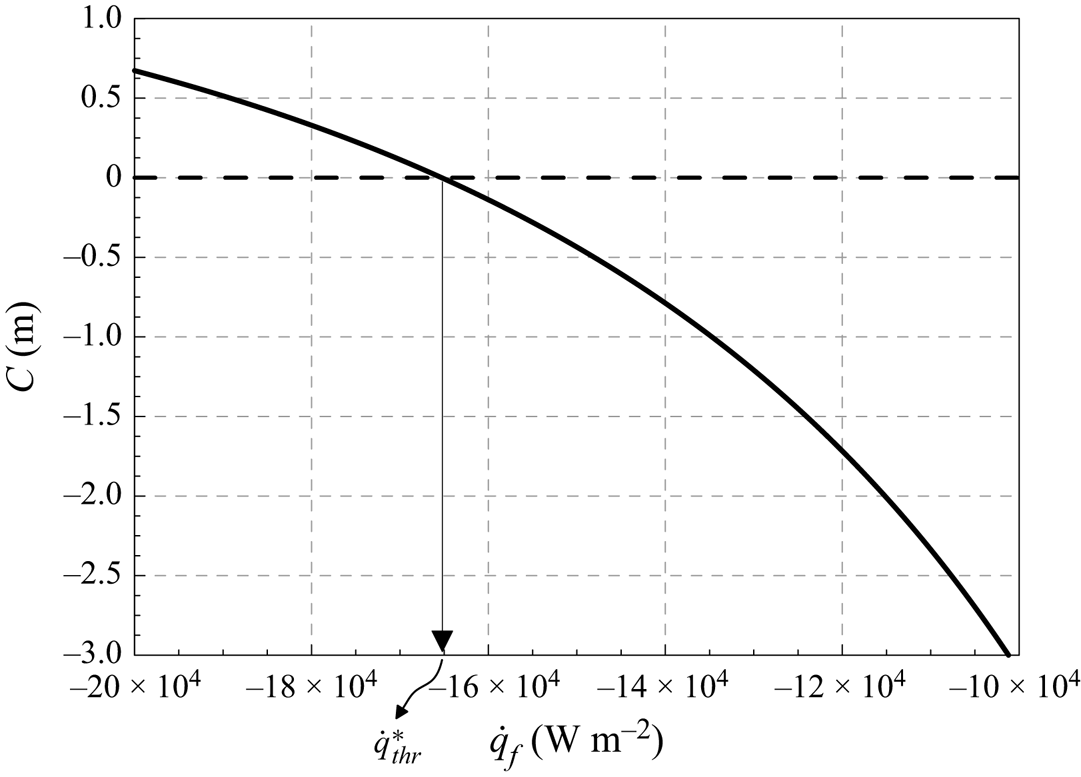
This relation can then be graphically solved to determine  $\dot {q}_{thr}^*$ for each set of inlet conditions and fixed values of
 $f$,
 $D$ and
 $\gamma$, as reported in figure 3. The inlet conditions and the
 $f$,
 $D$,
 $\gamma$ values used for the determination of
 $\dot {q}_{thr}^*$ in figure 3, from which one obtains
 $\dot {q}_{thr}^*\approx -16.53\times 10^4\ \mathrm {Wm}^{{-2}}$, are the same as those used in figure 2; hence, it can be verified that the two entropy–enthalpy curves that feature choking in figure 2 are characterised by
 $\dot {q}_f>-16.53\times 10^4\ \mathrm {Wm}^{{-2}}$. Therefore, for a supersonic flow, if
 $0>\dot {q}_f > \dot {q}_{thr}^*\ \forall x$, the flow can experience a choking condition for a particular pipe length,
 $L_{chok}$, otherwise, if
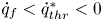 $\dot {q}_f<\dot {q}_{thr}^*<0$, the choking condition is never reached and the flow velocity can decrease with
 $x$ according to (3.1) until the
 $u_{min}^2/2=-(\gamma -1)/\gamma (\dot {q}_{thr} {\rm \pi}D^2)/(4f\dot {m})$ condition is achieved. If the pipe continues beyond the section where
 $u_{min}$ is reached, the velocity keeps a constant value equal to
 $u_{min}$, according to an incompressible flow, and the physical limit is represented by
 $T_2=0$ K. When
 $\dot {q}_f > \dot {q}_{thr}^*$, a further increase in the pipe length, with respect to
 $L_{chok}$, makes the steady-state solution admit a normal shock along the pipe. The shock position depends on the pressure in the downstream environment of the pipe (
 $p_v$) and it can be determined by means of an iterative procedure. A first tentative shock position is selected, the supersonic flow evolution in the piece of duct from the inlet to the shock is deduced by means of (2.2) and the subsonic flow conditions downstream from the shock can be evaluated by means of Rankine–Hugoniot relations. The theoretical pressure corresponding to the choking condition (
 $p_2^*$) can be determined by calculating the flow properties along this subsonic portion of the pipe: if
 $p_v>p_2^*$, the pressure at the pipe outlet, namely
 $p_2$, must be equal to
 $p_v$ (
 ${Ma}_2<1$), otherwise it must be
 $p_2= p_2^*$ (
 ${Ma}_2=1$). It is therefore possible to modify the position of the shock in order to fulfil the pressure condition at the pipe outlet and, finally, the entire flow evolution can be determined.
Graphical solution for the determination of  $\dot {q}_{thr}^*$ for a supersonic flow. Here,
 $D= 3$ cm,
 $p_1^0=2$ bar,
 $T_1^0=900$ K,
 ${Ma}_1=2$,
 $f=0.003$,
 $\gamma =1.4$,
 $r= 287\ \mathrm {J}\ (\mathrm {kgK})^{{-1}}$.

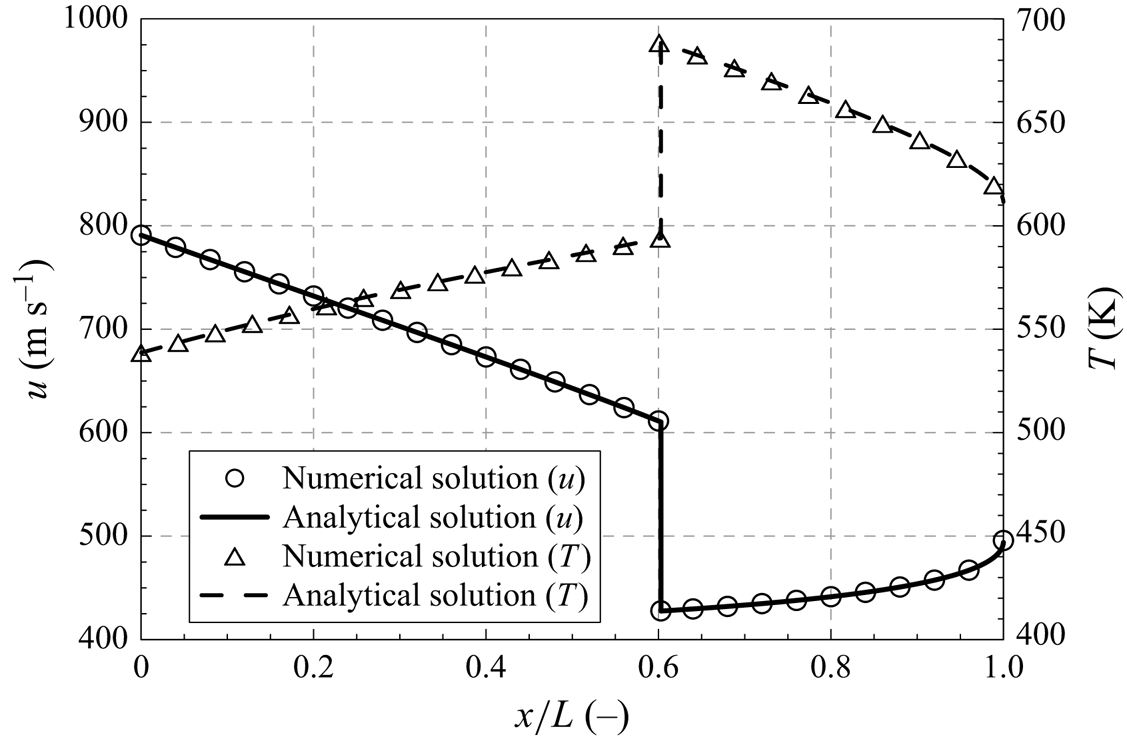
The iterative procedure adopted to obtain the analytical solution of a diabatic flow with wall friction characterised by a normal shock has been validated through a comparison with the corresponding time asymptotic numerical distributions obtained from the solution of the generalised Euler partial differential equations (Ferrari, Vento & Zhang Reference Ferrari, Vento and Zhang2021; Ferrari Reference Ferrari2021b) with wall friction and convective heat. The partial differential equations (PDEs) were discretised using a finite volume method, adopting a Godunov technique that applies a high-resolution upwind discretisation scheme with a MINMOD slope limiter (Toro Reference Toro2009). The spatial mesh size, namely  $\Delta x$, was selected to guarantee a grid independent numerical solution. The time step,
 $\Delta t$, was obtained by imposing an instantaneous Courant number,
 $\sigma$, equal to 0.9, where
 $\sigma =|u+\sqrt {\gamma RT}|_{max} \Delta t/\Delta x$ (Hirsch Reference Hirsch1988), and
 $|u+\sqrt {\gamma RT}|_{max}$ represents the maximum modulus of the
 $u(x,t)+\sqrt {\gamma RT(x,t)}$ eigenvalue space distribution at each time instant. The boundary conditions of the numerical problem were assigned in accordance with the characteristic theory for hyperbolic problems. The analytical solution of the flow velocity and temperature are plotted in figure 4 with continuous and dashed lines, respectively, while symbols represent the corresponding 1-D numerical solution. As can be inferred, the results of the analytical solution are in excellent agreement with the numerical ones. The shock strength for the case reported in figure 4 is equal to
 $p_2/p_1$= 1.65, therefore, the magnitude is comparable to those measured during experimental tests on ducts fed by supersonic diffusers (Neumann & Lustwerk Reference Neumann and Lustwerk1949).
A supersonic flow experiencing a normal shock. Here,  $D=3.5$ cm,
 $L=200$ cm,
 $p_1^0=1.5$ bar,
 $T_1^0=850$ K,
 ${Ma}_1=1.7$,
 $f= 0.002$,
 $\dot {q}_f= -8\times 10^4\ \mathrm {Wm}^{{-2}}$,
 $\gamma =1.4$,
 $r=287\ \mathrm {J}\ (\mathrm {kgK})^{-1}$.

5. Heated subsonic and supersonic flows ($\dot {q}_f>0$)

If a diabatic flow with wall friction is heated, the solution of the flow is always obtained from (2.2): friction and a heat exchange both increase the flow entropy and, according to (2.4),  $T\,\textrm {d}s$ can only be null if
 ${\textrm {d}x}=0$, because the term inside the brackets in (2.4) is always positive. Like Fanno and Rayleigh flows, when the choking condition (
 ${\textrm {d}x}=0$) is reached, one obtains
 ${Ma}_2=1$, which corresponds to the absolute maximum of the entropy in the enthalpy–entropy curve. A particular pipe length
 $L_{chok}$ always makes the flow reach the
 ${Ma}_2=1$ choking condition under a certain set of boundary conditions. A subsonic flow with
 $L>L_{chok}$ experiences a steady-state solution with a reduced mass flow rate (
 ${Ma}_1$ reduces for fixed
 ${Ma}_2=1$), while a supersonic flow with
 $L>L_{chok}$ presents a normal shock along the pipe, and the correct position can be determined with the abovementioned iterative procedure based on the value of
 $p_v$.
6. Dimensionless representation of the choking condition
The analytical solution given by (2.2) can be expressed by means of the following dimensionless form (Ferrari Reference Ferrari2021a):
 \begin{align} f\frac{x}{D_h}&=-\frac{1}{\varGamma}+\left\{C^*-\ln\left[\frac{{Cr}\sqrt{1+\varGamma fx/D_h}+\sqrt{{Cr}^2(1+\varGamma fx/D_h)+\varGamma \dfrac{\gamma-1}{\gamma}}}{\sqrt{|\varGamma| \dfrac{\gamma-1}{\gamma}}} \right]^{({\gamma+1})/{\gamma}} \right\}\nonumber\\ &\quad \times \frac{{Cr}\sqrt{1+\varGamma fx/D_h}}{\sqrt{{Cr}^2(1+\varGamma fx/D_h)+\varGamma \dfrac{\gamma-1}{\gamma}}}, \end{align}
where  $\varGamma = \dot {q}_f{\rm \pi} D^2/(4f\dot {m}h_{1}^0)$,
 $D_h$ is the ratio of cross-sectional area to wetted perimeter (
 $D_h=D/4$ for circular sections),
 $Cr={Ma}/\sqrt {{Ma}^2+2/(\gamma -1)}$ is the Crocco number and
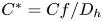 $C^*=Cf/D_h$. The dimensionless parameter
 $\varGamma$ is a quantitative representation of the relative importance of the heat transfer and of the wall friction for the flow evolution over the whole pipe. In particular, when
 $\varGamma$ approaches zero, the flow behaviour tends to the Fanno flow, while, for high absolute values of
 $\varGamma$, the flow behaves like a Rayleigh flow. Since the
 ${Cr}$ (or Ma) vs
 $fx/D_h$ evolution of a diabatic flow with wall friction only depends on the value of
 $\varGamma$, for a fixed set of
 $\gamma$ and
 ${Cr}_1$, the sensitivity of the solution to all the physical parameters can be interpreted based on how they affect the value of
 $\varGamma$.
Hence, choking for a cooled subsonic flow can be predicted based on the  $\varGamma$ value. In fact, the condition
 $\dot {q}_f>\dot {q}_{thr}^*=-2u_1^2\gamma f\dot {m}/[(\gamma -1){\rm \pi} D^2]$ can be stated in dimensionless form as follows (
 ${Ma}_1<1$):
 \begin{equation} \varGamma > \varGamma^*=-\frac{\gamma}{(\gamma-1)}\frac{{Ma}_1^2}{{Ma}_1^2+2/(\gamma-1)}. \end{equation}
For the curves reported in figure 1, it is  $\varGamma ^*\approx -0.109$, therefore, the two curves featuring choking in figure 1 are the ones with
 $\varGamma =-4.8\times 10^{-4}$ and
 $\varGamma =-2.9\times 10^{-3}$.
With reference to a cooled supersonic flow, since the rank of the dimensional problem is equal to 4, equation (4.1), which is a function of seven parameters, can be reduced to the following relation between three dimensionless groups ( ${Ma}_1>1$):
 \begin{equation} C^*(\varGamma^*,\gamma,{Ma}_1)=0. \end{equation}
This equation can be graphically solved to obtain the  $\varGamma ^*<0$ threshold above which (
 $\varGamma > \varGamma ^*$) a cooled supersonic flow with wall friction can experience the choking condition, for fixed values of
 $\gamma$ and
 ${Ma}_1$. For the case in figure 2 one obtains
 $\varGamma ^*\approx -0.3816$ and the two curves with
 $\varGamma =-0.227$ and
 $\varGamma =-0.346$ lead to the choking condition.
Finally, when a flow with wall friction is heated, i.e.  $\varGamma >0$, a pipe length for which the choking condition is reached always exists.
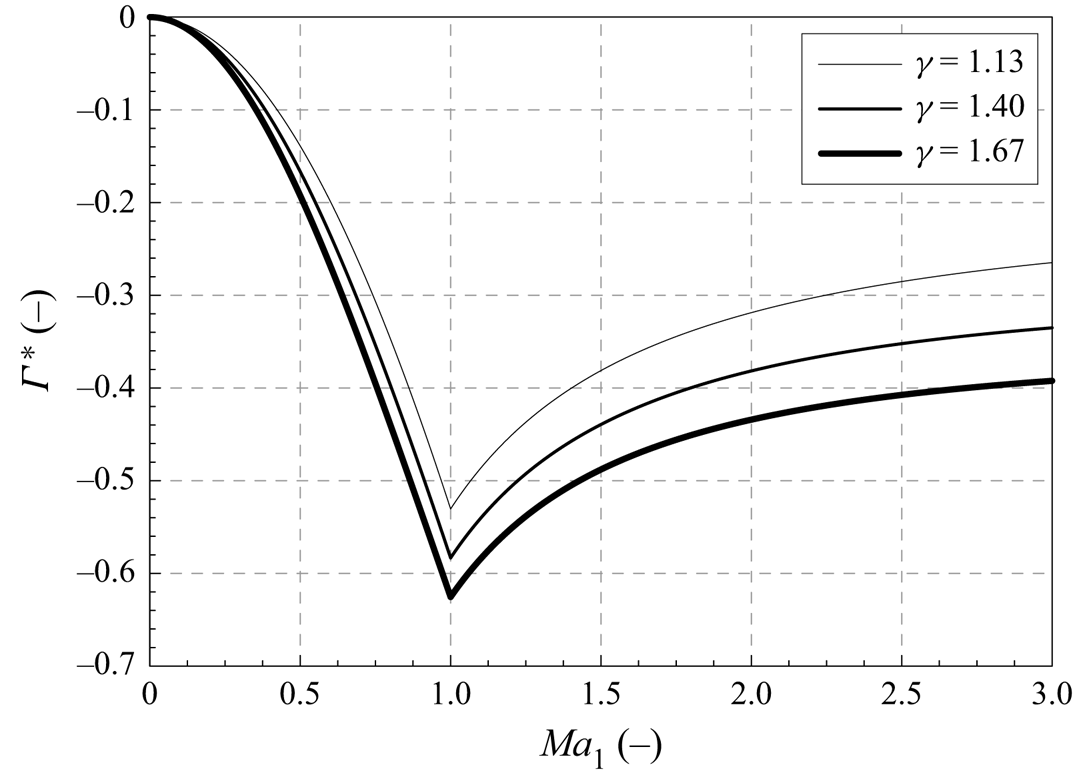
Figure 5 shows the values of  $\varGamma ^*$ as a function of
 ${Ma}_1$ for different
 $\gamma$ values (
 $\gamma =1.13$ for superheated steam,
 $\gamma =1.4$ for a biatomic perfect gas and
 $\gamma =1.67$ for a monoatomic perfect gas); hence, it is possible to predict, for a perfect gas characterised by a certain Mach number at the pipe inlet and a
 $\gamma$ value, whether the cooled flow with wall friction under investigation can experience choking.
Value of  $\varGamma ^*$ as a function of
 ${Ma}_1$ for different
 $\gamma$ values.

7. Conclusions
The choking condition of 1-D diabatic flows with wall friction has been analysed by means of analytical solutions. Entropy–enthalpy curves were obtained for a flow characterised by a heat flux released towards the wall for different values of this heat flux. A monotonic trend was not always observed for entropy; heat released to the walls can prevail over the friction work during the evolution of the flow, which leads to a local reduction in the entropy, otherwise, the entropy increases. The value of the flow velocity at which a local stationary point of the entropy can occur ( $\textrm {d}s=0$), due to a balance between the friction work and heat, is determined from the entropy equation, for both an initially subsonic flow and a supersonic one. The entropy equation shows another stationary point when
 ${\textrm {d}x}/\textrm {d}(u^2/2)=0$ (this is a local maximum point for
 $x$); the Mach number is equal to one here and a choked flow occurs. A further evolution beyond this condition would lead to a non-physical solution, which, according to the second law of thermodynamics, can be disregarded; in fact,
 ${\textrm {d}x}<0$ leads to an inconsistency in the sign of
 $ds$. If a flow is initially subsonic, the flow can experience a choking condition if
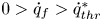 $0>\dot {q}_f>\dot {q}_{thr}^*$, where
 $\dot {q}_{thr}^*$ is the maximum value of
 $\dot {q}_{thr}(u)$, and a particular pipe length
 $L=L_{chok}$ can be identified. A further increment in the pipe length with respect to
 $L_{chok}$ makes the steady-state solution feature a diminished mass flow rate, which is obtained by reducing
 ${Ma}_1$ with respect to the
 $L=L_{chok}$ case. On the other hand, if
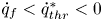 $\dot {q}_f< \dot {q}_{thr}^*<0$, the
 ${\textrm {d}x}/\textrm {d}(u^2/2)=0$ condition is never reached, and the flow cannot be choked; in this case, the flow evolution is limited by the
 $T_2=0$ K condition (the impossibility of reaching
 $T=0$ K is stated by the second law of thermodynamics through Nernst's theorem).
A specific value  $\dot {q}_{thr}^*<0$ was also identified for a cooled supersonic flow to predict whether, for a certain set of boundary and test conditions, the flow could experience choking or not. This value can be determined as the heat flux that solves
 $C=0$. If
 $0>\dot {q}_f > \dot {q}_{thr}^*$, the flow can be choked, while if
 $\dot {q}_f<\dot {q}_{thr}^*<0$, the choking condition is never reached, and the limit for the flow evolution is represented by
 $T_2=0$ K. When
 $0>\dot {q}_f > \dot {q}_{thr}^*$, and the pipe length exceeds
 $L_{chok}$, the steady-state 1-D solution features a shock along the duct. The correct axial position of such a shock can be determined by means of an iterative procedure, based on the pipe downstream environment pressure value,
 $p_v$. This procedure was validated successfully by comparing analytical patterns of the flow velocity and flow temperature with the corresponding outcomes of an accurate 1-D numerical model.
Finally, the case of a heat flux received by the fluid ( $\dot {q}_f>0$) was analysed. Even in this situation, the choking condition was reached when the Mach number was equal to one, for both an initially subsonic flow and a supersonic one, and this condition was found to coincide with the absolute maximum of entropy. If the flow is initially subsonic and the pipe length exceeds
 $L_{chok}$, the new steady-state solution can only be obtained by lowering the Mach number at the pipe inlet compared with the value corresponding to
 $L=L_{chok}$ (the mass flow rate therefore diminishes compared with the
 $L=L_{chok}$ case), while, for a supersonic flow, a shock appears in the duct and its position can be determined by means of the abovementioned iterative procedure, on the basis of the
 $p_v$ value.
The dimensionless form of the exact solution allows the definition of a universal choking condition for diabatic compressible flows with wall friction. The dimensionless parameter  $\varGamma$ is a quantitative representation of the relative importance of the heat transfer and of the wall friction for the flow evolution over the entire pipe. For either a diabatic subsonic or supersonic flow, the
 $\varGamma ^*({Ma}_1,\gamma )<0$ value above which (
 $\varGamma > \varGamma^{*}$) the flow can experience choking was determined.
Declaration of interests
The authors report no conflict of interest.