Introduction
Weaver ants (Hymenoptera: Formicidae) are social insects better known for forming noticeable nests on trees. Two species of weaver ant exist: the Asian weaver ant, Oecophylla smaragdina (Fabricius) and the African weaver ant, O. longinoda Latreille (Lokkers, Reference Lokkers1986). The species share bio- and ecological characteristics (Sribandit et al., Reference Sribandit, Wiwatwitaya, Suksard and Offenberg2008). Both species have multiple benefits. For example, they are used as biocontrol agents in tropical tree crops (Way and Khoo, Reference Way and Khoo1992; Lim and Kirton, Reference Lim and Kirton2001; Van Mele, Reference Van Mele2008; Peng and Christian Reference Peng and Christian2005, Reference Peng, Christian, Lach, Parr and Abbott2010; Peng et al., Reference Peng, Christian and Gibb2004, Reference Peng, Christian and Reilly2010), as a source of income (Sribandit et al., Reference Sribandit, Wiwatwitaya, Suksard and Offenberg2008), and as food (Sribandit et al., Reference Sribandit, Wiwatwitaya, Suksard and Offenberg2008; van Huis et al., Reference van Huis, Van Itterbeeck, Klunder, Mertens, Halloran, Muir and Vantomme2013; Offenberg et al., Reference Offenberg, Cuc and Wiwatwitaya2013). The multiple benefits have triggered great demand for Oecophylla spp., which suggests a need to sustain their populations.
More ants and nests of Oecophylla species are recorded during the rainy season (Van Mele and Cuc, Reference Van Mele and Cuc2007). Production of sexual ants commences at the start of the rainy season (Vanderplank, Reference Vanderplank1960; Peeters and Andersen, Reference Peeters and Andersen1989; Peng et al., Reference Peng, Christian and Gibb1999; Sribandit et al., Reference Sribandit, Wiwatwitaya, Suksard and Offenberg2008; Rwegasira et al., Reference Rwegasira, Mwatawala, Rwegasira and Offenberg2015a ).
The use of weaver ants in pest management involves collection and transfer of ant colonies into orchards. Establishment and perpetuation of the introduced colonies depend on the presence of an egg-laying queen. It is important, therefore, to locate the nest with the egg-laying queen when sampling colonies. Some colonies are large, and extend to many trees with more than 100 nests. It is always difficult to locate the nest with an egg laying queen, as it is often hidden in less accessible sites (Vanderplank, Reference Vanderplank1960; Peng et al., Reference Peng, Christian and Gibb1998). Furthermore, the mortality rate of mated queens is usually very high (> 99%) during the first six months of colony establishment (Vanderplank, Reference Vanderplank1960).
Peng and Christian (Reference Peng and Christian2005) and Ouagoussounon et al., (Reference Ouagoussounon, Sinzogan, Offenberg, Adandonon, Vayssières and Kossou2013, Reference Ouagoussounon, Offenberg, Sinzogan, Adandonon, Kossou and Vayssières2015) suggested the modification of the environment, to enable fast breeding and eliminate competing ants, and promote a quick build up in population of O. smaragdina and O. longinoda. Colonies of O. smaragdina readily accept artificial nesting sites in the form of plastic bottles, plastic cups, aluminium cans, test tubes, and other types of transparent vials (Offenberg, Reference Offenberg2014). There is usually one reigning queen in each colony (Greenslade, Reference Greenslade1971; Hölldobler and Wilson, Reference Hölldobler and Wilson1983, Reference Hölldobler and Wilson1990). However, Peeters and Andersen (Reference Peeters and Andersen1989) showed that during early establishment there might be multiple queens in a colony, although only a single queen will eventually remain in a mature colony. The life cycle of an O. smaragdina colony starts with a mated queen finding a sheltered site for a first nest between leaves of a tree or shrub, and laying a batch of about 35 eggs within 5–10 days after dealation/shedding her wings (Lokkers, 1990, as cited in Crozier et al., Reference Crozier, Newey, Schlüns and Robson2010). Larvae of O. smaragdina emerge from about day eight, pupae follow after day 17 (Crozier et al., Reference Crozier, Newey, Schlüns and Robson2010) and the first adult worker appears after 28 days (Peng et al., Reference Peng, Christian and Gibb1998; Crozier et al., Reference Crozier, Newey, Schlüns and Robson2010). Mated queens of O. smaragdina and O. longinoda can also be reared in a match box (Vanderplank, Reference Vanderplank1960), a cylindrical transparent plastic vial with a mango leaf (Offenberg et al., Reference Offenberg, Peng and Nielsen2012; Ouagoussounon et al., Reference Ouagoussounon, Sinzogan, Offenberg, Adandonon, Vayssières and Kossou2013, Reference Ouagoussounon, Offenberg, Sinzogan, Adandonon, Kossou and Vayssières2015) or in clove leaves, and they do not eat until the first workers appear (Way, Reference Way1954). Studies on rearing of O. longinoda are limited (Way, Reference Way1954; Vanderplank, Reference Vanderplank1960). Recent studies on O. smaragdina and O. longinoda show that pupae transplantation on newly mated queens before the emergence of first workers increases the development of the intrinsic brood (Ouagoussounon et al., Reference Ouagoussounon, Sinzogan, Offenberg, Adandonon, Vayssières and Kossou2013, Reference Ouagoussounon, Offenberg, Sinzogan, Adandonon, Kossou and Vayssières2015; Peng et al., Reference Peng, Nielsen, Offenberg and Birkmose2013).
The occurrence of antagonistic ant species, poor rearing conditions, harsh environments such as heavy rains, and the indiscriminate spraying of pesticides are major causes of weaver ant mortality in-situ, particularly in orchards and natural environments. Rearing colonies in screen houses/laboratories could reduce the mortality rate during the initial phase of colony establishment. Mortality can also be reduced if antagonistic species of ants are prevented from foraging on the young Oecophylla colonies (Vanderplank, Reference Vanderplank1960).
Collecting colonies from the wild is laborious, time consuming and unreliable. In this study, we intended to overcome these problems, by developing methods for rearing newly mated queens. We tested three rearing techniques of mated queens: continuous direct access to water (CDAW), continuous indirect access to water (CIAW) and limited access to water (LAW) (sprinkled). We also tested the effect of frequency of feeding on the growth of weaver ant colonies.
Materials and methods
Mated queens of O. longinoda were collected from citrus orchards in Tanga (6o 49'S; 37o 40'E) and in Morogoro Urban (5o 18'S; 38o 19'E) in Tanzania, using a light trap in February 2013 and January 2014 (Rwegasira et al., Reference Rwegasira, Mwatawala, Rwegasira, Mogens and Offenberg2015b ). The queens were transported to a screen house at the Crop Museum of Sokoine University of Agriculture (SUA).
Queen rearing
The effects of rearing methods on survival and reproduction of mated queens of O. longinoda queens were tested under indoor rearing conditions. In each case, a single-mated queen was placed in a mesh-topped plastic vial (3 cm wide, 11.6 cm high) and observed daily until the emergence of first workers. The three methods, namely: (i) Limited access to water (LAW), whereby water was sprinkled into vials once after every two days; (ii) continuous direct access to 5 ml of water (CDAW); and (iii) continuous indirect access to 15 ml of water (CIAW), were used. In the latter method, ants were separated from water by a 10 cm thick cotton wool pad. Each rearing method was replicated in 25 vials. Each vial was opened and the contents transferred into a plastic container (covered with wire mesh at the top) after the emergence of the first workers. Young colonies were supplied with water, 20% sugar solution and fresh ground fish every two days. The temperature in the screen house ranged from 26.6 to 29.6 °C. We inspected vials at 1000 h everyday for 60 days and counted the numbers of emerged workers after every 48 h.
We recorded the numbers of surviving queens, time taken from nuptial flights to production of first egg(s), and emergence of first larva(e), pupa(e) and workers. We also recorded numbers of individuals in each developmental stage 24 h after the first record, numbers of workers 24 h after recording the latest workers, and the proportion of queens that survived.
Feeding techniques
Feeding was undertaken after transferring young colonies in vials on potted trees established in the screen house. A vial with a colony of five to 10 workers was tied to a stem of a potted plant (10 plants each of citrus, Citrus sinensis L. Osbeck, mango Mangifera indica L. and coffee Coffea arabica L.) placed inside a basin with a shallow layer of water to restrict access by competing ants. Ants were provided with water, sugar solution and ground fish (0.3 to 1.5 g) every two days during the first six months. Water and sugar solutions (20%) were soaked in a piece of cotton wool, while ground fish was placed on top of the leaves. After six months, each colony was provided with water and sugar (20%) solution ad libitum using an Eppendorf tube. The colony was interchangeably supplied with either 5 g of ground fish, 5 to 10 termites or 2 cockroaches after every two days. Data collected were number of nests with workers, number of workers outside the nest after disturbances and number of empty nests.
Data analysis
Queen survival, total number of broods and developmental times were analysed using one-way ANOVA and the mean comparison was done using the Tukey–Kramer Test. Data were log transformed to obtain normal distribution and variance homogeneity. All other calculations were done using JMP 11. We maintained unequal replicates, due to mortality of queens during the experiment.
Results
Effects of rearing methods on queen survival and reproduction
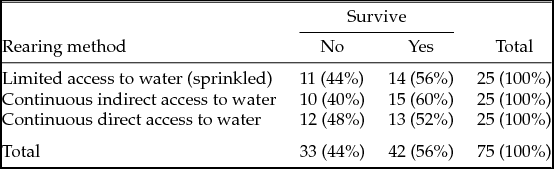
More than 50% of queens reared in each method produced workers. Thus, the queen survival was independent of rearing method (χ2 = 2.0; df = 2, 48; P = 0.36). However, survival was lowest when queens accessed water directly and continuously (Table 1).
Oecophylla longinoda queens for production of first workers reared under different methods within 60 days from nuptial flight

Effects of rearing method on developmental periods of broods
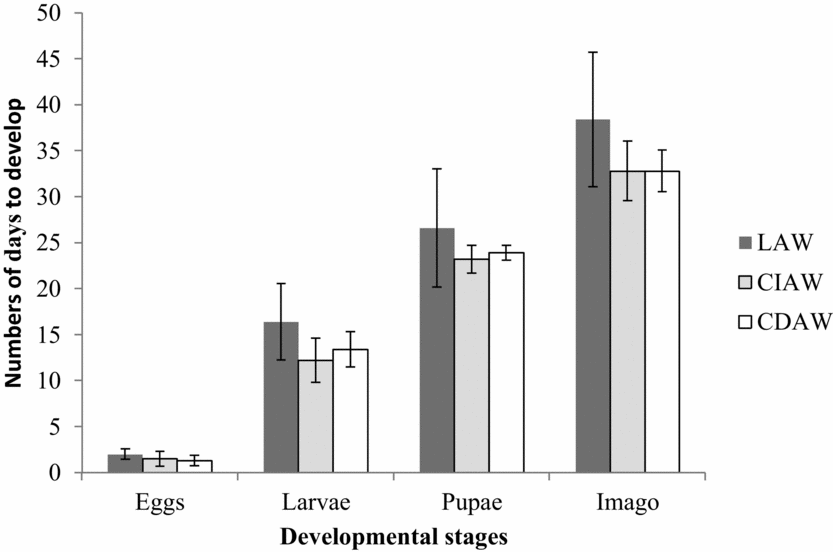
Except for two, all queens that produced workers shed their wings. On average, queens shed their wings one day from nuptial flight, while egg-laying started after an average of two days. Rearing methods significantly affected time taken from nuptial flight to egg production (F = 5.2312; df = 2, 62; P = 0.0080). Developmental stages emerged earlier on queens with continuous access to water than with LAW (Fig. 1).
Average number of days (± SD) from mating flight to developmental stages using different rearing methods within 60 days of Oecophylla longinoda queens rearing.

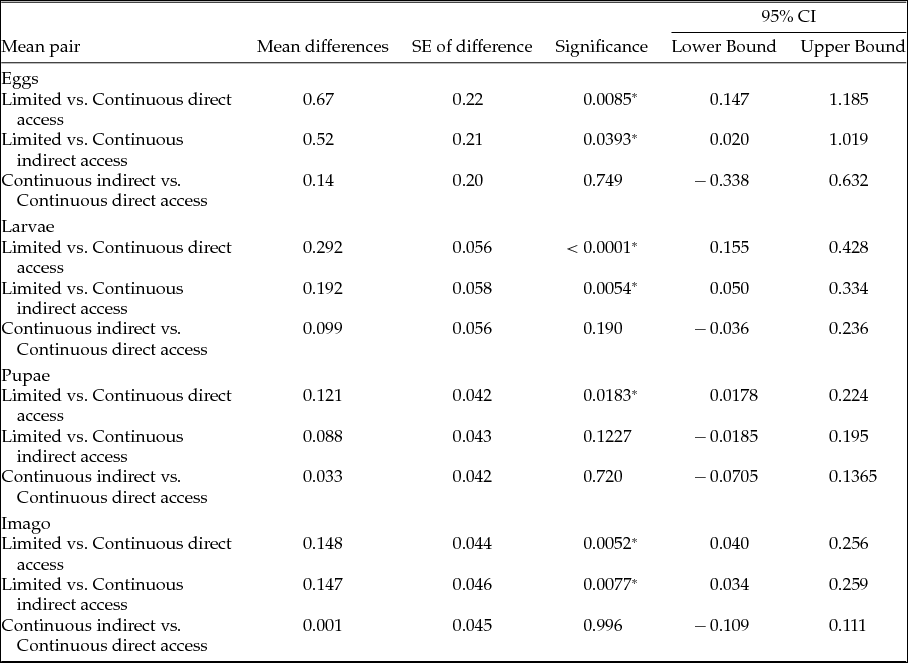
Our results further showed that rearing method significantly affected number of days from nuptial flight to emergence of first larvae (F = 13.55; df = 2, 51; P = 0.0001), first pupae (F = 4.26; df 2, 41; P = 0.0208), and first workers (F = 7.125; df = 2, 39; P = 0.0023). Days to emergence of immature stages and workers were significantly shorter when queens had continuous access to water (Table 2).
Multiple comparisons by Tukey HSD on rearing methods on number of days from mating flight to developmental stages and number of workers produced within 60 days of Oecophylla longinoda queens rearing

Note: Methods refer to access to water.
*The mean difference is significant at the 0.05 level.
Effects of rearing method on number of broods
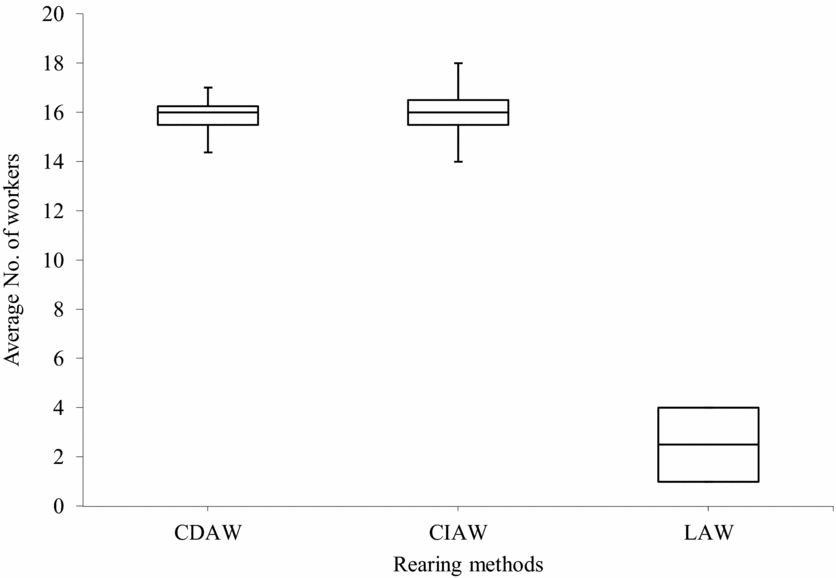
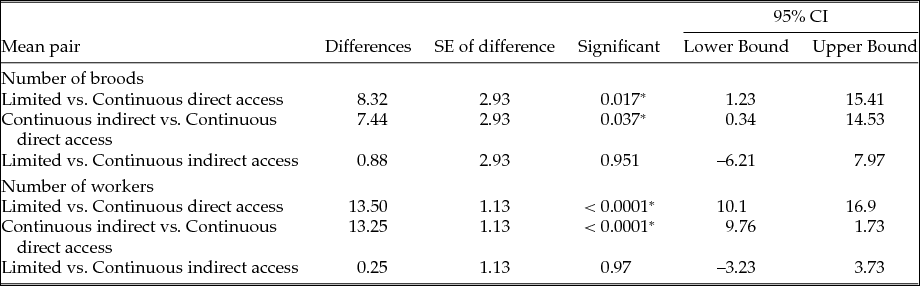
The number of broods produced decreased with developmental stage in all rearing methods. The lowest number of broods was recorded when queens had LAW (Table 3). Rearing methods significantly affected the total number of broods (F = 4.85; df = 2, 48; P = 0.012). Higher numbers of broods were recorded on the continuous indirect and direct access to water methods (Table 3). After the emergence of first workers, the numbers of workers continued to rise. Rearing methods significantly affected the average number of workers per queen observed on day 60 from nuptial flight (F= 92.3548; df = 2, 6; P = 0.0001) (Fig. 2). We observed significantly more broods and workers in queens with continuous access than with LAW (Post Hoc Tukey HSD, Table 4).
Average number of Oecophylla longinoda broods per queen observed on different rearing methods within 60 days after the nuptial flight

Note: Methods refer to access to water.
Number of workers per Oecophylla longinoda queen observed on day 60 from nuptial flights reared on different methods.

Multiple comparisons by Tukey HSD on rearing methods on total number of broods and number of workers observed within 60 days of Oecophylla longinoda queens rearing

Note: Methods refer to access to water.
*The mean differences are significant at the 0.05 level.
Effects of feeding technique on colony development
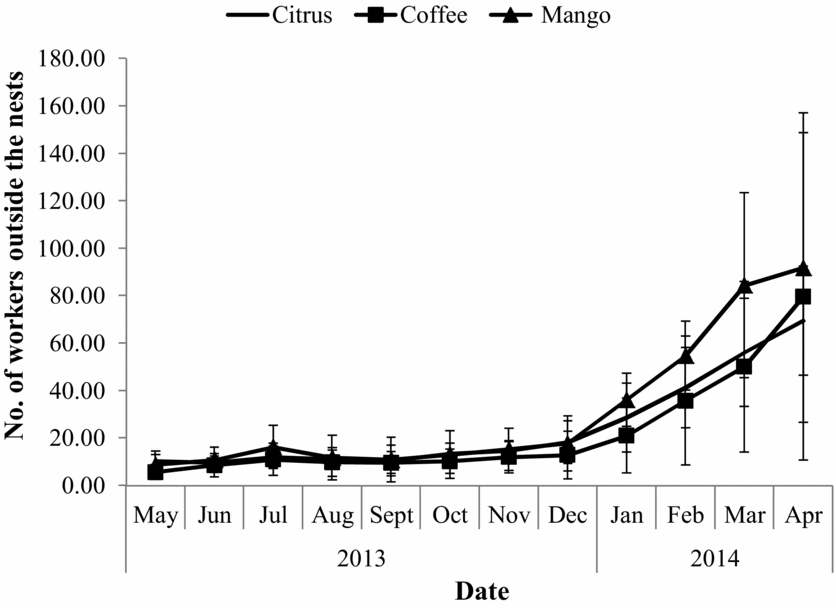
Newly formed colonies were raised in the screen house for one year. They were raised on small potted trees and fed on protein, sugar solution, and water. During that time, the number of workers observed foraging outside the nest was recorded. We observed that the number of workers found outside the nest after disturbance increased with time on all plant species used as hosts in the screen house (Fig. 3).
Average number of Oecophylla longinoda workers (± SD) outside the nests on potted plants in a screen house for a period of one year.

There were generally fewer workers observed outside the nests during the first six months, when colonies were supplied with fish as a source of protein, sugar solution and water every two days. Under similar conditions, the intrinsic rate of increase was higher during the period after the first six months when colonies were supplied ad libitum with water and sugar solution, and fish was supplemented with other sources of protein (Fig. 3). This trend was similar in all host plant species.
Discussion
We tested different queen rearing methods with the aim of developing O. longinoda nurseries for supplying ant colonies to farmers. This study showed that the different rearing methods tested failed to affect queens’ survival, but rather production of workers. However, mated queens reared on CDAW produced more workers, and their colonies grew faster. Queens took longer to produce first workers when reared on the LAW method, which slowed down development of the new colony. Queens reared under continuous indirect and direct access to water methods had a high number of workers 60 days from nuptial flight. These findings suggest that the queens need water during the initial colony establishment to survive and raise broods. This is supported by the fact that production of sexual ants commences at the start of the rainy season (Vanderplank, Reference Vanderplank1960; Peeters and Andersen, Reference Peeters and Andersen1989; Peng et al., Reference Peng, Christian and Gibb1999; Van Mele et al., Reference Van Mele, Vayssieres, Van Tillingen and Vrolijks2007; Sribandit et al., Reference Sribandit, Wiwatwitaya, Suksard and Offenberg2008; Rwegasira et al., Reference Rwegasira, Mwatawala, Rwegasira and Offenberg2015a ). Queens drank water as observed on several occasions, either direct or through the cotton wool. With availability of water, queens raised their broods until the formation of first workers without eating. Water positively affected production and rearing of weaver ant queens. The survival of queens reared on CDAW was low due to drowning, even though many first workers were produced. As such, the survival of mated queens could be improved by modifying rearing methods on CDAW, to protect queens from drowning. The present study found that CIAW was the best method for rearing mated queens of O. longinoda, because more queens survived and produced higher numbers of first workers.
Rearing mated queens under continuous access to water was less labour-intensive, because once the queens were introduced, there was no need to attend to them as frequently. In contrast, it was costly, in terms of labour and time, to sprinkle queens with water every two days. We observed that water was important during colony establishment, to prevent desiccation of the queens. Therefore, CIAW is a recommended method for rearing mated queens of O. longinoda under artificial rearing, such as in the screen house.
The time spent by the majority of O. longinoda queens to produce workers was similar to that reported by Way (Reference Way1954) and Peng et al., (Reference Peng, Christian and Gibb1998), with the exception of queens, which did not shed their wings. According to Peng et al., (Reference Peng, Christian and Gibb1998), mated queens of O. smaragdina took about 4 weeks to develop workers. They needed favourable conditions to produce workers at the right time. The few queens that failed to shed their wings were observed on the LAW method, and some took up to 60 days to produce workers. This period was longer than what has been reported (Way, Reference Way1954). It was observed that queens that shed wings cared more for the broods. The eggs and larvae laid by the queens that did not shed wings disappeared and afterwards new eggs were laid. The reason for the disappearance of broods was not established, but could be attributed to cannibalism by queens (since no predators were observed). We recorded more broods on CIAW than on CDAW and LAW methods. The total number of broods still remained low when queens had direct access to water, due to death by drowning. Generally, the number of broods decreased with advancing stages of development; consequently, there were fewer broods at the last stages.
Supply of water and sugar solution ad libitum improved growth of weaver ant colonies. Colonies responded to the availability of food, while less food reduced the rate of production of colonies. Reliance on one source of protein, i.e. fish, slowed down production of workers. Weaver ants often prefer different sources of protein (W. Nene, pers. commun.). Additionally, supply of water and sugar solution throughout increased rate of growth of O. longinoda colonies. Colonies survived and continued to lay eggs when food and water were available. Provision of water and sugar through cotton wool was ineffective, as the wool dried out fast. Conversely, use of the Eppendorf tube extended the availability of water and sugar solution, thus colonies were able to drink water/sugar solution on demand. As a result, there was an increase in the number of workers found outside the nests, which was a sign of strong colonies.
Conclusion
The ability of queens of O. longinoda to produce broods and develop workers was good when reared under the CIAW method. Although different rearing conditions failed to show a significant difference on queen survival, they affected the number of days taken by queens to produce the first workers and the number produced. Because provision of different sources of protein and an unlimited supply of water and sugar solution increased the number of workers of young colonies, future studies should aim to provide an understanding of the frequency and types of protein requirements throughout the initial colony developmental stages. In addition, the methods for transferring young colonies from nurseries to the open field or orchards need to be developed and optimized.
Acknowledgements
This study was funded by DANIDA through project DFC No. 10–025 at SUA. We are thankful to Semngano farmers in Tanga region and Mzinga Corporation in Morogoro region, for allowing us to trap mated queens in their fields. We appreciate the assistance by Mr John Kusolwa in trapping mated queens and Miss Saverina Tiba on the screen house activities. Dr Renkang Peng (University of Darwin, Australia) and Dr Joachim Offenberg (Aarhus University, Denmark) are acknowledged for the technical advice on queen rearing.