Historically, the medical model has determined the provision of care in long-term care (LTC) settings. The predominance of this paradigm has ensured that care within facilities has been provider driven (i.e., organized based on care provider routines with a primary focus on medical goals). This is emphasized by Crow (Reference Crow2004), who stated that “the philosophy of this approach is captured by the term compliance, which implies the need for obedience on the part of the patient and assumes a marked power differential in favour of the professional in the patient/practitioner relationship” (p. 22).
In recent years, however, there have been attempts to move towards social models of care. This zeitgeist has largely been operationalized via the development and implementation of management initiatives often referred to as culture change models (e.g., Wellspring, Person-Centred Care, Eden Alternative). Common to each culture change model (CCM) is the goal of increasing the provision of individualized care—that is, care that takes into account resident individuality, incorporates residents in decision making, and strives for a more holistic approach to wellness (Happ, Williams, Strumpf, & Burger, Reference Happ, Williams, Strumpf and Burger1996). This interdisciplinary approach acknowledges residents as unique, autonomous persons (Chappell, Reid, & Gish, Reference Chappell, Reid and Gish2006) and attempts to include residents and their families in care planning and delivery (Happ et al., Reference Happ, Williams, Strumpf and Burger1996).
The existing literature indicates that culture change in LTC is an inherently complex process and has, thus far, attained only limited success (Doty, Koren, & Sturla, Reference Doty, Koren and Sturla2008; Hagenow, Reference Hagenow2003; Talerico, O’Brien, & Swafford, Reference Talerico, O’Brien and Swafford2003). In fact, most research to date suggests that meaningful improvements in the provision of individualized care have yet to be realized (Anderson, Issel, & McDaniel, Reference Anderson, Issel and McDaniel2003; Barry, Brannon, & Mor, Reference Barry, Brannon and Mor2005; Coleman, Looney, O’Brien, Ziegler, Pastorino, & Turner, 2002; Ransom, Reference Ransom2000; Stone, Reinhard, Bowers, Zimmerman, Phillips, Hawes, & Fielding et al., 2002). A longitudinal study of the implementation of the Green House Program (a model of care based on small-house nursing homes) by Kane and colleagues (2007) did achieve desired outcomes. It should be noted, however, that this small-house residential model is not applicable to more traditional, large facilities in which the vast majority of LTC residents currently reside.
Kanter’s (Reference Kanter, Shafritz, Ott and Jang1979) theory of structural empowerment may elucidate why meeting the goal of individualized care provision through the implementation of CCMs has proved so elusive in LTC. Her theory asserts that employees’ access to empowerment structures (i.e., informal power, formal power, information, resources, support, opportunity structures) is a precondition for successful accomplishment of organizational goals. Therefore, it is reasonable to assert that the organizational goal of increasing provision of individualized care to LTC residents will largely depend on the care staffs’ access to empowerment structures within LTC (Kanter, Reference Kanter, Shafritz, Ott and Jang1979).
This assertion was supported by a recent study by Caspar and O’Rourke (Reference Caspar and O’Rourke2008) which determined that access to structural empowerment had a statistically significant and positive direct effect on reported provision of individualized care by Registered Nurses (RNs), Licensed Practical Nurses (LPNs), and care aides. More precisely, 48 per cent of observed variance in RNs/LPNs’ ability to provide individualized care was explained by their reported access to structural empowerment; likewise, 45 per cent of variance in care aides’ ability to provide individualized care was explained by their reported access to structural empowerment (Caspar & O’Rourke, Reference Caspar and O’Rourke2008).
The existing nursing literature provides support for Kanter’s (Reference Kanter, Shafritz, Ott and Jang1979) theory, and suggests that access to empowerment structures is significantly related to organizational trust, job satisfaction, and organizational commitment (Laschinger, Reference Laschinger1996; Laschinger, Finegan, & Shamian, Reference Laschinger, Finegan and Shamian2001). A paucity of research exists, however, demonstrating the utility of CCMs on LTC care staffs’ reported access to empowerment structures and provision of individualized care. Nor has research yet been undertaken to ascertain whether or not the influence of CCMs differs among formal caregiver groups (i.e., RNs, LPNs, care aides). With this study, we attempt to redress this knowledge gap. Formal caregivers working in facilities with no model of care were recruited as well as staff from facilities that had implemented the Eden Alternative, GentleCare, and Person-Centred Care (subsequently referred to as Facility Specific Social Model of Care).
Overview of Culture Change Models
The Eden Alternative
The Eden Alternative was developed to rectify psychosocial problems faced by LTC residents, such as loneliness, boredom, helplessness, and absence of meaning. In addition, the Eden Alternative espouses a set of principles that emphasize levelling administrative hierarchies, enabling decision-making by residents and frontline staff, and humanizing nursing routines. Although the Eden Alternative has been widely implemented in LTC facilities across North America and abroad, evaluation research has yielded unimpressive results (Angelelli, Reference Angelelli2004; Coleman, Looney, O’Brien et al., 2002). For example, Ruckdeschel and Van Haitsma (Reference Ruckdeschel and Van Haitsma2001) conducted a pilot study in which the living habitat aspect of the Eden Alternative was examined. Data were collected at the time of implementation of specific Eden Alternative elements and 6-months thereafter (i.e., after a systematic introduction of plants and animals to the environment). These authors determined that implementation of the Eden Alternative did not significantly affect satisfaction with care, boredom, loneliness, quality of care, pleasure, interest, anger, anxiety, sadness, confusion, or verbal aggression (Ruckdeschel & Van Haitsma, Reference Ruckdeschel and Van Haitsma2001). Only perceived control and positive engagement significantly changed over time; with respect to the former, however, perceived control actually declined with implementation of the Eden Alternative. Ruckdeschel and Van Haitsma (Reference Ruckdeschel and Van Haitsma2001) concluded that “there is no reason to expect that an intervention involving animals and plants would have a greater effect across the board than any other well-conceived psychosocial intervention” (p. 25). Brooke and Drew (Reference Brooke and Drew1999) reported findings related specifically to the impact of the Eden Alternative on care staff. They observed no change in staff turnover, ratings of self-esteem, job attitude or satisfaction, and organizational environment as a result of implementing the Eden Alternative.
GentleCare
GentleCare is a resident-centred approach to dementia care developed by Moyra Jones (Reference Jones1996). This model was included in our study because it is the only model to be formally adopted and endorsed by the British Columbia Ministry of Health (Gnaedinger, Reference Gnaedinger2003). The GentleCare model is based on staff education and consultation, imparted in seven training modules (Jones, Reference Jones1996). Central tenets of the GentleCare model include individualized care planning, lowering resident-staff ratios, staff education, permanent staff assignments, enhancing physical environments, and including residents and their family members in care planning (Jones, Reference Jones1996). Unfortunately, there are currently no published studies evaluating the effectiveness of the GentleCare model.
Person-Centred Care
Probably the first approach to advance the concept of individualized care in LTC, and certainly a precursor and foundation upon which a multitude of models of care have been developed, is person-centred care. A review of the literature indicates that person-centred care is more a philosophy than a specific model. The term person-centred evolved from the work conducted by Carl Rogers and his colleagues (Kirschenbaum, Reference Kirschenbaum2004). This approach was later adopted and applied to dementia care in LTC settings as described in Dementia Reconsidered: Person Comes First by Tom Kitwood (Reference Kitwood1997). In this book, Kitwood discusses a philosophical approach to formal caregiving that emphasizes residents’ unique personal preferences and needs to guide caregivers, thus enabling the individualization of care plans and care routines (Boise & White, Reference Boise and White2004). Additionally, a central feature of person-centred care is recognition that all human life, including persons with dementia, is grounded in relationships, and that persons with dementia require enriched social environments to foster personal growth while compensating for their impairment (Brooker, Reference Brooker2007).
Attempting to conduct a thorough literature review of person-centred care is a challenge because key elements of this philosophy have been described using an array of terms (e.g., resident-centred care, individualized care, consumer-directed care, patient-centred care, self-directed care). Each shares concepts and definitions that are philosophically congruent with the person-centred philosophy of care (Talerico et al., Reference Talerico, O’Brien and Swafford2003).
When conducting interviews for this study, we found that only one facility manager used the term person-centred to describe an implemented model. Several managers, however, used terms such as resident-centred care, client-centred care, and social model of care. In each of these facilities, managers indicated that they had not implemented a specific CCM; instead, they had adopted and implemented selected elements from person-centred, GentleCare, and Eden models best suited to their specific resident, staff, and facility needs. For the current study, we categorized these facilities under the rubric of Facility Specific Social Models of Care (FSSMOC).
Each of the CCMs included in this study espouses increasing provision of individualized care as a primary goal. Individualized care has been defined as an interdisciplinary approach that acknowledges residents as unique, autonomous persons and is practiced through consistent caring relationships (Chappell et al., Reference Chappell, Reid and Gish2006). Additionally, several themes are common to these CCMs. These include creating culture change in LTC, collapsing administrative hierarchies, staff education, including family members in care planning, placing the resident at the centre of care, and increasing resident autonomy (Boise & White, Reference Boise and White2004; Gnaedinger, Reference Gnaedinger2003; Jones, Reference Jones1996; Talerico et al., Reference Talerico, O’Brien and Swafford2003; Thomas, Reference Thomas1996; Thomas, Reference Thomas2003).
It is apparent that there are many more similarities than differences among these CCMs. A systematic review of outcome research, however, suggests that the results are, at best, mixed (Bergman-Evans, Reference Bergman-Evans2004; Brooke & Drew, Reference Brooke and Drew1999; Coleman et al., Reference Coleman, Looney, O’Brien, Ziegler, Pastorino and Turner2002; Hagenow, Reference Hagenow2003; Lutz & Bowers, Reference Lutz and Bowers2000; Ransom, Reference Ransom2000; Ruckdeschel & Van Haitsma Reference Ruckdeschel and Van Haitsma2001; Stone et al., Reference Stone, Reinhard, Bowers, Zimmerman, Phillips, Hawes and Fielding2002; Talerico et al., Reference Talerico, O’Brien and Swafford2003; Walker, Porter, & Gruman, Reference Walker, Porter and Gruman1999). Based on this review of the literature, we undertook our study to determine if differences in empowerment and reported ability to provide individualized care exist between LTC staff working in facilities with and without CCMs, and where differences exist, to determine if these are specific to one or more groups of formal caregivers (i.e., RNs, LPNs, care aides).
Methods
Participants
Convenience samples of RNS, LPNs, and care aides were recruited from 54 LTC facilities in three of five British Columbia Health Authorities. Participants were recruited over a 6-month period between January and May 2007. To be eligible, participants had to work on a permanent full-time or part-time basis (or as a casual in an equivalent full-time or part-time position), be proficient in English, and have been employed in that facility for at least 6 months. Participants were not asked to provide identifying information (e.g., their names), and study information letters stated that individual responses would not be shared with facility managers. As noted by Paulhus (Reference Paulhus, Robinson, Shaver and Wrightsman1991), anonymity enhances measurement reliability thus enabling greater confidence in the veracity of participant responses. This research received full ethical approval from the Office of Research Ethics at Simon Fraser University and from each of the health authorities in which participants were employed.
Registered Nurses
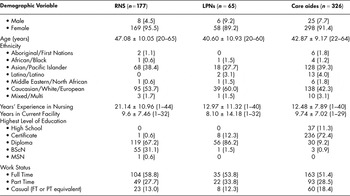
The participants were grouped according to their job title. The first group of participants comprised 177 RNs. As shown in Table 1, the average age of these participants was 47.08 years (SD = 10.05, range 20 to 65). They had 21.14 years of experience on average (SD = 10.96, range 1 to 43), and an average of 9.6 years’ experience within the facility in which they were recruited (SD = 7.46, range 1 to 31). Just over half identified themselves as Caucasian/White/Europeans (53.7%), and a notable proportion identified themselves as Asians/Pacific Islander (38.4%).
Descriptive characteristics of RNs, LPNs, and care aide groups

Note
Values are given as percentages in parentheses and as mean ± SD or range in parentheses.
Licensed Practical Nurses
The second group of participants comprised 65 LPNs. As shown in Table 1, the average age of these participants was 40.60 years (SD = 10.93, range 20 to 60. They had 12.97 years of work experience on average (SD = 11.32, range 1 to 39), and an average of 8.1 years within the facility in which they were recruited (SD = 14.18, range 1 to 32). The majority identified themselves as Caucasian/White/European (60%) with a notable proportion identifying themselves as Asian/Pacific Islanders (27.7%), similar to the overall population of British Columbia.
Care Aides
The third and final group of participants comprised 326 care aides. As shown in Table 1, the average age of these participants was 42.87 years (SD = 9.17, range 22 to 64). They had 12.48 years of work experience on average (SD = 7.89, range 1 to 40), and an average of 9.74 years within the facility in which they were recruited (SD = 7.03, range 1 to 29). A large percentage identified themselves as Caucasian/White/Europeans (42.3%) with a significant proportion identifying themselves as Asian/Pacific Islanders (39.3%).
Range of Facilities
Just over half (51.9 %) of participants worked in facilities in which senior management stated that the facility had not implemented a CCM, whereas 48.1 per cent worked in facilities with a CCM. Of the latter, 20.4 per cent of participants worked in a facility in which managers indicated that the Eden Alternative had been implemented, 16 per cent worked in facilities with GentleCare, and 11.6 per cent worked in facilities in which the manager stated that they had implemented an individually tailored Facility Specific Social Model of Care.
The majority of participants worked in facilities located in urban settings (75.5%) while 23.8 per cent worked in rural areas. Also, the majority worked in public not-for-profit facilities (52.3%), a notable proportion worked in private-for-profit facilities (28.5%), whereas a smaller proportion worked in private not-for-profit facilities (18.8%). The average number of residents in participating facilities was 155 (SD = 84.07, range 29 to 700). The vast majority of participants worked in unionized environments (80.8%) and in facilities providing complex care (90%). Less than half (40.5%) worked in facilities with special care units (i.e., dementia care).
Participant Comparisons by Recruitment Location
Surveys were completed by formal caregivers working in 54 LTC facilities. Data were collected from participants who worked in facilities where managers had agreed to allow their staff to be approached to participate in this study (n = 31) and at off-site educational sessions (e.g., continuing education workshops) from participants working in facilities where managers either did not respond or who had refused to enable onsite participation (n = 23). The most common reason given by managers for their refusal was a lack of time and/or resources.
To determine more accurately the generalizability of our findings, descriptive information was obtained from managers of the 23 facilities who did not agree to participate. Of note, there were no statistically significant differences between consenting and non-consenting facilities in terms of: (a) day shift staffing ratios for RNs [F(2, 49) = 2.7, ns], LPNs [F(2, 49) = 0.80, ns], or care aides [F(2, 48) = 0.82, ns]; and (b) night shift staffing ratios for RNs [F(2, 49) = 1.96, ns], LPNs [F(2, 49) = 1.95, ns], or care aides [F(2, 48) = 0.83, ns].
Because we had data from staff working in facilities where managers did not consent to onsite data collection, we were able to compare empowerment and individualized care responses between staff working in consenting facilities and those working in facilities with non-consenting managers (i.e., off-site recruitment). There were no significant differences for RNs and LPNs in reported empowerment [t(220) = 0.73, ns,] nor individualized care scores [t(223) = 1.88, ns]. The same was true for care aides in terms of both empowerment [t(320) = 1.15, ns,] and reported ability to provide individualized care [t(324) = 0.92, ns]. These findings provide greater ability to generalize findings beyond consenting facilities.
Descriptive Facility Differences by Model of Care (MOC)
Facilities did not differ by model of care with respect to an array of descriptive features (including MOC by consent for onsite recruitment, χ2[df = 3] = 1.34, ns). For example, facilities were indistinguishable by MOC with respect to unionization (χ2[df = 3] = 1.71, ns), facility type (i.e., public, private for-profit, private not-for-profit; χ2[df = 6] = 2.75, ns), nor urban versus rural location (χ2[df = 3] = 3.95, ns). Also, MOC was unrelated to day and night staffing ratios for RNs (F[3, 41] = 0.39, ns; F[3, 41] = 2.16, ns), LPNs (F[3,41] = 0.44, ns; F[3, 41] = 0.30, ns), and care aides (F[3, 41] = 0.24, ns; F[3, 41] = 0.60, ns). Finally, facilities did not differ in duration since implementation of their respective CCMs, F(2, 41) = 1.35, ns. Number of residents was the sole descriptive feature to differ by model type, F(3, 44) = 2.97, p < 0.05 as Eden Alternative facilities had more residents than those that had adopted no MOC (though comparable to both GentleCare and FSSMOC facilities). This near complete absence of descriptive differences by MOC negated the need to include covariates in subsequent analyses.
Instruments
Structural Empowerment
Laschinger’s (Reference Laschinger1996) Conditions of Work Effectiveness Questionnaire (CWEQ), the Job Activities Scale (JAS), and the Organizational Relationships Scale (ORS) were selected to measure seven constructs specific to Kanter’s (Reference Kanter, Shafritz, Ott and Jang1979) theory of structural empowerment in organizations. Total empowerment scores were created by summing responses to each subscale from the CWEQ, JAS, and ORS.
The CWEQ uses a 5-point Likert-type response key and consists of four subscales: (a) information—8 items; (b) support—9 items; (c) resources—7 items; and (d) opportunity—7 items. The CWEQ has been used in numerous studies in healthcare settings. Generally acceptable internal consistency for responses to each subscale has been reported ranging from 0.73 ≤ α ≤ 0.98 for information, 0.73 ≤ α ≤ 0.92 for support, 0.66 ≤ α ≤ 0.91 for resources, and 0.73 ≤ α ≤ 0.91 for opportunity (Laschinger, Reference Laschinger1996).
The JAS is a 9-item instrument (5-point Likert-type response key) that measures staff perceptions of formal power within work environments. Content validity was established with the aid of an expert panel. Adequate internal consistency of responses to the JAS has been reported ranging from 0.69 ≤ α ≤ 0.79 (Laschinger, Reference Laschinger1996).
The Organizational Relationships Scale is an 18-item instrument (5-point Likert-type response key) that measures staff perceptions of informal power within organizations. Support for the face validity of ORS responses was obtained through pilot testing with a convenience sample of RNs. Reported internal consistency of responses to the ORS scales is within optional parameters (i.e., 0.83 ≤ α ≤ 0.89).
Individualized Care
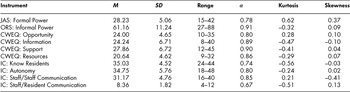
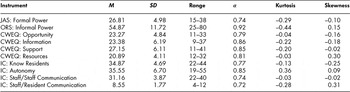
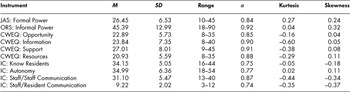
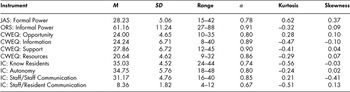
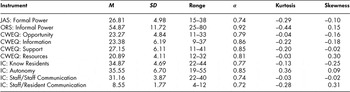
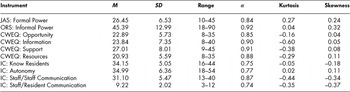
The Individualized Care Instrument (ICI), developed by Chappell and colleagues (2006), was used to measure care staffs’ reported ability to provide individualized care. The ICI is a 34-item scale (4-point Likert-type response key) which consists of four subscales: (a) Know Residents (IC-KNOW, 11 items); (b) Resident Autonomy (IC-AUTONOMY, 11 items); (c) Communication Staff/Staff (IC-COMMUNICATION, 10 items); and (d) Communication Staff/Resident (IC-COMMUNICATION-SR, 3 items). Reported internal consistency of responses is within an acceptable range for IC-KNOW (α = 0.77), IC-AUTONOMY (α = 0.80), and IC-COMMUNICATION (α = 0.84). Somewhat suboptimal alpha coefficients have been reported for IC-COMMUNICATION-SR (α = 0.67). This may well be due to the small number of items within this subscale (i.e., three items). As noted by O’Rourke, Hatcher and Stepanski (Reference O’Rourke, Hatcher and Stepanski2005), internal consistency of response can be underestimated when scales have fewer than eight items. While it is readily acknowledged that each of these instruments requires further testing, they are currently the only measures of individualized care with acceptable reliability response estimates. Descriptive statistics and psychometric properties of responses to study instruments are reported in Tables 2, 3, and 4 for RNs, LPNs and care aides, respectively.
Descriptive features and psychometric properties of model variables for RNs (n = 177)
Descriptive features and psychometric properties of model variables for LPNs (n = 65)
Descriptive features and psychometric properties of model variables for care aides (n = 326)
Analytic Strategy
Multivariate analyses of variance (MANOVA) were performed to compare reported empowerment and ability to provide individualized care by CCM (i.e., Eden Alternative, Gentle Care, Facility Specific Social Model of Care, and no CCM) for each of the three groupings of formal caregivers (i.e., RNs, LPNs, care aides). Empowerment and individualized care were examined together on the basis of previous findings indicating that these are strongly associated constructs. According to Caspar and O’Rourke (Reference Caspar and O’Rourke2008), access to empowerment structures is a significant antecedent to provision of individualized care. We subsequently computed one-way ANOVAs if results suggested univariate significance for either empowerment or individualized care across CCM groups. Lastly, we undertook post hoc analyses to ascertain which groups differed.
Results
The order of presentation of study questionnaires was counterbalanced, creating two alternate formats. Comparative analyses indicated that response levels did not significantly differ between the two; we thus contend it is unlikely that order effects confounded participant responses.
Registered Nurses
First, we computed a multivariate analysis of variance (MANOVA) to ascertain if an overall difference in RN empowerment and reported ability to provide individualized care differed across model type. No differences were observed. Multivariate findings indicated no response differences across facilities with and without CCMs, Pillai’s Trace = 0.01, F(6, 340) = 0.27, ns. Nor did univariate results indicate differences across model types. For neither empowerment nor individualized care did RN responses differ between those working in facilities with no model of care or each of the three specified CCMs. These findings suggest that functioning with a CCM does not influence RNs’ reported access to empowerment structures, nor does it enhance their ability to provide individualized care. This result is noteworthy given RNs’ relative proximity to managerial and administrative functions (where decisions regarding the implementation of CCMs are made) as compared to LPNs and care aides.
Licensed Practical Nurses
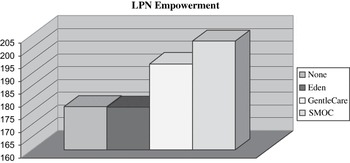
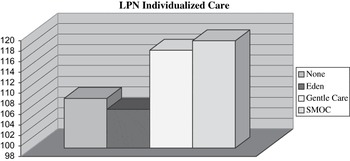
These analyses were next repeated to compare responses by LPNs across model types. Although multivariate significance once again was not observed, (Pillai’s Trace = 0.19, F[6, 122] = 2.11, ns), univariate significance emerged for both empowerment [F(3, 61) = 2.74, p = 0.05, partial η2 = 0.12] and reported ability to provide individualized care [F(3, 61) = 3.90, p = 0.01, partial η2 = 0.16].
Post hoc analyses were next undertaken to determine the source of univariate difference. First, with respect to reported empowerment, no between-group difference was observed between LPNs working in facilities with GentleCare or those with a tailored FSSMOC; nor was a difference observed between LPNs working in facilities with no CCM or facilities with the Eden Alternative. However, LPNs working in facilities with a FSSMOC reported statistically greater empowerment than those in both facilities with the Eden Alternative and facilities with no CCM. See Figure 1.
Model of care differences on LPN reported levels of access to structural empowerment

We next undertook post hoc analyses to compare LPNs’ reported ability to provide individualized care. Once again, no difference was observed between those working in facilities with GentleCare and FSSMOC, nor between those in Eden Alternative facilities and those with no CCM. With respect to individualized care, responses by LPNs working in facilities with the Eden Alternative, however, were significantly lower than those with both GentleCare and FSSMOC. As evident from Figure 2, the lowest levels of individualized care were reported by LPNs working in Eden Alternative facilities.
Model of care differences on LPN reported ability to provide individualized care

Care Aides
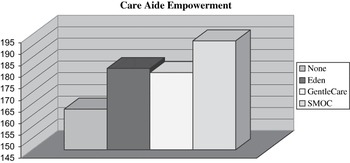
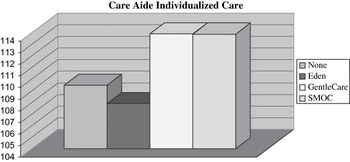
In contrast to other formal caregivers recruited for this study, multivariate significance was observed for responses by care aides, Pillai’s Trace = 0.10, F[6, 636] = 5.46, p < 0.01. In addition, univariate significance emerged for both care aide empowerment [F(3, 318) = 8.24, p < 0.01, partial η2 = 0.07] and individualized care [F(3, 322) = 4.54, p < 0.01, partial η2 = 0.04].
In this instance, post hoc analyses indicated that care aide empowerment did not differ across CCM type; the sole between-group difference was observed between those working in facilities with no CCM who reported significantly lower levels of empowerment vis-à-vis care aides in facilities with a CCM. Irrespective of CCM type, care aides reported greater empowerment compared to those working in facilities with no CCM. In contrast to LPNs, no specific empowerment advantage was conferred by one CCM over others in terms of care aide empowerment. See Figure 3.
Model of care differences on care aides reported levels of access to structural empowerment

This uniformity was not observed, however, in care aides’ reported ability to provide individualized care. No difference was observed between those working in facilities with GentleCare and FSSMOC, yet responses by these care aides were significantly higher than care aides working in facilities with the Eden Alternative and those in facilities with no CCM. Reported individualized care was virtually identical between care aides in Eden Alternative facilities and those in facilities with no CCM. See Figure 4.
Model of care differences on care aides reported ability to provide individualized care

Discussion
The aim of this study was to determine whether or not the implementation of a CCM influences care staffs’ reported access to empowerment structures and provision of individualized care in LTC facilities; comparisons were made between three specified CCMs versus no model of care, and also by job category. To the best of our knowledge, this is the first empirical study to compare reported levels of empowerment and individualized care across RNs, LPNs, and care aides by CCM. Our findings suggest that all CCMs are not created equal and that notable differences exist across LTC formal caregivers.
Findings suggest that CCMs exert no discernible influence on RNs’ reported access to empowerment or ability to provide individualized care. The same, however, was not true for the LPNs and the care aides recruited for this study. Results suggest that CCMs exert the strongest influence on care aides’ reported access to structural empowerment and ability to provide individualized care. Of further note, the greater the day-to-day contact with residents, the greater were the differences across CCMs.
For LPNs, responses clustered within two groupings: those working in facilities with a FSSMOC and GentleCare; and those in facilities with Eden Alternative and with no CCM; empowerment and individualized care responses were significantly higher for the former. In contrast, LPN responses did not differ between facilities with the Eden Alternative and those with no CCM. These findings suggest that certain CCMs enhance LPN empowerment and reported ability to provide individualized care; in both instances, response levels were highest for LPNs in facilities with a FSSMOC (though not statistically different from those with GentleCare). For LPNs, the Eden Alternative appears to confer no discernible benefits compared to no CCM. To our surprise, the reported ability to provide individualized care was, in fact, lowest for LPNs working in facilities that had implemented the Eden Alternative.
Similar patterns of response were observed for care aides across model type groupings. Once again, empowerment and individualized care responses were highest among care aides working in facilities with a FSSMOC, although not significantly higher than those working in facilities with GentleCare. Across the three formal caregiver groups, the only instance in which Eden Alternative appeared to confer any benefit relative to no CCM was care aide empowerment; this advantage, however, did not extend to the reported ability to provide individualized care.
In summary, empowerment and individualized care responses were consistently higher for both LPNs and care aides who worked in facilities that had implemented a FSSMOC than for these formal caregivers working in facilities that had implemented the Eden Alternative. Furthermore, in only one instance did responses by caregivers in Eden Alternative facilities significantly differ from those in facilities with no CCM; in fact, caregiver responses from facilities with the Eden Alternative were lower than formal caregivers’ responses in facilities with no CCM in three of four instances. Finally, CCMs appear to exert no discernible influence on RNs’ reported access to empowerment or ability to provide individualized care.
Interpretation of these results must be considered within the framework of the traditional hierarchical medical model that remains predominant in LTC (Doty et al., Reference Doty, Koren and Sturla2008). The LTC hierarchy ensures that staff with the highest education, salary, and position remain furthest from direct resident contact. As a result, those in LTC with the least resident contact have the most control in determining care decisions. Conversely, care aides provide between 80 and 90 per cent of all resident care yet receive the least amount of training, the lowest pay in healthcare, and are rarely consulted when care decisions are made or implemented (Blair & Glaister, Reference Blair and Glaister2005; Kane, Reference Kane1994; Stone & Yamada, Reference Stone and Yamada1998). Stone and Yamada (Reference Stone and Yamada1998) contend that care aides typically have considerable responsibilities although they lack both authority and autonomy within LTC. This conclusion was reiterated by Kane (Reference Kane1994), who stated that care aides “have at least one thing in common with their clientele: perceived and actual lack of power” (p. 71). Therefore, it could well be that, due to their perceived and actual lack of power, care aides, more than any other group of LTC caregivers, respond to any attempt and effort by management to enhance empowerment.
When reviewing these results in terms of practice implications, the cost of implementing the Eden Alternative must be addressed. Although some articles have stated that the “cost of Edenizing requires more a change of heart than change in the pocketbook” (Stermer, Reference Stermer1998, p. 35), others have reported very significant financial investments. For instance, Halbert (Reference Halbert2000), who is the administrator and CEO of the first facility to have adopted the Eden Alternative, reported that the annual budget for plant, garden, and animal maintenance and replacement was estimated at $21,400 for the year 2000. It is important to note that this cost does not include the expense of training staff nor Eden certification. Given the limited resources available for staff training, environmental adaptations and program development within LTC facilities, we feel that managers and administrators should consider the results of this study and other empirical evidence prior to making decisions regarding the adoption of the Eden Alternative as a means to increase the provision of individualized care. However, we readily acknowledge that further research examining the perceptions of residents and families is necessary before arriving at definitive recommendations.
As with all such work, limitations to this study must be acknowledged. First, only participants who worked in LTC facilities in three of five British Columbia Health Authorities were recruited for this study. Nor can differences between formal care providers who agreed to participate in this study versus those who declined be ascertained. As a result, we are unable to generalize individualized care or empowerment response levels to the population of LTC caregivers in this province. This limitation would be of greater concern had the results of this study not corresponded to previous empirical research suggesting the limited utility of the Eden Alternative (cf. Coleman et al., Reference Coleman, Looney, O’Brien, Ziegler, Pastorino and Turner2002). Also, and perhaps most importantly, the perceptions of residents and their family members were not examined. This limitation is most germane when we consider that reported ability to provide individualized care may not fully correspond to perceptions of care received.
As noted earlier, we did not recruit representative caregiver samples. Reliance upon convenience samples underscores the need to replicate findings with participants working in other jurisdictions. This is underscored by the observation that subsamples were unequal across the three caregiver groups (and variability in statistical power).
The cross-sectional nature of data derived for the current study must also be acknowledged as a limitation. Although results of the current study suggest that the Eden Alternative confers no discernible benefits in terms of staff empowerment or delivery of individualized care, it is possible that facilities in our study, which had adopted the Eden Alternative, had done so to improve upon previously very poor provision of individualized care, and so appearing on par with facilities with no CMM might represent an improvement. Only longitudinal measurement would enable this supposition to be discounted. Our knowledge of the facilities in which study participants work does not, however, support this likelihood. In fact, we were quite surprised how poorly facilities that had implemented the Eden Alternative appear in these findings given our familiarity with these institutions.
Despite these limitations, this study makes an important addition to the body of knowledge regarding the influence of CCMs on the quality of life for LTC residents and the quality of work life of their formal caregivers. The utility of CCMs appears to differ considerably across formal caregiver groups and across different CCMs. One encouraging finding to emerge from the current study is that the relative impact of CCMs is greatest among care aides who provide the vast majority of resident care (i.e., the formal caregiver group most likely to enhance resident quality of life).
When attempting to draw conclusions or make recommendations, it seems that what is most important is achieving the correct balance between the desired cultural change and the environmental and social realities within LTC facilities. Our findings suggest that this may be best achieved through the development of mutually agreed upon culture change initiatives between staff and managers rather than attempting to implement a pre-defined CCM such as the Eden Alternative. We believe this may largely explain why staff who work in facilities that have implemented a FSSMOC report the highest levels of both access to structural empowerment and the ability to provide individualized care.
The congruence model proposed by Nadler and Tushman (Reference Nadler and Tushman1980) emphasizes this point. According to these authors, organizations will be effective only to the degree that congruence exists across internal components (i.e., the way tasks are organized, the informal ways that people relate to each other, formal structure, policies and procedures, and the characteristics of the organization’s employees). Furthermore, before practice can be changed or innovative approaches implemented, organizational culture must be able to support change (Rader & Semradek, Reference Rader and Semradek2003). The literature consistently illustrates that the deciding factor in determining whether environmental or cultural change hurts or strengthens an organization is how management responds to and navigates change (Gibson & Barsade, Reference Gibson and Barsade2003). Based on the results of our study, we would conclude that one of the most important aspects of this is whether managers successfully empower staff so that they feel part of the goals and initiatives developed to achieve desired cultural change.