

Introduction
In the literature on trade attitudes, there appears to be growing consensus that individuals’ values and their perceptions of the effects of trade are important factors in shaping voters’ positions on free trade (Gidengil, Reference Gidengil1995; Mendelsohn et al., Reference Mendelsohn, Wolfe and Parkin2002; Wolfe and Mendelsohn, Reference Wolfe and Mendelsohn2005). Yet, the role of self-interest in influencing trade attitudes remains hotly debated. Early work on trade attitudes offered initial evidence that trade preferences aligned with assumptions used in standard economic trade theories (Beaulieu, Reference Beaulieu2002; Dasko, Reference Dasko and Cameron1986; Gidengil, Reference Gidengil1995). However, others suggest that self-interest plays a limited role, or no role at all, on the formation of trade attitudes (Mansfield and Mutz, Reference Mansfield and Mutz2009; Mendelsohn et al., Reference Mendelsohn, Wolfe and Parkin2002; Wolfe and Mendelsohn, Reference Wolfe and Mendelsohn2005). This paper joins the ongoing discussion among scholars and policy makers on why voters support (or oppose) trade openness. We do not challenge the findings showing little support for the self-interest hypothesis, but we do push back against the conclusions drawn based on those findings.
Two questions drive our course of inquiry in this paper: Do consumer and producer considerations influence support for future agreements and, if so, how? We advance an argument that focuses on the potential indirect pathways linking self-interest and trade preferences. We draw on existing hypotheses from separate strands in the literature to construct a theoretical model that incorporates perceptions of trade (perceived effect of trade on self and country) and different forms of self-interest (producer and consumer considerations). Our model highlights the indirect pathways for how self-interest may influence mass attitudes toward prospective agreements. Specifically, we hypothesize there is a causal chain connecting self-interest, perceptions of trade and trade preferences where perceptions of trade mediate the impact of self-interest on trade preferences. Our mediational hypothesis stands in contrast to existing work which has treated self-interest and perceptions of trade as alternative explanations. Based on our model, we perform a mediational analysis testing the direct and indirect pathways of self-interest using new data from a survey on attitudes toward the Trans-Pacific Partnership (TPP), conducted by the Asia-Pacific Foundation.
To preview our results, we find that producer considerations (measured as respondent's level of income) and consumer considerations (measured as respondent's recognition of how free trade influences prices) have weak direct effects on support for the TPP. These results are consistent with the recent literature on trade preferences. However, when testing for a mediating relationship, our findings show that producer considerations and consumer considerations have indirect effects on respondents’ support for the TPP and that the proportions of the total effects are largely mediated by perceptions of trade.
The research questions posed in the paper are relevant to theory and policy. In terms of theory, the argument and evidence presented in this paper contribute to what Hafner-Burton and colleagues (Reference Hafner-Burton, Haggard, Lake and Victor2017) refer to as the “behavioural revolution” in international relations. Two broad strands of research explore mass attitudes toward trade policy. In one strand, scholars have debated whether individual-level support for trade policy is based on economic self-interest or economic concerns about the national welfare of the country (sociotropism). A separate, but related, strand of research has investigated whether consumer or producer benefits from trade are driving support for free trade policies. We bring together these two strands of literature into one structured study. Both debates seek to explain support for trade policy but have existed as separate research programs. With regards to policy, simply knowing current levels of public support for macro-economic policies may not be sufficient information for policy makers if they intend to avoid potential future scenarios like Brexit. Our research sheds light on why voters are for and against trade openness and how voters reach those opinions.
The Diverse Pathways of Economic Self-Interest
The literature on explaining mass attitudes toward international trade policy has flourished in recent years. As a consequence of this growth, scholars are now examining different aspects of trade attitudes, both in terms of alternative explanations for trade attitudes (independent variables) as well as different outcomes of interest (dependent variables). Although once understood as a singular hypothesis, scholars have advanced several theories related to self-interest to explain trade preferences. We identify four related hypotheses relevant to the discussion on self-interest and trade preferences and outline them below. Then, in the following section, we use these hypotheses to build our theoretical model of support for prospective trade agreements.
1. Producer considerations and trade preferences hypothesis
Prior work on examining the self-interest hypothesis in trade preferences has primarily focused on what we refer to as “producer considerations,” that is, treating individuals as workers and income earners. These preference models are based on classic trade theory (Stolper-Samuelson theorem and Ricardo-Viner model) that assumes that individuals who benefit financially as workers from trade openness would likely be in favour of free trade policies. Financial benefits from trade openness include obtaining gainful employment in an exporting industry and/or receiving higher wages. For example, Breau and Brown (Reference Breau and Brown2011) find that wages increase in Canadian export sectors following the implementation of free trade agreements (FTAs). Conversely, workers in import-competing sectors are expected to be opposed to free trade because they wish to protect their job security and avoid downward pressure on wages.
Some of the earliest findings in the literature on trade preferences offer initial support for self-interest in the form of producer considerations, showing a positive relationship between variables related to the skill level and their expected preference for (or against) a certain economic policy (Kaltenthaler et al., Reference Kaltenthaler, Gelleny and Ceccoli2004). For example, Scheve and Slaughter (Reference Scheve and Slaughter2001) use average yearly earnings by occupation type and education to proxy skill level. They find that American respondents with higher levels of education and earnings are more likely to prefer free trade, a result consistent with the Stolper-Samuelson theorem. Using samples of Canadian respondents, scholars find similar evidence suggesting that producer considerations may have a direct effect on prospective agreements (Beaulieu, Reference Beaulieu2002; Dasko, Reference Dasko and Cameron1986; Gidengil, Reference Gidengil1995).Footnote 1 O'Rourke and Sinnott (Reference O'Rourke, Sinnott, Rodrik and M2001) and Mayda and Rodrik (Reference Mayda and Rodrik2005) use cross-national survey data from the 1995 ISSP National Identity module and find corroborating evidence that producer considerations are associated with trade preferences. Together, these studies offered initial empirical evidence in support of trade preference models based on classic trade theory which predicts that owners of abundant factors (skill level measured as yearly earnings and education level) are more likely to support trade openness.Footnote 2
2. Perceived effects of trade and trade preferences hypothesis
Other scholars argue that sociotropic perceptions (measured as how respondents believe trade affects the country as a whole) play a substantially larger role in influencing trade policy attitudes than more common measures of producer considerations, like yearly earnings and education levels (Mansfield and Mutz, Reference Mansfield and Mutz2009; Uslaner, Reference Uslaner1998; Wolfe and Mendelsohn, Reference Wolfe and Mendelsohn2005). In explaining attitudes toward new trade agreements, Wolfe and Mendelsohn conclude that “while individuals do, to some extent, assess trade agreements with reference to their own economic position, we find that retrospective evaluations of previous agreements are even more important” (Reference Wolfe and Mendelsohn2005: 61).Footnote 3
In a later study by Mansfield and Mutz (Reference Mansfield and Mutz2009), the authors include two measures of trade perceptions, one assessing perceived benefits from trade for self and one assessing perceived benefits for the country as a whole. For both measures, they find that positive assessments of trade are positively related to support for trade openness yet still come to the conclusion that “the self-interest hypothesis has little explanatory power when it comes to understanding attitudes toward trade” (Reference Mansfield and Mutz2009: 444), based on their objective measures of self-interest (industry of employment and yearly earnings) being insignificant in their models.
3. Consumer considerations and trade preferences hypothesis
Still others advance a different form of self-interest to explain trade preferences based on the consumer benefits obtained from free trade; we refer to this as “consumer considerations.” From a self-interested perspective, citizens as consumers are price sensitive and enjoy the lower prices and greater diversity of products obtained from trade openness (Baker, Reference Baker2003). While citizens may not know the specifics about the level of tariff reductions on particular goods, they can inspect country of origin tags and obtain information about whether the product is domestic or imported. Traded goods and services tend to be highly visible to consumers and many are aware of the country of origins when purchasing certain desirable products like cell phones and fashionwear. Moreover, consumers also obtain greater product variety from trade openness (Krugman, Reference Krugman1981). Products can vary in terms of attributes such as unique functionality in digital electronics and in terms of product quality (for example, off-brand clothing versus designer clothing). International trade dramatically increases variety (quality and attributes) for consumers. Therefore, individuals may favour free trade based on their personal experience in purchasing foreign products at lower prices. Consistent with this logic, Naoi and Kume (Reference Naoi and Kume2015) use survey experiments to test for producer and consumer considerations and find that respondents report greater support for free trade when they are primed to think as consumers rather than as producers.
4. Producer and consumer considerations and perceived effects of trade hypotheses
Finally, some scholars have sought to explain why people perceive trade as hurting or helping the nation and their households. For example, Bennett (Reference Bennett2004) uses data from a 1995–1996 International Social Survey Programme (ISSP) survey to explain the variation in retrospective assessments of the benefits of NAFTA.Footnote 4 In his sample of Canadian adults, he finds that higher levels of income are associated with the perception that NAFTA is beneficial for Canada. Similarly, in explaining support for trade in Latin America, Baker (Reference Baker2003) combines sociotropic perceptions of trade and support for the prospective Free Trade Area of the Americas (FTAA) to create an indexed dependent variable.Footnote 5 Baker finds little evidence of self-interest in the form of producer considerations (individuals as producers and income earners) but he does find support for consumer considerations (individuals receiving consumer benefits from free trade). Yet, the interpretation of Baker's results is complicated by the fact that he merges support for future agreements (FTAA) and sociotropic attitudes into a single dependent variable. In other words, it is difficult to discern if his findings explain sociotropic perceptions or trade preferences. And more recently, Fordham and Kleinberg (Reference Fordham and Kleinberg2012) have shown that traditional measures of self-interest, like income, can predict whether individuals perceive trade as beneficial for their household.
In summary, the extant literature on trade attitudes has become theoretically diverse in two distinct ways, probing different factors that shape trade attitudes and examining different outcomes of interests. The former—developing alternative explanations—is a productive process in better understanding why individuals support trade. The latter—explaining different aspects of trade attitudes—is also a logical development in all fields of study, but in doing so, the relationships between the different dependent variables need to be clearly defined and theoretically linked together to make sense of the individual parts. This process can become muddied when independent variables in some theories are used as dependent variables or when theoretically distinct dependent variables are used as proxies for one another. In the next section, we organize these related hypotheses to construct a theoretical model of support for prospective FTAs.
A Mediation Model of Support for Prospective Trade Agreements
What is the best way to make sense of the self-interest debate and its conflicting findings? We argue that there is a misstep in both theory and empirics linking self-interest to trade preferences. Rather than viewing perceptions of trade and self-interest as alternative explanations, we argue that self-interest and the perceived effects of trade are causally linked processes. In discussing the “self” as a cognitive structure, Sears and Funk observe that “the self may have an especially prominent role in organizing our perceptual experience and therefore our thinking and judgment” (Reference Sears and Funk1991: 10). And they further note that “subjective perceptions of objective conditions are indeed more proximal to the dependent variables… and so should have more effect” (69). Instead of understanding subjective perceptions of trade as an alternative explanation to objective measures like income, perceptions may be better understood as a mediator linking self-interest and trade preferences.
In accordance with this mediational logic, the four hypotheses described above correspond with the characteristics of a mediational relationship described in the canonical work by Baron and Kenny: “To demonstrate mediation one must establish strong relations between (a) the predictor and the mediating variable and (b) the mediating variable and some distal endogenous or criterion variable. For research oriented toward psychological levels of explanation (that is, where the individual is the relevant unit of analysis), mediators represent properties of the person that transform the predictor or input variables in some way” (Reference Baron and Kenny1986: 1177). In the context of the literature on trade preferences, the research using producer and consumer considerations to predict perceptions of trade (hypothesis 4 described above) represents condition (a) and the research using perceptions of trade to explain trade preferences (hypothesis 2 described above) represents condition (b). Understanding perceived effects of trade as an intermediary between self-interest and trade preferences is not entirely new. For example, Gidengil (Reference Gidengil1995) early on described the causal ordering of trade preferences, placing retrospective judgments of personal and national economic conditions before trade preferences but after material factors, such as income.
If perceptions do serve as a mediator, then our mediational hypothesis offers an alternative narrative to explain the mixed findings in the literature. For instance, self-interest (measured as income) is a significant predictor of trade preferences when other factors like perceptions are omitted from statistical models but then becomes insignificant when perceptions are included. Some scholars have suggested that when perceptual variables are added to the model, the insignificant effects of variables proxying self-interest do not matter for trade preferences (Mansfield and Mutz, Reference Mansfield and Mutz2009). However, this may not be the only valid interpretation because an insignificant result could also be suggestive of a mediational relationship. That is, X causes Y through a third variable (Z); where X is self-interest (producer and consumer considerations), Y is trade preferences and Z is perceived effects of trade. As Malhorta and Krosnick note: “Mediational pathways can reveal indirect effects that would be hidden when investigators do not carefully consider such possibilities before putting many predictors into a single regression equation” (Reference Malhotra and Krosnick2007: 276). Correspondingly, research using perceptions of trade as the dependent variable have shown that producer and consumer considerations are significant predictors, a result that is consistent with the argument that self-interest may be motivating whether one supports or opposes trade through their perceptions of trade (Baker, Reference Baker2003; Bennett, Reference Bennett2004; Fordham and Kleinberg, Reference Fordham and Kleinberg2012).
To illustrate our mediational argument, we present a theoretical model of support for prospective trade agreements that builds on previous work. We explicate the potential direct and indirect pathways connecting self-interest and support for prospective agreements. Specifically, our model links three endogenous factors of interest: perceptions of how trade has influenced the country as a whole, perceptions of how trade has influenced oneself and support for prospective trade agreements. The model takes into account the cautionary point by Fordham and Kleinberg who emphasize that “accounts of the role of economic interests in attitude formation that set aside these indirect effects are likely to draw overly negative conclusions” (Reference Fordham and Kleinberg2012: 326).Footnote 6
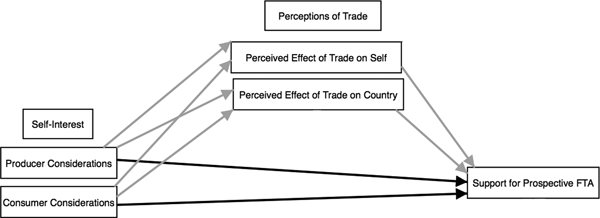
Figure 1 is a diagram presenting our theoretical model of how self-interest can shape individuals’ support for prospective trade agreements. In the diagram, the three sets of boxes represent self-interest (left side), perceived effects of trade (top middle) and trade preferences (right side). The causal directionality moves from left to right, starting with self-interest. Because scholars have noted that self-interest can take the form of producer and consumer considerations, we separate these two forms of self-interest on the left-hand side of the diagram. Perceptions of trade can be further separated into perceived effects on self and perceived effects on country. Self-interest may potentially influence support for new agreements directly (black arrows) and indirectly through retrospective assessment of the effects of trade on self and the country as a whole (grey arrows).
Model of Support for Prospective FTAs.

Admittedly, our theoretical model may appear quite simple and it could be argued that it is incomplete. However, we believe that it incorporates many of the existing pathways for how self-interest may shape trade attitudes toward new FTAs. For example, Rho and Tomz argue that “the connection between economic interests and policy preferences depends on causal beliefs—specifically, perceptions about how government policies would affect the material well-being of individuals and groups” (Reference Rho and Tomz2017: 86, emphasis added).Footnote 7 Similarly, on the consumer-side, Baker suggests that, “due to the visibility of trade's impact, citizens will recognize the positive effects on their consumer options and will tend to justify their support for free trade by referring to these types of gains” (Reference Baker2003: 434). Yet, despite the acknowledgement of a mediational relationship connecting self-interest, perceptions and trade preferences, the extant research remains firmly rooted in testing direct pathways.
Empirical Analysis: Support for the TPP
To test our mediational argument, we leverage new data from a nationally representative sample of voting-age Canadians (N=1,154). The Asia Pacific Foundation of Canada's 2015 National Opinion Poll: Canadian Views on the Trans-Pacific Partnership (herein APF survey) was conducted by EKOS Research Associates Incorporation on behalf of the Asia Pacific Foundation of Canada. In contrast to other online panels using quota or nonprobability sampling, EKOS's general population panel is probability-based with Canadian respondents in the panel recruited through random digit dialing. Probability-based sampling has desirable statistical attributes such as unbiasedness and quantifiable estimates of interest, like margins of error. EKOS reported a margin of  $ \pm 2.5\% $ for the sample in this study. The online survey panel was fielded September 9–17, 2015, approximately five months before Canada signed the agreement. The median completion time for the survey was 9.5 minutes. EKOS provided statistical weighting based on age, gender and region to ensure that the sample was representative of the adult population of Canada.Footnote 8 The survey data is ideal for our purposes because it was specifically designed to obtain attitudes toward a proposed agreement and contains several relevant measures to test our hypotheses.
The Statistical Model
The survey asks respondents about their level of support for Trans-Pacific Partnership (TPP), and we use responses to this question as the primary dependent variable in the analysis. The question asks, “Based on what you have read, seen, heard or know about the Trans-Pacific Partnership (that is the proposed regional free trade agreement among Asia Pacific countries), to what degree do you support or oppose Canada's government approving the TPP?” We label this variable, Support for TPP. The dependent variable is a 4-point measure: “Strongly support” = 4, “Moderately support” = 3, “Moderately oppose” = 2, “Strongly oppose” = 1. Consistent with other studies on Canadian trade preferences, it is not surprising that the APF sample of Canadian respondents expresses favourability toward the TPP, with the majority of respondents (53.1%) expressing either strongly or moderately supporting views. Descriptive statistics for all variables used in this study can be found in the online appendix.
Measuring Forms of Self-Interest
Because self-interest can take the form of producer and consumer considerations, we include both forms in our models. The typical measures of producer considerations are income, occupational yearly earnings and education attainment as proxies for skill level and occupational industry as a proxy for sector of employment. Income and education questions were included in the APF survey, but it did not ask respondents to identify the industry in which they work. Regarding the education variable, more recent literature has suggested that education level is proxying other concepts. For example, Hainmueller and Hiscox (Reference Hainmueller and Hiscox2006) suggest that the level of education may be representing a socializing effect. Individuals with higher levels of education are exposed to a broader range of perspectives including economic theories (specifically neoclassical economic theories taught in the classroom). Similarly, Mansfield and Mutz (Reference Mansfield and Mutz2009) associate education with cosmopolitan worldviews and not skill level. Therefore, we follow Wolfe and Mendelsohn (Reference Wolfe and Mendelsohn2005) who use respondents’ income as a measure of producer considerations, where higher levels of income proxy higher-skilled labour. Income is a 9-point variable with higher values indicating greater income.
An ideal measure of consumer consideration may be one that captures consumer habits of imported goods or their level of sensitivity to prices. The APF survey unfortunately did not include such questions. However, the survey did ask questions about the dairy and poultry industry, one of which asked about the effect of protectionist policies on prices: “Reducing tariffs on dairy and poultry will lead to lower prices for Canadian consumers,” and includes a four-point response: “Strongly agree” = 4, “Agree” = 3, “Disagree” = 2, “Strongly disagree” = 1. Though this question pertains to a specific set of industries, it also captures whether respondents recognize the consumer benefits of trade openness. According to Baker (Reference Baker2003), a measure of consumer considerations needs to capture whether respondents recognize and appreciate the benefits of free trade for their consumer options. We believe that responses to this question map on to Baker's operationalization of consumer considerations. We label responses to this question as Lower Prices.
Two potential issues could be raised with our measure of consumer considerations. First, individuals as consumers have more nuanced preferences that extend beyond price. It is reasonable to think that some consumers are willing to protect domestic industries despite knowing that protectionist policies are associated with higher prices. Second, industries that are governed by supply management may be picking up on ideological differences over the role of the government in the market rather than more general attitudes of consumer attitudes.
Taking these considerations into account, we include two additional measures in our models related to ideological values about fairness and market intervention. We include a measure to account for consumers who accept the higher costs associated with protectionist policies, Willing to Pay for Protection: “Paying a higher price for milk and chicken is a fair trade-off for protecting Canadian dairy and poultry farmers from foreign competition.” We control for ideological differences over government intervention in the market by including a measure of whether respondents disfavour supply management in this sector: Supply Management Unnecessary: “Canadian dairy and poultry farmers do not need supply management to stay in business.” Both measures are on a four-point scale: “Strongly agree” = 4, “Agree” = 3, “Disagree” = 2, “Strongly disagree” = 1.
Measuring Perceptions of Trade
We measure respondents’ perceived effects of trade using two sets of responses from the survey. First, we use responses from the following question to measure perceived effect on self: “In your view, has Canada's international trade with other countries (helped, hurt or has it had no effect on) your household's financial situation?” The question wording is ideal because it closely matches similar measures used in other recent studies on economic policy preferences.Footnote 9 Responses to this question are on a 5-point scale with higher values indicating that trade has financially helped the respondent's household.Footnote 10 We label this measure as Trade Good for Self in the analysis. Second, for our sociotropic measure, we use the following survey question: “In your view, has Canada's international trade with other countries (helped, hurt or has it had no effect on) the Canadian economy?” This question has two desirable attributes for our purposes. First, the question asks respondents to think about how trade policy influences the economic well-being of the nation. Second, the wording structure of the question parallels the one for perceived personal benefits. Also, it should be noted that existing studies have used similar language to measure retrospective assessment.Footnote 11 The variable is labelled Trade Good for Country in the analysis and has the same coding scheme as Trade Good for Self. We expect a positive association between the perception variables and support for the TPP, indicating that respondents who perceive the effects of trade as positive (negative) will be more likely to support (oppose) the TPP.
Additional Control Variables
The APF survey contains a short demographics battery and we include these variables in our statistical model to control for alternative explanations. We include education to account for attitudes related to cosmopolitanism (Mansfield and Mutz, Reference Mansfield and Mutz2009).Footnote 12 We control for the respondent's Age using an ordinal measure with five categories: (1) less than 35, (2) 35–44, (3) 45–54, (4) 55–64 and (5) 65 or older. Scholars have found that there is a gender divide over macro-economic policies (Gidengil, Reference Gidengil1995; Guisinger, Reference Guisinger2016; Mansfield et al., Reference Mansfield, Mutz and Silver2015). Therefore, Female is a dummy variable that we include to capture any gender-based differences in terms of trade policy. Earlier works in the literature on trade preferences argued that there may be an urban-rural divide based on the factoral model regarding resources (Rogowski, Reference Rogowski1987). To account for this possibility, we include Rural dummy variable where “1” indicates that the respondent currently lives in a rural area, otherwise “0.” We also include an ordinal 8-point measure Follow News as a control for capturing effects related to mass-media (Mutz, Reference Mutz1992). The APF survey asks four knowledge-based questions about the TPP. We code the responses as correct or incorrect and then combine the scores to create a single additive 4-point index labelled TPP Knowledge.Footnote 13 Scholars have shown that trade attitudes are correlated with regional geography (Bennett, Reference Bennett2004; Gravelle, Reference Gravelle2014; Martin, Reference Martin1995). We include dummies for Quebec, British Columbia, the Prairies (Alberta, Saskatchewan, Manitoba) and the Atlantic provinces. Ontario serves the reference category.Footnote 14
Hypotheses
Our generalized hypothesis is that the perceived effects of trade serves as a mediator linking forms of self-interest to trade preferences. Below, we formally state the indirect pathway hypotheses based on the key independent variables:
• Hyp1: Higher levels of income lead to more positive perceptions of trade (as beneficial for self and country), which in turn lead to greater support for the TPP.
• Hyp2: Recognition of the consumer benefits from trade lead to positive perceptions of trade (as beneficial for self and country), which in turn lead to greater support for the TPP.
Results
We use generalized structural equation models (GSEMs) to test the direct and indirect pathways of self-interest. Using GSEMs in a path-analytic framework enables researchers to decompose the indirect and direct effects of exogenous (or independent) variables (Kline, Reference Kline2015). Our path analysis consists of three structural equations in accordance with our theoretical diagram. One regresses all predictors in the analysis, including both forms of self-interest, perceived effects of trade and all control variables on Support TPP. This equation estimates the direct effects of each predictor on Support TPP and is functionally equivalent to the direct testing previously conducted by other scholars (black arrows in Figure 1). The second and third equations regress the mediators (Trade Good for Self and Trade Good for Country) on the forms of self-interest along with control variables. The estimates from these equations are used to calculate the indirect effect of producer and consumer considers on Support for the TPP (grey arrows in Figure 1).
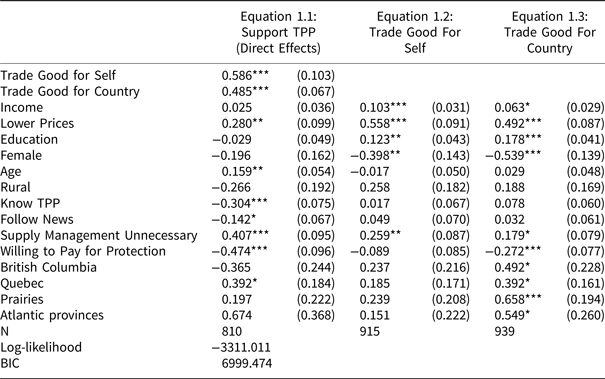
Because the dependent variable and both mediators are ordinal variables, all three equations are estimated using ordered logit regressions with survey weights provided by EKOS. Table 1 presents our results and contains three separate columns with the results from each equation.Footnote 15 We should note that we refer to each column as separate equations, and not models, because all three equations are simultaneously estimated in a single model.
Mediation Model of Support for the TPP

Entries report coefficients as ordered log-odds with standard errors (in parentheses). All models are estimated with survey weights. Statistical significance denoted as: * p < 0.05; ** p < 0.01; *** p < 0.001. Cut points are omitted for space considerations. Brant tests were conducted on each individual equation with insignificant test results, indicating equations do not violate proportional odds assumption.
Column 1 reports the (direct) effects of all covariates on Support TPP (equation 1.1). Trade Good for Country and Trade Good for Self obtain positive coefficients (0.586 and 0.485, respectively), indicating that retrospectively assessing the effects of trade as beneficial for household and country increases support for the TPP. These results are consistent with much of the literature showing a positive relationship between perceived effects of trade and attitudes toward trade openness. In line with the self-interest hypotheses, Income (0.025) and Lower Prices (0.280) have positive coefficients as expected but only the direct effect of Lower Prices is statistically significant. The statistically significant direct effects of perceptions of trade and the non-significant direct effect of Income map onto existing conclusions, suggesting that producer considerations have little to no effect on trade preferences (Mansfield and Mutz, Reference Mansfield and Mutz2009).
Continuing with discussion on the direct effects found in column 1, there are a number of control variables that are statistically significant. Individuals who answered more knowledge questions correctly are found to be less supportive of the TPP (Know TPP = −0.304). Similarly, Follows News has a negative coefficient (−0.142) indicating that greater attention to the news decreases support for the proposed agreement. Given that the large majority of respondents in the sample in favour of trade agreements, news and information about the agreement may be potentially moderating public opinion towards opposition to free trade if it mentions the harmful trade-offs associated with trade openness. Age is positive and statistically significant (0.159), indicating that older respondents are more likely to support the agreement. Regarding the industry-specific questions that we use to control for values related to fairness and ideology, we find strong support for both explanations. Respondents who agree that supply management is unnecessary for the industry to stay in business are more supportive of the TPP (0.407). This result corresponds with the expectations about ideological differences over the role of government in the market. Individuals who support state intervention are less likely to agree that supply management is unnecessary while also opposing the TPP. Relatedly, respondents who believe that paying higher prices is a fair trade-off for protecting these industries are less likely to support the TPP (−0.474). And, finally, respondents residing in Quebec are more supportive of the TPP than other regions, a result consistent with much of the trade preference literature.Footnote 16
Column 2 (equation 1.2) reports the results from the mediational equation with Trade Good for Self as the endogenous variable. In this equation, the coefficients on Income (0.103) and Lower Prices (0.558) are positive and statistically significant, indicating that both forms of self-interest (producer and consumer considerations) are positively associated with respondents’ perceptions that trade is beneficial for their household. These results are consistent with the mediational hypothesis that producer and consumer considerations influence retrospective assessments of trade on oneself (grey arrow linking producer and consumer considerations to Trade Good for Self). Although Fordham and Kleinberg (Reference Fordham and Kleinberg2012) do not directly test the indirect pathways of self-interest, they find a similar result for income when using Trade Good for Self as the dependent variable in their study of American aged-voters.
Lastly, column 3 (equation 1.3) reports the results from the mediational equation with Trade Good for Country as the endogenous variable. Overall, the results for producer and consumer considerations are similar to the results found in equation 1.2, with both forms of self-interest being positively correlated with retrospective assessments of trade on the Canadian economy. When comparing the coefficients of producer and consumer considerations across the mediation equations, we observe that the estimates of the self-interest measures are notably smaller in equation 1.3. The weaker results likely reflect that individuals rely on additional information outside their personal experiences, such as the news media and personal networks, to assess how trade has affected the country as a whole. The regional variables in the model correspond with this interpretation. All regional variables are positive and statistically significant in column 3, but not significant in column 2. Substantively speaking, respondents who reside outside of Ontario (reference category) are statistically more likely to hold the perception that trade is beneficial for the country, but are no more or less likely to believe that trade is good for their household. Put differently, collective level (or regional level) information may play an important role in shaping perceptions of how trade has affected the country as a whole.
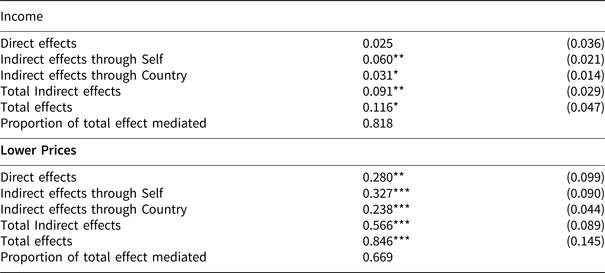
Having discussed the direct effects and the results from the mediation equations, we now assess the indirect effects of self-interest. If the effect of self-interest is mediated by perceptions of trade, then the indirect effects of Income and Lower Prices are expected to be positive. Indirect effects are calculated as the product of the coefficients on the mediators (perceived effects of trade) and the coefficients on the self-interest measures in the mediation equations. For example, we calculate the indirect effect of Income through Trade Good for Self by multiplying the coefficient on Trade Good for Self (0.586) in equation 1.1 by the coefficient on Income (0.103) in equation 1.2. Table 2 (decomposition) presents the decomposition of the effects of producer and consumer considerations. The indirect effects of Income are statistically significant by way of both mediators (Self (0.060) and Country (0.031)). The total indirect effect of Income—that is the combination of the indirect effects—is 0.091, nearly four times larger than the estimated direct effect. In other words, 81.8 per cent of the effect of Income is mediated by perceptions of how trade has affected the country as a whole and one's household. The indirect effects of Lower Prices follow a similar pattern, with the total indirect effects accounting for more than half of the total effect (66.9%).
Decomposition of the Effects of Income and Lower Prices on Support for TPP
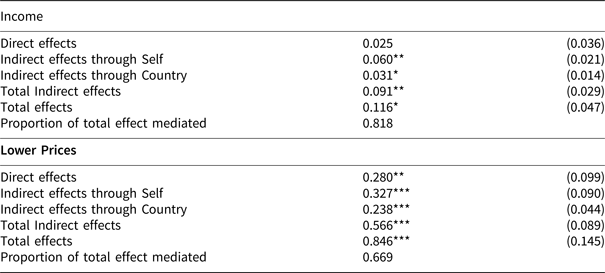
Entries report coefficients as ordered log-odds with standard errors (in parentheses). All estimates are calculated with survey weights. Statistical significance denoted as: * p < 0.05; ** p < 0.01; *** p < 0.001.
Together, these results support the mediational hypotheses. Rather than retrospective assessment being an alternative explanation to the self-interest hypothesis, our findings offer support for the argument that retrospective assessments serve as causal link—or mediator—between producer and consumer preferences and support for the TPP.
Discussion
Despite international trade receiving majority support in Canada, it remains less clear why Canadian voters support international trade. Addressing the European Parliament in Strasbourg after the ratification of the Comprehensive Economic and Trade Agreement (CETA), Prime Minister Justin Trudeau explained electoral support for trade as follows: “The people we represent will support trade if it creates better jobs and makes their lives more affordable. That's what they expect from us and we fully intend to deliver.”Footnote 17 Trudeau's statement is instructive because it invokes two distinct forms of self-interest to explain voter support for trade. On the one hand, free trade may create more job opportunities and higher wages in specific industries while potentially harming workers employed in less resource-efficient sectors; these are the producer-side considerations of free trade. On the other hand, lower barriers to trade reduce the price of foreign goods and services; these are the consumer-side considerations of free trade.
Although an explanation of trade preferences based on self-interest may appear theoretically straightforward, scholarship has produced mixed findings with some showing support for the hypothesis while others conclude that trade preferences are orthogonal to expectations from standard trade theory models. In this paper, we present a middle ground between these two extreme perspectives by arguing that self-interest can shape whether individuals perceive the effects of trade as being beneficial or harmful, which in turn influences their position on trade preferences. In part, we agree with scholars who doubt the direct linkage between self-interest and trade preferences. However, we believe the conclusion that self-interest has no effect on preferences is premature. Our results support a mediational hypothesis connecting producer and consumer considerations to trade preferences through retrospective assessment. In equal measure, we also agree with scholars arguing that self-interest is an important factor for understanding these attitudes. However, the effect of self-interest may not be as readily apparent as some would have us believe.
There are notable caveats worth mentioning that relate to the empirical analysis and scope of the findings presented here. Prior research has highlighted the importance of left/right political orientation and party identification on trade attitudes (Bennett, Reference Bennett2004; Gravelle Reference Gravelle2014; Rankin, Reference Rankin2004). The APF survey did not contain questions specific to political ideology or partisan identity, so we were unable to control for these variables in the analysis. As a second-best proxy of left/right market-orientation, we did find a strong association between disfavouring supply management and support for the TPP. What if direct measures of ideology and partisanship were included in the analysis? The estimated effects of the regional variables offer some insight here. Regions are significant predictors of perceptions about the country, indicating that the inclusion of other group interests—such as partisanship—could potentially attenuate the indirect effect of self-interest through the country. However, we do not expect much attenuation through perceptions about oneself because group interests, at least at the regional level, are poor predictors of perceptions of trade on self. A second caveat regards the measure of consumer considerations used in this analysis. Because we were unable to use a direct measure of respondents’ consumer habits, we recognize more testing is needed here. A better measure would be one that captured consumer habits of imported goods or potentially price sensitivity. A third caveat concerns the uniqueness of the TPP. Compared to other trade agreements signed by the Government of Canada, the TPP is magnitudes larger in terms of market size and membership, with members representing developed and developing states. Potentially, particular characteristics of the TPP, such as concerns over labour rights, may narrow the scope of generalizability of the findings presented here. However, these findings are likely more relevant to future trade deals as most countries are already members of regional trade blocs and are now negotiating trade deals with more economically diverse trading-partners.
Finally, the argument and empirical results presented in this paper suggest several avenues for future research. Although our findings show evidence of a mediational relationship between self-interest, perceptions and trade attitudes, more research is needed to explain the conditions under which there is a high and low correlation between these variables. Rho and Tomz (Reference Rho and Tomz2017) offer one possible explanation by arguing that the link between personal interests and trade policy preferences strengthens when respondents know more about the distributional effects of trade. Potentially, highly trade-dependent economies like Canada create an environment rich in contextual information about the costs and benefits of trade policies, thus enabling individuals to be more aware of the effects from international trade. This may be one explanation for the widespread support for free trade in Canada. Even within countries, there is likely rich variation that can be explored. For example, one role of trade unions and trade associations is acting as information disseminators to their members, which could activate producer considerations. Lastly, more testing of producer and consumer considerations is needed to better assess the relative causal weight of each and to understand when these different forms of self-interest are more or less likely to come to the political forefront.
Supplementary material
To view supplementary material for this article, please visit https://doi.org/10.1017/S0008423918000628.