Introduction
The ring-necked pheasant can provide an alternative source of meat in relation to the common commercial species of poultry, particularly in view of the nutritional and culinary value of the meat. As demonstrated by comparative studies, the content of selected amino acids, as well as vitamins B6 and B12, were higher in breast and thigh muscles of the pheasants compared to broiler chickens (Straková et al., Reference STRAKOVÁ, SUCHÝ, VITULA and VEČEREK2006). However, the success of pheasant production largely depends on the reproductive effects, i.e. obtaining the highest possible number of healthy chicks. Pheasants are usually held in aviaries, although there are some farms where the birds are kept in cages during the reproductive period, for economic reasons. In the case of pheasants, the results of artificial incubation have not been satisfactory (Deeming and Wadland, Reference DEEMING and WADLAND2001; Kirikçi et al., Reference KIRIKÇI, GUNLU, CETIN and GARIP2003). Research has indicated that age of females, quality of the egg (especially the shell) and conditions and duration of the egg storage before incubation all may affect the results of the hatchability (Ipek and Sahan, Reference IPEK and SAHAN2002; Farooq et al., Reference FAROOQ, DURRANI, SARBILAND, KHURSHID and MANZOOR2004; Krystianiak et al., Reference KRYSTIANIAK, KONTECKA, NOWACZEWSKI and ROSIŃSKI2007; Kożuszek et al., Reference KOŻUSZEK, KONTECKA, NOWACZEWSKI and ROSIŃSKI2009b). Similarly, the results of some experiments indicate a relationship between the colour of eggshells and shell ultrastructure, egg quality and hatchability (Mróz and Pudyszak, Reference MRÓZ and PUDYSZAK2000; Krystianiak and Kontecka, Reference KRYSTIANIAK and KONTECKA2002; Silversides and Budgell, Reference SILVERSIDES and BUDGELL2004; Kożuszek et al., Reference KOŻUSZEK, KONTECKA, NOWACZEWSKI, LEŚNIEROWSKI, KIJOWSKI and ROSIŃSKI2009a; Ristić et al., Reference RISTIĆ, MARKOVIĆ, KOVAČEVIĆ, NAD, MATEJEVIĆ and JOVANOVIĆ2013).
The shell colour of eggs laid by pheasants is determined genetically and can vary from very light to dark brown. In general, four basic colours may be distinguished: dark brown, light brown, olive, and blue (Hulet et al., Reference HULET, MARQUEZ, MOLLE and FLEGAL1978; Richards and Deeming, Reference RICHARDS and DEEMING2001; Kożuszek et al., Reference KOŻUSZEK, KONTECKA, NOWACZEWSKI, LEŚNIEROWSKI, KIJOWSKI and ROSIŃSKI2009a; Nowaczewski et al., Reference NOWACZEWSKI, SZABLEWSKI, CEGIELSKA-RADZIEJEWSKA and KONTECKA2013), and the intensity of colour decreases as the laying period progresses (Bezděková, 2007). Dark coloured eggs results from the presence of brown protoporphyrin IX pigment in the shell, which is derived from blood haeme. Warren and Conrad, according to Hulet et al. (Reference HULET, FLEGAL, CARPENTER and CHAMPION1985), found that 75% of the total pigment synthesis and deposition in brown shells occurs during the final five hours that the egg remains in the eggshell gland. The amount of the pigment deposited in the shell is proportional to the length of time that the egg stays in this part of the oviduct. Nowaczewski et al. (Reference NOWACZEWSKI, SZABLEWSKI, CEGIELSKA-RADZIEJEWSKA and KONTECKA2013) examined the relationship between the brightness of the shell, saturation with yellow, blue, red, and green colour and the quality of the pheasants' eggshell. These authors demonstrated that the brightness of the shell colour was negatively correlated with its thickness and was similar in the case of light-brown and olive eggs. Blue-coloured shells were characterised by the highest brightness. Olive and blue eggs possessed a low level of green colour in the shell (i.e. a negative value of parameter a*). Araucana chickens have the gene 00 which also determines the blue colour of the eggshell (Bednarczyk, Reference BEDNARCZYK1991), which is a derivative of the bile pigment biliverdin, a chelated form of zinc and protoporphyrin (Lang and Wells, Reference LANG and WELLS1987). The blue pigment penetrates through both layers (palisade and mammillary) of the pheasant eggshell (Mróz and Pudyszak, Reference MRÓZ and PUDYSZAK2000).
Good quality eggshell facilitates an appropriate exchange of gases (O2 and CO2) and water and is the primary source of minerals for the developing embryo; and so appropriate thickness and porosity are essential features (Christensen, Reference CHRISTENSEN1983; Tullett, Reference TULLETT1984; Bednarczyk and Kiełczewski, Reference BEDNARCZYK and KIEŁCZEWSKI1988). McDaniel et al. (Reference McDANIEL, ROLAND and COLEMAN1979) found that hatchability from eggs with an extremely thin shell was about 30% poorer than for thicker eggshells. Similarly, Dohnal et al. (Reference DOHNAL, KIEŁCZEWSKI, POŚPIECH and ŁAKOTA1989) observed a positive correlation between hatchability indices and the thickness and strength of the shell. These authors concluded that this relationship resulted from the fact that the eggshell thickness is inversely proportional to water vapour conductance, which is determined by the length, number, and arrangement of pores in the shell. Water vapour conductance through the shell is reflected in weight loss of eggs. According to Szczerbińska (Reference SZCZERBIŃSKA1997), water vapour conductance was subject to considerable changes in the eggs laid by hens over the course of the laying period. The genotype effect on this feature was demonstrated by Szczerbińska (Reference SZCZERBIŃSKA1996), who noted differences in water vapour conductance between different genetic lines of hens. High shell porosity leads to excessive water loss from the eggs during incubation, which results in increased embryo mortality. Heterogeneous structure of the eggshell affects the conditions for embryo development. Disturbances in the palisade or the mammillary layers reduce the quality of the shell, and poor hatchability results (McDaniel et al., Reference McDANIEL, ROLAND and COLEMAN1979; Fraser et al., Reference FRASER, CUSACK, SOLOMON and BAIN1999; Malec et al., Reference MALEC, BORZEMSKA and ROMANISZYN1999). Carnarius et al. (Reference CARNARIUS, CONRAD, MAST and MACNEIL1996) noted different strengths of hen eggshells, depending on the thickness of the mammillary layer.
The results of the studies on hen eggs with different eggshell colour indicate differences among them in terms of morphological characteristics. Silversides and Scott (Reference SILVERSIDES and SCOTT2001) demonstrated that brown eggs had a reduced yolk share of 0.5-1.0 percentage point compared to white-shelled eggs. On the other hand, Silversides and Budgell (Reference SILVERSIDES and BUDGELL2004) showed that the weight of the albumen derived from the hen eggs with white shells was about 9 g lower than for brown-shelled eggs. Scott and Silversides (Reference SCOTT and SILVERSIDES2000) and Silversides and Scott (Reference SILVERSIDES and SCOTT2001), demonstrated that the albumen height of brown eggs was lower compared to white eggs. Similarly, Silversides and Budgell (Reference SILVERSIDES and BUDGELL2004) found that the hen eggs with brown shells had a significantly higher albumen pH compared to white eggs (8.84 vs. 8.70). Previously, Silversides and Scott (Reference SILVERSIDES and SCOTT2001) showed no differences in the hens between dark- and light-coloured eggs in terms of this feature.
Egg morphology and egg shape
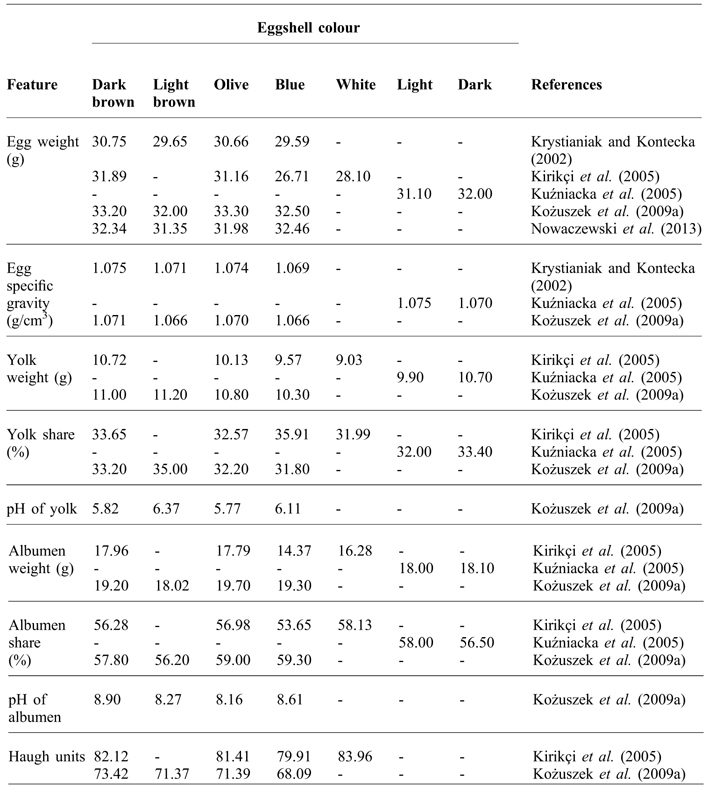
Studies conducted by previous authors demonstrated large differences in the structure and physical properties of eggs in pheasants (Table 1). Krystianiak et al. (Reference KRYSTIANIAK, KONTECKA and WĘŻYK2000, Reference KRYSTIANIAK, KOŻUSZEK, KONTECKA and NOWACZEWSKI2005), Krystianiak and Kontecka (Reference KRYSTIANIAK and KONTECKA2002), Kuźniacka et al. (Reference KUŹNIACKA, ADAMSKI and BERNACKI2005) and Kirikçi et al. (Reference KIRIKÇI, GUNLU and GARIP2005) found that eggs with a darker shell colour had a higher weight compared to light coloured ones. Different results were obtained by Kożuszek et al. (Reference KOŻUSZEK, KONTECKA, NOWACZEWSKI, LEŚNIEROWSKI, KIJOWSKI and ROSIŃSKI2009a) and Nowaczewski et al. (Reference NOWACZEWSKI, SZABLEWSKI, CEGIELSKA-RADZIEJEWSKA and KONTECKA2013). These authors found no differences weight among pheasant eggs of different colour.
Morphology and physical features of ring-necked pheasant eggs.

Kożuszek et al. (Reference KOŻUSZEK, KONTECKA, NOWACZEWSKI, LEŚNIEROWSKI, KIJOWSKI and ROSIŃSKI2009a) found, however, that eggs with olive, blue, and dark-brown shells were more spherical than light-brown eggs. Nowaczewski et al. (Reference NOWACZEWSKI, SZABLEWSKI, CEGIELSKA-RADZIEJEWSKA and KONTECKA2013) observed that the eggs with blue shells were significantly more elongated than the olive ones. Kirikçi et al. (Reference KIRIKÇI, GUNLU and GARIP2005) noted that brown, blue, and olive-green eggs had about 3.1 percentage higher shape index than the eggs with white colour shells. In turn, Mróz and Pudyszak (Reference MRÓZ and PUDYSZAK2000) found no significant differences in shape among eggs with different shell colours. The specific gravity of the eggs was evaluated in two consecutive periods of laying pheasants (Krystianiak and Kontecka Reference KRYSTIANIAK and KONTECKA2002). It was observed that specific gravity of eggs was higher in the second year compared to the first one, regardless of the shell colour. However, the dark-brown and olive eggs had a higher specific gravity value than the other ones. Kożuszek et al. (Reference KOŻUSZEK, KONTECKA, NOWACZEWSKI, LEŚNIEROWSKI, KIJOWSKI and ROSIŃSKI2009a) also found a higher value for this feature in dark-brown eggs.
Physical features of eggs
According to Kożuszek et al. (Reference KOŻUSZEK, KONTECKA, NOWACZEWSKI, LEŚNIEROWSKI, KIJOWSKI and ROSIŃSKI2009a), the eggs with blue shells had significantly lower (0.77 g on average) yolk weight compared to dark and light-brown eggs. Dark-brown, olive, and blue eggs had a similar yolk share in proportion to egg mass, while, in light-brown eggs the yolk share was higher. Kirikçi et al. (Reference KIRIKÇI, GUNLU and GARIP2005), Kuźniacka et al. (Reference KUŹNIACKA, ADAMSKI and BERNACKI2005), and Mróz and Pudyszak (Reference MRÓZ and PUDYSZAK2000) showed a higher weight of yolk in darker eggs of pheasants. The study conducted by Kirikçi et al. (Reference KIRIKÇI, GUNLU and GARIP2005) demonstrated that blue eggs had more than 2% higher yolk share compared to the other eggs. Kożuszek et al. (Reference KOŻUSZEK, KONTECKA, NOWACZEWSKI, LEŚNIEROWSKI, KIJOWSKI and ROSIŃSKI2009a) reported the lowest yolk weight in the eggs with light-brown shell. However, Kirikçi et al. (Reference KIRIKÇI, GUNLU and GARIP2005) observed the lowest value of this feature in the blue eggs.
The results of studies concerning the albumen in relation to the mass of pheasants’ eggs of different colours are not conclusive. In our study, it was found that the blue and olive eggs had higher percentage albumen compared to the eggs with a light-brown shell (Kożuszek et al., Reference KOŻUSZEK, KONTECKA, NOWACZEWSKI, LEŚNIEROWSKI, KIJOWSKI and ROSIŃSKI2009a). In contrast, Kirikçi et al. (Reference KIRIKÇI, GUNLU and GARIP2005) demonstrated that blue eggs had the lowest value, Mróz and Pudyszak (Reference MRÓZ and PUDYSZAK2000) did not observe any differences in the percentage albumen in eggs of different colours. However, Kuźniacka et al. (Reference KUŹNIACKA, ADAMSKI and BERNACKI2005) found higher albumen content in the eggs with a light coloured shell compared to the dark-shelled eggs. Analysing individual albumen fractions, these authors demonstrated a higher weight and percentage of thick albumen in dark-brown and blue eggs. On the other hand, a higher weight and percentage of thin albumen were found in olive eggs. The highest height of the thick albumen was found in the dark-brown eggs, and the lowest in the blue ones. However, the study of Krystianiak et al. (Reference KRYSTIANIAK, KONTECKA and WĘŻYK2000) did not confirm a relationship between the height of thick albumen and the shell colour. It was noted in the study conducted by Kożuszek et al. (Reference KOŻUSZEK, KONTECKA, NOWACZEWSKI, LEŚNIEROWSKI, KIJOWSKI and ROSIŃSKI2009a) on pheasants, that the blue eggs had the lowest value for Haugh units. These results were similar to those obtained by Kirikçi et al. (Reference KIRIKÇI, GUNLU and GARIP2005), who noted the lowest value of this feature in blue eggs, which may indicate a poorer quality of albumen in these eggs. However, Krystianiak et al. (Reference KRYSTIANIAK, KONTECKA and WĘŻYK2000) found no significant difference among the eggs of pheasants with different shell colours concerning Haugh units value.
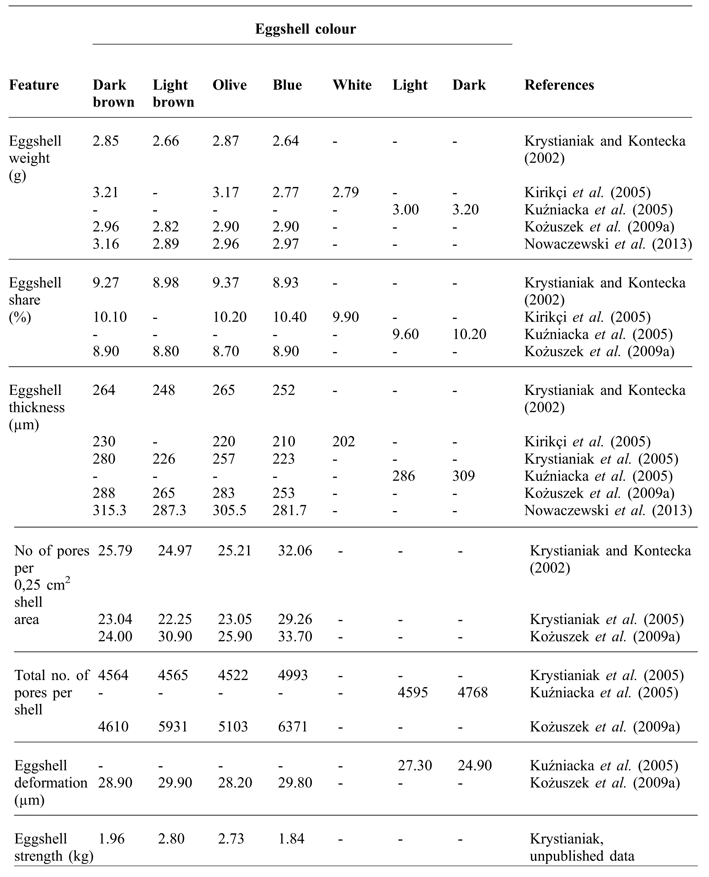
Table 2 presents data concerning the eggshell characteristics of pheasant published by many researchers. Kożuszek et al. (Reference KOŻUSZEK, KONTECKA, NOWACZEWSKI, LEŚNIEROWSKI, KIJOWSKI and ROSIŃSKI2009a) showed no significant differences in weight and percentage shell among the eggs of different colours. On the other hand, Krystianiak and Kontecka (Reference KRYSTIANIAK and KONTECKA2002), and Kirikçi et al. (Reference KIRIKÇI, GUNLU and GARIP2005) noted that the blue eggs had significantly lowest shell weight.
Eggshell characteristics of ring-necked pheasant eggs.
Lower shell thickness in the light coloured eggs, i.e. light brown and blue, was in turn demonstrated by Kożuszek et al. (Reference KOŻUSZEK, KONTECKA, NOWACZEWSKI, LEŚNIEROWSKI, KIJOWSKI and ROSIŃSKI2009a), which is consistent with the results obtained by Hulet et al. (Reference HULET, FLEGAL, CARPENTER and CHAMPION1985), Krystianiak et al. (Reference KRYSTIANIAK, KONTECKA and WĘŻYK2000; Reference KRYSTIANIAK, KOŻUSZEK, KONTECKA and NOWACZEWSKI2005), Krystianiak and Kontecka (Reference KRYSTIANIAK and KONTECKA2002), and Richards and Deeming (Reference RICHARDS and DEEMING2001), which demonstrated that blue eggs possessed lower shell thickness. However, Nowaczewski et al. (Reference NOWACZEWSKI, SZABLEWSKI, CEGIELSKA-RADZIEJEWSKA and KONTECKA2013) concluded that the quality of the shell is related not so much to its colour, but to its pigment saturation by analysing the colour parameters of the eggshell. Studying water vapour conductance through the shell, Krystianiak et al. (Reference KRYSTIANIAK, KOŻUSZEK, KONTECKA and NOWACZEWSKI2005) found the highest value for pheasant eggs with blue coloured shells, which was statistically significantly different from the eggs of other colours, although the weight of the eggs and the shell surface area of blue eggs were significantly lower. These authors demonstrated that the shells of blue eggs had significantly higher number of pores compared to the eggs of other colours. Similar results were obtained by Krystianiak and Kontecka (Reference KRYSTIANIAK and KONTECKA2002) and Kożuszek et al. (Reference KOŻUSZEK, KONTECKA, NOWACZEWSKI, LEŚNIEROWSKI, KIJOWSKI and ROSIŃSKI2009a). In contrast, Kuźniacka et al. (Reference KUŹNIACKA, ADAMSKI and BERNACKI2005) found that the darker pheasant eggs had a higher number of pores in the shell as compared with the light coloured shell eggs. It is worth mentioning that the results concerning the vapour conductance through the shell, as well as the total number of pores in the shell of the eggs of these birds (regardless of the colour) obtained by Ar and Rahn (Reference AR and RAHN1985) were higher than those shown by Krystianiak et al. (Reference KRYSTIANIAK, KOŻUSZEK, KONTECKA and NOWACZEWSKI2005). This difference could be due to the different sizes of the examined eggs or the conditions under which the birds were kept. A decrease in the number of pores in the shell may be a way of females adapting to unprofitable environmental conditions (Tullett, Reference TULLETT1984) to increase the number of hatched chicks.
Eggshell ultrastructure
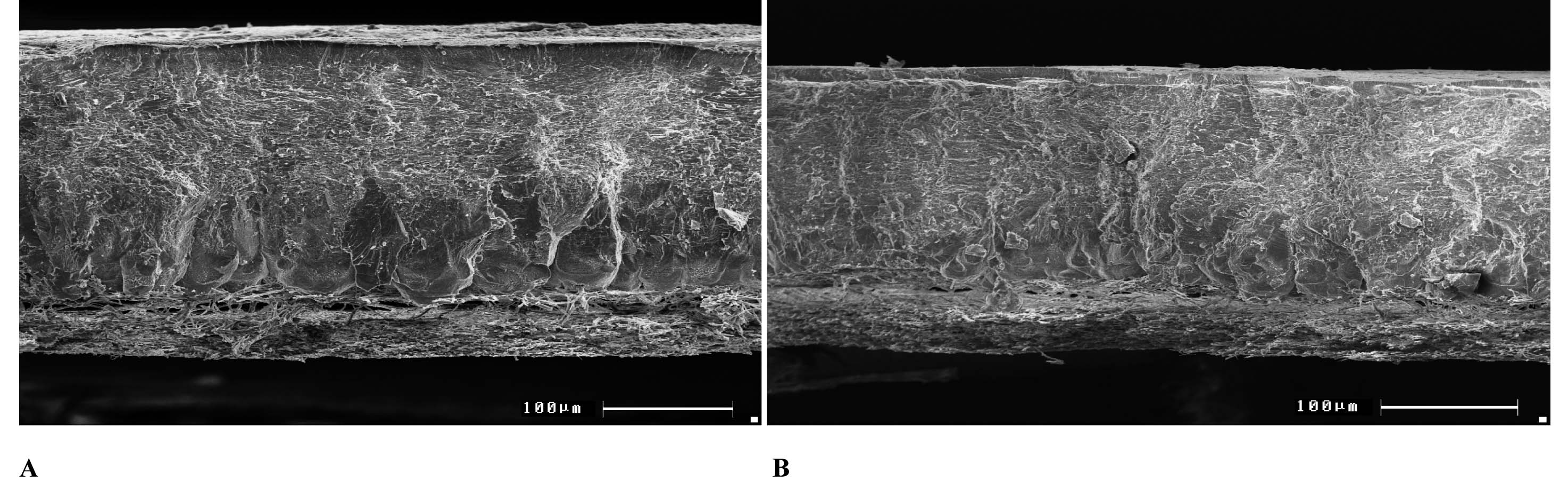
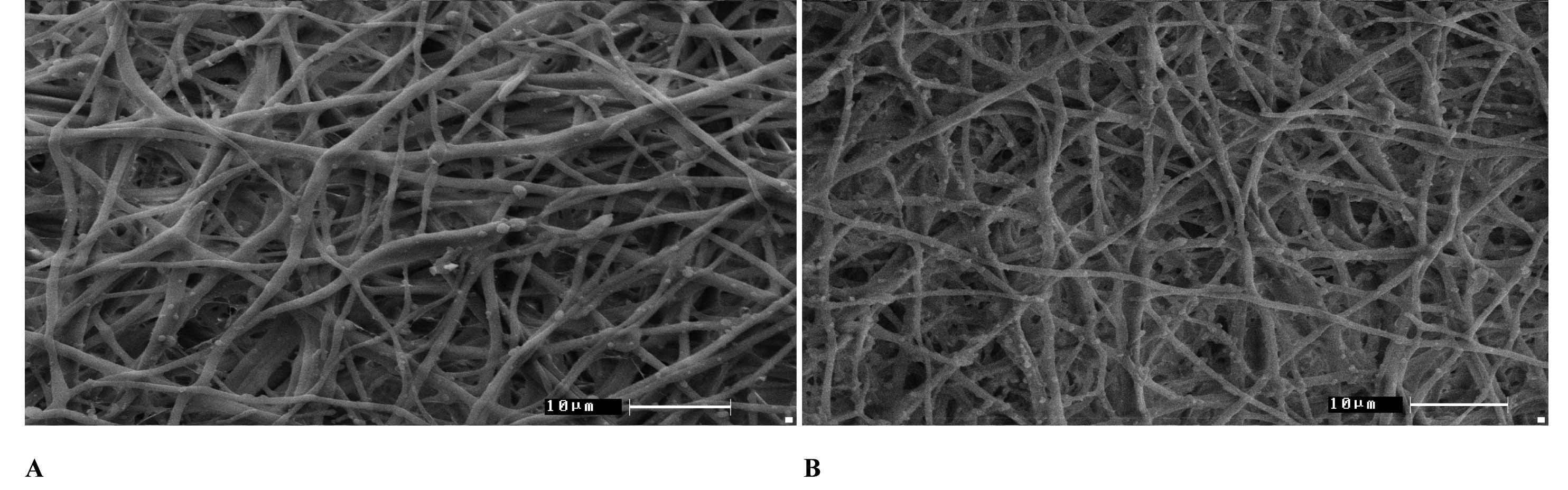
When analysing the cross-section of different colour pheasant shells it was seen that palisade and mammillary layer were marked clearly, with the exception of blue eggs (Krystianiak et al., Reference KRYSTIANIAK, KOŻUSZEK, KONTECKA and NOWACZEWSKI2005). The mammillary layer was significantly thinner compared to the eggs of other colours (Figure 1). Similar results were obtained by Richards and Deeming (Reference RICHARDS and DEEMING2001). All these authors found a tendency to an early joining of poorly visible papillae in the mammillary layer of blue shells, which resulted in this layer flattening, and the papillae occupied the biggest surface adhering to the outer shell membrane compared to the shells of the other colours. Blue eggs also had thinner (by 0.15 μm on average) fibres of the outer shell membrane compared to the other eggs (Krystianiak et al., Reference KRYSTIANIAK, KOŻUSZEK, KONTECKA and NOWACZEWSKI2005; Figure 2). In turn, Richards and Deeming (Reference RICHARDS and DEEMING2001) noted a higher average thickness of the egg membrane fibres, irrespective of the analysed colour of the shell as compared with results of Krystianiak et al. (Reference KRYSTIANIAK, KOŻUSZEK, KONTECKA and NOWACZEWSKI2005). No statistically significant differences were observed in shell membrane density between the pheasant eggs of different colours (Krystianiak et al., Reference KRYSTIANIAK, KOŻUSZEK, KONTECKA and NOWACZEWSKI2005). Analysis of blue eggshell ultrastructure demonstrated its structural defects, with reduced cohesion between its two layers (palisade and mammillary). This can affect the quality of the shell of the egg, and indirectly contribute to poor hatchability results of these eggs. Thus, the purposefulness of elimination of the eggs with blue-coloured shells from incubation has been confirmed.
Cross-section of pheasant's eggshells (A – olive, B – blue).
Outer shell membrane of pheasant egg (A - olive, B – blue).
Conclusions
The studies carried out and the results obtained confirm the existence of the relationship between the colour of pheasant eggshells and their structure, physical features and eggshell quality. Pheasant eggs with blue coloured shells have poor quality and their shell ultrastructure has improper construction.