INTRODUCTION
Attention-deficit/hyperactivity disorder (ADHD) is characterized mainly by the symptoms attention deficit, hyperactivity, impulsiveness, disorganization and emotional instability. Estimates of the proportion of children with ADHD who continue to meet full DSM-IV-consistent ADHD criteria as adults vary from 30% to 66% (Barkley et al. Reference Barkley, Fischer, Smallish and Fletcher2002; Faraone et al. Reference Faraone, Biederman and Mick2005). In a representative cohort in the USA, Kessler et al. (Reference Kessler, Adler, Barkley, Biederman, Conners, Demler, Faraone, Greenhill, Howes, Secnik, Spencer, Ustun, Walters and Zaslavsky2006) found an estimated prevalence of current adult ADHD of 4·4%.
One basic theory of ADHD suggests an inhibitory disorder (Barkley, Reference Barkley1997; Tannock, Reference Tannock1998; Schachar et al. Reference Schachar, Mota, Logan, Tannock and Klim2000; Konrad et al. Reference Konrad, Gauggel, Manz and Schöll2000a, Reference Konrad, Gauggel, Manz and Schollb) that mediates a wide variety of secondary problems in the executive system. Executive functioning refers to the maintenance of behaviour on a set goal and planful organization of behaviour (Pennington & Ozonoff, Reference Pennington and Ozonoff1996). Inhibition refers to both cognitive mechanisms that aim to suppress information irrelevant for problem solving and motor mechanisms that inhibit response. In their meta-analysis, Frazier et al. (Reference Frazier, Damaree and Youngstrom2004) examined the cognitive performance of ADHD patients in studies dating from 1980 to 2002 and found the greatest performance deficits in the executive and working memory tasks. Wodushek and Neumann (Reference Wodushek and Neumann2003) tested various neuropsychological functions in adult ADHD patients and found major inhibitory deficits in the stop signal task in individuals with high compared to low symptom levels of illness. Meta-analytic reviews also revealed deficient stopping performance in children and adults as a robust finding (Lijffijt et al. Reference Lijffijt, Kenemans, Verbaten and Van Engeland2005; Willcutt et al. Reference Willcutt, Pennington, Olson, Chhabildas and Hulslander2005). In other meta-analytic reviews of studies published before 2002, Hervey et al. (Reference Hervey, Epstein and Curry2004) and Schoechlin & Engel (Reference Schoechlin and Engel2005) found decreased performance not only in executive functions of adult ADHD patients but also in non-executive functions such as memory, information processing speed and motor functions. According to the cognitive-energetic model proposed by Sergeant (Reference Sergeant2005), slow information processing and high variability in reaction times (RTs) result from a defective regulation of activation and effort needed to optimize ongoing information processing.
Although inhibition impairment is thought to be at the crux of neuropsychological dysfunction in ADHD, the child ADHD literature, although extensive, does not consistently implicate or agree upon specific domains of neuropsychological impairment (Boonstra et al. Reference Boonstra, Oosterlaan, Sergeant and Buitelaar2005). The specificity of neuropsychological dysfunction is even more unclear in adults with ADHD.
Several earlier studies suggest that individuals with borderline personality disorder (BPD) also exhibit executive or, more precisely, inhibitory dysfunction, which is thought to be related to prefrontal disturbance in this personality disorder (Swirsky-Sacchetti et al. Reference Swirsky-Sacchetti, Gorton, Samuel, Sobel, Genetta-Wadley and Burleigh1993; Bazanis et al. Reference Bazanis, Rogers, Dowson, Taylor, Meux, Staley, Nevinson-Andrews, Taylor, Robbins and Sahakian2002; Nigg, Reference Nigg2005). Posner et al. (Reference Posner, Rothbart, Vizueta, Levy, Evans, Thomas and Clarkin2002) showed that BPD patients performed worse than healthy controls in the conflict module of the Attentional Network Task (ANT), indicating impaired frontal functioning. However, the validity of these results has been questioned repeatedly. Sprock et al. (Reference Sprock, Rader, Kendall and Yoder2000) hypothesized that only a subgroup of BPD patients would show a disorder in the frontal functioning, while a preliminary study by our group (Kunert et al. Reference Kunert, Drücke, Sass and Herpertz2003) failed to show deficits in any attentional task. These inconsistencies in the data might be explained by differences between samples regarding ADHD co-morbidity. Only one recently published study found that symptoms of BPD still correlated with response inhibition (measured by stop signal RT) after controlling for co-morbidity with ADHD (Nigg, Reference Nigg2005).
To date, there is much debate but little knowledge regarding whether any causal association exists between ADHD in childhood and the development of BPD during adolescence (Bohus et al. Reference Bohus, Schmahl and Lieb2004; Davids & Gastpar, Reference Davids and Gastpar2005; Philipsen, Reference Philipsen2006). ADHD and BPD share several symptoms, at least superficially, including impulsiveness, affective instability and difficulty in controlling anger. A follow-up study of hyperactive children suggested that ADHD children have a greater risk of later developing BPD than would be expected by chance (odds ratio 5·56) (Fischer et al. Reference Fischer, Barkley, Smallish and Fletcher2002). So far, only a few studies have concentrated on comparing BPD and ADHD. Dowson et al. (Reference Dowson, McLean, Bazanis, Toone, Young, Robbins and Sahakian2004b) found that ADHD and BPD subjects were best differentiated by scales and computerized tests referring to attention, organization and persistence. No study has yet compared neuropsychological in addition to behavioural profiles between ADHD and BPD.
Broadly following the differentiation of specific inhibition processes proposed by Nigg (Reference Nigg2000), the present study aimed to systematically examine various executive and, in particular, inhibitory functions in adult ADHD patients compared to BPD patients and a co-morbid group of ADHD+BPD patients, in addition to healthy controls. The following functions were investigated: (1) inhibition of prepotent responses using the go/no-go test in the Test for Attentional Performance (TAP) version 1.7 (Zimmermann & Fimm, Reference Zimmermann and Fimm1993); (2) motor inhibition of ongoing responses (stop signal; Logan, Reference Logan, Dagenbach and Carr1994); (3) inhibition of interfering responses, using the conflict task in the ANT (Posner & Petersen, Reference Posner and Petersen1990) and the Stroop test (Bäumler, Reference Bäumler1985); (4) shifting the focus of attention, using the orienting task in the ANT; (5) alertness (alerting in the ANT); and (6) working memory (digit span backwards measured using the Wechsler Memory Scale – Revised (WMS-R; Wechsler, Reference Wechsler1987). We expected ADHD patients to exhibit significantly worse performance in inhibitory executive function tasks than healthy controls and BPD patients. We did not expect ADHD patients to substantially differ from BPD patients in the behavioural profile. We further hypothesized that patients meeting the criteria for both diagnoses would display additive or greater than additive effects, that is they would show the cognitive deficits of ADHD in addition to the behavioural symptoms of impulsiveness and poor affect regulation (Herpertz et al. Reference Herpertz, Gretzer, Steinmeyer, Mühlbauer, Schürkens and Sass1997, Reference Herpertz, Kunert, Schwenger and Sass1999) shared by both disorders. It should therefore be possible to distinguish a subgroup of BPD patients who share certain neuropsychological abnormalities with ADHD patients.
METHOD
Subjects
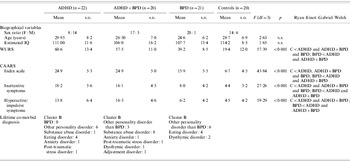
The study included all in-patients and out-patients from the Psychiatric Department at the Aachen University of Technology who met the criteria of ADHD, BPD or a co-morbid diagnosis of ADHD+BPD over a period of two and a half years. This department has specialized supra-regional services for both disorders at its disposal. The study comprised 22 ADHD, 21 BPD and 20 ADHD+BPD patients, plus 20 healthy controls; the groups were comparable with regard to age, education and IQ (see Table 1) and the age range was 18–45 years. Subjects with an IQ ⩽85 were excluded. IQ was calculated on the basis of four subtests (finding similarities, general knowledge, picture completion, block design) from the Hamburg-Wechsler Adult Intelligence Scale – Revised (HAWIE-R; Wechsler, Reference Wechsler1987).
Biographical and diagnostic data

ADHD, Attention-deficit/hyperactivity disorder; BPD, borderline personality disorder; C, control; F, female; M, male; s.d., standard deviation; df, degrees of freedom; n.s., not significant; IQ, intelligence quotient; WURS, Wender Utah Rating Scale; CAARS, Conners Adult ADHD Rating Scale.
The exclusion criteria were manifest DSM-IV axis 1 disorders as determined by a clinical interview and the Diagnostic Interview for Psychological Disorders (DIPS, Margraf et al. Reference Margraf, Schneider, Ehlers, DiNardo and Barlow1994). These included current and long-term diagnosis of psychiatric disorders caused by organic illness; schizophrenia and other psychotic disorders; bipolar disorders; and current major depression or current disorders associated with psychotropic drugs. In addition, our study excluded subjects with current drug or alcohol abuse; this was detected by taking the case history and carrying out unannounced drug screenings of all patients and controls on the day of the neuropsychological examination. Memory disorders were also excluded by means of neuropsychological assessment, using the WMS (Logical Memory I+II, digit span forward). BPD and other personality disorders from the DSM-IV Cluster B that are reported to be common among ADHD patients (Rey et al. Reference Rey, Morris-Yates, Singh, Andrews and Stewart1995; Sachdev, Reference Sachdev1999) were detected using the International Personality Disorder Examination (IPDE; Loranger et al. Reference Loranger, Sartorius, Andreoli, Berger, Buchheim, Channabasavanna, Coid, Dahl, Diekstra and Ferguson1994). Axis 1 and axis 2 disorders were assessed by raters blind to the clinical diagnosis.
All patients underwent a 2-h psychiatric examination by a senior psychiatrist experienced in diagnosing ADHD including the history of the development of symptoms from childhood and adolescence up to the present. The clinical examination took particular care to ensure that the patients, in accordance with DSM-IV criteria, had displayed at least some of the ADHD symptoms by the age of 7. In addition to clinical assessment, ADHD was diagnosed using two self-report instruments, the Wender Utah Rating Scale (WURS; Wender, Reference Wender1995), which assesses childhood symptoms of ADHD, and the Conners Adult ADHD Rating Scale (CAARS; Conners et al. Reference Conners, Erhardt and Sparrow2002), which assesses adult symptoms. Following the strict criteria proposed by Ward et al. (Reference Ward, Wender and Reimherr1993), we set a cut-off WURS value of ⩾46 for inclusion, thus setting the probability of false positives at ⩽0·1%. According to Conners et al. (Reference Conners, Erhardt and Sparrow2002), t scores ⩾80 on the CAARS, which were reported by six of our ADHD patients, may indicate an overestimation of symptoms; we therefore rechecked scores by additionally using the index scale from the CAARS observer version in these patients. The CAARS subsumes a wide variety of ADHD-related symptoms in adults. The inclusion criterion was a minimum standard deviation of 1·5 on the age- and gender-adjusted index scale, which according to Conners et al. (Reference Conners, Erhardt and Sparrow2002) contains the items with the highest selectivity. The CAARS also provides two subscales for assessing the DSM-IV criteria of the ADHD subtypes and the following subtypes were found: in the ADHD group, 14 patients met criteria of the primarily inattentive subtype, one of the hyperactive/impulsive and seven of the combined subtype. In the ADHD+BPD group, 11 met the criteria of the primarily inattentive, one of the hyperactive/impulsive and eight of the combined subtype.
By definition, the ADHD and ADHD+BPD groups were characterized by significantly higher WURS and CAARS scores than the BPD and control groups, but did not differ between each other (see Table 1). At the time of testing, all patients had been free of medication for at least 4 weeks. Informed consent was obtained and the study was approved by the Ethics Committee of the Medical Faculty of RWTH Aachen.
Neuropsychological tasks
Patients and controls completed a battery of computerized and non-computerized neuropsychological tests, which they took in a preset order. The subjects were tested on 2 days, with the neuropsychological tasks lasting for over 2 h in total. They were seated 50 cm in front of a computer screen (17-in. LCD) and responded to the presented stimuli by pressing one of the two response buttons with their preferred hand.
The ANT introduced by Posner & Petersen (Reference Posner and Petersen1990) differentiates three aspects of attention that are defined by different subnetworks of neurofunctional correlates: alerting, orienting, and executive control of attention. The non-language-oriented, computerized ANT requires participants to determine whether a central arrow (length 6 mm) is pointing left or right. The arrow appears above or below the fixation point (2×2 mm square) and can be accompanied by two identical flankers on each side (6 mm, with 1 mm between). The flankers consist of simple lines or arrows pointing left or right. The efficiency of the three attentional subnetworks is assessed by measuring how response times are influenced by alerting cues, spatial cues, and flankers (‘alerting’ effect=difference in RTs between trials with and without a visual cue preceding the trials; ‘orienting’ effect=difference in RTs between trials with a preceding visual cue carrying/not carrying predictive spatial information; ‘executive attention’=difference in RTs between trials with flankers pointing in the same or opposite direction). As both cues and targets vary from trial to trial, the complexity of the task is fairly high.
In the popular Stroop task, automated reading interferes with the ability to process the colour in which a word is printed, making it necessary to suppress an overlearned reaction to perform the task. The computerized Stroop task requires participants to operate a switch if the colour word (letter size 6 mm) and the colour of the ink in which the word is printed are identical. Comparable with the ANT conflict task, the Stroop also assesses the ability to suppress an interfering response, although the Stroop is much less difficult and complex.
In addition, we chose a computerized go/no-go paradigm from the TAP designed by Zimmermann and Fimm (Reference Zimmermann and Fimm1993). Single rectangles (height 2·8 cm, width 3·5 cm) in the form of five different patterns, two of which are go trials, appear on the screen (go/no-go ratio=20/30). The test subject is required to press a key whenever a go trial is presented, while the response must be withheld in the no-go trials.
The stop signal task constructed by Logan & Cowan (Reference Logan and Cowan1994) is a simple non-verbal motor inhibitory task. This test produces the stop signal reaction time (SSRT), which is the RT in which the subject is still able to stop an intended or already ongoing action. To measure inhibitory ability, a dynamic tracking algorithm was applied, with the SSRT calculated as the difference between the mean RT in go-trials minus the mean stimulus onset asynchrony (SOA). If the rate of successful inhibitions did not lie within the range 40–60%, the SSRT was calculated according to the conventional method suggested by Logan (Reference Logan, Dagenbach and Carr1994). The choice task requires the subject to press an assigned key in response to a given visual stimulus (circle of diameter 2·5 cm; equilateral triangle: 2·5 cm side length, 100 of 392 go stimuli were followed by a stop signal of 1000 Hz, lasting 500 ms) but not to press the key whenever a sound is heard. The test includes two rounds of exercises (one without and one with stop signals) and five rounds under experimental conditions. Whereas the go/no-go task has been criticized for failing to isolate functional inhibition (i.e. the failure to withhold a response to a no-go trial could be due to strong prepotent ‘go’ processes of disinhibition), the stop signal task claims to separate response output and inhibitory processes.
The simple digit span test backward from the WMS (1987) is a non-computerized test and was used as a control test to assess a verbal form of working memory without a time limit.
Psychometric tests
As impulsive behaviour is a common clinical feature of ADHD and BPD, we carried out a comprehensive assessment of impulsiveness. We chose the Barratt Impulsiveness Scale (BIS-10; Barratt, Reference Barratt, Spence and Izard1985), which includes the subscales motor impulsiveness (acting without thinking), cognitive impulsiveness (cognitive speed, speed in making decisions) and non-planning impulsiveness (lack of future-oriented problem-solving strategies). The trait subscale of the State-Trait Anger Expression Inventory (STAXI; Spielberger, Reference Spielberger1988) measures the intensity of dispositional anger dimensions: anger temperament, anger reaction, inwardly directed anger (anger-in), outwardly directed anger (anger-out), and anger control.
Statistical methods
After verifying normal distribution with the Kolmogorov–Smirnov test, the normally distributed variables were evaluated statistically by a univariate analysis of variance (ANOVA) and post-hoc Ryan–Einot–Gabriel–Welsh tests, including corrections for multiple comparisons. Effect sizes were calculated with η2, which estimates the proportion of variance in the dependent variable that is attributable to the group effect. Non-parametric Kruskal–Wallis tests with post-hoc overall α-Bonferroni correction and Mann–Whitney U tests for pairwise comparisons were used for variables that did not show a normal distribution. The significance level was set at p=0·05. Pearson correlations including Bonferroni corrections were performed between the most relevant neuropsychological measures of inhibition (SSRT and ANT conflict) and the most relevant questionnaire data on impulsiveness (BISmotor and BIScognitive, STAXIanger control) according to the results from group comparisons. All calculations were conducted using SPSS version 11.5 (SPSS Inc., Chicago, IL, USA).
RESULTS
Neuropsychological tasks
The ANT (Table 2) showed significant differences for conflict (p=0·016), with ADHD patients exhibiting significantly slower RTs than BPD patients (η2=0·10) and healthy controls (η2=0·12). The calculated conflict values of ADHD patients also indicated a variance that is more than twice as high as that of the other groups. In addition, ADHD patients displayed slower RTs than all other groups across all three ANT tasks (p<0·001) (ADHD>BPD: η2=0·24; ADHD>ADHD+BPD: η2=0·18; ADHD>controls: η2=0·38). No group differences were found for alerting and orienting. Although the co-morbid group exhibited the second longest RT in the conflict task, this group did not differ significantly from controls.
Attentional Network Task (ANT): results from one-way ANOVAs with post-hoc pairwise comparisons of group means and Kruskal–Wallis tests with post-hoc α-Bonferroni correction and Mann–Whitney U tests

ANOVA, Analysis of variance; ADHD, attention-deficit/hyperactivity disorder; BPD, borderline personality disorder; C, control; s.d., standard deviation; df, degrees of freedom; n.s., not significant.
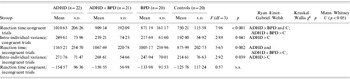
Analysis of the Stroop RTs (Table 3) for the congruent–incongruent condition revealed no significant group effect. This means that neither the ADHD nor the co-morbid group demonstrated higher interference effects than controls or BPD patients in this task. Significant group differences were found for RTs and intra-individual variance in congruent (RT: p<0·001; variance: p=0·041) and incongruent trials (RT: p=0·002; variance: p=0·039). In pairwise comparisons, ADHD (η2=0·39) and ADHD+BPD patients (η2=0·21) produced significantly longer RTs in congruent trials than healthy controls; in addition, ADHD patients differed significantly from BPD patients (η2=0·13). In incongruent trials, ADHD (η2=0·29) and ADHD+BPD (η2=0·18) showed significantly longer RTs than healthy controls.
Stroop Task: results from one-way ANOVAs with post-hoc pairwise comparisons of group means and Kruskal–Wallis tests with post-hoc α-Bonferroni correction and Mann–Whitney U tests

ADHD, Atention-deficit/hyperactivity disorder; BPD, borderline personality disorder; C, control; s.d., standard deviation; df, degrees of freedom; n.s., not significant.
In the go/no-go task, the ADHD patients displayed significantly longer RTs than the BPD patients (η2=0·14) and healthy controls (η2=0·14), as did ADHD+BPD patients compared to healthy controls (η2=0·15) (ADHD: 631·33±122·11 ms; BPD: 506·41±60·35 ms; ADHD+BPD: 569·76 ms±100·51 ms; controls: 484·15±59·66 ms; F=10·67, p<0·001). No differences were found with regard to errors or omissions. In addition, ADHD patients showed more intra-individual variance in the go/no-go task than BPD patients (η2=0·22) and controls (η2=0·24) (ADHD: 135·08±61·62 ms; BPD: 83·31±26·92 ms; ADHD+BPD: 112·42±69·61 ms; controls: 76·87±26·06 ms; χ2=12·69, p=0·004). In the digit span backwards task, the only test performed without a time limit, no group differences were found (ADHD: 6·95±1·89; BPD: 7·33±2·13; ADHD+BPD: 7·1±1·97; controls: 7·9±1·91).
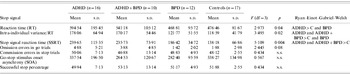
Technical difficulties in the stop signal task led to reduced data sets for 16 patients with ADHD, 12 patients with BPD, 10 co-morbid patients with ADHD+BPD, and 17 control subjects (see Table 4). A highly significant group effect was identified in the SSRT, with post-hoc pairwise comparisons indicating a significantly longer SSRT in ADHD patients compared to healthy controls (η2=0·24) as well as between ADHD+BPD patients and controls (η2=0·32). Further overall group effects were found for the variables RT and intra-individual variance of RT in go trials, with pairwise comparisons indicating longer RTs in ADHD patients than in controls (η2=0·15) and BPD patients (η2=0·14), and higher variance in the ADHD and ADHD+BPD group than in controls and BPD patients (ADHD v. controls: η2=0·17; ADHD v. BPD: η2=0·17; ADHD+BPD v. controls: η2=0·17; ADHD v. BPD: η2=0·19). In addition, a trend towards significance was found for omission errors in go trials.
Stop Signal Task: results from one-way ANOVAs with post-hoc pairwise comparisons of group means

ADHD, Attention-deficit/hyperactivity disorder; BPD, borderline personality disorder; C, control; s.d., standard deviation; df, degrees of freedom; n.s., not significant.
Psychometric data
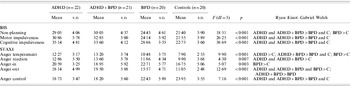
The results from the cognitive subscale of the BIS impulsiveness scale revealed a significant group effect, with co-morbid and pure ADHD patients scoring higher than BPD patients (ADHD+BPD: η2=0·29; ADHD: η2=0·37) and healthy controls (ADHD+BPD: η2=0·67; ADHD: η2=0·69) (Table 5). On the BIS scales for non-planning and motor impulsiveness, ADHD+BPD patients scored the highest of all groups, and both the co-morbid and the ADHD group scored significantly higher than BPD patients (ADHD+BPD: BISnon-planning: η2=0·29; BISmotor: η2=0·50; ADHD: BISnon-planning: η2=0·23; BISmotor: η2=0·33) and healthy controls (ADHD+BPD: BISnon-planning: η2=0·53; BISmotor: η2=0·63; ADHD: BISnon-planning: η2=0·49; BISmotor: η2=0·48). The BPD group scored higher than healthy controls on the BIScognitive subscale (η2=0·44).
Psychometric results on impulsivity and anger regulation from one-way ANOVAs with post-hoc pairwise comparisons

ADHD, Attention-deficit/hyperactivity disorder; BPD, borderline personality disorder; C, control; s.d., standard deviation; df, degrees of freedom; BIS, Barratt Impulsiveness Scale; STAXI, State-Trait Anger Expression Inventory.
Significant results were also found for all STAXI subscales, with ADHD and ADHD+BPD patients scoring significantly higher than healthy controls on the anger temperament (ADHD+BPD: η2=0·42; ADHD: η2=0·38), anger reaction (ADHD+BPD: η2=0·30; ADHD: η2=0·20) and anger-out scales (ADHD+BPD: η2=0·48; ADHD: η2=0·45). Again, the co-morbid group showed the highest scores of all groups, also exceeding the BPD group with regard to anger temperament (ADHD+BPD: η2=0·12), anger-out (ADHD+BPD: η2=0·13) and failure of anger control (ADHD+BPD: η2=0·12). The BPD group also deviated from the norm with regard to most STAXI subscales, that is compared to controls, they showed higher scores on the anger temperament (η2=0·14) and anger-out scales (η2=0·27) and turned out to be the only group evaluated with higher anger-in scores than controls (η2=0·24).
Correlations between neuropsychological and psychometric data
Pearson correlations between neuropsychological measures of inhibition (SSRT, RT in the conflict ANT task) and particularly relevant questionnaire data on impulsiveness (BISmotor, BIScognitive and STAXIanger control) were calculated. They indicated significant relationships between SSRT and BISmotor (r=0·379, adjusted p=0·024), BIScognitive (r=0·340, adjusted p=0·042) and STAXIanger control (r=–0·430, adjusted p=0·006) and between ANTconflict and BIScognitive (r=0·382, adjusted p=0·025).
DISCUSSION
Consistent with the primary hypothesis, ADHD patients performed significantly worse on the ANT conflict (interference) task and on the stop signal task, which has been shown to disentangle one of the most robust and specific inhibition deficits in ADHD across age, namely the ability to interrupt an already ongoing response (Lijffijt et al. Reference Lijffijt, Kenemans, Verbaten and Van Engeland2005; Nigg, Reference Nigg2005; Willcutt et al. Reference Willcutt, Pennington, Olson, Chhabildas and Hulslander2005). Deficiencies in stopping correlated significantly with questionnaire data on motor and cognitive impulsiveness as well as anger control, while the ANT conflict performance only correlated with cognitive impulsiveness.
ADHD individuals did not show significant deficits in Stroop interference or in the capacity to suppress prepotent responses as tested with the error rate of the go/no-go. In all inhibitory tasks, ADHD subjects showed generally longer RTs than controls. However, slow response speed was not specific to inhibitory function in these tasks, but was also found in non-critical conditions (e.g. congruent trials of the Stroop, general RTs of the stop signal and go/no-go tasks).
Data from the stop signal task are consistent with the theory that an impairment of inhibitory motor control is a core deficit in ADHD (Barkley, Reference Barkley1997). In addition, worse performance on the ANT conflict task suggests that adults with diagnosed ADHD also have difficulties in interference control, although their performance did not differ from controls on the Stroop task. Recently, it has been shown that interference effects on the Stroop and the flanker tasks are uncorrelated, indicating that both tasks assess different qualities of response interference and that only the Stroop task was correlated with working memory capacity (Stins et al. Reference Stins, Polderman, Boomsma and de Geus2005). Because, in our study, no deficit was observed in working memory capacity, the finding of a restricted deficit in the ANT conflict network might point to a pure response interference deficit in ADHD.
Slow response speed and high intra-individual variance, widely found in ADHD studies, can be explained neither by the theory of inhibitory disorder (Nigg, Reference Nigg2001) nor by deficient alertness, the latter being measured by the corresponding ANT module. Following Sergeant's cognitive-energetic model (2005), poor reaction times and high intra-individual variance instead reflect a defective regulation of activation and effort in the processing of ongoing information.
Consistent with our hypothesis, patients with ADHD+BPD did not differ significantly from those with pure ADHD on any cognitive task. Like the pure ADHD group, they exhibited worse performance on the stop signal task compared to controls, again underlining the robust finding of adult ADHD patients' failure in motor stopping. However, their performance did not significantly deviate from healthy controls in the ANT conflict task, which reflects a measurement of deficient cognitive inhibition. In RTs, ADHD+BPD patients performed worse than healthy controls and BPD subjects in most tasks, but they did rather better than the ADHD group; that is the restriction in performance was less pronounced on the whole than in subjects with ADHD alone. We were able to rule out the possibility that better performance could have resulted from less severe ADHD symptomatology in the co-morbid compared to the pure ADHD group. As there is no obvious reason why co-morbidity with BPD should improve cognitive functioning, we cannot exclude the possibility that less severe dysfunction in the female-dominated co-morbid group than in the predominantly male pure ADHD group reflects a gender rather than a diagnostic effect (cf. Gaub & Carlson, Reference Gaub and Carlson1997). Most pre-studies on executive dysfunction have been performed in samples that were exclusively or mostly male (Nigg, Reference Nigg2001).
Consistent with our preliminary data (Kunert et al. Reference Kunert, Drücke, Sass and Herpertz2003), BPD patients exhibited an attentional capacity that did not differ from healthy controls in any task, but did differ in the general RT in the ANT. Rather, the BPD group achieved significantly better results than the ADHD group in most tasks, including the ANT conflict (interference) task. Other authors have found deficits in executive functioning in BPD (Van Reekum et al. Reference Van Reekum, Links, Finlayson, Boyle, Boiago, Ostrander and Moustacalis1996; Bazanis et al. Reference Bazanis, Rogers, Dowson, Taylor, Meux, Staley, Nevinson-Andrews, Taylor, Robbins and Sahakian2002). These inconsistencies in findings might be explained by heterogeneity in the inclusion/exclusion criteria, that is co-morbid organic illnesses, uncontrolled substance abuse and the influence of medication, which served as exclusion criteria in both of our studies but were not controlled for in others. Posner et al. (Reference Posner, Rothbart, Vizueta, Levy, Evans, Thomas and Clarkin2002) reported that BPD patients perform significantly worse in the ANT conflict task than healthy controls, although these authors did not control for a co-morbid condition of ADHD.
Although BPD patients did not produce the cognitive or brain deficit characteristics of ADHD, they did overlap with ADHD in some behavioural symptoms of anger temperament and the non-planning facet of impulsivity, with their behavioural dyscontrol being clearly less severe than among ADHD patients with or without co-morbid BPD. Consistent with their intact performance on inhibitory tasks, they did not present higher scores on motor and cognitive impulsiveness, that is those psychometric measurements that turned out to correlate with neuropsychological inhibitory functioning. The BPD individuals in particular showed maladaptive modes of coping with feelings of anger, and they were the only group who reported to direct anger against themselves. Questionnaire data indicated very similar behavioural maladaption in the ADHD and ADHD+BPD group. These data may indicate impaired self-regulation in ADHD and ADHD+BPD patients, concordant with Barkley's model (Reference Barkley1997), according to which ADHD is associated with difficulties in behavioural and affect regulation. This study cannot answer whether – as Barkley claims – deficient self-regulation is in fact a consequence of impaired inhibitory capacity, especially because the co-morbid group showed a dysregulation syndrome that was at least as severe as in the pure ADHD group but with less severe attentional deficits.
The results suggest that BPD is a diagnostic entity distinct from ADHD, which is not characterized by a specific attentional deficit. The questionnaire data raise the suspicion of whether BPD subjects who demonstrate highly impulsive behaviour in the clinical setting might have a co-morbid condition with ADHD – a question for future research.
Some methodical limitations to our study need to be considered. The first is the fairly small sample size, which is, however, similar to those reported from other neuropsychological studies in clinical samples (e.g. Sprock et al. Reference Sprock, Rader, Kendall and Yoder2000; Dowson et al. Reference Dowson, McLean, Bazanis, Toone, Young, Robbins and Sahakian2004b). Furthermore, technical problems with the stop-signal task resulted in reduced data sets on this task. Because psychotropic medication needs to be an exclusion criterion in studies on cognitive functioning, the BPD group may not subsume patients with a high severity disorder. However, the disorder was severe enough to demand in-patient treatment in a supra-regional therapy unit specializing in a cognitive-behavioural psychotherapeutic approach to BPD. Moreover, it was not possible to ascertain gender differences because of the unequal gender distribution known from clinical groups. In addition, the order of the tasks was not varied systematically among the subjects, which may have influenced task performance; however, RTs in ADHD and ADHD+BPD were prolonged in tasks performed at the beginning or end of a session. Although we performed a detailed diagnostic assessment based on DSM-IV, in future studies self-report measurements of ADHD symptoms should be supplemented by (semi)structured interviews in order to further increase the validity of diagnostics.
CONCLUSIONS
Our results support the theory that impaired inhibition is a core feature in adults with ADHD, but not with BPD. Our data suggest that ADHD and BPD are two distinct disorders that share some behavioural symptoms but have no common attentional or at least inhibitory deficits. Nigg (Reference Nigg2005) emphasizes the central role of strong emotional reactivity in BPD, which could challenge the capacities of the executive control system. Accordingly, preliminary data suggest that inhibitory functioning in BPD deteriorates in the presence of emotional stimuli (Domes et al. Reference Domes, Winter, Schnell, Vohs, Fast and Herpertz2006).
ACKNOWLEDGEMENTS
This work was supported by a grant from the IZKF Aachen, RWTH. We thank Robert Hilse for his support in ADHD diagnostics and Ivo Marx and Christoph Berger for their recommendations in the statistical analyses of the stop signal task.
DECLARATION OF INTEREST
None.