Introduction
The energy expenditure of early lactation cows often exceeds the energy consumed (NRC, 2001). Diets with lower fibre and higher starch contents are fed to increase the energy intake, which increases the risk of some metabolic disorders such as acidosis and displaced abomasum. Long particles or sufficient NDF are needed to increase chewing activity, maintain rumen pH, optimise rumen environment for digestion, increase acetate to propionate ratio, increase milk fat concentration and avoid metabolic disorders (Teimouri Yansari et al., Reference Teimouri Yansari, Valizadeh, Naserian, Christensen and Eftekhari Shahroodi2004). However, in early lactation, the filling effect of long particles controls the feed intake (Armentano and Pereira, Reference Armentano and Pereira1997; Mertens, Reference Mertens1997). Digestibility and consequently dry matter intake (DMI) in ruminants is a function of competition between digestion and passage rates (Kennedy, Reference Kennedy1984). Therefore, reduction of particle size may increase digestibility and passage rates (Teimouri Yansari et al., Reference Teimouri Yansari, Valizadeh, Naserian, Christensen and Eftekhari Shahroodi2004) and may be used as a tool to increase feed intake in early lactation.
Mertens (Reference Mertens1997) suggested that NDF is the best single chemical predictor of voluntary DMI by ruminants. However, there is substantial evidence that NDF alone is inadequate as its filling effect varies with particle size, particle fragility, and rate and extent of NDF digestion (Kennedy, Reference Kennedy1984; Teimouri Yansari et al., Reference Teimouri Yansari, Valizadeh, Naserian, Christensen and Eftekhari Shahroodi2004). The concept of physically effective NDF (peNDF) was introduced (Mertens, Reference Mertens1997) to relate the physical characteristics of fibre (primarily particle size) to its effects on chewing activity and the biphasic nature of ruminal contents (floating mat of long particles on a pool of liquid and small particles). Particle size measurement is central to all effective fibre systems. However, functional specific gravity (FSG) of particles of the same size influences the effectiveness of fibre and rate of passage (Teimouri Yansari et al., Reference Teimouri Yansari, Valizadeh, Naserian, Christensen and Eftekhari Shahroodi2004). These authors reported that using a ratio of physical effectiveness factor (pef, based on particle size) to FSG of forage or total mixed rations (TMR) was better than pef alone in accounting for the variation in ruminal mean retention time (RMRT) and total chewing activity.
Decreasing forage particle size as a means to increase intake in cows during early lactation has been evaluated using different forms of alfalfa hay (Woodford and Murphy, Reference Woodford and Murphy1988). Small particles are desired for increased surface area for more rapid digestion, decreased RMRT, increased rumen turnover rate and potentially increased DMI. Reconstituting hay by soaking in distilled water increased FSG in a linear manner until 8 h and FSG continued to increase at a slower rate up to 24 h of immersion (Hooper and Welch, Reference Hooper and Welch1985; Stetter Neel et al., Reference Stetter Neel, Prigge and Townsend1995). Pasha et al. (Reference Pasha, Prigge, Russell and Bryan1994) observed that reconstitution of hay diets can increase the FSG of ruminal digesta and consequently increase particulate passage rate and DMI.
The objectives of this study were to evaluate the effects of particle size and reconstitution of alfalfa on feed FSG, DMI, RMRT, total mean retention time (TMRT), chewing behaviour and milk production at 2–6 weeks after calving in lactating Holstein dairy cows.
Material and methods
Animals and diets
Twelve multiparous lactating Holstein dairy cows (BW = 646 ± 26 kg) and 12 precipitous cows (BW = 575 ± 24 kg, day in milk = 11 ± 5 days) were used in a randomised complete block design with a factorial arrangement of two methods of alfalfa feeding (dry and reconstituted with water) and three geometric mean (GM) of particle sizes (9.13, 4.51 and 1.20 mm). The experiment consisted of 28 days (adaptation, 14 days; sample collection, 12 and 2 days for measurement of chewing activity). Diets contained 200, 200, 350, 70, 75, 100, 3, 1 and 1 g/kg of DM alfalfa, maize silage, ground barley, soyabean meal, sugar beet pulp, wheat bran, dicalcium phosphate, vitamin premix and salt, respectively. All diets had a 40 : 60 ratio of forage:concentrate. Water and mineralised salt were available for all cows throughout the experiment. Cows were housed in tie-stalls and fed ad libitum (at least 100 g/kg orts, as-fed basis) twice daily at 0900 and 2100.
Alfalfa at 15% flowering was harvested on 1 day, dried and chopped (Teimouri Yansari et al., Reference Teimouri Yansari, Valizadeh, Naserian, Christensen and Eftekhari Shahroodi2004). Individual small rectangular bales (average weight 10 kg) were chopped with a forage field harvester (Jaguar #62; Class Company, Visbek, Germany) for theoretical cut length 19 and 10 mm for preparation of long and medium particle size, also the fine particles were prepared by milling 10 mm alfalfa by a farm grinder with a 2-mm screen (Miller #11.02; Behsaz Company, Mashhad, Iran). Hays were reconstituted 24 h before feeding by placing the required amount of dry hay into an industrial container without mixing. Water at ambient temperature was added slowly to the hay during mixing to achieve a theoretical DM content of 350 g/kg. Hay and water were mixed and transferred to airtight containers.
Physical characteristics
Feed particle size was determined by dry sieving. The ASAE (2002) and original (Lammers et al., Reference Lammers, Buckmaster and Heinrichs1996) and new (Kononoff, 2002) Penn State particle separator (PSPS) sieves were used for measuring particle size distribution. The GM and the standard deviation of GM were calculated according to ASAE S424.1 (2002). The NDF content of all materials retained on PSPS sieves was measured (Van Soest et al., Reference Van Soest, Robertson and Lewis1991). The pef of forages and TMR was determined using three systems. According to Mertens (Reference Mertens1997), the pef was determined based on the proportion of DM retained on the 1.18-mm sieve (pef>1.18). Using the PSPS, the pef values were determined as the proportion of DM retained on 2 (19 and 8 mm) or 3 (19, 8 and 1.18 mm) sieves of the original (pef>8, Lammers et al., Reference Lammers, Buckmaster and Heinrichs1996) and new version of the PSPS (pefPSPSNew, Kononoff, 2002), respectively. By multiplying the NDF content of the TMR by the pef>1.18, the peNDF>1.18 of the TMR was calculated. The peNDF>8 and peNDFPSPSNew were calculated by multiplying the NDF content of each portion by each sieve on pef>8 and pefPSPSNew, respectively.
Bulk density (g/ml), insoluble dry matter (IDM; g/kg) and water-holding capacity (WHC; g/g IDM) of maize silage and the three particle sizes of alfalfa were measured as described by Giger-Reverdin (Reference Giger-Reverdin2000). Kinetics of hydration and FSG were measured with 100 ml pycnometers as in our previous work (Teimouri Yansari et al., Reference Teimouri Yansari, Valizadeh, Naserian, Christensen and Eftekhari Shahroodi2004). The first reading of the total weight of pycnometers was taken after 6 min (0.1 h) of initial soaking, which was the shortest interval necessary to eliminate all gas bubbles; therefore the value of FSG after 6 min was considered as initial FSG. In the current experiment, we did not measure IDM, rate of hydration and WHC for reconstituted alfalfa.
Body weight, intake, digestibility and chewing behaviour
Body weights were taken weekly. Intake of TMR was measured daily for all cows. Samples of forage, concentrates, and orts were collected each day. Faeces were collected from the cows at 0800 h on day 14 to day 20, weighed, sub-sampled and dried at 55°C, and ground through a Wiley mill (1-mm screen). Feed, faeces and orts were analysed for DM, organic matter (OM), Kjeldahl N, ether extract (EE) (Association of Official Analytical Chemists (AOAC), 2002), NDF (Van Soest et al., Reference Van Soest, Robertson and Lewis1991; using amylase and inclusive of residual ash), ADF (Van Soest et al., Reference Van Soest, Robertson and Lewis1991) and ash at 605°C. Non-fibre carbohydrate (NFC) was calculated by 1000 − (CP (g/kg) + NDF (g/kg) + Ash (g/kg) + EE (g/kg)) and digestibility was calculated for DM, OM and all nutrients.
Eating and ruminating activities were monitored visually for cows in the treatments over a 24 h period for 3 days from day 27 to day 28 of experiment. Eating and ruminating activities were noted at 5-min intervals, and each activity was assumed to persist for the entire 5-min interval (Teimouri Yansari et al., Reference Teimouri Yansari, Valizadeh, Naserian, Christensen and Eftekhari Shahroodi2004).
Ruminal characteristics and digestion kinetics
On day 25, 26, 27 and 28 of the experiment, ruminal fluid samples (50 ml) were taken at 1.5, 3, 6 and 12 h after the feeding by a stomach tube. Ruminal pH measurements were made immediately using a pH meter (Fisher Scientific, AR50), and samples were frozen at −20°C. The concentration of N-NH3 was measured with a Kjeltec Auto Analyser (Model 1030; Tecator Co., Sweden) according to AOAC (2002).
Chromium-mordanted alfalfa NDF marker was prepared as described by Uden et al. (Reference Uden, Colucci and Van Soest1980) and used as in a single dose marker for solid passage rate measurement. Marker preparation, feeding and faecal grab sampling were accomplished as our previous work (Teimouri Yansari et al., Reference Teimouri Yansari, Valizadeh, Naserian, Christensen and Eftekhari Shahroodi2004). Samples were dry-ashed, and faecal Cr concentrations were determined by direct current plasma emission spectroscopy (AOAC, 2002). Faecal Cr excretion curves were fitted to the double-compartment model represented by two exponential constants and a time delay (TD) (Grovum and Williams, Reference Grovum and Williams1973; Teimouri Yansari et al., Reference Teimouri Yansari, Valizadeh, Naserian, Christensen and Eftekhari Shahroodi2004).
Milk samples and analysis
Daily milk yields were recorded over the experiment. Samples were collected at each milking on day 18 to 22 of each period. About 100 ml of each morning and evening milk sample was composited and analysed for total N (CP), true protein N, fat, casein N, non-casein N and NPN. Lactose was determined by the Lane–Eynon method (AOAC, 2002).
Statistical analyses
All experimental data were analysed using the PROC MIXED of SAS® (1998) as a completely randomised complete block design (cows were blocked on parity) in 2 × 3 factorial with two replications by the following model:

where Yijkln is the dependent variable, μ is overall mean, PSi is the random effect of particle size (i = 1, 2 and 3); Mj the random effect of the method of alfalfa feeding (dry and reconstituted to achieve a theoretical DM content of 350 g/kg of DM; j = 1 and 2), PS*Mj (j ) the interaction effect of each size and method of alfalfa feeding; Bk the effect of parity of each cow used in the experiment and eijkl is experimental error. The data of particle size were analysed as a completely randomised design with model effects of forage and two methods of particle size measurement using the REML variance component and PROC MIXED of SAS® (1998). The data of ruminal pH and NH3 concentration over different sampling time were analysed while including time (hour of sampling) as a repeated measure. Mean separation was determined using the PDIFF procedure and significance was declared at P < 0.05. Analysis of correlations between NDF, peNDF>1.18 and forage intake (kg), FSG of TMR, FSG of forage, milk fat (%), total chewing activity (min/day), rumen pH at 1.5, 3, 6 and 12 h after feeding and RMRT was by the PROC CORR of SAS (1998).
Results and discussion
Chemical composition and physical properties
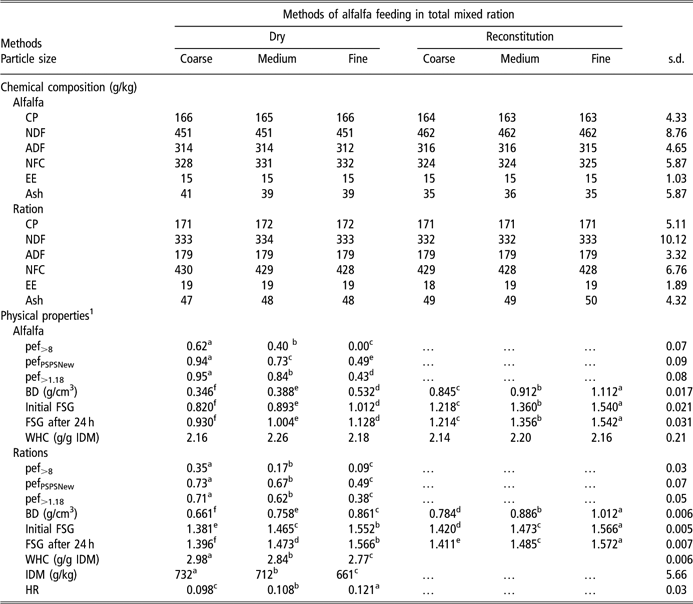
Reduction of particle size and reconstitution did not alter CP, NDF and ADF content of alfalfa (Table 1). All TMRs had similar composition (Table 2). Reduction of particle size and reconstitution of alfalfa increased the bulk density of alfalfa and TMR. The dry coarse alfalfa had the lowest but the reconstituted fine alfalfa had the highest bulk densities (Table 1). Reduction of particle size and reconstitution reduced the initial FSG of alfalfa and TMR. Reduction of particle size decreased WHC of alfalfa, but did not affect WHC of TMR. Teimouri Yansari et al. (Reference Teimouri Yansari, Valizadeh, Naserian, Christensen and Eftekhari Shahroodi2004) found that reduction of particle size increased bulk density, FSG and the rate of hydration and decreased WHC of alfalfa. In the current experiment, the increased moisture content of reconstituted alfalfa was sufficient to increase the ruminal FSG of the hays as intended. Reconstitution of fine alfalfa was not a limiting step for passage because according to Poppi et al. (Reference Poppi, Norton, Minson and Hendricksen1980), this size of digesta particle size and particle specific gravity escape from the rumen very quickly. Also, Kaske and Engelhardt (Reference Kaske and Engelhardt1990) showed that inert particles with a specific gravity (SG) of 1.22 or 1.42 passed from the rumen of sheep at a faster rate than those with SG of 0.92 and 1.03.
Chemical compositions and physical properties of three sizes of alfalfa and rations

NFC=non-fibre carbohydrate; EE = ether extract; BD=bulk density.
a,b,c,d,e,fMeans (for three sizes of dry and reconstituted alfalfa and maize) within a row with different superscripts differ (P < 0.05).
1pef>1.18: physically effective factor based on DM retained on a 1.18-mm sieve (Mertens, Reference Mertens1997); pef>8: physically effective factor determined as the proportion of DM retained on sieves of the original version of PSPS (Lammers et al., Reference Lammers, Buckmaster and Heinrichs1996); pefPSPSNew: physically effective factor determined as the proportion of DM retained on sieves of the new version of PSPS (Kononoff, 2002); FSG: functional specific gravity; WHC: water-holding capacity measured using filtration methods (Giger-Reverdin, Reference Giger-Reverdin2000); IDM: insoluble dry matter; HR: hydration rate (g/min).
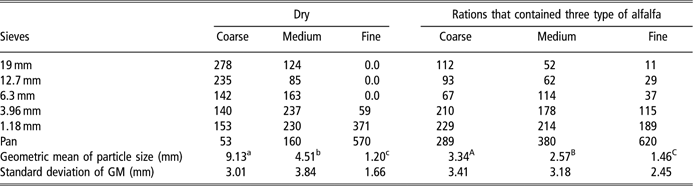
Particle size distribution1 (g/kg of dry matter (DM)) sizes of alfalfa and of three rations

GM = geometric mean of particle size.
a,b,cMeans for three sizes of alfalfa within a row with different superscripts differ (P < 0.05).
A,B,CMeans for three rations that contained three types of alfalfa within a row with different superscripts differ (P < 0.05).
1 Particle size distribution: material retained on each ASAE S424.1 sieve as g/kg of DM (ASAE S424.1, 2002).
Particles size and effective fibre
Reduction of alfalfa particle size resulted in less material being retained on the 19 mm sieve, especially for fine alfalfa where no material was recovered on the top screen with any sieving method (Table 1). As expected, grinding of alfalfa gave smaller particles and reduced the GM particle size of both alfalfa and TMR. As the GM of particle size decreased, the values of the GM of particle size decreased with original and new PSPS, but in TMRs, the GM of particle size increased when ASAE sieves were used in particle size measurements. These results are similar to previous studies (Kononoff, 2002; Teimouri Yansari et al., Reference Teimouri Yansari, Valizadeh, Naserian, Christensen and Eftekhari Shahroodi2004).
In TMRs, the values of the pef>1.18, the pef>8 and the pefPSPSNew were different between the systems (Table 2). Also, as the GM of alfalfa decreased, the value of pef in alfalfa and TMRs significantly decreased (Table 2).
Kinetic of hydration and functional specific gravity
Reduction of particle size increased the initial FSG of alfalfa (Table 1). Incubation in pycnometers for 24 h increased FSG for all particle size classes (Table 1) but there was no further increase after 24 h (data not shown), confirming the choice of 24 h for the reconstitution of alfalfa. Reduction of particle size decreased the IDM, and increased the rate of hydration, but decreased the WHC of rations (Table 1). Wattiaux (1990) reported that there was no significant change in FSG of alfalfa after 27 h of incubation. Hooper and Welch (Reference Hooper and Welch1985) found that soaking hay in distilled water increased its FSG in ionic solutions in a linear manner until 8 h and continued to increase at a slower rate up to 24 h of immersion. These observations suggest that reconstitution of hay diets can increase the FSG of ruminal digesta and consequently influence DMI, particulate passage rate and total chewing activity. However, Stetter Neel et al. (Reference Stetter Neel, Prigge and Townsend1995) found that the proportion of ruminal DM with a FSG less than 0.9 did not change over time, and at any given time, approximately 10% of the ruminal DM is of an SG that would resist passage from the rumen, as a result of the feeding and buoyancy on the SG of material in the digesta pool. In addition, Stetter Neel et al. (Reference Stetter Neel, Prigge and Townsend1995) reported that the proportions of ruminal DM in the FSG of 0.9 to 1.1 and 1.1 to 1.2 pools decreased linearly at a rate of approximately 0.5% (of total ruminal DM) per hour. Conversely, DM entered the higher than 1.2 FSG ruminal particulate pool in a linear fashion at a rate of approximately 0.9%/h (Pasha et al., Reference Pasha, Prigge, Russell and Bryan1994). Wattiaux (1990) found that the average SG of ruminal fluid was approximately 1.01. However, Teimouri Yansari et al. (Reference Teimouri Yansari, Valizadeh, Naserian, Christensen and Eftekhari Shahroodi2004) reported that all types of alfalfa had FSG higher than 1.1 after 0.5 h incubation and would sink in the ruminal fluid.
Body weight
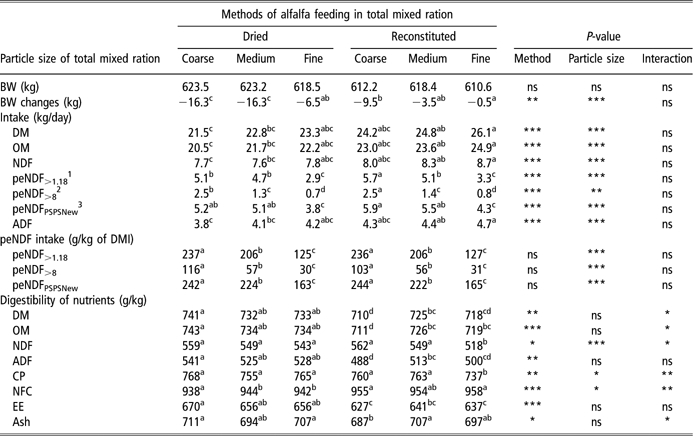
Reconstitution and reduction of particle size reduced the loss of BW in early lactation. Cows fed reconstituted fine alfalfa had the lowest BW losses and cows fed dry coarse alfalfa had the highest BW losses (Table 3). In early lactation, DMI does not provide adequate nutrients for high-producing cows, which then must mobilise energy and protein from limited body stores to support milk production. Effects of treatments on BW loss probably reflect effects on DMI.
Body weight, intake and digestibility of nutrients in experimental cows fed dry and reconstituted three sizes of alfalfa as a part of rations

DM=dry matter; OM=organic matter; peNDF=physically effective NDF; NFC=non-fibre carbohydrate; DMI = dry matter intake.
a,b,c,dMeans within a row with different superscripts differ (P < 0.05).
*P ⩽ 0.05; **P ⩽ 0.01; ***P ⩽ 0.001.
1peNDF>1.18: physically effective NDF based on DM retained on a 1.18-mm sieve (Mertens, Reference Mertens1997).
2peNDF>8: physically effective NDF determined as the proportion of DM retained on sieves of the original version of PSPS (Lammers et al., Reference Lammers, Buckmaster and Heinrichs1996).
3peNDFPSPSNew: physically effective NDF determined as the proportion of DM retained on sieves of the new version of PSPS (Kononoff, 2002).
Feed intakes
Reduction of particle size and reconstitution of alfalfa increased DMI and nutrient intake. However, the interaction of particle size and reconstitution was not significant (Table 3). Woodford and Murphy (Reference Woodford and Murphy1988), Shaver et al. (Reference Shaver, Nytes, Satter and Jorgenson1988) and Teimouri Yansari et al. (Reference Teimouri Yansari, Valizadeh, Naserian, Christensen and Eftekhari Shahroodi2004) reported that reduction of particle size had a positive effect on DMI.
Reduction of particle size decreased the intake of peNDF (regardless of the method of peNDF measurement) in both absolute terms (kg/day) and as a proportion of DIM (Table 3). Reconstitution increased daily peNDF intake but did not affect the proportion of peNDF in DMI (Table 3). The interaction of particle size and reconstitution did not have a significant effect on the intake (kg/day) of peNDFPSPSNew and peNDF>1.18 but had a significant effect on peNDF>8 intake (Table 3). Teimouri Yansari et al. (Reference Teimouri Yansari, Valizadeh, Naserian, Christensen and Eftekhari Shahroodi2004) reported that as particle size decreased, there was a reduction in peNDF intake (g/kg of DMI) but an increase in the intake of peNDF (kg/day). Voluntary intake and nutrient supply can be constrained by rumen fill and clearance of digesta from the rumen when high-forage diets are fed. Hence, forages that occupy lower bulk density should have a greater ruminal fill factor than more dense forages (Wattiaux, 1990). The results of the current experiment showed that manipulation of TMR physical characteristics, especially particle size and FSG, can be used as tools to control DMI. Influence of fine particle size on DMI may depend upon forage or NDF level in the diets of dairy cows.
Digestible nutrients
Forage particle size did not affect the digestibility of DM, OM, ADF, EE and ash, but the reduction of particle size reduced the digestibility of NDF, CP and NFC (Table 3). Reconstitution of alfalfa reduced the digestibility of all nutrients measured. Grinding decreased the digestibility of NDF less when alfalfa was reconstituted than when it was offered dry. In contrast, grinding had no effect on the digestibility of CP in dry alfalfa, but reduced the digestibility of CP when alfalfa was reconstituted. There was an interaction between particle size and reconstitution on the digestibility of DM, OM, NDF, CP, NFC and ash but not on the digestibility of ADF and EE (Table 3). Digestibility in ruminants is a function of competition between digestion and passage rates. The effect of particle size reduction and reconstitution of alfalfa on total tract digestibility can be explained by a reduction in ruminal digestion. In the current experiment, reduction of particle size and reconstitution reduced the RMRT and increased the passage rate (Table 5). The effect of the reconstitution of alfalfa on nutrient digestibility is not clear. Pasha et al. (Reference Pasha, Prigge, Russell and Bryan1994) found that reconstitution decreased the lag time for forage digestion and increased RMRT. Teimouri Yansari et al. (Reference Teimouri Yansari, Valizadeh, Naserian, Christensen and Eftekhari Shahroodi2004) found that the reduction of alfalfa particle size increased the FSG of alfalfa and TMR and reduced the digestibility of NDF and ash, decreased RMRT and increased the passage rate of ruminal digesta. Krause and Combs (Reference Krause and Combs2002) found that the total tract digestibility of OM tended to decrease when forage particle size was decreased. It is somewhat surprising that milk production increased with decreasing particle size considering the concurrent decrease in DMI and the trend towards a decrease in OM digestibility. Total tract digestibility of NDF was not affected by particle size, whereas digestibility of ADF decreased from 40.0% to 35.5% when forage particle size was decreased. Depressed fibre digestibility has been reported when forage particle size is reduced (Shaver et al., Reference Shaver, Nytes, Satter and Jorgenson1988; Woodford and Murphy, Reference Woodford and Murphy1988). However, Krause and Combs (Reference Krause and Combs2002) found that reducing forage particle size had no effect on fibre digestibility, but DMI increased as particle size decreased (Table 3).
Chewing behaviour
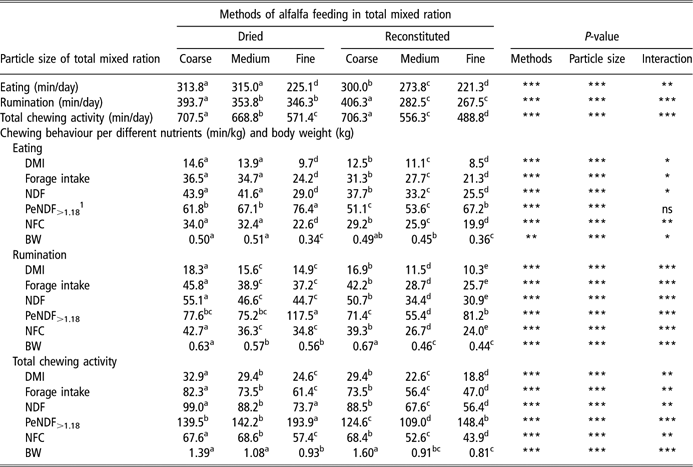
Both reducing particle size and reconstitution of alfalfa reduced total chewing activity, rumination and eating time. The interaction of particle size and reconstitution had a significant effect on total chewing activity and on rumination and eating time (Table 4).
Chewing activity in experimental cows fed dry and reconstituted three sizes of alfalfa as a part of rations

NFC = non-fibre carbohydrate; DMI = dry matter intake.
a,b,c,d,eMeans within a row with different superscripts differ (P < 0.05).
*P ⩽ 0.05; **P ⩽ 0.01; ***P ⩽ 0.001.
1peNDF>1.18: physically effective NDF based on DM retained on a 1.18-mm sieve (Mertens, Reference Mertens1997).
Cows spent most time eating coarse dry alfalfa (314 min/day) and the least when fed reconstituted fine hay (221 min/day). Reduction of particle size reduced eating time by 28.3%. Reconstituted coarse, medium and fine alfalfa had eating time 4.5%, 13.0% and 2.0% of the dry coarse, medium and fine alfalfa, respectively.
Cows spent more time ruminating when fed with reconstituted coarse alfalfa (407 min/day) compared to the reconstituted fine one (268 min/day). When cows were fed dry alfalfa, reduction of particle size significantly reduced the rumination time, but reconstitution of coarse alfalfa increased the rumination time compared with dry coarse alfalfa. The effects of reduction of particle size and reconstitution on total chewing activity were similar to effects on rumination.
Cows spent maximum time total chewing activity when fed coarse alfalfa (708 min/day) and minimum time total chewing activity when fed reconstituted fine alfalfa (489 min/day). When times spent for eating, rumination and total chewing activity were expressed as per kg of DMI, forage, NDF, ADF, peNDF, NFC intake and BW, reduction of alfalfa particle size and reconstitution of alfalfa significantly reduced eating time (Table 4). These results are similar to those reported by Beauchemin and Rode (Reference Beauchemin and Rode1994), Teimouri Yansari et al. (Reference Teimouri Yansari, Valizadeh, Naserian, Christensen and Eftekhari Shahroodi2004), Krause and Combs (Reference Krause and Combs2002) and Kononoff (2002).
Rumen measurements
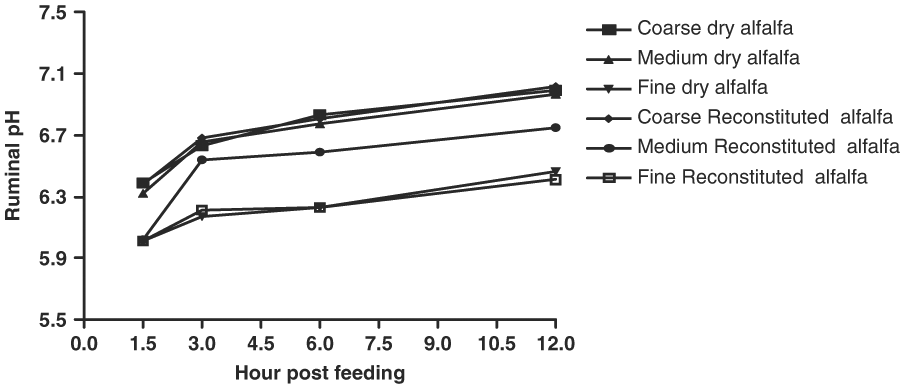
Rumen pH increased from 1.5 to 12 h after feeding (Figure 1). However, pH was lower for ration that had fine alfalfa than ration with coarse alfalfa and that reconstitution had relatively little effect. In the current experiment, cows in all treatments had ruminal pH higher than 6.0. The lower ruminal pH when cows were fed fine particles corresponds to lower total chewing activity and rumination time (Table 4). When animals are fed adequate amounts of long forage based on peNDF, ruminal pH is buffered due to increased saliva flow. Mertens (Reference Mertens1997) suggested that a minimum of 210 g/kg peNDF are required to stimulate chewing activity to maintain an average rumen pH greater than 6.0. However, in this experiment, when peNDF1.18 (g/kg DM) was much less 210 g/kg for both fine rations, the values of pH still maintained above 6. This may result from the increased intake of peNDF1.18 (kg/day).
The values of ruminal pH over the time of post feeding in experimental cows fed dry and reconstituted three sizes of alfalfa as a part of rations.

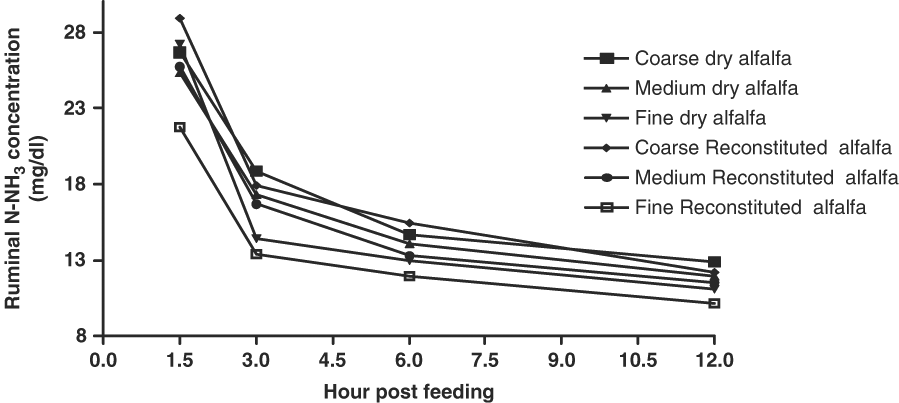
Rumen N-NH3 concentration decreased from 1.5 to 12 h after feeding and was lower for finely ground than medium or coarsely ground alfalfa (Figure 2). Reconstitution reduced rumen N-NH3 concentration at 3 and 12 h post feeding. The interaction of particle size and reconstitution had significant effect on rumen N-NH3 concentration at 1.5 and 6 h. Cows fed with fine and reconstituted fine alfalfa had lower N-NH3 concentration than the others, despite the higher DMI, and consequently the intake of CP and RDP, on these diets.
The values of N-NH3 concentration over the time of post feeding in experimental cows fed dry and reconstituted three sizes of alfalfa as a part of rations.

Mean retention time measurements
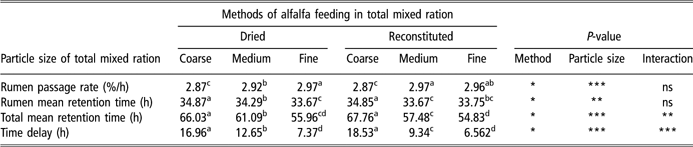
Reduction and reconstitution of alfalfa particles increased passage rate, but decreased TMRT and TD (Table 5). The decrease in TD with grinding was greater with reconstituted than dried alfalfa. The data of most investigators suggest a linear relationship between density and RMRT of particles in the forestomach (Kaske and Engelhardt, Reference Kaske and Engelhardt1990). Evans et al. (Reference Evans, Pearce, Burnett and Pillinger1973) reported that within the normal density range of digesta particles (0.8 to 1.5 g/ml), there was a clear negative relationship between particle density and RMRT. Particles with a low density are retained considerably longer in the reticulorumen than particles with a high density (52 to 91 h and 19 to 44 h, respectively). Teimouri Yansari et al. (Reference Teimouri Yansari, Valizadeh, Naserian, Christensen and Eftekhari Shahroodi2004) found that there was a clear positive relationship between particle size and RMRT. Particles with a higher GM are retained considerably longer in the reticulorumen than particles with a lower GM. In the current experiment, increased FSG due to reduction of particle size and reconstitution resulted in a reduction in RMRT, TMRT and TD and an increase in passage rate. Also, reconstitution increased the proportion of ruminal DM with an FSG higher than 1.2. It was expected that the passage rate would be faster in the reconstituted than in the dry forages, but the results in the current study do not confirm these expectations. Factors other than digesta FSG, such as particle size or ruminal motility or reduction of efficiency of chewing activity on particle breakdown as a result of reconstitution, may modify the FSG effects especially on rumen mat formation, RMRT and passage rate.
Ruminal kinetic of digestion in experimental cows fed dry and reconstituted three sizes of alfalfa as a part of rations

a,b,c,dMeans within a row with different superscripts differ (P < 0.05).
*P ⩽ 0.05; **P ⩽ 0.01; ***P ⩽ 0.001.
Milk production
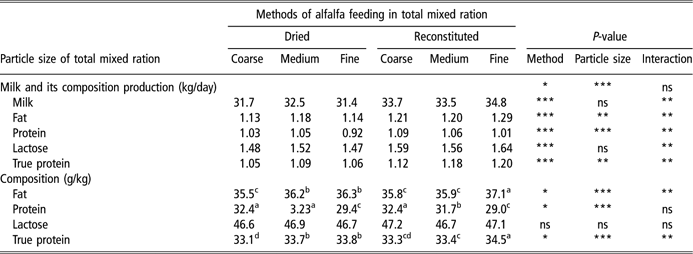
Reduction in alfalfa particle size had no effect on milk yield but decreased milk fat concentration and increased milk protein concentration (Table 6). Reconstitution of alfalfa increased milk yield, decreased milk fat concentration and increased milk protein concentration (Table 6). Grinding increased yield of true milk protein, but only when alfalfa was reconstituted before feeding (Table 6). However, Krause and Combs (Reference Krause and Combs2002) found that decreasing forage particle size tended to increase milk production despite the decrease in DMI. Grant et al. (Reference Grant, Colenbrander and Mertens1990) and Teimouri Yansari et al. (Reference Teimouri Yansari, Valizadeh, Naserian, Christensen and Eftekhari Shahroodi2004) reported that milk fat (g/kg) decreased with decreasing particle size due to the decrease of rumination time and rumen pH. Milk fat percentage is commonly used as an indicator of effective fibre, as it is often a good indicator of optimal rumen fermentation and ruminal pH levels. In contrast, milk protein increased as the particle size of alfalfa decreased.
Milk production and composition of cows fed dry and reconstituted three sizes of alfalfa as a part of rations

a,b,c,dMeans within a row with different subscripts differ (P < 0.05).
*P ⩽ 0.05; **P ⩽ 0.01; ***P ⩽ 0.001.
Effective fibre and functional specific gravity
Particle size is central to all effective fibre systems in ruminant nutrition. The critical size theory of Poppi et al. (Reference Poppi, Norton, Minson and Hendricksen1980) has been adopted into the peNDF system (Mertens, Reference Mertens1997). The peNDF is highly resistant to passage out of the rumen, and as a result stimulates chewing activity, saliva secretion and rumen mat formation; all factors that ultimately maintain rumen pH (Mertens, Reference Mertens1997).
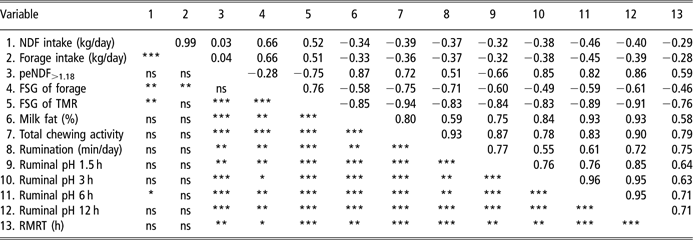
Teimouri Yansari et al. (Reference Teimouri Yansari, Valizadeh, Naserian, Christensen and Eftekhari Shahroodi2004) incorporated particle size and FSG of feeds (forage or TMR) in peNDF measurements and found that besides particle size, the FSG can be used as a discount factor of NDF on peNDF measurements. They found that the ratio of peNDF : FSG is a more useful parameter for predicting animal performance than peNDF. In the current study, FSG of forage and TMR were correlated negatively with total chewing activity, rumination time, ruminal pH and RMRT (Table 7). Regardless of which method of measuring fibre effectiveness was used, the ratio of peNDF/FSG correlated better with total chewing activity, rumination time, percentage of milk fat, ruminal pH and MRT than did peNDF alone (Table 7). In this experiment, the peNDF>1.18/FSG and peNDF>8/FSG of forage and TMR had higher correlation than peNDF>1.18 and peNDF>8 with animal responses (Table 7). In addition, the ratio of peNDFPSPSNew/FSG of forage and TMR had the coefficients of correlation 0.810, 0.609, 0.894, 0.737, 0.841, 0.841, 0.888, 0.627; 0.756, 0.567, 0.854, 0.698, 0.821, 0.808, 0.854 and 0.625 with total chewing activity, rumination time, percentage of milk fat, ruminal pH at 1.5, 3, 6 and 12 h post feeding and MRT, respectively. These high positive correlations suggest that FSG of forage or TMR should be used, in addition to particle size, in calculations of peNDF.
The correlation coefficients (%; above diagonal) between animal response variable and their P-values (below diagonal) in experimental cows fed dry and reconstituted three sizes of alfalfa as a part of rations

FSG = functional specific gravity; TMR = total mixed rations; RMRT = ruminal mean retention time.
*P ⩽ 0.05; **P ⩽ 0.01; ***P ⩽ 0.001.
peNDF>1.18: physically effective NDF based on DM retained on 1.18-mm sieve (Mertens, Reference Mertens1997).
Conclusions
Reduction of particle size and reconstitution of alfalfa increased the bulk density and FSG of alfalfa and TMR. Reduction of particle size decreased IDM, WHC and hydration rate of alfalfa. Reduction of particle size and reconstitution increased DIM, reduced NDF and ash digestibility, total MRT, RMRT and TD of marker, increased ruminal passage rate and also decreased ruminal pH, N-NH3, milk fat, total chewing activity, rumination and eating time. Reduction of particle size decreased the intake of peNDF in both absolute terms (kg/day) and as a proportion of DMI. Reconstitution increased daily peNDF intake but did not affect the proportion of all types of peNDF in DMI. Increased FSG as a result of the reduction of forage particle size and reconstitution of alfalfa was a major factor affecting DMI, milk composition, chewing behaviour, rumen function and digestibility. Results of a previous study (Teimouri Yansari et al., Reference Teimouri Yansari, Valizadeh, Naserian, Christensen and Eftekhari Shahroodi2004) and this experiment suggest that FSG of feeds (forage or TMR) as well as particle size should be used when calculating the effectiveness of NDF for the purpose of predicting intake and milk production in dairy cows. More research is need to clarify how changes in FSG of forage and TMR affect rumen conditions, how initial FSG of forage and TMR affects the distribution of particle size and how FSG and particle size can be integrated into a model to estimate pef.
Acknowledgements
This experiment was carried out at the dairy barn of University of Mashhad, Iran. Also, the authors thank Mrs. Maassoumeh Vahmian and Robabeh Vahmian for preparation of Cr-mordanated marker of forage particles, Mr. Mousa and Esmaiel Teimouri Yansari for their assistance and the staff of the dairy unit for care of the cows and sample collection. Also, the authors thank Dr P. Yu and H. Soita (Department of Animal and Poultry Science, University of Saskatchewan, Canada) for reading the paper and for some corrections.