Introduction
Drug use is recognised globally as a significant public health concern. In April 1998, the United Kingdom (UK) government published Tackling Drugs to Build a Better Britain, a 10-year drugs strategy which was subsequently updated in 2002 (Drugs Strategy Directorate 1998, 2002). Although the strategy sets out various policies, all are set in a framework of four areas of intervention: preventing young people commencing drug use, reducing the impact of drugs on communities (e.g. through reducing drug-related crime), improving treatment and harm minimisation, and reducing the supply and availability of drugs. There are key performance indicators for all four. Arguably, the main focus of the recent initiatives has been to encourage people into treatment, in the belief that treatment contacts will bring benefits for both individual drug users and the wider community. The main ways of achieving this have been to increase treatment capacity and the availability of services, but they have been coupled with the criminal justice initiatives of the Drug Interventions Programme (DIP) that are designed to encourage drug-using offenders to engage with treatment services. Older drug users are known to commit less crime than their younger counterparts (Gossop et al. Reference Gossop, Trakada, Stewart and Witton2006), possibly because they believe that criminal behaviour is too (physically) demanding, difficult or risky, or that the penalty of incarceration is too great (Levy and Anderson Reference Levy and Anderson2005). Older individuals therefore benefit little from criminal justice initiatives, and no programmes or interventions have the specific aim of encouraging older users to participate in treatment. There is still a widespread perception in the UK that older drug users do not exist or are very rare, partly, we argue, because older drug users are a ‘hidden’ population.
There was escalating drug use in the United Kingdom during the 1980s, with approximately 80 per cent using heroin, and most others being solely smokers of cannabis (Parker, Newcombe and Bakx Reference Parker, Newcombe and Bakx1987). A typical drug-using career is perceived to end in middle age, if not sooner, through death, illness, voluntary cessation or for other reasons, but this is not always the case. A study of 40 injecting drug users in a depressed area of Chicago found that some drug-users’ careers spanned 25 or more years (Levy and Anderson Reference Levy and Anderson2005). Harm-reduction measures and treatment programmes were introduced in the UK during the 1980s in response to the opiate outbreak, most notably substitute methadone prescribing to divert their need for heroin. It is not known if these have prevented the premature deaths of the first wave of drug users. If so, many of those still alive today would be aged 50 or more years. A 1984–85 study of opioid users in Wirral, Merseyside, reported that 276 of the 1,305 known users were aged 35 or more years (Parker, Newcombe and Bakx Reference Parker, Newcombe and Bakx1987); any that survived in 2006 would have been at least 57 years of age.
Furthermore, it is has been shown that some people commence drug use in later life. Johnson and Sterk's (Reference Johnson and Sterk2003) community study in the United States found that it was not uncommon for men aged 50 or more years, and women in midlife, to begin to use crack-cocaine, and that whilst some were already using other substances (most often heroin), others had no previous drug experience. While much has been written about the psychosocial correlates of drug abuse among young people (such as early aggressive behaviour, lack of parental supervision, substance abuse, drug availability and poverty; see National Institute on Drug Abuse 2003), little work has investigated the reasons for drug initiation amongst older people.
The Merseyside region is centred on the City of Liverpool, and Cheshire is to the southeast. The combined area has both rural and high population-density urban areas, and in mid-2005 had an estimated population of 2,047,003. It has been estimated that the prevalence of problematic drug use in the metropolitan centre (viz. usually addiction to opiates or crack-cocaine) is as high as 52 per 1,000 males aged 15–44 years (Beynon et al. Reference Beynon, Bellis, Millar, Meier, Thomson and Mackway Jones2001a). To date, there has been little local or national investigation of whether the age profile of the drug-using population has changed over time, even though it is well recognised that the British population, as in other affluent countries, is living longer although healthy life expectancy may be increasing more slowly; resulting in more years lived with ill or poor health from chronic conditions (House of Lords 2005). Harm reduction and treatment initiatives might have prevented the premature deaths of drug users who commenced drug use during the 1980s, but it is likely that these individuals currently suffer poorer health and long-term illnesses.
Aims and objectives
This paper first collates and analyses data from two well-established monitoring systems on the age of the clients of Tier 3 and Tier 4 drug-treatment interventions, which are predominantly substitute prescribing services, psycho-therapeutic interventions, structured counselling therapies, community and in-patient detoxification services, and community aftercare and day-care programmes.Footnote 1 It secondly examines changes in the age of drug injectors who are in contact with the agency-based syringe exchange programmes (SEPs) that were established in the UK during the 1980s in response to the emergence of the human immunodeficiency virus (HIV); they provide injecting drug users with clean injecting equipment. The first hypothesis was that the population of drug users in Cheshire and Merseyside has aged.
Methods
In 1997, on behalf of the local health services, the Centre for Public Health at Liverpool John Moores University established a bespoke monitoring system to record data on all those who contacted drug treatment services in Cheshire and Merseyside. The data were reported by calendar year until 2001–02, after which, to adhere to new national requirements, the reporting cycle was changed to the financial year (1st April to 31st March) (for an example of the published data, see Beynon, Birtles and Bellis Reference Beynon, Birtles and Bellis2001b). In 1997, the national monitoring system of drug treatment contacts did not collect prevalence data but only recorded new contacts. In 2001, a new National Drug Treatment Monitoring System (NDTMS), based largely on the Cheshire and Merseyside bespoke system (Beynon et al. Reference Beynon, Bellis, Millar, Meier, Thomson and Mackway Jones2001a), was initiated and began to collect annual treatment prevalence data by financial year. Both systems collected data in a pseudo-anonymous form, with each individual being identified by a code derived from their initials, date-of-birth and sex. The use of this ‘attributor code’ for data matching and duplicate removal has been validated (Crabbe and Domnall Reference Crabbe and Donmall1996). Particular NDTMS data fields, such as date-of-birth, are subject to verification checks (Donmall and Jones Reference Donmall and Jones2004). Given the similarities between the two systems, the data have been amalgamated into a single longitudinal database of 26,415 individuals aged 11–74 years who contacted treatment services between 1997 and 2004–05. For this paper, the data for the years 1998 to 2004–05 have been extracted.Footnote 2 Multiple records for an individual in one year were aggregated to remove double counting, and each individual's age at the end of the reporting period was calculated.
A system for recording all drug-related contacts at agency-based SEPs across Cheshire and Merseyside was established by the Centre for Public Health in 1991. As with the treatment data, an individual was identified by their attributor code (for an example of published data, see McVeigh, Beynon and Bellis Reference McVeigh, Beynon and Bellis2003). Data for the years 1992 to 2004 were extracted from the SEP database. People who were steroid injectors were removed, so only ‘problematic’ injectors remained (usually injectors of opiates and/or stimulants). Multiple records for individuals were aggregated to remove double counting. End-of-reporting-period ages were calculated for each individual. Chi-squared for trend analyses were used to assess changes in the proportion of people aged 11–49 years and 50–74 years in treatment and who attended SEPs.Footnote 3 A linear regression model was calibrated to establish whether there was a significant trend over the reporting period (1998 to 2004–05) in the proportion of individuals in drug treatment aged 40–49 years (i.e. the potential older drug users of the future).
Results
Drug users in contact with treatment services
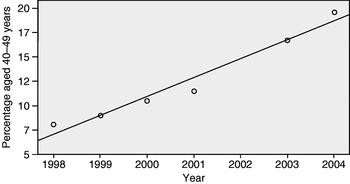
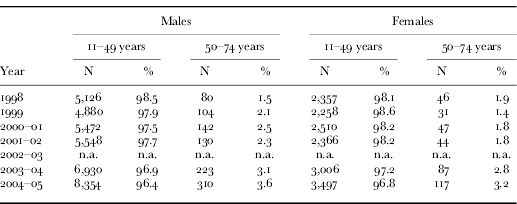
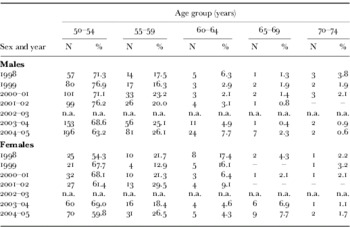
While most drug users who are in contact with health services for treatment in Cheshire and Merseyside are aged 11–49 years, between 1998 and 2004–05 the number aged 50–74 years of both genders increased (Table 1). The median age for those in contact with treatment services was 30.8 years (inter-quartile range: 26.8 to 34.9) in 1998, compared to 34.9 years (inter-quartile range: 29.9 to 39.6) in 2004–05. Because it is stipulated that any records that declare an age outside the range 11 to 74 years are spurious, and so are deleted, it is not known how many who received treatment were aged 75 or more years (Donmall and Jones Reference Donmall and Jones2004). Of those aged 50–74 years, the majority of those using drugs and receiving treatment were aged 50–54 years. Between 1998 and 2004–05, however, there was an increasing number of both male and female drug users aged 55–59 years, and of males aged 60–64 years (Table 2). Furthermore, the linear regression model showed a rising trend in the proportion of individuals in contact with treatment services aged 40–49 years (R 2=0.96, p=0.001, Figure 1); 8.1 per cent of the treatment population were aged 40–49 years in 1998 compared to 19.6 per cent in 2004–05.
Percentage of drug treatment population in Cheshire and Merseyside aged 40–49 years, 1998 to 2004–05.

The age of males and females receiving structured treatment for drug use in Cheshire and Merseyside, 1998 to 2004–05
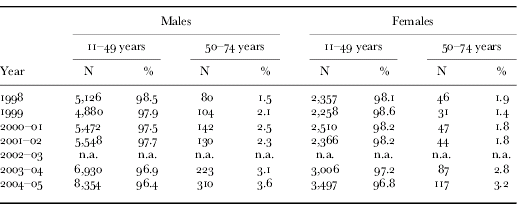
Notes: n.a. data not available for 2002–03 (see text). The chi-squared trend statistics were, for men, 63.73 (5 degrees of freedom (df), p<0.001), and for women, 24.69 (5 df, p<0.001).
The age distribution of males and females aged 50 or more years who received structured treatment for drug use in Cheshire and Merseyside, 1998 to 2004–05

Notes: n.a. data not available for 2002–03 (see text).
Drug users in contact with syringe exchange programmes
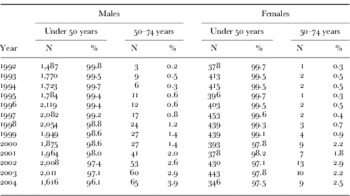
Of the drug users that accessed syringe exchange programmes between 1992 and 2004 the majority were aged 11–49 years, the number in this age group increased from 1,865 to 1,962, and they were predominantly male. Those aged 50–74 years were a minority, but the number increased from four (0.2%) in 1992 to 74 (3.8%) in 2004. The proportion aged 50–74 years significantly increased among both males and females, and the median age of problematic drug users in contact with syringe exchanges rose from 27.0 years (inter-quartile range: 23.8–30.9), to 34.9 years (inter-quartile range: 30.6–39.5) (Table 3).
The age of male and female problematic drug users in contact with agency based syringe exchange programmes in Cheshire and Merseyside, 1998 to 2004–05

Notes: The chi-squared trend statistics for the proportion aged 50–74 years were, for men, 172.02 (12 degrees of freedom (df), p<0.001), and for women, 31.22 (12 df, p<0.001).
Discussion
The population of problematic drug users in contact with structured treatment services and agency-based syringe exchange programmes in Cheshire and Merseyside is ageing. The median age of injectors in contact with SEPs, for example, increased by almost eight years between 1992 and 2004, and the proportion of in-treatment drug users aged 40–49 years increased from 8.1 per cent in 1998 to 19.6 per cent in 2004–05. The findings from Cheshire and Merseyside are not particular to the region or indeed to the UK. Whilst the exact UK prevalence of drug use is unknown (because much is covert), the 2004–05 British Crime Survey's representative sample of people living in England and Wales estimated that approximately 3.5 million people had used drugs during the previous year, and that one million had used Class A drugs (those deemed most harmful and associated with the most severe penalties). The age of the recorded respondents was constrained between 16 and 59 years, however, and there was no information on drug use among those aged 60 or more years because of their ‘very low prevalence rates for the use of prohibited drugs’ (Roe Reference Roe2005). While the ‘last year prevalence’ of drug use in the three youngest age groups decreased between 1998 and 2004–05, with those aged 16–19 and 20–24 years exhibiting the largest falls, the prevalence in the three oldest age groups increased; among those aged 35–44 years, from 6.0 to 7.3 per cent; among those aged 45–54 years, from 3.1 to 3.4 per cent; and among those aged 55–59 years, from 1.3 to 1.5 per cent (Roe Reference Roe2005). Outside the UK, the European Monitoring Centre for Drugs and Drug Addiction (EMCDDA) has shown that the average age of opiate users is rising in a number of European countries. In drug treatment centres in The Netherlands, for example, 40 per cent of new opiate clients are aged over 40 years (EMCDDA 2005), and the same rising trend is found among methadone users in the United States (Rosen Reference Rosen2004).
Despite this evidence that the drug users are becoming older, pertinent British government policies are still young-person focused, and particularly emphasise the prevention of their initiation into drug use. While this is sound public-health policy, the health needs of older drug users must not be ignored. It is no longer appropriate for the national monitoring systems to regard as spurious reports of drug use among people aged 75 or more years (Domnall and Jones Reference Donmall and Jones2004), or for the age group not to be included in UK surveys of alcohol consumption (Gilhooly Reference Gilhooly2005).
Whilst cannabis is the predominant drug in the UK, the government's strategy and practice interventions focus on the most problematic drugs – mainly opiates (heroin) and the stimulants, cocaine and crack-cocaine. Contacts with the structured treatment providers (Tier 3 and Tier 4 interventions) and with low threshold, Tier 2 services (which include SEPs), are the major sources of information regarding drug use and drug-user characteristics, but by definition only refer to the service users. As a result, there is a disparity between the number of problematic crack users that present to treatment services and the number identified through the criminal justice system (Sondhi, O'Shea and Williams Reference Sondhi, O'Shea and Williams2002). The concerns about the barriers to service uptake by minority sub-populations, for example, black and minority ethnic individuals, women and very young adults, may also apply to older people. Detailed interviews of chronic drug users aged 50 or more years in the United States have suggested, for example, that they believed that substituting methadone for heroin (the main treatment intervention for opiate addiction) implied moral failure and that it stigmatised them as having insufficient personal willpower (Levy and Anderson Reference Levy and Anderson2005). In such circumstances, older drug users may feel ill-at-ease in services full of younger people, and will therefore be largely absent from monitoring data.
Whilst much is known about young adults’ drug use (Boys et al. Reference Boys, Marsden, Griffiths, Fountain, Stillwell and Strang1999), far less is known about older people's drug habits. If older and younger people use different drugs, existing treatment interventions may be unsuitable. From their interviews with US drug injectors aged 50 or more years, Levy and Anderson (Reference Levy and Anderson2005) found that older injectors changed from ‘street drugs’ to alcohol and barbiturates when the former became difficult to obtain or were too harsh for their aged bodies to tolerate. Furthermore, the motivations for substance use are likely to vary by age. A recent study of the reasons for methamphetamine use amongst gay and bisexual men in New York found strong contrasts in the reported reasons for drug use between those aged in the twenties and those aged in the forties. Sexual, social and emotional reasons were cited by respectively 38.4, 38.5 and 7.7 per cent of the younger sample, compared to 91.7, zero and 33.3 per cent of the older sample (Halkitis, Fischgrund and Parsons Reference Halkitis, Fischgrund and Parsons2005).
Few studies have documented the medical correlates of long-term drug use (Hser et al. Reference Hser, Gelberg, Hoffman, Grella, McCarthy and Anglin2004), possibly from the perception that drug use declines with age. Moreover, cross-sectional studies of drug and alcohol use often fail to account for period and cohort effects, and the possibility is rarely recognised that today's older drug users when younger consumed less than today's young adults, and have continued an accustomed level of consumption into old age (Gilhooly Reference Gilhooly2005). In other words, the assumption that drug and alcohol use decline with age may be incorrect. An Australian survey of randomly-selected individuals aged 75 or more years reported that 72 per cent of men and 54 per cent of women drank alcohol, and that, of these, 11 per cent of males and six per cent of females consumed at hazardous or harmful levels (Dent et al. Reference Dent, Grayson, Waite, Cullen, Creasey and Broe2000). There is concern in the United States that, as the ‘baby boomers’ age, the demand for substance-use treatment will increase substantially (Gfroerer et al. Reference Gfroerer, Penne, Pemberton and Folsom2003).
Yet it is not only the increased demand for drug treatment that should concern us. As drug users age, their morbidity and mortality increase as deaths from chronic conditions are added to overdoses and external causes such as suicides or violence (EMCDDA 2005). Detailed medical examinations of 108 US drug-dependent males (mean age 58.4 years) who had been using heroin for on average 29.4 years, reported considerably higher morbidity than in the general population, most notably abnormal lung and liver function (Hser et al. Reference Hser, Gelberg, Hoffman, Grella, McCarthy and Anglin2004). More specifically, 34 per cent met the criterion for moderate obstructive lung disease (a rate 2.4 times higher than observed in the national population), and more than one-half of the sample had abnormal liver function. Blood tests among these men showed that 94.7 per cent tested positive for hepatitis C, and 85.6 per cent for hepatitis B, compared to 2.5 and 5.7 per cent respectively in the national male population. The combination of viral hepatitis and excessive alcohol use significantly increases the risk of liver failure. It was concluded that these estimates were conservative, because one-half of the sample recruited to the study 33 years previously had already died. The contribution of chronic infections, liver disease, suicides and the like to the mortality of older drug users is being missed in the UK, because deaths from these causes are not classified as ‘drug related’, i.e. they do not accord with the national definition of a drug-related death (Beynon and McVeigh Reference Beynon and McVeigh2007).
While chronic diseases are likely to constitute the major health burden among older drug users, the visual or auditory hallucinations associated with some psychoactive substances may considerably increase the risk of accidents and falls, particularly in combination with prescribed and over-the-counter medications (Ziere et al. Reference Ziere, Dieleman, Hofman, Pols, van der Cammen and Stricker2005). The use of psychotropic medications (for example benzodiazepines) is an established risk factor for hip fractures (Cumming and Le Couter Reference Cumming and Le Couteur2003). While in Britain there continues to be a dearth of robust epidemiological data on substance use by elderly drug users, including the non-medical use of prescription drugs, it is impossible to identify the exact risks that these older people face. It is known that a history of alcohol and/or drug use in an older person is associated with high rates of medical treatment and long hospital stays (Weintraub et al. Reference Weintraub, Weintraub, Dixon, Delahanty, Gandhi, Cohen and Hirsch2002). The cost of the ageing population of drug users may therefore be considerable.
In addition to physical problems, there is some evidence that older drug users exhibit relatively high levels of psychological ill health. Chronic drug use over many years can lead to a gradual erosion of a person's ties to non-drug-using family members, friends and acquaintances. As drug-using friends die or cease the habit, older users may be increasingly isolated from current drug users. The options available to a younger drug user, such as starting a family or a new job, may be unattainable for older drug users. A sense of marginalisation from the local ‘drug scene’ can be exacerbated by physical deterioration and may reduce self-esteem. The socio-emotional context of older drug use may therefore be marked by loneliness, stress and fear of victimisation (Levy and Anderson Reference Levy and Anderson2005).
Conclusions
The analyses presented in this paper have shown that the population of problematic drug users in contact with structured treatment services and syringe exchange programmes in Cheshire and Merseyside is ageing. Furthermore, the representation of those aged 40–49 years among those receiving treatment increased from 8.1 per cent in 1998 to 19.6 per cent in 2004–05. It is quite probable that this pattern is evident throughout the UK and beyond; a premise supported by the British Crime Survey, the European Monitoring Centre for Drugs and Drug Addiction, and United States research. In addition to acute drug-related affects, older drug users experience high morbidity and mortality from chronic conditions and reportedly greater levels of psychological ill health. There is a clear need for more research in the UK on the prevalence, circumstances and health-care needs of older drug users. In particular, detailed assessments of drug-taking experiences and histories across the lifecourse are required, along with more information about the impacts on families and social networks. The characteristics and health needs of this potentially vulnerable group of people warrant concerted investigation.
Acknowledgements
We thank all the staff at the services that report to the Centre for Public Health and the Cheshire and Merseyside Drug (and Alcohol) Action Teams for supporting the Inter Agency Drug Misuse Database. Thanks are also extended to Eduardo Fe-Rodriguez at the Centre for Public Health for his statistical support.