In April 2001, the people of Tobelo held a peace ceremony in an effort to ensure that the religious conflict that had plagued the eastern Indonesian island of Halmahera in 1999–2001 would not reignite. The ceremony consisted of an adat (Indonesian, customary law) ritual and pledge in which the Muslim and Christian Tobelo communities swore to renounce violence and to respect the rights of everyone in the “Tobelo adat region.” This ceremony was more than just a cultural display. It symbolized a decision by many in North Maluku to turn to adat as a guarantor of social unity and harmony in the region. They were looking to adat because of the inability, or unwillingness, of the Indonesian government or the armed forces to prevent the initial outbreaks of violence. Furthermore, neither the government nor the military had been particularly successful in facilitating reconciliation in postconflict North Maluku. Continuing tensions hampered efforts at reconstruction and impeded the return of thousands of displaced Muslims and Christians. The provincial government had informed high-ranking civil servants and other political leaders that if they could not calm the situation and facilitate the return of forced migrants, the capital of a new district of North Halmahera would be placed somewhere other than Tobelo town. Something needed to be done, and a number of influential community leaders thought that adat was the answer. They believed that a revitalization of adat would shift people's locus of identification from their religion (Christian or Muslim) to their ethnic identity (Tobelo). They argued that this change in focus would facilitate reconciliation, or at least peaceful coexistence, between the two religious communities.Footnote 1
Prior to the conflict of 1999–2001, the Tobelo, particularly those who lived in and around Tobelo town, were not well known for their concern with adat. Footnote 2 The 1990s had brought a new level of economic prosperity to the region, based largely on the expansion of logging and government-sponsored transmigration. The town had become a major transport center servicing these transmigration settlements and the timber industry and was well on its way to becoming the economic hub of northern Maluku. During this time, people began to see adat as a sign of backwardness, something for the elderly to discuss on the veranda, or dances to be performed at weddings or trotted out for visiting dignitaries. They associated it with village life, not with the boomtown atmosphere of Tobelo town and the future. Even the Tobelo language had started losing ground in town as large numbers of migrants arrived and parents saw fluency in Indonesian as more important. Adat practices and strong language use remained prevalent in rural villages, but even these communities were shifting their focus to church and mosque activities. The growth of reform Islam among the Muslim community, the rise of more conservative fundamentalist Christian churches, and subsequent responses by the Evangelical Protestant Church of Halmahera (the largest denomination in the region) had all diminished the importance and influence of adat among the Tobelo.
Many now look back on the views of that time as misguided. Lured by the promises of development and modernization, people became less concerned with local beliefs and adat. Yet these modernizing influences did not prevent them from becoming entangled in the religious conflict that engulfed the province. In postconflict North Maluku, many people see a renewed focus on adat as one possible solution to the problems that have besieged them since the turn of the century. In this article, I argue that there are several reasons people are now turning to a reinvigorated, or reimagined, adat as one remedy to the various ills that currently befall Tobelo. First and foremost, the failure of the state and the armed forces to ensure safety and stability during the conflict led to a loss of confidence in both institutions. As a result, people are looking for new alternatives to mediate intergroup relations. Second, new government policies concerning regional autonomy have provided an arena in which local leaders can play larger roles in development planning and in the allocation of income from natural resource exploitation. In this new political arena, local leaders often call upon local identity and adat to gain support from their constituencies, what Nils Bubandt (Reference Bubandt2004) has referred to as “the new politics of tradition” in Indonesia. Finally, the rhetoric of adat allows all sides in the conflict to continue pursuing their political and economic agendas through a discourse of inclusiveness (i.e., adat).
The people involved in these attempts to revitalize adat want to undo what they consider the damage done by thirty-two years of government religious policy and disregard for local culture. During the New Order regime (1967–98), religion became one of the more important factors of identification for Indonesians. All citizens were required to adhere to one of five officially recognized faiths, and failure to do so made life difficult (see Atkinson Reference Atkinson1983; George Reference George1996). It was religion, rather than ethnicity, that was noted on personal identification cards. It was religion, rather than local culture, that was a mandatory subject in the educational curriculum. These policies, as well as other factors (i.e., state patronage networks, New Order fears of communism and Islamization, and the regime's co-optation of the latter during its final years), created a situation in which religious identity played an important role in people's daily lives and in local and national politics (see Bertrand Reference Bertrand2004, 72–89; Hefner Reference Hefner2000; Liddle Reference Liddle1997; Sidel Reference Sidel2006). In some parts of Halmahera, the importance placed on religion led to a prioritization of religious identity during the second half of the twentieth century. People in Tobelo began to identify with their religious affiliation rather than their cultural and ethnic background. It is this hierarchy of identity that some community leaders and their supporters want to change with their focus on tradition and culture. They want to reorder this hierarchy and move Tobelo adat and identity to the front, where it would presumably serve to dampen the tensions and conflicts created by religion.
Articulating Tobelo Culture and Identity
In their efforts to revitalize adat as a primary marker of identity, the proponents of adat revitalization want to reinsert it into various realms of social interaction as well as revive or reshape adat practices and beliefs that have disappeared or are losing their significance. The goals behind these endeavors mirror the types of “invented traditions” that Eric Hobsbawm sought to illuminate: “those establishing or symbolizing social cohesion or the membership of groups, real or artificial communities [and] those establishing or legitimizing institutions, status or relations of authority” (Reference Hobsbawm, Hobsbawm and Ranger1983, 9). Although this would seem to be an apt description of what the Tobelo are attempting to do, the idea of “inventing traditions,” as many have pointed out (see Bubandt Reference Bubandt, Otto and Pederson2005; Linnekin Reference Linnekin1992; Ranger Reference Ranger, Ranger and Vaughan1993; Sahlins Reference Sahlins1999), often fails to explain the way local communities view, utilize, and deploy notions of “tradition” and how they conceive of “traditional practices.” Critics of the “invention of tradition” have noted that it sets up a false dichotomy between tradition, that which is invented and thus inauthentic, and custom, that which is autochthonous and thus more authentic (Handler and Linnekin Reference Handler and Linnekin1984; Kahn Reference Kahn1993, 28). Others have argued that the idea of invention demeans local traditions by calling into question their authenticity and hence their validity (Linnekin Reference Linnekin1992, 249). So how might one discuss adat and the revitalization and redeployment of (arguably newer and reconceptualized) forms of adat without using the language of “inventing tradition”?
Recent examinations of tradition and religion in Southeast Asia (Fox Reference Fox2002, 20–23; Li Reference Li2000, Reference Li2001) have found the notion of articulation more helpful in understanding changing systems of beliefs and practices and the identities associated with them. One of the more helpful theorizations of articulation comes from Stuart Hall, who defines it as a process that “can make a unity of two different elements, under certain conditions. It is a linkage which is not necessary, determined, absolute and essential for all time … A theory of articulation is both a way of understanding how ideological elements come, under certain conditions, to cohere together within a discourse, and a way of asking how they do or do not become articulated, at specific conjunctures to certain political subjects” (Reference Hall1986, 53). Thinking about Tobelo adat as an articulation (in this case, as a discourse that links together a set of beliefs and practices with a particular group of people) allows us to talk about it without seeing it either as something that is profoundly dehistoricized and essentialized (as it is by many in Tobelo) or as an “invented” tradition that exists in opposition to an equally problematic “real” tradition. As James Clifford notes, “articulation offers a non-reductive way to think about cultural transformation and the apparent coming and going of ‘traditional’ forms” (Reference Clifford2001, 478). It provides a way of thinking about the revitalization of adat without getting entangled in debates about authenticity. The Tobelo themselves are not overly concerned with authenticity in this revitalization of adat; most of them readily admit that many practices have been forgotten and that a large amount of local knowledge has fallen by the wayside over the years. They are more concerned with the reconfiguration of Tobelo adat—and subsequently Tobelo identity—to resemble that which existed in an essentialized and idealized past when religious differences were subsumed by adat ties. One of the strengths of theories of articulation, as Clifford demonstrates, is that “the whole question of authenticity is secondary … It is assumed that cultural forms will always be made, unmade, and remade. Communities can and must reconfigure themselves, drawing selectively on remembered pasts. The relevant question is whether, and how, they convince and coerce insiders and outsiders, often in power charged, unequal situations, to accept the autonomy of a ‘we’” (Reference Clifford2001, 479).
Although the focus in Tobelo is primarily on bridging religious differences, Hall notes that theories of articulation also “enable us to think how an ideology empowers people, enabling them to begin to make some sense or intelligibility of their historical situation, without reducing those forms of intelligibility to their socio-economic or class location or social position” (Reference Hall1986, 53). In the Tobelo case, these interests in revitalizing adat span various divisions in society, such as socioeconomic position, the rural–urban divide, and, in some cases, ethnicity. From a political standpoint, Hall's use of articulation, as Tania Li astutely points out, “draws attention to those articulations which have the potential to define broad constellations of shared or compatible interests, and mobilize social forces across a broad spectrum” (2000, 153). The articulation of Tobelo adat attempts to do just that. Certain members of the Tobelo society and their supporters are trying to articulate adat (to link a set of practices, such as language, kinship, and intragroup relations, with a particular group of people) in an effort to rearticulate a Tobelo identity for the twenty-first century.Footnote 3 The ideal result would be a community of Tobelo Muslims and Tobelo Christians, rather than the previous community of Muslim Tobelo and Christian Tobelo. To paraphrase Antonio Gramsci (Reference Gramsci, Hoare and Smith1971, 195), they want to take what was secondary (ethnic and cultural identity), or even incidental, and make it primary. The challenge for the proponents of adat is to convince both Muslims and Christians to accept this reconfiguration of community and identity in a postconflict situation.
A Brief History of Adat in Indonesia
The term adat, often glossed as “customary law,” generally refers to the local practices and institutions found among the various ethnic groups in Indonesia. Every ethnic group in Indonesia—the Javanese, the Bugis, the Tobelo, and so on—has its own adat. Scholars and local communities have often essentialized this idea of adat and explained it as the various rules and regulations that have always governed their social relations and interactions. These essentialized traditions bring to mind (again) the critical language of Eric Hobsbawm and Terence Ranger (Reference Hobsbawm and Ranger1983) about “the invention of tradition,” which showed how many of these “historical traditions” were in fact recent inventions of colonial powers. Along these lines, it should be noted that the importance, if not reification, of the adat concept resulted primarily from Dutch efforts to establish a plural legal system in Indonesia, one in which indigenous communities were held to a different, and subordinate, set of laws. The proponents of this legal pluralism argued that the indigenous people of the archipelago had their own legal systems by which they should be governed and which should regulate their lives. Dutch legal scholars aided the subsequent formalization and codification of adat law (Dutch, adatrecht) through the compilation of a vast quantity of information about these adat laws (e.g., the Adatrecht-bundels series that provided descriptions of these various types of adat). As part of this process, they identified nineteen primary adat law areas (Dutch, adatrechtskringen) in Indonesia. It was out of this large-scale effort at documentation that the “myth of adat”—that it was fixed law, rather than evolving custom—was born (Burns Reference Burns1989). The Dutch focus on adat also reflected their dislike of the universalistic claims of Islamic law that some thought could form the basis for anticolonial movements (Lev Reference Lev1985, 66). In an effort to undermine the strength of Islamic leaders, colonial officials, such as Christiaan Snouck-Hurgronje, argued that the Dutch should favor adat leaders. This respect for adat law, however, did not supersede Dutch political and economic interests.
What little power adat had in the colonial period decreased even more after independence. Although the Indonesian Constitution and other national legislation recognized the presence of adat and adat law (Indonesian, hukum adat), it was subordinate to national laws (Indonesian, hukum negara) and national interests. During this period, adat law came to signify “lower class, mainly rural Indonesians, conceived more as objects of administration than as subjects” (Lev Reference Lev1985, 71). Under President Suharto's New Order regime, adat was largely “redefined to codify highly limited aspects of “traditional” sociocultural life” (Spyer Reference Spyer1996, 29). The concepts of adat and culture (Indonesian, kebudayaan) were two of the many aspects of Indonesian society that the New Order government tried to manipulate to fit state agendas. One aim of the government's co-optation of adat was an attempt to unify the nation (and, I would argue, to minimize diversity at the same time) by putting forth homogenized notions of provincial cultures. To erase cultural differences at the provincial level, each province was seen to have a single adat system shared by all, a hybrid variant of the multiple cultural practices present in each province, often referred to as “regional culture” (Indonesian, kebudayaan daerah) (Picard Reference Picard, Picard and Wood1997, 198).
Just as the Dutch had reduced the archipelago to nineteen adat regions in their classification project, the New Order government tried to simplify the nation with its portrayal of adat in the country's (then) twenty-eight provinces.Footnote 4 The choice of a single house style, a single costume, and so on, to represent each province exemplified this supposed province-wide adat system. Elementary and secondary school students across the country had to memorize (and still do) these basic regional adat features of each province as part of their education. Although this correlation of provincial boundaries with adat practices may have been appropriate to a certain degree for Bali, or some parts of Java, it was not the case for most of the country. For example, the former province of Maluku was seen to have a “Moluccan Culture” (Indonesian, Kebudayaan Maluku) and a “Moluccan Adat” that was present, albeit with slight adjustments, throughout the entire province. The cultural unity inherent in a notion of “Moluccan Culture” contrasted with the vast diversity on the ground in a province that had more than 130 language communities.Footnote 5
New Order cultural policy focused on the development of these regional cultures. In his analysis of the performing arts in Indonesia, Philip Yampolsky (Reference Yampolsky1995, 710) has explored how the New Order government often tried to “upgrade” (Indonesian, meningkatkan) local cultural performances to make them more “respectable.” Government officials also sought to monitor the political and moral content of such performances. The Department of Education and Culture encouraged people to incorporate government messages into their performances or to use Indonesian rather than local languages (Yampolsky Reference Yampolsky1995, 711). Greg Acciaioli describes how local-level civil servants instructed people on how to bring their adat in line with “provincial norms” (1985, 148–49). This type of sanitized ethnicity (“display, not belief, performance, not enactment”) received state sanction and encouragement from the Department of Education and Culture (Acciaioli Reference Acciaioli1985, 161).Footnote 6Adat practices that did not meet these provincial norms, or that government officials deemed wasteful, were discouraged, and in some cases even outlawed (see Aragon Reference Aragon1996; Dove Reference Dove and Dove1988). The government largely ignored other aspects of adat, such as indigenous forms of land tenure or indigenous belief systems, that conflicted with larger development agendas.
In the post-Suharto period, adat has begun to take on new meanings for people throughout Indonesia (see Davidson and Henley Reference Davidson and Henley2007). Communities are now turning to adat as a source of autonomy to counter past mismanagement and corruption from Jakarta and the provincial capitals. Some hoped that the fall of the New Order and the new decentralization legislation passed in 1999 (and amended in 2004) would allow local communities to rebuild local modes of governance that had long been disparaged by New Order policies.Footnote 7 At the national level, a number of indigenous groups founded the Indonesian Alliance of Indigenous Peoples (Indonesian, Aliansi Masyarakat Adat Nusantara) in 1999 to fight for the rights of local communities that had suffered under the development-oriented New Order regime (Li Reference Li2000, Reference Li2001). As the New Order collapsed and communal violence broke out across the archipelago, many groups began to see adat, or its revitalization, as a tool for conflict prevention or conflict resolution (Laksono Reference Laksono2002; Pernama Reference Pernama2002; Thorburn Reference Thorburn2005). They hoped that local modes of conflict resolution based on adat would succeed where regional and national political and military solutions had failed. Along these lines, many in Tobelo believe that efforts to reinvigorate Tobelo adat can help rebuild unity and prevent future conflict in the region.Footnote 8
Background of the Conflict in North Maluku
This turn to adat in Tobelo must be looked at in light of the communal violence that took place across the province from August 1999 through June 2000 and the tensions that have persisted since that time. The North Maluku conflict was not unique in turn-of-the-century Indonesia. Concurrent with Suharto's fall from power in 1998 (and, in some cases, before that), violence broke out across the Indonesian archipelago, including anti-Chinese riots in major cities, renewed calls for independence in Aceh and East Timor, and communal violence in parts of Indonesian Borneo and Central Sulawesi. One conflict began in the Moluccan capital of Ambon in January 1999 when a dispute between a bus driver and two passengers quickly escalated into large-scale violence between Christians and Muslims. As the fighting spread outward from the city and to neighboring islands, the northern parts of Maluku—what would soon become the separate province of North Maluku—remained relatively peaceful. There were only a few minor incidents in early 1999, all of which were quickly placed under control.
The situation changed in mid-August 1999, when violent clashes broke out in the subdistrict of Kao on the island of Halmahera between indigenous people and Makian migrants. These clashes focused on government plans to carve out a new subdistrict, Makian Daratan, from the southern half of the Kao subdistrict. This new administrative unit would consist of all of the Makian villages that were established in 1975 when the Indonesian government resettled the Makian on empty land in Kao to protect them from a predicted volcanic eruption on their home island. Unfortunately, this “empty land,” as is often the case in Indonesia, was not empty at all, but was claimed by the indigenous Pagu people. Since that time, relations between the Makian and the indigenous communities had been fractious. The indigenous people accused the Makian of land-grabbing, ethnocentrism, and cultural insensitivity. In response, the Makian argued that the indigenous people simply resented their economic and political successes. Violence had broken out on several occasions over the course of twenty-five years, but the armed forces and police had been able to quickly bring it under control.
The 1999 conflict revolved around the inclusion of several Pagu villages in the proposed new subdistrict. The Pagu had no desire to be ruled by the Makian, or to be separated from their indigenous brethren, with whom they share customary ties. The indigenous people of Kao (which includes the Modole, Pagu, Tobelo Boeng, and Toliliko, the last of which includes the Kao Islam) have a strong sense of unity based on a shared history and a belief that the four ethnic groups of Kao cannot be divided.Footnote 9 Many people in Kao saw the inclusion of the five Pagu villages in the new subdistrict as a threat to this historical unity. The Makian, however, were resolute in their demands for a new subdistrict, something they had been promised since their resettlement in the 1970s. Numerous Makian civil servants and their supporters had been campaigning (again) for the new subdistrict since early 1999 and refused to be thwarted.Footnote 10 The resulting tensions led to violence on the day the new subdistrict was to be formally established. The armed forces quickly intervened, but the underlying problem remained unresolved. The people of Kao were determined not to be subsumed by the Makian, and the Makian were equally determined to have their new subdistrict. Disturbances broke out again in October, this time resulting in the total defeat of the Makian by the indigenous population. Approximately 15,000 Makian fled to the neighboring islands of Ternate and Tidore. Although the fighting started as an ethnic conflict, it soon took on a religious character, influenced by events to the south in Ambon, as the Makian are Muslim, and the majority of the indigenous people of Kao are Christian.
Violence then broke out on the islands of Tidore and Ternate with the appearance of a suspicious letter that called for Christians to cleanse the region of Muslims. This letter infuriated Muslims, particularly the displaced Makian, who were still angry about their defeat at the hands of the Kao. Subsequent riots in early November forced approximately 13,000 people, mainly Christians, to flee Tidore and Ternate to North Sulawesi and Halmahera. These riots were followed by “Muslim” attacks on the central and southern regions of Halmahera, forcing thousands of Christians to flee to North Sulawesi and northern Halmahera. At the end of 1999, after months of tension, violence broke out in the town of Tobelo, leading to the deaths of several hundred Muslims and the complete destruction of their homes and mosques in some of the fiercest fighting of the conflict. The violence then spread throughout most of the province. By the time major hostilities ended in June 2000, few areas were unaffected, and more than 220,000 people (almost one-quarter of the population) had been displaced from their homes.
Unlike other conflicts in Indonesia, in North Maluku, the government and the military played a negligible role in ending the violence. The large-scale violence stopped once both sides had been consolidated into strongholds that were essentially unassailable by the other. Furthermore, neither the central government nor the military played a major part in shaping the agreements that allowed some of the first forced migrants from North Maluku to return home, most of which were negotiated by local authorities (Tindage Reference Tindage2006). The central government's lack of interest in resolving the issues that caused the conflict mirrors its indifference to addressing the new ones created by the violence. The government's responses to postconflict North Maluku have focused primarily on the return of internally displaced persons (IDPs) to their places of origin and on rebuilding infrastructure (Duncan Reference Duncan and Hedman2008).Footnote 11 This lack of concern has largely left local communities on their own to restore intragroup relations and to prevent future outbreaks of violence.
Attempts to Prevent Violence in Preconflict Tobelo
After communal violence broke out in Ambon in January 1999, there were local efforts in Tobelo to prevent the conflict from spreading to northern Halmahera. Various sectors of North Moluccan society created organizations aimed at conflict prevention. These groups traveled throughout the subdistrict to allay fears and dispel rumors, but to no avail. In postconflict Tobelo, many people wanted to understand why these preconflict efforts had been unsuccessful. What had convinced neighbors, and in some cases family members, to turn on each other in the name of religion? Although claims of provocateurs and elite manipulation from Ternate or Jakarta appeased some, others remained unconvinced. Why had some parts of Halmahera been able to avoid the violence, while Tobelo had not? To answer these questions, many in Tobelo began to compare their experiences with those of the Kao directly to the south.
As mentioned earlier, Muslims and Christians in Kao had joined forces to fight and eventually expel the Makian from the Malifut region. Even after the conflict became a religious one, the two communities in Kao remained united. Thus, as Christians from Kao headed off to Tobelo or Jailolo to battle Muslims, Muslims in Kao were left unmolested, or in some cases fought against other Muslim militias to the south. People in Kao cited their continued respect for adat and history as the key to their unity. As Tobelo town became something of a boomtown in the last decades of the twentieth century, Kao remained a quiet backwater with a reputation as a stronghold of adat, particularly in the interior regions of Kao where the Modole live. For example, prior to the outbreak of violence, the Modole villages in western Kao were the only villages in what is now the district of North Halmahera that still maintained and used traditional ceremonial houses for community-wide rituals (see figure 1).Footnote 12 During the New Order, the government often criticized the Modole and others in Kao for their conservatism and old-fashioned ways. Regional officials expressed exasperation at their unwillingness to develop as rapidly as government officials would like despite their inclusion in large-scale development projects and the (often forced) resettlement of many communities (Leith Reference Leith2001). After the conflict, others in North Maluku developed a newfound respect for the Kao maintenance of adat as a potential bulwark against the threats and provocations that allowed the violence to spread.
A traditional ceremonial house (Indonesian, rumah adat; Modole, o halu) from the Modole village of Toguis in western Kao, Halmahera, August 1994. (Photo by Christopher R. Duncan).

With these ideas in mind, some community leaders now consider the weakness of Tobelo adat one of the primary reasons they fell prey to rumor and innuendo in 1999. The weakness of adat and, just as importantly, the strength of religion, had led most in Tobelo to identify themselves primarily as Muslims or Christians, rather than as Tobelo. Thirty-two years of New Order religious policies had strengthened religious identity at the expense of cross-religious adat ties. In the one part of Tobelo where adat was still considered particularly strong, Muslims and Christians had avoided conflict. The small Island of Kakara off the coast of Tobelo town has long been known as a stronghold of tradition. Tobelo adat still plays an important part in community relations, and Tobelo remains the language of daily interaction. Its reputation as a bastion of Tobelo culture led the subdistrict government to recognize it as a “culture island” (Indonesian, Pulau Kebudayaan) in 2001. As a result, special ceremonies are held there, such as the installation of a new subdistrict head (Indonesian, camat) in 2001, and a local college sends its students there to study Tobelo adat. When communal violence broke out in Tobelo, the majority Christian community on Kakara protected their Muslim neighbors until they could be safely evacuated to a nearby island. Many argue that if other parts of the Tobelo subdistrict had been more focused on adat and the historical and familial ties between Muslims and Christians, they, too, could have withstood the religious-based provocations of others.
This interest in adat arose before the outbreak of violence. Shortly after the conflict began in Ambon, there were a few isolated incidents in North Maluku. The people of Tobelo, both Muslims and Christians, quickly realized that the government and the armed forces were unable, or unwilling, to maintain the peace. In an effort to prevent the spread of violence, people turned to adat as one way to mitigate increasing animosities between the two religious communities. In March 1999, Christian and Muslim members of the community formed the Hibualamo Adat Council (Indonesian, Dewan Adat Hibualamo) to mediate rising tensions in the region. This organization sought to use adat, and in particular the adat notion of hibualamo, to unite the Tobelo in the face of religious provocation.
According to local history as told in 2002 (which differs significantly from Dutch colonial accounts), the Tobelo used to live in the interior of Halmahera in one large communal house.Footnote 13 Each family unit had its own wing attached to the house, which opened onto a large shared space that was referred to as the o hibualamo (Tobelo, big house).Footnote 14 The shared space served as a meeting place where families socialized and resolved community issues. As children married, or as newcomers arrived, they were each given a new wing and the house was expanded, but all wings opened onto the hibualamo. As settlement patterns changed, the hibualamo became a separate structure that was used as a meeting house around which other houses were arranged. These structures were present in many parts of Halmahera prior to large-scale conversions to Christianity and Islam after the Second World War.Footnote 15 They continued to serve as places of mediation between different villages, different religions, or members of the community.Footnote 16 Everyone was welcome in the hibualamo, and, ideally, it served to integrate the various factions of Tobelo society. As religious institutions and the colonial government began to take over these mediating functions at the beginning of the twentieth century, the hibualamo were relegated to serve as places for festive gatherings, such as wedding ceremonies. Eventually, the hibualamo structures themselves began to disappear, and the last one in the Tobelo subdistrict was torn down in the 1950s to make way for a market. With the disappearance of the physical structure of the hibualamo, only the idea remained with its focus on unity, but by the 1990s, even that had faded.
The adat council hoped that a return to this idealistic philosophy of inclusion and conflict mediation would ensure that Tobelo did not follow the path of Ambon. As one Muslim leader argued, adat was the key because “adat is not concerned with religion, it is concerned with solving disputes.” The council consisted of village adat leaders (Indonesian, kepala adat), politically powerful individuals, and various other influential members of Tobelo society. The adat council, as well as other conflict prevention organizations, received funding for their activities from the subdistrict government and donations from Chinese traders and other businesses in Tobelo. In some cases, they raised money by working as hired laborers in people's coconut groves and donating their wages to the organization. As one of their first activities, they held an adat feast to highlight the community's unity. They also held meetings across the subdistrict to discredit rumor and innuendo. Despite these efforts, when violence broke out in Kao-Malifut and tensions increased, many began to question whether the council could fulfill its mission. In particular, younger members of the community thought that the council, which consisted primarily of older men, had little sway with younger generations, the segment of the population most prone to provocation. Fights between (often intoxicated) youth from various neighborhoods have long been common in Tobelo town. Because neighborhoods tend to break down along religious lines, people feared that these brawls could escalate into full-scale communal conflict. To address these concerns, some young men (both Christian and Muslim) formed the Young Generation of Hibualamo (Indonesian, Generasi Muda Hibualamo, also known as GEMAHILO) in August 1999 to prevent violence among youth and in the community in general. However, as the fighting spread from Kao-Malifut to Tidore and southern Halmahera, both organizations proved unequal to their task. Tensions increased to the breaking point as thousands of Christian IDPs from southern and central Halmahera flooded into Tobelo with their tales of death and destruction. Eventually, fighting broke out in Tobelo town on December 26 and spread throughout the subdistrict. The adat council and GEMAHILO had proved powerless to stop it.Footnote 17
At this point, the adat council faded from prominence, and many thought that it had been an exercise in futility, if not outright treachery. Some Muslims interpreted it as a trick whereby Christians had lured Muslims into complacency before attacking them. Hasan Oesman and Kasman Ahmad (2000, 140–41), for example, argue that the adat council and GEMAHILO were tools of duplicity. The Christian community simply used the two organizations as “camouflage for a larger plan” that had already been agreed upon to remove Muslims from Tobelo (Oesman and Ahmad Reference Oesman, Ahmad, Ahmad and Oesman2000, 141). In their opinion, hibualamo had become “an ideology for exacting revenge” and “an umbrella for a certain religion [i.e., Christianity] that is more inclined to the politics of revenge” (Oesman and Ahmad Reference Oesman, Ahmad, Ahmad and Oesman2000, 142). Others, including members of the adat council, argue that it failed because certain factions of the community had already decided to resort to violence and could not be dissuaded.
During the conflict, the focus shifted from the peace-making power of adat to its martial aspects. Once the violence began, other adat leaders stepped to the fore, particularly those who took the position of war leader (Tobelo, o kapita). For the most part, these kapita did not correspond with preconflict leaders in civil society. Most were chosen for their knowledge of adat, war magic, or their prior military service. Other individuals with access to traditional forms of power played significant roles in planning strategy or in making magical charms (Indonesian, jimat). Practices such as blood debt and cannibalism supposedly reappeared among Christian communities, and some people, although not everyone, explained these practices in terms of their adat significance.
Paradoxically, many people now cite the failure of adat to prevent the violence when they say that it is the key to preventing future conflicts. They argue that adat could not prevent the outbreak of violence in Tobelo because it was weak. In places where it was strong, such as Kao, it had succeeded in maintaining unity within the community, and in some cases, such as among the Buli and Sawai in central Halmahera, in preventing the outbreak of violence altogether. Thus, by strengthening, and in some cases recreating, adat institutions, they believe they can ensure future peace and stability. One of the primary goals of this revitalization of adat is to persuade people to identify first with their adat, hence their ethnicity, as opposed to their religion. Proponents hope that people who identify as Tobelo, rather than as Muslims or Christians, will be less susceptible to religious provocation in the future. One adat leader explained it to me in the following way:
Adat is about maintaining harmony/peace between various groups. Take a wedding for example. Compare a church wedding with an adat wedding. The ceremony for a church wedding only brings together a small number of people, the immediate families. However, the adat wedding ceremony brings together entire communities, creating relationships that contribute to harmony.
The metaphor of the harmony that an adat wedding brings to the community conveys the hope that adat might similarly bring peace to Muslims and Christians in postconflict Tobelo.
Efforts to Reinvigorate Adat
The resurgence of adat has manifested itself in several ways in Tobelo between 2001 and 2009. One controversial initiative was the reconstitution of the adat council. The council was never formally disbanded, but faded from the spotlight once it failed in its objective and its Muslim members fled the region. Once a sufficient number of Muslim leaders had returned, several former members and the subdistrict head reassembled the council and sought to reunite Muslims and Christians. Unfortunately, the adat council has been marred by accusations of politicization and prestige seeking. For example, in 2001, the head of the council used his position to announce that the people of Tobelo supported a locally reviled candidate in the contentious North Maluku gubernatorial election. His announcement significantly damaged the image of the council in the eyes of the general public, as many people in Tobelo assumed that he had made the endorsement as part of a quid pro quo agreement. He was subsequently removed from the council and other members vowed to stay out of politics in the future. Others have criticized the council for being a top-down initiative supported by politicians and high-level civil servants for political purposes without any real grassroots support (Tindage Reference Tindage2006). These critics often point out that politicians and civil servants talk of adat and reconciliation to mixed audiences, but continue to use divisive rhetoric when talking to their own religious communities.
One of the leaders in these efforts at adat revitalization has been the district head (Indonesian, bupati), Hein Namotemo (a Tobelo Christian), who has very strong beliefs about the importance of adat and local culture in Tobelo society. He used these beliefs and his efforts along these lines during and immediately after the conflict as part of his successful campaign for district head in 2005. His association with adat (and other candidates' inability to deploy the rhetoric of adat successfully) was a significant factor in his election, particularly among rural communities and ethnic groups in Kao. His long-held interests in adat, including his role in arranging the April 2001 adat peace ceremony mentioned earlier, and his political and bureaucratic leadership during the communal violence, led to his being given the long-dormant adat title of Ruler of the Bay (Ternate, Jiko ma Kolano) in 2001.Footnote 18 He received this title after an elderly woman on Kakara Island had a vision in which she learned that a Jiko ma Kolano, after a long absence, was again present in Tobelo, and that it was Namotemo (who was then serving as the subdistrict head of Tobelo). She shared her vision with the adat leader (Indonesian, kepala adat) of Kakara, who agreed with her. They then held meetings with the adat leaders from the other societal groups (Tobelo, o hoana) in northern Halmahera, who also agreed to recognize Namotemo as the Jiko ma Kolano.
During Namotemo's campaign for district head, he made adat performances a major part of his campaign events, more so than his competitors. He also gave speeches in the Tobelo language when appropriate, a skill some of the other candidates lacked. He had the support of numerous well-respected adat leaders, including several influential war leaders (Tobelo, o kapita) and the traditional leaders of the four ethnic groups in Kao (Ternate, Sangaji). In interviews, these Sangaji noted that his strong beliefs in adat and the role it could play in maintaining the peace were one of the main reasons they supported him. It was not just adat leaders who voted for him based on his adat credentials. In interviews with his supporters in the Tobelo and Kao subdistricts before and after the 2005 election, people often cited his interest in adat, and his reputation for being knowledgeable on adat-related issues, as one of their reasons for voting for him.Footnote 19 These supporters, particularly in Kao, often stressed the importance of strong adat institutions to ensuring the peace.
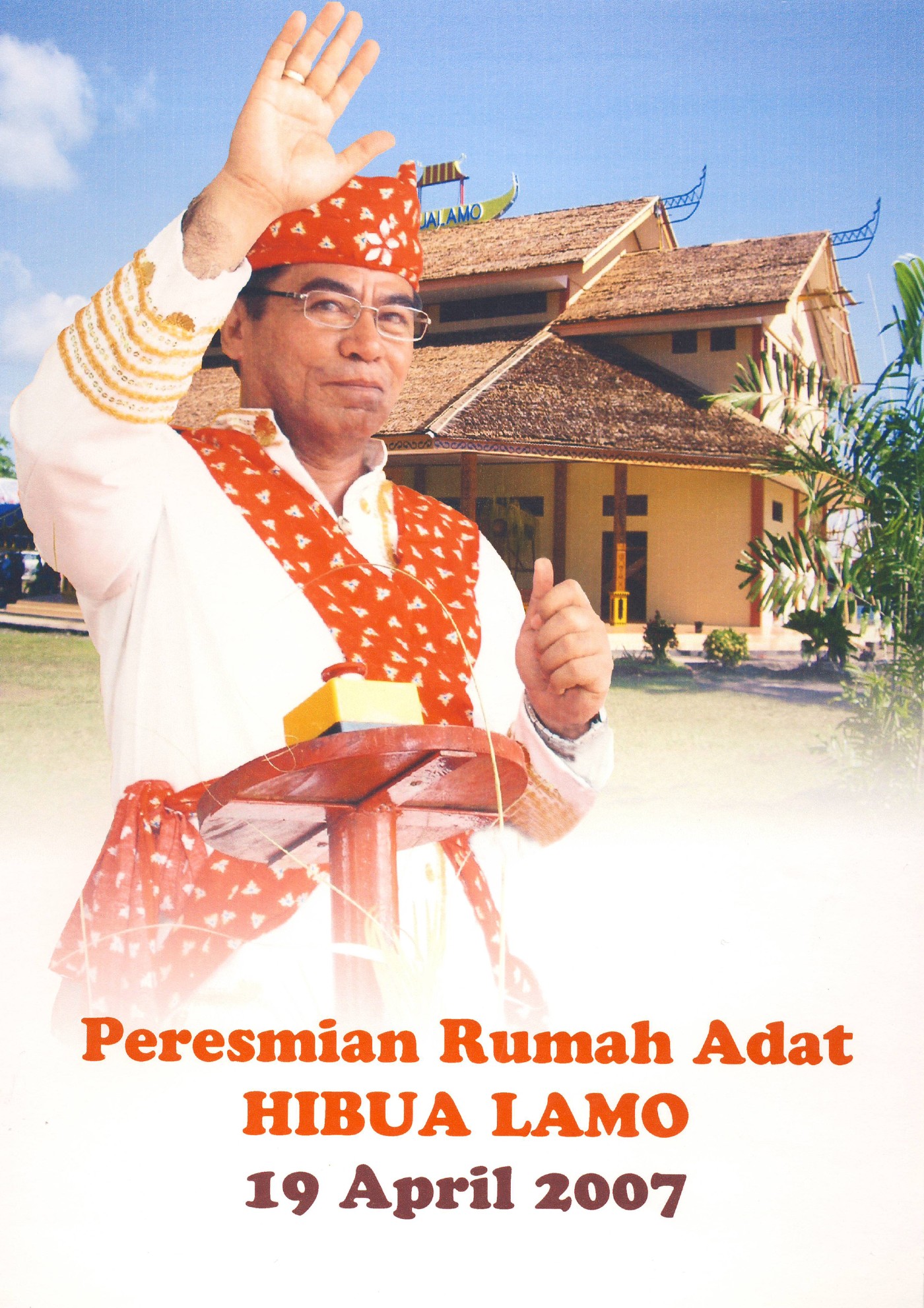
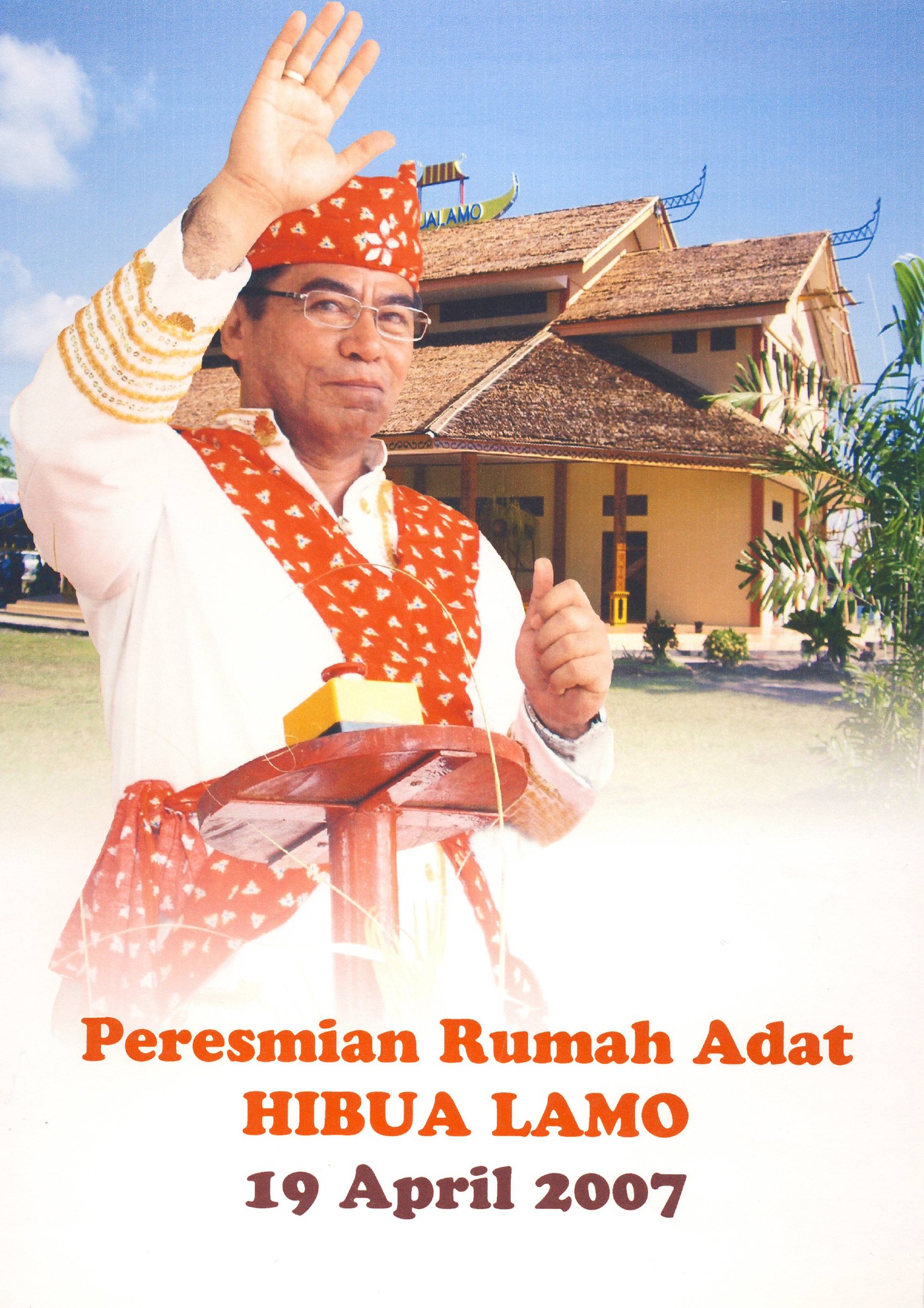
To promote the importance of adat, Namotemo appointed a special advisor on Tobelo adat issues when he was still the subdistrict head. This individual, who also serves as the secretary of the adat council, arranges adat displays and activities to accompany government ceremonies on Independence Day and other holidays and for government and church conferences. For example, he has introduced dances adapted from the now-abandoned healing ceremonies of the no longer existent local healers (Tobelo, o gomatere). He has also taken it upon himself to renew, if not create, other ceremonies, such as those surrounding the installation of the subdistrict head in 2001. Along these lines, he was the mastermind of the large-scale adat ceremony in which the newly elected district head was installed as the Jiko ma Kolano in 2005. He also teaches his version of Tobelo adat at a local college as part of its anthropology curriculum. In mid-2002, Namotemo and his adat advisor decided that building a hibualamo in every village in Tobelo would facilitate reconciliation and help maintain the peace. These hibualamo would serve as nongovernmental, nonreligious points of mediation and conflict resolution for Muslims and Christians, thus avoiding the religious and government institutions that had failed in 1999. According to one person involved in the project, they put together a proposal and asked the North Maluku Recovery program of the United Nations Development Programme (UNDP) to finance the initiative, but did not receive any funding.Footnote 20 Despite this lack of support, some efforts toward their goal have continued. One large hibualamo was formally opened in Tobelo town on April 19, 2007, on the sixth anniversary of the Tobelo peace ceremony (see figure 2).
Cover picture from a DVD produced by the district government commemorating the formal opening of a hibualamo in the district capital of Tobelo. The image shows a photograph of the district head (Indonesian, Bupati) of North Halmahera, Hein Namotemo, poised to hit a button that will open the hibualamo. His image is superimposed on that of the hibualamo in question. He is dressed in the traditional clothing (Indonesian, pakaian adat) of the Jiko ma Kolano. The DVD title translates as “Formal Opening of the Hibualamo Traditional Ceremonial House, 19 April 2007.” (Image courtesy of Studio 3 NTV, Tobelo, Halmahera Utara).
On April 19, 2008, and again in 2009 the district government held festivals at this large hibualamo to commemorate reconciliation and the importance of adat and the hibualamo in maintaining the peace. During the 2009 festivities, Namotemo noted the importance of the hibualamo when he said, “With this hibualamo traditional ceremonial house we have created a significant amount of peace in the region. And with these activities we continue to remember the moment of reconciliation so that people can live in safety and peace again” (Malut Post 2009). In May 2009, Namotemo issued an official memo asking that civil servants wear traditional costumes (Indonesian, pakaian adat) on the nineteenth of every month “to show appreciation and understanding of the eternal nature of reconciliation in the land of Hibualamo” (Rainu Reference Rainu2009).
The interest in adat revitalization is not limited to adat leaders and rural communities, but has support across various segments of Tobelo society. Those who support these efforts at revitalization span class, generation, educational background, and even ethnicity. A number of Chinese traders in Tobelo support these efforts and help fund activities, as well as attend adat council meetings, albeit only as observers. The newly established Peace Polytechnic of Halmahera, a local college, has a number of teachers and administrators (a number of whom also work as civil servants in the local government) who support these efforts at revitalization and have begun research projects that examine various aspects of Tobelo adat, in particular Tobelo notions of property rights (Pattiasina Reference Pattiasina2002). Those spearheading the movement tend to be Christian, but this stems largely from the fact that the decision to use adat as a guarantor of stability in Tobelo society was made soon after the end of hostilities, well after the Muslim community had fled. Thus, when the Muslim community returned to Tobelo, the focus on adat revitalization was almost a fait accompli. Despite their late arrival to the movement, numerous Muslim leaders in Tobelo and elsewhere support the move to use adat institutions to help maintain the peace.
Not everyone, however, views this new interest in adat as the proper choice for the future. Some argue that what is needed is a “new Halmahera,” one that leaves past traditions and tensions behind. Adat failed to prevent the violence, and then played a major role in the conflict—thus it has lost its utility and should be discarded. The few who vocally advocate this path tend to be people who have returned to North Maluku from Ambon or other major urban centers in Indonesia since the conflict ended. They believe that the way to ensure future stability is to embrace modernization. Some of those who make this case also argue that it is the place of religion to maintain the peace. These individuals tend to be more fervent Christians or modernist Muslims who see a return to adat as a divergence from Christianity or Islam. Their disparagement of local custom stems in part from its newfound popularity as a result of the conflict. For example, at a 2001 conference about reconciliation in Tobelo, the adat advisor to the subdistrict head introduced his version of a new dance based on former Tobelo healing rituals. The dance received a positive reaction from the all-Christian crowd. Many judged it suitable to compete with other indigenous dance forms in Indonesia. However, the performance upset some of the more fervent Christians in the audience. They saw it as a regression to pre-Christian belief systems and a threat to Christianity. At this same conference, one of these individuals gave a speech condemning the use of adat during the conflict, arguing that practices such as the use of magical charms were improper behaviors for Christians. Ministers and other leaders from various Christian churches also worry about the resurgence of pre-Christian beliefs.
Some Muslims also argue against the revitalization of adat. The reformist school of Islam, which advocates the rejection of local practices in an effort to more strictly follow the Qur'an, has a significant following in North Maluku, and Tobelo is no exception. There have been efforts in North Maluku to purge local practices from Islamic communities (Kiem Reference Kiem1995). For example, Christians from throughout North Maluku noted that Muslims had previously taken part in adat celebrations for Christian segments of the community and even took part in celebrations associated with Christmas and the New Year. Since 1981, because of a fatwa from the Indonesian Association of Ulama, certain segments of the Muslim community have stopped taking part in these activities. The idea of adat as a basis for community is largely antithetical to the beliefs of this segment of the Muslim community.
Adat and the Question of Exclusion
In a community recovering from religious conflict, it is important to examine how this new discourse of adat addresses religious differences. Other than some ardent Christians and modernist Muslims, many in Tobelo see the benefits that can be gained by accessing this rhetoric of adat. Christian Tobelo, who consider themselves the victors, see it as one way to further their own agenda without calling on the divisive anti-Muslim rhetoric prevalent during and immediately after the conflict. They can argue against certain state initiatives (which they often read as pro-Muslim) in terms of their incompatibility with local adat. Muslims see similar benefits. They suffered a complete defeat in Tobelo and for more than two years were in exile. Their previous positions in local economies were usurped by local Christians or by the thousands of Christian IDPs in the subdistrict who have no plans to leave.Footnote 21 The rhetoric of adat allows them a forum, and an opportunity, to reintegrate themselves into the Tobelo economy and the larger community without resorting to religious labels. They can demand inclusion as Tobelo, rather than asking for it as Muslims and potentially reigniting tensions along religious lines. Their return demonstrates their intent to reenter Tobelo society, and one way to facilitate this return and reintegration is through the hibualamo.
Although this adat revival may be inclusive in terms of religious differences, economic differences (there are both middle-class civil servants as well as poorer village-based farmers on the council), and gender (there are female members on the council), other factions in Tobelo society remain unrepresented or underrepresented. Questions remain concerning the role of non-Tobelo in this new adat community. Will the various migrants to the region, such as forced migrants, transmigrants, and others, be welcome in the hibualamo and allowed to play a role in community affairs? A number of non-Tobelo support this initiative, and several prominent Chinese businesspeople in Tobelo have taken an active role in facilitating and funding various activities. Supporters of adat revitalization argue that the concept of the hibualamo includes everyone who lives in the Tobelo region, regardless of ethnicity or religion. One explanation of how outsiders fit in is based on the following story:
One day [in the past] a few Tobelo were sewing thatch made from sago palm leaves to make a communal house [Tobelo, o halu], apparently an Arab and a few Chinese passed by. Suddenly they sat down with the Tobelo and each person sewed one section of thatch. After [they finished their thatch] they excused themselves to continue on their journey. Before they left, the Tobelo promised that when the halu was finished being constructed, the Arab and even the Chinese had the right to use the halu as a hibualamo, a place for discussion and deliberation, as long as they lived together. (Namotemo Reference Namotemo2001)
The inclusion of nonindigenous communities under the banner of hibualamo was vividly displayed in the community festival (Indonesian, pesta rakyat) that followed the installation of the first directly elected district head of North Halmahera in 2005. As part of this festival, ethnic groups from throughout the district performed cultural displays. These included performances by local groups as well as migrants, such as the Javanese, Chinese, and Sangir. Organizers argued that the inclusion of these performances, and their placement on par with local cultural traditions, demonstrated the inclusive nature of the hibualamo and Tobelo society.
Proponents of the current notion of the hibualamo stress inclusiveness and argue that everyone, regardless of ethnicity, religion, or place of origin, is included. As one man put it, “Everyone is welcome in the hibualamo, as long as they are good houseguests.” This statement leaves unanswered the question of who decides what constitutes a good houseguest. For example, during the tensions preceding the outbreak of violence in 1999, one faction in Tobelo sought to have the ethnic Tidore, Ternate, and Makian (almost all of whom are Muslim) removed from the subdistrict until tensions eased. In response, another faction made a similar request, asking that all the Ambonese (a large number of whom are Christian) return to Ambon (Duncan Reference Duncan2005, 70). One of the general beliefs of that time period was that, if left to their own devices, the Tobelo could avoid violence, but the presence of outsiders threatened their ability to so. Thus, once the peace was threatened, certain migrants were no longer welcome in Tobelo by certain factions of the Tobelo community. Although adat is currently seen as an argument for inclusion, it could eventually be used as a tool of exclusion.
Another troublesome tendency visible in Tobelo desires to re-create these adat mechanisms is an inclination toward homogenization. Proponents of adat revitalization often fuse different ethnic groups together under the rubric of “Tobelo” to suit their needs. In some cases, they have argued for the establishment of district-wide adat practices, which could be read as the expansion of Tobelo adat to cover the Galela, Loloda, Modole, Pagu, and other indigenous groups in the district of North Halmahera. For example, in their effort to build new hibualamo as points of mediation, the subdistrict head and others wanted to build them in every village in the subdistrict of Galela as well. The subdistrict of Galela consists largely of Galela-speaking communities who recognize themselves as ethnically distinct from the Tobelo. The Galela have a different notion of what constitutes a traditional ceremonial house (Galela, o bangsaha), and it was not seen to play a uniting role similar to the hibualamo, but simply was seen as a (now-defunct) style of communal house. The cultural practices of the Galela made no difference to the plans of the Tobelo elite. Some have complained that this reductionism is in fact cultural chauvinism on the part of the Tobelo.
Proponents of this view note that the installation of the newly elected district head (Indonesian, Bupati) as the Ruler of the Bay was almost entirely based on Tobelo adat, although there was a choral performance by some Galela women. The official commentary accompanying the ceremony was in three languages: Indonesian, Tobelo, and English (the last for the benefit of foreign guests). Other indigenous groups were included in the ceremony; for example, as the Ruler of the Bay's procession marched from his house to the ceremonial field, he was met by representatives from each societal group (Tobelo, o hoana) in North Maluku, which included delegations from the Tobelo, the Modole, the Pagu, and the Galela. But the Makian, the ethnic group at the heart of the 1999 conflict, were not recognized as a distinct group, but rather were subsumed as part of the Pagu delegation. Neither the Makian nor the Pagu consider the Makian to be part of the Pagu ethnic group. One local journalist raised the question (off the record) about what would happen if the next district head was Makian. It is highly unlikely that the people of Tobelo would allow such a ceremony to be replaced by one based on Makian adat. Alternatively, it is equally unlikely that a Makian district head could be forced to use Tobelo adat in any such ceremony.
Although many in Tobelo are hoping that the revitalization of adat will enable them to avoid future outbreaks of violence, they run the danger of simply shifting the locus of differentiation to ethnicity. This shift from religion to adat is not only a new form of inclusiveness, but also is a new mode of exclusion. It shifts the us/them dichotomy from Muslim/Christian to Tobelo/non-Tobelo. A reliance on adat for conflict resolution purposes can pose, or create, a problem in regions that contain multiple indigenous ethnic groups as well as migrants (see Davidson Reference Davidson, Davidson and Henley2007; Li Reference Li2002). For example, migrants, many of whom lack valid adat-based claims to their land or to their status in local society, are unlikely to submit to indigenous power structures from which they are excluded. In some places in Indonesia, the decision not to rely on adat has been a positive one in efforts to end or prevent conflict (Acciaioli Reference Acciaioli2001). Decisions regarding which adat system to prioritize could lead to conflict among competing indigenous groups in Halmahera. As some critics in Tobelo have noted, this attempt to articulate a new sense of Tobelo identity, one that focuses on a shared Tobelo adat between Muslim and Christian Tobelo, does not address interethnic issues across the district.
Fears of future ethnic conflict do not obviate the need to solve the current religious tensions that plague communities in postconflict Tobelo and elsewhere in North Halmahera.Footnote 22 The national and provincial governments are currently not pursuing reconciliation or conflict resolution activities in North Maluku, such as truth and reconciliation committees or criminal trials. Ideas of restorative justice, such as those being pursued in East Timor by the Timorese Commission for Reception, Truth and Reconciliation (see Babo-Soares Reference Babo-Soares2004; Gorjão Reference Gorjão2001), appear to have been deemed inappropriate or not conducive to peace. Before the first meetings to resolve the conflict in northern Halmahera, both sides agreed that discussing the violence would only prolong the conflict and that it would not be conducive to peace to attempt to assign blame or guilt. Thus, the conflict, its causes and consequences, and its victims and perpetrators are, for the moment, rarely discussed in formal intergroup settings, and the topics of justice and accountability are simply not on the table. The proponents of adat, however, are not interested in revisiting the violence, but rather in preventing it from happening again.
Conclusion
Looking at the attempt by some in Tobelo to revitalize adat as a process of articulation rather than as an invention of tradition has several strong points in a postconflict situation such as North Maluku. In addition to circumventing unconstructive debates about “authenticity,” the notion of articulation allows observers to move beyond a monolithic and static notion of what qualifies as “Tobelo adat.” Tobelo adat has always been in flux and has often been a matter of debate in local communities. As a result, it has varied from village to village throughout North Maluku, particularly in the case of different religious affiliations (e.g., Christian, Muslim, or, until recently, followers of the indigenous cosmology).Footnote 23 Tobelo Christians share a set of adat practices associated with their religious affiliation that differ from, and in some cases are mutually exclusive of, practices shared by Tobelo who are Muslim. Hall's idea of articulation provides room for these differences in a rearticulated Tobelo adat when he notes that “an articulation between different practices does not mean that they become identical or that one is dissolved into the other. Each retains its distinct determinations and conditions of existence. However once an articulation is made, the two practices can function together, not as an ‘immediate identity’ … but as ‘distinctions within a unity’” (Reference Hall1985, 113–14 n. 2; see also Hall Reference Hall1980, 325). Thus, in the Tobelo case, we can better understand how Tobelo Muslims continue to practice their “Tobelo adat,” which includes practices related to their Muslim beliefs, while Tobelo Christians do the same. At the same time, they both can call on the rhetoric of adat institutions such as the hibualamo to maintain their unity in the face of religious-based provocation.
Although the revitalization of adat may not be a panacea or prevent all future conflicts in the region, it does offer one possible avenue for easing the religious tensions present in postconflict North Halmahera. As a significant amount of the recent violence in Indonesia has been based on religion to one degree or another, a focus on easing religious tensions would seem an appropriate focus for Tobelo leaders. Rearticulating a Tobelo identity based on shared adat and language does not preclude eventually articulating some sort of pan–northern Halmahera identity in the future, based on linguistic and cultural similarities or political interests. As I have argued, and as Hall's notion of articulation suggests (Reference Hall1985, 113), identities, whether cultural or political, can be rearticulated. As Hall notes elsewhere, “Identity is not in the past to be found, but in the future to be constructed” (Reference Hall1995, 14). It is this future construction, or articulation, of Tobelo identity that is the main concern of proponents of adat in Tobelo as they seek to prevent further outbreaks of communal violence in the region.
Acknowledgments
This paper is based on fieldwork carried out in North Sulawesi and North Maluku from June 2001 through November 2002 sponsored by LIPI and Universitas Sam Ratulangi and in North Maluku in 2005 sponsored by LIPI and Politeknik Perdamaian Halmahera. The research was funded at various points by the Anthropologists' Fund for Urgent Anthropological Fieldwork in coordination with the Royal Anthropological Institute and Goldsmiths College of the University of London and by a Research and Writing Grant from the John A. and Catherine T. MacArthur Foundation. Previous versions of this paper were presented at Yale University Southeast Asia Studies, the Southeast Asia Program at Cornell University, and the 2002 Annual Meeting of the American Anthropological Association. I would also like to thank Lorraine Aragon, Jesaya Banari, Nils Bubandt, Richard Fox, Ken George, James Hagen, Pamela McElwee, James Rush, Mark Woodward, and two anonymous reviewers for their insightful comments.