Introduction
Ionising radiation applied to the cervical region can cause hypothyroidism, as the thyroid gland is included in the irradiated area.Reference Smith, Smith, Giordano, Shih, Woodward and Strom 1 , Reference Aich, Ranjan, Pal, Naha and Amitabh 2 Subclinical hypothyroidism usually develops (elevated thyroid-stimulating hormone (TSH) levels with normal free thyroxine (T4) levels). This can remain stable for years or progress to a clinical form (elevated TSH levels with decreased T4 levels).Reference Sinard, Tobin, Mazzaferri, Hodgson, Young and Kunz 3 Thyroid dysfunction usually remains undiagnosed for a long time because symptoms, which include asthenia, depression, fatigue, weight gain, skin changes or dyslipidaemia,Reference Alterio, Jereczek-Fossa, Franchi, D'Onofrio, Piazzi and Rondi 4 , Reference Lo Galbo, de Bree, Lips and Leemans 5 are often non-specific, and are attributed to the disease or treatment. Diagnosis during the subclinical phase is important to avoid evolution to the clinical form.Reference Karmisholt, Andersen and Lauber 6
We performed a long-term follow-up study to evaluate the incidence of hypothyroidism in patients treated with radiotherapy (RT) for head and neck carcinoma in our hospital. The influences of variables related to the patients, tumours and treatments were analysed.
Materials and methods
This prospective study entailed a standardised follow up of thyroid hormone levels in patients diagnosed with head and neck tumours in our department between 2000 and 2009. All procedures were approved by the institutional review board and all patients signed a consent form.
A total of 263 patients were treated with RT alone or RT combined with surgery and/or chemotherapy. Twenty-two patients were excluded: 12 did not complete follow up, 8 had previous thyroid disease, 1 was irradiated previously for lymphoma and 1 underwent total thyroidectomy. The remaining 241 patients were included in the study.
The TSH, free T4 and triiodothyronine levels were measured for five years. Measurements were made 3, 6 and 12 months after completing RT, and then annually for the first 5 years. Patients diagnosed with hypothyroidism were admitted to the endocrinology department for further studies.
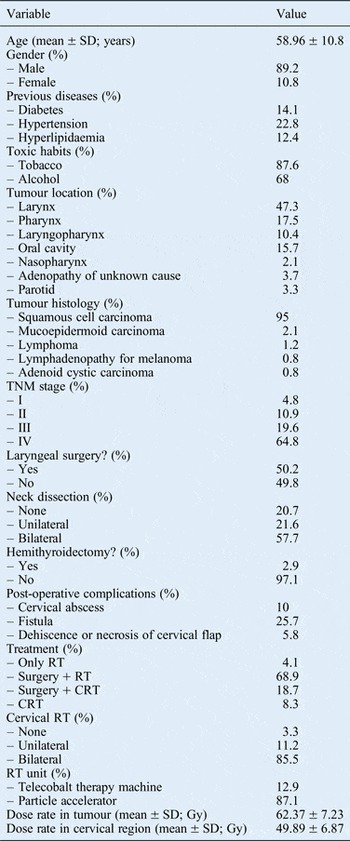
The variables analysed in this study are shown in Table I. Statistical analyses were performed (using SPSS software, version 12.0 (SPSS, Chicago, Illinois, USA)) to assess the relationships between the variables and hypothyroidism. Non-parametric contrast tests (chi-square, Mann–Whitney and Kruskal–Wallis tests) were used to assess possible relationships between pairs of variables, and logistical regression models were used to analyse multivariate relationships. A p value of less than 0.05 was considered significant.
Study variables

Total n = 241. SD = standard deviation; TNM = tumour–node–metastasis classification; RT = radiotherapy; CRT = chemoradiotherapy
Results
Hypothyroidism was detected in 52.7 per cent of irradiated patients. Within this group, 71.7 per cent developed subclinical hypothyroidism and 28.3 per cent developed clinical hypothyroidism.
Significant variables included tumour location, laryngeal surgery type, neck dissection type, cervical RT, RT unit type (linear particle accelerator or telecobalt therapy technology) and post-operative complications (Table II). No relationships were detected between hypothyroidism and the population-related variables in the multivariate analysis.
Variables related to hypothyroidism onset*

Data represent percentages of patients, unless indicated otherwise.
* p < 0.05. †Total n = 241; ‡ n = 114 (47.3 per cent); **n = 127 (52.7 per cent). RT = radiotherapy
Among the tumour-related variables, only tumour location was significantly associated with the development of hypothyroidism. Of those who developed hypothyroidism, 72 per cent (n = 18) had laryngopharyngeal tumours, 63.2 per cent (n = 72) had laryngeal tumours, 60 per cent (n = 3) had nasopharyngeal tumours, 42.9 per cent (n = 18) had pharyngeal tumours, 33.3 per cent (n = 3) had adenopathy of unknown cause, 31.6 per cent (n = 12) had oral cavity tumours and 12.5 per cent (n = 1) had a parotid tumour. Tumour–node–metastasis stage and histology did not influence hypothyroidism development.
Treatment-related variables related to hypothyroidism included: laryngeal surgery (61.4 per cent of patients), neck dissection (42 per cent of patients who had no neck dissection developed hypothyroidism vs 44.2 per cent and 59.7 per cent who underwent unilateral and bilateral neck dissection, respectively), post-operative complications (79.2 per cent of patients with cervical infection, 67.7 per cent with fistula and 78.6 per cent with partial neck flap necrosis), cervical RT (12.5 per cent of patients who did not receive RT developed hypothyroidism vs 40.7 per cent and 55.8 per cent who received RT on one or both sides, respectively), and RT unit type (49.5 per cent of patients irradiated with a linear particle accelerator vs 74.2 per cent treated with telecobalt therapy technology).
Telecobalt therapy and laryngeal surgery both influenced the development of hypothyroidism according to logistical regression models.
Approximately 48 per cent of patients were diagnosed with hypothyroidism during the first year of the study: 14 per cent were diagnosed after three months of RT, 9.3 per cent after six months and 23.7 per cent at one year. Notably, in 7.69 per cent of patients, hypothyroidism was detected five years after RT (Figure 1).
Percentage of patients with hypothyroidism according to time of onset post-radiation.

Discussion
Treatment for subclinical hypothyroidism is recommended, to normalise TSH levels, in the following situations: in patients positive for peroxidase antibodies; in those with goitre; in patients with TSH levels over 10 mU/l; following radioiodine, RT or thyroidectomy; in patients with major depression or cyclothymia; and in pregnant, infertile or amenorrhagic women.Reference Lucas Martin 7 Treatment can prevent evolution to clinical hypothyroidism and correct the increased risk for cardiovascular pathology (e.g. atherosclerosis, hypertension).Reference Jereczek-Fossa, Alterio, Jassem, Gibelli, Tradati and Orecchia 8
The incidence of hypothyroidism after RT in patients with head and neck cancer is 15–50 per cent.Reference Ho, Ho, Lam, Yuen and Wei 9 – Reference Kumpulainen, Hirvikoski, Virtaniemi, Johasson, Simonen and Treävä 13 Radiotherapy combined with surgery increases the incidence of hypothyroidism.Reference de Bree, Lips and Leemans 14 , Reference Ozawa, Saitou, Mizutari, Takata and Ogawa 15 Several pathogenic mechanisms have been reported to explain hypothyroidism in these patients, such as surgical manipulation of the gland during laryngeal surgery, vasculitis due to RT, cellular lysis, and autoimmune processes with antibody formation.Reference Jereczek-Fossa, Alterio, Jassem, Gibelli, Tradati and Orecchia 8 , Reference Alkan, Baylancicek, Ciftçic, Sozen and Dadaş 11 , Reference Gal, Gal, Klotch and Cantor 16 , Reference Bhandare, Kennedy, Malyapa, Morris and Mendenhall 17
In our series, the combination of laryngeal surgery and telecobalt therapy was the principal risk factor for developing hypothyroidism, which was attributed to the stress of laryngeal surgery on the thyroid gland. Handling and ligation of vessels could compromise the blood supply to the thyroid, which could induce development of gland dysfunction when RT is applied.Reference Smolarz, Malke, Voth, Scheidhauer, Eckel and Jungehülsing 18 Neck dissection was related to the incidence of hypothyroidism for the same reason, and the incidence was higher in our series when bilateral neck dissection was performed.
Post-operative complications are associated with the development of hypothyroidism. Post-operative complications have previously been associated with hypothyroidism, but they have been considered a consequence. Hypothyroidism induces a delay in wound healing, which can influence the development of complications.Reference Alkan, Baylancicek, Ciftçic, Sozen and Dadaş 11 , Reference Gal, Gal, Klotch and Cantor 16 , Reference Bohannon, Carrol, Magnuson and Rosenthal 19 This is the first report suggesting that surgical complications can cause hypothyroidism in these patients. Infection may induce necrosis of the thyroid parenchyma and thyroiditis as a result of local inflammation. Furthermore, salivary enzymatic action should be considered in cases of a fistula.
Tumour location determines the type of surgery and RT. The thyroid gland is necessarily included in the irradiation field when laryngeal and laryngopharyngeal tumours are irradiated. The patients in our study who received RT on both neck sides were more likely to develop hypothyroidism than those receiving radiation on one side or those who did not require cervical RT.
Radiation dose was not related to the occurrence of hypothyroidism in our series. This is most likely because the radiation doses used for oncological pathology of the head and neck were very similar in all patients.
-
• The incidence of hypothyroidism in radiotherapy (RT)-treated head and neck cancer patients was analysed
-
• In this series, laryngeal surgery and telecobalt therapy were principal risk factors for developing hypothyroidism
-
• Surgical complications could cause hypothyroidism after RT
A higher incidence of hypothyroidism was detected in patients treated using telecobalt therapy than in patients treated with a linear particle accelerator. The irradiation fields are broader when using cobalt therapy than those created by particle accelerators;Reference Kumpulainen, Hirvikoski, Virtaniemi, Johasson, Simonen and Treävä 13 thus, a greater amount of the thyroid parenchyma is included in the former. In addition, the particles used in cobalt therapy are photons, which have less energy than linear accelerator-generated particles. As photons have low energy, they do not penetrate deep inside tissues; the energy is instead concentrated on superficial planes.
The effect produced by RT is progressive; therefore, the occurrence of hypothyroidism may be delayed. In our series, approximately 7.7 per cent of hypothyroidism cases were diagnosed five years after RT, which is why thyroid function should be monitored long-term in these patients.
Conclusion
The rate of hypothyroidism after RT in patients treated for head and neck carcinoma was 52.7 per cent. Hypothyroidism was more common in patients who underwent laryngeal surgery and received complementary telecobalt therapy than in patients treated in other ways, particularly if they received telecobalt therapy on both sides of the neck. Post-operative complications were associated with the occurrence of hypothyroidism after RT. A standardised analysis should be carried out every six months and performed up to five years after RT in these patients.