Dietary recommendations indicate a reduction of fat intakes, in terms of saturated and trans fatty acids, and of fat of animal origin. Milk fat has been criticised because it contains low concentrations of polyunsaturated fatty acids (PUFA), 20 to 25% of monounsaturated fatty acids (MUFA), and more than 70% of saturated fatty acids (SFA) (Kennelly, Reference Kennelly1996). Nevertheless, fat of milk and dairy products contains minor fatty acids, which are considered health-promoting, such as vaccenic acid (VA, trans-11 C18:1) and rumenic acid (RA, cis-9, trans-11 C18:2) that are the principal naturally occurring anticarcinogens (Bauman et al. Reference Bauman, Lock, Corl, Ip, Salter, Parodi, Sejrsen, Hvelplund and Nielsen2006). RA mainly derives from endogenous synthesis through the desaturation of VA by Δ9-desaturase in the mammary gland and represents the most important isomer of naturally occurring conjugated linoleic acid (CLA) isomers in milk and dairy products. Milk and dairy products are the most important food source of CLA, accounting for about 70% of total food intake of CLA in the USA (Ritzenthaler et al. Reference Ritzenthaler, McGuire, Falen, Shultz, Dasgupta and McGuire2001). As a consequence, improving milk fat by reducing SFA, such as C12:0, C14:0, and C16:0, which have hypercholesterolemic effects, and increasing MUFA and PUFA, such as VA and RA, could have a potential outcomes on human health. Variations in PUFA content of milk can be achieved mainly by the diet of ruminants (Woods & Fearon, Reference Woods and Fearon2009; Jutzeler van Wijlen & Colombani, Reference Jutzeler van Wijlen and Colombani2010). Animal studies indicated that about 800 mg CLA/d are required to obtain biological effects in humans (Watkins & Li, Reference Watkins, Li, Sébébio, Christie and Adlof2003), but further studies are needed to test the effects of naturally CLA-enriched food on human health by clinical trials. As a consequence, there is a growing interest in the development of dairy products naturally enriched in PUFA and in CLA in particular, to be tested for their biological effects on human health.
Generally, milk processing has a moderate impact on PUFA content of cheeses, which is directly related to the initial PUFA content of milk (Jones et al. Reference Jones, Shingfield, Kohen, Jones, Lupoli, Grandison, Beever, Williams, Calder and Yaqoob2005; Allred et al. Reference Allred, Dhiman, Brennand, Khanal, McMahon and Luchini2006). Avramis et al. (Reference Avramis, Wang, McBride, Wright and Hill2003), however, suggested that milk from cows fed a fish meal supplementation can have different processing properties compared with conventional milk, because alterations in size of casein micelles and in protein distribution, as well as in the distribution of fat globule diameter were found.
In a previous paper Caroprese et al. (Reference Caroprese, Marzano, Marino, Gliatta, Muscio and Sevi2010) found that feeding flaxseed to dairy cows can be considered a strategy to increase both fat content and yield, improving both composition and nutritional properties of milk. In addition, both flaxseed and fish oil supplementation to dairy cows contributed to improve the healthy properties of milk, enhancing the CLA content of milk suggesting its consumption to benefit human health. Mozzarella cheese is a pasta filata cheese, a typical dairy product of Southern Italy, now widely manufactured and consumed around the world as a table cheese. To our knowledge no studies evaluating the effects of using milk naturally-enriched with PUFA to manufacture Mozzarella cheese have been reported.
We considered of some importance firstly to evaluate the possibility to improve the fatty acid profile of Mozzarella cheese by supplementing the diet of dairy cows. Secondly, we believe it could be of interest to verify the potential differences in processing a conventional milk or a PUFA-enriched milk into Mozzarella cheese by the application of a traditional protocol. The hypothesis is that conventional and PUFA-enriched milk could have different processing properties which could result in differences in chemical and textural peculiarities of Mozzarella cheese.
The aim of this study was, therefore, to evaluate chemical and textural properties of Mozzarella cheese made from milk naturally enriched in PUFA using flaxseed or fish oil as lipid supplement in cow's diet.
Materials and methods
Animals, experimental design, and dietary treatments
The experiment was conducted on a commercial farm in Southern Italy. A 12 week trial was performed using 24 Italian Friesian cows, divided into 3 groups of 8 animals. Treatments involved feeding diets with different source of fat supplementation, flaxseed or fish oil, according to Caroprese et al. (Reference Caroprese, Marzano, Marino, Gliatta, Muscio and Sevi2010). Control cows (CT) fed a basal diet containing dry cracked corn (5·70%), oat hay (32·9%), concentrate (61·4%) and no supplemental fat; flaxseed cows (FS) fed a diet containing 1·2 kg/d of whole flaxseed in substitution of an equal amount of concentrate, and fish oil cows (FO) fed a diet containing 200 g/d of microencapsulated fish oil (Orovital Cod, Ascor Chimici srl, Capocolle di Bertinoro, Italy) in addition to control diet. Formulation of experimental diets and chemical composition of the diets has been shown in Caroprese et al. (Reference Caroprese, Marzano, Marino, Gliatta, Muscio and Sevi2010). The ether extract contents of FS and FO diets were 5·31 and 3·46%, respectively (DM basis).
Milk sampling and analysis
At the end of the 12-week trial the bulk milk from each group was collected at afternoon and morning milking for cheese making. Three samples of bulk milk from each group were used for chemical analysis consisting in the following measurements: total protein, fat and lactose content using an infra red spectrophotometer (Milko Scan 133B; Foss Electric, Hillerød, Denmark) according to the International Dairy Federation standard (IDF, 1990). Somatic cell count (SCC) was determined using a Foss Electric Fossomatic 90 cell counter (IDF, 1995). Renneting characteristics (rennet coagulation time, rate of clot formation, and clot firmness after 30 min) were measured by a Foss Electric formagraph (Foss Electric, Hillerød, Denmark) according to Zannoni & Annibaldi (Reference Zannoni and Annibaldi1981).
Mozzarella cheese manufacture
Bulk milk collected separately from each group was stored under refrigeration at 4 °C and transported in tanks to a dairy plant to be processed for Mozzarella cheese production. Two mozzarella cheese-making trials were performed for each experimental group, according to a traditional protocol. Briefly, raw milk was heated at 36 °C in three different cheese vats and inoculated with Streptococcus thermophilus (CR 73, Chemiferm, Lodi, Italy) until pH reached 5·3. Subsequently, in each vat, liquid rennet was added to inoculated milk favouring the formation of a soft and delicate curd. When the curd was firm (approximately after 30 min), it was horizontally and vertically cut to facilitate the drainage of whey and then cut again to hazelnut-size (30×30×30 mm) pieces. The curd was allowed to ripen for about 3 h 30 min, and subsequently stirred to facilitate whey ejection. The cheese curds were then milled, stretched, and moulded by hands in hot water of about 82 °C until they were adequately smooth and elastic. Mozzarella balls of about 50 g were formed and placed into cold water (4 °C). Packaged Mozzarella cheeses were immersed in brine (10% NaCl) and transported to our laboratory where they were sampled and stored at −20 °C until analysis. The average pH of Mozzarella cheese was 5·3±0·2.
Whey and Mozzarella cheese chemical analysis
Whey samples were analysed for fat, protein, lactose content as for milk samples. A total of 18 samples of Mozzarella cheeses were used for chemical analyses. The moisture and ash contents were determined according to IDF (1986), and AOAC (2000), respectively. Ash was analysed for Ca determination through titration with potassium permanganate (IDF, 1992), while fat content of cheeses was determined by Soxhlet extraction method using petroleum ether. Total Nitrogen (TN), Non-Protein Nitrogen (NPN), Non-Casein Nitrogen (NCN) were determined using kjeldahl method as described by Gripon et al. (Reference Gripon, Desmazeaud, Le Bars and Bergere1975). TN minus NPN yielded casein nitrogen, NCN minus NPN yielded whey proteins. The level of phosphotungstic acid-soluble nitrogen (PASN) was determined as reported in Gripon et al. (Reference Gripon, Desmazeaud, Le Bars and Bergere1975).
Mozzarella fatty acids composition
Lipid extraction from Mozzarella Cheese was based on the method of Bligh & Dyer (Reference Bligh and Dyer1959) as described by Lin et al. (Reference Lin, Boylston, Chang, Luedecke and Shultz1995). Mozzarella samples (6 g) were mixed with 24 ml distilled water and homogenised with methanol and chloroform using an Ultra Turrax homogeniser (Diax 600, PBI International) at 13 500 rpm. The chloroform-lipid extracts were concentrated (Büchi Rotavapor R200/B490) at 37 °C and were recovered for methylation (ISO-IDF, 2002). Fatty acid methyl esters (FAME) were analysed immediately on an Agilent gas-chromatograph (model 6890N; Agilent Technologies, Inc.) equipped with an automatic on-column injector (Agilent 7683 Series; Agilent Technologies, Inc.) and a flame ionisation detector (FID). Fatty acids were injected through the split injector port and separated using a capillary column Agilent HP88 (100 m length, 0·25 mm internal diameter, 0·20 μm film thickness).
The injector and flame-ionisation detector temperatures were set at 260 °C and the chromatographic analysis involved a run temperature programmed starting at 100 °C, with a step up ramp of 3·5 °C/min to 240 °C, and held for 15 min. The total run time was 50 min.
The split ratio was 1 : 50 and He was used as a carrier gas at a pressure of 5 bar and a linear velocity of 1 ml/s. The percentage of each fatty acid was calculated by diving the area under fatty acid peak by the sum of the areas under the total reported fatty acid peaks. Eight measurements replication were made on each Mozzarella cheese group. Atherogenic (AI) and Trombogenic (TI) indexes were calculated according to Ulbricht & Southgate (Reference Ulbricht and Southgate1991) formula:
 $$\eqalign{ {\rm AI} &= ({\rm C}12:0 + 4 \times {\rm C}14:0 + {\rm C}16:0) \cr & \left[ {\left( {\sum {\rm MUFA} + \sum {\rm PUFA}(n - 6)\;{\rm and}\;(n - 3)} \right)} \right]; \cr {\rm TI} &= ({\rm C}14:0 + {\rm C}16:0 + {\rm C}18:0)/[(0{\cdot}5 \cr & \times \sum {\rm MUFA} + 0{\cdot}5 \times \sum {\rm PUFA}(n - 6) + 3 \cr & \times \sum {\rm PUFA}(n - 3) + (n - 3)/(n - 6)].} $$
Textural profile analysis
Textural properties of the cheeses were determined by texture profile analysis (TPA). The TPA (Metzger et al. Reference Metzger, Barbano, Kindstedt and Guo2001) was conducted using an Instron Universal Testing Machine (model 3343; Instron Ltd, High Wycombe, UK) equipped with a 500 N load cell and a flat plunger. Eight cheese samples of each group were equilibrated at 4 °C overnight; then, a sample cylinder (20 mm in diameter×20 mm high) was obtained from each Mozzarella cheese using a cylindrical corer. Test portions were wrapped with plastic film, placed in a plastic bag; 1 h before the test, the bags containing the test portions were placed in a water bath at 10 °C. To start the test, the cheese cylinder was removed from the bag and immediately compresses twice by 75% of their original height with a crosshead speed of 12·7 cm/min at room temperature (21–22 °C). The cheese sample was placed at the centre of the base plane of the instrument with the fibres in perpendicular direction to the surface of plane; the test took about 25 s. The core temperature of samples was 10 °C at the beginning of the test whereas at the end it was about 13±1 °C. The texture profile parameters such as hardness, cohesiveness and springiness were determined from the force-time curve obtained during cheese compression as defined by Bourne (Reference Bourne1978).
Statistical analysis
All variables were tested for normality using the Shapiro–Wilk test (Shapiro & Wilk, Reference Shapiro and Wilk1965). Then, data were processed by ANOVA, using the GLM procedure of SAS (1999). The variation due to the fat supplementation was tested. When significant effects were found (at P<0·05), the Student t-test was used to locate significant differences between means.
Results and discussion
Milk composition
This study was performed to evaluate chemical and physical features of Mozzarella cheese made with milk naturally-enriched with PUFA.
Chemical composition and renneting parameter of bulk milk as affected by dietary treatment are reported in Table 1. FS bulk milk had the highest content of fat, protein, and lactose; FO displayed intermediate levels except for protein content whereas CT bulk milk had the lowest levels of these components. FS supplementation influenced bulk milk composition evidencing the role of flaxseed in improving fat content. Milk fat displays an important role in cheese manufacture because it acts as a plasticiser, affects cheese flavour by its fatty acid profile, and is a solvent for flavour compounds produced from lipids, proteins, and lactose (Fox et al. Reference Fox, Guinee, Cogan, McSweeney and Fox2000). Fat supplementation can affect milk fat content depending on several factors, including the source of fat, and the level of supplementation. The increase in milk protein content could be the result of a decrease in the ruminal degradability of protein given with the whole flaxseed. Indeed, the administration of whole flaxseed (i.e. non-decorticated and non-extruded) could have increased the amino acid availability for protein synthesis in the mammary gland by increasing the flow of nitrogen to the duodenum, due to bypass protein content of whole flaxseed. The combination of increased fat, and protein content can be responsible for reduced rennet coagulation time observed in FS milk (P<0·001) in association with SCC content that was lowest in FS milk (126×103 cells/ml vs. 277 and 355×103 cells/ml ±4·74 in CT and FO, respectively). The increased number of fat globules in FS milk can cause the gel strands to be more elongated to occlude the fat globules, and this can result in thinner and weaker gel strands (Fox et al. Reference Fox, Guinee, Cogan, McSweeney and Fox2000). This observation may help to explain the reduced curd firmness measured in FS than in CT milk (P<0·001), together with a possible difference in composition of milk protein in FS milk. Previous authors found a different distribution of milk protein after supplementation of dairy cows with fish meal (Avramis et al. Reference Avramis, Wang, McBride, Wright and Hill2003). FO milk displayed intermediate features between FS and CT milk. Fish oil supplementation had a slight effect on milk composition, and this may be ascribed to two different factors: first of all it could be argued that the amounts of fish oil administrated in the supplementation were not enough to induce an evident improvement of milk quality; secondly a possible rumen biohydrogenation of the fish oil may have occurred, thus thwarting the expected improvement of milk composition.
Least squares means±sem of chemical composition, and renneting parameters of bulk milk from cows fed control diet (CT), and fish oil (FO), and flaxseed (FS) supplemented diets

a,b,c Means within a row with different superscripts differ (P<0·05)
NS, not significant, *P<0·05, **P<0·01, ***P<0·001
Whey and Mozzarella cheese composition
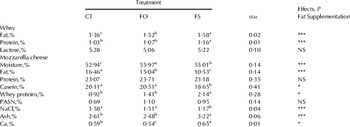
Whey and Mozzarella cheese composition are reported in Table 2. The fat content of whey from both FS and FO milk was higher than in the control. Such an increase of fat loss in the whey was also observed by other authors, when processing milk from sheep supplemented with 18 and 26% flaxseed in the diet, and milk enriched with CLA (Jones et al. Reference Jones, Shingfield, Kohen, Jones, Lupoli, Grandison, Beever, Williams, Calder and Yaqoob2005; Zhang et al. Reference Zhang, Mustafa and Zhao2006). Jones et al. (Reference Jones, Shingfield, Kohen, Jones, Lupoli, Grandison, Beever, Williams, Calder and Yaqoob2005), feeding fish oil and sunflower oil to dairy cows, found smaller and more uniformly sized fat globules in experimental than in control milk, together with higher losses of fat in whey during the manufacture of experimental cheese. Accordingly, the fat loss in FS whey suggests a fat escape from casein matrix possibly due to the size of fat globules, although no measurements of fat globule size were carried out in our experiment. The loss of both fat and protein in the whey could also be ascribed to the formation of a soft gel after milk coagulation, as shown by the lowest clot firmness in FS milk. As a result, FS and FO Mozzarella cheeses showed lower fat content and higher moisture than control (P<0·001). Rudan et al. (Reference Rudan, Barbano, Yun and Kindstedt1999) observed a decrease of fat loss in the stretching water of Mozzarella cheese as the fat content of the cheese decreased, and speculated that a lower fat recovery in Mozzarella cheese than in common cheeses can be expected as a result of both the milk temperature at clotting and the stretching of the cheese curd, which allows increased losses of fat in the stretching water. Moreover, at a low ratio of casein to fat, the curd matrix at cutting cannot further increase its fat-holding capacity in relation to the average curd size, and this allows increased fat lost in the whey (Rudan et al. Reference Rudan, Barbano, Yun and Kindstedt1999). In addition, even if no differences for protein content in Mozzarella cheese among groups emerged, FS Mozzarella had the lowest casein and the highest whey protein content (P<0·05). As the pH decreases during cheese manufacture, colloidal calcium phosphate dissolves and is removed from the curd by the whey (Fox et al. Reference Fox, Guinee, Cogan, McSweeney and Fox2000). Therefore, the reduced calcium content measured in FO Mozzarella cheese (P<0·05) can probably be attributed to an excessively rapid lowering of pH.
Least squares means±sem of chemical composition of whey and mozzarella cheese (n=18) produced with milk from cows fed control diet (CT), and fish oil (FO), and flaxseed (FS) supplemented diets

a, b, c, d Means within a row with different superscripts differ (P<0·05)
NS, not significant, *P<0·05, **P<0·01, ***P<0·001
Fatty acid composition of Mozzarella cheese
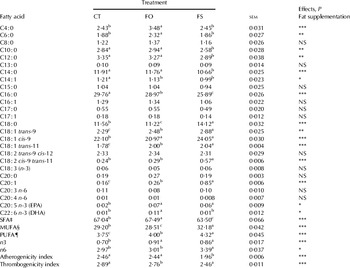
Milk fatty acid composition is not reported because it was part of a previous paper (Caroprese et al. Reference Caroprese, Marzano, Marino, Gliatta, Muscio and Sevi2010). Briefly, milk from cows receiving flaxseed supplementation displayed an improvement in the fatty acid profile, with an increase in the PUFA, MUFA, and CLA content and a decrease in SFA content. As observed by previous authors, fatty acid composition of cheese was not different from milk fatty acid composition (Jones et al. Reference Jones, Shingfield, Kohen, Jones, Lupoli, Grandison, Beever, Williams, Calder and Yaqoob2005; Allred et al. Reference Allred, Dhiman, Brennand, Khanal, McMahon and Luchini2006). The increased dietary intake of C18:3 in flaxseed supplemented cows resulted in increased levels of trans-11 C18:1 (VA), and of CLA cis-9 trans-11 C18:2 (P<0·001), and reduced levels of short-chain fatty acids, such as C4:0 (P<0·001), C6:0, C10:0, and C12:0 (P<0·01) (Table 3). Both fish oil and flaxseed supplementations increased the content of n-3 PUFA in Mozzarella cheese (P<0·001); FO Mozzarella cheese had the highest eicosapentaenoic acid C20:5 (EPA) and docosahexaenoic acid C22:6(DHA) content (P<0·05). Enrichment in PUFA and MUFA (P<0·001), particularly in FS Mozzarella cheese, was accompanied by a reduction of SFA (P<0·001). In particular, in this study, FS Mozzarella cheese had lower C14:0 and C16:0 content than FO and CT Mozzarella cheese (P<0·001), thus reducing the adverse effects on human health associated with consuming dairy products (Noakes et al. Reference Noakes, Nestel and Clifton1996). The increased levels of PUFA, MUFA, total n-3 FA and total n-6 FA (P<0·001 and P<0·05, respectively), were responsible for lower AI and TI in FS than in FO and CT Mozzarella cheese. Mozzarella cheese with low AI and TI is less likely to induce atherosclerosis and coronary thrombosis, and thus is less detrimental for human health. Moreover, FS Mozzarella cheese, beside having a reduced level of undesirable fatty acids, displayed increased levels of VA, and CLA. It is now widely accepted that VA, as well as CLA, can be considered functional component in milk and dairy products: VA can be used in humans for the endogenous synthesis of CLA (Bauman et al. Reference Bauman, Lock, Corl, Ip, Salter, Parodi, Sejrsen, Hvelplund and Nielsen2006). Fatty acid profile of Mozzarella naturally enriched in PUFA and CLA together with reduced level of SFA suggest a biological effect on human health. Jones et al. (Reference Jones, Shingfield, Kohen, Jones, Lupoli, Grandison, Beever, Williams, Calder and Yaqoob2005) wished to produce milk and dairy products naturally modified without compromising the acceptability and processing characteristics of the milk.
Least squares means±sem of fatty acid composition (g/100 g of fatty acid) of mozzarella cheeses (n=18) produced with milk from cows fed control diet (CT), and fish oil (FO), and flaxseed (FS) supplemented diets fish oil (FO) or flaxseed

a, b, c, d Means within a row with different superscripts differ (P<0·05). NS, not significant, *P<0·05, **P<0·01, ***P<0·001
‡SFA, saturated fatty acids; §MUFA, monounsaturated fatty acids; ¶PUFA, polyunsaturated fatty acids
Physical properties of Mozzarella cheese
Cheese composition has a major impact on the body and texture of cheese and it is mainly controlled by the initial composition of cheese milk and the manufacturing protocols used for cheese making (Lucey et al. Reference Lucey, Johnson and Horne2003). It is well known that lowering the fat content of Mozzarella cheese can have important consequences on the texture of cheese. Changes in fat content can affect protein aggregation thus modifying cheese texture. Moreover, fat has a lubricating effect, contributing to less firm and more elastic cheeses, and its reduction contributes to increased hardness of cheese (Rudan et al. Reference Rudan, Barbano, Yun and Kindstedt1999): the higher the fat content of cheese, the softer is the cheese. The moisture content is able to deeply influence textural properties of cheese, and can act as a plasticiser in the protein matrix (Fox et al. Reference Fox, Guinee, Cogan, McSweeney and Fox2000). TPA hardness and cohesiveness were higher in FS than in FO and in CT Mozzarella (P<0·001, Table 4). The loss of fat in FS Mozzarella cheese can contribute to explain the increase observed for these parameters. Rudan et al. (Reference Rudan, Barbano, Yun and Kindstedt1999) reported that the reduction of fat has been proved to be responsible for increased hardness and cohesiveness in low-fat Mozzarella cheese. Furthermore, FS Mozzarella cheese was characterised by high levels of Ca content, which is bound as calcium phosphate with casein in a colloidal phase, and contributes to cheese hardness by crosslinking with proteins. Also the reduced moisture levels of FS Mozzarella cheese can be claimed to explain the increased hardness, as reported by Tunick et al. (Reference Tunick, Mackey, Smith and Holsinger1991). As chewiness and gumminess parameters are closely related to the hardness of cheese, their values were found higher in FS Mozzarella (Zisu & Shah, Reference Zisu and Shah2005). Jones et al. (Reference Jones, Shingfield, Kohen, Jones, Lupoli, Grandison, Beever, Williams, Calder and Yaqoob2005) found that CLA-enriched butter and cheese were softer and less firm than conventional butter and cheese.
In the present experiment no sensorial analysis on Mozzarella cheese were performed; however, other authors observed that milk and dairy products naturally enriched with PUFA does not display off flavour or rancid notes in their sensory profile, thus demonstrating that PUFA enrichment has no adverse effect on consumer acceptability (Jones et al. Reference Jones, Shingfield, Kohen, Jones, Lupoli, Grandison, Beever, Williams, Calder and Yaqoob2005; Allred et al. Reference Allred, Dhiman, Brennand, Khanal, McMahon and Luchini2006).
Least squares means±sem on texture profile analysis (TPA) parameters measured at 10 °C of mozzarella cheeses (n=24) produced with from cows fed control diet (CT), and fish oil (FO), and flaxseed (FS) supplemented diets

a, b, c Means within a row with different superscripts differ (P<0·05)
NS, not significant, *P<0·05, **P<0·01, ***P<0·001
Conclusions
The Mozzarella cheese from flaxseed supplemented cows displayed a loss of fat during cheese manufacturing responsible for an increase in TPA, hardness and cohesiveness. Furthermore, Mozzarella cheese from FS was enriched in VA, CLA and PUFA levels displaying low atherogenic and thrombogenic indexes.
The Mozzarella cheese manufactured with milk from fish oil supplemented group showed increased n-3 polyunsaturated fatty acids and displayed the highest EPA and DHA content.
Further investigations are needed to verify the biological effect on human health of Mozzarella cheese obtained from milk naturally enriched in PUFA and to evaluate the differences with dairy products added with synthetic CLA isomers.