Although healthcare workers are the focus of most hand hygiene initiatives, hand hygiene performance by patients may also be important to prevent acquisition of healthcare-associated pathogens and to reduce the risk for transmission by colonized patients.Reference Kundrapu, Sunkesula, Jury, Sitzlar and Donskey 1 , Reference Gagné, Bédard and Maziade 2 For example, a hand hygiene intervention focused on patients and visitors in a community hospital was associated with a reduction in nosocomial methicillin-resistant Staphylococcus aureus (MRSA) infections.Reference Gagné, Bédard and Maziade 2 Similarly, regular use of alcohol hand rub by patients on a psychiatric ward was associated with a decrease in nosocomial outbreaks due to respiratory viruses.Reference Cheng, Wu and Cheung 3 In a long-term care facility (LTCF), residents were aware of the importance of hand hygiene, but barriers such as inaccessible or difficult to use products limited compliance.Reference O’Donnell, Harris and Horn 4 A sustained improvement in mealtime performance of hand hygiene measures was achieved by providing a hand hygiene station in the cafeteria and by engaging staff and residents in efforts to promote hand hygiene.Reference O’Donnell, Harris and Horn 4 Others have similarly noted that engaging nursing staff may be valuable as a means to promote patient hand hygiene.Reference Ardizzone, Smolowitz, Kline, Thom and Larson 5
Studies are needed to identify effective strategies to involve patients in hand hygiene measures. Here, we surveyed patients to determine their opinions on hand hygiene and evaluated patient hand hygiene practices. We examined patient hand hygiene performance on a surgical ward before and after implementation of an intervention in which healthcare personnel facilitated patient hand hygiene.
METHODS
The Cleveland VA Medical Center is a 215-bed acute care facility. The facility’s institutional review board approved the study protocol. Patient access to hand hygiene equipment includes a sink in each room, a bottle of alcohol gel supplied with other toiletry supplies, and towelettes (moist towelettes, US Foods, Rosemont, IL) with meal trays that are folded inside a 2×2-inch packet.
The study was conducted in 3 consecutive phases during an 8-month period from February through September 2014. First, we identified mealtime, exiting and re-entering patient rooms, and contact with catheters, devices, or wounds as opportunities for patient hand hygiene that might easily be facilitated by providers. Identification of specific moments when hand hygiene measures are indicated has been previously used to improve understanding, training, and monitoring of healthcare personnel hand hygiene.Reference Sax, Allegranzi, Uçkay, Larson, Boyce and Pittet 6 A “Four Moments for Patient Hand Hygiene” poster was designed that included these 3 moments and after use of the bathroom as a fourth moment (Figure 1). The initial version of the poster was refined after being shown to 85 staff members, including infection control practitioners, nurses, physicians, and ancillary staff.
Poster showing the “Four Moments for Patient Hand Hygiene.”

Second, we surveyed a convenience sample of 100 patients from 6 medical-surgical units using a 5-level Likert scale 9-item questionnaire to assess opinions and practices regarding hand hygiene. Concurrently, 2 of the authors (VCKS and SN) conducted observations of patient hand hygiene performance on the same wards. The auditors used a standardized data collection form based on the “Four Moments for Patient Hand Hygiene,” and initial observations were performed together.
Finally, we implemented a 1-month pilot study of a provider-facilitated, patient hand hygiene intervention based on the “Four Moments for Patient Hand Hygiene” on a 36-bed surgical telemetry ward. Interviews with nurses and food service personnel suggested that food tray delivery staff would be ideally suited to facilitate mealtime patient hand hygiene. We previously found that the towelettes provided on trays may be difficult for many patients to open.Reference O’Donnell, Harris and Horn 4 Therefore, canisters of antiseptic wipes (Purell sanitizing wipes, GOJO Industries, Akron, OH) were placed on the food tray delivery carts; the delivery staff placed a fresh wipe on top of each food tray and reminded patients to clean their hands. Patient transport personnel were asked to inquire whether each patient would like to perform hand hygiene at the time of pick-up and drop-off from the unit. Nursing staff were asked to educate patients about hand hygiene and to remind patients to clean their hands on room entry and exit and before and after touching devices or wounds.
Observations of patient hand hygiene performance for 2 of the 4 moments (before eating and when entering or exiting the room) were collected by 2 of the authors (VCKS and SN) during 1-month periods before and after the intervention. To minimize the potential for a Hawthorne effect, the observations were conducted surreptitiously. Pearson’s χ2 test was used to compare the pre- and post-intervention compliance rates. Data were analyzed using R statistical software (R version 3.1.2).
RESULTS
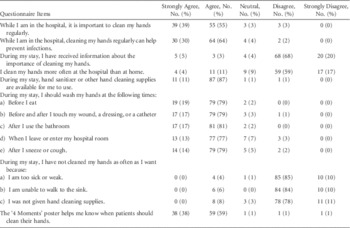
The results of the survey are shown in Table 1. A majority of patients agreed that hand hygiene can help prevent infections, that hand cleaning supplies are available, and that they should clean their hands during each of the 4 moments. However, a majority of patients disagreed that they received information about the importance of hand hygiene, that they cleaned their hands more often in the hospital than at home, and that factors such as being sick or weak prevented them from performing hand hygiene. In total, 97% of patients agreed that the Four Moments poster helped them to know when to clean their hands.
Survey of Hand Hygiene Practices among Patients

Of 606 observations of hand hygiene opportunities, only 59 patients (10%) performed hand hygiene. Hand hygiene measures were performed in 52 of 389 observations (13%) before meals, in 2 of 160 observations (1%) on room entry or exit, and in 5 of 60 observations (8%) after using the rest room.
The intervention was associated with a significant increase in patient hand hygiene. Performance of hand hygiene measures increased from 10% (4 of 41 observations) to 79% (448 of 569 observations) before meals and from 0% (0 of 29 observations) to 51% (100 of 197 observations) when exiting or entering patient rooms (P<.0001 for both comparisons). All of the mealtime observations occurred in the setting of prompting by food tray delivery staff, whereas observations of hand hygiene performance on room exit and entry included some hand hygiene measures when prompting was not provided by staff.
DISCUSSION
We found that a majority of patients were aware of the importance of hand hygiene and that hand hygiene supplies were available for use. However, performance of hand hygiene was uncommon. An intervention in which healthcare personnel facilitated patient hand hygiene at specific moments during routine care activities resulted in a significant increase in patient hand hygiene.
Our findings have implications for the development of patient hand hygiene interventions. First, active involvement of healthcare personnel in reminding patients of when to perform hand hygiene may be helpful. This observation is consistent with findings of other recent studies.Reference O’Donnell, Harris and Horn 4 , Reference Ardizzone, Smolowitz, Kline, Thom and Larson 5 Second, our findings suggest that engagement of ancillary staff members such as food service and patient transport and providing products that are easy to use may be beneficial. Finally, to maximize effectiveness, it may be helpful to select specific moments when patient hand hygiene measures can be easily facilitated by staff.
Our study has some limitations. The intervention was conducted on a single small unit, and we did not determine whether the improvement was sustained beyond the study period. In addition, we cannot exclude the possibility that factors other than the interventions contributed to the improvement in hand hygiene compliance.
In summary, a provider-facilitated patient hand hygiene intervention based on “Four Moments for Patient Hand Hygiene” improved hand hygiene on a surgical ward. Further studies are needed to determine whether patient hand hygiene interventions can reduce healthcare-associated infections.
Acknowledgments
The authors thank Mr. Bruce Biro, graphic designer at the Louis Stokes Cleveland Veterans Affairs Medical Center for his artwork and design of the “Four Moments for Patient Hand Hygiene” poster.
Financial support: This work was supported by the Department of Veterans Affairs.
Potential conflicts of interest: CJD has received research grants from GOJO, EcoLab, STERIS, and Clorox. All other authors report no conflicts of interest relevant to this article.