Introduction
In a simulated disaster scenario with over 1000 disaster victims, we evaluated factors associated with victim survival for Medical Reserve Corps’ volunteer responders. Based on our past research, public health and healthcare workers were less willing to respond to terrorist attacks than to natural disasters. Reference Cone and Cummings1,Reference Ludtke, Narayan and Matariyeh2 The 2001 anthrax bioterrorism attacks revealed deficits in the public health and medical system emergency response. Reference Brannen and Stanley3 At the time, emergency response plans and integration between local public health agencies, law enforcement, and the medical system were lacking. Communities were inundated with ‘white powder’ thought to be associated with terrorism. The response system was unprepared to rule out events as non-credible. Thousands of ‘powder’ specimens were sent to overwhelmed public health laboratories. Emergency preparedness continued to be lacking for more than a decade.
Tactical emergency casualty care (TECC) includes external bleeding control, first aid, CPR, and bystander safety, as well as recognition of critical injuries, airway and chest injury, environmental-related hazards, and rapid evacuation to care. Reference Smith, Bobko and Shapiro4 The initial link in the TECC chain is the first care provider (FCP), who are typically bystanders in the proximity of a mass casualty incident. Reference Callaway, Bobko and Smith5 Triage is the sorting and classification of victims or casualties to determine the priority of need and proper sequence for treatment. SALT triage starts with sorting, assessing, beginning lifesaving interventions, treatment and transport. Prior to SALT, triage varied by the FCP training and the event’s circumstances. TECC ends when the staff at the trauma center receives the injured. Healthcare staff have triage expertise. However, their response will depend on the capacity of the trauma center to manage the victim numbers and types of injuries.
Over the years, communities adopted triage models such as Simple Triage and Rapid Treatment (START). Some found the START Model ineffective. Intuitive triage was found to be significantly faster than START triage without significant disagreement between over and under-triage. Reference Hart, Nammour and Mangolds6 In 2014, the Federal Interagency Committee on Emergency Medical Services recommended SALT triage as the uniform standard for mass casualty triage. 7 Research has shown SALT to be more effective than START in mass casualty incidents. Reference Silvestri, Field and Mangalat8 Individuals with SALT training often respond similarly regardless of their healthcare background. Triage accuracy, error patterns, and time to triage completion were found to be similar between primary care paramedic students and fire science students in a simulated mass casualty incident (MCI) using SALT triage. Reference Lee, McLeod and Van Aarsen9
Public health triage training was found to increase the willingness of workers and volunteers to respond. Reference Ludtke, Narayan and Matariyeh2 Triage systematically improved the emergency response to the disaster event. A prospective analysis of the 2009 H1N1 pandemic found that better management of public health and medical systems improved health outcomes for communities. Reference Brannen, McDonnell and Schmitt10 Incident-command-communications that were consistent within an organizations’ type were better able to increase the adoption of protective health behaviors for their respective community. Comparable results were found regarding mass trauma events with novel communication strategies, flexible leadership structures, and information systems affecting morbidity and mortality. Reference Goralnick, Halpern and Loo11 During the COVID-19 pandemic, government effectiveness, along with vaccination rate, and socioeconomic development, were found to be protective. Reference Sarkar, Morshed and Chakraborty12
Citizen’s Corps and Medical Reserve Corps (MRC) are groups of community-based volunteers. The volunteers respond to natural disasters such as tornados, storms, fires, and pandemics. Reference Brannen, Schmitt and McDonnell13–Reference Brannen, Branum and Pawani15 Over the past several decades, human-made events including terrorism and active shooter incidents have escalated. 16 During public safety events, bystanders have frequently been the ones providing first care until emergency services arrived on the scene. Reference King, Larentzakis, Ramly and Trauma Collaborative17 Bystander volunteers were found to be as efficient as experts in triaging victims, and the triage improved with increasing acuity. Reference Hong, Sierzenski and Bollinger18 Further, medical knowledge, disaster preparedness and public health triage training increased volunteers’ triage accuracy. Reference Ludtke, Narayan and Matariyeh2 Likewise, just-in-time training of a layperson more than doubled the proper application of a Combat Application Tourniquet (CAT) from 20 to 44%. Reference Goolsby, Branting and Chen19 Laypeople successfully apply tourniquets about 50% of the time, if provided with just-in-time instructions. This percentage increases to 80% after practicing tourniquet application. Reference Goolsby, Chen and Branting20 A training project conducted by MRC units to activate bystanders at a mass casualty event, has been found to be appropriate for members of the public with little or no first aid knowledge. Reference Smith, Baker and Roberts21 The real-world volunteer response to mass casualty terrorist attacks is an ongoing integral emergency medical response in some areas of the world. Reference Alpert, Lipsky and Elie22,Reference Yafe, Walker and Amram23 Volunteers as first-care bystander responders have been shown to be an effective force multiplier in public health emergencies.
The MRC has an expanded focus beyond TECC. MRC volunteer activities have focused on prevention and the after-event needs of victims, survivors, and the general population. For those affected by disasters, MRC activity is not limited to supporting shelter services to those displaced, but to the whole community. The missions during the aftermath of a disaster may be unique depending on the support, available resources, and the priorities set by the community. A typical mission of the MRC in Ohio has been to support local public health organizations. Many MRC units also have a mission to help support shelters run by the American Red Cross, including general shelters, medical shelters, and non-conventional shelters including decontamination-processing centers. MRC volunteers may also support survivor reception centers and community reception centers after a radiological event. While some MRC units focus on specialized activities such as supporting mortuary services, those specialized activities will not be the focus of this paper.
A large-scale disaster affects all types of persons including those with functional needs. Chronic care triage (CCT) is a component of disaster response. Volunteers may need extra time for CCT when persons have conditions such as diabetes, dementia, or heart disease. Those with chronic conditions may need periodic, intermittent, or continuous care. When medically-cleared disaster survivors were sorted to community-mass-care services, triage significantly improved by up to 15% when past traumatic events, personal care assistance, or service methodology were accounted for. CCT that considers the availability of personal care assistance and service methodology enhanced functional needs support services for persons who were disabled. Reference Fannin, Brannen and Howell14 It is recommended that sufficient capacity (i.e., personal care assistance) be assigned to address persons with functional needs to avoid delays. Reference Brannen, Branum and Pawani15 For medically cleared disaster survivors, triage should be repeated for psychological screening with consideration for not only severity but cumulative past trauma to help decrease disaster-related sequelae. Reference Brannen, Barcus and McDonnell24 The Fast Mental Health Tool flowchart was shown to be more effective than a checklist during targeted mental health screening by MRC volunteers rather than paramedics.
Public trust for effective government response during a widespread disaster varies from optimistic to pessimistic. Reference Jackson, Rhoades and Reimer25 Trust in the public health authority and the adoption of protective health behavior is mediated by a belief in having adequate coping skills. Reference Sarwar, Imam and Jameel26 SALT triage is a management system that if applied early in mass trauma events, would increase the effectiveness of the emergency response overall. After bystander first care and traditional TECC, chronic care triage of those medically cleared disaster survivors to essential services would ultimately improve chronic health outcomes among the population. By training volunteers to have the capacity to be first care providers if they happen to be bystanders of a mass trauma event, it can be assumed that health outcomes will improve. Since trust in government is commensurate with government effectiveness, which in turn improves health outcomes during public health emergencies, building trust among the community’s civilian volunteer corps would be a beneficial first step. It is unclear if the community-based volunteers would increase their trust in the public health/government authority because of the added capacity to provide first aid to trauma victims and triage survivors appropriately. If the MRC volunteers believe they have the skills to make a difference in a disaster, they would be more willing to respond. Researchers found that laypersons’ self-efficacy and reported willingness to use tourniquets in an emergency improved after a short training. Reference Ross, Redman and Mapp27 The Stop-the-Bleed course has been found to increase response usage among those trained and survival among victims. Reference Parvin-Nejad, Padmanaban and Jalloh28 Additionally, Stop-the-Bleed is part of a recommended mitigation strategy for active shooter situations. Reference Tzvetanov, Cline and Thomas29
In this evaluation, the MRC leadership is housed within the public health authority. This project will evaluate the level of trust before and after the training. It is hypothesized that trust in the public health authority will be improved among those who have higher skills at baseline and trust in the public health authority will be higher for those with the greatest improvement.
Methods
Institutional review board approval was not required as no subjects participated as the disaster victims were simulated. All data were collected in a de-identified manner. The research was conducted under the duties of health departments in Ohio to study the prevalence of disease and health conditions within its district, which may be released in summary, statistical, or aggregate form (Ohio Revised Codes 3709.22 and 3701.23). Health departments were the housing agencies for the MRC volunteers that participated in this effort. The Public Health Foundation states that the Public Health Accreditation Board ‘specifically highlights the importance of quality improvement under Domain 9: Improve and innovate public health functions through ongoing evaluation, research, and continuous quality improvement. Demonstration of continuous improvement is also encouraged throughout the accreditation process and among many standards and measures.’ 30 The cases and controls were determined from the characteristics of the MRC volunteers. The data collected for evaluations of MRC training effectiveness and provided an opportunity for a secondary case-control study of disaster victim survival.
The study design was a mixed method, retrospective case-control, cross-sectional design. In August 2022, 70 MRC volunteers participated in an annual training workshop. MRC volunteers were provided with an Introduction to MRC 101, Stop-the-Bleed, SALT triage, and other disaster preparedness (DP) sessions. The DP sessions included chronic care triage (CCT), scene safety, and disaster stress. The disaster stress portion included materials derived from the Substance Abuse and Mental Health Services Administration’s (SAMHSA) website regarding Disaster Responder Stress Management, 31 and the National Child Traumatic Stress Network’s (NCTSN) Learning Center for Child and Adolescent Trauma. 32 The DP portion also had a hands-on portion of practical lessons from the field from a veteran MRC volunteer and doctoral-level nursing professor. The SALT triage had a hands-on portion from the senior paramedic for the Dayton Metropolitan Medical Response System. The STB had a hands-on portion using the American College of Surgeons’ STB training kits augmented by HOSA-Future Health Professionals acting as victims with 2 MRC units providing moulage teams. MRC volunteers were provided with clinical vignettes prior to the training. Volunteers’ baseline characteristics were collected including their volunteer role, occupation, years of occupational experience, number of disasters they have responded to, years of disaster experience, and any training on STB, SALT, and DP. A post-evaluation was conducted after the hands-on portions were completed.
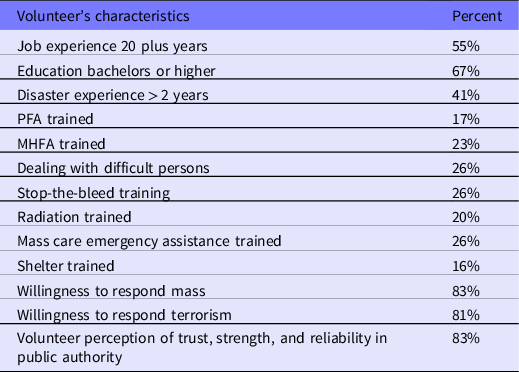
Descriptive statistics of the MRC volunteers are shown in Table 1. Statistical analysis including change from baseline of the post-training scores on percent correct for the STB, SALT, and DP vignettes. Cross-sectional modeling was conducted on roles, experience, trainings, willingness to respond (WTR) to disasters, level of volunteer trust in the public authority, on the number of correct responses of DP, STB, and SALT. The effectiveness of the workshop training on STB, DP, and SALT was evaluated using paired samples t-test of the number correct. If the training had no effect, the average difference between the pre- and post-tests should be equal to 0. The scores should be higher if the training improved knowledge, so a 1-sided P - value was used with the confidence level set to 95%. The total correct answers for the 3 workshop sub-topics was totaled and pre- to post- test results were compared. The WTR was also compared on the basis of pre- and post- training.
The data set was aggregated per person with the last measured observation used to model the total correct responses. Variables were excluded based on the largest non-significant result using P > 0.05. The summary totals were used for total trainings, any public health role, any healthcare worker role, willingness to respond, total trainings in mental health, total training in STB, and total trainings in SALT. If any summary variable was significant, the subcomponent variables replaced the summary variable in the model.
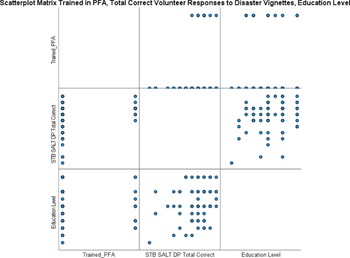
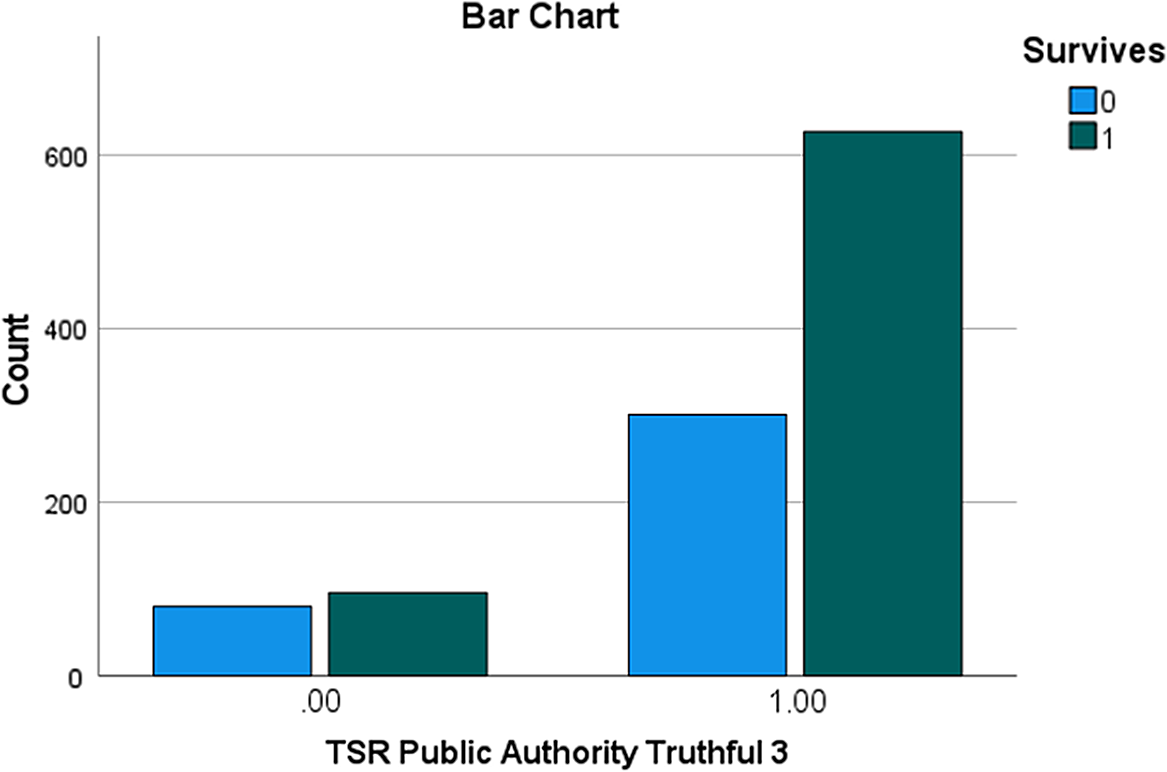
Logistic regression was used to predict the volunteer characteristics that affected victims’ survival. A total of 70 volunteers were presented with 16 disaster vignettes (6 STB, 6 DP, and 4 SALT). The vignettes included trauma center care, focusing on likely bystander response and MRC missions from disaster preparedness, safety, bystander response, sheltering, to self-care. The vignettes were analyzed from the victim’s perspective. Wrong responses were coded as death, and correct responses were coded as survived. Job experience, education level, and disaster experience were recorded in binary values with 0 being lower and 1 set to high levels. Past training types were coded as 1 if present and 0 if not taken. Willingness to respond and trust in public authority were also set to binary values. A total of 1104 vignettes were evaluated in the model. A scatterplot matrix with 95% CI was plotted to determine which independent variables might be correlated (Fig. 1). This resulted in the volunteers’ perception of the public authority’s strength, reliability, trustworthiness, and truthfulness being considered iteratively in the model. A post hoc evaluation of the significant finding of trust on disaster survival is shown in Fig. 2.
The MRC volunteers’ ratings of the disaster vignette’s reliability were evaluated using the intraclass correlation coefficient. The inter-rater reliability was tested post hoc on 10 randomly selected raters. The randomly selected rater was then matched pairwise to the random rater’s responses on 4 characteristics (rater’s perception of public authority’s truthfulness of protective health behavior, willingness to respond to a terrorist event, 16 or more years of education, and trained in psychological first aid). This pairwise matching was done to avoid treating the differences between the raters the same when they are expected to differ. The inter-rater reliability should be random across the raters.
Scatterplot matrix of PFA, total correct, and education level.

Trust in public authority’s truthful protective health recommendations improved disaster survival.

Descriptive statistics of medical reserve corps and citizen’s corps volunteers (N = 69) and disaster vignettes responded to (N = 1104)

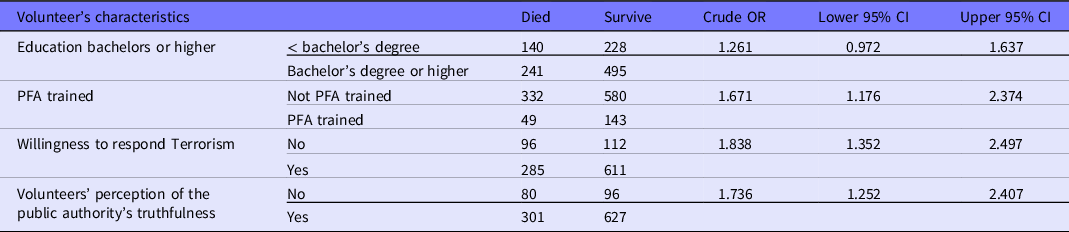
Count of mass casualty victim’s outcomes by volunteers’ characteristics

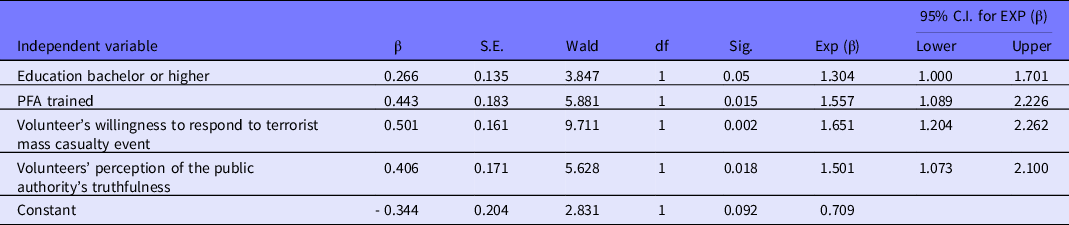
Medical reserve corps and citizen’s corps volunteer’s characteristics that predict victims (N = 1104) survival during a mass casualty incident using logistic regression

Results
The 10 randomly selected pairwise Cohen kappa inter-rater reliability scores spanned the range of agreements, from about 50% being poor or discordant and 50% being okay to excellent agreement. The average scores of the responders’ ratings of the disaster vignettes were highly reliable (confidence interval 95.5% to 99.0%). The STB training significantly improved rates of victim survival from 77.2% to 93.2% (P < 0.001). The training did not significantly improve DP (75.5% to 73%, P = 0.181) and SALT (33.5% to 35.1%, P = 0.376). The crude odds ratio for the final model variables are shown in Table 2. The final model to predict volunteer performance in a mass casualty disaster involving hemorrhaging and triage was education level (β .251, P = 0.031, and psychological first aid training (PFA), (β 1.73, P = 0.019) (Table 3). Post hoc analysis of the total correct disaster vignettes found that those volunteers trained in PFA correctly responded to 11.9 (11.28 - 12.5, 95% CI) events versus 10.32 (9.6 - 10.9, 95% CI) to those who did not.
Limitations
Disaster preparedness is a complex and wide field. In our workshop design, we chose to select the didactic portion of the training on selected topics. These topics included an introduction to the MRC, Stop-the-Bleed, SALT triage, chronic care triage, disaster stress, scene safety, and a hands-on portion for MCI triage using SALT, tourniquet and apply pressure, crisis intervention and how to de-escalate. The workshop was divided into 3 major categories of Stop-the-Bleed, triage, and disaster preparedness. The disaster preparedness portion covered disaster stress, scene safety, crisis intervention, and how to de-escalate. These were chosen because they would strengthen and complement the hemorrhage control and triage as a first care provider would be expected to experience. All the presenters/trainers were subject matter experts; and triage and hemorrhage control training were based on nationally accepted standards, the disaster stress portion was ‘adapted’ and condensed from SAMHSA, the scene safety, de-escalation, and mass casualty portions were provided based on subject matter expertise, availability of local resources, and experience in the field. To reproduce the workshop and challenges presented to the participants, not only would subject matter experts have to be available; the resources would have to be available as well. This would include moulage kits, moulage team, Stop-the-Bleed trainers and kits, and other resources.
‘Nobody who sees a disaster is untouched by it.’ Reference DeWolfe and Nordboe33 Some victims in a real-life disaster may refuse lifesaving interventions. Putting on a tourniquet during a simulated training event on an artificial training limb or a live uninjured pretend victim is much different than putting a tourniquet on an actual injured person. Given the nature of disasters, the participants could not be randomized into actual disaster scenarios. While most of the participants are licensed medical professionals ranging from surgeons, other physicians, advanced nurses, registered nurses, LPNs, pharmacists, and other allied medical professionals, a few were allied health students and undergraduate nursing students. This mix of participants were from a wide geographical area of over 1.2 million residents. While this mix of participants represents those who have responded to past disasters, it is uncertain if they will match future responses. The research construct is such that it focuses on MRC volunteers as first care providers and later as participating in the public health response. This portends a lower public health impact on the population overall as the MRC volunteers even if ‘out-and-about’ on the day of the disaster event, would only be a small fraction of bystanders (assuming there were survivors left to be bystanders) providing first care to the disaster victims. While this is a serious limitation of the estimated public health impact of these results, a single, trained, and willing volunteer has had a significant impact on the course of disaster event by being at the right place and time. Reference Brannen, Schmitt and McDonnell13
Discussion
The rationale was that correct responses correlated to the success of a disaster volunteer’s first care actions. From a disaster victim’s perspective, the important measure is ‘Was the lifesaving intervention delivered effectively?’ The public health emergency preparedness paradigm calls for an assessment of the current state of readiness, determination of activities, and evaluations. Assessing the capacity of the skills and tasks of volunteer disaster responders; as well as what volunteer characteristics enabled the best health outcomes of disaster victims fits well into FEMA’s phases of disasters and Public Health’s preparedness and response capabilities. 34,35 Evaluating the effectiveness of the training from the responder’s performance as well as the health outcomes from the disaster victims’ performance allows for generalization to real-world disaster events. Of interest is that other mental health, disaster preparedness, and triage type trainings did not affect the number of disaster vignettes responded to successfully, including MHFA, and other disaster preparedness courses with the notable exception of PFA.
A methodology that could have been used was to recode disaster victims as not surviving if the volunteer was unwilling to respond. The reason why we did not recode those victims is because of the concept of the bystander who responds. The MRC is built upon volunteers who respond within their community. The scenario embedded the volunteer as an on-scene first care provider.
For every 4 years of education or certification PFA, the volunteers saved the life of 2 additional victims out of the 16 disaster responses. The adjusted odds ratio found that volunteers who had a positive perception of the public authority’s truthfulness, stated a willingness to volunteer, had undergone psychological first aid training and had a bachelor’s degree or higher will save more disaster victims’ lives. PFA training should be considered a basic requirement for disaster preparedness. Public health information officers should be promoted throughout the local public health system. Colleges and universities should be focused recruitment areas for the MRC program. Adding substantially to the national response to the COVID-19 response efforts the region’s volunteers was very impactful and contributed to the success of vaccine clinics. Reference Doran, Hess and Andersen36
Conclusion
MRC volunteers who had trust in the public authority to provide protective health recommendations, had been trained in Stop-the-Bleed, and/or Psychological First Aid training significantly improved mass casualty victims’ chance of survival. As for overall policy considerations, ongoing support for training and support for the coordinators of the MRC units is critical to ensure that communities are ready to meet public health emergencies in the future.
Author contributions
Donald Brannen – Author of first draft and biostatistician; Cecilia Bidigare – Revisions and editing; Jaime Shuster – Revisions, editing, formatting and compliance with local and federal good clinical practices; Melissa Howell – Team authority and project oversight
Funding statement
Direct financial support was provided by the first author’s hosting organization. The data originated from an award received by Greene County Public Health from the National Association of County and City Health Officials (NACCHO). NACCHO received a grant from the Department of Health and Human Services Office of the Assistant Secretary for Preparedness and Response (Grant No. 5 HITEP 200045-02-00, CFDA # 93.008) to build the capacity of local Medical Reserve Corps (MRC) units. The content is solely the responsibility of the authors and does not necessarily represent the official views of NACCHO, Greene County Public Health, or the Department of Health and Human Services, Office of the Assistant Secretary for Preparedness and Response.
Conflicts of interest
The authors have no financial or ethical conflicts of interest.
Abbreviations
BSN, Bachelor of Science in Nursing; CAT, Combat Application Tourniquet; CCT, Chronic Care Triage; CPR, Cardiopulmonary Resuscitation; DP, Disaster Preparedness; FCP, First Care Providers; FEMA, Federal Emergency Management Agency; MCI, Mass Casualty Incident; MHFA, Mental Health First Aid; MRC, Medical Reserve Corps; NCTSN, National Child Traumatic Stress Network; PFA, Psychological First Aid; SALT, Sort, Assess, Lifesaving interventions, Treatment, and Transport; SAMHSA, Substance Abuse and Mental Health Services Administration; START, Simple Triage and Rapid Treatment; STB, Stop the Bleed; TECC, Tactical Emergency Casualty Care; WTR, Willingness to Respond