On the Bonfire Night of 1857, Guy Fawkes was joined in the flames by effigies of a new national enemy who attracted curses and excited condemnation from crowds across Britain. This newcomer was an Indian prince, represented in London by an immense model at least five times larger than life, ‘dressed up in the most extravagant style of theatrical finery, with a blackened face, and a huge placard on his back, with the words “Nana Sahib, the murderer of women and children at Cawnpore”’.Footnote 1 It is a name almost entirely forgotten in Britain today, but for much of the nineteenth century Nana Sahib had a good claim to being the nation's most widely reviled foreign enemy as a result of his role in the Indian Rebellion. In the summer of 1857, sepoy troops across northern India mutinied against their British officers in an uprising which was joined in many areas by civilian populations and local princes. Among the rebel nobles was the Maratha prince Dhondu Pant, known as the Nana Sahib, whose hostility towards the East India Company stemmed from its refusal to grant him the pension and titles he was entitled to have inherited. Initially believed to be an ally of the British, he became the arch-villain of the Mutiny in their eyes after presiding over the events at Cawnpore, a formative imperial trauma in which some 900 British men, women, and children were besieged by rebels in a poorly prepared entrenchment for three weeks. With supplies dwindling and casualties high, they accepted an offer from Nana of safe passage down the Ganges to British-held territory. Despite this agreement, the British were fired upon as they boarded the boats on 27 June, and the riverside ghat became the scene of a slaughter. The women and children left alive afterward were imprisoned, only to be killed on 15 July as a British army approached to recapture the town.
The first reports of the massacres to reach Britain were embellished by shocking rumours of rape, torture, and mutilation which aroused public anger to fever pitch, and Nana, the ‘Tiger of Cawnpore’, was quickly identified as the epitome of oriental treachery, cruelty, and predatory lustfulness, whose capture or death came to be seen as the key to suppressing the Mutiny – the Manchester Guardian would later remark: ‘It may be doubted whether in all its history the nation has ever hated any man so thoroughly or with half so much reason.’Footnote 2 The British appetite for vengeance was to be disappointed, however, as Nana fought and evaded the advancing armies before disappearing into the swampy lowlands of Nepal. Reports of his death by malaria circulated in 1859, but many were unconvinced – over the following decades, more than twenty Indians were arrested on suspicion of being the fugitive, while stories periodically emerged that he was alive and plotting a new rebellion in the mountains of the north. Early British histories tended to conclude their narrative of Nana as he moved into the realm of rumour, while more recent accounts have generally appended a brief description of the various suspects detained and discredited over the years, ending with the 1895 incident in which a district officer reported that he had arrested an itinerant sadhu who claimed to be Nana, and was ordered by his superiors to release the man immediately.Footnote 3
It is possible, however, that this anecdote strikes a falsely conclusive note. Nana remained a potent figure in the Victorian popular imagination for many years, with his disappearance leading him to be viewed as a lingering threat to imperial stability in both literal and symbolic terms. His name became a byword for savagery and resistance to British authority, invoked in cases ranging from the Irish Fenians to the Chinese Boxers. He was also a recurring figure in the Mutiny novels and stage melodramas which proliferated in the high imperial decades, recycling the conflict as a historical backdrop against which lessons about national duty and destiny could be imparted. This Mutiny novel genre has been extensively examined by Patrick Brantlinger and Gautam Chakravarty, while the rebellion's 150th anniversary in 2007 saw the publication of several studies of Nana's representation in British and European culture.Footnote 4 Among these works, Nicola Frith's compared the rebel's depiction in Britain and France, while those of Anil Bhatti and Kim Wagner examined his use in contemporary German fiction.Footnote 5 What has been neglected, however, apart from a brief treatment at the end of Pratul Chandra Gupta's 1963 biography, is a broader survey of Nana's lasting cultural impact in Britain over the decades after the rebellion.Footnote 6 Such a study may be valuable not only for our understanding of 1857 and its legacies, but also as a contribution in the lively current debate in imperial history. Claims by historians such as Catherine Hall and John MacKenzie that late nineteenth-century British culture was suffused in imperial ideologies have been challenged by Bernard Porter, who argues that an exaggerated importance has been read into the imperial discourses of a culture which was, in fact, largely unreceptive to the appeals of empire.Footnote 7 This article will explore a potentially fruitful new framework for understanding attitudes towards empire which incorporates issues of reception by drawing on both cultural history and memory studies, giving equal consideration to depictions of Nana and his changing presence in the British collective memory.Footnote 8 The outline of such a presence can be traced not simply from the pages of a history book or novel, but from Marc Bloch's ‘convergent rays of light coming from very different types of evidence’ – the reviews of a play, the lyrics of a song, the letters of a colonial administrator, the commemoration of a historic site, the joke of a Punch columnist, and the myriad of other manifestations revealed, however imperfectly, by the surviving archives.Footnote 9
Nana Sahib is an ideal subject for such a cultural-memory study. The immediate responses to Cawnpore saw the creation and propagation of a national enemy figure in the popular consciousness, while the periodic revivals of interest across the decades both inspired new fictional depictions and prompted commentators to reflect on the endurance or fading of Mutiny memories in the national psyche. As a result, there is a rich vein of testimony demonstrating evolving attitudes towards British imperial history across different generations and different sections of society. The disjuncture between metropolitan and colonial culture is especially evident. Despite moments of apparent imperial unity such as 1857, there was never a perfect sympathy between Britons at home and those whose lives were spent out in the Empire – mutual incomprehension often marked their relationship. Warren Hastings cast a long shadow, and ‘Anglo-Indians’ frequently found themselves suspected of corruption or tyrannical tendencies by a home public they in turn viewed as ill-informed, condescending, and overly lenient. In this case, colonial anxieties which found their focus in Nana Sahib could be dismissed as paranoia in a metropole where he had gradually been converted into something of a storybook monster. As such, the fundamental questions of what Nana meant to the British at home and abroad, how his memory was used, and what nerves his name struck in the collective memory have a wider significance in the imperial history of the Victorian period. The failure to capture the rebel created an absence that became an echo chamber in which history, myth, memory, and culture collided and combined.
I
The dramatic stories arriving from India over the summer of 1857 provoked an immense interest in a domestic public generally ignorant or indifferent about Eastern affairs. Nana Sahib alone was said to have taken a dozen captive Englishwomen into his harem, employed doubles to spread confusion over his whereabouts, and instructed his bodyguards to kill him if he was in danger of capture.Footnote 10 These sensational reports, sourced from Anglo-Indian rumour and self-promoting military despatches, indicate the extent to which even the purportedly factual early accounts of Nana lay in an ambiguous area between fact and fiction. The elevation in the public imagination of the British generals Havelock and Campbell into Christian holy warriors also had a corresponding effect on views of their foe – there was no wickedness that could not be believed of the satanic Tiger of Cawnpore.Footnote 11 The public appetite for information about this new enemy, barely slaked by the slow trickle of news, encouraged a frenzy of metropolitan speculation which saw old images and ideas revived, and which played a large role in forming Nana's place in the collective memory.
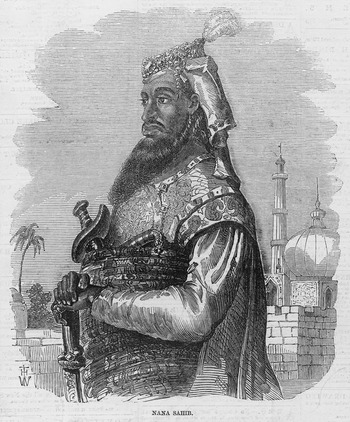
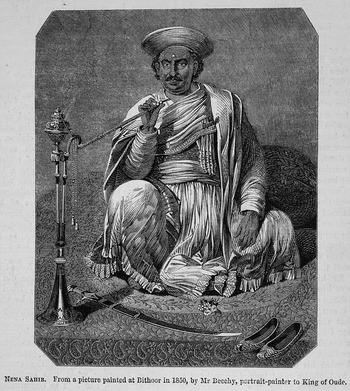
This appetite for information took its most basic form in curiosity as to what Nana looked like. Photography had not reached northern India by 1857, and the journalist G. A. Sala would later recall that when it became apparent no authentic pictures of Nana existed, the street-vendors who sold such topical souvenirs simply re-labelled existing portraits of ‘the eminent Indian philanthropist Dwarkanauth Tagou’.Footnote 12 Two very different images of Nana from this period have survived to become the typical illustrations for histories of 1857, although both are of dubious provenance. One depicts Nana as a fierce, bearded warrior, while in the other he is a lavishly dressed, hookah-smoking prince – a binary neatly encapsulating both the fear-mongering and the patronizing aspects of contemporary orientalist thinking. The warrior picture was published in the Illustrated London News on 26 September 1857, reportedly based on a sketch of Nana received from a Major O. Gandini (Figure 1).Footnote 13 This intimidating figure did not match any of the more reliable descriptions of Nana that subsequently emerged, however, and one reviewer later speculated that he was simply ‘a compound of two or three natives made up to suit English notions’.Footnote 14 The case against the prince picture is still more damning. This seated portrait appears to have been featured in several publications, most notably George Dodd's History of the Indian Revolt (Figure 2).Footnote 15 In his 1893 memoir, the Mutiny veteran William Forbes-Mitchell described an opportunistic artist seizing upon its original, a portrait of a wealthy Indian contractor owned by the barrister and journalist John Lang, as a suitable Nana. When Lang protested at this deception, warning that this figure looked nothing like Nana and would never pass in India as a Maratha chief, ‘the artist declared he did not care for people in India; he required the picture for the people of England’.Footnote 16 The commercial imperatives that drove this image-making can also be seen in the popular Mutiny exhibitions which sprang up around London; Wyld's Great Globe in Leicester Square claimed to have on display Nana's elaborate court dress, while Madame Tussaud's unveiled a waxwork based on the prince portrait, smoking a hookah in its Napoleon Room. Although one reviewer insisted that Nana's model was ‘too harrowing for anything but immediate destruction’, the success of such exhibitions trumped both their dubious accuracy and the concerns about their propriety – the model was later transferred to a still more prominent place in the Chamber of Horrors, in a move reflecting Nana's elevation from mere military rival into the pantheon of national demons.Footnote 17 As John Lang's protests might suggest, this metropolitan myth-making did not go unchallenged by colonial veterans. Mowbray Thomson was one of the four British survivors of Cawnpore, but although his memoir The story of Cawnpore was drawn on by generations of historians and novelists, his first-hand description of Nana as ‘exceedingly corpulent, of middle height…and like all Marathas, clean shaven’ made little or no impact on the public imagination.Footnote 18 The rebel's image as a fierce, bearded warlord had already been firmly imprinted by a popular culture which was sensitive to its audience's expectations, quick to market and not in the least concerned with accuracy.
‘Nana Sahib’, Illustrated London News, 26 Sept. 1857. © Mary Evans Picture Library.

‘Nena Sahib’, in George Dodd, The history of the Indian Revolt (London, 1859), p. 124. © The British Library Board. Asia, Pacific & Africa V 8918.

The most immediate and visceral depictions of Nana were produced on the stage, as playhouses mounted hastily written Mutiny dramas often featuring the Maratha rebel as their antagonist. Such dramas exercised a large influence over metropolitan conceptions of colonial affairs, combining claptrap patriotic entertainment with a strong didactic element in what Martin Meisel describes as ‘a form of topical news show’, anticipating the newsreel in its condensation and editing of materials.Footnote 19 The Surrey Theatre production India in 1857 appears to have been the first Mutiny play staged in London, written by the actor-manager duo William Creswick and Richard Shepherd in October 1857 and quickly revised to add a third act after news of the fall of Delhi arrived the following month.Footnote 20 Dion Boucicault wrote his Mutiny drama, Jessie Brown, or, The relief of Lucknow, for staging in New York after reading a news report containing the apocryphal story of a young Scottish woman who had been the first to hear the bagpipes of the regiments arriving to save the besieged garrison.Footnote 21 Both plays drew on the established theatrical model of the cruel, sensual oriental villain, while also offering a distillation of popular ideas about Nana. One of these recurring themes often depicted in Mutiny fictions was the civilized, progressive impression Nana had left with British visitors he entertained before the Mutiny at his palace in Bithur, reported to have had rooms enthusiastically decorated with a mismatched collection of English furniture, fine art, and cheap knick-knacks. Typically, in India in 1857, it is only the female intuition of the oblivious Colonel Morton's daughter Emily that allows her to see through this façade: ‘Ah! I fear that you and others are much deceived, and but little understand the real nature of the high caste Indian! He's like the Tiger of his own jungle, prowling fierce and cowardly, waiting but your weak and unguarded hour to spring upon you.’Footnote 22
One of the special horrors of the Mutiny for contemporary observers was the presence of women and children at the centre of the conflict, and the resulting violation of the sacred domestic space seen most tragically in Cawnpore.Footnote 23 Boucicault's Jessie Brown dramatizes this threat to the British family unit by characterizing its Nana as a charismatic brute who has fallen in love with the Scottish widow Mrs Campbell. The theme is depicted most spectacularly in a scene which sees the rebel sneak into her besieged bungalow – Nana passionately professes his love before holding a Turkish yatagan to her sleeping son's neck, warning ‘No cry! Or this steel is in his throat!’, in order to compel her to return his affections.Footnote 24 This portrayal of Nana is heavily influenced by the stereotype of the lustful Muslim conjured up by European fascination with the Ottoman harem, and the tradition of the Gothic villain as a charismatic, unscrupulous but ultimately thwarted suitor.Footnote 25 Although the real Nana was a Hindu, Boucicault's version is, in fact, a Muslim, much given to swearing by Muhammad. This fictional conversion was repeated in Mutiny narratives across the century, reflecting variously ignorance, a reliance on older European villainous tropes, and the theory that the Mutiny could only have been the result of a Muslim conspiracy, Hindus being considered too indolent and unworldly. The elevation of the Mughal emperor as the rebellion's figurehead lent credence to this vision of the Mutiny as a Muslim ‘holy war of persecution aimed at the restoration of the Mughal empire’ – a vision appealing enough to some metropolitan dramatists and authors that the conflict's arch-villain Nana might be discreetly tailored to fit it.Footnote 26
These plays offered the crowd-pleasing spectacle of a national hate figure being chastised for his crimes, but they also raised the sensitive question of Nana's ultimate punishment. India in 1857 opted for a finale mixing fact with pure wish-fulfilment. An elaborately staged climax showing the fall of Delhi also pre-empted the most keenly anticipated report from India, with the curtain falling as ‘Nena, overcome by the British, is stood over by [the British hero] Frederick in triumph.’Footnote 27 This premature celebration was condemned by the Era, which noted that audiences had received the piece ‘coldly’, and warned: ‘To be in advance of the contemporary caterers for the public taste is one thing, but to anticipate the events themselves before they have occurred is another.’Footnote 28 Within weeks, the play had been shifted down the bills, and it soon disappeared entirely.Footnote 29 The contemporary debate over commercial opportunism versus artistic propriety, hastily ignored by the Surrey duo, was tactfully negotiated by Boucicault. The playwright himself acted as Nana in New York, allegedly because nobody else would risk it – there were reports that actors playing the reviled rebel in Britain had been pelted with bottles, hats, and umbrellas.Footnote 30 The play's uplifting climax, in which the heroine hears the bagpipes and rallies the dispirited garrison, skilfully occludes the fate of Nana by transforming a personal narrative into a triumphant national one, while in its 1862 London run, Boucicault cautiously opted to rename Nana as ‘Rajah Gholam Bahadoor’.Footnote 31 His production was the most enduring fiction to emerge during the Mutiny; it had been staged some 820 times by 1875, and almost forty years later the actor Henry Irving would recall the ‘electrical’ effect the climax could provoke in an audience.Footnote 32 Boucicault's Nana, if nominally disguised, was the most widely seen and influential depiction of the rebel in the Victorian era – an enjoyably wicked and charismatic villain, who nonetheless finally met his uncertain fate somewhere offstage.
If the works examined here could be seen as forming merely the image of Nana Sahib constructed around London's West End and Printing House Square, there is ample evidence of an organic public folklore simultaneously growing up around him. The study of collective memory has been analogized as anything from a police interrogation to a psychological analysis, and in the case of the voracious, easily distracted Britain of the mid-nineteenth century, it is tempting to apply the idea of the collective memory as a marketplace in which Nana was a successful product, adapted to suit its customers' desires.Footnote 33 This commercial interpretation may, however, fail to encompass the genuine popular hatred which was being tapped, and the resulting proliferation of ‘unofficial’ representations. One columnist found that Nana attracted considerable custom when he was used as the bull's-eye at the rifle-galleries of a funfair.Footnote 34 He was the villain of several broadside ballads, which set topical lyrics to traditional airs – in one sheet sold in Belfast, ‘that demon Nena Sahib’ is described gloating over the execution of five priests.Footnote 35 Nana's adaptation into existing popular tradition was also demonstrated at a Christmas mummers' performance in Hampshire in 1861: ‘The dramatis personae wore white trousers, and coats like tunics of printed calico, with scarves, wooden swords, and hats covered with ribbons and artificial flowers. They represent Sir Henry Havelock, who kills Nana Sahib, and Sir Colin Campbell, who kills Tanty Tobes.’Footnote 36 The strongest example of a spontaneous public display of antipathy has already been mentioned; on 5 November 1857, Nana had the dubious distinction of being burned in effigy on Guy Fawkes Night, joining the ranks of such former national hate figures as Robespierre and Cardinal Wiseman.Footnote 37 He evidently cut a memorable figure – during the Second Anglo-Afghan War of 1878, a columnist remarked that ‘the brown mask of Nana Sahib had been reissued to do duty for Shere Ali’, the amir of Afghanistan.Footnote 38 This recycling of faces and songs, the symbolic dance of the mummers, the generic Indian portraits passed off as Nana and the resurrection of hoary old melodramatic villains all suggest that the popular image of a national enemy can be viewed as a palimpsest, a template containing traces of previous foes and eventually being overwritten itself to serve new conflicts. The stereotyped enemy figure, eternally rediscovered in fresh contexts, is a personified counterpart of the recurring moral panics or invasion scares that periodically grip nations. Nana could in this way be seen as simply the latest example of the vices against which Britain had traditionally defined itself in its colonial wars, and which it had previously found in such enemies as the Black Hole of Calcutta's perpetrator Siraj ud-Daulah, or Tipu Sultan, the ‘Tiger of Mysore’. Unlike the other nine days' wonders entombed in Tussaud's Chamber of Horrors, however, Nana's indeterminate fate allowed his memory to return, refracted through the suspicions of colonial Britons and the sensational lens of metropolitan fictions, to trouble the popular imagination at times of doubt and unrest across the growing empire.
II
The Times report of the massacre at Cawnpore concluded its catalogue of horrors with the war-cry of the avenging British soldiers: ‘If they should in future be accused of cruelty in their vengeance, it need only be replied, – Remember Cawnpore!’Footnote 39 The ubiquity of this phrase during the early months of the Mutiny, echoed in newspapers, theatricals, and topical poetry, indicates how quickly Cawnpore became what Pierre Nora has termed a lieu de mémoire, ‘a symbolic element of the memorial heritage’ of the British by which they converted the chaos of past events into a coherent, instructive narrative.Footnote 40 In the post-Mutiny era of reform and reconciliation, however, the vengeful associations of ‘remembering Cawnpore’ inevitably had an uneasy resonance. Cawnpore was a uniquely problematic site of commemoration, carrying with it anxiety over the British position in India and the unsettled fate of Nana Sahib. The repeated false alarms of his capture kept his memory ever-present for Anglo-Indians, while the contrasting experiences of metropolitan and colonial visitors to Cawnpore suggests that if they were remembering the same events, they were doing so for very different purposes.
Nana did not remain dead for long; only weeks after the reports of his funeral in Nepal, rumours circulated that the fugitive had himself caused the story to be spread in order to throw off pursuit. This belief gained currency in 1860 when the tenant of a European planter in Gorakhpur returned home after an absence of several months claiming he had been held prisoner in Nana's camp.Footnote 41 The widely credited story launched many covert hunts in the following decades, with spies despatched to Nepal and several shooting expeditions by off-duty officers later revealed as attempts to claim the £10,000 bounty that remained on Nana's head.Footnote 42 In the absence of accurate pictures, a description was circulated listing Nana's distinguishing features, including a series of surgical scars. The first such suspect to arouse interest in Britain was a merchant apprehended in the port city of Karachi in 1861, while attempting to leave India for Persia.Footnote 43 In a triumphant editorial, the Morning Post recommended an exemplary hanging in Cawnpore and concluded wistfully that, although rightly outlawed, medieval methods of torture would be justified in this case.Footnote 44 Doubts over the man's identity had already arisen, however, with conflicting judgements from witnesses who had known Nana. The Times correspondent declared that Nana was probably still alive but was in Nepal, admitting: ‘This uncertainty is not favourable to political quiet.’Footnote 45 The inconclusive question largely disappeared from the press until July, when the mail from Calcutta reported that the prisoner had died with ‘considerable doubts’ still hanging over his identity.Footnote 46
It was a pattern which was to be repeated many times. The next suspect, a sadhu arrested only the following year at a temple in Ajmer, initially appeared a far more likely prospect. He had allegedly revealed to a police informant his true identity and the details of an ‘extensive conspiracy’ to incite a new rebellion, with the support of several princes and an army of 45,000 rebels.Footnote 47 Vengeance was, again, savoured; one journal regretted that there was no chance of ‘parading such a monster through the length and breadth of the land’ before execution.Footnote 48 The prisoner was, in fact, paraded through Cawnpore when he was brought there for identification, but the Times of India correspondent found local opinion agreed that the man was not Nana, and the Cawnpore authorities flatly contradicted Ajmer's officials by finding no similarities between the prisoner and Nana's description.Footnote 49 This extraordinary setback in identification – a ‘diabolical miracle’, in the frustrated correspondent's estimation – raised the unsettling prospect that Nana could be any one of the religious mendicants who travelled the roads of India, their features often obscured by heavy beards, long hair, and a coating of ashes.Footnote 50
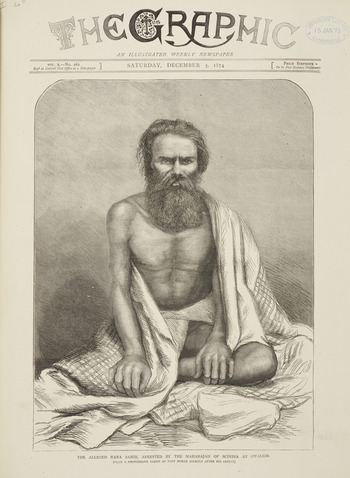
The question of native loyalty was especially central in the case of the third widely publicized arrest, when the person responsible was neither an informant nor a policeman, but an Indian prince. Maharajah Scindia of Gwalior was approached in 1874 by a holy man who claimed to be Nana seeking sanctuary – he promptly had the man arrested and informed the British authorities. Praising Scindia's loyalty, the Times predicted that the news would ‘stir the blood of every Englishman with the stern satisfaction of accomplished vengeance’ – and indeed, two weeks after the news arrived, Nana was again burned in effigy on Guy Fawkes Night, while Tussaud's installed a new Nana waxwork.Footnote 51 The Graphic carried a front-page illustration of the ‘Alleged Nana Sahib’, scrupulously vouching for the accuracy of this portrait with the note that it had been copied from a photograph (Figure 3).Footnote 52 Others were less sanguine, however, especially as it emerged that Scindia had been forced to mobilize his troops for fear of an uprising. A pessimistic editorial in the Spectator asserted that this unrest was proof of a nascent Indian ‘national feeling’, regarding Nana as a hero transcending religion and caste.Footnote 53 The Gwalior prisoner subsequently recanted his confession, claiming that his real name was Jumna Khan and that he had been acting under the influence of hunger and drugs.Footnote 54 When an official inquiry ruled that he was not Nana, suspicion fell on the previously lauded Scindia of having deceived the British. Old fears were reaffirmed; the Manchester Guardian saw in all this confusion evidence of persistent ‘elements of mischief’ in India, and praised the salutary effect of occasionally arresting even the wrong man as a ‘wholesome warning’ for new generations without memories of the Mutiny.Footnote 55
‘The alleged Nana Sahib’, Graphic, 5 Dec. 1874. © Cambridge University Library.

In the public imagination of the 1860s and 1870s, then, Nana Sahib was transformed from a military opponent into a shadowy mastermind who could only be foiled by detective-work and eternal vigilance – the Gwalior prisoner was the latest of almost twenty suspects arrested since the Mutiny.Footnote 56 Each supposed capture prompted relieved admissions that the Mutiny had felt somehow unsettled while Nana's fate was unknown, raising the spectre of the conflict but, as the prisoners were discredited, ultimately failing to exorcise it. By 1873, the number of reports linking his name to seditious documents and conspiracies was such that the secretary of state for India could complain: ‘I feel like handing over India to Nana Sahib and retiring from India.’Footnote 57 The unsettled period of the Eastern Crisis and Second Anglo-Afghan War saw rumours spread that Nana would soon return to India at the head of a Russian army, or that a hitherto-unknown son of the infamous fugitive had sworn vengeance against the British and was working in the tsar's secret service.Footnote 58 Even as the rebel was reconfigured in Britain as a larger-than-life villain of historical fiction, his lingering presence in India cast doubt on the imperial mission, revealing the limits of its temporal and cultural power. The British could suppress a rebellion, but could apparently neither catch its figurehead nor convince the population that he was the villain they perceived him to be. To colonial Britons, the rebel's former enthusiasm for European innovations demonstrated how skin-deep the affiliations of Westernizing Indians might be; Edwin Arnold, working in an Indian school, was asked: ‘What the devil is the good of teaching the niggers, Sir? You taught Nana Sahib, you did, and he learned to read French novels and to cut our throats.’Footnote 59 Nana's Europhilia was almost certainly exaggerated – he apparently never spoke English, for one thing – but the contrast between his ‘civilized’ veneer and the barbaric instincts lurking beneath was a favourite theme of those who wished to dismiss the possibility of Indian self-government.Footnote 60 The doubt was not all with regards to Indians, however – each arrest also brought back troubling memories of the atavistic fury the Mutiny had aroused in Britain. Sir George Trevelyan's Competition-Wallah would later claim that Britons had since ‘learned to blush’ at such memories: ‘Who does not remember those days, when a favourite amusement on a wet afternoon, for a party in a country house, was to sit on and about the billiard-table devising tortures for the Nana…?’Footnote 61 It was an amusement revived with each arrest, in the letters and editorials invoking archaic punishments, execution by cannon, humiliation, and torture. Cawnpore retained the ability to enrage a certain generation into shameful fantasies of vengeance.
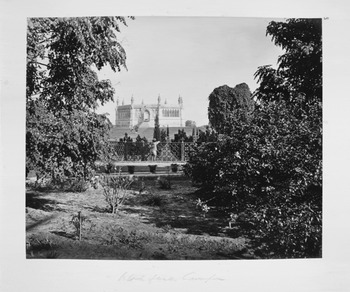
These bloodthirsty sentiments had their origin in the shock of 17 July 1857, when British forces recaptured the city and discovered the Bibighar well into which the bodies of the women and children killed days earlier had been thrown. It became the site of both reprisal executions and vows of vengeance by the soldiers, and in the following years the well, entrenchment, and ‘Massacre Ghat’ were enshrined as the stations in what one visitor termed a ‘sacred pilgrimage’, a solemn stop in every Indian itinerary where tourists could draw the lessons they deemed appropriate from its history.Footnote 62 The tensions over the interpretation of Cawnpore were prefigured in the debate about a statue to mark the site of the Well. Viceroy Canning rejected as too inflammatory the initial grisly design of a woman pierced by a sword and surrounded by dead children, opting instead for Carlo Marochetti's tastefully vague angel holding palm fronds.Footnote 63 The All Souls Memorial Church was built over the nearby entrenchment site, while the Bibighar was demolished and a large park planted with the covered well and angel statue at its centre (Figure 4). Despite the conciliatory attitude of the government, both sites were deliberately set apart from the Indian population in a manner which propagated the Mutiny's siege mentality and kept the massacre forever at the centre of civic memory. The memorials were largely paid for by a punitive fine imposed on the city, but were closed to Indians without a permit; as one visitor recalled, ‘Into this sacred garden no dogs nor natives are admitted.’Footnote 64 Cawnpore quickly became a grimly popular destination – Andrew Ward estimates that in the decade after the Mutiny, the otherwise unremarkable and notoriously dusty industrial city was more frequently visited than the Taj Mahal.Footnote 65 Day-trippers could buy postcards and peruse cheap locally printed guidebooks as they inspected the entrenchment lines, which were marked out in bricks in 1876 and further indicated with pillars and low hedges by 1911.Footnote 66
‘Outside of Well, Cawnpore’, Samuel Bourne, c. 1864. © The British Library Board. Asia, Pacific and Africa Photo 1224.

What did such visitors make of it all? Trevelyan, whose popular history Cawnpore must have been read by many of them, concluded his imaginary tour of post-Mutiny Cawnpore with a prayer for ‘the conciliation of races estranged by a terrible memory’.Footnote 67 The theme of sorrow and reform was echoed in an 1875 guidebook, which advocated ‘a feeling of pity for the past, and of good intentions for the future’.Footnote 68 These appear to have been the avowed sentiments of most visitors who have left records; they were moved to pity, pious horror, and the hope that such terrible scenes might never be repeated. Others, however, drew a sterner lesson from the sights. Visiting in the mid-1860s, ‘An Old Indian’ declared that the well ‘still awakes feelings of angry vengeance’. Cawnpore provided a venue for his musings on ‘the organization of the black’ and his capacity for ‘the most atrocious cruelty’.Footnote 69 Some thirty years later, Emily Richings drew similar conclusions from her tour, warning that ‘the subtle Hindu temperament’ concealed ‘an element of perpetual danger’.Footnote 70 The superintendence of Cawnpore's memorial by soldiers also had the effect of introducing metropolitan visitors to unavoidable issues of reprisal and punishment. The first caretaker was Private Murphy, one of the survivors of Cawnpore, who delighted the ‘Old Indian’ with stories of roughly ejecting ‘“respectable” natives' from the park.Footnote 71 Visiting in 1896, the Irish historian John Bowles Daly noted the strange morbidity of the experience as his soldier guide related the story of the massacre, wondering what the ‘mental machinery’ of such a man must be and concluding: ‘Why go back on those old memories fraught with blood and tears?’Footnote 72 The same question occurred to the Times correspondent William Howard Russell, who had visited Cawnpore in 1857 and whose return in 1876 prompted him to reflect on his generation's reasons for preserving its evil memories. It was a puzzle embodied in the statue. ‘No two persons agree as to the expression of Marochetti's Angel which stands over the Well’, he recorded. ‘Is it pain? – pity? – resignation? – vengeance? – or triumph?’Footnote 73
It was, perhaps, all of these, along with whatever other conflicting sentiments the observer might have brought with them. To ‘remember Cawnpore’ meant experiencing grief, horror, pity, and pride, but even a brief survey of the further lessons extrapolated reveals the gulfs that existed between generations, between metropolitan and colonial Britons, and especially between the imperial and subject races. It was a disjuncture which in some ways prefigured the recent problems found in commemorating ‘difficult heritage’ sites related to war and genocide, where communities often differ over whether to preserve certain memories or let them fade.Footnote 74 While day-tripping British tourists saw Cawnpore as the melancholy site of a historic tragedy, many colonial Britons like the ‘Old Indian’ experienced it more viscerally as the scene of a crime, the perpetrator of which might still be at large. Away from British discourse, the local population – who, according to one frustrated visitor, persisted in mistaking the statue's palm fronds for the brooms of a low-caste sweeper – were certainly acutely conscious of the park's function as a long-standing accusation against them.Footnote 75 Upon independence in 1947, the well site was reclaimed for India and renamed Nana Rao Park. Marochetti's angel was vandalized shortly afterwards, and was subsequently moved to the Memorial Church, near the old lines of the entrenchment.Footnote 76
III
The New Imperialism that emerged in Britain during the 1870s was an unprecedented phenomenon, and one in which the memories of Nana Sahib and Cawnpore were put to work as an origin myth legitimizing and popularizing the new vision of Britain's overseas mission. Novels were at the forefront of this process; in a glowing review of the 1896 Mutiny novel The great white hand, the Times hailed its fin du siècle timeliness, declaring: ‘When envious foreigners expatiate on the decadence of Britain…we are always inclined to answer with a reminder of the Indian Mutiny.’Footnote 77 The author Hilda Gregg, in her 1897 survey of the flourishing genre, bemoaned the tendency of writers to shoehorn ‘the inevitable Nana Sahib’ into their plots in the same predictable manner, ‘mingling in English society previous to the revolt’.Footnote 78 Brantlinger identifies Nana's archetypal role in these fictions as the ‘Satanic locus of all oriental treachery, lust and murder’, and, indeed, while his opponents had often developed into anachronistic New Imperial paladins, Nana still generally appeared as an essentially regressive figure whose defeat was necessary to secure the future progress of India.Footnote 79 At the same time, introducing a historical villain whose true fate was unknown presented difficulties to the more scrupulous authors, as it had to earlier playwrights. In the bleak and unsatisfying conclusion to the first Mutiny novel, The wife and the ward, the hero, Edgington, shoots and kills the heroine during the Cawnpore riverbank massacre to prevent her capture by sepoys, before attempting a narratively impossible revenge on the Mutiny's arch-villain: ‘“Now, hell-hound!” shrieked Edgington, as he leapt from the boat…He rested his revolver on his left arm, and fired the last charge it contained at his – at England's deadly foe; but the Nana was reserved for a later fate, and the bullet touched him not.’Footnote 80 Similar problems of plot would occur in many of the later Mutiny novels; in The disputed V. C., the hero finds Nana in his gun-sights and fires, only to find that he has, inevitably, run out of bullets.Footnote 81
These endlessly repeated fictional near-misses offer an indication of how, away from avowedly respectable culture, Nana could develop into something of a punchline. His outsized villainous image made him an ideal vehicle for subversive humour: one columnist jokingly wished for ‘a Nana Sahib’ to rid him of pestering women and children.Footnote 82 ‘Nana Sahib’ became an outré costume for a fancy-dress ball, a humorous nom de plume for newspaper inquiries and a popular name for circus tigers.Footnote 83 The repeated false alarms of his capture were occasions for mockery, like the 1875 Fun parody on unreliable telegram news: ‘Nana Sahib was captured in Regent-street this afternoon. He has been selling scent packets about London for years.’Footnote 84 The despised enemy of one generation, by the very virulence of his representation, could become a fantastical monster for succeeding generations, a subject for parody and play. In one 1890s children's story, the tragedy of Cawnpore is repeated as a farcical game when young Harry suggests to his female cousins: ‘Let's play mutiny! Pretend the bungalow is in India…I'll be Nana Sahib, attacking, and you be English, and defend it.’Footnote 85 Boucicault's extravagantly villainous Nana loomed large in the public imagination, and his influence was felt in the theatre whenever a dark-skinned foe menaced Englishwomen – the Egyptian antagonist of one topical melodrama was described as ‘a compound of Nana Sahib and Arabi’.Footnote 86
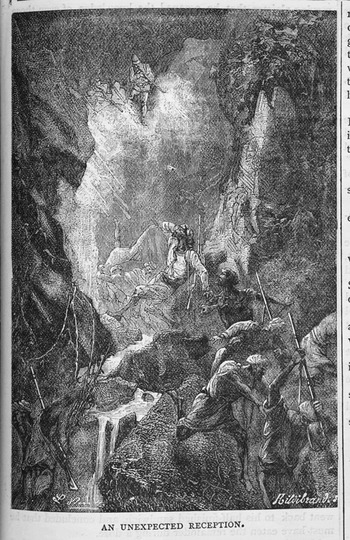
At the same time, there remained among metropolitan Britons a vague awareness of the psychic wounds the Mutiny had left on their colonial compatriots, which were explored in some fictions through the uncertain fate of Nana. In the Boy's Own story ‘The mystery of the mountain’, Captain Hayward loses his wife at Cawnpore, ventures into Nepal to avenge himself on Nana, and becomes a wild jungle hermit who attacks every native he sees. His violent one-man counter-insurgency is only ended after twenty years when his son discovers him.Footnote 87 The classic of this type of narrative was Jules Verne's 1880–1 serialized novel The steam house, which, although written by a Frenchman, was simultaneously translated into English in The Union Jack boys' newspaper.Footnote 88 Verne had already semi-fictionalized Nana in his famous character Captain Nemo – at the climax of The mysterious island, published shortly after the Gwalior arrest, the submariner's true identity is revealed on his deathbed as Prince Dakkar, an exiled Indian rebel who has vowed revenge against the British.Footnote 89 The more forceful anti-imperial sentiments were generally omitted from Verne's English translations, but, although he was no enthusiast of British imperialism, his reliance on British colonial sources reveals itself in Steam house's plot and structure.Footnote 90 Verne's India is a distillation of the most sensational rumours from the colonial press; it is a land still ripe for revolt, where Nana and his brother Bala Rao find sanctuary in lawless tribal country and move through cities in disguise exchanging secret signals with co-conspirators. A second rebellion is only forestalled when a British patrol ambushes and apparently kills Nana, a cliffhanger by which Verne embeds the uncertainty of the various death rumours into the structure of the novel – it is, of course, only Nana's brother who has been killed (Figure 5).Footnote 91 The second plot strand follows the travels of a group of Britons and the French narrator in one of Verne's technological marvels, the ‘Steam House’, a steam-powered mechanical elephant built for the late King of Bhutan. The trip is ostensibly being undertaken to distract the obsessive Colonel Munro from brooding over the death of his wife Laura at Cawnpore, but soon takes on the resonances of an ‘imperial pilgrimage’ – the Mutiny history of each destination is discussed at length, and Munro breaks down in tears at Cawnpore's Memorial Well. The trauma of the Mutiny is embodied in Laura, who is revealed to have survived the massacre only to have been ‘crazed by the horrors’, wandering into the hills and surviving on local charity before providentially reappearing just in time to save the captured Munro from execution by Nana.Footnote 92 During their escape, Nana himself is captured and bound to the mechanical elephant's neck, only to be obliterated when the boiler is overheated and blown up in order to throw off pursuit. The result is that, without a body, we are told his followers refuse to believe in Nana's death, regarding him ‘as an immortal being’.Footnote 93 In any case, Munro is satisfied and his wife is nursed back to health; as in the Boy's Own story, sanity is only restored to the unbalanced British characters when the hunt for Nana can be abandoned, if not definitively completed. In this way, Verne's fiction reflects metropolitan views of the traumatized colonial mindset after the Mutiny, found in vengeful survivors like Hayward and Munro who were now regarded with pity and a certain amount of horror by their distant compatriots. Rewriting history to provide the long-expected conclusion of British vengeance against Nana allowed some measure of closure for the trauma of the Mutiny – a closure which still proved elusive in reality.
Léon Benett, ‘An unexpected reception’, The steam house, in The Union Jack, 27 Jan. 1881. © The British Library Board. General Reference Collection P. P.5993.rd.

Just as ‘Pandy’, the surname of one of the first Indian mutineers, became a derogatory term for rebels in the British imperial lexicon, a survey of newspapers and reports reveals that the label of ‘Nana Sahib’ soon came to be applied to military and insurgent leaders around the world, with connotations ranging from extreme cruelty to simple elusiveness. The reports in which the Maratha rebel was invoked included stories about a military commander in Mexico (1859), Union generals in the USA (1862–3), a bandit chief in Brazil (1864), Fenian rebels in Ireland (1867), King Theodore of Abyssinia (1867), Maori rebels in New Zealand (1868), President López of Paraguay (1869), Ottoman officers in Bulgaria (1876), the Mahdi in the Sudan (1884), the Mashona of South Africa (1897), and, in 1900–1, the Boer and Chinese armies.Footnote 94 In many of these cases, ‘the Nana Sahib’ of a particular country is merely a descriptive flourish, but his name could also be a powerful orientalist object lesson; in 1894, the Graphic used Nana's example as an apparent ‘model of culture’ to lend credence to stories of atrocities by apparently Westernized Japanese troops in Port Arthur.Footnote 95 He could also be a useful device in whipping up martial enthusiasm. In 1882, the Standard's Egypt correspondent issued exaggerated reports of Europeans massacred by the nationalist leader Ahmed ‘Urābī's forces, and repeated the demand of a British official for swift action against ‘a man who is emulating the deeds of Nana Sahib’.Footnote 96 Although quickly discredited, the sceptical Freeman's Journal noted that these ‘shameful fabrications’ had been effective: ‘Arabi is reviled and classed with Nana Sahib, the English war paint is put on.’Footnote 97
The memories of Nana and Cawnpore were repeatedly invoked as cautionary examples by officials and civilians in the colonial sphere. Governor Edward Eyre's defence against accusations of brutality in suppressing the 1865 Morant Bay rebellion included testimony from missionaries who believed he had prevented ‘atrocious acts’ comparable to the Indian massacre.Footnote 98 One of the European hostages in Abyssinia in 1867 warned that King Theodore might escape British retribution to become ‘a second Nana Sahib, always supposed to be dead, but always turning up somewhere’.Footnote 99 The colonial services kept a strong institutional memory of Cawnpore; several books on the subject were to be found in the British Legation at Peking, and were among the favourite reading of the Europeans besieged there by Chinese troops and Boxer rebels in 1900.Footnote 100 Domestic reports of the Peking siege, where British men, women, and children faced overwhelming numbers of ‘natives’, drew heavily on the language of Mutiny history, and especially Cawnpore. The parallels seemed tragically complete in July 1900 when false reports circulated that the legation had been overrun and the defenders tortured and killed – indeed, alongside its blood-curdling headlines of ‘Foreigners Roasted To Death’, one newspaper declared that this was ‘Cawnpore Again’.Footnote 101 Among the calls for vengeance, the Boxer leader Prince Tuan was singled out as ‘the Nana Sahib of the whole affair’ – an identification which endured even after the massacre reports were disproved with the arrival of a relief force.Footnote 102 This outburst of dismay over the apparent fate of the legations should caution against too programmatic a reading of how the Mutiny was remembered in the new imperialist decades. Cawnpore was certainly a historical proving-ground for G. A. Henty's fictional boy-heroes and a rhetorical stick with which to beat native resistance, but its power in these functions came from the fact that its memory retained the ability to genuinely disturb many Britons, especially those in the Indian colonial services.
The last suspect considered a credible candidate to be the original Nana was arrested in 1894 – a sadhu discovered in a rural temple in Kathiawar, who displayed the scars listed in the descriptive roll. The familiar story of denial and witness disagreement repeated itself, however, and the old man was returned to his temple. Against a backdrop of communal tensions and growing Indian political organization, the Viceroy Lord Elgin warned that further public attempts to identify or prosecute the old rebel ‘would stir passions which I believe it is the primary object of every one of us in the Government of India…to allay’.Footnote 103 Such an attitude explains the swift order to release the 1895 suspect mentioned earlier, but the circumstances of the 1894 arrest also suggest a remarkable degree of continuity in the hunt for Nana – his description was evidently still being circulated and memorized, and his reappearance was even then considered to have the potential to cause unrest. Elgin may have been eager to banish this spectre of the Mutiny, but even as Nana's literal return became increasingly unlikely colonial anxieties persisted over his legacy and continuing influence on the Indian population. An increasingly assertive Indian nationalism could even, in certain circumstances, bring these old colonial concerns home to metropolitan society. In 1908, the India House group of revolutionary Indian students provoked outrage by honouring Nana in a meeting held in the heart of London.Footnote 104 Its members included V. D. Savarkar, whose revisionist Mutiny history published the following year had as its hero ‘the Nana Sahib Peshwa, at the very sound of whose name the Feringhi [foreigner] shudders with fear’.Footnote 105 The book was swiftly banned in India, but Savarkar's reclamation of Mutiny history and inversion of the long-standing British demonization of Nana became part of a long-standing imperial discourse in which unease over Indian intellectuals and the independence movement could be reformulated in evocative historical terms. Nana would eventually fade from prominence as a ‘useful’ figure in British conceptions of India, aided by factors including the passing of the Mutiny generation, the emergence of more overtly political threats to colonial rule, the service of Indian troops in the First World War, and the moral outrage which followed the Amritsar Massacre of 1919. Still, for many years the old allusions to the Mutiny and Cawnpore would be periodically unearthed, allowing colonial Britons to put an incontrovertibly vicious face on their opponents; as late as 1922, Mahatma Gandhi could be accused of possessing ‘the race-hatred of a Nana Sahib’.Footnote 106
IV
In folklore, national heroes like Arthur, Barbarossa, and Charlemagne have long been imagined sleeping under a mountain until the hour when their country needs them again. The case of Nana Sahib suggests that national villains may sometimes do the same. Cawnpore made him the embodiment of the most powerful nightmares of Victorian society in its imperial encounters – the latent treachery of all subject races, the rejection of British progress, the destruction of the sacred family unit and the rape of British women. His cultural image was hurriedly cobbled together from unreliable news sources and the spare parts of older villains, yet proved so powerful that, decades later, the Illustrated London News's bearded warrior could still be found stalking the pages of Mutiny novels and plays. Nana retained this potency in the popular imagination not only because of the special horror with which Cawnpore was regarded, but because of his indeterminate fate and the repeated alarms of his capture – alarms which, over the years, remained a serious concern in India, but were increasingly greeted with weary resignation in Britain as ‘silly-season paragraphs in the newspaper’.Footnote 107 In this way, his memory worked to reveal the profound gap between British metropolitan and colonial attitudes. The Mutiny remained a vivid and frequently cited episode for a relatively small class of administrators and soldiers in India, but its memory was drawn upon by metropolitan society only when needed, from its receptacles in the battlefields and old soldiers of India. The radical journalist Henry Nevinson was born in 1856, and recalled that in his youth, ‘all British boys and girls were brought up on tales of “the Mutiny”’, thrilling and terrifying stories which left them with the impression that India was ‘nothing but the scene of massacre’. For most of his contemporaries, the prejudices that these tales inspired would remain largely dormant. For those entering the colonial sphere, however, the childhood stories would be reactivated and given new resonance as parables for an imperial race. Nevinson travelled to India in 1907, and found his fellow passengers on the P&O liner excitedly planning their first excursion – a visit to Cawnpore, which he predicted would imprint them ‘with the hatred and contempt appropriate to their treatment of “natives”’.Footnote 108 The long-lived generation of Mutiny veterans was another source for such first-hand testimony, and exhuming their memories in the cause of ideology or entertainment was a common venture. It could also, however, be an unnerving experience, as one social diarist at the 1891 London Naval Exhibition discovered when he questioned ‘Old Glory’, a seventy-two-year-old Cawnpore veteran:
The old man's bent frame straightened, and his twisted palsied hands clenched nervously…It was strange to see the fury which even now blazed out in that weak and tottering old man as he recalled the red scenes of carnage…I regret that most of ‘Old Glory's’ reminiscences were too ghastly for reproduction here.Footnote 109
For many later Victorians considering the Mutiny, pride appears to have been accompanied by a profound discomfort at the bloody deeds their parents and grandparents had committed, condoned, and even relished. The ferocity that Nana could still inspire in an older generation must certainly have been strange to those who grew up knowing him as a dastardly stage villain, a bowdlerized storybook monster or a dusty waxwork. British India may have been haunted by his memory, but Britain itself only heard ghost stories.
This process suggests one of the central premises of memory studies: that the memory of the past is interpreted and reinterpreted at different speeds in different areas of culture, with each facet of this collective memory acting as ‘an inspiration, a check, and a referent’ for the others.Footnote 110 Applying the concerns of memory studies to questions concerning the impact of imperialism on domestic British culture can broaden the debate beyond sterile excavations of the ideology underlying certain texts or genres by addressing their reception and alteration in the public consciousness, adding an invaluable human element. The case of Nana Sahib suggests that the metropolitan public was not a passive audience for imperial narratives, but often changed them as much as or more than they were themselves changed by them. Addressing the passage of memory down through generations has its difficulties of evidence and analysis, but it also has the potential to yield a more nuanced picture of the mental topography of a society by acknowledging that ideas can retain significance even when they are not part of everyday discourse. Rather than insisting on a consistent visible stream of evidence, such a study can search for the periodic dredging-up of old memories from their subterranean channels when required. The enduring power of Nana in the collective memory can be seen by the haste with which he was invoked in times of crisis, as the unpunished horrors of Cawnpore allowed Britons to stake a permanent claim on the moral high ground, first in India and later around the world.
In these new imperial encounters, the repeated references to Nana suggest that, beyond broader orientalist discourses of race and culture, the totemic figure of the villain could play a large role in shaping opinion. Nations use the characteristics of their enemies to mirror and define their own self-image, unifying opinion around hatred of a loathsome opposite.Footnote 111 Political and cultural differences are reduced to vicious personal attributes, and acts of rebellion and resistance reduced to crimes.Footnote 112 An iconic villainous figure such as Nana could be immensely influential in shaping perceptions of other races and nations – indeed, one newspaper remarked in 1874 that ‘no native of the Indian Peninsula has been so well known to the British nation’ since the death of the last comparable enemy, Tipu Sultan.Footnote 113 It is an extraordinary statement, yet one that is difficult to contradict and worthy of further consideration. If Carlyle's Great Man theory of history is discredited today, it was an attractive interpretative lens for nineteenth-century audiences, who could understand imperial affairs through the adventures of figures like Gordon, Livingstone, and Havelock. These national heroes have been the subject of numerous works examining the ideological underpinnings of their public images, but this revealing analysis has yet to be extended to their enemies, that changing cast of exotic, barbaric figures who, like Nana, both typified and condemned their nations in the British public imagination. The Tiger of Cawnpore was the ideal type of the treacherous, barbaric native ruler in the Victorian collective memory, a position which he inherited from older foes and passed on, refreshed, and reformulated, to new enemies. Theodore, ‘Urābī, Shere Ali, and Tuan could all be damned by association with him, as commentators discovered ‘Nana Sahibs’ in every part of the globe where conquest, annexation, or military intervention required context or justification. The mask of Nana Sahib could be fixed on to new figures, to be burned over and over again.