School psychologists provide critical psychological services that help to foster children's wellbeing, schools’ capacities to support wellbeing, and, also indirectly, educators’ wellbeing. The complexity of school psychology, involving potentially many diverse aspects of practice, makes regular professional supervision very important (Simon, Cruise, Huber, Swerdlik, & Newman, Reference Simon, Cruise, Huber, Swerdlik and Newman2014). Despite the complexity and significance of the school psychologist's role, past research has suggested that the availability of clinical supervision in Australia has been scarce. Previous research has indicated that Australian school psychologists have had limited engagement in supervision (Thielking, Moore, & Jimerson, Reference Thielking, Moore and Jimerson2006), and changes to continuing professional development requirements have mandated supervision and reignited this issue.
Schools and Psychology
Schools provide a pivotal entry point for psychological services to support young peoples’ emotional, social, and educational needs. Children and adolescents are commonly affected by developmental disabilities and mental health problems, which if left untreated may continue to affect lives into adulthood (Boyle et al., Reference Boyle, Boulet, Schieve, Cohen, Blumberg, Yeargin-Allsopp and Kogan2011; Dick & Ferguson, Reference Dick and Ferguson2015; Urbis, 2011). The second national report on the mental health of Australian children and adolescents (Lawrence et al., Reference Lawrence, Johnson, Hafekost, Boterhoven de Haan, Sawyer, Ainley and Zubrick2015) found that schools were a major provider of mental health services and referral sources. Children and adolescents who used individual school counselling services had often engaged multiple times, with nearly a third (31.4%) receiving more than 10 sessions of counselling and support programs.
An adequate supply of school psychologists was historically recommended as 1:1,000 children and adolescents (National Association of School Psychologists [NASP], 2010). However, one psychologist per 500–700 students was favoured by the American NASP (2010), and endorsed by the Australian Psychological Society (APS, 2009) due to the high prevalence of mental health issues among children and young people. Despite these benchmarks, the actual ratios have been approximately 1:1,500 students per school psychologist in America and Australia (Curtis, Hunley, & Grier, Reference Curtis, Hunley and Grier2002; Jimerson, Stewart, Skokut, Cardenas, & Malone, Reference Jimerson, Stewart, Skokut, Cardenas and Malone2009; Thomas, Reference Thomas2000). Additionally, there are predicted personnel shortages extending until 2025 (Castillo, Curtis, & Tan, Reference Castillo, Curtis and Tan2014). School psychologists working with larger numbers of students have been less satisfied with their work and less likely to engage in preventative and intervention services (Bell & McKenzie, Reference Bell and McKenzie2013; Curtis, Grier, & Hunley, Reference Curtis, Grier and Hunley2004; Curtis et al., Reference Curtis, Hunley and Grier2002).
Work Contexts, Roles, and Related Challenges
There has been a shift from traditional employment arrangements in Australian school psychology over the past decade (Faulkner, Reference Faulkner, Jimerson, Oakland and Farrell2007). School psychologists used to work predominantly in public education, across school sectors and age groups (APS, 2009; Curtis, Castillo, & Gelley, Reference Curtis, Castillo and Gelley2012). Given current school wellbeing units may not include a psychologist, individual contracts in the private or public sector have become increasingly common (Faulkner, Reference Faulkner, Jimerson, Oakland and Farrell2007).
These contemporary service structures have created new challenges. Contractors’ relative unfamiliarity with and separation from schools’ student support systems and resources affects service types (Faulkner, Reference Faulkner, Jimerson, Oakland and Farrell2007). Ethical boundaries for communication between school employees and contractors have increasing complexity (APS, 2009; Faulkner, Reference Faulkner, Jimerson, Oakland and Farrell2007). Furthermore, accurate information about the actual number of practising school psychologists has become more difficult to obtain.
Within their employment setting, school psychologists deliver widely diverse services (Bell & McKenzie, Reference Bell and McKenzie2013; Curtis et al., Reference Curtis, Hunley and Grier2002; Hosp & Reschly, Reference Hosp and Reschly2002). The model of school psychology provision has been argued to be conceptually distinct from other psychological specialisms due to its educational context. Simon et al. (Reference Simon, Cruise, Huber, Swerdlik and Newman2014) suggested that school psychologists and their supervisors employ developmental, ecological, and problem-solving approaches to best practice service delivery. Paradigm shifts have also shaped overall expectations, with school psychologists increasingly encouraged by the profession to incorporate systemic models and evidence-based interventions into practice (Annan & Priestly, Reference Annan and Priestly2011; Kratochwill & Shernoff, Reference Kratochwill and Shernoff2004). However, current employment models make the likelihood of psychologists’ input into their employment circumstances and service system inconsistent at best (Eckersley & Deppeler, Reference Eckersley and Deppeler2013).
Studies of Australian school psychologists indicated that counselling, consultation with stakeholders, and psychoeducational assessments were their primary responsibilities (Bell & McKenzie, Reference Bell and McKenzie2013; Jimerson et al., Reference Jimerson, Graydon, Yuen, Lam, Thurm, Klueva and Phillips2006). Assessment was particularly prevalent within government schools (Thielking et al., Reference Thielking, Moore and Jimerson2006) and was similarly prioritised in America (Castillo, Curtis, & Gelley, Reference Castillo, Curtis and Gelley2012). Program development, consultation, and other systemic-level services may be gradually becoming more common, with profession-led efforts to refocus services to support groups and whole-school communities (Bell & McKenzie, Reference Bell and McKenzie2013; Bramlett, Murphy, Johnson, Wallingsford, & Hall, Reference Bramlett, Murphy, Johnson, Wallingsford and Hall2002; Castillo et al., Reference Castillo, Curtis and Gelley2012; Ysseldyke et al., Reference Ysseldyke, Burns, Dawson, Kelley, Morrison, Ortiz and Telzrow2006). However, a small group (N = 16) of Victorian school psychologists nominated as ‘effective’ practitioners reported that they still mostly undertook individually oriented practices (Eckersley & Deppeler, Reference Eckersley and Deppeler2013).
As minority professionals in schools, psychologists have been presented with challenges that affect their efficacy and effectiveness. Bell and McKenzie (Reference Bell and McKenzie2013) found large discrepancies between the perspectives of educators, parents, and school psychologists about their potential contribution. Although there was agreement about psychologists’ roles in counselling and student contact, overall parents and teachers disagreed with school psychologists on 20 of 30 listed responsibilities. This lack of agreement potentially affects referral types, service use, expected outcomes, and interdisciplinary relationships in schools. Furthermore, psychologists’ stance on confidentiality, together with their disciplinary isolation, have resulted in their actual and felt marginalisation within school settings (Eckersley & Deppeler, Reference Eckersley and Deppeler2013; McMahon & Patton, Reference McMahon and Patton2000). Psychologists have reported that many principals lack understanding of their services and their potential contributions. Consequently, principals may not prioritise psychologists’ organisational, financial, and professional support (Eckersley & Deppeler, Reference Eckersley and Deppeler2013; Suldo, Friedrich, & Michalowski, Reference Suldo, Friedrich and Michalowski2010). Such role confusions, diverse student issues, and organisational barriers intensify school psychologists’ need for clinical supervision support.
Supervision
Recently, Bernard and Goodyear (Reference Bernard and Goodyear2014) defined supervision as ‘an intervention provided by a senior member of a profession to more junior colleague/s’ (p. 3). They concluded that the supervisory relationship is evaluative, continuing to advance supervisees’ professional development and to safeguard clients. School psychologists’ supervision has emphasised high-quality service outcomes, promotion of interpersonal skills (Freitas, Reference Freitas2002; McIntosh & Phelps, Reference McIntosh and Phelps2000), systemic goals, and contemporary best practices (NASP, 2011). In addition, the generative and restorative functions of supervision have become increasingly pertinent with greater burnout risks later in school psychology careers (Howard, Reference Howard2008).
The Value of Supervision
Numerous interdisciplinary literature reviews have suggested that clinical supervision adds value to practice (Kilminster & Jolly, Reference Kilminster and Jolly2000; Spence, Wilson, Kavanagh, Strong, & Worrall, Reference Spence, Wilson, Kavanagh, Strong and Worrall2001; Wheeler & Richards, Reference Wheeler and Richards2007). The most common benefit of supervision to school counselling (including presumably school psychology) is its supportive function (McMahon & Solas, Reference McMahon and Solas1996; Sutton & Page, Reference Sutton and Page1994). Sixty percent of early career school psychologists felt that supervision enabled them to manage or reduce professional stress (Culbreth, Scarborough, Banks-Johnson, & Solomon, Reference Culbreth, Scarborough, Banks-Johnson and Solomon2005; Silva, Newman, Guiney, Valley-Gray, & Barrett, Reference Silva, Newman, Guiney, Valley-Gray and Barrett2016; Swalwell & Harvey, Reference Swalwell, Harvey, Thielking and Terjesen2016) and to mitigate burnout (McMahon & Patton, Reference McMahon and Patton2000; Mills & Huebner, Reference Mills and Huebner1998).
Reported effects of school psychology supervision have included greater confidence, skill development, increased awareness of blindspots, and less felt pressure to practise outside their competence (Agnew, Vaught, Getz, & Fortune, Reference Agnew, Vaught, Getz and Fortune2000; Fishetti & Crespi, Reference Fischetti and Crespi1999; McMahon, Reference McMahon2005; Silva et al., Reference Silva, Newman, Guiney, Valley-Gray and Barrett2016). Supervision has been positively related to resilience, ethical practice, skill development, and supervisees’ broadening roles (Harvey & Struzziero, Reference Harvey and Struzziero2008).
Expectations of Supervision
The high value placed on supervision is evident in the standards and expectations set by professional associations and accrediting bodies (APS, 2009; NASP, 2011). In their school psychology framework, the APS (2009) reminded practitioners and employers that regular supervision facilitates client outcomes, professional quality, and adherence to ethical obligations (Bambling, King, Raue, Schweitzer, & Lambert, Reference Bambling, King, Raue, Schweitzer and Lambert2006).
In July 2010, continuing professional development (CPD) became mandated for annual general registration in Australia, consistent with many other countries (Psychology Board of Australia [PsyBA], 2010). Individual and group supervision were specifically designated as critical components, and psychologists were required to relate supervision to their overall CPD goals (PsyBA, 2010).
Uptake of Supervision in School Psychology
Poor participation in supervision has been persistently evident in past school psychology studies. However, there have been recent steady increases in clinical supervision in America from only 10% of NASP members (Fischetti & Crespi, Reference Fischetti and Crespi1999), to nearly 29% a decade later (Curtis et al., Reference Curtis, Castillo and Gelley2012), although administrative supervision was still more common at 39% (Silva et al., Reference Silva, Newman, Guiney, Valley-Gray and Barrett2016). In Australia, participation in supervision has often varied as a function of school type, experience, and whether its provision was funded (Thielking et al., Reference Thielking, Moore and Jimerson2006). From Thielking et al. (Reference Thielking, Moore and Jimerson2006), only 45% of psychologists working in government or independent schools pursued supervision. In contrast, in Catholic schools where supervision was more commonly funded, the rate was 86%. While a significant portion (46%) was found to undertake regular supervision, the majority was not (Thielking et al., Reference Thielking, Moore and Jimerson2006). Additionally, more experienced practitioners were significantly less likely to receive supervision (APS, 2009). In past reports, school psychologists most commonly described supervision as sporadic, ‘as needed’ or ‘irregular’ (Fischetti & Crespi, Reference Fischetti and Crespi1999; Silva et al., Reference Silva, Newman, Guiney, Valley-Gray and Barrett2016; Thielking et al., Reference Thielking, Moore and Jimerson2006).
Availability of Supervision
Low engagement in supervision has often been related to its unavailability. More school psychologists have sought supervision than have been able to access it (Chafouleas, Clonan, & Vanauken, Reference Chafouleas, Clonan and Vanauken2002; Fischetti & Crespi, Reference Fischetti and Crespi1999; Silva et al., Reference Silva, Newman, Guiney, Valley-Gray and Barrett2016). Inadequate clinical supervision, duration and frequency have been concerning to psychologists (Fischetti & Crespi, Reference Fischetti and Crespi1999; Jimerson et al., Reference Jimerson, Graydon, Yuen, Lam, Thurm, Klueva and Phillips2006; McMahon & Solas, Reference McMahon and Solas1996; Silva et al., Reference Silva, Newman, Guiney, Valley-Gray and Barrett2016). Similarly, Thielking et al. (Reference Thielking, Moore and Jimerson2006) found that more than half of their Victorian participants sought increased supervision time, and 46% rated themselves dissatisfied with their current supervision.
The amount of time in supervision has significant bearing on work satisfaction. Chafouleas, Clonan, and Vanauken (Reference Chafouleas, Clonan and Vanauken2002) found that practitioners with moderate amounts of supervision were significantly more satisfied than those with minimal or no supervision. Likewise, practitioners were more satisfied if they were receiving adequate formal, rather than informal, supervision (Chafouleas et al., Reference Chafouleas, Clonan and Vanauken2002; Fernando & Hulse-Killacky, Reference Fernando and Hulse-Killacky2005; Silva et al., Reference Silva, Newman, Guiney, Valley-Gray and Barrett2016). Peer networks have been widely used as an adjunct to, or replacement for, adequate clinical supervision (Annan & Ryba, Reference Annan and Ryba2013; McMahon & Patton, Reference McMahon and Patton2001; McMahon & Solas, Reference McMahon and Solas1996).
Barriers to Supervision for Psychologists in Schools
Apart from insufficient and inadequate supervision, barriers inherently related to the school system have been cited (Gonsalvez & Milne, Reference Gonsalvez and Milne2010), including demanding workloads and student ratios (Jimerson et al., Reference Jimerson, Graydon, Yuen, Lam, Thurm, Klueva and Phillips2006; McMahon, Reference McMahon2005; Thielking et al., Reference Thielking, Moore and Jimerson2006). Victorian school psychologists have described a lack of policies in schools to support supervision (Eckersley & Deppeler, Reference Eckersley and Deppeler2013), along with a supervisor shortage, which led to the APS (2015) creating a register of school psychology supervisors.
Additionally, the use of administrative managers as clinical supervisors may impede adequate clinical supervision as they also manage organisational issues, including personnel evaluation (Harvey & Struzziero, Reference Harvey and Struzziero2008). Disclosing difficulties or practice shortcomings to obtain guidance from administrators while simultaneously trying to portray professional competence places supervisees in a double bind. Role conflicts negatively affect outcomes (Fischetti & Crespi, Reference Fischetti and Crespi1999; Ladany & Friedlander, Reference Ladany and Friedlander1995; Nelson & Friedlande, Reference Nelson and Friedlander2001) for ongoing support and development (Bernard & Goodyear, Reference Bernard and Goodyear2014). Yet, previous findings have described a significant proportion of practitioners as unsupervised.
Mandatory Supervision
The few Australian studies of school psychologists were conducted prior to the creation of the National Registration and Accreditation Scheme in 2010. In view of the subsequent reforms requirements of mandatory supervision, it was timely to examine supervision practices of school psychologists in a national Australian context. Hence, this study aimed to: (a) summarise findings from a national survey of school psychologists regarding employment contexts and roles; and (b) explore school psychologists’ current supervision participation, availability, supervisor type, and satisfaction.
Method
Participants and Procedure
The sample consisted of 77 school psychologists, including 61 females (79%), 15 males (19%), and one participant whose gender was not disclosed. Participants were predominately current practitioners of school psychology (96%) and were not supervising other psychologists (87%). Of the participants, 36% had less than 5 years’ experience as a psychologist, 23% had between 6 and 10 years, 23% had between 11 and 20 years, while 18% of participants had more than 21 years’ experience. Despite wide circulation of information and attempted active recruitment, the participant sample was largely from New South Wales and Victoria (n = 69).
Following ethics approval, participants were recruited via professional associations and school psychology interest groups. An online information sheet explained the purpose of the research and informed school psychologists that their involvement was voluntary and that responses were anonymous.
Survey Measure
The online questionnaire designed for this study was derived from interview questions used by Harvey and Pearrow (Reference Harvey and Pearrow2010) and from preliminary discussions with Australian school psychologists and their supervisors. Forty-five survey items examined professional and employment demographics, supervision practices, support, and satisfaction with supervision. The survey comprised mostly closed-ended questions and scaled response items. Compatible with the exploratory aims of this research, some open-ended questions were included to enhance interpretation of the quantitative results (Leech & Onwuegbuzie, Reference Leech and Onwuegbuzie2007).
Results
Employment Characteristics
Employment demographics of school psychologists were examined on five variables: employment setting, permanency of position, school and student ratios, and services provided.
Employment setting
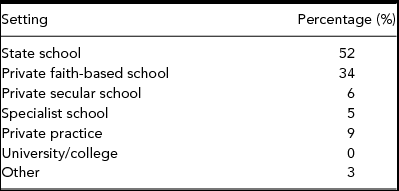
Of the settings in which participants (N = 77) were employed (see Table 1), the most common were state and private faith-based schools. Eight participants indicated dual employment, primarily working in private practice and in a school.
Employment Settings of School Psychologists (N = 77)

Note: Percentages add up to higher than 100% as several participants were employed in more than one setting.
Permanency
Of the school psychologists (n = 76), 83% indicated that they were permanent employees. Of those participants who were not permanent (n = 13), 92% reported being on short-term contracts.
Student and school ratios
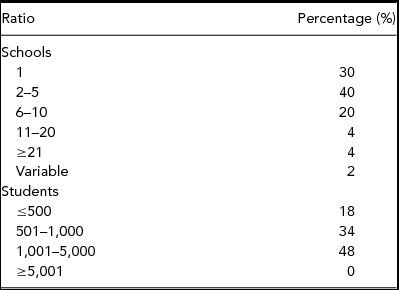
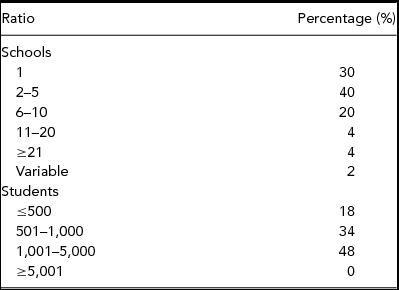
The majority of school psychologists served 2–5 schools and were responsible for providing services to more than 1,000 students. The data indicates less than one fifth of school psychologists were working in conditions with the recommended ratio of 500 students or less (APS, 2009).
A Mann-Whitney U Test revealed school psychologists employed in state schools (and not in dual employment) were responsible for a significantly greater number of students (Mdn = 1,001–5,000) than participants working in private schools, which included secular and faith-based schools (Mdn = 501–1,000), U = 437.00, z = -2.40, p = .02. This finding had a small-to-medium effect size of r = .28 (Cohen, Reference Cohen1988).
School and Student Ratios of School Psychologists (N = 77)
Services provided
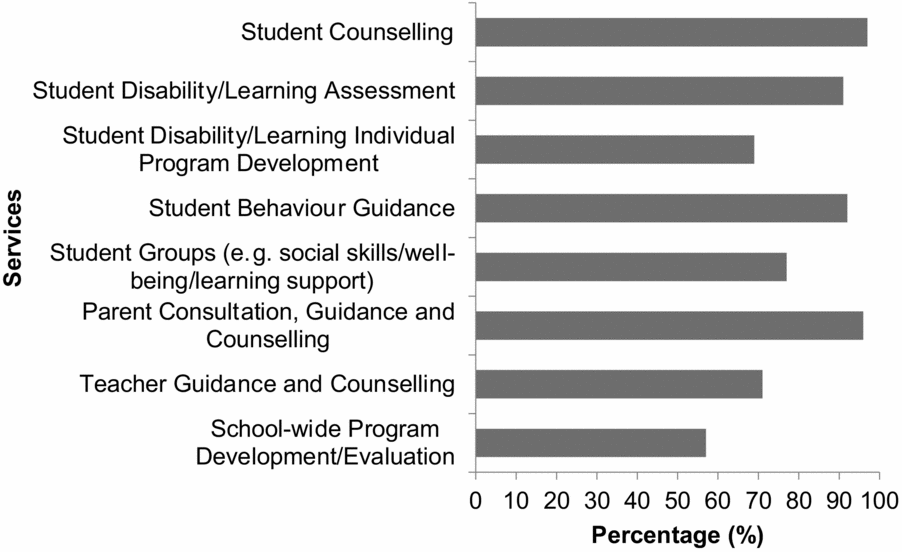
In terms of the roles and responsibilities of school psychologists (N = 77), many participants reported engagement in all services listed (39%). As seen in Figure 1, nearly all participants indicated that they counselled students and parents. The vast majority of school psychologists also provided behaviour guidance and undertook student disability or learning assessments. Development or evaluation of school-wide programs was the least common service, although still delivered by more than half of the sample.
Range of services delivered by respondents.

While the questionnaire did not ask about the frequency of engagement in each type of school psychology activity, it would appear from the results that school psychologists are providing a wide range of psychological services across substantial numbers of children and school environments from early in their careers.
Supervision
Supervision of school psychologists was assessed with respect to four variables: participation, availability and access, supervisor type, and satisfaction.
Participation rate, format, and frequency
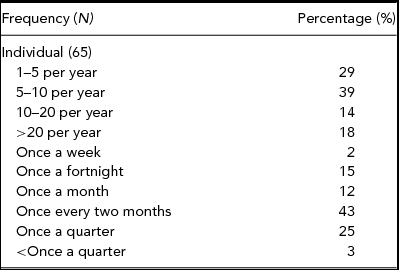
All school psychologists in our sample indicated they were receiving supervision. Most participants pursued both individual and group supervision (76%), while exclusive receipt of group (14%) or individual (10%) supervision was less common. Table 3 presents the frequency in which these sessions were received. Participants usually obtained less than 10 sessions of individual supervision sessions annually. In terms of group supervision, participants most commonly attended a session every two or three months.
Frequency of Individual and Group Supervision of School Psychologists

The relationship between frequency of supervision and amount of experience in psychology
A Spearman rank-order correlation was conducted to determine whether a relationship existed between the frequency of individual supervision sessions undertaken and participants’ experience in psychology. A significant negative correlation of medium strength was found between the frequency of individual sessions and number of years’ experience in psychology, rs = -.29, n = 66, p = .02. Less frequent supervision was associated with more years of experience.
Availability and access
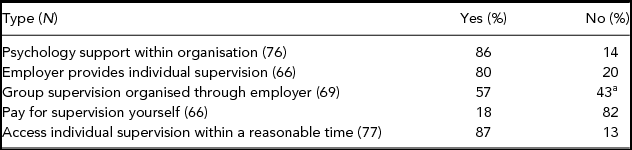
Participants’ ratings of their employer's support of supervision and their ease of access to it are presented in Table 4. Overall, participants reported that individual supervision was provided in their organisation, paid for, and timely. However, nearly one fifth of the sample did not. Group supervision was less commonly organised through employers as it was sometimes established via professional organisations (8%) or other sources (35%), such as peer groups and supervisors.
School Psychologists’ Supervision Availability and Access

Note: aRespondents also selected the categories of ‘professional organisations’ and ‘other’ sources.
Supervisor type
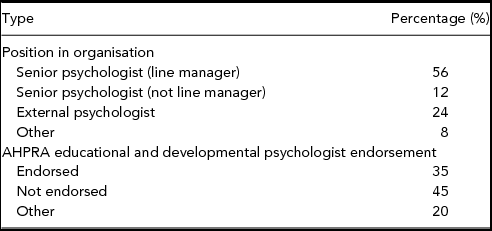
In examining the types of practitioners who were supervising school psychologists, their status regarding Australian Health Practitioner Regulation Agency (AHPRA) endorsement and position in the organisation were assessed. Results are presented in Table 5. Participants who selected outside the options listed described provision of supervision by a general, clinical, or counselling psychologist, and being supervised by both internal and external psychologists.
Position and Endorsement Status of Supervisors (n = 66)

Satisfaction
Participants usually perceived their current supervision favourably. School psychologists most commonly reported being satisfied with their supervision (35%), or very satisfied (31%). However, more than a third of the sample did not rate their supervision positively and indicated feeling neutral (18%), dissatisfied (14%), or very dissatisfied (1%) with their current supervision.
The relationships between satisfaction with supervision, access to, and position of supervisor
Mann-Whitney U tests were conducted to examine whether participant satisfaction differed in relation to reasonable access to supervision and dual-line supervisor positions. School psychologists who reported the ability to receive individual supervision in a reasonable time when needed were significantly more satisfied with their supervision (Mdn = Satisfied [4], n = 67) than participants who indicated they could not (Mdn = between Dissatisfied and Neutral [2.5], n = 10), U = 138.00, z = -3.12, p = .002. This result had a medium effect size of r = .35 (Cohen, Reference Cohen1988).
There was no significant difference in satisfaction between participants whose supervisor was a senior psychologist and line manager (Mdn = Satisfied [4], n = 37) and participants whose supervisor was a senior psychologist but not a line manager (Mdn = Satisfied [4], n = 25), U = 385.50, z = -1.16, p = .25.
General Comments
A manually conducted qualitative review of participants’ comments revealed barriers to supervision and more detail about perceptions of supervision quality.
Barriers (18)
Comments from participants offered insights into obstacles to supervision. The number of participant statements referring to each theme is noted in parentheses to indicate the relative frequency of topic related comments.
School support (5)
Participants discussed a general lack of understanding by schools and staff of the necessity and value of supervision for school psychologists. In this case, supervision was seen as a ‘personal responsibility’ rather than the preferred ‘employer supported PD’.
Time (4)
A lack of time was considered a major limiting factor. The demands of participants’ usual work responsibilities restricted time available for supervision, particularly when schools did not allow for the time off to engage in it.
Supervisor availability (9)
There were substantial reports from participants of insufficient access to suitable supervisors. Participants frequently acknowledged the heavy workloads of supervisors when indicating their desire for greater guidance. Other challenges raised included finding supervisors in regional locations or those with an area of practice endorsement in educational and developmental psychology.
Perceptions of Quality (15)
Range of perceptions (9)
The quality of supervision portrayed by participants was mixed. Satisfied participants often recognised and appreciated how fortunate their supervisory situation was in comparison to other systems. In relation to different supervision modes, participants with access to a cohesive team described peer supervision as a frequent and convenient source of support, while others felt an organisational shift towards greater reliance on peer supervision was undesirable.
Supervisory personnel (6)
Some school psychologists deemed supervision with a line manager as unsatisfactory and perceived it as having an ‘enormous difference’ in the adequacy of supervision. The organisational requirements that primarily occupied time in supervision conflicted with participants’ goals of skill and knowledge development. A perceived power imbalance also resulted in reluctance to bring professional development issues to line manager supervisor.
Discussion
Employment Contexts and Services
Congruent with past studies, the school psychologist participants predominately worked in the public education sector and in private faith-based schools (APS, 2009; Curtis et al., Reference Curtis, Castillo and Gelley2012). Private practitioners comprised only a minor proportion of the current national sample, and these respondents often additionally held a school employee position. A small subgroup of practitioners was on short-term contracts. There has been a suggested increase in school autonomy over their budgets and an associated increase in the availability of only short-term contracts for school psychologists (Faulkner, Reference Faulkner, Jimerson, Oakland and Farrell2007).
The student-psychologist ratios in the work conditions reported by participants usually exceeded the recommended levels, particularly in state schools (APS, 2009). This is congruent with previous Australian and American findings (Curtis et al., Reference Curtis, Castillo and Gelley2012; Curtis et al., Reference Curtis, Hunley and Grier2002; Jimerson et al., Reference Jimerson, Stewart, Skokut, Cardenas and Malone2009). This result indicates an inadequate supply of psychologists in schools continues to be a problem locally, which could be a reflection of funding arrangements for their employment. High student-psychologist ratios have been associated with lower job satisfaction and a reduction in the ability of practitioners to adequately meet student needs, especially with preventative and intervention services (Bell & McKenzie, Reference Bell and McKenzie2013; Curtis et al., Reference Curtis, Hunley and Grier2002).
Many school psychologists reported engaging in all the listed services. Indeed, the diversity and flexibility of job activities were cited in Jimerson et al. (Reference Jimerson, Stewart, Skokut, Cardenas and Malone2009) as among the most favoured aspects of their positions. Engagement in direct, individual services such as counselling tended to be more frequently reported than indirect or whole-school services, which supports past survey findings (Jimerson et al., Reference Jimerson, Stewart, Skokut, Cardenas and Malone2009; Thielking et al., Reference Thielking, Moore and Jimerson2006).
Still, a significant proportion of practitioners were involved in indirect and whole-school services. This suggests that consistent with trends in Victoria (Bell & McKenzie, Reference Bell and McKenzie2013; Thielking et al., Reference Thielking, Moore and Jimerson2006), practitioners nationally are adopting the systemic model advocated by the profession (APS, 2009; Ysseldyke et al., Reference Ysseldyke, Burns, Dawson, Kelley, Morrison, Ortiz and Telzrow2006). It is important to note that frequency of service system engagement was not established. School psychologists in Eckersley and Deppeler (Reference Eckersley and Deppeler2013) described organisational barriers and lack of opportunities for promoting a systemic approach as limiting their strategies. These barriers and the existing high student ratios could be currently preventing even greater use of practices that support whole school communities.
Supervision Practices
In contrast to previous research of Australian school psychologists and counsellors, all participants in this study reported receiving supervision, which could be an artifact of the survey. However, the most recent findings on this subject indicated that 61% (Jimerson et al., Reference Jimerson, Graydon, Yuen, Lam, Thurm, Klueva and Phillips2006) to 64% (Thielking et al., Reference Thielking, Moore and Jimerson2006) of practitioners were supervised. Nearly a decade later, during which national mandatory supervision was introduced, supervision engagement has unsurprisingly increased markedly.
Although in the minority, some participants still highlighted issues such as difficulty finding nearby or endorsed supervisors of educational and developmental psychology. Other problems included current supervisors without sufficient time or inclination to provide adequate clinical supervision. These challenges were congruent with findings from past research (McMahon, Reference McMahon2005; McMahon & Patton, Reference McMahon and Patton2001; Thielking et al., Reference Thielking, Moore and Jimerson2006). In light of these issues, the frequent use of group or peer supervision by participants may provide a convenient means to gain desired additional support (Annan & Ryba, Reference Annan and Ryba2013; McMahon & Patton, Reference McMahon and Patton2001) as well as helping satisfy CPD requirements.
More experienced psychologists in this study tended to have less frequent individual supervision, which may reflect their past supervisory history (Thielking et al., Reference Thielking, Moore and Jimerson2006) and their higher levels of felt competency (Harvey & Struzziero, Reference Harvey and Struzziero2008). Although not examined, it is also possible they utilise group supervision more frequently, supplementing their lower engagement in individual supervision. Unlike Thielking et al. (Reference Thielking, Moore and Jimerson2006), this study indicates that experienced psychologists are now receiving at least one form of supervision that should assist their objectivity, update their knowledge and skills, and reduce burn-out (Bernard & Goodyear, Reference Bernard and Goodyear2014).
Organisational Support of Supervision
Employers of school psychologists generally provided individual supervision and a greater proportion paid for it than indicated by Thielking et al. (Reference Thielking, Moore and Jimerson2006). The widespread report of organisational support is an important development that suggests some level of organisational change (Eckersley & Deppeler, Reference Eckersley and Deppeler2013; McMahon Reference McMahon2005; McMahon & Patton, Reference McMahon and Patton2001, McMahon & Solas, Reference McMahon and Solas1996). Yet, many of the same organisational barriers cited in the literature were raised in participants’ comments, demonstrating that some practitioners still contend with certain obstacles to supervision in their work contexts.
The reported deficiency in knowledge and appreciation in schools of the need for psychological supervision echoed the results of Eckersley and Deppeler (Reference Eckersley and Deppeler2013), who asserted a need for more psychologists in school leadership positions. This lack of understanding by schools may partly be the basis for the reported lack of time granted for participants’ supervision. Previous Victorian studies have described time pressures as hindering supervision engagement of school psychologists and counsellors (McMahon, Reference McMahon2005; Thielking & Jimerson, Reference Thielking and Jimerson2006). The APS (2009) stipulates that employers are responsible for facilitating supervision to occur during normal work hours. Without full support by school leaders, supervision becomes an additional burden in what participants identified as overstretched schedules. Practitioners may then pursue supervision less frequently than needed for their optimal practice, potentially affecting the quality of their services and resilience in the profession (McMahon & Patton, Reference McMahon and Patton2000). Since ongoing practice supervision is not yet a requirement for educators, school principals may not appreciate its value for school psychologists unless the latter advocate for it when arranging their conditions of employment.
Satisfaction with Supervision
Results showed school psychologists were generally satisfied with their supervision. Thielking et al. (Reference Thielking, Moore and Jimerson2006) reported lower levels of satisfaction among Victorian school psychologists. However, this could be expected, given participants in the aforementioned study were also much less likely to be receiving supervision than the current sample. For example, Chafouleas et al. (Reference Chafouleas, Clonan and Vanauken2002) found school psychologists were satisfied when provided with a moderate amount of supervision within a reasonable timeframe.
In the qualitative data, line manager supervision in particular was deemed unsatisfactory. Consistent with school counsellors (Barletta, Reference Barletta1996), school psychologists with line manager supervisors described administrative matters overshadowing their supervision time, rather than the sought focus on skill and knowledge development. Furthermore, power imbalances and conflict in roles inhibited full disclosure from some supervisees.
Despite the criticisms in the qualitative data, no significant differences in satisfaction were found among practitioners supervised by a senior psychologist, whether this supervisor was a line manager or not. These results are consistent with previous findings that supervisor position was less important than amount of supervision in determining satisfaction (Chafouleas et al., Reference Chafouleas, Clonan and Vanauken2002). Overall, the results suggest that while there is a real risk of reducing the quality and quantity of supervision, the duality of the role may, at times, be managed in a manner satisfactory to the supervisees.
Implications
The barriers to satisfactory supervision identified in this study have practical implications. By continuing to advocate for greater clinical supervision opportunities within the school system, practitioners and representative associations can facilitate shifting of school policies closer to practice guidelines (APS, 2009). To assist in this goal, the findings suggest a need to educate more school leaders about the significant demands on school psychologists (as sole practitioners in a team of educators) and the related ethical and professional imperatives of regular supervision.
While the regulatory board does not currently require it, some line managers might need supervisor training to enhance their confidence and skills in providing clinical supervision when charged with the role. This type of arrangement is susceptible to conflicts in roles and expectations; thus, transparency and clear communication in the supervisory relationship is especially important. To circumvent problems related to dual roles, a separate senior psychologist within the organisation or an external psychologist should provide clinical supervision where possible (Harvey & Struzziero, Reference Harvey and Struzziero2008).
Limitations
This study's results should be viewed with some caution. Due to the ambiguity in professional designations around Australia, counsellors or other non-psychologist professionals working in schools may have linked to the survey. Generalisability across the population is also unclear given the limited sample size and the self-selected nature of the survey participation. It is possible that findings reflected the activities and perceptions of a subgroup of practitioners particularly interested in issues surrounding supervision.
In the pretrial, there was confusion about terminology, so the questionnaire items about supervision did not specify ‘clinical supervision’. Furthermore, supervisors were often reported as providing both administrative and clinical supervision. As a result, responses to some questions, such as frequency of individual supervision, may have additionally reflected time spent on administrative components. In future surveys, a return to use of ‘clinical supervision’ may produce a more accurate account of experiences.
Future Research Recommendations
This study suggests that future research into supervisors of school psychologists is warranted. Supervisors were described at times to be difficult to find, inadequate in their performance, and unable to meet current demands for their services. Therefore, to investigate the availability of supervisors, their professional training, workloads, and access to support, it would be appropriate to question supervisors directly.
Another logical step is to examine the future capacity of the profession to supply appropriately qualified supervisors. Professionals who supervise school psychologists tend to have previously held a school psychologist role (Curtis et al., Reference Curtis, Hunley and Grier2002; Hunley et al., Reference Hunley, Harvey, Curtis, Portnoy, Chesno Grier and Helffrich2000). Hence, it will be important to ascertain the likelihood of current school psychologists becoming supervisors, and to understand any perceived barriers. In addition, the trend towards private practice provision of school psychology may increase divergence between the backgrounds of school psychologist providers and the potential available supervisors.
Conclusions
This study provides a snapshot on aspects of the conditions of an industrious workforce of school psychologists in Australia. Given the increasing demands on their role and professional isolation they often face, promising results were found in the widespread engagement with supervision 7 years after the introduction of APHRA supervision requirements. The data suggests significant improvements to support school psychologists could be made in respect to employment pressures, supervisor workloads, organisational policies on supervision time, and the dual role of line managers. Moreover, the findings reaffirm the critical role of employers in supporting the supervision of school psychologists and by extension, their beneficial work with school communities.
Author Note
Nina Ding completed this research as part of her post graduate studies at Monash University.
Conflict of Interest
None.