Introduction
In an agroecosystem, heterospecific insect predators partition their prey resources on the basis of their own size and/or the size of their prey. Within a guild, heterospecific predators of small and large size capture and consume smaller and larger prey, respectively (Stephens & Krebs, Reference Stephens and Krebs1986; Sloggett, Reference Sloggett2008a , Reference Sloggett b ; Costa, Reference Costa2009). Optimal foraging models predict that large predators should prey upon large prey in order to maximize their energy intake (Stephens & Krebs, Reference Stephens and Krebs1986). Heterospecific size-based resource partitioning is quite common in ladybirds (Coleoptera: Coccinellidae) (Sloggett, Reference Sloggett2008a , Reference Sloggett b ). Other than the body size, the resource partitioning by aphidophagous ladybirds is also governed by the prey density. Small ladybird species have low energy requirements; they therefore feed on low densities of small aphids. In contrast, they require high densities of large aphid species having sufficient numbers of small instars (Dixon, Reference Dixon2007). However, the low densities of small aphids cannot fulfill the high energy requirements of large ladybird species. They require either: (i) high densities of small aphids, or (ii) low densities of large aphids, at which they can easily capture even the biggest aphids, which are greater energy sources than small ones (Dixon, Reference Dixon2007; Sloggett, Reference Sloggett2008a , Reference Sloggett b ). The best way to investigate resource partitioning in variable sized ladybirds is to evaluate their predation and oviposition at varying densities of different instars of the prey. These may be assessed measuring the functional (predation in relation to varying prey density) and numerical (oviposition in relation to varying prey density) responses of ladybird predators.
Five types of functional responses of predators, viz. Type I (linear); Type II (curvilinear); Type III (sigmoidal, Holling, Reference Holling1959); Type IV (dome shaped, Luck, Reference Luck, Huffaker and Rabb1985) and Type V (negatively exponential, Watt, Reference Watt1959) have been reported. Type II response is quite common in ladybirds (Omkar & Srivastava, Reference Omkar and Srivastava2003; Omkar & Pervez, Reference Omkar and Pervez2004; Osman & Bayoumy, Reference Osman and Bayoumy2011; Gupta et al., Reference Gupta, Pervez, Guroo and Srivastava2012), with a few studies also having reported modified Type II (Kumar et al., Reference Kumar, Mishra and Omkar2014) and Type III responses (Sarmento et al., Reference Sarmento, Pallini, Venzon, Desouza, Molina-Rugama and Oliveira2007; Abdollahi et al., Reference Abdollahi, Afshari, Baniameri, Dadpour, Asadeh and Yazdanian2010; Bayoumy, Reference Bayoumy2011a ). The numerical response investigations have revealed that oviposition increases with increase in prey density. When fed on different aphid species, several studies have evaluated the functional and/or numerical responses of adult ladybirds individually (Omkar & Pervez, Reference Omkar and Pervez2004; Fathipour et al., Reference Fathipour, Hosseini, Talebi and Moharramipour2006; Sarmento et al., Reference Sarmento, Pallini, Venzon, Desouza, Molina-Rugama and Oliveira2007; Abdollahi et al., Reference Abdollahi, Afshari, Baniameri, Dadpour, Asadeh and Yazdanian2010; Bayoumy, Reference Bayoumy2011a ; Bayoumy & Michaud, Reference Bayoumy and Michaud2012; Omkar & Kumar, Reference Omkar and Kumar2013) and within guilds (Losey & Denno, Reference Losey and Denno1998, Reference Losey and Denno1999; Snyder & Ives, Reference Snyder and Ives2003; Costamagna et al., Reference Costamagna, Landis and Difonzo2007; Snyder, Reference Snyder2009; Grez et al., Reference Grez, Rivera and Zaviezo2007, Reference Grez, Zaviezo and Mancilla2011, Reference Grez, Viera and Soares2012, Omkar & Pervez, Reference Omkar and Pervez2011).
However, the above studies on resource partitioning have considered only the interspecific size variation in ladybirds, while the intraspecific size variation has been completely neglected despite the occurrence of variable sized conspecific ladybirds in the fields. We have earlier investigated resource partitioning in relation to intraspecific size variation in ladybirds, which revealed that large ladybirds prefer large aphid instars and the small ladybirds prefer the small sized instars (Chaudhary et al., unpublished data). However, the effect of prey density on resource partitioning in terms of functional and numerical responses on different sized instars of the conspecific prey has not been evaluated. Thus, in the present study, we have combined these two aspects together and have investigated resource partitioning by different sizes of ladybird, Menochilus sexmaculatus (Fabricius) using functional and numerical responses in relation to variable density of cowpea aphid, Aphis craccivora Koch, as a prey. Menochilus sexmaculatus is an aphidophagous ladybird of Oriental region with wide prey range (Omkar & Pervez, Reference Omkar and Pervez2000; Agarwala & Yasuda, Reference Agarwala and Yasuda2000) and with greater competitive reproductive ability (Omkar et al., Reference Omkar, Mishra, Srivastava, Gupta and Singh2005). Aphis craccivora is a serious pest of leguminous crops (Agarwala et al., Reference Agarwala, Das and Bhaumik1987) and is most suitable prey of this ladybird (Kumar et al., Reference Kumar, Pandey, Mishra and Omkar2013).
Materials and methods
Stock maintenance
Adults of M. sexmaculatus (n = 40) were collected from agricultural fields close to Lucknow, India (26°50′N,80°54′E), paired and reared in plastic Petri dishes (14.5 × 1.5 cm2) under constant abiotic conditions (27 ± 2° C temperature; 65 ± 5% relative humidity; 14 L: 10 D photoperiod) in Biological Oxygen Demand (BOD) Incubator (YORCO; York Scientific Industries Pvt. Ltd., India). They were provided with A. craccivora reared on bean (Dolichos lablab L.; Fabaceae) maintained in polyhouse (27 ± 2° C temperature; 65 ± 5% relative humidity and 14 L: 10 D photoperiod). The eggs laid were collected every 24 h and observed for hatching. The neonates obtained were reared individually under the above mentioned abiotic conditions on the same prey as given to parents.
Experimental design
Ten-day-old adult virgin females were selected from the stock for experiments, because they are more voracious than middle aged (Mishra et al., Reference Mishra, Omkar, Kumar and Pandey2012) and old females. The unmated females were selected because: (i) they do not lay eggs and reduce errors due to variations in the reproductive performance of ladybirds (Omkar et al., Reference Omkar, Mishra, Kumar, Singh and Pandey2014); (ii) mated females might consume their own eggs resulting in a reduced consumption of prey and would thus provide an unrealistic estimate of number of prey that can be consumed; and (iii) unmated females are more voracious than mated females (Rhamhalinghan, Reference Rhamhalinghan1987).
The variable sized 10-day-old virgin females were segregated into two significantly (t-value = 9.57; P < 0.0001) different sized groups of small (7.00 ± 2.00 mg; n = 50) and large (14.00 ± 2.00 mg; n = 50) females. They were fed well and allowed to mate once with well fed 10-day-old unmated males of medium size (5.00 ± 2.00 mg taken from the stock). These mated females of varying sizes were then used to evaluate the functional and numerical responses. Females of moderate size were avoided since; most of the earlier studies (see Dixon, Reference Dixon2007; Sloggett, Reference Sloggett2008a , Reference Sloggett b ) on resource partitioning have emphasized on the ladybird species of small and large size and not on moderate size.
Functional response
Soon after mating, females were separated and placed individually in plastic Petri dishes (size as above) containing any one of the following diets: (i) a mixed diet of 5 small (second) and 5 large (fourth) instars; (ii) a mixed diet of 10 small and 10 large instars; (iii) a mixed diet of 20 small and 20 large instars; (iv) a mixed diet of 30 small and 30 large instars; and (v) a mixed diet of 40 small and 40 large instars of A. craccivora. The Petri dishes were sealed for the next 6 h and placed in BOD incubator for the evaluation of functional response at abiotic conditions similar to that of stock. The arenas were devoid of host plant twigs to prevent rapid growth of aphid instars as well as their reproduction, to keep their numbers constant. Time duration of 6 h was taken to avoid their molting into advanced stages. After 6 h, the numbers of unconsumed aphid instars per Petri dish were counted and recorded. Each treatment was conducted in 10 replicates for both ladybird sizes.
Numerical response
Once the numbers of unconsumed aphid instars per Petri dish were counted and recorded (as done in previous experiment), females were isolated and kept singly in separate Petri dishes. The Petri dishes were placed in BOD incubator for next 18 h at abiotic conditions similar to that of stock. Thereafter the number of eggs laid was recorded. Each treatment was conducted in 10 replicates for both ladybird sizes.
Statistical analysis
The data were analyzed to evaluate the functional and numerical responses of large and small sized females of M. sexmaculatus. The distributions of the results in all the datasets were checked for normality using the Kolmogorov–Smirnoff test. Means were separated using Tukey's test when data were normally distributed and variances were homogeneous (Bartlett's test for equal variances).
Functional response
Analyses of data were done to determine the functional response and related parameters (Juliano, Reference Juliano, Cheiner and Gurven2001). Initially, the shape of the functional response curve was analyzed to discriminate between Type II and Type III responses using a logistic regression (Juliano, Reference Juliano, Cheiner and Gurven2001) of the proportion of prey eaten (N e ) as a function of initial prey density (N o ). The data were fitted to a polynomial regression function using statistical software SAS (Version 9.0). The equation used was:
 $$\displaystyle{{{N_e}\; \;} \over {{N_o}}} = \displaystyle{{\; \; \; \; {\rm exp}\,\left( {{P_o} + {\rm} {P_1}{N_o}{\rm} + {\rm} {P_2}N_o^2 + {\rm} {P_3}N_o^3} \right)} \over {\; \; \; \; \; \; 1 + {\rm exp}\,\left( {{P_o} + {\rm} {P_1}{N_o} + {\rm} {P_2}NN_o^2 + {\rm} {P_3}N_o^3} \right)}}$$
where, P o (intercept), P 1 (linear), P 2 (quadratic) and P 3 (cubic) are the parameters to be estimated. Positive linear (P 1 > 0) and negative quadratic (P 2 < 0) parameters indicate a Type III functional response. If P 1 < 0, the proportion of prey consumed declines monotonically with the initial numbers of prey offered, thus describing a Type II functional response (Juliano, Reference Juliano, Cheiner and Gurven2001). The Proc CATMOD procedure was used to estimate these parameters. The second analysis used a nonlinear least squares regression, Proc NLIN (SAS Version 9.0), to estimate the parameter values (T h and either a for Type II, or b, c and d for Type III). Because the experiment was carried out without replacing the prey that were eaten, the appropriate model for a Type II functional response is the ‘random-predator’ equation (Rogers, Reference Roger1972):
 $${N_e}\; = \; {N_o}\{ 1-{\rm exp}[a({T_{\rm h}}{N_e}-T)]\}$$
 $${N_e}\; = \; {N_o}\{ 1 - {\rm exp}[(d + b{N_o})({T_{\rm h}}{N_e} - T)/(1 + c{N_o})]\}$$
where, N e is the number of prey consumed, N o is initial prey density, a is the attack rate, T h is the handling time per prey, T is the total time of exposure, and b, c and d are constants.
Data on prey consumption and proportion of prey consumed at different densities of prey were subjected to two way ANOVA considering prey density, size of predator (large and small) and their interaction as independent factors and prey consumption and proportion of prey consumed as dependent factors. Tukey's post hoc test was used for the comparison of means. Statistical analyses were performed using SAS (Version 9.0).
Numerical response
Data on number of eggs laid by both sized ladybird females at different prey densities were subjected to two way ANOVA taking prey density and size of predator as independent factors and number of eggs as the dependent factor. Tukey's post hoc test was used for the comparison of means. Further, numbers of eggs laid by both sized females were subjected to correlation and regression analyses against different sized aphid instars. Statistical analyses were performed using SAS (Version 9.0).
Results
Functional response
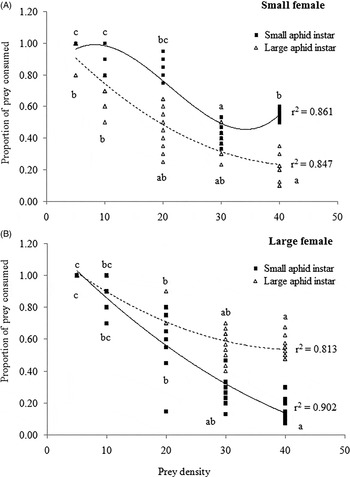
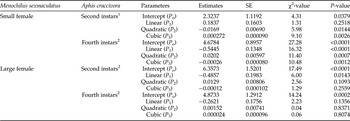
Linear parameters (P 1) for small females were negative (P 1 < 0; indicates that the slope of the functional response curve is declining) in response to increasing densities of large aphid instars. An accompanying decline in proportion of prey consumed (N e /N o ; polynomial regression function) by small females with increasing densities of large aphid instars confirmed a Type II functional response (table 1; figs 1A and 2A). However, a positive estimate for linear parameter (P 1) and a significant negative estimate for quadratic parameter (P 2) for small females on increasing density of small aphid instars indicates that the slope of the functional response curve was declining, which indicated a Type III functional response. But, the accompanying decline in proportion of prey consumed (N e /N o ; polynomial regression function) by small females with increasing densities of small aphid instars further confirms a modified Type II functional response instead of Type III (table 1; figs 1A and 2A). In comparison to large aphid instars, the attack rate was high whereas handling time was low when small females of M. sexmaculatus were fed on small aphid instars. Moreover, the predicted consumption of prey over a period of 24 h (T/T h) by small females was high on small aphid instars and low on large aphid instars (table 2).
(A and B): Fitted relationships for prey consumption and oviposition by small and large females of M. sexmaculatus when provided with five different densities of small (S; second) and large (L; fourth) instars of A. craccivora. Small letters represent comparison of means among densities.

(A and B): Fitted relationships for proportion of prey consumed by small and large females of M. sexmaculatus when provided with five different densities of small (second) and large (fourth) instars of A. craccivora. Small letters represent comparison of means among densities.

Maximum likelihood estimates derived from the logistic regression of proportion of aphid prey (A. craccivora) eaten as a function of the initial prey density by small and large females of M. sexmaculatus.

1 A positive estimate for parameter P 1 and significant negative estimate for P 2 indicates that the slope of the functional response curve is declining, which indicates a Type III functional response.
2 A significant negative estimate for parameter P 1 indicates that the slope of the functional response curve is declining, which indicates a Type II functional response).
Estimates (±SE) of the attack rate (a) and handling time (T h) plus the 95% confidence limits (CL) for the small and large females of M. sexmaculatus derived from their functional responses (here, T = 24 h).

In large females, the linear parameters (P 1) in response to increasing densities of small and large aphid instars were negative (P 1 < 0; indicates that the slope of the functional response curve is declining) along with an accompanying decline in proportion of prey consumed (N e /N o ; polynomial regression function) confirming a Type II functional response (table 1; figs 1B and 2B). The attack rate and handling time of large females on large aphid instars was high and low, respectively. The predicted consumption of prey over a period of 24 h (T/T h) was high on large aphid instars and low on small aphid instars (table 2).
Results of two-way ANOVA revealed a significant influence of ladybird size (F = 145.61; P < 0.0001; df = 1, 99 and F = 162.48; P < 0.0001; df = 1, 99), prey density (F = 72.46; P < 0.0001; df = 4, 99 and F = 81.54; P < 0.0001; df = 4, 99) and their interactions (F = 25.74; P < 0.0001; df = 4, 99 and F = 47.30; P < 0.0001; df = 4, 99) on the consumption of small and large aphid instars, respectively. Two-way ANOVA further revealed a significant influence of ladybird size (F = 124.08; P < 0.0001; df = 1, 99 and F = 91.18; P < 0.0001; df = 1, 99), prey density (F = 130.99; P < 0.0001; df = 4, 99 and F = 281.92; P < 0.0001; df = 4, 99) and their interaction (F = 6.64; P < 0.0001; df = 4, 99 and F = 19.30; P < 0.0001; df = 4, 99) on the proportion of small and large aphid instars consumed, respectively.
Numerical response
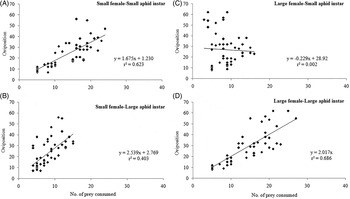
The numbers of eggs laid by small females increased linearly with increase in density of both small and large aphid instars (fig. 1A); and oviposition showed strong positive correlations with the consumption of both small (fig. 3A ) and large (fig. 3B) aphid instars. While at lower and medium prey densities, oviposition by small females mainly increased due to increased consumption of both small and large aphid instars; but at higher prey densities, oviposition by the small females increased due to higher consumption of small aphid instars (fig. 3A, B).
(A, B, C and D): Scatter plot graph showing the relationship between oviposition and number of small (second) and large (fourth) instars consumed by small and large M. sexmaculatus females.

The number of eggs laid by large females also increased linearly with increase in prey density (fig. 1B), with their oviposition showing a strong positive correlation to consumption of large aphid instars but not small aphid instars (fig. 3C, D). Although large females consumed insignificant amount of small aphid instars at all prey densities, but their oviposition increased mainly due to their increased consumption of large aphid instars (fig. 3C, D). Two-way ANOVA further revealed a significant influence of ladybird size (F = 6.69; P = 0.011; df = 1, 99) and aphid density (F = 67.66; P < 0.0001; df = 4, 99) on the number of eggs laid by the females of M. sexmaculatus. However, the number of eggs was not significantly affected by the interaction between ladybird size and aphid density (F = 0.72; P = 0.580; df = 4, 99).
Discussion
In the present study, rate of prey consumption decreased with increased prey density when: (i) small females were fed on large aphid instars, and (ii) large females were fed on small or large aphid instars. This decrease in prey consumption rate with an increase in prey density indicates a Type II functional response. This has been reported in previous studies (Omkar & Pervez, Reference Omkar and Pervez2011; Bayoumy, Reference Bayoumy2011a , Reference Bayoumy b ; Osman & Bayoumy, Reference Osman and Bayoumy2011; Omkar & Kumar, Reference Omkar and Kumar2013).
The modified Type II functional response curve (intermediate in form between a Type II and III) for small females on small aphid instars may be a consequence of using a small experimental arena (Petri dishes). It is highly likely that the functional responses of predators may be better estimated using more natural arenas like small plants. It is also likely that using a wider range and number of different prey abundances would greatly increase the accuracy with which functional responses can be estimated. Similar results with modified Type II functional response curves (as a consequence of small experimental arena) have been reported for the parasitoid, Aphytis diaspidis Howard (Bayoumy, Reference Bayoumy2011b) and coccinellid predators, Stethorus gilvifrons Mulsant (Osman & Bayoumy, Reference Osman and Bayoumy2011). Kumar et al. (Reference Kumar, Mishra and Omkar2014) also reported modified Type II functional response curves when Coccinella septempunctata (L.) and Coccinella transversalis F. were kept in conspecific and heterospecific combinations and exposed to increasing biomass of pea aphid.
High attack rate and short handling time of small females on small aphid instars and those of large females on large aphid instars, as recorded in the present study, further revealing that small and large females are more capable of capturing and consuming small and large instars, respectively. This may be owing to: (i) body size constraint in small females (Dixon, Reference Dixon2000), and (ii) high energy requirements and metabolic costs of large females (Mishra et al., Reference Mishra, Kumar, Shahid, Singh and Omkar2011, Reference Mishra, Omkar, Kumar and Pandey2012).
The numbers of eggs laid by small and large females of M. sexmaculatus increased linearly with increase in prey density. This may be ascribed to the fact that an increase in food quantity facilitates the development of more numbers of ovarioles (Evans, Reference Evans2000). Earlier, Honek (Reference Honek1978) reported a positive relationship between the ovariole maturation in ladybirds and the aphid densities provided to them. Thus, increasing aphid densities affects the egg production in ladybirds. Similar results have been reported previously (Sabaghi et al., Reference Sabaghi, Sahragard and Hosseini2011; Omkar & Kumar, Reference Omkar and Kumar2013; Tulli et al., Reference Tulli, Carmona and Vincini2013).
The results of the present study further reveal that at higher prey densities, increased oviposition by small females is mainly due to higher consumption of small aphid instars. This may be owing to the: (i) size of small females which is a constraint in capturing and consuming large aphid instars, and (ii) availability of higher number of small instars to fulfill high energy requirements for oviposition. However, the consumption of large aphid instars by small females at lower and medium prey densities may be owing to the availability of lesser number of small instars to fulfill their high oviposition costs. On the other hand, at all prey densities, oviposition by large females increased with increase in consumption of large aphid instars. However, the influence of small instars on oviposition by large females was insignificant at all prey densities. It, therefore, appears that although large females are capable of capturing and consuming both small and large aphid instars, but more energy-rich large aphid instars better fulfill the high energy requirements and oviposition costs of large females.
It therefore seems that intraspecific resource partitioning in M. sexmaculatus is visible in large females rather than in small females. And, despite presence of both large and small instars, large females selectively consume large instars to bear their high energy expenses and metabolic costs. In contrast, size of small females is a constraint in capturing and consuming large aphid instars. They, therefore, increase their oviposition mainly by consuming higher number of small aphid instars.
Acknowledgements
Desh Deepak Chaudhary gratefully acknowledges the DST-INSPIRE fellowship (IF 130333) awarded to him. Omkar and Geetanjali Mishra are thankful to the Department of Higher Education, Govt. of U.P., Lucknow, India for providing financial assistance under the Centre of Excellence program for this work.