INTRODUCTION
Subjective memory impairment (SMI), defined by memory complaints with normal age-, gender- and education-adjusted cognitive performance, is a frequent phenomenon in elderly people. Many cross-sectional studies have attributed SMI to depression (O'Connor et al. Reference O'Connor, Pollitt, Roth, Brook and Reiss1990; Ponds et al. Reference Ponds, Commissaris and Jolles1997; Riedel-Heller et al. Reference Riedel-Heller, Matschinger, Schork and Angermeyer1999; Jorm et al. et al. Reference Jorm, Butterworth, Anstey, Christensen, Easteal, Maller, Mather, Turakulov, Wen and Sachdev2004a; Jungwirth et al. Reference Jungwirth, Fischer, Weissgram, Kirchmeyr, Bauer and Tragl2004), personality traits (Hanninen et al. Reference Hanninen, Reinikainen, Helkala, Koivisto, Mykkanen, Laakso, Pyorala and Riekkinen1994; Ponds et al. Reference Ponds, Commissaris and Jolles1997; Jorm et al. Reference Jorm, Butterworth, Anstey, Christensen, Easteal, Maller, Mather, Turakulov, Wen and Sachdev2004a) and physical morbidity (Jorm et al. Reference Jorm, Butterworth, Anstey, Christensen, Easteal, Maller, Mather, Turakulov, Wen and Sachdev2004a), while the association with memory test performance in these studies has been mostly poor.
The majority of longitudinal studies, however, have identified SMI as a predictor for future cognitive decline (Jonker et al. Reference Jonker, Geerlings and Schmand2000; Reid & MacLullich, Reference Reid and MacLullich2006). Based on these longitudinal data, a recent consensus conference concluded that SMI precedes cognitive deterioration to mild cognitive impairment (MCI) and dementia by up to 15 years (Gauthier et al. Reference Gauthier, Reisberg, Zaudig, Petersen, Ritchie, Broich, Belleville, Brodaty, Bennett, Chertkow, Cummings, de Leon, Feldman, Ganguli, Hampel, Scheltens, Tierney, Whitehouse and Winblad2006).
Post-mortem studies have identified Alzheimer's disease (AD)-related pathology in non-demented subjects with cognitive impairment (Riley et al. Reference Riley, Snowdon and Markesbery2002; Markesbery et al. Reference Markesbery, Schmitt, Kryscio, Davis, Smith and Wekstein2006) and in subjects with memory complaints, including mildly impaired individuals (Jorm et al. et al. Reference Jorm, Masaki, Davis, Hardman, Nelson, Markesbery, Petrovitch, Ross and White2004b; Barnes et al. Reference Barnes, Schneider, Boyle, Bienias and Bennett2006). In a recent study, very mild cognitive dysfunction in subjects who still performed within the age-adjusted normal range on neuropsychological tests, and were not rated as impaired, has also been associated with AD pathology (Bennett et al. Reference Bennett, Schneider, Arvanitakis, Kelly, Aggarwal, Shah and Wilson2006). It may be speculated that this minor subthreshold cognitive dysfunction is related to subjective memory impairment at least in subjects who are sensitive to changes in their own cognitive ability. In this case, subjects with SMI should perform slightly worse on memory tests compared with non-complaining elderly individuals.
One reason for the failure to find an association between SMI and cognitive performance in many cross-sectional studies might be insufficient statistical power. The sample size needs to be large for two reasons: (1) the variation in cognitive performance is small and the group difference between complainers and non-complainers is minor, if the analysis is restricted to cognitively healthy subjects, and (2) confounding factors such as depression have a great impact. Accordingly, large studies with sufficient power observed an association of SMI with cognitive performance, independent of depression (e.g. Gagnon et al. Reference Gagnon, Dartigues, Mazaux, Dequae, Letenneur, Giroire and Barberger-Gateau1994; Jonker et al. Reference Jonker, Launer, Hooijer and Lindeboom1996).
A second reason for the frequent lack of association between SMI and cognitive performance might be variation in definition and broad assessment of memory complaints. Different profiles of complaints may be differentially associated with either memory performance or other factors such as depression. These complex patterns are frequently not investigated and might not be identifiable by standard statistical approaches, such as logistic regression models.
In the present report, we aimed to address the issues that might prevent the identification of memory impairment in SMI. To achieve an adequate statistical power, the study was performed in a large sample of 2389 cognitively unimpaired subjects above 75 years of age, recruited from the German Study on Ageing, Cognition and Dementia in Primary Care Patients (AgeCoDe), which is part of the German Competence Network on Dementia. The AgeCoDe study is a general practice-based longitudinal project on risk factors for cognitive decline in the elderly.
To identify those SMI subgroups that show inferior memory performance, we first applied a cluster analysis based on a set of questions on self-perception of memory. Second, we used a Classification and Regression Tree (CART) analysis (Breiman et al. Reference Breiman, Friedman, Olshen and Stone1984) to identify variables that differentiate between these clusters. The CART analysis is capable of detecting complex interactions of variables that might be missed by standard statistical approaches. As independent variables, we included gender, age, number of depressive symptoms, apolipoprotein E (apoE) genotype, verbal delayed recall and verbal fluency. Delayed verbal recall indicates medial temporal lobe (MTL) function and is the most sensitive neuropsychological indicator for future cognitive decline (Bäckman et al. Reference Bäckman, Small and Fratiglioni2001), while verbal fluency is an indicator of executive frontal brain function (Alvarez & Emory, Reference Alvarez and Emory2006).
We tested the hypotheses that different clusters of SMI can be identified and aimed at identifying the respective discriminators.
METHOD
Study population
The cohort consisted of subjects participating in the AgeCoDe study. The participants were recruited at six centres by 19–29 general practitioners (GPs) per site (138 in total). Inclusion criteria for potentially eligible patients were 75–89 years of age, absence of dementia according to the judgement of the GP, and at least one contact with the GP within the past 12 months. Exclusion criteria were consultations only by home visits, severe illness, insufficient knowledge of German language, deafness or blindness, and lack of capability for informed consent. Of the eligible patients (n=10 850), 6619 randomly selected patients were contacted by mail. Of these, 3292 subjects either refused or did not respond to the letter, and 3327 gave informed consent to the GP for participation. The participants were then contacted by the study centres for the assessment by a trained interviewer at the subjects' homes. Eighty-five subjects were excluded after the interview because of the presence of dementia (n=41), age below 75 (n=39) or grossly incomplete data (n=5). A total of 3242 subjects formed the database for the AgeCoDe study.
Assessment of subjective memory impairment
In the initial phase of the interview, the following questions to assess subjective memory impairment were asked: ‘Do you feel like your memory is becoming worse?’ Possible answers were: ‘no’, ‘yes, but this does not worry me’ and ‘yes, this worries me’.
All subjects were additionally asked the following questions, which were derived from the Subjective Memory Decline Scale (Jorm et al. Reference Jorm, Christensen, Korten, Jacomb and Henderson2001): (1) ‘Do you have trouble remembering things that have happened to you recently?’, (2) ‘Are you worse at remembering where belongings are kept?’, (3) ‘Do you have trouble recalling conversations a few days later?’ and (4) ‘Do you have more trouble remembering appointments and social arrangements?’ The choices of answers were the following: (1) no, not much worse; (2) yes, a bit worse; (3) yes, a lot worse.
Neuropsychological battery and clinical interview
Neuropsychological and clinical assessment was based on the Structured Interview for Diagnosis of Dementia of Alzheimer type, Multi-infarct dementia and dementia of other aetiology according to DSM-IV and ICD-10 (SIDAM; Zaudig & Hiller, Reference Zaudig and Hiller1996). The SIDAM contains (1) a neuropsychological test battery and (2) a 14-item scale for the assessment of activities of daily living (SIDAM-ADL-Scale). The cognitive battery covers 55 items (SIDAM cognitive score, SISCO) including the Mini-Mental State Examination (MMSE; Folstein et al. Reference Folstein, Folstein and McHugh1975). A SISCO below 34 indicates dementia (Zaudig, Reference Zaudig1992). German age-, gender- and education-specific norms of the SISCO are available (Busse et al. Reference Busse, Aurich, Zaudig, Riedel-Heller, Matschinger and Angermayer2002). In addition, the semantic verbal fluency test and the verbal memory test (10-item word list) of the neuropsychological battery of the Consortium to Establish a Registry for Alzheimer's Disease (CERAD) were administered (Morris et al. Reference Morris, Heyman, Mohs, Hughes, van Belle, Fillenbaum, Mellits and Clark1989). The free delayed recall score was used in the present analysis.
Depressive symptoms were assessed with the 15-item version of the Geriatric Depression Scale (GDS; Yesavage et al. Reference Yesavage, Brink, Rose, Lum, Huang, Adey and Leirer1982). A score of ⩾6 is indicative for clinically relevant depression. Scores below 6 indicate single subthreshold depressive symptoms.
Definition of the sample for the analysis
The present study focused on participants with unimpaired cognition. Therefore, MCI subjects were excluded from this analysis. MCI was defined according to the consensus criteria proposed by the International Working Group on Mild Cognitive Impairment (Winblad et al. Reference Winblad, Palmer, Kivipelto, Jelic, Fratiglioni, Wahlund, Nordberg, Backman, Albert, Almkvist, Arai, Basun, Blennow, de Leon, DeCarli, Erkinjuntti, Giacobini, Graff, Hardy, Jack, Jorm, Ritchie, van Duijn, Visser and Petersen2004). The criteria include: (1) absence of dementia according to DSM-IV or ICD-10, (2) self- or informant-reported cognitive decline, (3) impairment on cognitive tasks, and (4) preserved ADL or only minimal impairment in complex instrumental functions.
These criteria were checked by the following procedures. Dementia according to DSM-IV was excluded with the SIDAM (see above). Subjective memory complaints were checked with the question: ‘Do you feel like your memory has become worse?’ (see above). Objective cognitive impairment was defined by the SISCO according to the German age-, gender- and education adjusted normative database (Busse et al. Reference Busse, Aurich, Zaudig, Riedel-Heller, Matschinger and Angermayer2002, Reference Busse, Hensel, Guhne, Angermeyer and Riedel-Heller2006). A score of 1 standard deviation (s.d.) below the mean was defined as impairment. ADL was assessed with the SIDAM-ADL-Scale, which includes 14 items. According to SIDAM criteria, a score of 2 or higher is considered to reflect ADL impairment (Zaudig & Hiller, Reference Zaudig and Hiller1996).
In addition, subjects without memory complaints who were cognitively impaired (e.g. scoring below 1·0 s.d. on the SISCO) were excluded.
Of the 3242 subjects in the AgeCoDe database, 818 were excluded according to the above procedure. Thirty-five participants had incomplete data regarding the SMI questions and were also excluded. Of the 2389 subjects who constituted the sample for the present analyses, 1529 (64%) were female and 860 (36%) were male. The mean age was 80·1 years (s.d.=3·52).
apoE genotyping was performed according to standard procedures (Hixson & Vernier, Reference Hixson and Vernier1990). For 90 subjects, either DNA was not available or the apoE genotype could not be determined. Of the remaining subjects, 14 (0·6%) were homozygote apoE4 carriers, 456 (19·8%) were heterozygote apoE4 carriers and 1829 (79·6%) did not carry an apoE4 allele.
Statistical analyses
To find groups of participants with similar patterns of SMI, a cluster analysis using the method of Partitioning Around Medoids (PAM; Kaufman & Rousseeuw, Reference Kaufman and Rousseeuw2005) with the adaptation for large datasets was performed. For a given number of groups, the algorithm computes the representative objects, called medoids, and then each object is assigned to the nearest medoid. The representative objects should minimize the sum of the dissimilarities of all objects to their nearest medoid. To determine the most appropriate number of groups, the resulting silhouette plots were compared. Compared to the well-known k-means algorithm, the method of PAM is more robust to outliers. For the cluster analysis, the SMI questions were grouped in the following manner: With regard to the first general question, subjects were either classified as ‘no’ or as ‘yes’, with ‘yes’ combining subjects with and without worries. The questions addressing specific areas of everyday memory were also grouped as ‘no ‘ or ‘yes’, with ‘yes’ including ‘a bit worse’ and ‘a lot worse’.
To identify factors that can discriminate between the identified clusters, a CART analysis with the cluster membership as response variable was performed. The CART method is based on recursive partitioning analysis (Breiman et al. Reference Breiman, Friedman, Olshen and Stone1984); the aim is to form prediction rules by constructing binary trees. Splitting rules are used as criteria to select the best split at each node, for example the Gini index of diversity as a measure of node impurity. A 10-fold cross-validation was used to accurately assess its goodness of fit. CART analysis has several advantages over traditional statistical methods, including logistic regression models. It is non-parametric; no assumptions are made regarding the underlying distribution of values of the discriminator with respect to predictor variables. It can handle numerical data that are highly skewed or multimodal and categorical predictors with either an ordinal or a non-ordinal structure. CART is often able to uncover complex interactions or patterns between predictors that may be difficult or impossible to uncover using traditional multivariate techniques. CART also produces trees that are relatively simple for non-statisticians to interpret.
To test for the presence of the apoE effect (i.e. healthy apoE4 carriers performing worse compared with non-carriers on memory tests), delayed recall and verbal fluency were compared between apoE4 carriers and non-carriers within each cluster by the Mann–Whitney U test.
For the cluster analysis, S-Plus version 7.0 was used. The CART analysis was performed with CART version 5.0 (Salford Systems, San Diego, CA, USA). For all other statistical tests, SPSS version 14.0 (SPSS Inc., Chicago, IL, USA) was used.
RESULTS
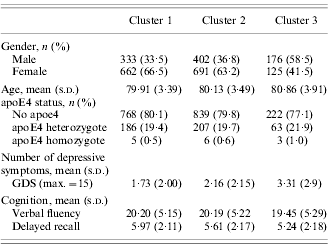
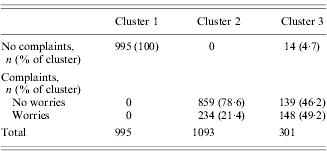
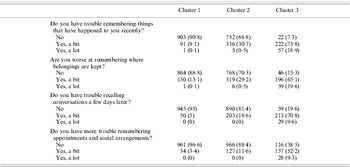
The cluster analysis identified three groups of subjects according to the pattern of memory complaints. Cluster 1 contained subjects who denied any memory problems in the general question and mostly in all other questions. Cluster 2 contained subjects who reported memory problems but mostly denied any impairment on the specific questions. Cluster 3 identified subjects with general memory complaints and frequent impairment in individual tasks. Table 1 lists the demographic data for subjects within each cluster. Tables 2 and 3 list the frequency of responses to the questions in each cluster, including the grading questions (worries/no worries; a bit impaired/a lot impaired).
Demographics, apoE genotype, depressive symptoms and cognitive performance of the clusters
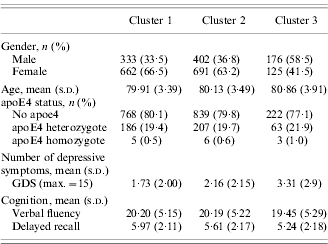
GDS, Geriatric Depression Scale (Yesavage et al. Reference Yesavage, Brink, Rose, Lum, Huang, Adey and Leirer1982).
Distribution of general memory complaints within the three clusters of subjective memory impairment
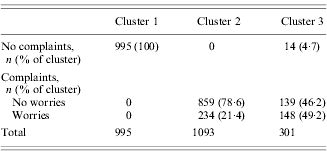
Distribution of complaints about change in specific areas of everyday memory within the three clusters of subjective memory impairment

Values are given as n (% of cluster).
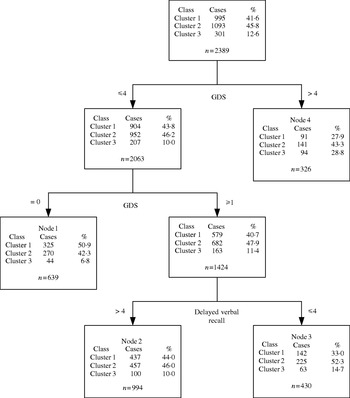
The CART analysis with gender, age, site, apoE status, depression score, verbal fluency and delayed recall as independent predictors yielded a classification tree with four terminal nodes, as depicted in Fig. 1.
Classification and Regression Tree (CART) analysis, identifying discriminators between the three clusters. Depicted are the number of cases within each cluster and the separation of the cluster into subgroups according to the identified discriminator. The Geriatric Depression Scale (GDS) discriminates at the first and second levels. At the third level verbal delayed recall discriminates among subjects with a GDS between 1 and 4 points. Here, SMI subjects (clusters 1 and 2) are more likely to score below 4 on verbal delayed recall than non-complainers.

At the first level, the tree analysis identified a cut-off of 4 points on the GDS as the major discriminator. Clusters 1 and 2 were more likely to score below or equal to 4, while in cluster 3 a larger portion scored higher. At the second level, those scoring below or equal to 4 on the GDS were discriminated by a GDS score of 0. The portion of subjects with a GDS score of 0 was greatest in cluster 1 and smallest in cluster 3. At the third level, those scoring between 1 and 4 on the GDS were discriminated by a verbal delayed recall score of 4 (of 10) items. The portion of subjects recalling more than four words was greatest in cluster 1 and smallest in cluster 3.
These results indicate that the number of depressive symptoms is the most relevant factor to discriminate between memory complainers and non-complainers. In those with low depression scores, verbal delayed recall discriminates between memory complainers and non-complainers. Gender, age, education, site, apoE genotype and verbal fluency did not discriminate between the clusters.
Within each cluster, verbal fluency and delayed verbal recall were compared between apoE4 carriers and non-carriers. The only significant difference of all comparisons was observed for verbal delayed recall in cluster 2 (apoE4 carriers: mean 5·3, s.d.=2·15; apoE4 non-carriers: mean 5·7, s.d.=2·17; p=0·008).
DISCUSSION
The aim of this study was to identify types of SMI that are related to memory performance. We identified three clusters of memory complaints. The first cluster contained subjects who did not complain about memory impairment, and the second cluster contained subjects who reported a general memory complaint but mainly did not report impairment on individual memory tasks. The third cluster contained subjects with a general memory complaint and with frequent subjective impairment on individual tasks of daily living.
The number of depressive symptoms was the major discriminator between complainers and non-complainers. A large number of depressive symptoms were particularly over-represented in SMI subjects, with several complaints in individual tasks of daily living. This finding is in agreement with many cross-sectional studies that reported depressive symptoms to be associated with memory complaints (O'Connor et al. Reference O'Connor, Pollitt, Roth, Brook and Reiss1990; Ponds et al. Reference Ponds, Commissaris and Jolles1997; Riedel-Heller et al. Reference Riedel-Heller, Matschinger, Schork and Angermeyer1999).
However, in subjects with only a minor number of depressive symptoms, verbal delayed recall discriminated between SMI subjects and non-complainers. These data are in agreement with large population-based studies (Gagnon et al. Reference Gagnon, Dartigues, Mazaux, Dequae, Letenneur, Giroire and Barberger-Gateau1994; Jonker et al. Reference Jonker, Launer, Hooijer and Lindeboom1996) showing that memory performance in SMI subjects is inferior compared with non-complainers after controlling for depression.
Verbal fluency did not discriminate between non-complainers and complainers, indicating that cognitive impairment in SMI subjects is not of a general nature. While verbal fluency is associated with frontal brain function (Alvarez & Emory, Reference Alvarez and Emory2006), delayed verbal recall is highly dependent on MTL integrity (Moscovitch et al. Reference Moscovitch, Nadel, Winocur, Gilboa and Rosenbaum2006). The neurodegeneration in AD starts in the MTL (e.g. Braak & Braak, Reference Braak and Braak1991) and delayed verbal memory has been identified as an early and sensitive indicator of future cognitive decline (e.g. Bäckman et al. Reference Bäckman, Small and Fratiglioni2001). Thus, the inferior performance on delayed verbal memory in those SMI subjects with only a minor number of depressive symptoms may point to MTL damage and AD-related neuronal dysfunction. This hypothesis is supported by recent neuroimaging studies, indicating volume reductions of the hippocampus (van der Flier et al. Reference van der Flier, van Buchem, Weverling-Rijnsburger, Mutsaers, Bollen, Admiraal-Behloul, Westendorp and Middelkoop2004; Saykin et al. Reference Saykin, Wishart, Rabin, Santulli, Flashman, West, McHugh and Mamourian2006) and the entorhinal cortex (Jessen et al. Reference Jessen, Feyen, Freymann, Tepest, Maier, Heun, Schild and Scheef2006) in SMI.
ApoE4 is a well-established genetic risk factor for AD (Rubinsztein & Easton, Reference Rubinsztein and Easton1999). Healthy middle-aged and elderly apoE4 carriers perform worse on memory tasks than healthy non-carriers (Mayeux et al. Reference Mayeux, Small, Tang, Tycko and Stern2001; Nilsson et al. Reference Nilsson, Adolfsson, Backman, Cruts, Nyberg, Small and Van Broeckoven2006) and are at increased risk for cognitive decline (Blair et al. Reference Blair, Folsom, Knopman, Bray, Mosley and Boerwinkle2005; Heun et al. Reference Heun, Kolsch and Jessen2006). Furthermore, apoE4 carriers show more AD-related neuropathology than non-carriers, irrespective of the cognitive status (Ghebremedhin et al. Reference Ghebremedhin, Schultz, Thal, Rub, Ohm, Braak and Braak2001; Riudavets et al. Reference Riudavets, Rubio, Cox, Rudow, Fowler and Troncoso2006). The inferior performance of apoE4 carriers on verbal delayed recall in cluster 2 (general memory complaint, rarely complaints on individual tasks) reflects the expected apoE effect and makes the presence of confounding factors with major effects on memory unlikely.
There was no apoE effect in cluster 1, which contained subjects without memory complaints. Longitudinal studies show that not all apoE4 carriers develop dementia. At the age of 90, 40% of heterozygote apoE carriers do not have dementia, suggesting that these subjects carry unknown protective factors (Khachaturian et al. Reference Khachaturian, Corcoran, Mayer, Zandi and Breitner2004). Subjects with these protective factors might be over-represented in the group of elderly non-complainers in our study, which would explain the lack of the apoE effect in this group and the best memory performance of all clusters.
The lack of the apoE effect on memory in the SMI subjects of cluster 3 (general complaint and complaints on individual tasks of daily living) might be related to the presence of depressive symptoms, which may cover the apoE effect. In addition, severe memory complaints may be related to personality traits and other factors that have not been assessed in detail in the present investigation (Hanninen et al. 1996; Jorm et al. Reference Jorm, Butterworth, Anstey, Christensen, Easteal, Maller, Mather, Turakulov, Wen and Sachdev2004a).
To summarize, our data suggest that general memory complaints in non-depressed subjects are associated with reduced performance in delayed recall, which may be an indicator for the presence of AD.
Our study is limited by not including more cognitive variables. Because of the high age of the population and the application of clinical instruments, the number of cognitive measures was limited. However, delayed recall is a sensitive measure of MTL function, while verbal fluency is mainly subserved by frontal lobe function. Thus, these two tasks are representative for two distinct neuronal systems, of which delayed recall is particularly sensitive for early AD.
We are not able to define the predictive power of the different SMI subtypes with regard to cognitive deterioration in this cross-sectional study. However, all participants are followed up longitudinally, which will eventually reveal whether different types of SMI predict different rates of cognitive decline.
APPENDIX
Further members of the AgeCoDe study group: Heinz-Harald Abholz, Matthias Angermeyer, Cadja Bachmann, Martin Dichgans, Ulrich Finckh, Anja Frenzen, Sandra Gorfer, Franziska Haller, Teresa Kaufeler, Melanie Luppa, Manfred Mayer, Heinz-Peter Romberg, Hagen Sandholzer, Hendrik van den Bussche, Michael Wagner, and Anja Wollny.
We thank all participating patients and their GPs for their excellent collaboration: Hamburg: Gundula Bormann, Winfried Bouché, Doris Fischer-Radizi, Michael Funke, Heike Gatermann, Wolfgang Herzog, Petra Hütter, Stefanie Kavka-Ziegenhagen, Günther Klötzl, Bernd-Uwe Krug, Dietrich Lau, Ursula Linn, Andrea Moritz, Karl-Christian Münter, Detlef Niemann, Klaus Richard-Klein, Walter Schreiber, Ursula Schröder-Höch, Gerhard Schulze, Klaus Stelter, Carl-Otto Stolzenbach, Ljudmila Titova, Klaus Weidner, Otto-Peter Witt, Eckehard Zeigert. Mannheim: Gerhard Arnold, Veit-Harold Bauer, Werner Besnier, Hanna Böttcher-Schmidt, Hartmut Grella, Gernot Kunzendorf, Ingrid Ludwig, Manfred Mayer, Hubert Mühlig, Arnt Müller, Adolf Noky, Helmut Perleberg, Carsten Rieder, Michael Rosen, Georg Scheer, Michael Schilp, Matthias Schneider, Jürgen Wachter, Brigitte Weingärtner, Hans-Georg Willhauck. Bonn: Jörg Eimers-Kleene, Klaus Fischer, Maria Goebel-Schlatholt, Peter Gülle, Wolf-Dietrich Honig, Hans Jürgen Kaschell, Hanna Liese, Manfred Marx, Eberhard Prechtel, Heinz-Peter Romberg, Heribert Schützendorf, Annemarie Straimer, Martin Tschoke, Karl-Michael Werner. Halstenbek: Herrmut Mayen. Königswinter: Theodor Alfen. Bad Honnef: Klaus Weckbecker. Niederkassel: Inge Bürfent. Alfter-Oedekoven: Johann von Aswege. Erfstadt-Liblar: Arndt Uhlenbrock. Windeck-Herchen: Wolf-Rüdiger Weisbach. Leipzig: Martina Amm, Heinz-Michael Assmann, Horst Bauer, Barbara Bräutigam, Jochen Ebert, Angelika Gabriel, Eva Hager, Gunter Kässner, Ina Lipp, Thomas Lipp, Ute Mühlmann, Gabi Müller, Thomas Paschke, Gabriele Rauchmaul, Ina Schmalbruch, Holger Schmidt, Hans-Christian Taut, Ute Voß, Bettina Winkler, Sabine Ziehbold. München: Eugen Allwein, Guntram Bloß, Peter Dick, Johann Eiber, Lutz-Ingo Fischer, Peter Friedrich, Helga Herbst, Andreas Hofmann, Günther Holthausen, Karl-Friedrich Holtz, Ulf Kahmann, Elke Kirchner, Hans Georg Kirchner, Luitpold Knauer, Andreas Koeppel, Heinz Koschine, Walter Krebs, Franz Kreuzer, Karl Ludwig Maier, Christoph Mohr, Elmar Schmid, Gabriel Schmidt, Johann Thaller. Haar: Richard Ellersdorfer, Michael Speth. Düsseldorf: Angela Ackermann, Pauline Berger, Florinela Cupsa, Barbara Damanakis, Klaus-Wolfgang Ebeling, Tim Oliver Flettner, Michael Frenkel, Friederike Ganßauge, Kurt Gillhausen, Hans-Christian Heede, Uwe Hellmessen, Benjamin Hodgson, Bernhard Hoff, Helga Hümmerich, Boguslaw-Marian Korman, Dieter Lüttringhaus, Dirk Matzies, Vladimir Miasnikov, Wolfgang Josef Peters, Birgitt Richter-Polynice, Gerhard Erich Richard Schiller, Ulrich Schott, Andre Schumacher, Harald Siegmund, Winfried Thraen, Roland Matthias Unkelbach, Clemens Wirtz.
AcknowledgementS
This study was supported by the German Competence Network on Dementia (CND) funded by the German Federal Ministry for Education and Research (grant O1GI 0102).
Declaration of Interest
None.